
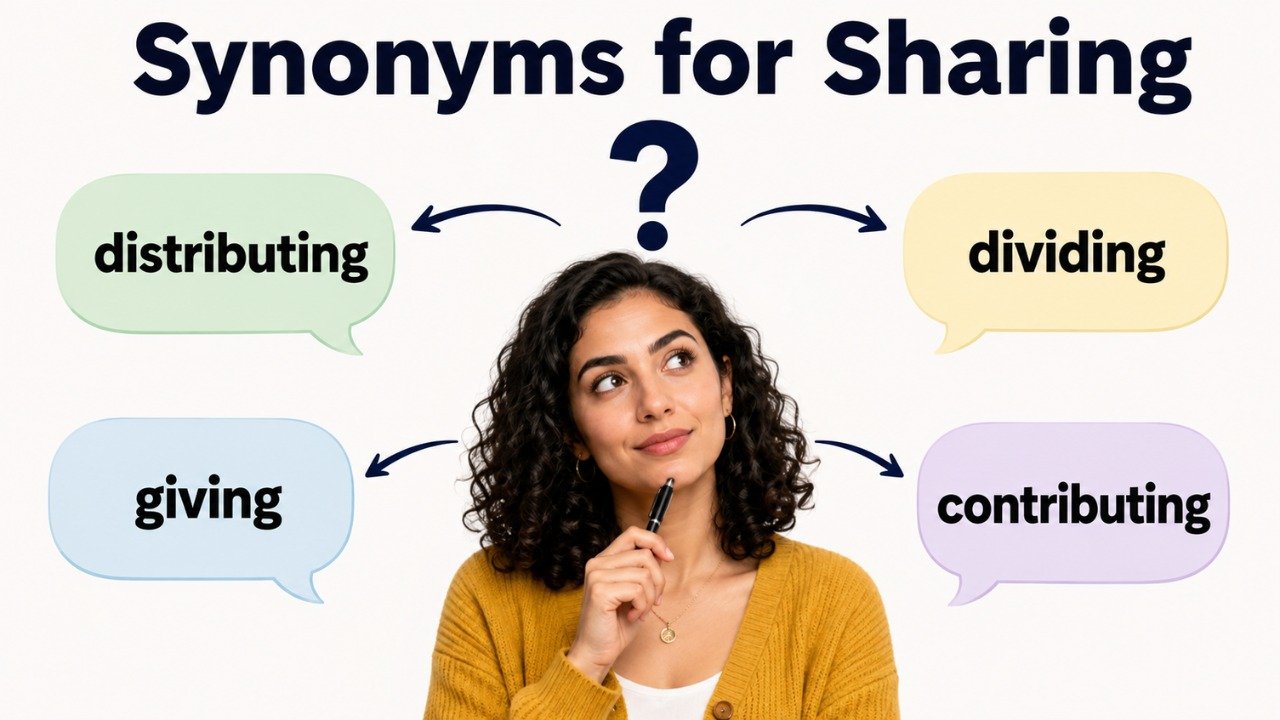
Quick Answer: Useful synonyms for sharing include distributing, giving, dividing, allocating, contributing, exchanging, communicating, disclosing, imparting, and spreading. The best choice depends on context. Use distributing for goods or materials, allocating for resources, contributing for giving toward a common purpose, exchanging for mutual sharing, communicating for ideas or information, disclosing for revealing private details, and imparting for knowledge or advice.
Pronunciation and Word Details
Word: Sharing.
Pronunciation: /ˈʃerɪŋ/
Part of Speech: Noun, gerund, and present participle of share.
Meaning: The act of giving part of something to others, using something together, or communicating information, ideas, feelings, or experiences.
US Pronunciation:
UK Pronunciation:
What Does “Sharing” Mean?
Sharing means giving part of something to another person, allowing others to use something, or communicating information, thoughts, experiences, or feelings.
The word can describe physical actions, social behavior, communication, cooperation, and emotional openness. It comes from the verb share and often functions as a noun or gerund.
Physical use: Sharing may involve dividing food, money, equipment, or another resource among people.
Information use: It can mean communicating facts, ideas, news, instructions, or knowledge.
Emotional use: Sharing can describe expressing feelings, memories, concerns, or personal experiences.
Cooperative use: It can refer to people using responsibilities, resources, or opportunities together.
Because the meaning changes with context, the most accurate synonym for sharing also changes.
Meaning, Tone, and Context of “Sharing”
Sharing is usually a neutral and positive word. It often suggests cooperation, generosity, communication, participation, or openness.
In everyday conversation, sharing commonly refers to giving someone part of something or telling another person about an experience.
In professional writing, the word may describe the communication of information, distribution of resources, transfer of knowledge, or division of responsibilities.
In emotional contexts, sharing often suggests openness and trust. A person may share thoughts, concerns, memories, or feelings.
In academic or technical contexts, more precise alternatives such as distribution, allocation, communication, disclosure, transmission, or exchange may be better.
When and How to Use “Sharing”
For Resources: Use sharing when people use or divide money, food, equipment, space, or other resources.
Example: Sharing the available equipment helped everyone complete the task.
For Information: Use sharing when someone communicates facts, updates, instructions, or ideas.
Example: Sharing accurate information helped the group make a better decision.
For Feelings: Use sharing when someone expresses emotions or personal experiences.
Example: Sharing her concerns helped her explain why she was worried.
For Responsibilities: Use sharing when two or more people divide duties or obligations.
Example: Sharing household responsibilities made the routine easier for everyone.
For Knowledge: Use sharing when someone passes knowledge, skills, or advice to another person.
Example: Sharing practical knowledge helped the new workers learn quickly.
For Possessions: Use sharing when people allow one another to use the same object or space.
Example: The children practiced sharing their art supplies.
Best Synonyms for Sharing
Distributing: Giving portions of something to several people or places.
Example: The volunteers were distributing supplies to the families.
Giving: Providing something to another person.
Example: Giving others access to the materials encouraged cooperation.
Dividing: Separating something into portions for different people or purposes.
Example: They were dividing the remaining food equally.
Allocating: Assigning resources, money, time, or responsibilities for particular purposes.
Example: The manager was allocating resources among several projects.
Contributing: Giving something toward a shared purpose, activity, or result.
Example: Everyone was contributing ideas during the discussion.
Exchanging: Giving and receiving something mutually.
Example: The students were exchanging notes after the lesson.
Communicating: Passing information, thoughts, or ideas to other people.
Example: Communicating the changes clearly prevented confusion.
Disclosing: Making information known, especially information that was private or previously unknown.
Example: She felt uncomfortable disclosing personal information.
Imparting: Giving knowledge, wisdom, advice, or information to someone.
Example: The instructor focused on imparting practical knowledge.
Spreading: Causing information, ideas, news, or something else to reach more people.
Example: The organization focused on spreading awareness about the issue.
50 Synonyms for Sharing with Short Meanings
- Distributing: Giving portions to several people.
- Giving: Providing something to another person.
- Dividing: Separating something into portions.
- Allocating: Assigning resources for particular purposes.
- Contributing: Giving toward a common goal.
- Exchanging: Giving and receiving mutually.
- Communicating: Passing information or ideas to others.
- Disclosing: Making private or unknown information known.
- Imparting: Giving knowledge or advice.
- Spreading: Causing something to reach more people.
- Providing: Making something available to someone.
- Offering: Presenting something for another person to use or accept.
- Supplying: Providing something that is needed.
- Dispensing: Giving out something in portions.
- Apportioning: Dividing something according to a plan.
- Partitioning: Dividing something into separate parts.
- Splitting: Dividing something between people or groups.
- Allotting: Assigning a particular amount or portion.
- Assigning: Giving responsibility, resources, or work to someone.
- Handing out: Giving items to several people.
- Passing on: Giving information, knowledge, or possessions to another person.
- Passing around: Allowing several people to receive or use something.
- Circulating: Moving information or materials among people.
- Transmitting: Sending information from one person or place to another.
- Conveying: Communicating an idea, message, or feeling.
- Relaying: Passing information from one person to another.
- Reporting: Communicating facts or events.
- Telling: Communicating information directly.
- Expressing: Communicating thoughts or feelings.
- Revealing: Making something previously hidden known.
- Divulging: Revealing information that may be private.
- Confiding: Sharing private feelings or information with someone trusted.
- Opening up: Speaking honestly about personal feelings or experiences.
- Discussing: Talking about information, ideas, or experiences together.
- Explaining: Making information or ideas understandable.
- Informing: Giving someone knowledge or facts.
- Announcing: Making information publicly known.
- Broadcasting: Sending information to a wide audience.
- Publishing: Making information or written material available to readers.
- Presenting: Showing or communicating information to others.
- Collaborating: Working together while sharing ideas or responsibilities.
- Cooperating: Working together toward a common purpose.
- Participating: Taking part in a shared activity.
- Pooling: Combining resources for common use.
- Contributing to: Adding resources, ideas, or effort to something.
- Delegating: Giving responsibility or duties to others.
- Transferring: Moving something from one person or place to another.
- Granting: Giving someone access, permission, or a benefit.
- Lending: Allowing someone to use something temporarily.
- Communing: Sharing thoughts, feelings, or experiences closely with others.
Read Also:
Synonyms for Hurt Feelings

Synonyms for Sharing by Context
When Sharing Means Giving or Distributing
When sharing refers to physical items, resources, food, money, or materials, useful alternatives include distributing, giving, providing, supplying, dispensing, and handing out.
Example: The group spent the morning distributing food to visitors.
Example: He was providing supplies for everyone involved.
When Sharing Means Dividing Something
When something is separated into portions, dividing, splitting, apportioning, allotting, and allocating are more precise.
Example: They were dividing the budget among four departments.
Example: The coordinator was allocating time according to each task.
When Sharing Means Communicating Information
For information, ideas, facts, news, or instructions, use communicating, conveying, relaying, informing, transmitting, or reporting.
Example: She was communicating the instructions clearly.
Example: He was relaying the latest information to the team.
When Sharing Means Revealing Personal Information
For private thoughts, feelings, experiences, or secrets, alternatives include disclosing, revealing, divulging, confiding, expressing, and opening up.
Example: She felt comfortable confiding in her closest friend.
Example: He avoided disclosing information that was meant to remain private.
When Sharing Means Exchanging
When each person gives or receives something, exchanging is often the strongest replacement. Discussing and collaborating can also work when the exchange involves ideas.
Example: The researchers spent the afternoon exchanging ideas.
Example: The group was discussing possible solutions.
When Sharing Means Using Something Together
For common use of resources, pooling, cooperating, collaborating, and participating may fit better.
Example: The families were pooling their resources to reduce costs.
Example: Both departments were collaborating on the project.
When Sharing Means Teaching Knowledge
When sharing refers to knowledge, skills, wisdom, or experience, imparting, explaining, teaching, conveying, and passing on are strong alternatives.
Example: The mentor enjoyed imparting practical knowledge to new employees.
Example: She was passing on skills learned through years of experience.
Another Word for Sharing
A strong general replacement for sharing is distributing, but it mainly works when something is being given to several people. There is no single synonym that fits every meaning of sharing.
Communicating works better for information, exchanging for mutual interaction, allocating for resources, and disclosing for private information.
Original: The teacher was sharing worksheets with the class.
Better Option: The teacher was distributing worksheets to the class.
Original: She was sharing important information with the group.
Better Option: She was communicating important information to the group.
Original: The two researchers were sharing ideas.
Better Option: The two researchers were exchanging ideas.
Original: He was sharing personal details about his experience.
Better Option: He was disclosing personal details about his experience.
When Not to Use “Sharing”
Sharing is useful, but it can become vague when a more precise verb would explain exactly what is happening.
Avoid overusing sharing when you mean distributing physical materials, allocating resources, revealing confidential information, exchanging ideas, or communicating instructions.
Weak: The manager was sharing money between the departments.
Better: The manager was allocating money among the departments.
Weak: The speaker was sharing the new rules.
Better: The speaker was explaining the new rules.
Weak: She was sharing confidential information.
Better: She was disclosing confidential information.
Weak: The students were sharing their opinions with one another.
Better: The students were exchanging their opinions.
Sharing may also sound too general in formal reports when the exact process matters. In those situations, choose a more specific word such as distribution, communication, disclosure, allocation, or transfer.
Words Commonly Confused With Sharing
Sharing vs Giving: Giving usually describes providing something to another person. Sharing often suggests that more than one person uses, receives, or experiences something.
Sharing vs Distributing: Sharing is broad and can involve possessions, feelings, knowledge, or information. Distributing specifically emphasizes giving items or resources to several recipients.
Sharing vs Exchanging: Sharing can happen in one direction, while exchanging usually involves mutual giving and receiving.
Sharing vs Communicating: Communicating specifically involves information, messages, ideas, or feelings. Sharing can also involve physical objects and resources.
Sharing vs Disclosing: Disclosing means making information known, especially private or previously hidden information. Sharing is less specific and usually sounds softer.
Sharing vs Contributing: Contributing means adding something to a larger effort, project, collection, or purpose. Sharing does not always involve a common goal.
Sharing vs Allocating: Allocating means formally assigning resources, time, money, or responsibilities. Sharing is broader and less formal.
Sharing vs Dividing: Dividing focuses on separating something into portions. Sharing focuses more on allowing others to receive, use, or experience part of it.
Which Synonym Should You Choose?
Choose distributing when physical items, materials, or supplies are being given to several people.
Choose giving when one person simply provides something to another.
Choose dividing when something is separated into portions.
Choose allocating when writing formally about money, resources, time, duties, or budgets.
Choose contributing when someone gives effort, ideas, money, or resources toward a common purpose.
Choose exchanging when both sides are giving and receiving information, opinions, or objects.
Choose communicating for instructions, ideas, facts, reports, emails, and professional information.
Choose disclosing when private, sensitive, or previously unknown information becomes known.
Choose imparting when discussing knowledge, wisdom, education, advice, or skills.
Choose spreading when information, awareness, news, or ideas are reaching a wider audience.
For essays and reports, precise words such as distributing, allocating, communicating, exchanging, and disclosing usually create clearer sentences than the general word sharing.
Real Life Examples of “Sharing” in Sentences
Original: The volunteers were sharing meals with the visitors.
Better Option: The volunteers were distributing meals to the visitors.
Original: The manager is sharing resources among the departments.
Better Option: The manager is allocating resources among the departments.
Original: We spent the meeting sharing ideas.
Better Option: We spent the meeting exchanging ideas.
Original: She was sharing her concerns with a friend.
Better Option: She was expressing her concerns to a friend.
Original: He enjoys sharing his knowledge with younger workers.
Better Option: He enjoys imparting his knowledge to younger workers.
Original: The instructor was sharing the new procedure with everyone.
Better Option: The instructor was explaining the new procedure to everyone.
Original: They are sharing the cost of the trip.
Better Option: They are splitting the cost of the trip.
Original: The members are sharing their equipment.
Better Option: The members are pooling their equipment for common use.
Original: She avoided sharing confidential details.
Better Option: She avoided disclosing confidential details.
Original: The neighbors were sharing responsibilities during the event.
Better Option: The neighbors were dividing responsibilities during the event.
Synonym Groups and Usage Differences
Giving and Distribution Group
This group includes distributing, giving, providing, supplying, dispensing, offering, and handing out. These words work best when something tangible is being provided to others.
Example: The workers were distributing fresh supplies to each location.
Division and Allocation Group
This group includes dividing, splitting, allocating, allotting, and apportioning. These words emphasize how resources or responsibilities are separated among recipients.
Example: The committee was allocating funds according to need.
Communication Group
Communicating, conveying, relaying, informing, reporting, telling, and transmitting belong to this group. They focus on passing information from one person to another.
Example: The supervisor was communicating the changes to every employee.
Disclosure Group
Disclosing, revealing, divulging, confiding, expressing, and opening up relate to making thoughts, feelings, experiences, or private information known.
Example: He felt comfortable confiding his concerns to a trusted colleague.
Exchange Group
Exchanging, discussing, collaborating, and pooling suggest interaction between several people rather than simple one way giving.
Example: The participants were exchanging ideas about possible solutions.
Knowledge Group
Imparting, explaining, informing, teaching, conveying, and passing on are useful when sharing involves knowledge, skills, experience, or advice.
Example: Her role involved imparting practical knowledge to new employees.
Antonyms of Sharing
The opposite of sharing depends on whether sharing refers to possessions, information, feelings, or participation.
Withholding: Refusing to give or reveal something.
Keeping: Retaining something instead of giving part of it to others.
Concealing: Preventing information from becoming known.
Hiding: Keeping something out of sight or knowledge.
Hoarding: Keeping excessive amounts instead of allowing others access.
Retaining: Continuing to possess or control something.
Restricting: Limiting access to something.
Excluding: Preventing someone from participating or receiving something.
Secrecy: The practice of keeping information hidden.
Monopolizing: Controlling something for personal use instead of allowing others to use it.
Comparison: Sharing vs Related Words
Sharing vs Distributing
Sharing is broader and may refer to objects, feelings, knowledge, experiences, or responsibilities. Distributing mainly emphasizes giving items or resources among several people.
Example With Sharing: They were sharing their supplies with nearby families.
Example With Distributing: They were distributing supplies to nearby families.
Sharing vs Giving
Giving usually describes transferring something to another person. Sharing often suggests that the original person still has access to the item, experience, or information.
Example With Sharing: Maya was sharing her notes with a classmate.
Example With Giving: Maya was giving her classmate a copy of the notes.
Sharing vs Exchanging
Sharing can happen in one direction, while exchanging normally involves two or more sides giving something to each other.
Example With Sharing: He was sharing his opinion with the group.
Example With Exchanging: The group members were exchanging opinions.
Sharing vs Communicating
Sharing is general, while communicating specifically focuses on messages, information, ideas, thoughts, or feelings.
Example With Sharing: She was sharing the instructions with everyone.
Example With Communicating: She was communicating the instructions to everyone.
Sharing vs Disclosing
Sharing sounds neutral and broad. Disclosing is more precise when information was private, sensitive, hidden, or previously unknown.
Example With Sharing: He was sharing details about the agreement.
Example With Disclosing: He was disclosing confidential details about the agreement.
Sharing vs Contributing
Sharing involves allowing others to receive, use, or know something. Contributing means adding something to a common effort or purpose.
Example With Sharing: She was sharing her ideas during the discussion.
Example With Contributing: She was contributing ideas to the project.
Sharing vs Allocating
Sharing is informal and broad. Allocating is more formal and refers to deliberately assigning resources, time, money, or responsibilities.
Example With Sharing: The teams were sharing the available budget.
Example With Allocating: The director was allocating the available budget among the teams.
Common Phrases and Expressions With Sharing
Sharing Information: Communicating facts, knowledge, updates, or details with others.
Sharing Ideas: Communicating thoughts, suggestions, or possible solutions.
Sharing Responsibilities: Dividing duties among two or more people.
Sharing Resources: Allowing several people or groups to use available materials, money, equipment, or services.
Sharing Experiences: Telling others about events or situations someone has personally experienced.
Sharing Feelings: Expressing emotions openly to another person.
Sharing Knowledge: Giving information, skills, expertise, or understanding to others.
Sharing the Cost: Dividing an expense between two or more people.
Sharing a Meal: Eating together or giving part of a meal to another person.
Sharing a Space: Using the same physical area with another person or group.
Common Mistakes to Avoid
Repetition: Avoid using sharing several times within the same paragraph when more precise alternatives are available.
Weak: The group was sharing information, sharing ideas, and sharing responsibilities.
Better: The group was communicating information, exchanging ideas, and dividing responsibilities.
Wrong Synonym Choice: Do not assume every synonym for sharing works in every context.
Weak: She was allocating her feelings with a friend.
Better: She was sharing her feelings with a friend.
Allocating works for resources, money, time, or duties, not emotions.
Confusing Sharing With Exchanging: Exchanging normally requires mutual action. If information only moves from one person to another, sharing or communicating may be more accurate.
Weak: The instructor exchanged the safety instructions with the students.
Better: The instructor communicated the safety instructions to the students.
Unnatural Phrasing: Some formal synonyms sound awkward in ordinary conversation.
Weak: He imparted his sandwich with his brother.
Better: He shared his sandwich with his brother.
Imparting is appropriate for knowledge, wisdom, information, or advice rather than food.
Vague Usage: Sharing can be too general when the reader needs to know exactly what happened.
Weak: The department was sharing the funds.
Better: The department was allocating the funds among three programs.
Confusing Disclosure With Ordinary Sharing: Disclosure usually suggests information that was private, sensitive, or not previously known.
Weak: She disclosed a funny story about her weekend.
Better: She shared a funny story about her weekend.
Choose the synonym that describes the exact action rather than replacing sharing mechanically.
Conclusion
The best synonyms for sharing depend on what is being given, divided, communicated, or experienced together. Distributing works well for physical items, allocating for resources, exchanging for mutual ideas, communicating for information, disclosing for private details, and imparting for knowledge. Other useful synonyms for sharing include giving, contributing, dividing, providing, and spreading. Choosing a precise alternative makes writing clearer because it shows whether people are transferring resources, expressing feelings, exchanging ideas, or communicating information.
FAQs About Synonyms for Sharing
What is the best synonym for sharing?
Distributing is a strong synonym when physical items are involved, but the best replacement depends on context. Communicating, exchanging, giving, allocating, and contributing may be better in other situations.
What is another word for sharing information?
Communicating is one of the best alternatives. Other choices include conveying, relaying, informing, reporting, and transmitting.
What is another word for sharing ideas?
Exchanging is often the strongest option when several people contribute ideas. Discussing, communicating, contributing, and collaborating can also work.
What is a formal synonym for sharing?
Allocating is useful for resources, distributing for materials, communicating for information, disclosing for private details, and imparting for knowledge.
What is another word for sharing feelings?
Expressing is a natural alternative. Confiding, revealing, discussing, and opening up may also work depending on how personal the feelings are.
Are sharing and giving the same?
Not exactly. Giving often means transferring something to another person, while sharing may involve dividing something, using it together, or allowing another person access to it.
What is the opposite of sharing?
Common opposites include withholding, keeping, concealing, hoarding, restricting, and excluding. The best antonym depends on whether the context involves possessions, information, feelings, or access.
