
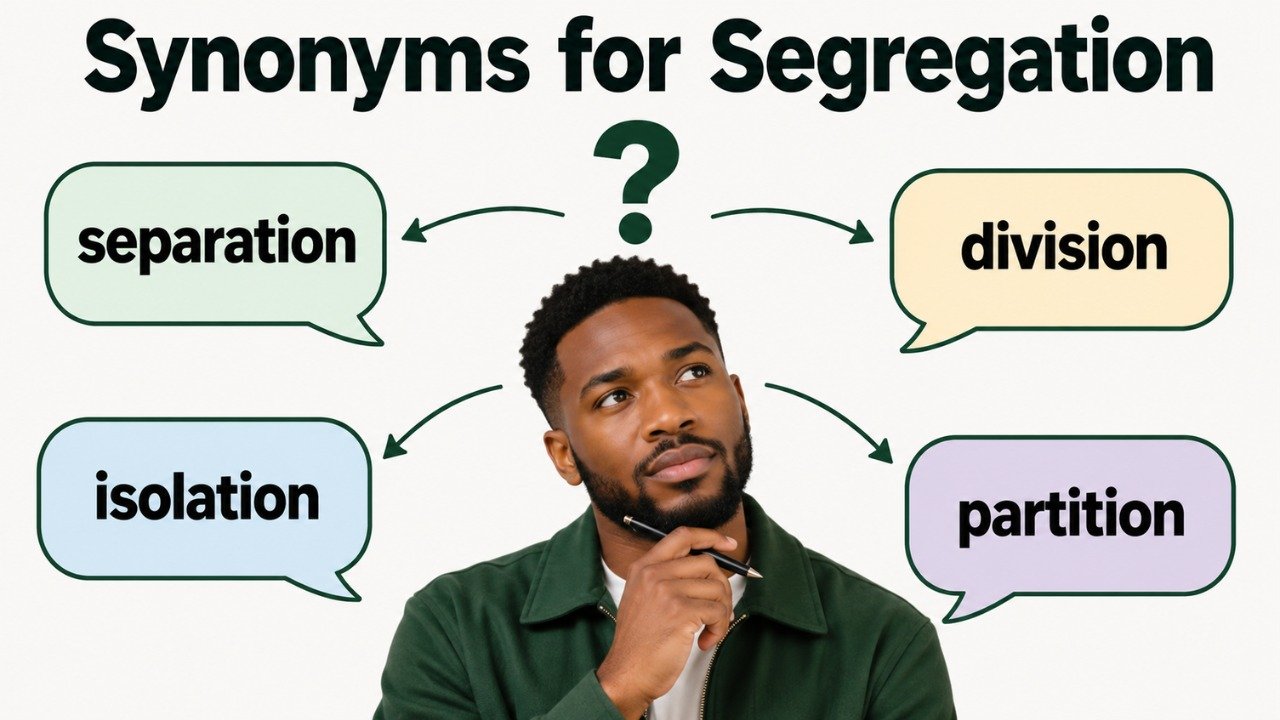
Quick Answer: Synonyms for segregation include separation, division, isolation, exclusion, partition, separation, classification, sorting, compartmentalization, and detachment. Separation is the most general replacement. Division works well when people, areas, or groups are split. Isolation emphasizes being kept apart, while exclusion highlights being prevented from joining or participating. Partition suits physical or territorial division. Classification and sorting are better when segregation means organizing items into separate categories.
Pronunciation and Word Details
Word: Segregation.
Pronunciation: /ˌseɡ.rɪˈɡeɪ.ʃən/
Part of Speech: Noun.
Meaning: The act or process of separating people, things, areas, or groups from one another.
US Pronunciation:
UK Pronunciation:
What Does “Segregation” Mean?
Segregation means the act, condition, or process of keeping people, objects, categories, or areas separate from one another.
As a noun, segregation can describe deliberate separation, natural separation, organized sorting, or a social system in which different groups are kept apart.
In social and historical contexts, segregation often refers to the enforced separation of groups of people, particularly when access to schools, housing, transportation, services, or public spaces is restricted.
In technical or practical contexts, the word can have a more neutral meaning. Waste segregation, for example, means separating different kinds of waste so they can be handled appropriately.
The exact meaning therefore depends strongly on context.
Meaning, Tone, and Context of “Segregation”
Segregation is usually a formal and serious word. Its tone changes according to what is being separated and why.
Social Context: Segregation often carries a strongly negative meaning when people are separated because of race, ethnicity, social class, religion, disability, or another group distinction.
Historical Context: The word frequently appears in discussions about laws, institutions, education, housing, and civil rights.
Academic Context: Researchers may use segregation when discussing patterns of residential, economic, occupational, educational, or social separation.
Technical Context: Segregation can be neutral when describing the sorting of materials, data, waste, products, or substances.
Everyday Context: In casual conversation, separation is usually more natural unless the speaker specifically means systematic or organized separation.
Because segregation can refer to serious social inequality, writers should choose the term carefully and avoid replacing it with a softer synonym when the stronger meaning is important.
When and How to Use “Segregation”
For Social Separation: Use segregation when different groups of people are systematically kept apart.
Example: The study examined patterns of residential segregation across several neighborhoods.
For Historical Discussion: Use the word when describing institutional or legally enforced separation in historical settings.
Example: The museum exhibition explored the effects of segregation on education and public life.
For Physical Separation: Segregation can describe objects or materials being divided into different areas.
Example: Proper segregation of recyclable materials makes processing easier.
For Classification: The word can describe sorting things into distinct categories.
Example: The laboratory requires careful segregation of different types of samples.
For Workplace or Economic Patterns: Segregation may describe the concentration of different groups in separate occupations, industries, or roles.
Example: The report examined occupational segregation across several fields.
For Geographic Separation: Use segregation when groups or activities become concentrated in different locations.
Example: Housing patterns contributed to greater geographic segregation.
Best Synonyms for Segregation
Separation: The condition or process of keeping people or things apart.
Example: The separation of the materials prevented contamination.
Division: The act of splitting something into different groups, parts, or sections.
Example: The division of the neighborhood created distinct social areas.
Isolation: The condition of being separated from others, often with limited contact.
Example: Prolonged isolation reduced opportunities for interaction.
Exclusion: The act of preventing someone or something from participating or belonging.
Example: The policy resulted in the exclusion of certain applicants.
Partition: The division of an area, space, or territory into separate parts.
Example: The partition of the building created several independent sections.
Classification: The organization of people or things into distinct categories.
Example: Classification helped researchers organize the samples efficiently.
Sorting: The process of arranging things according to type, quality, or category.
Example: Sorting the recyclable materials made collection easier.
Compartmentalization: The division of something into separate sections or categories.
Example: The compartmentalization of the storage area reduced accidental mixing.
Detachment: A state of being separated or disconnected from something else.
Example: The detachment of the unit allowed it to operate independently.
Seclusion: The condition of being apart from other people or activity.
Example: The remote location created a sense of seclusion.
50 Synonyms for Segregation with Short Meanings
- Separation: The act of keeping things or people apart.
- Division: The splitting of something into separate parts.
- Isolation: The condition of being separated from others.
- Exclusion: The act of preventing participation or inclusion.
- Partition: The division of a space, region, or group.
- Classification: The arrangement of things into separate categories.
- Sorting: The organization of items according to type.
- Compartmentalization: The division of something into distinct sections.
- Detachment: The state of being disconnected or separated.
- Seclusion: The condition of being away from others.
- Severance: The act of cutting or ending a connection.
- Disconnection: The state of no longer being connected.
- Divisionism: A tendency toward creating separate groups or divisions.
- Differentiation: The process of distinguishing one group or type from another.
- Distinction: A separation based on a noticeable difference.
- Categorization: The process of placing things into separate categories.
- Grouping: The arrangement of people or things into groups.
- Stratification: The arrangement of people or things into distinct levels.
- Separationism: Support for maintaining separation between groups.
- Partitioning: The process of dividing something into separate parts.
- Zoning: The division of an area according to particular uses or categories.
- Quarantine: Enforced separation to prevent contact or transmission.
- Confinement: The condition of being restricted to a particular area.
- Containment: The act of keeping something within defined limits.
- Disassociation: The process of becoming disconnected from a group or relationship.
- Disengagement: Withdrawal or separation from involvement.
- Disunion: The state of being divided rather than united.
- Disjunction: A separation or lack of connection between things.
- Discrimination: Unequal treatment that may create or maintain separation.
- Marginalization: The process of pushing a person or group to the edge of society.
- Alienation: Separation from a group, community, or sense of belonging.
- Ostracism: Deliberate exclusion from a group or community.
- Banishment: Forced removal or exclusion from a place or group.
- Expulsion: The act of forcing someone or something out.
- Removal: The act of taking something away from a place or group.
- Exclusionism: A policy or attitude favoring the exclusion of certain groups.
- Dispersal: The act of spreading people or things into separate areas.
- Dispersion: The state or process of being distributed apart.
- Allocation: The assignment of people or things to separate places or categories.
- Distribution: The arrangement or spreading of things among different areas.
- Subdivision: The division of something into smaller sections.
- Separation of groups: The keeping of different groups apart.
- Social separation: Separation between social groups or communities.
- Spatial separation: Physical separation across different locations.
- Residential separation: The concentration of groups in different living areas.
- Institutional separation: Separation maintained through organizations or systems.
- Social division: A condition in which groups remain socially apart.
- Physical division: The separation of spaces, objects, or areas.
- Restricted separation: Separation maintained through limitations or controls.
- Organized separation: Deliberate arrangement into distinct groups or sections.
Read Also:
Synonyms for Sharing

Synonyms for Segregation by Context
When Segregation Means Physical Separation
Separation, partition, division, subdivision, detachment, and compartmentalization work well when objects or spaces are physically divided.
Example: The physical separation of hazardous materials improved safety.
Example: A partition divided the work area into separate sections.
When Segregation Means Social Separation
Social separation, division, isolation, exclusion, marginalization, and stratification can describe people or communities being separated socially.
Example: The researchers studied social separation between different communities.
Example: Economic inequality contributed to greater social division.
When Segregation Means Exclusion
Exclusion, ostracism, marginalization, banishment, and expulsion emphasize being kept outside a group, activity, or opportunity.
Example: The new rules were designed to prevent exclusion from public programs.
Example: Ostracism left the individual disconnected from the wider group.
When Segregation Means Sorting or Classification
Sorting, classification, categorization, grouping, differentiation, and allocation are useful when the process is organizational rather than social.
Example: The classification of samples allowed the researchers to compare results accurately.
Example: Sorting the materials by type improved recycling efficiency.
When Segregation Means Geographic Division
Partition, zoning, spatial separation, residential separation, subdivision, and distribution can describe separation across locations.
Example: Residential separation reduced everyday contact between the communities.
Example: Zoning created distinct areas for different activities.
Another Word for Segregation
The best general replacement for segregation is separation because it works in many physical, social, and organizational contexts. However, the best alternative depends on the exact meaning.
Use exclusion when people are being denied participation. Use isolation when limited contact is important. Use partition when a physical place or territory is divided. Use classification or sorting when things are simply being organized.
Original: The segregation of recyclable materials improved processing.
Better Option: The sorting of recyclable materials improved processing.
Original: The report examined segregation between social groups.
Better Option: The report examined separation between social groups.
Original: The segregation of the building created several sections.
Better Option: The partition of the building created several sections.
Original: The policy contributed to the segregation of certain participants.
Better Option: The policy contributed to the exclusion of certain participants.
When Not to Use “Segregation”
Segregation should not be used automatically whenever two things are separate. The word can suggest systematic, deliberate, or socially significant separation, so a simpler term may sometimes be more accurate.
Weak: The segregation of the books by author made them easier to find.
Better: The classification of the books by author made them easier to find.
Sorting or classification sounds more natural because the books are merely being organized.
Weak: She preferred the segregation of her personal documents from her work files.
Better: She preferred the separation of her personal documents from her work files.
Separation is clearer and less formal in this context.
Weak: The segregation of the cake into eight pieces made serving easier.
Better: The division of the cake into eight pieces made serving easier.
Division accurately describes splitting something into portions.
Weak: His segregation from the conversation lasted several minutes.
Better: His isolation from the conversation lasted several minutes.
Isolation better expresses a lack of social connection.
Words Commonly Confused With Segregation
Segregation vs Separation: Separation is the broadest term and can describe almost anything being kept apart. Segregation often suggests a more organized, systematic, or socially meaningful form of separation.
Segregation vs Isolation: Segregation emphasizes separation into distinct groups or areas. Isolation emphasizes limited contact or complete separation from others.
Segregation vs Exclusion: Segregation involves keeping groups apart. Exclusion means preventing someone from entering, participating, or belonging.
Segregation vs Discrimination: Segregation is separation, while discrimination is unequal or unfair treatment based on a characteristic or group distinction. Discrimination can contribute to segregation, but the terms are not identical.
Segregation vs Partition: Segregation can concern people, objects, institutions, or spaces. Partition usually refers more specifically to dividing space, land, territory, or another whole into separate parts.
Segregation vs Classification: Segregation involves separation. Classification involves organizing things into categories according to shared characteristics. Classification does not necessarily imply unequal treatment.
Segregation vs Stratification: Segregation refers to separation between groups. Stratification refers to arranging groups into different levels, ranks, or social layers.
Which Synonym Should You Choose?
Choose separation when you need a general and neutral word for keeping people or things apart.
Choose division when something is being split into separate groups, areas, or sections.
Choose isolation when the main idea is limited contact with others.
Choose exclusion when someone is prevented from joining, participating, or gaining access.
Choose partition when describing the physical division of land, space, rooms, or territories.
Choose sorting when items are being arranged according to type.
Choose classification when information, objects, or people are being organized into categories for analysis or administration.
Choose compartmentalization when separate sections are deliberately created to prevent mixing.
Choose marginalization when a person or group is pushed away from meaningful participation or influence.
Choose stratification in academic writing when describing groups arranged into distinct social or economic levels.
For essays and reports discussing social systems, segregation may remain the most precise term when systematic group separation is the subject.
For ordinary emails or conversation, separation, division, sorting, or isolation often sounds more natural.
Real Life Examples of “Segregation” in Sentences
Original: The study investigated residential segregation across the city.
Better Option: The study investigated residential separation across the city.
Original: Proper segregation of recyclable waste is required in the facility.
Better Option: Proper sorting of recyclable waste is required in the facility.
Original: The segregation of the samples prevented contamination.
Better Option: The separation of the samples prevented contamination.
Original: The policy increased segregation between different social groups.
Better Option: The policy increased division between different social groups.
Original: The building design allowed segregation of private and public spaces.
Better Option: The building design allowed separation of private and public spaces.
Original: The researchers measured occupational segregation within the industry.
Better Option: The researchers measured occupational division within the industry.
Original: Segregation from the wider community increased feelings of loneliness.
Better Option: Isolation from the wider community increased feelings of loneliness.
Original: The segregation of products into categories simplified inventory management.
Better Option: The classification of products into categories simplified inventory management.
Original: The rules resulted in segregation of some members from group activities.
Better Option: The rules resulted in exclusion of some members from group activities.
Original: Physical segregation of the substances was necessary for safe storage.
Better Option: Physical separation of the substances was necessary for safe storage.
Synonym Groups and Usage Differences
Separation Group
Separation, division, partition, subdivision, and detachment describe things being kept or moved apart.
These terms are useful for physical spaces, objects, systems, and groups.
Example: The separation of the two materials reduced the risk of contamination.
Isolation Group
Isolation, seclusion, disconnection, disengagement, and alienation emphasize distance, reduced contact, or lack of connection.
These words are especially useful when describing individuals or communities that have limited interaction with others.
Example: Geographic isolation made communication more difficult.
Exclusion Group
Exclusion, ostracism, marginalization, banishment, and expulsion focus on someone being prevented from joining or remaining within a group.
Some of these words are stronger than segregation because they suggest complete removal rather than simple separation.
Example: The organization revised its rules to reduce exclusion.
Organization Group
Sorting, classification, categorization, grouping, and differentiation are useful when segregation simply means organizing things into separate categories.
These alternatives usually carry no negative social meaning.
Example: Careful sorting of the materials made processing more efficient.
Social Division Group
Social separation, social division, stratification, residential separation, and institutional separation describe patterns in communities and institutions.
These expressions are useful in academic, sociological, historical, and policy related writing.
Example: The study examined social division across different neighborhoods.
Antonyms of Segregation
The opposite of segregation depends on whether the subject is people, objects, communities, or systems. Most antonyms emphasize joining, inclusion, connection, or mixing.
Integration: The process of bringing separate groups or parts together.
Inclusion: The practice of allowing people to participate and belong.
Unity: The condition of being joined together as a whole.
Unification: The act of combining separate parts or groups.
Combination: The joining of separate things.
Merging: The process of becoming one combined unit.
Connection: A relationship or link between previously separate things.
Association: Interaction or connection between people or groups.
Mixing: The process of bringing different materials or groups together.
Incorporation: The act of including something within a larger whole.
Cohesion: The condition of remaining connected or united.
Participation: Active involvement in a group, activity, or community.
Comparison: Segregation vs Related Words
Segregation vs Separation
Segregation is a specific type of separation that often involves distinct groups, categories, spaces, or systems. Separation is broader and more neutral.
Example With Segregation: The research focused on patterns of residential segregation.
Example With Separation: A wall provided separation between the two work areas.
Segregation vs Isolation
Segregation means dividing or keeping groups apart. Isolation emphasizes being removed from contact with others.
Example With Segregation: Segregation limited interaction between the two communities.
Example With Isolation: Geographic isolation made regular interaction difficult.
Segregation vs Exclusion
Segregation keeps groups apart, while exclusion prevents someone from participating, entering, or belonging.
Example With Segregation: The arrangement created segregation between different groups.
Example With Exclusion: The rule led to the exclusion of some applicants.
Segregation vs Partition
Segregation can involve people, categories, objects, or areas. Partition usually describes dividing a physical space or territory.
Example With Segregation: The facility requires segregation of certain materials.
Example With Partition: A partition divided the large room into two offices.
Segregation vs Classification
Segregation separates items or groups. Classification identifies categories and places things within them.
Example With Segregation: Segregation of the samples prevented them from mixing.
Example With Classification: Classification of the samples helped researchers compare their characteristics.
Segregation vs Discrimination
Segregation describes separation, while discrimination describes unequal treatment. The concepts can be related, but they are not interchangeable.
Example With Segregation: The researchers examined segregation within the housing system.
Example With Discrimination: The investigation focused on discrimination in access to housing.
Common Phrases and Expressions With Segregation
Racial Segregation: Separation of people according to racial group.
Residential Segregation: Separation of groups into different residential areas.
Social Segregation: Separation between social communities or categories.
School Segregation: Separation of students into different schools or educational settings based on group distinctions.
Occupational Segregation: Concentration of different groups in different jobs or professions.
Spatial Segregation: Physical separation of people, activities, or areas across space.
Economic Segregation: Separation between groups according to income or economic position.
Institutional Segregation: Separation maintained through organizational structures, practices, or systems.
Waste Segregation: Sorting waste into separate categories for handling or processing.
Material Segregation: Separation of different materials to prevent mixing or contamination.
Common Mistakes to Avoid
One common mistake is treating every synonym for segregation as completely interchangeable. Each alternative carries a different emphasis.
Repetition: Avoid repeating segregation several times in one paragraph when separation, division, isolation, or another precise synonym would improve readability.
Wrong Synonym Choice: Do not replace segregation with exclusion when the subject involves separate groups but nobody is actually being denied access.
Unnatural Phrasing: Avoid using segregation for simple everyday organization when sorting, grouping, or classification sounds more natural.
Confusing Discrimination and Segregation: Discrimination refers to unequal treatment. Segregation refers to separation. One may contribute to the other, but they describe different concepts.
Ignoring Context: Social segregation carries different implications from waste segregation or material segregation. Make the subject clear.
Using a Softer Word When Precision Matters: In historical, legal, or social discussions, replacing segregation with a vague term such as difference can weaken the intended meaning.
Vague Usage: Do not write that segregation increased without explaining what was separated. Identify the groups, locations, materials, or categories whenever possible.
Conclusion
Synonyms for segregation include separation, division, isolation, exclusion, partition, classification, sorting, compartmentalization, marginalization, and stratification. Separation is the strongest general alternative, while isolation emphasizes reduced contact and exclusion emphasizes being kept out. Partition works for physical or territorial division, while sorting and classification suit organizational contexts. In social or historical writing, segregation itself may be the most accurate term when systematic group separation is being discussed. Choosing the right synonym depends on what is separated, how it happens, and why the distinction matters.
FAQs About Synonyms for Segregation
What is the best synonym for segregation?
Separation is the best general synonym because it can describe people, objects, spaces, and categories being kept apart. More precise alternatives include isolation, exclusion, partition, and sorting.
What is another word for social segregation?
Social separation, social division, isolation, stratification, and exclusion can work depending on the context. Segregation may still be the most precise term for systematic separation between social groups.
Is isolation a synonym for segregation?
Yes, but the words are not identical. Isolation focuses on limited contact or being apart, while segregation usually emphasizes the separation of distinct groups or categories.
Is exclusion the same as segregation?
No. Exclusion means preventing someone from participating or belonging. Segregation means keeping groups separate. A situation can involve both, but the concepts are different.
What is a formal synonym for segregation?
Separation, partition, stratification, differentiation, compartmentalization, and classification can all work in formal writing. The most appropriate word depends on the subject.
What is the opposite of segregation?
Integration is one of the clearest opposites. Other antonyms include inclusion, unity, unification, connection, incorporation, and mixing.
Which synonym should I use for waste segregation?
Sorting or separation usually works best. For example, waste segregation can often be rewritten as waste sorting or separation of waste into different categories.
