
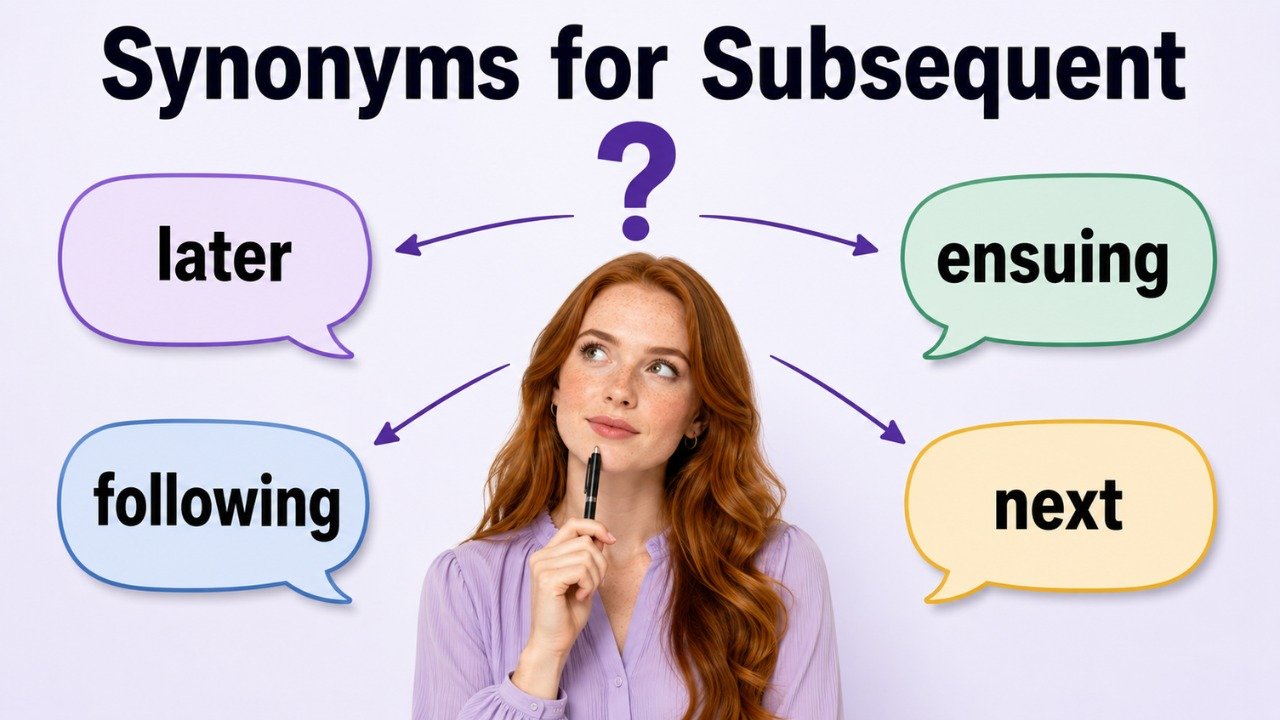
Quick Answer: The best synonyms for subsequent include following, later, succeeding, ensuing, next, future, upcoming, successive, posterior, and forthcoming. The exact choice depends on context. Use following for something that comes directly after another event, later for general time order, ensuing for events that develop afterward, successive for a continuing sequence, and posterior in highly formal or technical writing. These synonyms for subsequent help express order, time, sequence, and later development more precisely.
Pronunciation and Word Details
Word: Subsequent
Pronunciation: /ˈsʌb.sɪ.kwənt/
Part of Speech: Adjective
Meaning: Happening, appearing, or coming after something else in time, order, or sequence.
US Pronunciation:
UK Pronunciation:
What Does “Subsequent” Mean?
Subsequent means happening or coming after something else in time, order, or sequence. It is mainly used as an adjective to describe an event, action, stage, period, or development that occurs later.
For example, a subsequent meeting is a meeting that happens after an earlier one. Subsequent events are events that take place later than the event already being discussed.
The word does not always mean immediately next. Something subsequent simply occurs afterward. There may be other events between the original event and the subsequent one.
Example: The first experiment failed, but subsequent tests produced better results.
In this sentence, the tests happened after the first experiment.
Meaning, Tone, and Context of “Subsequent”
Subsequent has a neutral to formal tone. It appears frequently in academic writing, reports, essays, business communication, historical descriptions, legal discussion, research, and other contexts where the order of events matters.
In everyday conversation, speakers often prefer simpler words such as later, next, or following.
Formal Context: Subsequent analysis confirmed the initial findings.
Neutral Context: Her subsequent visits became more frequent.
Conversational Alternative: We talked about it again later.
Subsequent is especially useful when a writer wants to connect an earlier event with developments that happened afterward without suggesting that those developments occurred immediately.
It commonly modifies nouns such as events, years, meetings, studies, chapters, changes, developments, attempts, decisions, reports, generations, periods, and investigations.
When and How to Use “Subsequent”
For Events in Time: Use subsequent when describing something that happened after an earlier event.
Example: Subsequent events changed the direction of the investigation.
For Stages in a Process: Use subsequent for stages that follow an earlier stage.
Example: The problem was corrected during subsequent stages of production.
For Research and Analysis: Subsequent is useful when referring to later studies, tests, or findings.
Example: Subsequent research supported the original conclusion.
For Historical Writing: Use subsequent to describe developments occurring after a particular historical moment.
Example: The agreement influenced subsequent political developments.
For Reports and Formal Documents: Subsequent can clearly establish chronological order.
Example: The error was addressed in a subsequent report.
For Repeated Attempts: Use subsequent when later attempts are being compared with an earlier one.
Example: Her subsequent attempts were much more successful.
Best Synonyms for Subsequent
Following
Synonym: Following means coming after something in time, position, or order.
Example: The following chapter explains the results in greater detail.
Later
Synonym: Later means occurring after a particular time or event.
Example: Later studies produced similar findings.
Succeeding
Synonym: Succeeding means coming after something else in a sequence.
Example: The succeeding generations continued the tradition.
Ensuing
Synonym: Ensuing means occurring afterward, especially as events continue to develop.
Example: The ensuing discussion lasted more than an hour.
Next
Synonym: Next means immediately or most naturally following in order.
Example: The next meeting will focus on implementation.
Future
Synonym: Future means belonging to a time that has not yet arrived.
Example: Future research may provide a clearer answer.
Upcoming
Synonym: Upcoming means expected to happen relatively soon.
Example: The upcoming session will address the remaining questions.
Successive
Synonym: Successive means following one after another in a continuing series.
Example: Sales increased during three successive months.
Posterior
Synonym: Posterior can mean later in time or order and is mainly used in formal or technical contexts.
Example: The posterior stage of the analysis examined long term effects.
Forthcoming
Synonym: Forthcoming means expected to appear, happen, or become available in the future.
Example: The forthcoming report will contain the complete findings.
50 Synonyms for Subsequent with Short Meanings
- Following: Coming after something else.
- Later: Happening after an earlier time.
- Succeeding: Coming next in order.
- Ensuing: Happening afterward as events develop.
- Next: Coming immediately or naturally afterward.
- Future: Belonging to a later time.
- Upcoming: Expected to happen soon.
- Successive: Following one after another.
- Posterior: Later in time or sequence.
- Forthcoming: Expected to happen or appear later.
- Afterward: Occurring or being considered after an earlier event.
- After: Coming later than something else.
- Thereafter: Happening from that point onward.
- Later occurring: Taking place at a later time.
- Later arriving: Appearing or arriving afterward.
- Later developing: Developing after an earlier stage.
- Later emerging: Becoming noticeable afterward.
- Later appearing: Appearing after something already mentioned.
- Later arising: Occurring as a later development.
- Later formed: Created after an earlier form or stage.
- Later produced: Produced after an earlier example.
- Later issued: Released after something earlier.
- Later published: Published at a later time.
- Later reported: Reported after an earlier account.
- Later recorded: Documented after an earlier record.
- Later observed: Noticed during a later period.
- Later discovered: Found after an earlier event or investigation.
- Later established: Created or confirmed afterward.
- Later introduced: Brought in after an earlier stage.
- Later adopted: Accepted or used afterward.
- Later added: Included after something else.
- Later revised: Changed after an earlier version.
- Later amended: Formally changed afterward.
- Later updated: Modified with newer information.
- Later completed: Finished after an earlier stage.
- Later conducted: Carried out at a later time.
- Later undertaken: Begun or performed afterward.
- Later developed: Created or improved later.
- Later generated: Produced at a later point.
- Later received: Obtained after an earlier event.
- Later mentioned: Referred to afterward.
- Later discussed: Considered at a later point.
- Later reviewed: Examined afterward.
- Later examined: Studied after an earlier stage.
- Later considered: Thought about afterward.
- Later scheduled: Planned for a later time.
- Coming: Approaching or expected later.
- Impending: Expected to happen relatively soon.
- Prospective: Expected or likely to occur in the future.
- To come: Expected to happen in a later period.
Read Also:
Synonyms for Segregation

Synonyms for Subsequent by Context
When Subsequent Means Following in Time
When subsequent simply means happening after an earlier event, following, later, and succeeding are usually the strongest alternatives.
Following: Natural in both formal and neutral writing.
Example: The following investigation uncovered additional evidence.
Later: Simple and flexible for both writing and conversation.
Example: Later investigations reached the same conclusion.
Succeeding: More formal and especially useful for periods, generations, stages, and years.
Example: Succeeding generations expanded the original settlement.
When Subsequent Means Next in a Sequence
Use next, following, succeeding, or successive when discussing ordered stages or items.
Next: Best when something comes directly after another item.
Example: The next section explains the methodology.
Following: Useful for chapters, steps, days, weeks, and stages.
Example: Performance improved during the following week.
Successive: Best when several items occur one after another.
Example: The team recorded gains in four successive quarters.
When Subsequent Refers to Later Developments
Use ensuing, later, or succeeding when describing events that develop after an initial event.
Ensuing: Often suggests a chain of developments following an event.
Example: The ensuing debate revealed several disagreements.
Later: Best when only chronological order matters.
Example: Later developments changed public understanding of the issue.
Succeeding: Works well for formal descriptions of periods or stages.
Example: Succeeding stages became increasingly complex.
When Subsequent Refers to the Future
Use future, forthcoming, upcoming, prospective, or to come when the later event has not happened yet.
Future: Broad and neutral.
Example: Future studies should examine a larger sample.
Forthcoming: Useful for reports, publications, announcements, and planned releases.
Example: The forthcoming report will provide additional details.
Upcoming: More conversational and often suggests that something will happen soon.
Example: The upcoming meeting will focus on the budget.
When Subsequent Means One After Another
Use successive when multiple events, periods, or actions follow each other in a continuous sequence.
Successive: Emphasizes repeated or consecutive occurrence.
Example: She improved her score during three successive attempts.
This meaning is narrower than subsequent because subsequent does not necessarily mean that events happen without interruption.
Another Word for Subsequent
Following is often the best general replacement for subsequent because both words describe something coming after something else. However, the most accurate alternative depends on whether you mean later in time, directly next in order, developing afterward, or expected in the future.
Original: Subsequent meetings focused on practical solutions.
Better Option: Following meetings focused on practical solutions.
Original: Subsequent research confirmed the original finding.
Better Option: Later research confirmed the original finding.
Original: The subsequent discussion became increasingly detailed.
Better Option: The ensuing discussion became increasingly detailed.
Original: Subsequent generations preserved the custom.
Better Option: Succeeding generations preserved the custom.
When Not to Use “Subsequent”
Subsequent can sound unnecessarily formal in relaxed conversation. In those situations, later or next is usually clearer.
Weak: I will explain that during our subsequent conversation.
Better: I will explain that during our next conversation.
Avoid subsequent when you specifically mean immediately next. Subsequent only means later, so it can be less precise.
Weak: Turn to the subsequent page.
Better: Turn to the next page.
Do not use subsequent when describing something that happened before the event being discussed.
Weak: The subsequent warning occurred before the accident.
Better: The earlier warning occurred before the accident.
Avoid repeating subsequent too frequently in formal writing.
Weak: Subsequent studies influenced subsequent policies during subsequent years.
Better: Later studies influenced new policies during the following years.
Use ensuing carefully. It is most natural when discussing events or situations that develop after something, rather than ordinary objects.
Weak: She opened the ensuing book on the shelf.
Better: She opened the next book on the shelf.
Words Commonly Confused With Subsequent
Subsequent vs Following: Both indicate something later. Following often sounds more natural and can suggest a closer position in a sequence.
Subsequent vs Next: Next normally identifies the item immediately after another one. Subsequent may refer to anything that happens later.
Subsequent vs Successive: Subsequent means later, while successive emphasizes several things occurring one after another.
Subsequent vs Ensuing: Subsequent simply establishes later order. Ensuing often describes events that unfold after a particular situation.
Subsequent vs Consequent: Subsequent refers to time or sequence. Consequent usually refers to something resulting from another event.
Subsequent vs Future: Subsequent is relative to an earlier event, while future broadly refers to time that has not yet occurred.
Subsequent vs Forthcoming: Subsequent can describe past or future events. Forthcoming normally refers to something expected in the future.
Subsequent vs Previous: These words express opposite directions in a sequence. Subsequent means later, while previous means earlier.
Which Synonym Should You Choose?
Choose following when you need a natural, versatile replacement for something that comes afterward.
Choose later when chronological order matters but you do not need a formal tone.
Choose succeeding when writing formally about generations, periods, stages, rulers, or other ordered sequences.
Choose ensuing when describing discussion, conflict, confusion, debate, events, or consequences that develop after something happens.
Choose next when you mean the item or event immediately following another one.
Choose successive when several events occur one after another in a continuing sequence.
Choose future when discussing general plans, research, possibilities, developments, or periods that have not happened yet.
Choose forthcoming for reports, books, announcements, publications, or events expected in the near future.
Choose upcoming for meetings, events, sessions, and other activities expected relatively soon.
Choose posterior mainly in formal, academic, scientific, or technical contexts where later position or order must be expressed precisely.
Real Life Examples of “Subsequent” in Sentences
Original: Subsequent meetings focused on reducing unnecessary expenses.
Better Option: Later meetings focused on reducing unnecessary expenses.
Original: The subsequent chapter examines the causes of the problem.
Better Option: The following chapter examines the causes of the problem.
Original: Subsequent experiments produced more reliable results.
Better Option: Later experiments produced more reliable results.
Original: The announcement influenced subsequent events.
Better Option: The announcement influenced ensuing events.
Original: Subsequent generations continued the family tradition.
Better Option: Succeeding generations continued the family tradition.
Original: The company improved its procedures in subsequent years.
Better Option: The company improved its procedures in the following years.
Original: Subsequent attempts were considerably more successful.
Better Option: Later attempts were considerably more successful.
Original: The issue was corrected during a subsequent review.
Better Option: The issue was corrected during a later review.
Original: Subsequent sections provide additional examples.
Better Option: The following sections provide additional examples.
Original: Subsequent research may reveal additional patterns.
Better Option: Future research may reveal additional patterns.
Synonym Groups and Usage Differences
General Time Order Group
Following, later, succeeding, and subsequent all describe something occurring after something else.
Following is often the easiest replacement. Later is the most conversational. Succeeding sounds more formal and works particularly well with periods or generations.
Example: Later reports confirmed the original findings.
Immediate Sequence Group
Next and following are useful when the order between two items is close or direct.
Next is more precise when there is no item between the two.
Example: The next stage begins tomorrow.
Developing Events Group
Ensuing, later, and subsequent work well for events that happen after an important incident.
Ensuing often suggests that events unfold from an earlier situation.
Example: The ensuing debate continued throughout the evening.
Repeated Sequence Group
Successive and succeeding are useful when describing several stages, periods, attempts, or events.
Successive strongly emphasizes one after another.
Example: Production increased during three successive months.
Future Time Group
Future, forthcoming, upcoming, prospective, and to come describe something that has not yet happened.
Their meanings differ slightly. Upcoming often suggests the near future, while future is much broader.
Example: Future studies should examine the issue more closely.
Antonyms of Subsequent
The opposite of subsequent usually refers to something earlier in time or order.
Antonym: Previous means existing or happening before the current point.
Antonym: Earlier means occurring before another time or event.
Antonym: Prior means coming before something else in time, order, or importance.
Antonym: Preceding means directly or generally coming before something.
Antonym: Former means belonging to an earlier period or state.
Antonym: Initial means occurring at the beginning.
Antonym: First means coming before all others in order.
Antonym: Original means existing at the beginning rather than being introduced later.
Antonym: Antecedent means preceding something in time or order.
Antonym: Preliminary means occurring before the main activity or stage.
Comparison of Subsequent and Related Words
Subsequent vs Following
Subsequent and following both mean coming after something. Following is generally more common and can refer to something directly afterward. Subsequent sounds more formal and does not necessarily mean immediately afterward.
Example With Subsequent: Subsequent studies examined different populations.
Example With Following: The following study examined a different population.
Subsequent vs Later
Later is simpler and more conversational. Subsequent is more formal and usually appears directly before a noun.
Example With Subsequent: Subsequent reports confirmed the problem.
Example With Later: Later reports confirmed the problem.
Subsequent vs Next
Next normally means immediately following in an order. Subsequent can describe any later event.
Example With Subsequent: A subsequent meeting addressed the unresolved issue.
Example With Next: The next meeting is scheduled for Monday.
Subsequent vs Succeeding
Both words describe something coming afterward. Succeeding is especially natural with generations, periods, rulers, stages, and other sequences.
Example With Subsequent: Subsequent generations adopted different customs.
Example With Succeeding: Succeeding generations adopted different customs.
Subsequent vs Successive
Subsequent means later. Successive means occurring one after another, usually as part of a series.
Example With Subsequent: Subsequent attempts produced better results.
Example With Successive: She succeeded on three successive attempts.
Subsequent vs Ensuing
Subsequent is a neutral word for something later. Ensuing often describes events that develop after a particular incident or situation.
Example With Subsequent: Subsequent discussions focused on the proposal.
Example With Ensuing: The ensuing discussion exposed several disagreements.
Subsequent vs Consequent
These words are related in appearance but differ in meaning. Subsequent primarily describes chronological order. Consequent describes something resulting from another condition or event.
Example With Subsequent: Subsequent changes improved the system.
Example With Consequent: The decline in demand and consequent reduction in production affected revenue.
Subsequent vs Future
Future means belonging to a time that has not happened yet. Subsequent means later relative to a particular event and can describe events that are already in the past.
Example With Subsequent: Subsequent investigations confirmed what happened.
Example With Future: Future investigations may provide additional evidence.
Common Phrases and Expressions With Subsequent
Subsequent Events: Events that happen afterward.
Subsequent Years: Years following a particular year or period.
Subsequent Research: Research conducted after earlier research.
Subsequent Studies: Studies completed after an initial study.
Subsequent Developments: Changes or events that occur afterward.
Subsequent Investigation: An investigation conducted after an earlier inquiry or event.
Subsequent Attempts: Attempts made after the first attempt.
Subsequent Generations: Generations that come after earlier ones.
Subsequent Changes: Changes occurring after an initial event or condition.
Subsequent Discussion: Discussion taking place after an earlier statement, event, or meeting.
Common Mistakes to Avoid
One common mistake is assuming subsequent always means immediately next. It does not. If immediate order matters, next may be more precise.
Mistake: The subsequent page contains the answer when you specifically mean the very next page.
Better Choice: The next page contains the answer.
Another mistake is confusing subsequent with consequent. Subsequent expresses later time or order, while consequent usually expresses a result.
Mistake: The storm and subsequent flooding caused damage when you want to emphasize that the flooding resulted from the storm.
Better Choice: The storm and consequent flooding caused damage.
Writers also sometimes overuse subsequent because it sounds formal. Repeating it can make sentences heavy.
Repetitive: Subsequent studies examined subsequent changes during subsequent years.
Improved: Later studies examined changes during the following years.
Avoid replacing subsequent with successive unless events genuinely occur one after another.
Mistake: Several successive reviews occurred over ten years when the reviews were separated by unrelated stages.
Better Choice: Several subsequent reviews occurred over ten years.
Be careful with forthcoming and upcoming. They describe events expected in the future and normally cannot replace subsequent when discussing past events.
Mistake: Forthcoming studies confirmed the theory twenty years ago.
Better Choice: Subsequent studies confirmed the theory twenty years ago.
Finally, make sure the noun clearly identifies what came later. Vague expressions such as subsequent things or subsequent stuff weaken formal writing.
Vague: Subsequent things changed the result.
Clear: Subsequent developments changed the result.
Conclusion
Synonyms for subsequent help writers express time and sequence with greater precision. Following is the strongest general alternative, while later works well in simple and conversational contexts. Use next for immediate sequence, succeeding for formal order, successive for events occurring one after another, and ensuing for developments that unfold afterward. Future, upcoming, and forthcoming are useful when the event has not happened yet. Choosing the right alternative depends on whether you are emphasizing chronology, direct sequence, continuing order, later development, or future timing.
FAQs About Synonyms for Subsequent
What Is the Best Synonym for Subsequent?
Following is usually the best general synonym because it clearly describes something that comes after another event, stage, or item.
Is Later a Synonym for Subsequent?
Yes. Later is a common and natural synonym for subsequent when you simply mean happening afterward in time.
What Is a Formal Synonym for Subsequent?
Succeeding, ensuing, and posterior can function as formal alternatives depending on context. Succeeding is particularly useful for ordered periods and generations.
What Is the Difference Between Subsequent and Next?
Next usually means immediately following. Subsequent means happening later and does not require the event to come immediately afterward.
Can Following Replace Subsequent in Every Sentence?
Not always. Following is often an excellent replacement, but subsequent may be better when referring broadly to later developments rather than something directly following another item.
What Is the Opposite of Subsequent?
Previous, prior, preceding, and earlier are common antonyms. They describe something that comes before another event or point in a sequence.
Is Subsequent a Formal Word?
Yes. Subsequent has a neutral to formal tone and is particularly common in academic writing, reports, research, professional communication, and detailed explanations of chronological events.
