
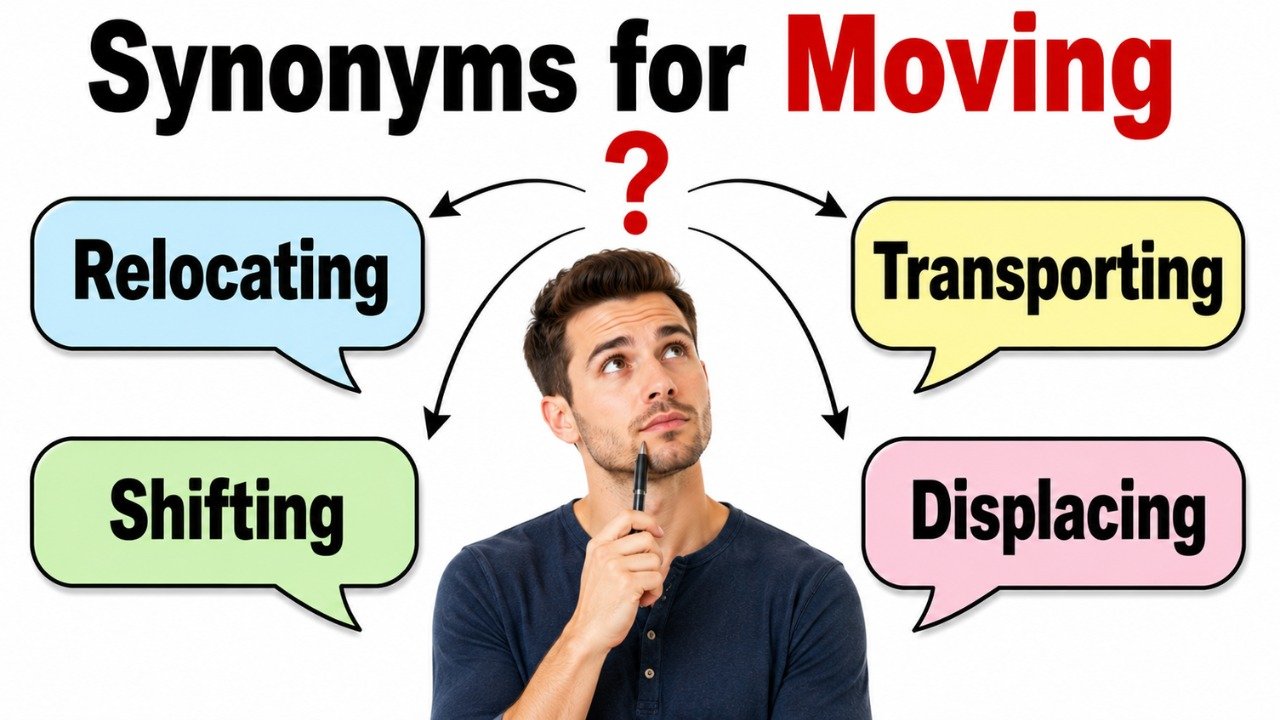
Quick Answer: Useful synonyms for moving include traveling, shifting, relocating, advancing, progressing, stirring, touching, emotional, transferring, and changing. The best choice depends on context. Traveling works for physical movement from place to place, relocating suits changing homes or locations, shifting describes a change in position, advancing and progressing suggest forward development, transferring fits formal movement between places or roles, while touching and stirring are best when moving means causing strong emotion.
Pronunciation and Word Details
Word: Moving
Pronunciation: /ˈmuːvɪŋ/
Part of Speech: Adjective, present participle, and gerund form of the verb move
Meaning: Moving describes something changing position, going from one place to another, developing forward, or causing strong emotion.
US Pronunciation:
UK Pronunciation:
What Does “Moving” Mean?
Moving means changing position, traveling from one place to another, making progress, relocating, or causing a strong emotional response.
As an adjective, moving can describe something that is physically in motion or emotionally powerful. A moving vehicle is traveling, while a moving speech is deeply touching.
Moving is also the present participle of the verb move. In this form, it can describe an ongoing action such as moving furniture, moving toward a goal, or moving to another city.
The exact meaning depends heavily on the sentence. It may refer to physical motion, relocation, emotional impact, change, progress, or transfer.
Meaning, Tone, and Context of “Moving”
Moving is a common and flexible English word with a generally neutral tone. Its emotional meaning can become warm, serious, sympathetic, or powerful depending on context.
In everyday conversation, moving often refers to relocation. Someone may say they are moving to a new apartment, neighborhood, or city.
In physical descriptions, moving means being in motion. A moving object, moving vehicle, or moving crowd is changing position.
In professional and formal writing, alternatives such as transferring, relocating, progressing, advancing, and transitioning can sometimes provide greater precision.
When moving describes an emotional experience, it usually has a positive or serious tone. A moving story, ceremony, message, or performance creates strong feelings such as sympathy, admiration, sadness, or joy.
When and How to Use “Moving”
For Physical Motion
Use moving when a person, object, vehicle, or group is changing position.
Example: The moving train disappeared into the distance.
For Relocation
Use moving when someone is changing their home, workplace, or general location.
Example: Our neighbors are moving to another town next month.
For Progress
Moving can describe forward development toward a goal or result.
Example: The project is moving in the right direction.
For Emotional Impact
Use moving when something creates strong feelings.
Example: Her farewell speech was deeply moving.
For Changing Position
Moving can describe something being shifted from one location to another.
Example: They are moving the chairs into the larger room.
For Transition
Moving can describe changing from one stage, condition, activity, or topic to another.
Example: The discussion is moving toward a practical solution.
Best Synonyms for Moving
Traveling: Going from one place to another.
Example: The traveling group reached the village before sunset.
Shifting: Changing position, direction, or focus.
Example: The workers were shifting the equipment across the room.
Relocating: Moving permanently or temporarily to a different place.
Example: The family is relocating to a quieter neighborhood.
Advancing: Moving forward physically or toward greater progress.
Example: The team is advancing toward its final objective.
Progressing: Developing or improving over time.
Example: The construction work is progressing steadily.
Transferring: Moving something or someone from one place, position, or system to another.
Example: She is transferring the documents to another department.
Transitioning: Changing gradually from one state, stage, or situation to another.
Example: The organization is transitioning to a new working process.
Touching: Creating feelings of tenderness, sympathy, or emotion.
Example: His message was simple but touching.
Stirring: Producing powerful feelings or excitement.
Example: The audience heard a stirring account of courage.
Changing: Becoming different or moving from one condition to another.
Example: The situation is changing rapidly.
50 Synonyms for Moving with Short Meanings
- Traveling: Going from one place to another.
- Shifting: Changing position or direction.
- Relocating: Changing to a new place.
- Advancing: Moving forward.
- Progressing: Developing toward a goal.
- Transferring: Moving between places or positions.
- Transitioning: Changing from one state to another.
- Changing: Becoming different.
- Traveling onward: Continuing toward another place.
- Proceeding: Continuing forward.
- Going: Traveling or changing position.
- Journeying: Traveling over a distance.
- Walking: Moving on foot.
- Running: Moving quickly on foot.
- Gliding: Moving smoothly and easily.
- Sliding: Moving smoothly across a surface.
- Drifting: Moving slowly without firm direction.
- Flowing: Moving continuously and smoothly.
- Rolling: Moving by turning over or along a surface.
- Turning: Changing direction or position.
- Circulating: Moving continuously around an area or system.
- Roaming: Moving freely from place to place.
- Wandering: Moving without a fixed destination.
- Departing: Leaving a place.
- Leaving: Going away from a location.
- Migrating: Moving from one region to another.
- Repositioning: Placing something in a different position.
- Transporting: Carrying something from one place to another.
- Conveying: Taking or carrying something elsewhere.
- Removing: Taking something away from its position.
- Displacing: Moving something from its usual position.
- Redirecting: Sending movement in a different direction.
- Approaching: Moving closer.
- Receding: Moving farther away.
- Ascending: Moving upward.
- Descending: Moving downward.
- Developing: Growing or becoming more advanced.
- Evolving: Changing gradually over time.
- Improving: Becoming better.
- Growing: Increasing or developing.
- Proceeding onward: Continuing forward.
- Touching: Causing tender emotions.
- Stirring: Producing strong emotion.
- Emotional: Creating or involving strong feelings.
- Heartfelt: Expressing deep sincere emotion.
- Poignant: Producing strong feelings, often sadness.
- Affecting: Producing a noticeable emotional response.
- Powerful: Creating a strong emotional impression.
- Inspiring: Encouraging strong positive feelings or action.
- Compelling: Holding attention through strong emotional or intellectual force.
Read Also:
Synonyms for Justified

Synonyms for Moving by Context
When Moving Means Traveling
When moving refers to physical travel, useful alternatives include traveling, going, journeying, proceeding, roaming, and wandering.
Example: The travelers were moving through the valley.
Alternative: The travelers were journeying through the valley.
Traveling is usually the broadest replacement. Journeying suggests a longer trip, while roaming and wandering imply less fixed direction.
When Moving Means Changing Position
Shifting, sliding, repositioning, turning, transferring, and displacing work when an object or person changes position.
Example: She was moving the table closer to the window.
Alternative: She was shifting the table closer to the window.
Shifting is especially natural for small changes in location or position.
When Moving Means Relocating
Relocating, transferring, migrating, leaving, and departing may replace moving when a person changes where they live or work.
Example: They are moving to another city.
Alternative: They are relocating to another city.
Relocating sounds more formal and specific than moving.
When Moving Means Making Progress
Advancing, progressing, developing, improving, proceeding, and evolving are strong choices when moving describes forward progress.
Example: We are moving toward a solution.
Alternative: We are progressing toward a solution.
Progressing emphasizes development, while advancing emphasizes forward movement.
When Moving Means Emotionally Powerful
Touching, stirring, poignant, affecting, heartfelt, inspiring, and powerful are useful alternatives.
Example: It was a moving tribute.
Alternative: It was a touching tribute.
Touching often suggests warmth or tenderness. Poignant usually combines deep emotion with sadness, memory, or reflection.
Another Word for Moving
The best single replacement for moving is often shifting when physical position is involved, relocating when changing location, and touching when strong emotion is involved. No single synonym works for every meaning, so the surrounding sentence should guide your choice.
Original: They are moving to a new house.
Better Option: They are relocating to a new house.
Original: The workers are moving the boxes.
Better Option: The workers are transferring the boxes.
Original: Her story was extremely moving.
Better Option: Her story was extremely touching.
Original: The plan is moving forward.
Better Option: The plan is progressing.
When Not to Use “Moving”
Moving can sound vague when a more precise word would show exactly what kind of movement or change is happening.
Avoid overusing moving when the action has a clear direction, purpose, or emotional quality.
Weak: The company is moving its staff.
Better: The company is transferring its staff to another office.
The better version explains the specific type of movement.
Moving may also sound less descriptive when writing about emotion.
Weak: The ceremony was moving.
Better: The ceremony was deeply touching.
Touching gives the reader a clearer sense of emotional impact.
In formal reports, moving may occasionally be too conversational.
Weak: The project is moving well.
Better: The project is progressing steadily.
Progressing is clearer because it directly describes development.
Words Commonly Confused With Moving
Moving vs Traveling: Moving is broader and can describe any change in position, while traveling usually involves going from one place to another over some distance.
Moving vs Relocating: Moving can refer to any physical movement, while relocating specifically means changing where someone or something is based.
Moving vs Shifting: Moving is general, while shifting often describes a smaller change in position, direction, opinion, or focus.
Moving vs Progressing: Moving may suggest physical or figurative motion, while progressing clearly indicates development toward a goal.
Moving vs Transitioning: Moving can happen suddenly or gradually, while transitioning usually emphasizes a gradual change between stages or conditions.
Moving vs Touching: Moving can describe emotion or physical motion, while touching specifically refers to creating tender or sympathetic feelings.
Moving vs Poignant: Moving broadly describes strong emotional impact, while poignant often involves sadness, nostalgia, sympathy, or emotional depth.
Moving vs Stirring: Moving may create quiet emotion, while stirring often suggests stronger feelings, excitement, courage, or inspiration.
Which Synonym Should You Choose?
Choose traveling when describing movement between places.
Choose shifting when something changes position, direction, focus, or balance.
Choose relocating when discussing a change of home, office, city, or permanent location.
Choose transferring for formal writing involving movement between departments, systems, positions, accounts, or locations.
Choose advancing when emphasizing forward movement or achievement.
Choose progressing when describing steady development toward a goal.
Choose transitioning when describing a gradual change between stages or conditions.
Choose touching when something produces warm, sympathetic, or tender emotion.
Choose poignant when the emotion contains sadness, reflection, or nostalgia.
Choose stirring when something creates powerful emotion, excitement, courage, or enthusiasm.
Real Life Examples of “Moving” in Sentences
Original: The car was moving slowly through traffic.
Better Option: The car was traveling slowly through traffic.
Original: We are moving to another apartment next month.
Better Option: We are relocating to another apartment next month.
Original: He was moving the desk toward the door.
Better Option: He was shifting the desk toward the door.
Original: The negotiations are moving toward an agreement.
Better Option: The negotiations are progressing toward an agreement.
Original: The crowd was moving toward the entrance.
Better Option: The crowd was advancing toward the entrance.
Original: Her speech was moving.
Better Option: Her speech was touching.
Original: It was a moving description of their final meeting.
Better Option: It was a poignant description of their final meeting.
Original: The department is moving employees between offices.
Better Option: The department is transferring employees between offices.
Original: The industry is moving toward new methods.
Better Option: The industry is transitioning toward new methods.
Original: The story was moving enough to silence the room.
Better Option: The story was affecting enough to silence the room.
Synonym Groups and Usage Differences
Physical Motion Group
Traveling, going, gliding, sliding, rolling, drifting, walking, and running all describe physical movement.
Traveling is broad, while gliding suggests smooth movement and drifting suggests movement without a strongly controlled direction.
Example: The boat was drifting slowly across the lake.
Relocation Group
Relocating, transferring, migrating, departing, and leaving describe movement from one established place to another.
Relocating is especially useful for homes and workplaces. Migrating is often used for movement between regions.
Example: Several families are relocating to the surrounding area.
Progress Group
Advancing, progressing, developing, improving, proceeding, and evolving describe forward movement in plans, projects, abilities, or situations.
Progressing focuses on continued development.
Example: The research is progressing steadily.
Emotional Impact Group
Touching, stirring, affecting, poignant, heartfelt, inspiring, and powerful describe experiences that create emotion.
Touching tends to be warm and tender, while poignant often carries sadness or reflection.
Example: The reunion produced a touching moment for everyone present.
Change Group
Changing, transitioning, evolving, shifting, and developing describe movement from one condition or state to another.
Transitioning is useful when the change happens gradually.
Example: The team is transitioning into a different working structure.
Antonyms of Moving
The opposite of moving depends on whether moving refers to physical motion, progress, relocation, or emotional impact.
Stationary: Remaining in one position.
Still: Not moving physically.
Motionless: Completely without movement.
Fixed: Firmly placed and not changing position.
Immobile: Unable or unlikely to move.
Stopped: No longer moving.
Static: Remaining unchanged or inactive.
Stagnant: Showing little or no development.
Regressing: Moving backward rather than progressing.
Remaining: Staying in the same place or condition.
Unchanging: Not becoming different.
Unaffecting: Producing little emotional response.
Unemotional: Lacking strong emotion.
Dull: Failing to create strong interest or emotional impact.
Comparison: Moving vs Related Words
Moving vs Shifting
Moving is the broader term. Shifting usually refers to a change in position, direction, balance, attention, or opinion.
Example With Moving: He is moving the chair across the room.
Example With Shifting: He is shifting the chair slightly to the left.
Moving vs Relocating
Moving may describe any kind of movement. Relocating specifically refers to changing an established location.
Example With Moving: The workers are moving the equipment.
Example With Relocating: The business is relocating its office.
Moving vs Traveling
Moving simply means changing position. Traveling usually means making a journey between locations.
Example With Moving: The vehicle is moving again.
Example With Traveling: The vehicle is traveling across the country.
Moving vs Progressing
Moving may be literal or figurative. Progressing specifically means developing or moving toward improvement or completion.
Example With Moving: The conversation is moving forward.
Example With Progressing: The negotiations are progressing steadily.
Moving vs Transitioning
Moving can describe any change, while transitioning emphasizes movement from one stage or condition to another.
Example With Moving: The discussion is moving to another topic.
Example With Transitioning: The organization is transitioning to a different structure.
Moving vs Touching
Moving has both physical and emotional meanings. Touching mainly refers to causing tender feelings.
Example With Moving: The final scene was moving.
Example With Touching: The final scene was deeply touching.
Moving vs Stirring
Both words may describe emotional impact. Moving is broad, while stirring often suggests powerful emotion, enthusiasm, courage, or excitement.
Example With Moving: The memorial speech was moving.
Example With Stirring: The leader delivered a stirring speech about courage.
Moving vs Poignant
Moving describes something emotionally powerful in general. Poignant commonly suggests deep emotion connected with sadness, memory, loss, or reflection.
Example With Moving: She shared a moving memory from childhood.
Example With Poignant: She shared a poignant memory of her final day with her grandmother.
Common Phrases and Expressions With Moving
Moving Forward: Continuing toward progress, improvement, or a future goal.
Moving On: Leaving a past situation behind and continuing with life.
Moving Away: Increasing distance from a place, idea, or position.
Moving Toward: Progressing in the direction of something.
Moving Around: Changing position repeatedly within an area.
Moving Out: Leaving a home, building, or location.
Moving In: Beginning to live or work in a new place.
Moving Up: Advancing to a better, higher, or more important position.
Moving Slowly: Progressing or traveling at a low speed.
Deeply Moving: Producing a powerful emotional response.
Common Mistakes to Avoid
One common mistake is using moving repeatedly when a more precise verb or adjective would improve clarity.
Instead of saying that an object is moving, consider whether it is sliding, rolling, drifting, traveling, advancing, or shifting.
Another mistake is confusing physical movement with relocation. Relocating is usually more precise when a person, family, office, or organization changes its established location.
Writers also sometimes use emotional synonyms incorrectly. Touching is suitable for warm or sympathetic emotion, while poignant often includes sadness or reflection. Stirring usually suggests strong inspiration, excitement, or emotional energy.
Avoid forcing formal alternatives into casual sentences. Transferring and transitioning can sound unnecessarily technical when moving is already clear.
Finally, consider the direction and purpose of the action. Advancing means forward movement, receding means moving away, ascending means moving upward, and descending means moving downward. Choosing a specific synonym makes the sentence clearer and more informative.
Conclusion
Synonyms for moving vary according to whether the word describes physical motion, relocation, progress, change, or emotional impact. Traveling and shifting work well for physical movement, while relocating and transferring are clearer for changes of place. Progressing and advancing suit development toward a goal, and transitioning describes gradual change. When moving refers to emotion, touching, stirring, affecting, and poignant provide more precise alternatives. Choosing the synonym that matches the exact context makes writing clearer, more natural, and more expressive.
FAQs About Synonyms for Moving
What is the best synonym for moving?
The best synonym depends on meaning. Shifting works for position, relocating for changing location, progressing for development, and touching for emotional impact.
What is another word for moving from one place to another?
Traveling, relocating, transferring, migrating, and journeying can all describe moving from one place to another, depending on the situation.
What is a formal synonym for moving?
Relocating, transferring, progressing, advancing, and transitioning are useful formal alternatives.
What is a synonym for emotionally moving?
Touching, stirring, poignant, affecting, heartfelt, and powerful can describe something that produces strong emotion.
What is another word for moving forward?
Advancing, progressing, proceeding, developing, and improving are common alternatives for moving forward.
Is shifting the same as moving?
They are similar, but shifting usually describes a smaller or more specific change in position, direction, focus, or balance.
Is moving a positive word?
Moving is usually neutral when describing physical motion. When it describes emotion, it often has a positive or sympathetic sense, although the emotion may involve sadness, loss, joy, or admiration.
