
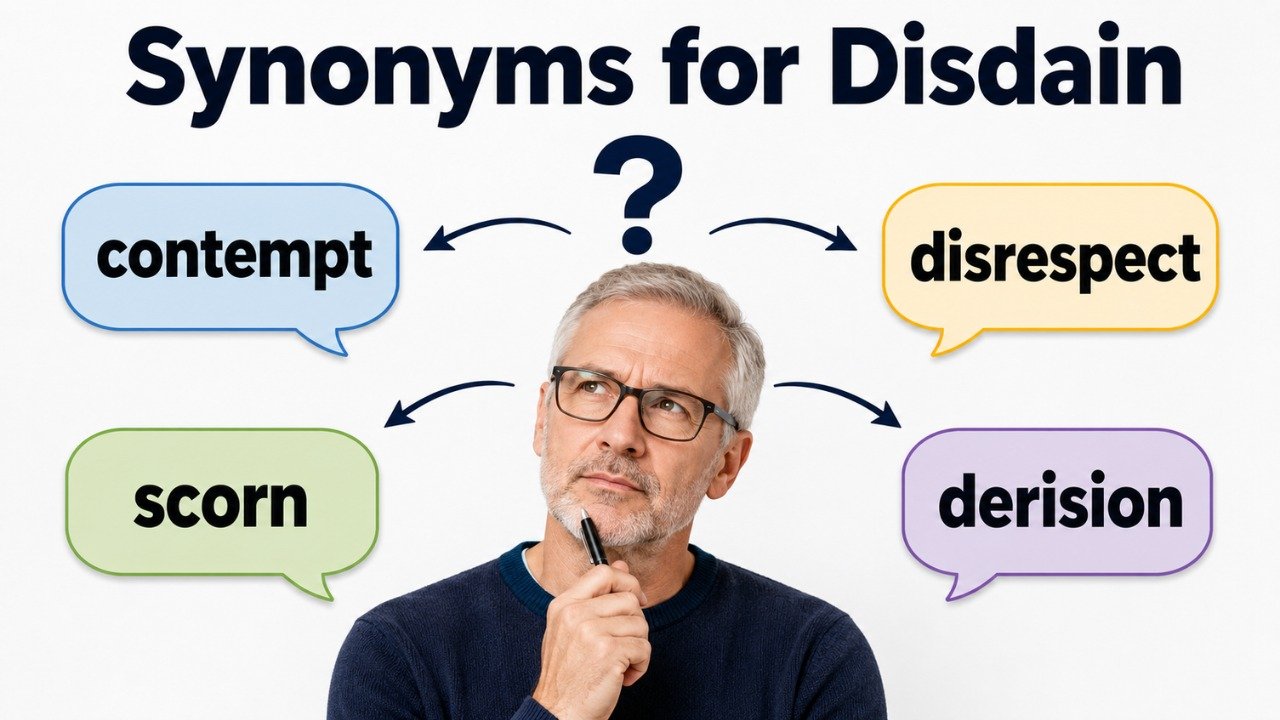
Quick Answer: Common synonyms for disdain include contempt, scorn, disrespect, derision, condescension, disgust, aversion, rejection, disparagement, and contemptuousness. Use contempt for a strong belief that someone is unworthy of respect, scorn for openly expressed contempt, derision for mocking criticism, condescension for a superior attitude, and disgust for strong emotional dislike. The best choice among synonyms for disdain depends on whether you mean disrespect, superiority, mockery, dislike, or rejection.
Pronunciation and Word Details
Word: Disdain.
Pronunciation: /dɪsˈdeɪn/
Part of Speech: Noun and verb.
Meaning: A strong feeling that someone or something is unworthy of respect, or the act of treating something as beneath consideration.
US Pronunciation:
UK Pronunciation:
What Does “Disdain” Mean?
Disdain means a strong feeling of contempt or lack of respect toward someone or something considered inferior, unworthy, foolish, or beneath consideration.
As a noun, disdain describes an attitude or emotion. Someone may speak with disdain, show disdain for dishonesty, or feel disdain toward behavior they consider shameful.
As a verb, disdain means to regard something with contempt or to refuse something because it seems unworthy. A person might disdain empty praise or disdain an offer they consider insulting.
The word often suggests more than ordinary dislike. Disdain usually contains a sense of superiority. The person feeling disdain believes the object of that feeling does not deserve respect, attention, or approval.
Meaning, Tone, and Context of “Disdain”
Disdain has a strong, negative, and often formal tone. It is more intense than simple dislike and usually carries an element of contempt or superiority.
The word appears naturally in essays, literature, criticism, news style writing, formal conversation, character descriptions, and discussions about attitudes or social behavior.
Formal Tone: Disdain works well when describing serious disrespect, contempt, or rejection in essays and analytical writing.
Emotional Tone: The word can communicate strong negative feelings, especially when someone considers another person or idea beneath respect.
Literary Tone: Writers often use disdain to reveal pride, arrogance, conflict, or emotional distance between characters.
Conversational Tone: Disdain can appear in everyday conversation, although contempt, scorn, dislike, or disgust may sometimes sound more natural.
Social Context: Disdain often describes attitudes toward people, customs, opinions, behavior, institutions, or values.
Behavioral Context: A facial expression, remark, gesture, or refusal can communicate disdain even when the feeling is not directly stated.
When and How to Use “Disdain”
For Strong Disrespect
Use disdain when someone regards another person, behavior, or idea as undeserving of respect.
Example: She spoke with disdain about people who deliberately deceived their friends.
For Feelings of Superiority
Disdain can describe an attitude in which someone believes another person or activity is beneath them.
Example: He viewed routine office work with obvious disdain.
For Moral Disapproval
Use disdain when criticism involves both disapproval and contempt.
Example: The teacher expressed disdain for students who took credit for another person’s work.
For Rejecting Something as Unworthy
As a verb, disdain can mean refusing or rejecting something because it seems beneath consideration.
Example: She disdained the offer because she considered its terms insulting.
For Character Descriptions
Disdain is useful in fiction and descriptive writing when showing pride, arrogance, hostility, or emotional distance.
Example: His expression of disdain made everyone at the table uncomfortable.
For Formal Criticism
The word can strengthen essays and reports when describing a clearly contemptuous attitude.
Example: The writer showed disdain for arguments based entirely on prejudice.
Best Synonyms for Disdain
Contempt: A strong feeling that someone or something deserves little or no respect.
Example: She felt contempt for anyone who exploited vulnerable people.
Scorn: Open and often harsh contempt for someone or something.
Example: He responded to the dishonest excuse with scorn.
Derision: Contempt expressed through mocking or ridicule.
Example: The proposal was initially greeted with derision.
Disrespect: A lack of proper respect or consideration.
Example: His remarks showed disrespect toward his colleagues.
Condescension: An attitude that treats other people as less intelligent or important.
Example: Her condescension irritated everyone in the meeting.
Disgust: A strong feeling of emotional or physical revulsion.
Example: He reacted with disgust to the cruel behavior.
Disparagement: Speech or behavior that lowers the value or reputation of someone or something.
Example: Constant disparagement damaged the team’s confidence.
Dismissiveness: An attitude suggesting that something is not worth serious attention.
Example: Her dismissiveness made the concerns seem unimportant.
Aversion: A strong feeling of dislike or unwillingness toward something.
Example: He had a deep aversion to dishonest business practices.
Rejection: Refusal to accept, approve, or consider something.
Example: Her rejection of the proposal reflected both disagreement and disdain.
50 Synonyms for Disdain with Short Meanings
- Contempt: Strong lack of respect for someone or something.
- Scorn: Open contempt toward something considered unworthy.
- Derision: Contempt expressed through ridicule or mockery.
- Disrespect: Lack of respect or proper regard.
- Condescension: A superior attitude toward other people.
- Contemptuousness: The quality of showing strong disrespect.
- Dismissiveness: Treating something as unworthy of attention.
- Disparagement: Speaking about something in a belittling way.
- Disgust: Strong dislike accompanied by revulsion.
- Aversion: Strong unwillingness or dislike.
- Antipathy: Deep and lasting dislike.
- Loathing: Extremely strong dislike or hatred.
- Detestation: Intense hatred or dislike.
- Abhorrence: Powerful moral or emotional dislike.
- Revulsion: A strong feeling of repugnance or disgust.
- Repugnance: Intense dislike caused by something offensive.
- Dislike: A general negative feeling toward someone or something.
- Hostility: An unfriendly or antagonistic attitude.
- Disapproval: A negative judgment about behavior or ideas.
- Disesteem: Lack of respect or favorable opinion.
- Disregard: Lack of attention, respect, or concern.
- Haughtiness: Proud behavior showing a sense of superiority.
- Arrogance: An exaggerated sense of personal importance.
- Superciliousness: Proud behavior that treats others as inferior.
- Snobbery: An attitude based on feeling socially or culturally superior.
- Superiority: A sense of being better than other people.
- Mockery: Ridicule directed at someone or something.
- Ridicule: Speech or behavior intended to make something appear foolish.
- Scoffing: Speaking about something with mocking disbelief or contempt.
- Sneering: Showing contempt through words, tone, or facial expression.
- Jeering: Mocking someone through rude or insulting remarks.
- Belittlement: Treatment that makes someone seem unimportant or inferior.
- Denigration: Unfair criticism that damages value or reputation.
- Deprecation: Expression of disapproval or reduced regard.
- Derogation: Treatment or language that lowers someone’s status or worth.
- Censure: Strong formal criticism or disapproval.
- Reproach: Criticism expressing disappointment or disapproval.
- Opprobrium: Severe public criticism or disgrace.
- Rejection: Refusal to accept or approve something.
- Refusal: An unwillingness to accept or consider something.
- Slight: An action or remark showing lack of respect.
- Insult: Words or behavior showing disrespect.
- Sarcasm: Cutting language that can express ridicule or contempt.
- Taunting: Deliberate mocking intended to provoke someone.
- Disparaging: Showing that someone or something has little value.
- Scornfulness: A manner that openly displays contempt.
- Contemptibility: The quality of being considered deserving of contempt.
- Rejectionism: A strong tendency to refuse or dismiss an idea or proposal.
- Disfavor: Lack of approval or favorable regard.
- Devaluation: Treatment that reduces the perceived worth or importance of something.
Read Also:
Synonyms for Word

Synonyms for Disdain by Context
When Disdain Means Contempt
Contempt is usually the closest general synonym when disdain means believing someone or something is unworthy of respect.
Useful alternatives include contempt, scorn, contemptuousness, disesteem, and scornfulness.
Example: She regarded deliberate cruelty with contempt.
When Disdain Means Open Mockery
When the feeling is expressed through laughter, insulting remarks, or mocking behavior, derision and ridicule are more precise.
Useful alternatives include derision, mockery, ridicule, scoffing, sneering, and jeering.
Example: His suggestion was met with derision by people who refused to consider it seriously.
When Disdain Means Superiority
If disdain comes from believing oneself better than others, condescension or haughtiness may communicate the idea more accurately.
Useful alternatives include condescension, arrogance, haughtiness, snobbery, superiority, and superciliousness.
Example: Her condescension made ordinary conversation feel uncomfortable.
When Disdain Means Strong Dislike
Disgust, aversion, and loathing are useful when the emotional reaction matters more than the sense of superiority.
Useful alternatives include disgust, aversion, antipathy, loathing, abhorrence, repugnance, and revulsion.
Example: He felt deep aversion toward deliberate dishonesty.
When Disdain Means Dismissal
When someone treats an idea or concern as unworthy of serious attention, dismissiveness may be more precise than disdain.
Useful alternatives include dismissiveness, disregard, rejection, refusal, and disapproval.
Example: Her dismissiveness prevented the complaint from receiving proper attention.
When Disdain Means Critical Disrespect
In formal criticism, words such as disparagement, censure, denigration, and reproach can describe different forms of negative judgment.
Example: The constant disparagement of his work eventually affected his confidence.
Another Word for Disdain
The best single replacement for disdain is usually contempt. Both words describe a strong lack of respect for someone or something considered unworthy.
However, the best alternative depends on context. Scorn emphasizes openly expressed contempt. Disgust emphasizes emotional revulsion. Condescension emphasizes superiority. Derision emphasizes mockery.
Original: She looked at the dishonest scheme with disdain.
Better Option: She looked at the dishonest scheme with contempt.
Original: He laughed at the suggestion with disdain.
Better Option: He responded to the suggestion with derision.
Original: Her disdain for inexperienced workers was obvious.
Better Option: Her condescension toward inexperienced workers was obvious.
Original: He reacted with disdain to the cruel act.
Better Option: He reacted with disgust to the cruel act.
When Not to Use “Disdain”
Disdain is powerful, but it is not the best word for every negative reaction.
Do not use it when you simply mean mild dislike. Disdain implies stronger disrespect or a belief that something is beneath consideration.
Weak: I have disdain for slightly sweet coffee.
Better: I dislike slightly sweet coffee.
Avoid disdain when disgust is the central emotion.
Weak: She felt disdain when she smelled the spoiled food.
Better: She felt disgust when she smelled the spoiled food.
Do not use disdain when criticism is formal but does not involve contempt.
Weak: The committee expressed disdain about several errors in the report.
Better: The committee expressed concern about several errors in the report.
Avoid repeating disdain when a more precise word can reveal the exact attitude.
Weak: He showed disdain for the plan, disdain for its supporters, and disdain for the discussion.
Better: He rejected the plan, mocked its supporters, and dismissed the discussion with scorn.
Words Commonly Confused With Disdain
Disdain vs Contempt: Disdain and contempt both describe strong lack of respect. Disdain often suggests proud rejection or superiority, while contempt more directly means believing someone or something is worthless or deserving little respect.
Disdain vs Scorn: Disdain can be a private feeling, while scorn often suggests contempt that is openly expressed through words, facial expressions, or behavior.
Disdain vs Disgust: Disdain focuses on lack of respect or superiority. Disgust focuses on revulsion or strong emotional rejection.
Disdain vs Disrespect: Disrespect is broader and can describe any failure to show proper respect. Disdain is stronger and usually includes contempt.
Disdain vs Derision: Derision means contempt expressed through mockery or ridicule. Disdain does not necessarily involve laughing at or mocking someone.
Disdain vs Condescension: Condescension involves treating someone as inferior while appearing superior. Disdain is the contemptuous feeling itself and does not always involve patronizing behavior.
Disdain vs Aversion: Aversion means strong dislike or avoidance. Disdain specifically involves lack of respect or contempt.
Which Synonym Should You Choose?
Choose contempt when you need the closest general replacement for a strong lack of respect.
Choose scorn when contempt is openly expressed through words, expressions, or actions.
Choose derision when someone responds with mocking laughter or ridicule.
Choose disrespect when the meaning is simply a lack of proper respect.
Choose condescension when someone behaves as though another person is less intelligent, capable, or important.
Choose disgust when the reaction involves strong emotional revulsion.
Choose aversion when someone strongly dislikes or avoids a person, activity, or idea.
Choose dismissiveness when someone refuses to treat a concern or idea seriously.
Choose disparagement in formal writing when criticism lowers the reputation or perceived value of someone or something.
Choose censure in reports, essays, or formal contexts when referring to strong official criticism.
Real Life Examples of “Disdain” in Sentences
Original: She spoke with disdain about the dishonest practice.
Better Option: She spoke with contempt about the dishonest practice.
Original: He looked at the suggestion with disdain.
Better Option: He looked at the suggestion with scorn.
Original: The audience reacted to the ridiculous claim with disdain.
Better Option: The audience reacted to the ridiculous claim with derision.
Original: Her disdain for new employees was obvious.
Better Option: Her condescension toward new employees was obvious.
Original: He showed disdain for anyone who questioned his judgment.
Better Option: He showed disrespect toward anyone who questioned his judgment.
Original: She responded with disdain to the cruel behavior.
Better Option: She responded with disgust to the cruel behavior.
Original: The manager treated the complaint with disdain.
Better Option: The manager treated the complaint with dismissiveness.
Original: His disdain for dishonest advertising shaped his decision.
Better Option: His aversion to dishonest advertising shaped his decision.
Original: The critic wrote about the performance with disdain.
Better Option: The critic wrote about the performance with scorn.
Original: They disdained the proposal without examining its details.
Better Option: They dismissed the proposal without examining its details.
Synonym Groups and Usage Differences
Contempt Group
This group describes a belief that someone or something deserves little respect.
Useful words include contempt, scorn, disdain, disesteem, and contemptuousness.
Example: His contempt for dishonest conduct was clear from his response.
Mockery Group
These words show contempt through teasing, ridicule, laughter, or insulting remarks.
Useful words include derision, mockery, ridicule, scoffing, sneering, and jeering.
Example: The speaker ignored the jeering and continued calmly.
Superiority Group
These words describe attitudes based on believing oneself better, smarter, more important, or more refined than others.
Useful words include condescension, arrogance, haughtiness, snobbery, and superciliousness.
Example: Her haughtiness made cooperation difficult.
Strong Dislike Group
These alternatives emphasize emotional rejection rather than superiority.
Useful words include disgust, aversion, antipathy, loathing, abhorrence, and revulsion.
Example: He expressed abhorrence at the deliberate cruelty.
Critical Disapproval Group
These words are useful when the context involves criticism, negative judgment, or damage to someone’s reputation.
Useful words include censure, reproach, disparagement, denigration, and deprecation.
Example: The official faced widespread censure for the decision.
Dismissal Group
These words describe refusing to value, accept, or seriously consider something.
Useful alternatives include dismissiveness, disregard, rejection, refusal, and disfavor.
Example: Her dismissiveness prevented a serious discussion of the problem.
Antonyms of Disdain
The opposite of disdain usually involves respect, admiration, approval, or appreciation. The best antonym depends on whether disdain describes an emotion, attitude, or action.
Respect: Recognition of someone’s value, rights, or qualities.
Admiration: Warm approval of someone’s abilities or character.
Esteem: High respect and favorable regard.
Regard: Respectful attention or consideration.
Appreciation: Recognition of value, quality, or importance.
Approval: A favorable opinion or acceptance.
Praise: Positive expression of admiration or approval.
Honor: Deep respect shown toward someone.
Reverence: Profound respect or admiration.
Acceptance: Willingness to receive or consider something favorably.
Affection: Warm feelings of fondness or care.
Approval: Positive judgment toward an action, person, or idea.
Comparison: Disdain vs Related Words
Disdain vs Contempt
Disdain and contempt are very close in meaning. Contempt emphasizes the belief that someone or something is unworthy of respect. Disdain often adds a feeling of superiority or proud rejection.
Example With Disdain: She regarded the shallow argument with disdain.
Example With Contempt: She regarded deliberate dishonesty with contempt.
Disdain vs Scorn
Scorn is often more visible than disdain. Someone can privately feel disdain, while scorn frequently appears through remarks, gestures, expressions, or laughter.
Example With Disdain: He silently regarded the boastful behavior with disdain.
Example With Scorn: He laughed with scorn at the boastful claim.
Disdain vs Disgust
Disdain is mainly about contempt and lack of respect. Disgust involves a powerful feeling of revulsion.
Example With Disdain: She felt disdain for his arrogant attitude.
Example With Disgust: She felt disgust at his cruel treatment of the animal.
Disdain vs Disrespect
Disrespect is a broader concept. Someone can behave disrespectfully without actually feeling contempt. Disdain represents a stronger internal judgment.
Example With Disdain: His disdain for the committee was obvious.
Example With Disrespect: His rude interruption showed disrespect for the committee.
Disdain vs Derision
Derision is contempt communicated through ridicule. Disdain does not require any mocking behavior.
Example With Disdain: She ignored the proposal with disdain.
Example With Derision: She greeted the proposal with mocking derision.
Disdain vs Condescension
Disdain is a feeling of contempt. Condescension is a manner of behaving toward people as though they are less capable or important.
Example With Disdain: He felt disdain toward anyone he considered careless.
Example With Condescension: He explained the simple task with unnecessary condescension.
Common Phrases and Expressions With Disdain
With Disdain: In a manner showing contempt or lack of respect.
Example: She looked at the dishonest proposal with disdain.
Treat With Disdain: To behave as though someone or something deserves no respect.
Example: Serious concerns should never be treated with disdain.
Look With Disdain: To give someone a facial expression showing contempt.
Example: He looked with disdain at the poorly prepared argument.
Show Disdain: To make a contemptuous attitude visible.
Example: She made no effort to hide her disdain.
Express Disdain: To communicate strong contempt through words or behavior.
Example: The critic openly expressed disdain for careless writing.
Open Disdain: Contempt that is clearly and publicly displayed.
Example: His open disdain damaged the working relationship.
Deep Disdain: A powerful and lasting feeling of contempt.
Example: She developed a deep disdain for deliberate dishonesty.
Utter Disdain: Complete and unmistakable contempt.
Example: He rejected the accusation with utter disdain.
Disdain for Authority: Contempt or lack of respect toward people or institutions with power.
Example: The character’s disdain for authority created constant conflict.
Disdain for Convention: Contempt for accepted customs, traditions, or expectations.
Example: Her disdain for convention influenced her unconventional approach to art.
Common Mistakes to Avoid
One common mistake is using disdain as a simple synonym for dislike. Disdain is normally stronger because it suggests contempt, disrespect, or superiority.
Another mistake is choosing a synonym based only on intensity. Disgust may be strong, but it emphasizes revulsion rather than lack of respect. Derision emphasizes mockery, while condescension emphasizes superiority.
Writers should also distinguish the noun and verb forms. You can feel disdain for something, show disdain toward something, or disdain something you regard as unworthy.
Avoid repeating disdain several times in one paragraph. Use a more precise alternative when the context changes.
Do not automatically replace disdain with hatred. Hatred expresses extreme hostility or dislike, while disdain centers more strongly on contempt and low regard.
Be careful with contempt and scorn as well. They are close synonyms, but scorn often sounds more openly expressive.
Conclusion
Synonyms for disdain include contempt, scorn, derision, disrespect, condescension, disgust, aversion, dismissiveness, and disparagement. Contempt is usually the closest general replacement, while scorn works well for openly expressed contempt and derision is best for mocking criticism. Use condescension when superiority is central, disgust for revulsion, and dismissiveness for concerns that are treated as unimportant. Choosing the most precise alternative makes descriptions of negative attitudes clearer, stronger, and more natural.
FAQs About Synonyms for Disdain
What Is the Best Synonym for Disdain?
Contempt is usually the best general synonym for disdain because both describe a strong lack of respect for someone or something considered unworthy.
Is Scorn a Synonym for Disdain?
Yes. Scorn is a strong synonym for disdain, especially when contempt is openly expressed through words, facial expressions, laughter, or behavior.
Is Disgust the Same as Disdain?
No. Disgust emphasizes revulsion, while disdain emphasizes contempt and the belief that someone or something is beneath respect.
What Is a Formal Synonym for Disdain?
Contempt is suitable for most formal writing. Disparagement, censure, disesteem, and derision can also work depending on the intended meaning.
What Is a Stronger Word Than Disdain?
Loathing, abhorrence, and detestation can sound more emotionally intense, but they emphasize strong hatred or dislike rather than exactly the same sense of contempt.
What Is the Opposite of Disdain?
Respect is the most direct general opposite. Admiration, esteem, appreciation, approval, and reverence can also function as antonyms depending on context.
Can Disdain Be Used as a Verb?
Yes. As a verb, disdain means to regard someone or something as unworthy or to reject something because it seems beneath consideration. For example, she disdained praise that she considered insincere.
