
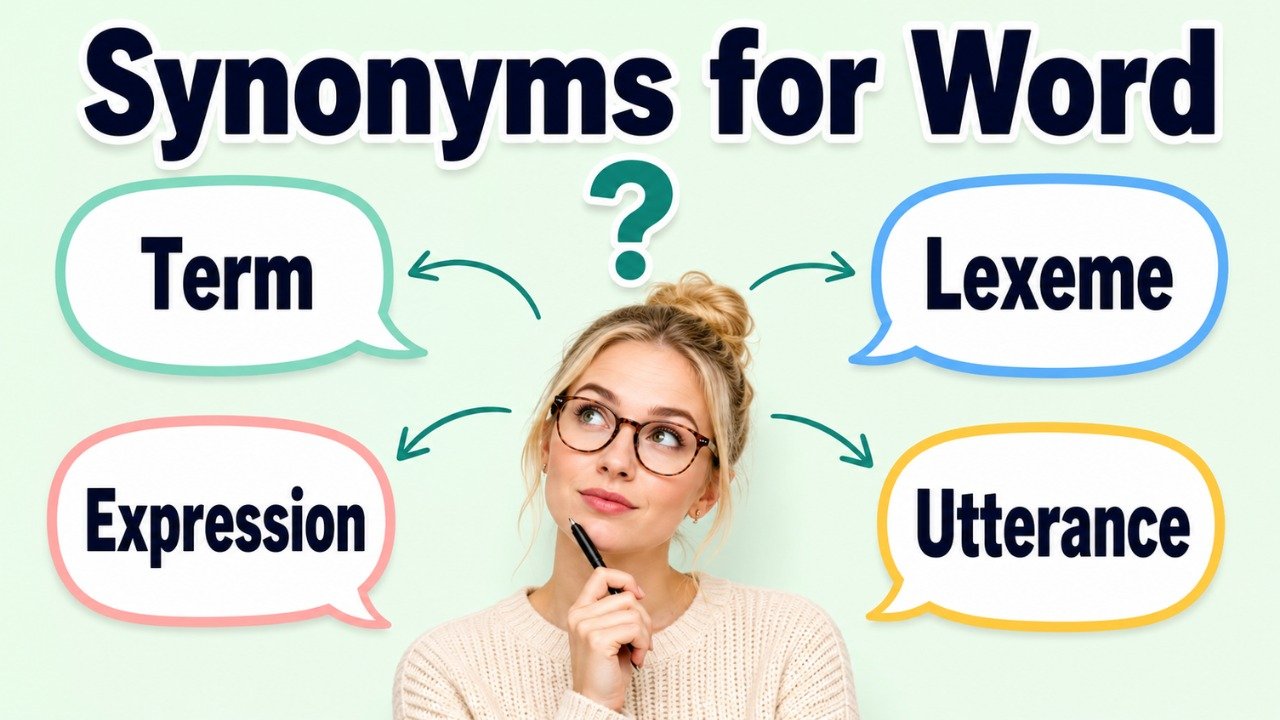
Quick Answer: Common synonyms for word include term, expression, phrase, remark, statement, message, wording, name, promise, and information. Among the best synonyms for word, use term when referring to a particular vocabulary item, expression for an idea communicated through language, phrase for a group of words, remark for a brief spoken comment, statement for a clear declaration, message for communicated information, and promise when word refers to a commitment. The best choice depends on whether you mean language, speech, communication, information, or a promise.
Pronunciation and Word Details
Word: Word.
Pronunciation: /wɜːrd/
Part of Speech: Noun, also used as a verb.
Meaning: A unit of language that carries meaning, or something spoken, written, communicated, or promised.
US Pronunciation:
UK Pronunciation:
What Does “Word” Mean?
Word means a meaningful unit of spoken or written language. As a noun, it can refer to one individual vocabulary item, something someone says, a message, information, a promise, or a particular way of expressing an idea.
The meaning changes according to the sentence.
In “This is a difficult word,” word means a vocabulary item.
In “She said a few words,” it refers to spoken remarks.
In “I received word about the decision,” it means information or news.
In “He gave me his word,” it means a promise or assurance.
Word can also function as a verb. To word something means to express an idea using particular language. For example, someone may carefully word a formal request so that the meaning is clear and polite.
Meaning, Tone, and Context of “Word”
Word is a common and generally neutral English term. It appears naturally in casual conversation, academic writing, education, literature, professional communication, grammar discussions, and everyday speech.
When word refers to a vocabulary unit, its tone is neutral and suitable for almost any context.
When it refers to something spoken, alternatives such as remark, comment, statement, or utterance may provide greater precision.
When word means information, terms such as message, news, notice, or report may be clearer.
When someone gives their word, the meaning becomes more personal and serious because word represents a promise, commitment, or assurance.
In formal writing, replacing word with a more specific synonym often makes the sentence clearer. Term, expression, statement, wording, and designation can all provide greater precision when the context requires it.
When and How to Use “Word”
For Vocabulary: Use word when referring to an individual unit of language that carries meaning.
Example: The word “calm” can describe a peaceful state.
For Speech: Use word when referring generally to something someone says.
Example: She did not say a word during the meeting.
For a Brief Conversation: Word can describe a short private discussion.
Example: Could I have a word with you after class?
For Information: Word can mean news or information received from another person.
Example: We finally received word that the application had been approved.
For a Promise: Word can represent a personal commitment or assurance.
Example: He gave his word that he would return the book.
For Wording: Word can refer to the particular language chosen to express an idea.
Example: She carefully selected each word in her statement.
For Naming Something: Word may refer to the term or name used for a particular idea or object.
Example: What is the word for this type of fabric?
Best Synonyms for Word
Term: A particular word or expression used to describe something.
Example: “Photosynthesis” is a scientific term.
Expression: A word or group of words used to communicate an idea.
Example: That expression is common in informal conversation.
Phrase: A short group of words functioning together.
Example: She replaced the repeated word with a clearer phrase.
Remark: A brief spoken or written comment.
Example: His opening remark made everyone feel comfortable.
Statement: A clear expression of information, belief, or opinion.
Example: The witness gave a detailed statement.
Message: Information communicated from one person to another.
Example: I received your message this morning.
Wording: The particular words chosen to express something.
Example: The wording of the invitation sounded warm and welcoming.
Name: A word used to identify a person, place, object, or idea.
Example: There is a special name for this technique.
Promise: A commitment that someone will do something.
Example: She kept her promise to help with the project.
Information: Facts or details communicated to someone.
Example: We are waiting for more information about the schedule.
50 Synonyms for Word with Short Meanings
- Term: A word used for a particular idea or subject.
- Expression: Language used to communicate an idea or feeling.
- Phrase: A short group of words used together.
- Utterance: Something spoken aloud.
- Remark: A short spoken or written comment.
- Statement: A clear expression of information or opinion.
- Comment: Something said or written about a subject.
- Saying: A familiar expression or group of words.
- Name: A word used to identify someone or something.
- Designation: A formal name or descriptive title.
- Label: A word or description attached to something.
- Title: A name given to a work, position, or subject.
- Lexeme: A basic vocabulary unit considered by meaning.
- Vocable: A spoken or written word considered as a linguistic unit.
- Wording: The particular language chosen to express an idea.
- Language: Words and expressions used for communication.
- Diction: The choice and use of words in speaking or writing.
- Formulation: A particular way of expressing an idea.
- Description: Words used to explain what something is like.
- Definition: Words explaining the meaning of something.
- Message: Information communicated to another person.
- Communication: Information or ideas shared with others.
- Notice: Information given to make someone aware of something.
- Note: A short written message or comment.
- Information: Facts or details communicated to someone.
- News: Newly received information.
- Report: An account that provides information about something.
- Account: A spoken or written description of an event.
- Announcement: A public or formal statement of information.
- Advice: Words intended to guide or recommend an action.
- Instruction: Words explaining what someone should do.
- Command: An authoritative direction expressed in words.
- Order: A direction telling someone to do something.
- Request: Words used to ask for something.
- Reply: Words given in response to someone.
- Answer: A response to a question or problem.
- Response: Something said or written in reaction to something.
- Promise: A commitment expressed to another person.
- Assurance: A confident promise or statement intended to remove doubt.
- Pledge: A serious or formal promise.
- Guarantee: A strong assurance that something will happen.
- Declaration: A clear and often formal statement.
- Pronouncement: A formal or authoritative statement.
- Assertion: A confident statement that something is true.
- Conversation: An exchange of spoken words between people.
- Talk: Spoken communication or discussion.
- Discussion: An exchange of ideas through conversation.
- Speech: Spoken language addressed to others.
- Mention: A brief reference to someone or something.
- Reference: Words that direct attention to a person, thing, or idea.
Read Also:
Synonyms for Lively
Synonyms for Word by Context
When Word Means a Vocabulary Item
When word refers to an individual element of language, the most useful alternatives include term, expression, lexeme, vocable, name, and designation.
Term: Best when a word belongs to a specific subject or field.
Example: “Variable” is an important mathematical term.
Expression: Useful when language communicates a particular idea.
Example: That expression has several meanings.
Lexeme: Useful in technical linguistic discussion.
Example: A lexeme can appear in several grammatical forms.
Name: Best when the word identifies something.
Example: Is there a name for this type of pattern?
When Word Means Something Said
Word can refer generally to speech or a particular spoken comment. More precise alternatives include remark, comment, utterance, statement, response, and declaration.
Remark: Best for a brief comment.
Example: Her remark changed the direction of the conversation.
Utterance: Best when focusing on something that was spoken.
Example: His final utterance was difficult to hear.
Statement: Best for a clear expression of facts or beliefs.
Example: The speaker issued a clear statement.
Comment: Best for a reaction, observation, or opinion.
Example: His comment was thoughtful and relevant.
When Word Means a Message or Information
When word means information that has been communicated, useful synonyms include message, information, news, notice, report, and announcement.
Message: Best for information sent directly to someone.
Example: She left a message about the appointment.
Information: Best for facts or details.
Example: We need more information before making a decision.
News: Best for recently received information.
Example: They shared the good news with their family.
Notice: Best for information provided as an alert or formal communication.
Example: Residents received notice of the change.
When Word Means a Promise
When someone gives their word, word means a promise or personal commitment. Suitable alternatives include promise, assurance, pledge, and guarantee.
Promise: The most natural general substitute.
Example: He made a promise to return before sunset.
Assurance: Best when the speaker wants to create confidence.
Example: She gave us her assurance that the work would be completed.
Pledge: Best for a serious or formal commitment.
Example: The volunteers made a pledge to support the project.
Guarantee: Best when expressing strong certainty.
Example: No one can give a guarantee that the plan will succeed.
When Word Means Particular Language
When discussing how an idea is expressed, useful alternatives include wording, diction, formulation, and expression.
Wording: Best for the exact language used in a sentence or document.
Example: The wording of the question was unclear.
Diction: Best for discussing a writer’s or speaker’s choice of vocabulary.
Example: The author’s diction creates a formal tone.
Formulation: Best for a carefully constructed way of expressing an idea.
Example: This formulation makes the argument easier to understand.
Another Word for Word
The best general replacement for word is often term when you mean a single vocabulary item. However, no one synonym works in every sentence because word can also mean a statement, expression, message, promise, or piece of information.
Original: This word is frequently used in academic writing.
Better Option: This term is frequently used in academic writing.
Original: He said a kind word about my work.
Better Option: He made a kind remark about my work.
Original: We received word about the final decision.
Better Option: We received information about the final decision.
Original: She gave me her word that she would attend.
Better Option: She gave me her promise that she would attend.
When Not to Use “Word”
Word is useful because it is broad, but that broad meaning can also make writing vague. Avoid it when a more precise noun would help the reader understand exactly what you mean.
Do not use word when you actually mean an entire phrase, sentence, message, statement, or promise.
Weak: The teacher explained the word “in spite of.”
Better: The teacher explained the phrase “in spite of.”
“In spite of” contains several words, so phrase is more accurate.
Avoid repeatedly using word when discussing vocabulary in formal or academic writing.
Weak: This word is a technical word used in biology.
Better: This term is technical vocabulary used in biology.
Use statement when you mean a complete declaration rather than one vocabulary item.
Weak: The manager released a word about the change.
Better: The manager released a statement about the change.
Use wording when referring to the exact language of a sentence or document.
Weak: I do not like the word of this sentence.
Better: I do not like the wording of this sentence.
Use message when referring to information communicated directly.
Weak: She sent me a word about tomorrow’s meeting.
Better: She sent me a message about tomorrow’s meeting.
Words Commonly Confused With Word
Word vs Term: A word is any meaningful unit of language. A term is usually a word or expression associated with a particular meaning, subject, profession, or field. Every term may function as a word or phrase, but not every word is a specialized term.
Word vs Phrase: A word is normally one vocabulary unit, while a phrase contains two or more words that function together.
Word vs Expression: An expression may consist of one word or several words used to communicate a particular meaning or feeling. Word is more basic and general.
Word vs Wording: Word refers to an individual unit of language. Wording refers to the particular choice and arrangement of words used to express something.
Word vs Vocabulary: A word is one individual item. Vocabulary refers to the collection of words known, used, or associated with a language, person, subject, or field.
Word vs Statement: A word is an individual linguistic unit, while a statement usually communicates a complete idea, fact, belief, or position.
Word vs Message: A word can be part of a message. A message is the information or idea communicated as a whole.
Which Synonym Should You Choose?
Choose term when referring to a particular vocabulary item, especially in educational, professional, scientific, or technical writing.
Choose expression when discussing language that communicates an idea, feeling, or cultural meaning.
Choose phrase when the language contains more than one word functioning together.
Choose remark for a brief spoken comment in everyday conversation or narrative writing.
Choose statement for a clear declaration, opinion, explanation, or official position.
Choose message when referring to information communicated directly from one person to another.
Choose wording when discussing the exact language used in a sentence, question, notice, document, or request.
Choose information when word means facts or details that have been communicated.
Choose promise when word refers to a personal commitment.
Choose assurance when you want to emphasize confidence and trust.
Choose designation when referring to a formal name, classification, or identifying term.
Choose diction when analyzing vocabulary choices in essays, speeches, or literary writing.
Real Life Examples of “Word” in Sentences
Original: I do not understand this word.
Better Option: I do not understand this term.
Original: She said a few encouraging words before the interview.
Better Option: She made a few encouraging remarks before the interview.
Original: We received word that the event would continue.
Better Option: We received information that the event would continue.
Original: His final word on the matter was clear.
Better Option: His final statement on the matter was clear.
Original: What is the word for this type of material?
Better Option: What is the term for this type of material?
Original: She sent word that she would arrive late.
Better Option: She sent a message that she would arrive late.
Original: He gave his word that the work would be finished.
Better Option: He gave his promise that the work would be finished.
Original: I would change one word in the invitation.
Better Option: I would change part of the wording in the invitation.
Original: His words surprised everyone in the room.
Better Option: His remarks surprised everyone in the room.
Original: The word used in the report sounded too informal.
Better Option: The expression used in the report sounded too informal.
Synonym Groups and Usage Differences
Vocabulary Group
Term, expression, lexeme, vocable, name, designation, and label belong to the vocabulary group.
Use these alternatives when discussing individual language units, naming, terminology, or linguistic meaning.
Example: “Habitat” is an important scientific term.
Term is usually the strongest general alternative when word refers to vocabulary.
Spoken Language Group
Remark, comment, utterance, statement, declaration, and assertion describe things that are said or expressed.
Remark and comment are usually shorter and more conversational. Statement is clearer and more formal. Declaration is often stronger and more deliberate.
Example: Her opening remark immediately attracted attention.
Communication Group
Message, communication, notice, note, announcement, and response relate to the exchange of information.
Message works well for information sent directly. Notice often communicates an important update. Announcement usually presents information to a wider group.
Example: We received a message explaining the change.
Information Group
Information, news, report, account, and notice can replace word when it means communicated facts or updates.
News usually refers to new information. Report suggests a more detailed account. Information is the broadest neutral alternative.
Example: We are still waiting for information about the results.
Promise Group
Promise, assurance, pledge, and guarantee relate to word when it means a commitment.
Promise is the most common general choice. Assurance emphasizes confidence. Pledge sounds more serious or formal. Guarantee expresses stronger certainty.
Example: She gave her assurance that the documents were accurate.
Language Choice Group
Wording, diction, formulation, and expression describe how language is selected or arranged.
Wording focuses on the exact words used. Diction focuses on vocabulary choice and style. Formulation emphasizes how an idea has been constructed.
Example: The wording of the final paragraph is clearer now.
Antonyms of Word
Word does not have one universal antonym because it has several meanings. Its opposite changes according to context.
Silence: The absence of spoken words or sound.
Action: Something done rather than merely said.
Deed: An action, especially when contrasted with spoken promises.
Omission: Something deliberately or accidentally left unsaid.
Secrecy: The withholding of information.
Denial: A statement rejecting or contradicting a claim.
Retraction: The withdrawal of something previously stated.
Misinformation: Incorrect information, in contrast with reliable word or information.
Betrayal: Failure to honor a promise or commitment.
Quiet: A state with little or no speech or sound.
When word means speech, silence is the clearest opposite. When word means a promise, betrayal or broken commitment may express the opposite idea. When word means information, secrecy or omission can provide the contrasting meaning.
Comparison: Word vs Related Words
Word vs Term
Word is the general name for a meaningful unit of language. Term is more specific and often refers to vocabulary associated with a particular subject or clearly defined concept.
Example With Word: This word appears several times in the paragraph.
Example With Term: This medical term has a very specific meaning.
Word vs Phrase
A word is generally one linguistic unit. A phrase is a group of words that work together but may not form a complete sentence.
Example With Word: “Beautiful” is a descriptive word.
Example With Phrase: “Very beautiful” is a simple phrase.
Word vs Expression
Word usually refers to one unit of language. Expression refers to language used to communicate a particular meaning and may consist of one word or several words.
Example With Word: She learned a new word today.
Example With Expression: She learned an informal expression today.
Word vs Wording
Word refers to an individual language unit. Wording describes the specific selection and arrangement of words in a sentence or text.
Example With Word: Replace the last word in the sentence.
Example With Wording: The wording of the sentence needs improvement.
Word vs Message
A word can be a small part of communication. A message represents the information being communicated as a whole.
Example With Word: I could not read the final word.
Example With Message: I understood the message clearly.
Word vs Statement
A word is a vocabulary unit. A statement is usually a complete expression of a fact, opinion, position, or belief.
Example With Word: That word sounds too informal.
Example With Statement: Her statement clearly explained the decision.
Word vs Promise
Word can mean a promise only in specific expressions involving trust or commitment. Promise directly names the commitment.
Example With Word: He gave me his word that he would help.
Example With Promise: He made a promise that he would help.
Common Phrases and Expressions With Word
Give Your Word: Make a sincere promise.
Keep Your Word: Do what you promised to do.
Take My Word for It: Believe what I am telling you.
Have a Word: Speak briefly and often privately with someone.
Spread the Word: Share information with other people.
Put in a Good Word: Say something positive about someone to help them.
Word for Word: Using exactly the same words as the original.
In Other Words: Used to explain something in a different or clearer way.
In a Word: Used to summarize something very briefly.
Word of Mouth: Information passed directly from person to person through conversation.
Common Mistakes to Avoid
One common mistake is treating word and phrase as interchangeable. If an expression contains several separate words, phrase may be the more accurate term.
Another mistake is using word when statement, message, or remark would communicate the intended meaning more clearly.
Avoid excessive repetition. Writing word repeatedly in the same paragraph can make the language sound basic or vague. Use precise alternatives where appropriate.
Do not assume every synonym works in every context. Term can replace word when discussing vocabulary, but it usually cannot replace word when someone gives their word as a promise.
Similarly, message works when word means communicated information, but it is not a replacement when discussing one vocabulary item.
Do not confuse word with wording. Word identifies an individual unit of language, while wording refers to the language chosen for an entire phrase, sentence, question, or passage.
Avoid overly technical vocabulary unless the context requires it. Lexeme and vocable are useful in linguistic discussion, but term or word will usually sound more natural in ordinary writing.
Always choose the synonym according to the intended meaning rather than simply replacing one word with another.
Conclusion
The best synonyms for word depend on what word means in the sentence. Term is usually the strongest choice for vocabulary, while expression and phrase work well for language units and ideas. Remark, comment, and statement suit spoken or written communication. Message and information are better when word means news or communication, while promise and assurance fit commitments. Understanding these differences helps you choose synonyms for word that make your writing clearer, more natural, and more precise.
FAQs About Synonyms for Word
What Is the Best Synonym for Word?
The best general synonym is term when word refers to a vocabulary item. In other contexts, expression, remark, statement, message, wording, or promise may be more accurate.
What Is Another Word for Word in Writing?
Term, expression, wording, phrase, and diction can all work in writing. The correct choice depends on whether you mean a vocabulary item, language choice, or a group of words.
Is Term a Synonym for Word?
Yes. Term is one of the closest synonyms when word refers to a vocabulary item with a particular meaning, especially in academic, professional, or technical contexts.
Are Word and Phrase the Same?
No. A word is normally one vocabulary unit, while a phrase consists of two or more words functioning together.
What Is a Formal Synonym for Word?
Term, designation, statement, expression, formulation, and declaration can be more formal alternatives depending on the intended meaning.
What Is a Synonym for Word When It Means Promise?
Promise is the most direct alternative. Assurance, pledge, and guarantee may also work depending on how strong or formal the commitment is.
What Is a Synonym for Word When It Means Information?
Information, message, news, notice, report, and communication are useful alternatives when word refers to something that has been communicated.
