
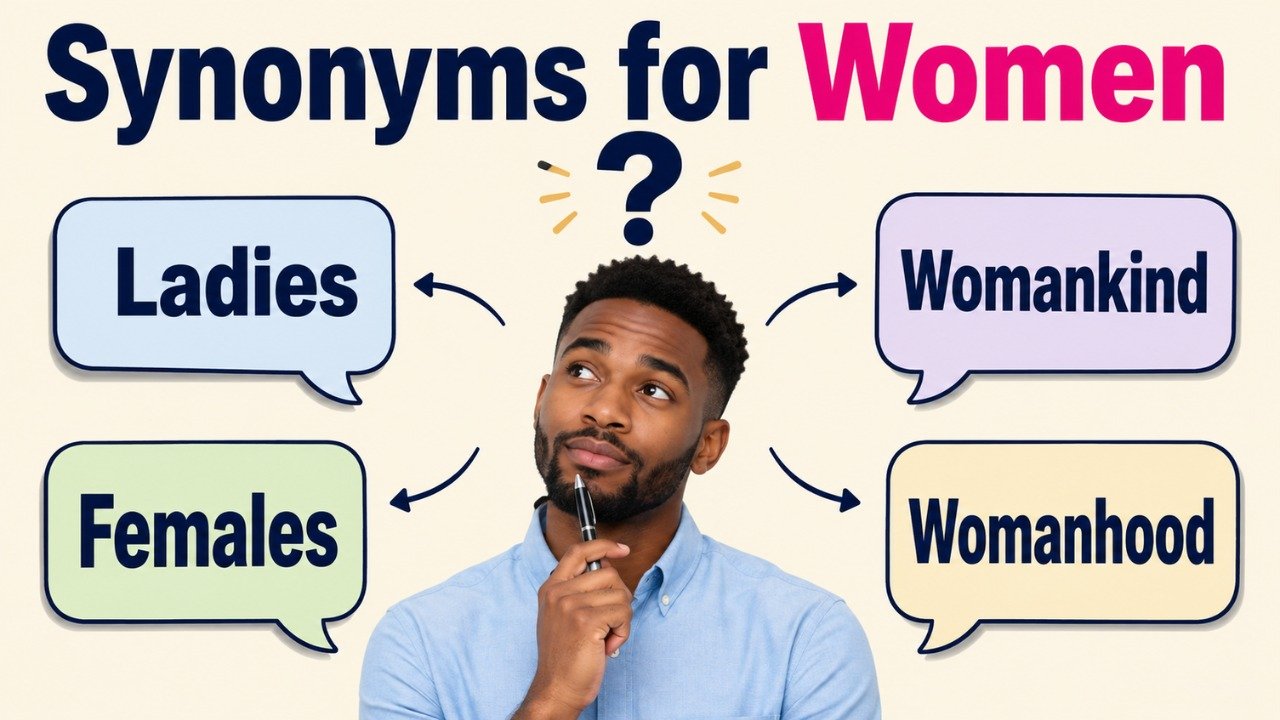
Quick Answer: The best synonyms for women include ladies, adult females, female adults, womenfolk, womankind, female population, female community, female professionals, female citizens, and female participants. The best choice depends on context. Ladies works well in polite or social language, while adult females is more precise in scientific or demographic writing. Womenfolk can suit informal or traditional contexts, and female population is useful when discussing statistics or demographics. In most everyday and professional writing, women remains the clearest and most respectful general term.
Pronunciation and Word Details
Word: Women
Pronunciation: /ˈwɪmɪn/
Part of Speech: Plural noun
Meaning: Adult female human beings considered individually or as a group.
US Pronunciation:
UK Pronunciation:
What Does “Women” Mean?
Women means adult female human beings. It is the plural form of woman and is commonly used when referring to more than one adult female person.
The word functions mainly as a plural noun. It can describe people generally, identify a demographic group, or refer to people in a particular profession, community, age group, or situation.
General use: Women gathered for the community meeting.
Professional use: Women are increasingly represented in senior leadership roles.
Demographic use: The survey included women from several age groups.
Historical use: Women played important roles in the development of the movement.
Women is usually the most natural word when gender is relevant to the meaning of a sentence. More specific alternatives may be better when age, profession, relationship, social setting, or statistical classification matters.
Meaning, Tone, and Context of “Women”
Women is generally a neutral, respectful, and widely accepted term. Its tone depends mainly on the sentence in which it appears.
Neutral tone: Women is suitable for most everyday descriptions.
Formal tone: It is appropriate in reports, essays, academic discussions, and professional communication.
Conversational tone: It sounds natural in ordinary speech when gender is relevant.
Demographic context: Terms such as female adults or female population may be more precise when discussing statistics.
Social context: Ladies may sound more polite or traditional in certain settings, although it should not automatically replace women.
Historical context: Womenfolk, womankind, and similar terms may appear in traditional, historical, or literary writing.
Professional context: More specific expressions such as women professionals, women leaders, or women employees can clarify the group being discussed.
The best synonym for women should match the intended meaning rather than simply replace the word mechanically.
When and How to Use “Women”
For General Reference: Use women when referring broadly to multiple adult female people.
Example: Women from across the region attended the conference.
For Professional Contexts: Use women when gender is relevant to employment, leadership, education, or professional participation.
Example: The organization created more opportunities for women in management.
For Demographic Information: Use women or a more technical alternative when describing a population group.
Example: The study examined the experiences of women between the ages of thirty and fifty.
For Historical Discussion: Women works naturally when describing the experiences or contributions of adult female people in history.
Example: Women contributed significantly to social and economic change.
For Social Groups: Women can identify members of a community or organized group.
Example: The program brought together women from several neighborhoods.
For Specific Roles: Use a more precise term when the role is more important than gender.
Example: Instead of saying women attended the seminar, writers may use teachers, researchers, managers, or participants when those terms better describe the group.
Best Synonyms for Women
Ladies: A polite or socially traditional term for adult women.
Example: The ladies gathered in the reception area before dinner.
Adult Females: A precise expression for female human beings who have reached adulthood.
Example: The research focused on adult females between twenty five and forty years of age.
Female Adults: A formal alternative used when age and sex classification are important.
Example: The survey compared responses from male and female adults.
Womenfolk: An informal or traditional term referring collectively to women.
Example: The womenfolk of the village organized the annual celebration.
Womankind: Women considered collectively as a group, especially in literary or broad social writing.
Example: The speech reflected on achievements that have influenced womankind.
Female Population: Women considered as a demographic group.
Example: The report measured changes within the female population.
Female Community: A group of women connected by location, interest, identity, or shared experience.
Example: The initiative received strong support from the local female community.
Female Professionals: Women working in professional occupations.
Example: The event created networking opportunities for female professionals.
Female Citizens: Women considered in their role as citizens.
Example: The reform expanded opportunities for female citizens to participate in public life.
Female Participants: Women taking part in a study, program, event, or activity.
Example: Female participants completed the questionnaire after the session.
50 Synonyms for Women with Short Meanings
Not every alternative below is interchangeable with women in every sentence. Some are broad synonyms, while others are useful contextual alternatives when age, profession, relationship, social role, or demographic meaning is known.
- Ladies: A polite or traditional term for adult women.
- Adult Females: Female human beings who have reached adulthood.
- Female Adults: Adult people of the female sex.
- Females: A biological or technical term that may refer to female people when context is clear.
- Womenfolk: Women considered collectively, usually in informal or traditional language.
- Womankind: Women considered collectively as a broad social group.
- Female Population: Women viewed as a demographic population.
- Female Community: Women connected through a shared community or interest.
- Adult Women: A more explicit expression emphasizing adulthood.
- Young Women: Adult women who are relatively young.
- Older Women: Women belonging to an older age group.
- Mature Women: Adult women, often emphasizing greater age or experience.
- Professional Women: Women working in professional careers.
- Female Professionals: Professional workers who are women.
- Working Women: Women who are employed or economically active.
- Women Workers: Female members of a workforce.
- Female Workers: Women described according to their role as workers.
- Women Employees: Female members of an organization or workforce.
- Female Employees: Employees who are women.
- Businesswomen: Women engaged in business.
- Career Women: Women strongly involved in professional careers.
- Women Entrepreneurs: Women who establish or operate businesses.
- Female Entrepreneurs: Entrepreneurs who are women.
- Women Leaders: Women who hold leadership positions.
- Female Leaders: Leaders who are women.
- Women Managers: Women responsible for managing people or organizations.
- Female Managers: Managers who are women.
- Women Executives: Women holding senior business positions.
- Female Executives: Executives who are women.
- Women Professionals: Women working in skilled or professional occupations.
- Women Scholars: Women involved in advanced study or academic research.
- Female Scholars: Scholars who are women.
- Women Students: Female people studying at an educational institution.
- Female Students: Students who are women or girls, depending on age.
- Women Athletes: Adult female people who participate in sports.
- Female Athletes: Athletes who are female.
- Women Artists: Adult female people who create art.
- Female Artists: Artists who are women.
- Women Authors: Adult female people who write books or other works.
- Female Authors: Authors who are women.
- Women Voters: Adult female people participating in elections.
- Female Voters: Voters who are women.
- Women Citizens: Women considered according to citizenship.
- Female Citizens: Citizens who are women.
- Women Residents: Adult female people living in a particular place.
- Female Residents: Residents who are women.
- Women Participants: Adult female people taking part in an activity or study.
- Female Participants: Participants who are women.
- Women Members: Adult female members of a group or organization.
- Female Members: Members of a group who are women.
Read Also:
Synonyms for Digital

Synonyms for Women by Context
When Women Means Adult Female People
The most direct alternatives are adult females and female adults. These expressions emphasize both sex and adulthood and are usually more technical than women.
Women: Several women participated in the health study.
Adult Females: Several adult females participated in the health study.
Female Adults: The research involved female adults from several age groups.
Women normally sounds more natural in everyday writing, while adult females or female adults may be useful when precise classification matters.
When Women Means Ladies
Ladies can replace women in certain polite, social, or traditional settings. It often carries a more courteous or formal social tone.
Example: The ladies gathered near the entrance before the ceremony.
Ladies should not be treated as a universal replacement for women. In academic, legal, demographic, and analytical writing, women is usually clearer.
When Women Refers to a Demographic Group
Female population is useful when discussing statistics, public policy, demographics, or research.
Example: The female population represented slightly more than half of the survey group.
Female community may work when the sentence describes women connected through a location, profession, interest, or shared experience.
Example: The program received support from the local female community.
When Women Refers to Professionals
Specific professional terms usually provide greater clarity than the general word women.
Example: Women professionals attended the training session.
Example: Female executives discussed changes in workplace leadership.
Example: Women entrepreneurs shared their experiences with new business owners.
When Women Refers to Workers
Working women, women workers, female workers, and female employees can describe women in employment related contexts.
Example: The policy was designed to improve opportunities for working women.
Example: Female employees participated in the professional development program.
When Women Refers to Leadership
Women leaders and female leaders are useful when gender is relevant to a discussion of authority, management, politics, or organizational leadership.
Example: Women leaders from several organizations attended the discussion.
Example: The program encourages more female leaders to enter senior management.
When Women Refers to a Traditional Collective Group
Womenfolk is more traditional and informal than women.
Example: The womenfolk prepared food for the village celebration.
Womankind is broader and more literary.
Example: The writer described the changing opportunities available to womankind.
Both expressions are less common in modern neutral prose.
Another Word for Women
Another word for women is ladies, but it is not always the best replacement. Ladies usually works in polite, social, or traditional situations. In ordinary, professional, academic, or factual writing, women is often more natural.
When precision matters, adult females, female adults, female population, or a role specific term may be better.
Original: The women entered the dining hall.
Better Option: The ladies entered the dining hall.
Original: The study included women aged thirty and older.
Better Option: The study included female adults aged thirty and older.
Original: The program supports women who own businesses.
Better Option: The program supports women entrepreneurs.
Original: Women from the organization attended the training.
Better Option: Female employees from the organization attended the training.
When Not to Use “Women”
Women is usually clear and respectful, but another term may communicate the intended meaning more precisely.
When the Profession Matters More Than Gender
If the sentence is really about teachers, doctors, researchers, managers, or athletes, naming the profession may make the sentence more informative.
Weak: Several women explained the research findings.
Better: Several researchers explained the findings.
When Age Is Unclear
Women refers specifically to adults. It should not automatically be used for female children.
Weak: The school serves women between the ages of eight and twelve.
Better: The school serves girls between the ages of eight and twelve.
When Gender Is Irrelevant
Mentioning women can be unnecessary if gender adds nothing to the meaning.
Weak: The women employees completed their routine paperwork.
Better: The employees completed their routine paperwork.
When a More Precise Role Is Available
A role based term may give the reader more useful information.
Weak: The women approved the proposal.
Better: The committee members approved the proposal.
When Repetition Becomes Distracting
Repeated use of women in nearby sentences can make prose sound mechanical.
Weak: The women entered the hall. The women found their seats. The women listened to the speaker.
Better: The women entered the hall, found their seats, and listened to the speaker.
Words Commonly Confused With Women
Women vs Woman: Woman is singular, while women is plural. One woman attended the meeting, but several women attended the meeting.
Women vs Girls: Women refers to adults, while girls generally refers to female children or young people who have not reached adulthood.
Women vs Ladies: Women is neutral and broadly applicable. Ladies can sound more polite, traditional, or socially formal.
Women vs Females: Women specifically refers to adult female humans. Females is a broader biological term that can refer to humans or animals and may sound clinical when used as a noun for people.
Women vs Womankind: Women refers to actual adult female people, either individually or collectively. Womankind refers broadly to women as a collective category.
Women vs Womenfolk: Women is standard and neutral. Womenfolk is more informal, traditional, regional, or historical.
Women vs Female Adults: Women is more natural in ordinary language. Female adults sounds more technical and emphasizes classification.
Which Synonym Should You Choose?
Choose women for most general, professional, academic, and conversational references to adult female people.
Choose ladies when the setting is polite, social, ceremonial, or traditionally formal.
Choose adult females when scientific, medical, demographic, or technical precision is important.
Choose female adults when comparing adult groups by sex or gender category in formal writing.
Choose female population when discussing demographic figures, statistics, population trends, or research.
Choose female community when referring to women connected by location, shared experiences, or common interests.
Choose women professionals when emphasizing women working in professional occupations.
Choose women leaders or female leaders when the discussion specifically concerns leadership.
Choose women employees or female employees when employment status is central to the sentence.
Choose a role such as researchers, teachers, athletes, managers, participants, or voters when that role is more important than gender.
Real Life Examples of “Women” in Sentences
Original: Several women attended the formal dinner.
Better Option: Several ladies attended the formal dinner.
Original: The research examined health outcomes among women over forty.
Better Option: The research examined health outcomes among female adults over forty.
Original: Women living in the district completed the survey.
Better Option: Female residents of the district completed the survey.
Original: The company organized a workshop for women who manage teams.
Better Option: The company organized a workshop for women managers.
Original: Women who owned small businesses joined the discussion.
Better Option: Women entrepreneurs joined the discussion.
Original: The program encourages women to pursue senior positions.
Better Option: The program encourages female professionals to pursue senior positions.
Original: Women from several universities attended the seminar.
Better Option: Women scholars from several universities attended the seminar.
Original: The study recorded answers from women who volunteered.
Better Option: The study recorded answers from female participants.
Original: Women in the organization elected a new representative.
Better Option: Female members of the organization elected a new representative.
Original: Many women voted in the local election.
Better Option: Many female voters participated in the local election.
Synonym Groups and Usage Differences
General Reference Group
Women, ladies, adult females, and female adults all refer to adult female people, but their tones differ.
Women is neutral and natural. Ladies is more socially polite or traditional. Adult females and female adults are more technical.
Example: The study involved fifty female adults.
Demographic Group
Female population, female residents, female citizens, and female voters work well when discussing populations, communities, civic participation, or statistics.
Example: Female residents were invited to complete the community survey.
Professional Group
Professional women, female professionals, businesswomen, women entrepreneurs, women managers, and women executives specify occupational roles.
Example: Female professionals from several industries attended the conference.
Leadership Group
Women leaders, female leaders, women managers, and women executives emphasize responsibility, authority, or decision making.
Example: Women leaders discussed strategies for improving workplace communication.
Academic Group
Women scholars, female scholars, women students, and female students work in educational and research contexts.
Example: Women scholars presented their research during the symposium.
Participation Group
Women participants, female participants, women members, and female members describe women taking part in an activity, organization, study, or event.
Example: Female participants completed a short questionnaire.
Traditional Collective Group
Womenfolk and womankind refer to women collectively but have distinctive tones.
Womenfolk often sounds traditional or informal. Womankind is broader and more literary.
Example: The novel describes the changing expectations placed upon womankind.
Antonyms of Women
Women does not have a perfect antonym in every context because it names a category of people rather than describing a quality. However, several contrasting terms may be useful depending on meaning.
Men: Adult male human beings and the most direct contrasting term for women.
Boys: Male children or young male people, contrasting with women in both gender and age.
Male Adults: Adult people of the male sex, especially in technical contexts.
Adult Males: A formal or scientific term for male human beings who have reached adulthood.
Male Population: Men viewed collectively as a demographic group.
Male Participants: Men taking part in an activity, study, or event.
Male Employees: Men considered in an employment context.
Male Leaders: Men holding leadership positions.
These words are better understood as contrasting gender or demographic terms rather than strict grammatical antonyms.
Comparison: Women vs Related Words
Women vs Ladies
Women is neutral and appropriate in nearly all ordinary contexts. Ladies often adds politeness, tradition, or social formality.
Example With Women: The women discussed the proposal after the meeting.
Example With Ladies: The ladies were invited to enter the dining room.
Women vs Adult Females
Women is natural in everyday language, while adult females is more scientific or technical.
Example With Women: Women from several communities joined the program.
Example With Adult Females: The study included adult females between thirty and sixty years old.
Women vs Female Adults
Women emphasizes ordinary human reference. Female adults emphasizes classification by sex and age.
Example With Women: The women answered questions about their experiences.
Example With Female Adults: Female adults formed one of the study groups.
Women vs Females
Women specifically means adult female humans. Females can refer to female humans or animals and therefore has a broader biological meaning.
When referring to people in ordinary conversation, women usually sounds more natural than females used alone as a noun.
Example With Women: The women waited outside the office.
Example With Females: The experiment compared adult males and females.
Women vs Girls
Women refers to adults. Girls generally refers to female children or younger people who are not adults.
Example With Women: Three women joined the professional workshop.
Example With Girls: Three girls joined the school reading club.
Women vs Womenfolk
Women is neutral and modern. Womenfolk is more traditional, informal, or literary.
Example With Women: The women organized the event.
Example With Womenfolk: The womenfolk gathered for the village celebration.
Women vs Womankind
Women can refer to specific individuals or groups. Womankind refers collectively to women as a broad category.
Example With Women: Women from different countries shared their experiences.
Example With Womankind: The essay examined social changes affecting womankind.
Common Phrases and Expressions With “Women”
Women in Business: Women working in commercial or entrepreneurial fields.
Women in Leadership: Women serving in positions of authority or influence.
Women in Education: Women participating in teaching, learning, research, or educational leadership.
Women in Science: Women working or studying in scientific fields.
Women in Sports: Women participating professionally or recreationally in athletic activities.
Women at Work: Women considered in employment and workplace contexts.
Women in Society: Women considered according to their roles, experiences, and participation in society.
Women in History: Women whose lives, achievements, or experiences are studied historically.
Women of Influence: Women who have significant authority, impact, or public importance.
Women Around the World: Women considered across different countries, regions, and cultures.
Common Mistakes to Avoid
One common mistake is assuming every word referring to a female person is an exact synonym for women. Age, context, relationship, profession, and tone can significantly change the meaning.
Another mistake is using girls when referring to adult women in professional or formal situations. Girls normally refers to children or younger people, so it can sound inaccurate when adulthood matters.
Using females as a noun repeatedly in ordinary conversation can also sound overly clinical or impersonal. Women is generally more natural when referring to adult female people.
Writers should also avoid replacing women with ladies simply to create variety. Ladies carries a different tone and may sound overly formal, traditional, or patronizing in some contexts.
Role based vocabulary can improve clarity. If a group consists specifically of doctors, teachers, researchers, voters, athletes, or managers, using the precise role may tell readers more than the general word women.
Repetition is another issue. Instead of forcing a different synonym into every sentence, restructure the paragraph, use pronouns where clear, or identify people by their relevant roles.
Finally, do not add gender when it is irrelevant. Good writing includes the information readers need without introducing unnecessary classifications.
Conclusion
The best synonyms for women depend strongly on context. Ladies is useful in polite or social situations, while adult females and female adults provide greater precision in technical writing. Female population works well for demographic discussion, and terms such as women professionals, female participants, and women leaders are useful when a specific role matters. Women itself remains the clearest choice in most everyday, academic, and professional writing. Choosing among synonyms for women carefully helps make sentences more precise, natural, respectful, and informative.
FAQs About Synonyms for Women
What Is the Best Synonym for Women?
The best general alternative is ladies in certain social contexts, but women itself is usually the most neutral and versatile term. Adult females is better when technical precision is required.
Is Ladies a Synonym for Women?
Yes, ladies can refer to adult women, particularly in polite, formal, or social situations. However, it is not appropriate as a replacement in every sentence.
Is Females Another Word for Women?
Females can refer to women in biological or technical contexts, but the term is broader because it can also refer to animals. Women is usually more natural when talking about adult female people.
What Is a Formal Word for Women?
Adult females and female adults are formal alternatives when classification matters. In most professional and academic writing, however, women is already an appropriate formal term.
Can Girls Be Used as a Synonym for Women?
Not usually. Girls generally refers to female children or younger people, while women specifically refers to adults. Using girls for adult women may be inaccurate in formal or professional contexts.
What Is Another Word for Women in Professional Writing?
Depending on the situation, useful alternatives include female professionals, women employees, women leaders, women managers, female participants, or the specific occupational role of the people involved.
What Is the Difference Between Women and Womankind?
Women can describe specific adult female people or groups. Womankind describes women collectively as a broad social or human category and usually has a more literary tone.
