
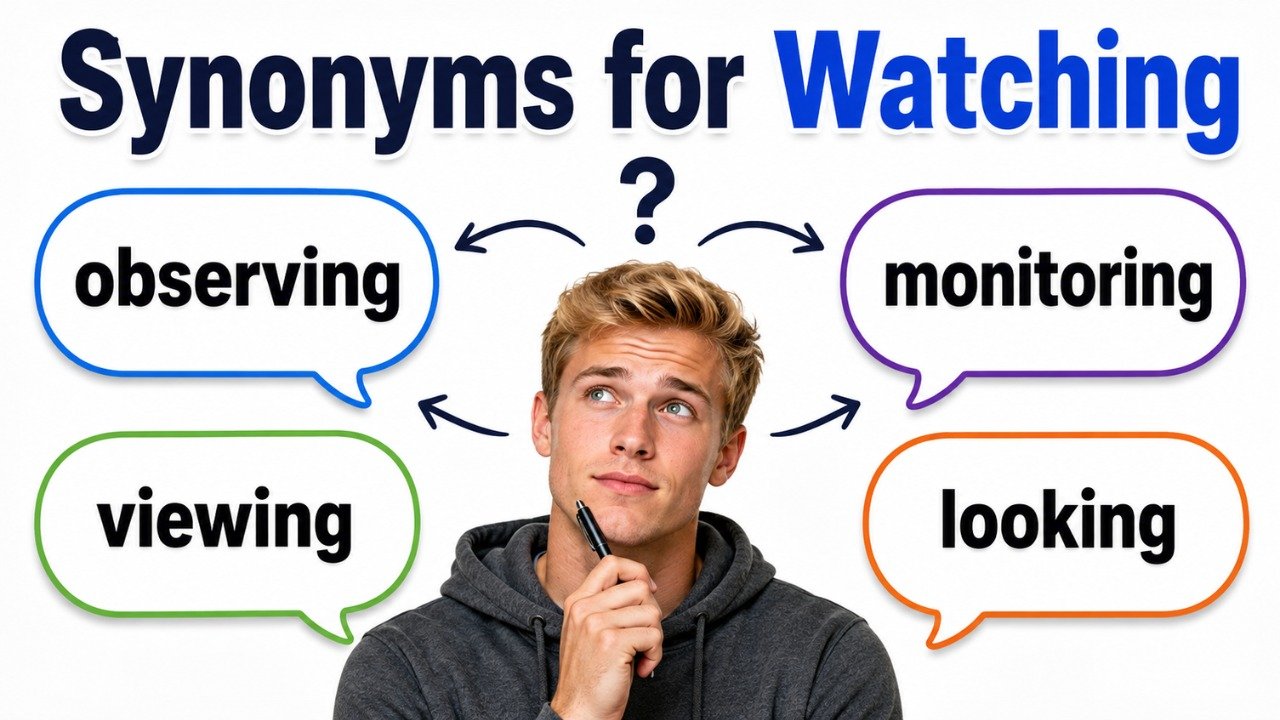
Quick Answer: The best synonyms for watching include observing, viewing, monitoring, looking at, supervising, tracking, studying, witnessing, examining, and overseeing. Use observing for careful or formal attention, viewing for television, films, images, or displays, and monitoring when checking something continuously for changes. Looking at suits casual speech, supervising describes watching people or work responsibly, tracking means following progress or movement, and witnessing is best when someone directly sees an important event.
Pronunciation and Word Details
Word: Watching.
Pronunciation: /ˈwɑːtʃɪŋ/.
Part of Speech: Verb, present participle, and gerund.
Meaning: Directing attention toward someone or something for a period of time.
US Pronunciation:
UK Pronunciation:
What Does “Watching” Mean?
Watching means looking at someone or something carefully, continuously, or for a particular purpose. It is the present participle and gerund form of the verb watch.
The word often describes paying visual attention to an activity, person, screen, event, or situation. Someone may be watching a film for entertainment, watching a child for safety, or watching a process to notice changes.
Watching can also refer to following something without looking at it constantly. For example, a manager may be watching sales figures, or a doctor may be watching a patient’s progress.
The exact meaning depends on the sentence. It may suggest casual entertainment, careful observation, supervision, protection, investigation, or continued monitoring.
Meaning, Tone, and Context of “Watching”
Watching is usually a neutral and conversational word. It appears naturally in everyday speech, informal writing, instructions, descriptions, and storytelling.
In entertainment contexts, watching means viewing something for interest or enjoyment. People watch films, programs, performances, matches, and online lessons.
In safety contexts, watching means supervising or protecting someone. A parent may watch a child, while a guard may watch an entrance.
In professional or technical contexts, more precise alternatives may be preferable. Observing suits formal reports and research. Monitoring fits systems, health conditions, performance, and changing data. Supervising is appropriate when someone has responsibility for people or activities.
Watching may also sound emotional or suspicious in certain situations. Saying that someone is watching another person can suggest concern, protection, curiosity, or unwanted surveillance. The surrounding context determines the tone.
When and How to Use “Watching”
For Entertainment
Explanation: Use watching when someone is paying attention to a film, program, performance, match, or other visual content.
Example: We were watching a documentary about ocean life.
For Careful Observation
Explanation: Use watching when someone is studying an action or situation over time.
Example: The students were watching how the liquid reacted to heat.
For Supervision
Explanation: Use watching when someone is responsible for another person’s safety or behavior.
Example: Her aunt is watching the children this afternoon.
For Monitoring Change
Explanation: Use watching when checking a condition, result, or situation for new developments.
Example: The medical team is watching his condition carefully.
For Protection
Explanation: Use watching when someone is guarding a person, place, or object.
Example: A security officer was watching the main entrance.
For Following Progress
Explanation: Use watching when paying attention to how something develops.
Example: Investors are watching the company’s performance closely.
For Learning
Explanation: Use watching when gaining knowledge by seeing how someone performs a task.
Example: She learned the technique by watching an experienced baker.
For Witnessing an Event
Explanation: Use watching when someone is present and sees an event happen.
Example: Hundreds of people were watching the parade from the street.
Best Synonyms for Watching
Observing
Synonym: Observing means looking at something carefully to understand or notice details.
Example: The researcher was observing the animals in their natural environment.
Viewing
Synonym: Viewing means looking at visual content, an object, a place, or a display.
Example: We are viewing the photographs from yesterday’s event.
Monitoring
Synonym: Monitoring means checking something continuously for changes, problems, or progress.
Example: The technicians are monitoring the system throughout the night.
Looking At
Synonym: Looking at means directing your eyes toward someone or something.
Example: She was looking at the map before choosing a route.
Supervising
Synonym: Supervising means watching people or activities while being responsible for them.
Example: A trained instructor was supervising the swimming lesson.
Tracking
Synonym: Tracking means following the movement, progress, or development of something.
Example: The team is tracking customer responses to the new service.
Studying
Synonym: Studying means examining something closely to understand it.
Example: He was studying the painting’s fine details.
Witnessing
Synonym: Witnessing means personally seeing an event happen.
Example: The crowd was witnessing a remarkable performance.
Examining
Synonym: Examining means looking at something carefully to discover facts or problems.
Example: The inspector was examining the damaged wall.
Overseeing
Synonym: Overseeing means watching and directing a process, project, or group.
Example: She is overseeing the renovation work.
50 Synonyms for Watching with Short Meanings
- Observing: Looking carefully to notice details.
- Viewing: Looking at visual content or an object.
- Monitoring: Checking continuously for changes or problems.
- Looking At: Directing the eyes toward something.
- Seeing: Noticing something with the eyes.
- Noticing: Becoming aware of a visible detail.
- Supervising: Watching people or work responsibly.
- Tracking: Following movement, progress, or development.
- Studying: Looking closely to understand something.
- Witnessing: Personally seeing an event occur.
- Examining: Inspecting something carefully for information.
- Inspecting: Checking closely for quality or problems.
- Surveying: Looking over an area or situation.
- Regarding: Looking at or considering attentively.
- Contemplating: Looking at something while thinking deeply.
- Scrutinizing: Examining with extremely careful attention.
- Scanning: Looking quickly across an area or text.
- Following: Watching the progress or movement of something.
- Checking: Looking to confirm a condition or fact.
- Overseeing: Watching and directing an activity.
- Guarding: Watching something to protect it.
- Keeping an Eye On: Watching informally and attentively.
- Attending To: Giving careful attention to someone or something.
- Gazing At: Looking steadily, often with interest or admiration.
- Staring At: Looking continuously with fixed attention.
- Glancing At: Looking briefly or quickly.
- Peering At: Looking closely because something is difficult to see.
- Beholding: Seeing or looking at something impressive.
- Spotting: Seeing or identifying something suddenly.
- Detecting: Discovering something through careful attention.
- Perceiving: Becoming aware of something through the senses.
- Noting: Seeing and mentally recording a detail.
- Recognizing: Identifying someone or something previously known.
- Reviewing: Looking over something for evaluation.
- Assessing: Observing something to form a judgment.
- Analyzing: Studying details to understand meaning or structure.
- Spectating: Watching a public event or competition.
- Surveilling: Watching someone or somewhere systematically.
- Patrolling: Watching an area while moving through it.
- Shadowing: Following and watching someone closely.
- Standing Guard: Watching a place to keep it safe.
- Chaperoning: Supervising people during an activity or trip.
- Babysitting: Caring for and watching children temporarily.
- Tending: Watching and caring for someone or something.
- Looking On: Watching without taking part.
- Watching Over: Protecting or caring for someone attentively.
- Keeping Watch: Remaining alert while observing an area.
- Keeping Under Observation: Watching continuously for a purpose.
- Viewing Closely: Looking with focused visual attention.
- Eyeing: Looking at someone or something with particular interest.
Read Also:
Synonyms for Fitness
Synonyms for Watching by Context
When Watching Means Observing Carefully
Observing, studying, examining, scrutinizing, inspecting, and analyzing are useful when attention is deliberate and detailed.
Example: The scientist was observing the changes in the sample.
Example: The mechanic was examining the engine for signs of damage.
Example: The editor was scrutinizing every paragraph for errors.
Observing is neutral and formal. Examining suggests searching for information or faults. Scrutinizing expresses especially close and critical attention.
When Watching Means Viewing Entertainment
Viewing, seeing, spectating, looking on, and following are suitable for films, performances, competitions, and public events.
Example: We spent the evening viewing a historical drama.
Example: Thousands of fans were spectating from the stands.
Example: She has been following the tournament since it began.
Viewing sounds slightly more formal than watching. Spectating specifically describes watching an event without participating. Following suggests continued interest across several events or episodes.
When Watching Means Monitoring
Monitoring, tracking, checking, observing, and keeping under observation work well when watching a condition or development over time.
Example: The nurses are monitoring the patient’s breathing.
Example: The company is tracking changes in customer demand.
Example: Engineers are checking the equipment for unusual activity.
Monitoring is best for systems, health, performance, and data. Tracking emphasizes movement or measurable progress. Checking often describes shorter or repeated inspections.
When Watching Means Supervising
Supervising, overseeing, chaperoning, babysitting, tending, and keeping an eye on describe responsible attention to people or activities.
Example: A teacher was supervising the students during the experiment.
Example: She is overseeing the work of several departments.
Example: His brother is babysitting the children tonight.
Supervising and overseeing suit professional responsibilities. Babysitting is specific to temporary childcare. Keeping an eye on is informal and may suggest light supervision.
When Watching Means Protecting
Guarding, standing guard, keeping watch, watching over, and patrolling describe observation for safety or security.
Example: Two officers were guarding the entrance.
Example: Volunteers kept watch throughout the night.
Example: The nurse was watching over the recovering patient.
Guarding focuses on preventing danger or access. Watching over often expresses care and protection. Patrolling involves moving around an area while checking it.
When Watching Means Looking Briefly
Glancing, scanning, spotting, noticing, and checking describe shorter periods of visual attention.
Example: She glanced at the clock before leaving.
Example: He scanned the room for an empty seat.
Example: I noticed a small mark on the window.
Glancing is a very brief look. Scanning means moving the eyes quickly across a wider area. Noticing means becoming aware of a particular detail.
When Watching Means Seeing an Event
Witnessing, beholding, seeing, and looking on describe being present when something happens.
Example: The audience witnessed an unforgettable performance.
Example: We stood silently, beholding the mountain landscape.
Example: Several residents looked on as the bridge opened.
Witnessing is appropriate for important, unusual, or serious events. Beholding is literary and often expresses admiration. Looking on suggests watching without becoming involved.
Another Word for Watching
Observing is often the best single replacement for watching because it expresses careful and purposeful attention. However, the most accurate alternative depends on what is being watched and why.
Use viewing for visual entertainment, monitoring for continuous checks, supervising for responsible control, and witnessing for directly seeing an event.
Original: She was watching the birds from the window.
Better Option: She was observing the birds from the window.
Original: They were watching a film after dinner.
Better Option: They were viewing a film after dinner.
Original: The technician was watching the machine’s temperature.
Better Option: The technician was monitoring the machine’s temperature.
Original: He was watching the workers during the installation.
Better Option: He was supervising the workers during the installation.
When Not to Use “Watching”
Watching is useful in ordinary language, but it may sound repetitive, vague, or less precise in formal writing.
Avoid using watching repeatedly when several different types of attention are being described. Select a more specific verb that explains whether someone is observing, monitoring, inspecting, supervising, or viewing.
When Describing Technical Monitoring
Weak: The engineer was watching the pressure levels.
Better: The engineer was monitoring the pressure levels.
Monitoring is more precise because it suggests continuous measurement and attention to possible changes.
When Describing Formal Research
Weak: The researchers were watching the animals’ behavior.
Better: The researchers were observing the animals’ behavior.
Observing sounds more professional and emphasizes careful study.
When Describing Responsible Management
Weak: She was watching the construction team.
Better: She was supervising the construction team.
Supervising clearly shows that she had responsibility and authority.
When Describing a Detailed Inspection
Weak: The officer was watching the damaged vehicle.
Better: The officer was examining the damaged vehicle.
Examining indicates a close search for evidence, damage, or information.
When Describing a Brief Look
Weak: He was watching the message for a second.
Better: He glanced at the message for a second.
Watching normally suggests continued attention, while glancing describes a brief look.
When the Meaning Could Sound Suspicious
Weak: A man was watching her outside the building.
Better: A man was standing near the building and looking in her direction.
The better sentence provides clearer details and avoids suggesting surveillance unless that meaning is intended.
Words Commonly Confused With Watching
Watching vs Seeing: Watching is intentional and usually continues for a period of time. Seeing may happen naturally without deliberate attention.
Example With Watching: We were watching the birds build a nest.
Example With Seeing: I saw a bird near the window.
Watching vs Looking: Looking means directing the eyes toward something. Watching usually involves continued attention to movement, activity, or change.
Example With Watching: She was watching the dancers perform.
Example With Looking: She was looking at the stage.
Watching vs Observing: Watching is common in everyday speech, while observing is more deliberate and often more formal.
Example With Watching: They were watching people in the park.
Example With Observing: The researcher was observing patterns of public behavior.
Watching vs Monitoring: Watching is broad, while monitoring means checking something systematically over time.
Example With Watching: He was watching the machine.
Example With Monitoring: He was monitoring the machine’s temperature and speed.
Watching vs Viewing: Watching often involves activity or movement. Viewing can describe looking at films, images, properties, displays, or objects.
Example With Watching: We were watching the players warm up.
Example With Viewing: We were viewing the photographs in the exhibition.
Watching vs Witnessing: Watching means giving attention to an event. Witnessing means being present and seeing it happen, often when the event is important.
Example With Watching: The family was watching the ceremony.
Example With Witnessing: The family witnessed a historic ceremony.
Watching vs Supervising: Watching may be casual, while supervising includes responsibility, guidance, and control.
Example With Watching: He was watching the workers from a distance.
Example With Supervising: He was supervising the workers and checking their progress.
Which Synonym Should You Choose?
Choose observing when describing careful, deliberate, or formal attention.
Choose viewing when referring to films, programs, images, displays, properties, or visual material.
Choose monitoring when checking health, systems, equipment, data, performance, or changing conditions.
Choose looking at for ordinary conversation and simple descriptions of visual attention.
Choose supervising when someone is responsible for people, work, safety, or behavior.
Choose tracking when following movement, progress, results, deliveries, or development.
Choose studying when someone is looking closely to understand details.
Choose examining when searching for evidence, damage, faults, or important information.
Choose witnessing when someone directly sees a notable event happen.
Choose scrutinizing when attention is extremely careful, critical, or detailed.
Choose glancing when the look is brief.
Choose scanning when the eyes move quickly across a page, room, screen, or area.
Choose guarding when the purpose is protection or security.
Choose overseeing in reports, professional emails, and formal descriptions of management.
Choose keeping an eye on in casual conversation when describing informal supervision.
Real Life Examples of “Watching” in Sentences
Original: The children were watching the magician perform.
Better Option: The children were observing the magician perform.
Original: We were watching a nature program after dinner.
Better Option: We were viewing a nature program after dinner.
Original: The nurse was watching the patient’s condition.
Better Option: The nurse was monitoring the patient’s condition.
Original: She was watching the employees complete the task.
Better Option: She was supervising the employees as they completed the task.
Original: The analyst is watching changes in the market.
Better Option: The analyst is tracking changes in the market.
Original: He stood near the painting and kept watching it.
Better Option: He stood near the painting and studied it carefully.
Original: The officer was watching the package for damage.
Better Option: The officer was examining the package for damage.
Original: We were watching the parade from a balcony.
Better Option: We were viewing the parade from a balcony.
Original: Several people were watching when the accident occurred.
Better Option: Several people witnessed the accident.
Original: Her neighbor is watching the house while she travels.
Better Option: Her neighbor is keeping an eye on the house while she travels.
Synonym Groups and Usage Differences
Observation Group
Observing, studying, examining, inspecting, scrutinizing, and analyzing belong to the observation group. These words describe purposeful attention intended to discover information or understand details.
Observing is general and formal. Studying involves concentration. Examining and inspecting focus on condition or quality. Scrutinizing suggests critical attention. Analyzing involves interpreting what is observed.
Example: The specialist was examining the material for hidden defects.
Entertainment Group
Watching, viewing, seeing, spectating, and following commonly describe attention to entertainment or public events.
Viewing is suitable for films, images, exhibitions, and presentations. Seeing is natural when attending a film or performance. Spectating refers to watching a competition or event. Following suggests continued interest over time.
Example: Many families were viewing the performance from the front rows.
Monitoring Group
Monitoring, tracking, checking, surveying, and keeping under observation describe continued attention to progress, movement, conditions, or possible problems.
Monitoring is systematic. Tracking focuses on movement or measurable progress. Checking may be occasional. Surveying gives a broad view. Keeping under observation often appears in medical, safety, or investigative contexts.
Example: The team is monitoring the situation for further changes.
Supervision Group
Supervising, overseeing, chaperoning, babysitting, tending, and keeping an eye on describe watching while accepting some responsibility.
Supervising is common in workplaces and education. Overseeing often includes management. Chaperoning involves accompanying and supervising a group. Babysitting refers to temporary childcare. Tending includes care and attention.
Example: An experienced manager was overseeing the entire project.
Protection Group
Guarding, patrolling, standing guard, keeping watch, and watching over express protection or security.
Guarding focuses on preventing danger or unauthorized access. Patrolling involves movement. Standing guard suggests remaining in one position. Watching over can express emotional care as well as physical protection.
Example: Two guards were keeping watch near the entrance.
Brief Attention Group
Glancing, scanning, spotting, noticing, and peering describe specific ways of looking.
Glancing is quick. Scanning covers a wider area. Spotting means suddenly finding something. Noticing means becoming aware of a detail. Peering describes looking with difficulty or intense focus.
Example: She scanned the list until she spotted her name.
Witnessing Group
Witnessing, seeing, beholding, and looking on describe being present while something happens.
Witnessing often relates to meaningful or serious events. Beholding is literary. Looking on suggests that someone watches without participating.
Example: The visitors witnessed the opening ceremony.
Antonyms of Watching
The opposite of watching depends on whether watching means observing, supervising, monitoring, or protecting.
Ignoring: Deliberately giving no attention.
Overlooking: Failing to notice something.
Missing: Not seeing or experiencing an event.
Neglecting: Failing to give necessary care or attention.
Disregarding: Choosing not to consider or notice something.
Avoiding: Staying away from someone or something.
Abandoning: Leaving someone or something without care.
Forgetting: Failing to remember to check or observe.
Turning Away: Moving the eyes or body in another direction.
Looking Away: Deliberately stopping visual attention.
Losing Sight Of: No longer being able to see or follow something.
Leaving Unsupervised: Allowing someone or something to remain without responsible observation.
Comparison: Watching vs Related Words
Watching vs Observing
Watching is an everyday term for giving visual attention. Observing is more deliberate and often involves noticing or recording details.
Example With Watching: The children were watching the butterflies.
Example With Observing: The students were observing the butterflies’ feeding behavior.
Watching vs Viewing
Watching commonly refers to movement, action, or entertainment. Viewing can refer to visual content, artwork, property, scenery, or a formal inspection.
Example With Watching: We were watching the actors rehearse.
Example With Viewing: We were viewing the completed stage design.
Watching vs Monitoring
Watching is broad and may be casual. Monitoring is systematic and usually has a specific purpose.
Example With Watching: She was watching the weather.
Example With Monitoring: She was monitoring weather conditions before the journey.
Watching vs Looking
Watching involves continued attention. Looking simply means directing the eyes toward something.
Example With Watching: He was watching the dog play in the garden.
Example With Looking: He was looking at the dog.
Watching vs Seeing
Watching is usually intentional. Seeing can happen without planning or concentration.
Example With Watching: I was watching the cyclist approach.
Example With Seeing: I saw a cyclist near the bridge.
Watching vs Witnessing
Watching emphasizes attention during an activity. Witnessing emphasizes being present when an event occurs.
Example With Watching: They were watching the award ceremony.
Example With Witnessing: They witnessed the winner receive the final award.
Watching vs Supervising
Watching can be passive. Supervising involves responsibility, authority, and guidance.
Example With Watching: She was watching the trainees work.
Example With Supervising: She was supervising the trainees and correcting their mistakes.
Watching vs Tracking
Watching means paying attention. Tracking means following changes, movement, progress, or results over time.
Example With Watching: He was watching the delivery vehicle.
Example With Tracking: He was tracking the delivery vehicle’s location.
Common Phrases and Expressions With “Watching”
Watching Closely: Giving careful attention to details or changes.
Watching Carefully: Looking with caution and concentration.
Watching Over: Protecting or caring for someone.
Watching From Afar: Observing from a distant position.
Watching and Waiting: Remaining attentive until something happens.
Watching the Clock: Repeatedly checking the time.
Watching the Road: Paying close attention while travelling or driving.
Watching Your Step: Moving carefully or behaving cautiously.
Watching Your Back: Remaining alert to possible danger or betrayal.
Watching With Interest: Giving attention because something is engaging.
Common Mistakes to Avoid
Repeating Watching Too Often
Using watching several times in one paragraph makes the writing sound repetitive.
Repetitive: She was watching the children while watching the road and watching the time.
Improved: She was supervising the children while checking the road and keeping track of the time.
Using Watching for a Brief Look
Watching usually suggests continued attention. Use glancing for a quick look.
Incorrect: She watched the clock for one second.
Better: She glanced at the clock.
Confusing Watching With Seeing
Seeing does not always involve intention, while watching normally does.
Incorrect: I was watching a flash of light for an instant.
Better: I saw a flash of light.
Using a Casual Word in Formal Reports
Watching may sound too general in academic, medical, or technical writing.
Weak: The researchers were watching the results.
Better: The researchers were monitoring the results.
Choosing an Overly Strong Synonym
Scrutinizing and surveilling can sound intense or suspicious. Do not use them for ordinary visual attention.
Unnatural: She was surveilling a comedy program.
Better: She was watching a comedy program.
Confusing Supervision With Observation
Observing does not necessarily include responsibility. Supervising does.
Unclear: The manager was observing the new employees.
Clearer: The manager was supervising the new employees.
Using the Wrong Preposition
Watching normally takes a direct object without at.
Incorrect: We were watching at the performers.
Correct: We were watching the performers.
Looking usually requires at before an object.
Correct: We were looking at the performers.
Using Watching Without Clear Context
The word may sound suspicious when the reason for watching is not explained.
Vague: Someone was watching the building.
Clearer: A security officer was guarding the building’s entrance.
Conclusion
The most suitable synonyms for watching depend on the purpose and length of the attention. Observing works well for careful or formal study, while viewing fits films, images, and visual content. Use monitoring for continued checks, supervising for responsible oversight, tracking for progress, and witnessing for seeing an important event. Other useful synonyms for watching include examining, scanning, guarding, studying, and keeping an eye on. Choosing a precise alternative makes each sentence clearer, more natural, and more informative.
FAQs About Synonyms for Watching
What Is the Best Synonym for Watching?
Observing is the best general synonym when watching involves careful attention. Viewing, monitoring, supervising, and witnessing may be more accurate in specific contexts.
What Is a Formal Word for Watching?
Observing is a formal alternative for careful attention. Monitoring is better for systems, progress, health, or changing conditions.
What Is Another Word for Watching a Film?
Viewing is a suitable alternative. Seeing also works when talking about attending or experiencing a film.
What Is Another Word for Watching Someone?
Observing is neutral, supervising suggests responsibility, and keeping an eye on is more casual. Surveilling suggests systematic or secret observation.
What Is Another Word for Watching Closely?
Scrutinizing, examining, studying, monitoring, and observing closely are useful alternatives.
Is Seeing the Same as Watching?
No. Seeing may happen without intention, while watching usually involves deliberate attention for a period of time.
What Is Another Word for Watching Over Someone?
Supervising, protecting, tending, caring for, guarding, and keeping an eye on are appropriate alternatives, depending on the situation.
