
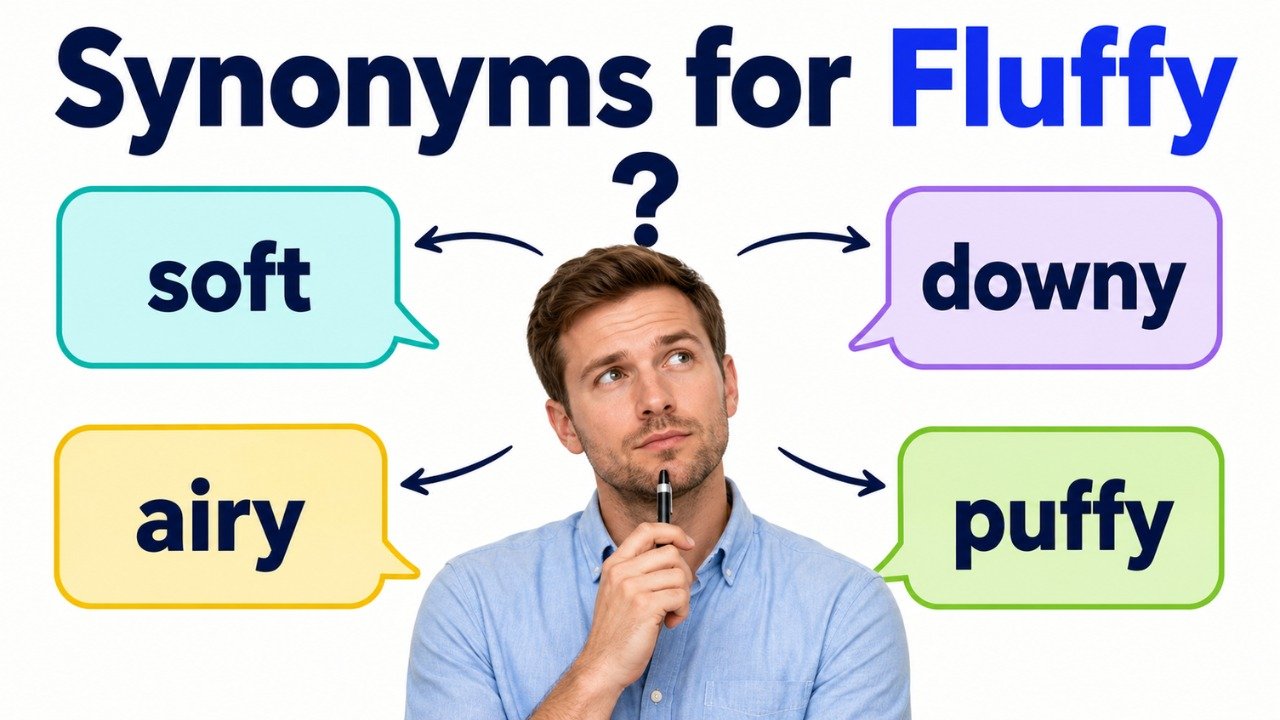
Quick Answer: The best synonyms for fluffy include soft, downy, feathery, fuzzy, fleecy, puffy, airy, plush, pillowy, and light. Use soft as the most flexible replacement for a pleasant texture. Downy and feathery suit fur, hair, and delicate materials. Puffy works for clouds, clothing, and rounded shapes, while airy and light are best for cakes, bread, and whipped foods. Plush describes rich softness. In formal criticism, wordy, padded, or insubstantial may replace fluffy when writing lacks depth.
Pronunciation and Word Details
Word: Fluffy.
Pronunciation: /ˈflʌfi/.
Part of Speech: Adjective.
Meaning: Soft, light, full, and often covered with fine fibers, air, fur, or loosely arranged material.
US Pronunciation:
UK Pronunciation:
What Does “Fluffy” Mean?
Fluffy means soft, light, full, and often made of fine fibers, fur, feathers, air, or loosely arranged material.
Fluffy is an adjective. It commonly describes animals, hair, fabrics, pillows, clouds, clothing, cakes, bread, foam, and other things that appear soft or expanded.
The word can describe physical texture.
Example: The kitten has fluffy white fur.
It can describe something filled with air.
Example: The cake was fluffy and tender.
It can describe a rounded or expanded appearance.
Example: Fluffy clouds moved slowly across the sky.
Fluffy may also have a figurative meaning. Writing, conversation, or entertainment can be called fluffy when it is pleasant and easy to enjoy but lacks serious detail, depth, or substance.
Example: The article was entertaining, but some sections felt fluffy.
The meaning of fluffy therefore depends on context. A fluffy blanket is soft and comfortable. Fluffy hair is full and voluminous. Fluffy food is light and airy. Fluffy writing is usually vague, decorative, or lacking useful information.
Meaning, Tone, and Context of “Fluffy”
Fluffy usually has a positive, warm, and friendly tone when describing physical texture. It often creates an image of softness, comfort, lightness, or cuteness.
The word is common in everyday conversation, product descriptions, recipes, fashion writing, beauty discussions, animal descriptions, and creative writing.
Conversational Context: Fluffy is natural and easy to understand in casual speech.
Descriptive Context: It creates a clear sensory image of softness, fullness, or lightness.
Emotional Context: The word can suggest comfort, warmth, gentleness, innocence, or charm.
Food Context: Fluffy describes food that is light, soft, and filled with small pockets of air.
Animal Context: It often describes thick, soft fur or feathers.
Fashion Context: Fluffy may refer to soft fibers, full shapes, padded clothing, or accessories with a light texture.
Beauty Context: It can describe full hair, soft curls, brows, lashes, or loosely styled volume.
Weather Context: Fluffy commonly describes soft looking white clouds.
Formal Context: Fluffy is less common in scientific or technical descriptions because more precise terms may be needed.
Critical Context: When used about writing, ideas, or speech, fluffy can be negative. It may suggest that the content is wordy, vague, sentimental, decorative, or lacking evidence.
In professional writing, words such as downy, aerated, voluminous, padded, or insubstantial may communicate the intended meaning more accurately.
When and How to Use “Fluffy”
For Soft Fur
Use fluffy when an animal has thick, soft, and loosely arranged fur.
Explanation: This use often creates a warm or affectionate image.
Example: The fluffy puppy slept beside the fireplace.
For Feathers
Use fluffy for birds, chicks, feathers, or feather filled materials that appear light and soft.
Explanation: Downy and feathery are often more precise alternatives.
Example: The fluffy chick stayed close to its mother.
For Hair
Use fluffy when hair appears soft, full, light, or loosely expanded.
Explanation: Voluminous, full, frizzy, or bouffant may be better when describing a particular hairstyle.
Example: Her fluffy curls framed her face.
For Fabric and Bedding
Use fluffy for blankets, towels, rugs, pillows, and other materials with a soft, raised texture.
Explanation: Plush, fleecy, pillowy, or velvety may provide greater detail.
Example: He wrapped himself in a fluffy blanket.
For Cakes and Bread
Use fluffy when baked food is light, soft, and filled with air.
Explanation: Airy, light, tender, risen, and aerated are useful food related alternatives.
Example: The bread remained fluffy after cooling.
For Whipped Foods
Use fluffy when cream, frosting, eggs, or mixtures have been beaten until light and expanded.
Explanation: Whipped, foamy, frothy, and aerated are more specific choices.
Example: Beat the mixture until it becomes pale and fluffy.
For Clouds
Use fluffy when clouds look soft, rounded, bright, and full.
Explanation: Puffy, billowy, cottony, and cloudlike can strengthen the visual description.
Example: Fluffy clouds gathered above the hills.
For Clothing
Use fluffy for clothing made from soft fibers or designed with a full, puffy shape.
Explanation: Fleecy, fuzzy, plush, puffy, or voluminous may better identify the texture or shape.
Example: She wore a fluffy coat during the cold evening.
For a Comfortable Appearance
Use fluffy when something looks soft enough to touch, sit on, or rest against.
Explanation: Pillowy, cushioned, plush, and soft are strong choices in this context.
Example: The chair had a fluffy seat and deep cushions.
For Weak or Vague Writing
Use fluffy when writing contains too many decorative words but too little useful information.
Explanation: Wordy, padded, vague, superficial, or insubstantial are clearer in formal criticism.
Example: The introduction sounded fluffy because it did not answer the main question.
Best Synonyms for Fluffy
Soft
Synonym: Pleasant to touch and not hard, rough, or firm.
Example: The soft blanket kept the child warm.
Downy
Synonym: Covered with fine, soft hair or delicate feathers.
Example: The young bird had downy feathers.
Feathery
Synonym: Light, delicate, and similar to feathers in texture or appearance.
Example: The plant produced feathery green leaves.
Fuzzy
Synonym: Covered with short, soft fibers, hair, or fur.
Example: She wore a fuzzy sweater on the cold morning.
Fleecy
Synonym: Soft, warm, and similar to sheep’s wool.
Example: The fleecy lining made the jacket comfortable.
Puffy
Synonym: Expanded, rounded, or filled with air.
Example: Puffy clouds covered the afternoon sky.
Airy
Synonym: Light in texture because it contains plenty of air.
Example: The dessert had an airy texture.
Plush
Synonym: Luxuriously soft, thick, and comfortable.
Example: The hotel room had plush pillows and deep chairs.
Pillowy
Synonym: Soft, full, and shaped like a comfortable pillow.
Example: The rolls had pillowy centers.
Light
Synonym: Not heavy, dense, firm, or difficult to eat.
Example: The chef created a light and delicate cake.
50 Synonyms for Fluffy with Short Meanings
- Soft: Pleasant to touch and not hard or rough.
- Downy: Covered with fine hair or delicate feathers.
- Feathery: Light and delicate like a feather.
- Fleecy: Soft and warm like wool.
- Fuzzy: Covered with short, soft fibers or fur.
- Furry: Covered with thick or noticeable fur.
- Woolly: Having a texture similar to wool.
- Plush: Richly soft, thick, and comfortable.
- Velvety: Smooth and soft like velvet.
- Silky: Smooth, fine, and pleasantly soft.
- Cottony: Soft, light, and similar to cotton.
- Pillowy: Soft, full, and cushionlike.
- Puffy: Swollen, expanded, or rounded with air.
- Airy: Light and filled with air.
- Light: Not dense, heavy, or firm.
- Billowy: Full, flowing, and softly expanded.
- Cloudlike: Soft, pale, and shaped like a cloud.
- Buoyant: Light enough to rise or remain lifted.
- Spongy: Soft, springy, and filled with small spaces.
- Cushioned: Made soft or comfortable with padding.
- Voluminous: Large and full in shape or appearance.
- Full: Thick, abundant, or well expanded.
- Bushy: Thick and spreading with hair or growth.
- Shaggy: Covered with long, rough, or untidy hair.
- Tufted: Formed or decorated with small bunches of fibers.
- Thick: Dense, full, or abundant in texture.
- Flossy: Soft, light, and similar to fine fibers.
- Flocculent: Containing soft, woollike clumps or particles.
- Foamy: Filled with many small bubbles.
- Frothy: Light and covered with bubbles or foam.
- Whipped: Beaten until light, soft, and expanded.
- Risen: Expanded through air, steam, or a raising process.
- Tender: Soft, delicate, and easy to cut or eat.
- Aerated: Filled with air to create a lighter texture.
- Porous: Containing many tiny spaces or openings.
- Puffed: Expanded or swollen with air.
- Expanded: Increased in size, volume, or fullness.
- Frizzy: Formed into small, loose, or uneven curls.
- Bouffant: Styled in a rounded and voluminous shape.
- Poofy: Informally large, soft, and puffed out.
- Wordy: Using more words than necessary.
- Verbose: Expressed with excessive wording.
- Flowery: Filled with decorative or elaborate language.
- Padded: Lengthened with unnecessary details or words.
- Vague: Lacking clear meaning or specific information.
- Superficial: Concerned only with the surface of a subject.
- Insubstantial: Lacking enough strength, depth, or importance.
- Lightweight: Lacking seriousness, complexity, or depth.
- Sentimental: Expressing emotion in an excessive or overly sweet way.
- Ornate: Highly decorated in language, style, or appearance.
Read Also:
Synonyms for Over Time
Synonyms for Fluffy by Context
When Fluffy Means Soft to Touch
Soft, plush, velvety, silky, fleecy, cushioned, and pillowy are useful when describing pleasant physical texture.
Soft is the broadest choice. Plush suggests rich comfort and thickness. Velvety emphasizes smoothness. Fleecy suggests warmth. Pillowy and cushioned describe softness created by padding or fullness.
Example With Fluffy: The fluffy blanket felt warm against her skin.
Example With Soft: The soft blanket felt warm against her skin.
Example With Plush: The plush blanket felt luxurious against her skin.
Example With Fleecy: The fleecy blanket kept her warm throughout the night.
When Fluffy Means Covered With Fur
Furry, fuzzy, downy, woolly, shaggy, bushy, and soft are useful for animals or objects covered with hair or fibers.
Furry emphasizes visible fur. Fuzzy describes short fibers. Downy suggests very fine softness. Shaggy describes longer and less orderly hair. Bushy describes thickness and outward growth.
Example With Fluffy: The fluffy dog waited beside the door.
Example With Furry: The furry dog waited beside the door.
Example With Shaggy: The shaggy dog waited beside the door.
Example With Downy: The downy rabbit rested beneath the tree.
When Fluffy Means Feathered
Downy, feathery, flossy, fleecy, and soft work well for chicks, birds, feathers, and delicate natural textures.
Downy is the most precise choice for the fine feathers of young birds. Feathery may also describe plants, hair, clouds, or decorative textures.
Example With Fluffy: The fluffy chick followed the hen.
Example With Downy: The downy chick followed the hen.
Example With Feathery: The bird had feathery plumage around its neck.
When Fluffy Means Full Hair
Voluminous, full, bushy, bouffant, frizzy, thick, and poofy can describe hair with noticeable size or body.
Voluminous is suitable for beauty and fashion writing. Full is simple and positive. Frizzy focuses on uneven curls or raised strands. Bouffant describes a rounded style. Poofy is casual and may sound playful.
Example With Fluffy: Her fluffy hair moved in the breeze.
Example With Voluminous: Her voluminous hair moved in the breeze.
Example With Full: Her full curls moved in the breeze.
Example With Bouffant: Her hair was arranged in a bouffant style.
When Fluffy Means Light Food
Airy, light, tender, aerated, risen, spongy, pillowy, whipped, and puffed are strong choices for food.
Airy and light describe a texture containing small pockets of air. Tender emphasizes softness. Risen refers to expansion during preparation or baking. Whipped suits cream, frosting, eggs, and mixtures.
Example With Fluffy: The pancakes were fluffy and warm.
Example With Airy: The pancakes were airy and warm.
Example With Light: The pancakes had a light texture.
Example With Pillowy: The pancakes were soft and pillowy.
When Fluffy Means Foamy
Foamy, frothy, whipped, aerated, bubbly, and light are appropriate for drinks, cream, soap, mixtures, and other substances containing bubbles.
Foamy describes visible bubbles. Frothy suggests a light surface layer. Whipped means the mixture has been beaten to add air.
Example With Fluffy: The topping became fluffy after several minutes.
Example With Whipped: The topping became light after being whipped.
Example With Frothy: The drink had a frothy surface.
Example With Foamy: The mixture developed a foamy texture.
When Fluffy Means Puffy or Expanded
Puffy, puffed, billowy, expanded, voluminous, full, and cloudlike describe shapes that appear enlarged or filled with air.
Puffy is common for clouds, clothing, eyes, and soft objects. Billowy suggests flowing movement. Voluminous emphasizes size. Cloudlike adds a gentle visual comparison.
Example With Fluffy: Fluffy clouds filled the sky.
Example With Puffy: Puffy clouds filled the sky.
Example With Billowy: Billowy clouds moved above the valley.
Example With Cloudlike: Cloudlike shapes floated above the hills.
When Fluffy Describes Clothing
Fuzzy, fleecy, plush, woolly, furry, puffy, and voluminous are useful for coats, sweaters, scarves, slippers, and accessories.
Fuzzy describes short surface fibers. Fleecy suggests warmth. Plush suggests softness and quality. Puffy focuses on shape or padding. Voluminous refers to overall size.
Example With Fluffy: She chose a fluffy winter jacket.
Example With Fleecy: She chose a fleecy winter jacket.
Example With Puffy: She chose a puffy winter jacket.
Example With Plush: She chose a plush scarf for the evening.
When Fluffy Means Vague or Lacking Depth
Wordy, verbose, flowery, padded, vague, superficial, insubstantial, lightweight, sentimental, and ornate can replace fluffy in criticism.
Wordy and verbose describe excessive language. Padded suggests unnecessary material added to increase length. Vague means unclear. Superficial and insubstantial suggest weak ideas or limited depth.
Example With Fluffy: The report was too fluffy to guide the decision.
Example With Vague: The report was too vague to guide the decision.
Example With Padded: The report was padded with unnecessary details.
Example With Insubstantial: The report was too insubstantial to support the recommendation.
Another Word for Fluffy
Soft is usually the best single replacement for fluffy because it works for fur, fabric, bedding, hair, and many comfortable textures. However, the most accurate alternative depends on what is being described.
Use airy for food, puffy for clouds and clothing, downy for feathers and fine fur, plush for rich softness, and wordy or insubstantial for weak writing.
Original: The cat had fluffy white fur.
Better Option: The cat had soft white fur.
Original: The cake was fluffy and moist.
Better Option: The cake was light and moist.
Original: Fluffy clouds appeared over the mountains.
Better Option: Puffy clouds appeared over the mountains.
Original: The article included several fluffy paragraphs.
Better Option: The article included several padded paragraphs.
When Not to Use “Fluffy”
Fluffy is useful in everyday descriptions, but it may sound vague, childish, overly casual, or inaccurate in formal and technical writing.
When Texture Must Be Precise
Use a more specific word when the reader needs to understand the exact surface.
Weak: The fabric has a fluffy texture.
Better: The fabric has a soft, fleecy texture.
When Describing Scientific Material
Fluffy is usually too informal for technical descriptions of particles, fibers, or substances.
Weak: The sample contained fluffy particles.
Better: The sample contained soft, flocculent particles.
When Describing Food Professionally
Fluffy may not explain why the food feels light.
Weak: The bread had a fluffy structure.
Better: The bread had an airy, well risen structure.
When Criticizing Writing
Fluffy can sound unclear or overly conversational in a formal review.
Weak: The report contains fluffy writing.
Better: The report contains vague and insubstantial writing.
When Describing Long Animal Hair
Fluffy may not communicate whether the fur is thick, long, tangled, or smooth.
Weak: The animal had fluffy hair.
Better: The animal had thick, shaggy fur.
When Describing Hair Texture
Fluffy can be interpreted as soft, frizzy, full, or poofy. Choose the intended meaning.
Weak: Her hairstyle looked fluffy.
Better: Her hairstyle looked full and voluminous.
When Fluffy Is Repeated
Repeating fluffy makes descriptive writing sound limited.
Weak: The fluffy dog rested on a fluffy rug beside a fluffy pillow.
Better: The furry dog rested on a plush rug beside a pillowy cushion.
When the Tone Must Be Serious
Fluffy can sound playful and may weaken a formal explanation.
Weak: The proposal offers a fluffy description of the problem.
Better: The proposal offers a superficial description of the problem.
Words Commonly Confused With Fluffy
Fluffy vs Soft: Soft describes a texture that is not hard or rough. Fluffy adds the idea of lightness, fullness, fine fibers, or trapped air.
Fluffy vs Fuzzy: Fluffy suggests a soft and expanded appearance. Fuzzy usually describes a surface covered with short fibers or fine hair.
Fluffy vs Furry: Fluffy describes the appearance or texture of fur. Furry simply means covered with fur.
Fluffy vs Downy: Fluffy is broad. Downy specifically describes extremely fine hair or soft feathers.
Fluffy vs Puffy: Fluffy suggests softness and lightness. Puffy focuses more on swelling, roundness, or expansion.
Fluffy vs Airy: Fluffy can describe many textures. Airy specifically means light because air is present within the structure.
Fluffy vs Plush: Fluffy suggests loose softness. Plush suggests rich, thick, luxurious comfort.
Fluffy vs Fleecy: Fluffy is general. Fleecy describes something soft and warm like sheep’s wool.
Fluffy vs Frizzy: Fluffy hair may be soft and full. Frizzy hair has small, raised, uneven, or loosely curled strands.
Fluffy vs Foamy: Fluffy describes a soft, light texture. Foamy specifically means filled with visible bubbles.
Fluffy vs Wordy: Fluffy writing may lack depth or useful detail. Wordy writing specifically uses more words than necessary.
Fluffy vs Flowery: Fluffy writing is vague or insubstantial. Flowery writing uses elaborate, decorative, or overly emotional language.
Which Synonym Should You Choose?
Choose soft for a simple and flexible description of pleasant texture.
Choose downy for fine animal hair, young bird feathers, or delicate plant surfaces.
Choose feathery for something light, fine, and shaped like feathers.
Choose fuzzy for short fibers, soft fabric, or fine hair.
Choose furry when something is clearly covered with fur.
Choose fleecy for warm fabric or material resembling wool.
Choose plush for luxurious blankets, carpets, furniture, toys, or clothing.
Choose velvety when the texture is smooth as well as soft.
Choose silky for fine, smooth hair, fabric, fur, or food texture.
Choose pillowy for bread, cushions, soft rolls, clouds, or other full shapes.
Choose puffy for clouds, coats, sleeves, eyes, or rounded forms.
Choose airy for cakes, bread, desserts, batters, and light interiors.
Choose light when you need a simple food description in a recipe or review.
Choose billowy for clouds, fabric, smoke, or clothing that moves in soft waves.
Choose cloudlike for creative descriptions of pale, soft, rounded objects.
Choose spongy for food or material that is soft, springy, and porous.
Choose voluminous for hair, clothing, fabric, or shapes with noticeable fullness.
Choose bushy for thick hair, brows, tails, plants, or growth that spreads outward.
Choose shaggy for long, rough, or untidy hair and fur.
Choose tufted for fabric, fur, grass, or materials arranged in small clusters.
Choose whipped for cream, frosting, eggs, butter, or mixtures beaten with air.
Choose risen for baked goods that have expanded properly.
Choose tender for soft cakes, bread, meat, or food that is easy to eat.
Choose aerated for formal food, manufacturing, or technical descriptions.
Choose foamy for substances containing many visible bubbles.
Choose frothy for drinks or liquids with a light layer of bubbles.
Choose frizzy for hair with small, raised, or uneven curls.
Choose bouffant for rounded and deliberately full hairstyles.
Choose poofy in casual conversation for large, expanded hair, dresses, or decorations.
Choose wordy when a paragraph uses too many words.
Choose verbose in formal criticism of excessively long language.
Choose flowery when writing is too decorative or elaborate.
Choose padded when content has been lengthened with unnecessary material.
Choose vague when the message lacks clarity or specific facts.
Choose superficial when the discussion covers only the surface.
Choose insubstantial when an argument lacks depth, evidence, or importance.
Choose lightweight when entertainment or discussion lacks seriousness.
Choose sentimental when language expresses excessive sweetness or emotion.
Choose ornate when the language or design contains elaborate decoration.
Real Life Examples of “Fluffy” in Sentences
Original: The fluffy rabbit rested under the chair.
Better Option: The downy rabbit rested under the chair.
Original: She bought a fluffy blanket for the bedroom.
Better Option: She bought a plush blanket for the bedroom.
Original: The baker served fluffy rolls with dinner.
Better Option: The baker served pillowy rolls with dinner.
Original: Fluffy clouds drifted above the field.
Better Option: Billowy clouds drifted above the field.
Original: His fluffy hair became difficult to control in humid weather.
Better Option: His frizzy hair became difficult to control in humid weather.
Original: The whipped cream looked fluffy and smooth.
Better Option: The whipped cream looked light and airy.
Original: She wore a fluffy coat on the cold morning.
Better Option: She wore a fleecy coat on the cold morning.
Original: The introduction was fluffy and unclear.
Better Option: The introduction was vague and insubstantial.
Original: The chair had a fluffy seat.
Better Option: The chair had a soft, cushioned seat.
Original: The puppy had a fluffy tail.
Better Option: The puppy had a thick, bushy tail.
Synonym Groups and Usage Differences
Soft Texture Group
Soft, plush, velvety, silky, fleecy, cushioned, and pillowy describe pleasant physical textures.
Soft is general. Plush implies thickness and luxury. Velvety and silky emphasize smoothness. Fleecy suggests warmth. Pillowy suggests soft fullness.
Example: The room included plush chairs and soft cushions.
Fur and Feather Group
Downy, feathery, fuzzy, furry, woolly, shaggy, bushy, flossy, and tufted relate to hair, fur, feathers, or fibers.
Downy describes very fine softness. Furry means covered with fur. Shaggy suggests long and untidy hair. Tufted describes small grouped sections.
Example: The young animal had downy fur around its ears.
Food Texture Group
Airy, light, risen, tender, spongy, aerated, whipped, puffed, and pillowy describe foods with softness or trapped air.
Airy and light are positive general terms. Risen describes expansion. Tender focuses on softness. Whipped describes the preparation method.
Example: The rolls were light, tender, and well risen.
Foam and Bubble Group
Foamy, frothy, whipped, aerated, and bubbly describe materials containing visible or trapped air.
Foamy refers to many bubbles. Frothy often describes a lighter surface layer. Aerated is more formal and technical.
Example: The liquid developed a frothy surface after mixing.
Full Shape Group
Puffy, billowy, expanded, voluminous, full, cloudlike, bouffant, and poofy describe enlarged or rounded forms.
Puffy is common and neutral. Billowy suggests movement. Voluminous sounds more polished. Poofy is casual.
Example: The dress had voluminous sleeves and a full skirt.
Hair Volume Group
Full, voluminous, bushy, frizzy, bouffant, thick, and poofy describe different kinds of hair volume.
Full and voluminous are usually positive. Bushy emphasizes density. Frizzy describes uneven raised strands. Bouffant refers to an intentional rounded style.
Example: The stylist created soft, voluminous curls.
Weak Writing Group
Wordy, verbose, padded, vague, superficial, insubstantial, and lightweight describe writing that lacks clarity, depth, or efficiency.
Wordy and verbose focus on excessive length. Padded means unnecessary material has been added. Vague means unclear. Superficial and insubstantial indicate limited depth.
Example: The report was padded with vague statements instead of evidence.
Decorative Language Group
Flowery, ornate, sentimental, sugary, and elaborate describe language with strong decoration or emotion.
Flowery and ornate may be positive in creative writing but negative when clarity matters. Sentimental suggests strong emotional expression.
Example: The formal report avoided flowery language and focused on facts.
Antonyms of Fluffy
The opposite of fluffy depends on whether the word refers to texture, volume, food, fur, clouds, or writing.
Hard: Firm and resistant to pressure.
Rough: Uneven, coarse, or unpleasant to touch.
Coarse: Made of thick or harsh fibers.
Smooth: Flat and even rather than covered with loose fibers.
Flat: Lacking height, expansion, or volume.
Compressed: Pressed into a smaller and denser form.
Dense: Closely packed and not filled with much air.
Heavy: Having substantial weight or a thick texture.
Firm: Solid and not easily pressed.
Compact: Closely arranged within a small space.
Thin: Having little thickness, volume, or fullness.
Limp: Lacking firmness, body, or volume.
Sleek: Smooth, controlled, and close to the surface.
Straight: Lacking curls, waves, or expanded volume.
Crisp: Firm, dry, or sharply structured.
Chewy: Requiring more effort to bite or eat.
Tough: Difficult to cut, tear, or chew.
Solid: Firm rather than airy, foamy, or porous.
Substantial: Containing depth, importance, evidence, or useful information.
Concise: Expressing meaning clearly with few words.
Specific: Clear, exact, and detailed.
Direct: Stating the main point without decoration.
Serious: Focused on important or weighty matters.
Evidence Based: Supported by facts, examples, or proof.
Comparison: Fluffy vs Related Words
Fluffy vs Soft
Soft means pleasant to touch and not hard. Fluffy means soft as well as light, full, furry, fibrous, or filled with air.
Example With Fluffy: The fluffy pillow had a full shape.
Example With Soft: The soft fabric felt gentle against the skin.
Fluffy vs Fuzzy
Fluffy suggests greater fullness and volume. Fuzzy describes a surface covered with short, fine fibers or hair.
Example With Fluffy: The fluffy cat had a large tail.
Example With Fuzzy: The fuzzy sweater had short surface fibers.
Fluffy vs Furry
Fluffy describes the texture and appearance of fur. Furry simply states that something has fur.
Example With Fluffy: The fluffy rabbit looked soft and round.
Example With Furry: The furry animal left hair on the chair.
Fluffy vs Downy
Fluffy is broad and informal. Downy describes extremely fine, delicate hair or feathers.
Example With Fluffy: The fluffy chick rested in the nest.
Example With Downy: The downy chick had fine yellow feathers.
Fluffy vs Puffy
Fluffy suggests softness and lightness. Puffy focuses on a swollen, rounded, or air filled shape.
Example With Fluffy: The fluffy scarf felt soft around her neck.
Example With Puffy: The puffy coat had thick insulated sections.
Fluffy vs Airy
Fluffy can refer to fur, fabric, clouds, hair, or food. Airy mainly describes something light because it contains air or open space.
Example With Fluffy: The fluffy cake rose above the pan.
Example With Airy: The airy cake had many small pockets inside.
Fluffy vs Plush
Fluffy suggests loosely arranged softness. Plush suggests thick, rich, and luxurious softness.
Example With Fluffy: The fluffy rug felt warm.
Example With Plush: The plush rug gave the room a luxurious feeling.
Fluffy vs Billowy
Fluffy describes soft fullness. Billowy emphasizes flowing, expanding movement.
Example With Fluffy: Fluffy clouds covered the horizon.
Example With Billowy: Billowy clouds rolled across the sky.
Fluffy vs Voluminous
Fluffy is casual and sensory. Voluminous is more formal and emphasizes large size or fullness.
Example With Fluffy: Her fluffy curls framed her face.
Example With Voluminous: Her voluminous curls created a dramatic style.
Fluffy vs Wordy
Fluffy writing may lack depth, focus, or evidence. Wordy writing specifically contains more words than necessary.
Example With Fluffy: The essay contained fluffy claims without support.
Example With Wordy: The essay used several wordy sentences that could be shortened.
Common Phrases and Expressions With Fluffy
Fluffy Hair: Hair that appears soft, full, light, or expanded.
Fluffy Fur: Thick, soft fur with a full appearance.
Fluffy Clouds: Soft looking, rounded clouds that often appear white.
Fluffy Pancakes: Pancakes with a light, soft, and airy interior.
Fluffy Cake: Cake with a tender texture and many small air pockets.
Fluffy Bread: Bread that is light, risen, and soft inside.
Fluffy Towel: A thick, soft towel with raised fibers.
Fluffy Blanket: A warm covering with a soft and full texture.
Fluffy Pillow: A soft pillow with generous filling and volume.
Fluffy Writing: Writing that sounds pleasant or elaborate but lacks clarity, evidence, or depth.
Common Mistakes to Avoid
Using Fluffy for Every Soft Texture
Not every soft object is fluffy. A smooth silk sheet may be soft without being fluffy.
Incorrect: The fluffy glass surface felt cool.
Correct: The smooth glass surface felt cool.
Confusing Fluffy and Furry
Furry means covered with fur. Fluffy describes the fur’s soft and full appearance.
Incorrect: The furry cake looked delicious.
Correct: The fluffy cake looked delicious.
Using Fluffy for Dense Food
Fluffy food should be light and airy rather than heavy or compact.
Incorrect: The dense loaf had a fluffy interior.
Correct: The dense loaf had a firm interior.
Using Fluffy as Formal Criticism
Fluffy may sound vague in professional feedback. State the exact weakness.
Vague: The report is fluffy.
Clear: The report is repetitive and lacks supporting evidence.
Confusing Puffy and Fluffy
Puffy focuses on shape, swelling, or expansion. Fluffy focuses on softness and lightness.
Incorrect: His eyes looked fluffy after he woke up.
Correct: His eyes looked puffy after he woke up.
Using Fluffy When Hair Is Frizzy
Fluffy hair may look soft and full. Frizzy hair has raised or uneven strands.
Vague: Humidity made her hair fluffy.
Clear: Humidity made her hair frizzy.
Repeating Fluffy Too Often
Repeated use weakens descriptive writing.
Repetitive: The fluffy dog sat on the fluffy rug beside a fluffy toy.
Improved: The furry dog sat on the plush rug beside a soft toy.
Choosing an Unnatural Synonym
A synonym must match the object being described.
Unnatural: The report was downy and unclear.
Natural: The report was vague and unclear.
Ignoring Positive and Negative Meanings
Fluffy is usually positive for textures and food but often negative for serious writing.
Positive Example: The bread was soft and fluffy.
Negative Example: The explanation was fluffy and lacked useful detail.
Using an Unclear Comparison
Explain whether fluffy refers to softness, volume, air, fur, or weak content.
Unclear: The second version is fluffier.
Clear: The second cake is lighter and more airy.
Conclusion
The best synonyms for fluffy change according to texture and context. Soft, fuzzy, downy, fleecy, and plush describe fur, fabrics, and comfortable surfaces. Puffy, billowy, and cloudlike suit rounded shapes and clouds. Airy, light, whipped, and pillowy work well for food. Voluminous and full describe hair, while wordy, padded, vague, and insubstantial identify weak writing. Understanding these synonyms for fluffy helps you choose language that is clearer, more descriptive, and more accurate.
FAQs About Synonyms for Fluffy
What Is the Best Synonym for Fluffy?
Soft is the best general synonym. However, airy is better for food, downy for feathers, puffy for clouds, and plush for luxurious fabrics.
What Is Another Word for Fluffy Fur?
Downy, furry, fuzzy, woolly, fleecy, shaggy, and soft are useful alternatives. Choose the word according to the length and texture of the fur.
What Is a Synonym for Fluffy Food?
Airy, light, tender, pillowy, whipped, risen, aerated, and spongy can describe fluffy food.
What Is Another Word for Fluffy Hair?
Voluminous, full, bushy, frizzy, bouffant, thick, and poofy may replace fluffy when describing hair.
What Is a Formal Word for Fluffy?
Downy, feathery, aerated, voluminous, flocculent, or insubstantial may work in formal writing, depending on the intended meaning.
What Does Fluffy Writing Mean?
Fluffy writing contains unnecessary words, vague claims, decorative language, or weak ideas. It may sound pleasant while providing little useful information.
What Is the Opposite of Fluffy?
Common opposites include hard, rough, flat, dense, firm, compressed, sleek, concise, specific, and substantial.
