
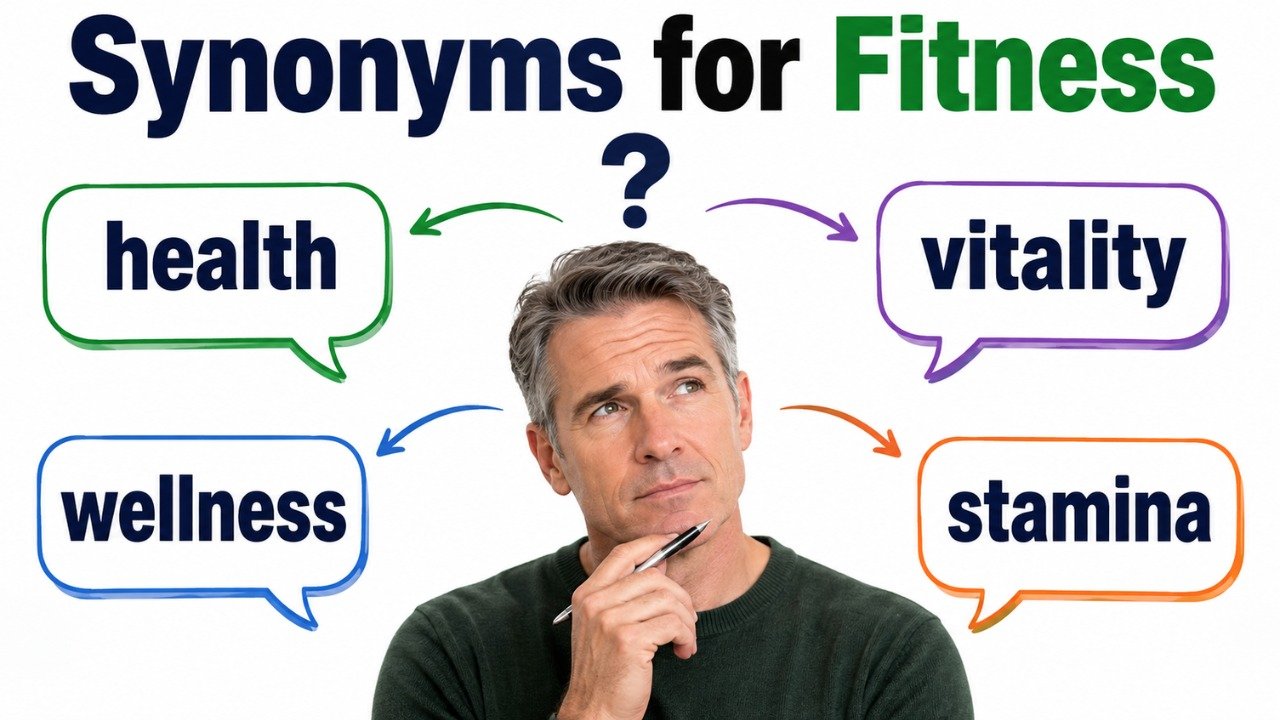
Quick Answer: The best synonyms for fitness include health, wellness, physical condition, conditioning, strength, stamina, endurance, vitality, suitability, and readiness. Use health for general physical well being, wellness for a balanced state of body and mind, conditioning for exercise preparation, strength for muscular ability, stamina for sustained effort, and endurance for long lasting performance. Suitability is the best formal alternative when fitness means being appropriate for a purpose, while readiness works well when describing preparation for a task.
Pronunciation and Word Details
Word: Fitness.
Pronunciation: /ˈfɪtnəs/.
Part of Speech: Noun.
Meaning: The state of being physically healthy, capable, prepared, or suitable for a particular purpose.
US Pronunciation:
UK Pronunciation:
What Does “Fitness” Mean?
Fitness means the condition of being healthy, strong, capable, or suitable for a particular activity or purpose. It is a noun that can describe physical health, athletic ability, readiness, appropriateness, or biological success.
In everyday language, fitness usually refers to the health and physical condition of the body.
Example: Regular movement can improve your fitness.
In sports, fitness describes a person’s strength, stamina, endurance, flexibility, speed, and overall physical performance.
Example: The coach tested the fitness of every player.
In formal contexts, fitness can mean suitability or qualification for a role, responsibility, or purpose.
Example: The committee questioned his fitness for the position.
In technical or biological contexts, fitness can describe how successfully an organism survives and reproduces within its environment.
Example: Adaptation can affect the biological fitness of a species.
The correct meaning depends on the surrounding words and the subject being discussed.
Meaning, Tone, and Context of “Fitness”
Fitness is usually a neutral word. Its tone changes according to the context in which it appears.
In health and exercise discussions, fitness is positive and encouraging. It suggests strength, energy, physical improvement, and healthy habits.
Example: She is working steadily toward better fitness.
In sports, fitness has a practical and performance focused tone. It may refer to speed, stamina, strength, mobility, or readiness to compete.
Example: His fitness improved before the tournament.
In professional writing, fitness can sound formal. It may describe whether someone or something is suitable for a role, task, duty, or purpose.
Example: The assessment measured her fitness for the responsibility.
In legal, medical, or workplace contexts, fitness may have a serious and technical meaning. It can refer to whether a person is physically or mentally capable of completing a duty safely.
In biology, fitness is an academic term connected with survival, adaptation, and reproductive success.
The word is common in the following contexts:
Health: Physical condition and general well being.
Exercise: Strength, endurance, mobility, and conditioning.
Sports: Readiness and ability to perform.
Employment: Capability to complete job duties.
Suitability: Appropriateness for a purpose or role.
Biology: Success in surviving and reproducing.
When and How to Use “Fitness”
For General Physical Health
Use fitness when discussing the overall condition of a person’s body.
Example: Walking each morning has improved his fitness.
For Exercise Ability
Use fitness when referring to someone’s ability to perform physical activity.
Example: Her fitness allows her to exercise for longer periods.
For Athletic Performance
Use fitness when describing the condition needed to train, compete, or recover effectively.
Example: The athlete returned to full fitness before the final match.
For Strength and Endurance
Use fitness as a broad term when several physical abilities are involved.
Example: Swimming develops strength, endurance, and overall fitness.
For Personal Goals
Use fitness when discussing healthy routines or physical improvement.
Example: His main fitness goal is to increase his stamina.
For Readiness
Use fitness when someone must be prepared for a demanding activity or responsibility.
Example: The examination confirmed her fitness to return to work.
For Suitability
Use fitness when judging whether someone or something is appropriate for a purpose.
Example: The panel evaluated each candidate’s fitness for the role.
For Equipment or Materials
Fitness can describe whether an object is suitable, functional, or safe for a particular use.
Example: The inspector checked the equipment’s fitness for continued use.
For Biological Success
Use fitness in scientific discussions about survival, adaptation, and reproduction.
Example: Certain traits may increase an organism’s biological fitness.
Best Synonyms for Fitness
Health
Synonym: Health means the general condition of the body and mind.
Example: Daily movement can support better health.
Wellness
Synonym: Wellness means an active state of physical, mental, and emotional well being.
Example: The program focuses on nutrition, movement, and wellness.
Physical Condition
Synonym: Physical condition describes the current health and performance level of the body.
Example: The trainer assessed her physical condition before the session.
Conditioning
Synonym: Conditioning means physical preparation developed through regular training.
Example: Months of conditioning prepared the runners for the race.
Strength
Synonym: Strength means the physical ability to produce force or resist pressure.
Example: Lifting exercises can improve strength.
Stamina
Synonym: Stamina means the ability to continue an activity without becoming tired quickly.
Example: Regular cycling helped him build stamina.
Endurance
Synonym: Endurance means the ability to sustain physical effort over a long period.
Example: Long distance swimming requires excellent endurance.
Vitality
Synonym: Vitality means physical energy, liveliness, and healthy strength.
Example: She approached the day with renewed vitality.
Suitability
Synonym: Suitability means being appropriate for a particular purpose, role, or situation.
Example: The interview assessed his suitability for the position.
Readiness
Synonym: Readiness means being prepared and capable of acting or performing.
Example: The test measured the team’s readiness for competition.
50 Synonyms for Fitness with Short Meanings
- Health: The general condition of the body or mind.
- Wellness: A balanced state of physical and mental well being.
- Physical Health: The healthy condition and functioning of the body.
- Physical Condition: The current state of bodily health and ability.
- Conditioning: Physical preparation gained through regular training.
- Strength: The ability to produce force or resist pressure.
- Stamina: The ability to continue without tiring quickly.
- Endurance: The ability to sustain effort for a long time.
- Vitality: Strong physical energy and liveliness.
- Vigor: Active physical or mental strength.
- Robustness: The quality of being strong and healthy.
- Hardiness: The ability to tolerate difficult physical conditions.
- Soundness: A healthy, stable, or reliable condition.
- Athleticism: Natural or developed ability in physical activities.
- Agility: The ability to move quickly and easily.
- Flexibility: The ability to bend and move through a wide range.
- Mobility: The ability to move freely and effectively.
- Balance: The ability to remain stable while standing or moving.
- Coordination: The ability to control different body movements together.
- Resilience: The ability to recover from effort, stress, or difficulty.
- Energy: The physical power needed for activity.
- Power: The ability to apply strength quickly and effectively.
- Capacity: The ability to perform or manage an activity.
- Work Capacity: The amount of physical effort a person can sustain.
- Exercise Capacity: The ability to perform physical exercise effectively.
- Performance: The level at which a person completes an activity.
- Form: A person’s current physical condition or performance level.
- Shape: A healthy or prepared physical state.
- Tone: Firmness and condition of the muscles.
- Trimness: A lean and physically maintained condition.
- Healthiness: The quality of being healthy.
- Bodily Health: The healthy condition of the physical body.
- Physical Readiness: Preparation for physical activity or effort.
- Preparedness: The state of being ready for a task.
- Readiness: The condition of being prepared and capable.
- Suitability: The quality of being right for a purpose.
- Appropriateness: The quality of fitting a situation or need.
- Qualification: The ability or experience required for a role.
- Aptitude: A natural ability to perform a task well.
- Capability: The power or ability to complete something.
- Competence: The ability to perform effectively and correctly.
- Ability: The skill or power needed to do something.
- Functionality: The quality of working properly.
- Serviceability: The condition of being usable and dependable.
- Usability: The quality of being practical for use.
- Compatibility: The ability to work or fit well with something.
- Adaptability: The ability to adjust successfully to new conditions.
- Durability: The ability to remain strong through continued use or stress.
- Constitution: A person’s general physical health and bodily strength.
- Physical Well Being: A comfortable, healthy, and capable bodily state.
Read Also:
Synonyms for Fluffy

Synonyms for Fitness by Context
When Fitness Means Physical Health
Health is the most direct synonym when fitness refers to the overall condition of the body. Wellness is broader because it can include emotional and mental health as well.
Useful alternatives include health, wellness, physical health, healthiness, bodily health, soundness, robustness, and physical well being.
Example With Fitness: Regular sleep is important for physical fitness.
Example With Health: Regular sleep is important for physical health.
Example With Wellness: Rest is an essential part of personal wellness.
When Fitness Means Exercise Condition
Conditioning and physical condition are suitable when discussing exercise preparation or training progress.
Useful alternatives include conditioning, physical condition, shape, form, tone, trimness, exercise capacity, and work capacity.
Example With Fitness: Her fitness improved after several weeks of training.
Example With Conditioning: Her conditioning improved after several weeks of training.
Example With Physical Condition: The assessment showed that his physical condition had improved.
When Fitness Means Strength and Energy
Strength, vitality, vigor, power, and energy work well when fitness refers to physical force or liveliness.
Example With Fitness: The exercises improved his overall fitness.
Example With Strength: The exercises improved his physical strength.
Example With Vitality: Better sleep gave her greater vitality.
When Fitness Means Stamina
Stamina and endurance are the best alternatives when fitness refers to continuing an activity without becoming exhausted.
Example With Fitness: The runner showed impressive fitness during the long race.
Example With Stamina: The runner showed impressive stamina during the long race.
Example With Endurance: Long training sessions helped her develop endurance.
When Fitness Means Movement Ability
Agility, flexibility, mobility, balance, and coordination describe specific parts of physical fitness.
Example With Fitness: Stretching can improve certain areas of fitness.
Example With Flexibility: Stretching can improve flexibility.
Example With Mobility: The exercises helped restore shoulder mobility.
When Fitness Means Suitability
Suitability and appropriateness are the strongest alternatives when fitness means being right for a role, task, or purpose.
Example With Fitness: The committee considered his fitness for the position.
Example With Suitability: The committee considered his suitability for the position.
Example With Appropriateness: The review examined the appropriateness of the proposed method.
When Fitness Means Ability
Capability, competence, ability, qualification, and aptitude are useful when fitness refers to having the qualities required for a task.
Example With Fitness: The test examined her fitness to manage the project.
Example With Capability: The test examined her capability to manage the project.
Example With Competence: The interview demonstrated his competence in leadership.
When Fitness Means Readiness
Readiness, preparedness, and physical readiness are suitable when discussing preparation for work, sport, or demanding activity.
Example With Fitness: The coach checked the players’ fitness before the match.
Example With Readiness: The coach checked the players’ readiness before the match.
Example With Preparedness: The exercise tested the team’s preparedness for an emergency.
When Fitness Means Biological Success
In biology, fitness refers to an organism’s ability to survive, reproduce, and pass traits to future generations. General synonyms such as health or strength may be inaccurate in this context.
More precise alternatives include reproductive success, survival capacity, adaptability, and biological advantage.
Example With Fitness: The trait increased the organism’s fitness in that environment.
Example With Reproductive Success: The trait increased the organism’s reproductive success.
Another Word for Fitness
Health is usually the best single replacement for fitness when the sentence refers to general physical condition. However, the best alternative depends on the intended meaning.
Choose wellness for balanced healthy living, conditioning for training preparation, endurance for sustained effort, and suitability when discussing whether someone or something is right for a purpose.
Original: Walking regularly can improve your fitness.
Better Option: Walking regularly can improve your health.
Original: The team needs more fitness before the tournament.
Better Option: The team needs better conditioning before the tournament.
Original: Her fitness helped her complete the long journey.
Better Option: Her endurance helped her complete the long journey.
Original: The board discussed his fitness for the role.
Better Option: The board discussed his suitability for the role.
When Not to Use “Fitness”
Fitness is a broad word, so it may sound unclear when a more specific term would communicate the exact meaning.
When Referring Only to Strength
Do not use fitness when you specifically mean muscular force.
Weak: The exercise increased his fitness in his arms.
Better: The exercise increased the strength in his arms.
When Referring Only to Endurance
Use endurance or stamina when the main idea is continuing for a long time.
Weak: She needs more fitness to finish the long race.
Better: She needs more endurance to finish the long race.
When Referring to Flexibility
Use flexibility when discussing how easily the body bends or stretches.
Weak: The routine improved his fitness around the hips.
Better: The routine improved his hip flexibility.
When Referring to Suitability
In formal writing, suitability is often clearer than fitness when judging whether something is appropriate.
Weak: We reviewed the fitness of the software for the task.
Better: We reviewed the suitability of the software for the task.
When Referring to Qualifications
Use qualification, competence, or capability when discussing professional skills.
Weak: Her fitness for accounting was clear from her experience.
Better: Her qualifications for accounting were clear from her experience.
When the Meaning Could Be Misunderstood
Fitness may suggest exercise even when you intend to describe readiness or appropriateness.
Weak: The manager questioned the applicant’s fitness.
Better: The manager questioned the applicant’s suitability for the position.
When Repeating the Word Too Often
Repeated use of fitness can make a paragraph sound dull or vague.
Weak: Fitness training improves fitness by building fitness skills.
Better: Physical training improves conditioning by building strength, stamina, and mobility.
Words Commonly Confused With Fitness
Fitness vs Health: Fitness usually refers to physical ability and condition, while health includes the overall state of the body and mind. A person may have good athletic fitness while still managing a health concern.
Fitness vs Wellness: Fitness mainly concerns physical condition and performance. Wellness is broader and can include mental, emotional, social, and physical well being.
Fitness vs Strength: Fitness is a broad concept that includes several abilities. Strength refers specifically to the ability to produce or resist force.
Fitness vs Stamina: Fitness describes general physical capability. Stamina is the ability to continue an activity without becoming tired quickly.
Fitness vs Endurance: Fitness includes strength, mobility, balance, and other qualities. Endurance focuses on maintaining effort for a long time.
Fitness vs Conditioning: Fitness is a person’s physical state. Conditioning is the process or result of training the body for activity.
Fitness vs Athleticism: Fitness can be developed by almost anyone. Athleticism often includes natural or trained qualities such as speed, coordination, power, and agility.
Fitness vs Suitability: Fitness can refer to physical condition or appropriateness. Suitability refers specifically to being right for a purpose or situation.
Fitness vs Readiness: Fitness describes capability or condition. Readiness emphasizes being prepared to act at a particular time.
Fitness vs Well Being: Fitness mainly concerns physical capacity. Well being describes a broader state of comfort, health, and life satisfaction.
Which Synonym Should You Choose?
Choose health when discussing general physical condition or the absence of physical problems.
Choose wellness when discussing a balanced lifestyle that includes physical and mental well being.
Choose physical condition when describing the current state of someone’s body.
Choose conditioning when discussing exercise preparation, sports training, or physical development.
Choose strength when referring to muscular force or the ability to lift, push, or resist.
Choose stamina when discussing the ability to continue an activity without tiring quickly.
Choose endurance when describing long lasting effort during exercise, sport, or demanding work.
Choose vitality when emphasizing liveliness, energy, and healthy enthusiasm.
Choose agility when discussing quick and controlled movement.
Choose flexibility when discussing bending, stretching, or range of movement.
Choose mobility when referring to the ability to move freely and comfortably.
Choose suitability in formal reports, assessments, essays, and professional communication about whether something is right for a purpose.
Choose readiness when discussing preparation for a task, event, competition, or responsibility.
Choose competence when evaluating whether a person can perform a professional duty effectively.
Choose capability when referring to the general ability to complete a task.
Choose qualification when discussing education, training, experience, or professional requirements.
Choose adaptability in biological, environmental, or organizational discussions about adjustment to changing conditions.
Real Life Examples of “Fitness” in Sentences
Original: She improved her fitness by walking every evening.
Better Option: She improved her health by walking every evening.
Original: The players worked on their fitness before the season began.
Better Option: The players worked on their conditioning before the season began.
Original: His fitness allowed him to climb the hill without resting.
Better Option: His stamina allowed him to climb the hill without resting.
Original: Swimming helped improve her overall fitness.
Better Option: Swimming helped improve her endurance and strength.
Original: The trainer evaluated my fitness before creating a routine.
Better Option: The trainer evaluated my physical condition before creating a routine.
Original: The doctor assessed his fitness to return to work.
Better Option: The doctor assessed his readiness to return to work.
Original: The interview focused on her fitness for the position.
Better Option: The interview focused on her suitability for the position.
Original: Regular stretching supports physical fitness.
Better Option: Regular stretching supports flexibility and mobility.
Original: The athlete reached peak fitness before the competition.
Better Option: The athlete reached peak form before the competition.
Original: The inspection confirmed the machine’s fitness for use.
Better Option: The inspection confirmed the machine’s serviceability.
Synonym Groups and Usage Differences
General Health Group
This group includes health, wellness, physical health, bodily health, healthiness, soundness, and physical well being.
Use these words when discussing the overall condition of the body rather than one particular physical skill.
Example: A balanced routine can support long term physical health.
Strength and Power Group
This group includes strength, power, vigor, robustness, and hardiness.
Use these words when emphasizing force, durability, or the ability to resist physical pressure.
Example: The training routine improved her strength and power.
Endurance Group
This group includes stamina, endurance, work capacity, exercise capacity, and resilience.
Use these words when describing sustained effort, resistance to tiredness, or recovery after physical strain.
Example: Cycling regularly helped him develop greater endurance.
Energy Group
This group includes vitality, vigor, energy, and liveliness.
Use these words when fitness refers to active energy, enthusiasm, or healthy physical force.
Example: Better sleep restored her energy and vitality.
Movement Group
This group includes agility, flexibility, mobility, balance, and coordination.
Use these terms for specific movement abilities rather than general fitness.
Example: The routine develops balance, coordination, and mobility.
Training Condition Group
This group includes conditioning, physical condition, form, shape, tone, and trimness.
Use these words when describing the results of physical training or a person’s current exercise condition.
Example: The player returned to excellent form after several weeks of conditioning.
Suitability Group
This group includes suitability, appropriateness, compatibility, usability, functionality, and serviceability.
Use these words when fitness means being right, practical, or functional for a purpose.
Example: The review examined the suitability of the equipment for outdoor use.
Ability Group
This group includes capability, competence, ability, aptitude, qualification, and capacity.
Use these words when fitness refers to the qualities or skills required to perform a task.
Example: Her experience demonstrated her capability to lead the project.
Readiness Group
This group includes readiness, preparedness, and physical readiness.
Use these terms when emphasizing preparation for immediate action or responsibility.
Example: The assessment confirmed the team’s readiness for the event.
Adaptation Group
This group includes adaptability, resilience, durability, and compatibility.
Use these words when discussing adjustment, survival, recovery, or continued effectiveness under changing conditions.
Example: Adaptability can improve an organism’s chances of survival.
Antonyms of Fitness
The opposite of fitness depends on whether the word refers to health, strength, ability, readiness, or suitability.
Unfitness: The condition of not being physically capable or suitable.
Illness: Poor health caused by disease or physical disorder.
Weakness: A lack of physical strength or power.
Frailty: Physical weakness and reduced resistance.
Fatigue: Extreme tiredness that limits performance.
Exhaustion: A severe lack of physical or mental energy.
Inactivity: A lack of physical movement or exercise.
Incapacity: An inability to perform a task or duty.
Inability: A lack of the power or skill to do something.
Unsuitability: The quality of not being right for a purpose.
Inappropriateness: The quality of not fitting a situation or need.
Unpreparedness: A lack of readiness for an activity or event.
Incompetence: A lack of the required ability or skill.
Poor Condition: An unhealthy or ineffective physical state.
Vulnerability: A reduced ability to resist harm, pressure, or difficulty.
Comparison: Fitness vs Related Words
Fitness vs Health
Fitness describes physical capability, conditioning, and performance. Health is a broader concept that includes physical and mental condition.
Example With Fitness: Regular running improved her fitness.
Example With Health: Nutritious meals supported her general health.
Fitness vs Wellness
Fitness mainly concerns the body’s physical condition. Wellness includes physical, emotional, mental, and social well being.
Example With Fitness: Strength training is part of his fitness routine.
Example With Wellness: Rest and stress management are part of her wellness routine.
Fitness vs Strength
Fitness is an overall condition made up of several abilities. Strength is one specific part of fitness.
Example With Fitness: The program develops complete physical fitness.
Example With Strength: The exercise develops upper body strength.
Fitness vs Stamina
Fitness refers to general physical ability. Stamina refers to continuing an activity without tiring quickly.
Example With Fitness: His overall fitness improved during training.
Example With Stamina: His stamina helped him finish the demanding hike.
Fitness vs Endurance
Fitness includes strength, movement, balance, and physical condition. Endurance describes the ability to sustain effort over time.
Example With Fitness: The test measured several areas of fitness.
Example With Endurance: The long run tested her endurance.
Fitness vs Conditioning
Fitness is the physical state a person has achieved. Conditioning is the training process that develops that state.
Example With Fitness: The athlete is in excellent fitness.
Example With Conditioning: Daily practice improved the athlete’s conditioning.
A more natural sentence would often use “excellent physical condition” or “excellent shape” instead of “excellent fitness.”
Fitness vs Athleticism
Fitness can refer to anyone’s physical condition. Athleticism usually suggests strong natural or trained ability in sports and movement.
Example With Fitness: Walking can improve fitness at any age.
Example With Athleticism: Her speed and coordination reveal impressive athleticism.
Fitness vs Suitability
Fitness can mean physical health or appropriateness. Suitability only means being appropriate for a role, purpose, or situation.
Example With Fitness: The doctor evaluated his fitness for physical work.
Example With Suitability: The manager evaluated his suitability for the position.
Fitness vs Readiness
Fitness describes physical capability or general suitability. Readiness emphasizes preparation at a particular moment.
Example With Fitness: The training improved the team’s fitness.
Example With Readiness: The final practice confirmed the team’s readiness.
Common Phrases and Expressions With Fitness
Physical Fitness: The health, strength, and performance condition of the body.
General Fitness: Overall physical ability rather than one specific skill.
Fitness Level: The current degree of physical health and capability.
Fitness Goal: A desired improvement in health, strength, endurance, or movement.
Fitness Routine: A regular plan of physical activities.
Fitness Training: Exercise performed to improve physical condition.
Fitness Assessment: An evaluation of strength, stamina, mobility, and other abilities.
Fitness Test: A structured test of physical capacity or readiness.
Peak Fitness: The highest level of physical condition or performance.
Return to Fitness: The process of regaining physical condition after illness, injury, or inactivity.
Fitness for Purpose: The quality of being suitable and effective for an intended use.
Fitness to Work: The physical or mental ability to complete job duties safely.
Fitness for Duty: Readiness and capability to perform an assigned responsibility.
Cardiovascular Fitness: The ability of the heart and lungs to support sustained physical activity.
Muscular Fitness: The strength and endurance of the muscles.
Common Mistakes to Avoid
Using Fitness as a Replacement for Every Health Word
Fitness does not always mean complete health. Someone can be physically active while still experiencing a medical condition.
Use health when referring to the overall condition of the body or mind.
Confusing Fitness With Strength
Strength is only one part of fitness. A strong person may still have limited endurance, mobility, or flexibility.
Use strength when muscular force is the exact meaning.
Confusing Stamina and Endurance
Stamina often emphasizes how long someone can continue before becoming tired. Endurance usually emphasizes sustained effort over a longer period.
The meanings overlap, but the most natural choice depends on the activity.
Using Fitness for Suitability Without Context
A sentence such as “We questioned his fitness” may sound as though it refers to physical health.
Add the purpose or replace fitness with suitability.
Unclear: We questioned his fitness.
Clear: We questioned his suitability for the leadership role.
Choosing a Broad Word Instead of a Precise One
Fitness may be too general when you mean balance, coordination, flexibility, strength, or endurance.
Vague: The exercises improved her fitness.
Precise: The exercises improved her balance and mobility.
Repeating Fitness Too Frequently
Using the same word in every sentence makes writing repetitive.
Repetitive: Fitness classes improve fitness by teaching fitness exercises.
Improved: Exercise classes improve physical condition by developing strength, mobility, and stamina.
Using Unnatural Phrases
Expressions such as “excellent fitness” can sound less natural than “excellent shape,” “excellent condition,” or “high fitness level.”
Unnatural: He has excellent fitness.
Natural: He is in excellent physical condition.
Ignoring the Technical Meaning
In biology, fitness does not simply mean strength or good health. It refers more specifically to survival and reproductive success.
Choose scientific terms carefully when writing in an academic context.
Assuming Fitness Always Refers to Appearance
Fitness concerns physical ability and condition, not only body size or appearance. Avoid language that treats a particular appearance as proof of health or capability.
Conclusion
The best synonyms for fitness depend on the intended meaning. Health and wellness suit general well being, while conditioning and physical condition describe exercise preparation. Strength, stamina, endurance, vitality, agility, and mobility identify particular physical abilities. In formal writing, suitability is the clearest choice when fitness means being appropriate for a purpose, while readiness emphasizes preparation. Understanding these differences helps you choose precise, natural alternatives and use synonyms for fitness confidently in health, sports, professional, academic, and everyday contexts.
FAQs About Synonyms for Fitness
What Is the Best Synonym for Fitness?
Health is the best general synonym when fitness refers to physical well being. Suitability is better when fitness means being right for a purpose.
Is Wellness a Synonym for Fitness?
Wellness is a close alternative, but it has a broader meaning. Fitness focuses mainly on physical condition, while wellness can include mental and emotional well being.
Is Strength the Same as Fitness?
No. Strength is one part of fitness. Fitness may also include stamina, endurance, flexibility, balance, mobility, and coordination.
What Is Another Word for Physical Fitness?
Useful alternatives include physical health, physical condition, conditioning, healthiness, athleticism, form, shape, and bodily health.
What Is a Formal Synonym for Fitness?
Suitability is the strongest formal synonym when discussing a role or purpose. Capability, competence, qualification, and readiness may also work depending on the sentence.
What Is the Difference Between Fitness and Stamina?
Fitness describes general physical condition. Stamina describes the ability to continue an activity without becoming tired quickly.
Can Fitness Mean Suitability?
Yes. Fitness can mean being suitable or qualified for a role, responsibility, task, or intended purpose.
