
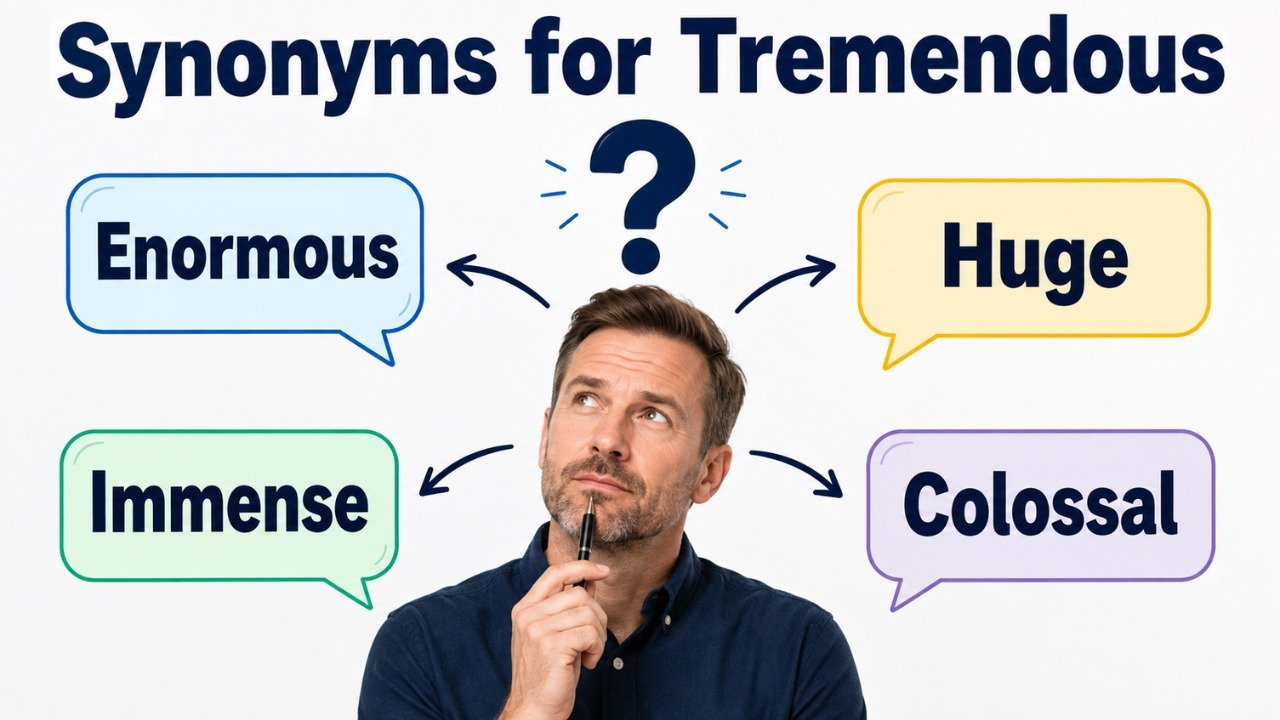
Quick Answer: The best synonyms for tremendous include enormous, immense, massive, extraordinary, remarkable, exceptional, outstanding, powerful, phenomenal, and spectacular. Use enormous or massive for physical size, immense for a great amount or degree, exceptional and outstanding for excellent quality, powerful for force or influence, remarkable for notable achievements, and phenomenal or spectacular for highly impressive results. The most suitable synonyms for tremendous depend on whether you are describing size, quantity, intensity, success, quality, effort, influence, or emotional impact.
Pronunciation and Word Details
Word: Tremendous.
Pronunciation: /trəˈmen.dəs/
Part of Speech: Adjective.
Meaning: Extremely large, powerful, impressive, intense, or excellent.
US Pronunciation:
UK Pronunciation:
What Does “Tremendous” Mean?
Tremendous means extremely large, great, powerful, impressive, or excellent.
It is an adjective used before a noun or after a linking verb. The word can describe physical size, quantity, intensity, importance, effort, success, influence, or quality.
Example: The project required a tremendous amount of work.
In this sentence, tremendous means very great in amount.
Tremendous can describe something physically large.
Example: A tremendous wave struck the shore.
It may also describe strong power, pressure, emotion, or influence.
Example: The decision placed tremendous pressure on the team.
In positive contexts, tremendous often means excellent, remarkable, or highly impressive.
Example: She gave a tremendous performance.
The word can also describe serious damage, difficulty, or loss.
Example: The storm caused tremendous damage.
Tremendous therefore does not always express praise. Its meaning depends on the noun it modifies. A tremendous success is positive, while tremendous suffering is negative.
Meaning, Tone, and Context of “Tremendous”
Tremendous has a strong and emphatic tone. It communicates that something is far beyond an ordinary level.
The word is common in everyday conversation, professional communication, journalism, speeches, essays, descriptions, and promotional writing. It can sound enthusiastic when used for achievements, performances, opportunities, or improvements.
Positive Context: The new approach produced tremendous results.
In formal writing, tremendous is acceptable, but it may sound less precise than substantial, significant, extensive, or considerable.
Formal Context: The policy produced a significant improvement in safety.
Conversational Context: The policy made a tremendous difference.
Tremendous may also express emotional intensity.
Example: The family felt tremendous relief after hearing the news.
In technical, scientific, or academic writing, exact measurements are often better than broad descriptive words.
Vague: The temperature showed a tremendous increase.
Precise: The temperature increased by fifteen degrees.
The tone of tremendous can be positive, negative, or neutral. It is positive in tremendous achievement, negative in tremendous damage, and neutral in tremendous force.
When and How to Use “Tremendous”
For Large Size
Use tremendous when something is unusually large in physical scale.
Example: A tremendous tree stood at the center of the garden.
For Great Quantity
The word can describe a very large amount of time, money, work, information, or support.
Example: The research required a tremendous amount of patience.
For Strong Effort
Use tremendous to emphasize exceptional work, determination, or energy.
Example: The volunteers made a tremendous effort to complete the repairs.
For Major Success
Tremendous can describe an achievement or result that greatly exceeds expectations.
Example: The campaign was a tremendous success.
For Excellent Quality
Use tremendous informally to mean excellent, impressive, or outstanding.
Example: The singer delivered a tremendous performance.
For Strong Power
The word can describe physical force, authority, energy, or influence.
Example: The waterfall released tremendous power.
For Emotional Intensity
Use tremendous for powerful feelings such as joy, relief, fear, pride, or sadness.
Example: She felt tremendous pride in her students.
For Serious Pressure
Tremendous can emphasize a heavy responsibility, demand, or burden.
Example: The deadline placed tremendous pressure on the entire department.
For Important Impact
Use the word when an action, event, or person creates a major effect.
Example: Her research had a tremendous impact on the field.
For Major Improvement
Tremendous can describe rapid or highly noticeable progress.
Example: His confidence showed tremendous improvement.
For Great Opportunity
Use tremendous when an opportunity offers unusually high potential.
Example: The program provides a tremendous opportunity for young writers.
For Serious Damage
Tremendous can emphasize severe harm, destruction, or loss.
Example: The flooding caused tremendous damage to local farms.
Best Synonyms for Tremendous
Enormous: Extremely large in size, amount, or degree.
Example: The repairs required an enormous amount of money.
Immense: Extremely great in size, extent, or intensity.
Example: She felt immense relief when the examination ended.
Massive: Very large, heavy, extensive, or important.
Example: The project involved a massive construction effort.
Extraordinary: Far beyond what is usual or expected.
Example: The team achieved extraordinary results.
Remarkable: Unusual and worthy of attention or admiration.
Example: She made remarkable progress in a short period.
Exceptional: Unusually excellent or superior.
Example: The restaurant was known for its exceptional service.
Outstanding: Extremely good and noticeably better than others.
Example: He received recognition for his outstanding performance.
Powerful: Having great force, strength, or influence.
Example: The speech delivered a powerful message.
Phenomenal: Extremely impressive, successful, or remarkable.
Example: The product experienced phenomenal growth.
Spectacular: Highly impressive, dramatic, or visually striking.
Example: The audience enjoyed a spectacular display.
50 Synonyms for Tremendous with Short Meanings
- Enormous: Extremely large in size or amount.
- Immense: Very great in scale, degree, or intensity.
- Vast: Extremely large in area, range, or quantity.
- Huge: Very large in size, amount, or importance.
- Gigantic: Extremely large in physical size.
- Colossal: Exceptionally large, powerful, or impressive.
- Massive: Very large, heavy, extensive, or important.
- Monumental: Extremely important, difficult, or impressive.
- Mammoth: Unusually large and demanding.
- Towering: Extremely impressive, important, or physically tall.
- Prodigious: Remarkably great in size, ability, or amount.
- Substantial: Large enough to be important or noticeable.
- Considerable: Great in amount, size, or importance.
- Extensive: Covering a large area, range, or amount.
- Expansive: Wide, extensive, or large in scope.
- Boundless: Having no apparent limit.
- Limitless: Seemingly without restriction or end.
- Extraordinary: Far beyond what is normal.
- Remarkable: Unusual and worthy of attention.
- Exceptional: Unusually excellent or impressive.
- Outstanding: Extremely good or clearly superior.
- Magnificent: Extremely beautiful, impressive, or excellent.
- Marvelous: Exceptionally good or wonderful.
- Superb: Excellent in quality.
- Excellent: Extremely good or successful.
- Impressive: Creating strong admiration or respect.
- Spectacular: Dramatic and highly impressive.
- Phenomenal: Remarkably successful or extraordinary.
- Astonishing: Extremely surprising or impressive.
- Astounding: So impressive that it causes great surprise.
- Amazing: Causing wonder or admiration.
- Incredible: Extremely impressive or difficult to believe.
- Wonderful: Extremely pleasing or excellent.
- Terrific: Extremely good, intense, or powerful.
- Powerful: Having great force, strength, or influence.
- Intense: Extremely strong in degree or feeling.
- Overwhelming: So great that it is difficult to manage.
- Profound: Very great, deep, or important.
- Major: Great in importance, size, or effect.
- Significant: Important or large enough to be noticed.
- Great: Large, important, strong, or excellent.
- Mighty: Possessing great power or strength.
- Forceful: Strong, energetic, or influential.
- Formidable: Extremely powerful, difficult, or impressive.
- Dramatic: Striking, sudden, or highly noticeable.
- Staggering: So large or impressive that it causes shock.
- Stupendous: Extremely impressive or enormous.
- Awesome: Extremely impressive or inspiring.
- Splendid: Excellent, impressive, or beautiful.
- Breathtaking: Exceptionally impressive or beautiful.
Read Also:
Synonyms for Occur

Synonyms for Tremendous by Context
When Tremendous Means Very Large
Enormous, immense, huge, gigantic, massive, colossal, mammoth, and vast are useful when describing physical size or quantity.
Enormous is the strongest general alternative.
Example With Tremendous: The building contained a tremendous entrance hall.
Example With Enormous: The building contained an enormous entrance hall.
Massive often suggests large physical size, weight, scale, or organization.
Example: A massive stone wall surrounded the property.
Gigantic emphasizes extreme physical size.
Example: A gigantic statue stood above the entrance.
Vast is especially natural for areas, distances, resources, knowledge, and spaces.
Example: The region contains vast areas of untouched forest.
When Tremendous Means a Great Amount
Immense, substantial, considerable, extensive, enormous, and vast work well for money, effort, information, support, time, and resources.
Substantial sounds formal and measured.
Example: The program received substantial financial support.
Considerable means large enough to deserve attention.
Example: The repairs required considerable time and effort.
Immense emphasizes an exceptionally high degree.
Example: The project demanded immense patience.
When Tremendous Means Excellent
Outstanding, exceptional, superb, excellent, marvelous, splendid, and magnificent are suitable when tremendous expresses praise.
Outstanding suggests performance that is clearly better than average.
Example: She produced an outstanding piece of work.
Exceptional means unusually good.
Example: The hotel provided exceptional service.
Superb is concise and strongly positive.
Example: The chef prepared a superb meal.
Magnificent can describe quality, beauty, grandeur, or achievement.
Example: The orchestra gave a magnificent performance.
When Tremendous Means Impressive
Remarkable, phenomenal, spectacular, astonishing, astounding, breathtaking, and incredible describe something that creates admiration or surprise.
Remarkable is useful in formal and neutral writing.
Example: The patient made a remarkable recovery.
Phenomenal emphasizes exceptional success, speed, talent, or growth.
Example: The athlete achieved phenomenal results.
Spectacular often describes something visually impressive or dramatically successful.
Example: The event ended with a spectacular display.
Breathtaking is especially suitable for scenery, beauty, skill, and dramatic experiences.
Example: The mountain view was breathtaking.
When Tremendous Means Powerful
Powerful, mighty, forceful, formidable, intense, and overwhelming suit descriptions of strength, energy, pressure, authority, or influence.
Powerful is the clearest general choice.
Example: The speaker delivered a powerful argument.
Mighty has a literary or dramatic tone.
Example: A mighty wind swept across the valley.
Formidable suggests something powerful and difficult to oppose.
Example: The team faced a formidable opponent.
Intense emphasizes the strength of a feeling, experience, condition, or activity.
Example: The athletes trained under intense pressure.
When Tremendous Means Important
Major, significant, monumental, profound, and substantial fit changes, decisions, achievements, discoveries, and effects.
Significant is useful in formal, academic, and professional writing.
Example: The change produced a significant improvement in safety.
Major is clear and direct.
Example: The project reached a major milestone.
Monumental suggests exceptional importance, difficulty, or historical value.
Example: Completing the agreement was a monumental achievement.
Profound describes a deep and lasting effect.
Example: The experience had a profound influence on her writing.
When Tremendous Means Intense
Intense, overwhelming, staggering, extraordinary, and powerful describe strong emotions, pressure, pain, excitement, or effort.
Overwhelming means so strong or great that it becomes difficult to manage.
Example: She received overwhelming support from the community.
Staggering emphasizes a degree that causes shock or disbelief.
Example: The final cost was staggering.
Extraordinary can describe strength or intensity beyond the usual level.
Example: The rescue required extraordinary courage.
When Tremendous Means Rapid Growth
Phenomenal, dramatic, remarkable, substantial, exceptional, and impressive fit growth, progress, improvement, or expansion.
Dramatic suggests a highly noticeable change.
Example: The patient showed dramatic improvement.
Phenomenal suggests exceptional speed or scale.
Example: The small business experienced phenomenal growth.
Substantial is more measured and formal.
Example: The organization reported substantial progress.
When Tremendous Means Serious Damage
Enormous, extensive, massive, severe, devastating, and considerable may replace tremendous when discussing harm or loss.
Extensive focuses on the wide range or area affected.
Example: The storm caused extensive damage.
Massive emphasizes the large scale of the harm.
Example: The failure resulted in massive financial losses.
Considerable sounds less emotional and more formal.
Example: The building suffered considerable structural damage.
Another Word for Tremendous
The best single replacement for tremendous is often immense when the word describes size, quantity, force, or degree.
However, the best alternative depends on context. Exceptional is better for quality, outstanding suits performance, enormous fits size, and remarkable describes notable progress or success.
Original: The project required a tremendous amount of effort.
Better Option: The project required an immense amount of effort.
Original: She gave a tremendous performance.
Better Option: She gave an outstanding performance.
Original: The organization achieved tremendous growth.
Better Option: The organization achieved phenomenal growth.
Original: The storm caused tremendous damage.
Better Option: The storm caused extensive damage.
When Not to Use “Tremendous”
Tremendous is expressive and useful, but it may sound vague, exaggerated, repetitive, or less accurate than another adjective.
When Exact Information Is Available
Use measurements, percentages, or exact figures in technical and analytical writing.
Weak: The building showed a tremendous increase in energy use.
Better: The building’s energy use increased by thirty percent.
When the Increase Is Only Moderate
Tremendous suggests an extreme level. Do not use it for a small or ordinary change.
Weak: Attendance increased tremendously from one hundred people to one hundred and three.
Better: Attendance increased slightly from one hundred people to one hundred and three.
When a More Specific Word Is Available
Choose an adjective that identifies the type of greatness.
Weak: The performer had tremendous skill.
Better: The performer had exceptional skill.
In Highly Formal Reports
Significant, substantial, extensive, or considerable may sound more objective.
Weak: The policy had a tremendous effect on costs.
Better: The policy had a significant effect on costs.
When Describing Physical Size
Enormous, massive, vast, or gigantic may create a clearer picture.
Weak: A tremendous vehicle blocked the entrance.
Better: A massive vehicle blocked the entrance.
When Describing Emotional Depth
Profound, intense, or overwhelming may communicate the feeling more precisely.
Weak: She experienced tremendous sadness.
Better: She experienced profound sadness.
When Describing Excellent Quality
Outstanding, superb, or exceptional may sound more polished.
Weak: The report was tremendous.
Better: The report was exceptionally clear and thorough.
When the Word Is Repeated
Frequent use reduces its effect.
Weak: The team made tremendous progress through tremendous effort and achieved tremendous success.
Better: The team made remarkable progress through exceptional effort and achieved outstanding success.
When the Tone Should Be Modest
Tremendous may sound exaggerated in restrained professional communication.
Weak: I made a tremendous contribution to the project.
Better: I made a substantial contribution to the project.
When the Meaning Is Unclear
State whether you mean large, powerful, excellent, difficult, or impressive.
Weak: The change was tremendous.
Better: The change produced a significant improvement in efficiency.
Words Commonly Confused With Tremendous
Tremendous vs Enormous: Tremendous can mean very large, powerful, or excellent. Enormous mainly emphasizes large size, amount, or degree.
Tremendous vs Immense: Both express a very high degree. Immense often describes size, quantity, feeling, or importance, while tremendous can also mean excellent.
Tremendous vs Massive: Tremendous is broad and emotional. Massive usually emphasizes physical size, weight, scale, or quantity.
Tremendous vs Huge: Huge is common and conversational. Tremendous sounds more emphatic and can describe quality as well as size.
Tremendous vs Great: Great has a broad range of meanings and may be mild or strong. Tremendous always suggests an unusually high degree.
Tremendous vs Terrific: Both can mean excellent. Terrific is more conversational, while tremendous also commonly describes large amounts, force, or impact.
Tremendous vs Outstanding: Tremendous may describe size, power, or excellence. Outstanding specifically describes superior quality or performance.
Tremendous vs Exceptional: Tremendous emphasizes greatness or intensity. Exceptional means unusually good or different from the normal standard.
Tremendous vs Remarkable: Tremendous emphasizes scale or excellence. Remarkable emphasizes that something deserves attention because it is unusual.
Tremendous vs Significant: Tremendous is expressive and emphatic. Significant is more formal and means important or large enough to matter.
Tremendous vs Substantial: Tremendous suggests an extreme level. Substantial means large or important but usually sounds more measured.
Tremendous vs Profound: Tremendous emphasizes great size, force, or degree. Profound emphasizes depth, seriousness, or lasting influence.
Tremendous vs Spectacular: Tremendous can describe many forms of greatness. Spectacular emphasizes dramatic, visual, or highly impressive qualities.
Which Synonym Should You Choose?
Choose enormous when describing extremely large objects, quantities, costs, or problems.
Choose immense for great effort, relief, pressure, importance, size, or emotional intensity.
Choose vast for land, distance, knowledge, resources, opportunities, or large areas.
Choose huge in casual speech when describing size, amount, popularity, or success.
Choose gigantic for exceptionally large physical objects.
Choose colossal for dramatic descriptions of size, failure, cost, or achievement.
Choose massive for physical scale, construction, support, losses, change, or organized effort.
Choose substantial in reports, essays, and professional emails when the amount is large but the tone should remain measured.
Choose considerable when something is important or large enough to deserve attention.
Choose extensive for damage, research, experience, knowledge, changes, or areas covered.
Choose extraordinary when something goes far beyond what is normal or expected.
Choose remarkable when a result, improvement, skill, recovery, or achievement deserves attention.
Choose exceptional for quality, ability, talent, service, performance, or circumstances.
Choose outstanding for superior work, results, performance, or achievement.
Choose superb for concise praise of quality, skill, food, service, or performance.
Choose magnificent for impressive beauty, grandeur, quality, or artistic achievement.
Choose phenomenal for rapid growth, extraordinary ability, popularity, or success.
Choose spectacular for dramatic achievements, visual displays, scenery, or performances.
Choose astonishing or astounding when something creates strong surprise.
Choose breathtaking for scenery, beauty, skill, speed, or an impressive experience.
Choose powerful for force, influence, arguments, speeches, emotions, or machinery.
Choose intense for pressure, emotion, heat, pain, competition, or concentration.
Choose overwhelming when the amount or force is difficult to manage.
Choose profound for emotional depth, serious meaning, or lasting impact.
Choose major for important events, changes, problems, decisions, or achievements.
Choose significant in academic, analytical, or professional writing.
Choose formidable for powerful opponents, difficult tasks, or impressive ability.
Choose dramatic for sudden and highly noticeable changes.
Choose staggering when a number, cost, amount, or result is shockingly large.
Real Life Examples of “Tremendous” in Sentences
Original: The volunteers made a tremendous effort to clean the park.
Better Option: The volunteers made an extraordinary effort to clean the park.
Original: The new system produced tremendous improvements.
Better Option: The new system produced significant improvements.
Original: She felt tremendous relief after receiving the results.
Better Option: She felt immense relief after receiving the results.
Original: The actor gave a tremendous performance.
Better Option: The actor gave an outstanding performance.
Original: The storm caused tremendous damage to the coastline.
Better Option: The storm caused extensive damage to the coastline.
Original: The organization received tremendous support from residents.
Better Option: The organization received overwhelming support from residents.
Original: The company achieved tremendous growth during the period.
Better Option: The company achieved phenomenal growth during the period.
Original: The machine generates tremendous power.
Better Option: The machine generates immense power.
Original: The discovery had a tremendous impact on the research.
Better Option: The discovery had a profound impact on the research.
Original: Completing the bridge was a tremendous achievement.
Better Option: Completing the bridge was a monumental achievement.
Synonym Groups and Usage Differences
Size Group
Enormous, immense, huge, gigantic, massive, colossal, mammoth, and vast describe physical size or scale.
Enormous and huge are broad. Massive suggests weight or scale. Gigantic and colossal are more dramatic. Vast works for areas and ranges.
Example: A massive structure dominated the landscape.
Quantity Group
Immense, substantial, considerable, extensive, vast, and enormous describe large amounts.
Substantial and considerable suit formal writing. Immense and enormous are stronger and more emotional. Extensive emphasizes range.
Example: The investigation required extensive resources.
Excellence Group
Outstanding, exceptional, superb, excellent, splendid, marvelous, and magnificent express high quality.
Outstanding emphasizes superiority. Exceptional means unusually good. Superb is concise and polished. Magnificent adds grandeur.
Example: She received praise for her exceptional leadership.
Achievement Group
Remarkable, phenomenal, extraordinary, monumental, impressive, and outstanding describe notable results.
Remarkable focuses on being worthy of attention. Phenomenal suggests exceptional success. Monumental emphasizes importance and difficulty.
Example: The team made remarkable progress in six months.
Power Group
Powerful, mighty, forceful, formidable, intense, and overwhelming describe strength or influence.
Powerful is general. Mighty is dramatic. Forceful suits arguments or actions. Formidable suggests strength that is difficult to oppose.
Example: The lawyer presented a forceful argument.
Impact Group
Profound, major, significant, dramatic, substantial, and far reaching describe important effects.
Profound suggests depth and lasting influence. Significant is formal. Dramatic indicates a noticeable change. Major is direct and clear.
Example: The decision had a profound effect on the community.
Surprise Group
Astonishing, astounding, staggering, incredible, amazing, and stupendous express wonder or disbelief.
Astonishing and astounding emphasize surprise. Staggering often describes shocking numbers or costs. Incredible is common in conversation.
Example: The final expenses reached a staggering total.
Visual Impression Group
Spectacular, breathtaking, magnificent, splendid, awesome, and impressive describe scenes, displays, performances, or designs.
Spectacular is dramatic. Breathtaking emphasizes beauty or wonder. Impressive is more neutral and professional.
Example: Visitors enjoyed a spectacular view from the summit.
Intensity Group
Intense, overwhelming, profound, powerful, and extraordinary describe feelings, pressure, heat, effort, or concentration.
Intense focuses on strength. Overwhelming suggests difficulty managing the experience. Profound indicates depth.
Example: The workers faced intense pressure to meet the deadline.
Antonyms of Tremendous
The opposite of tremendous depends on whether the word describes size, importance, quality, power, or intensity.
Tiny: Extremely small in physical size.
Small: Limited in size, amount, or degree.
Little: Small in quantity or importance.
Minor: Not very important or serious.
Slight: Small in degree or amount.
Modest: Limited, moderate, or not extreme.
Limited: Restricted in amount, range, or extent.
Negligible: So small that it has little importance.
Insignificant: Too small or unimportant to matter.
Trivial: Of very little importance or seriousness.
Ordinary: Normal rather than exceptional.
Average: Typical and not unusually good.
Mediocre: Only moderate in quality.
Unimpressive: Failing to create admiration.
Poor: Low in quality or effectiveness.
Weak: Lacking strength, power, or influence.
Mild: Not strong, severe, or intense.
Moderate: Neither small nor extreme.
Minimal: The smallest possible amount.
Inconsequential: Having little or no important effect.
Comparison: Tremendous vs Related Words
Tremendous vs Enormous
Tremendous can describe size, amount, power, impact, or excellence. Enormous mainly describes an extremely large size, amount, or degree.
Example With Tremendous: She made a tremendous contribution to the project.
Example With Enormous: The project required an enormous financial investment.
Tremendous vs Immense
Tremendous and immense both express a very high degree. Immense is especially natural for size, emotion, effort, and importance.
Example With Tremendous: The event was a tremendous success.
Example With Immense: The organizers felt immense pride in the result.
Tremendous vs Massive
Tremendous is broad and often emotional. Massive focuses more directly on physical size, quantity, scale, or organized activity.
Example With Tremendous: The decision received tremendous support.
Example With Massive: The construction required a massive workforce.
Tremendous vs Outstanding
Tremendous may mean large, powerful, or excellent. Outstanding specifically means extremely good or superior.
Example With Tremendous: The singer gave a tremendous performance.
Example With Outstanding: The singer gave an outstanding performance.
Tremendous vs Exceptional
Tremendous emphasizes greatness or intensity. Exceptional emphasizes quality that is unusually high.
Example With Tremendous: The team achieved tremendous results.
Example With Exceptional: The team demonstrated exceptional skill.
Tremendous vs Remarkable
Tremendous emphasizes scale, force, or excellence. Remarkable emphasizes something unusual enough to deserve attention.
Example With Tremendous: The athlete displayed tremendous strength.
Example With Remarkable: The athlete made a remarkable recovery.
Tremendous vs Significant
Tremendous is expressive and strong. Significant is more objective and appropriate in formal or analytical writing.
Example With Tremendous: The change had a tremendous effect on production.
Example With Significant: The change had a significant effect on production.
Tremendous vs Substantial
Tremendous suggests an extreme level. Substantial describes a large or important amount without sounding exaggerated.
Example With Tremendous: The repairs required tremendous investment.
Example With Substantial: The repairs required substantial investment.
Tremendous vs Phenomenal
Tremendous is a broad word for greatness. Phenomenal commonly describes exceptional success, growth, talent, or performance.
Example With Tremendous: The program achieved tremendous popularity.
Example With Phenomenal: The program experienced phenomenal growth.
Tremendous vs Profound
Tremendous emphasizes a great amount or degree. Profound emphasizes depth, seriousness, or lasting influence.
Example With Tremendous: The speech received tremendous attention.
Example With Profound: The speech had a profound emotional impact.
Common Phrases and Expressions With “Tremendous”
Tremendous Success: An exceptionally strong or impressive achievement.
Example: The community event was a tremendous success.
Tremendous Effort: An unusually great amount of work or energy.
Example: Completing the rescue required tremendous effort.
Tremendous Impact: A very powerful or important effect.
Example: The discovery had a tremendous impact on the project.
Tremendous Amount: An extremely large quantity.
Example: The process generates a tremendous amount of information.
Tremendous Growth: A very large or rapid increase.
Example: The organization experienced tremendous growth.
Tremendous Pressure: An extremely high level of demand or stress.
Example: The team worked under tremendous pressure.
Tremendous Opportunity: A highly valuable or promising chance.
Example: The scholarship provides a tremendous opportunity.
Tremendous Support: A very large amount of assistance or approval.
Example: The proposal received tremendous support from residents.
Tremendous Achievement: An exceptionally important or difficult accomplishment.
Example: Finishing the project early was a tremendous achievement.
Tremendous Difference: A major and noticeable change or effect.
Example: Regular practice made a tremendous difference.
Common Mistakes to Avoid
Using Very Before Tremendous
Tremendous already expresses an extreme degree. Very tremendous usually sounds redundant.
Weak: The result was very tremendous.
Better: The result was tremendous.
Better: The result was truly remarkable.
Using Tremendous for a Small Change
Do not use tremendous when the difference is minor.
Weak: The price showed a tremendous increase of one percent.
Better: The price showed a slight increase of one percent.
Using a Vague Adjective Instead of Evidence
In reports and essays, support claims with facts or measurements.
Vague: The new method produced tremendous savings.
Precise: The new method reduced costs by twenty percent.
Repeating Tremendous Too Often
Overuse weakens emphasis and makes writing monotonous.
Repetitive: The plan produced tremendous growth, tremendous savings, and tremendous public support.
Improved: The plan produced remarkable growth, substantial savings, and widespread public support.
Using Tremendous Amount With Countable Nouns
Use number with countable nouns and amount with uncountable nouns.
Incorrect: A tremendous amount of people attended.
Correct: A tremendous number of people attended.
Correct: A tremendous amount of support was received.
Choosing a Positive Synonym for a Negative Context
Superb and marvelous cannot naturally replace tremendous when discussing damage, pain, or loss.
Incorrect: The storm caused marvelous damage.
Correct: The storm caused extensive damage.
Choosing a Size Word for Quality
Gigantic and mammoth usually refer to size or scale, not excellent performance.
Unnatural: She gave a gigantic performance.
Better: She gave an outstanding performance.
Using Tremendous When Profound Is More Accurate
Use profound for deep emotional, intellectual, or lasting effects.
Weak: The experience had a tremendous emotional meaning.
Better: The experience had profound emotional meaning.
Using Tremendous in Restrained Formal Writing
Tremendous may sound emotional in reports. Significant or substantial often fits better.
Emotional: The policy created tremendous improvements.
Formal: The policy created significant improvements.
Forming an Awkward Comparative
More tremendous is grammatically possible in rare contexts, but greater, more impressive, or more substantial usually sounds better.
Awkward: The second result was more tremendous than the first.
Better: The second result was more impressive than the first.
Misspelling Tremendous
The correct spelling is tremendous.
Incorrect: Tremendious.
Correct: Tremendous.
Confusing Tremendous With Tremendously
Tremendous is an adjective that modifies a noun. Tremendously is an adverb that modifies a verb, adjective, or another adverb.
Adjective: She made tremendous progress.
Adverb: She improved tremendously.
Using Tremendous Without a Clear Meaning
Choose a more exact word when readers need to know whether something was large, excellent, intense, or influential.
Vague: The response was tremendous.
Clear: The response was overwhelmingly positive.
Conclusion
The best synonyms for tremendous include enormous, immense, massive, extraordinary, remarkable, exceptional, outstanding, powerful, phenomenal, and spectacular. Use enormous for size, immense for amount or intensity, outstanding for performance, and exceptional for quality. Significant and substantial suit formal writing, while phenomenal describes remarkable growth or success. Powerful fits force and influence, and profound expresses deep impact. Choosing the right alternative makes descriptions more accurate, natural, and effective without relying on vague exaggeration.
FAQs About Synonyms for Tremendous
What Is the Best Synonym for Tremendous?
Immense is a strong general synonym for size, amount, force, and degree. The best replacement still depends on the sentence.
What Is a Formal Synonym for Tremendous?
Significant, substantial, considerable, extensive, exceptional, and extraordinary are useful formal alternatives.
What Is Another Word for Tremendous Success?
Outstanding success, remarkable success, phenomenal success, exceptional achievement, and major accomplishment are natural alternatives.
Is Enormous a Synonym for Tremendous?
Yes. Enormous can replace tremendous when describing extremely large size, quantity, or degree.
What Is a Synonym for Tremendous Effort?
Immense effort, extraordinary effort, considerable effort, exceptional dedication, and remarkable determination are suitable choices.
Can Tremendous Mean Excellent?
Yes. Tremendous can informally mean excellent, outstanding, or highly impressive.
Example: She gave a tremendous performance.
What Is the Opposite of Tremendous?
Common opposites include tiny, small, minor, slight, modest, insignificant, ordinary, weak, and unimpressive.
