
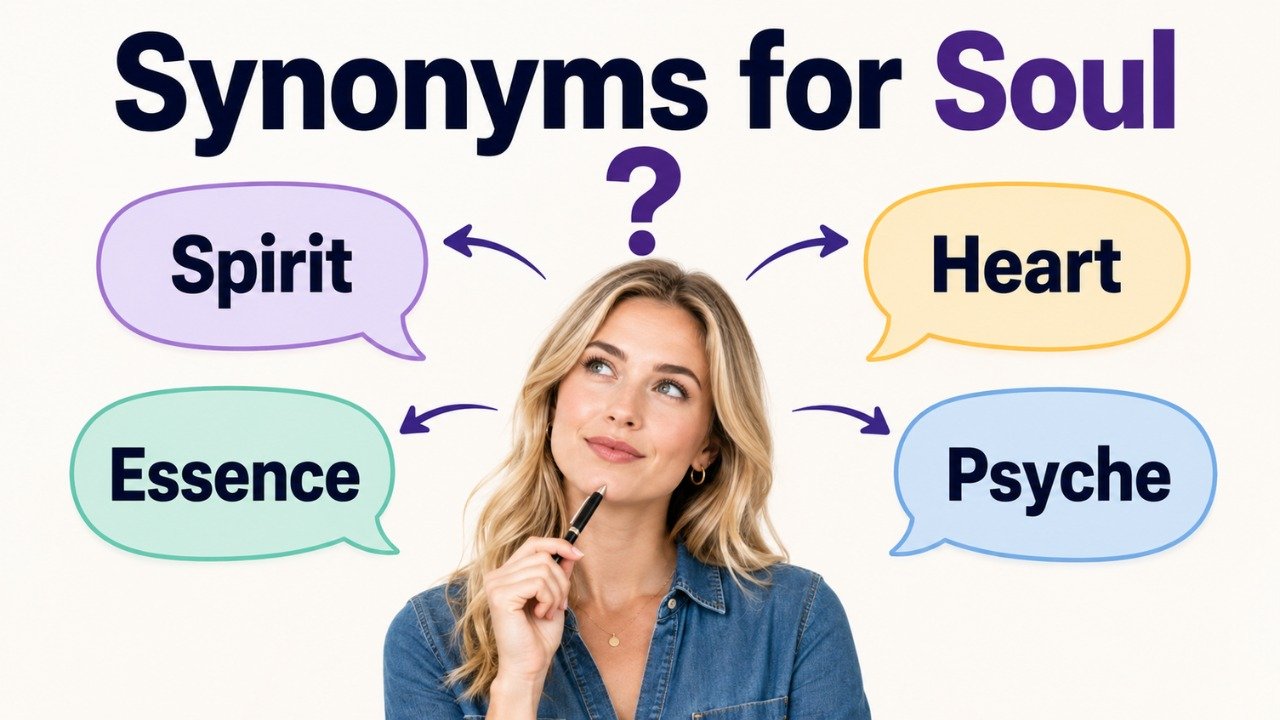
Quick Answer: The best synonyms for soul include spirit, psyche, essence, self, being, heart, core, consciousness, character, and inner self. Among these synonyms for soul, spirit is the strongest general replacement when referring to the nonphysical or spiritual part of a person. Psyche works well in psychological or intellectual contexts, while essence describes the fundamental nature of someone or something. Heart suits emotional contexts, character emphasizes moral qualities, and core refers to a person’s deepest qualities or beliefs.
Pronunciation and Word Details
Word: Soul.
Pronunciation: /soʊl/.
Part of Speech: Noun.
Meaning: The soul is the spiritual, emotional, or essential part of a person that represents their deepest identity, feelings, or inner nature.
US Pronunciation:
UK Pronunciation:
What Does “Soul” Mean?
Soul means the deepest spiritual, emotional, or essential part of a person. It is primarily used as a noun and can describe a person’s spiritual existence, inner identity, emotions, character, or fundamental nature.
In spiritual contexts, soul often refers to the nonphysical part of a person that is believed to exist independently of the body. In emotional language, it can describe someone’s deepest feelings or inner character.
Soul can also refer to the essence of something rather than a person. For example, someone might say that trust is the soul of a strong friendship. In this use, soul means the central or most important quality.
The word can therefore describe spiritual identity, emotional depth, personality, consciousness, character, or essential nature depending on the sentence.
Meaning, Tone, and Context of “Soul”
Soul is generally an emotional and expressive word. It can sound spiritual, philosophical, literary, personal, or poetic depending on the context.
In spiritual discussion, soul has a serious and meaningful tone. It refers to the spiritual part of human existence.
In everyday conversation, soul may describe someone’s personality, kindness, or emotional nature. Saying someone has a gentle soul, for example, suggests kindness and sensitivity.
In literary writing, soul often communicates powerful feelings, identity, inner conflict, love, grief, or personal transformation.
In philosophical contexts, soul may be connected with consciousness, identity, mind, or the nature of existence.
The word can also describe emotional depth in an activity, performance, place, or creative work. Something that has soul feels genuine, expressive, warm, and deeply human.
When and How to Use “Soul”
For Spiritual Identity
Use soul when referring to the spiritual or nonphysical part of a person.
Example: She believed that the soul continues beyond physical life.
For Inner Character
Soul can describe someone’s deepest personality or moral nature.
Example: Everyone described him as a generous soul.
For Deep Emotion
Use soul when expressing powerful or deeply personal feelings.
Example: The experience touched her soul.
For Essential Nature
Soul can describe the fundamental quality that gives something its identity.
Example: Creativity is the soul of the project.
For Personal Identity
Soul may represent a person’s deepest sense of who they are.
Example: Traveling helped him understand his own soul.
For Emotional Warmth
Soul can describe warmth, sincerity, passion, or emotional depth.
Example: Her performance had remarkable soul.
Best Synonyms for Soul
Spirit
Synonym: The nonphysical or inner part of a person.
Example: Her generous spirit inspired everyone around her.
Psyche
Synonym: The human mind, emotions, and inner mental life.
Example: The experience left a lasting impression on his psyche.
Essence
Synonym: The fundamental quality or true nature of someone or something.
Example: Kindness was the essence of her personality.
Self
Synonym: A person’s individual identity and sense of who they are.
Example: He finally felt comfortable expressing his true self.
Being
Synonym: A person’s entire existence or inner identity.
Example: She felt peaceful throughout her entire being.
Heart
Synonym: The emotional center of a person’s feelings and character.
Example: He spoke directly from the heart.
Core
Synonym: The deepest and most fundamental part of someone or something.
Example: Honesty was at the core of her character.
Consciousness
Synonym: Awareness of oneself, thoughts, and surroundings.
Example: The discussion explored the nature of human consciousness.
Character
Synonym: The moral and personal qualities that define someone.
Example: His actions revealed the strength of his character.
Inner Self
Synonym: A person’s private thoughts, feelings, and deepest identity.
Example: Quiet reflection helped her reconnect with her inner self.
50 Synonyms for Soul with Short Meanings
- Spirit: The nonphysical or spiritual part of a person.
- Psyche: The mind and emotional nature of a person.
- Essence: The fundamental nature of someone or something.
- Self: A person’s individual identity.
- Being: A person’s entire existence or inner identity.
- Heart: The emotional center of a person.
- Core: The deepest or most essential part.
- Consciousness: Awareness of oneself and one’s surroundings.
- Character: The qualities that define a person’s nature.
- Nature: A person’s basic qualities or disposition.
- Identity: The qualities that make someone who they are.
- Personality: The distinctive traits and behaviors of a person.
- Mind: The part associated with thought and awareness.
- Inner Self: A person’s private and deepest identity.
- Inner Being: The deepest emotional or spiritual part of a person.
- True Self: A person’s genuine identity or nature.
- Life Force: The energy believed to give life to a person.
- Vitality: The energy and strength associated with life.
- Life: The state or principle of being alive.
- Breath: A poetic symbol of life or living spirit.
- Anima: The inner life principle or soul.
- Spiritual Self: The spiritual aspect of personal identity.
- Spiritual Essence: The fundamental spiritual nature of a person.
- Immortal Essence: The part believed to continue beyond physical life.
- Inner Nature: A person’s deepest natural qualities.
- Essential Nature: The qualities that fundamentally define someone.
- Innermost Being: The deepest personal or emotional self.
- Deepest Self: The most private and genuine part of one’s identity.
- Inner Core: The central part of a person’s character or identity.
- Inner Life: A person’s private thoughts, feelings, and reflections.
- Personhood: The state and qualities of being an individual person.
- Individuality: The qualities that make someone distinct.
- Humanity: The human qualities of feeling, compassion, and understanding.
- Conscience: The inner sense of right and wrong.
- Moral Center: The fundamental principles guiding someone’s behavior.
- Emotional Center: The deepest source of feelings and emotional responses.
- Feeling: Emotional sensitivity or depth.
- Emotion: A strong internal feeling or response.
- Passion: Powerful emotion or enthusiasm.
- Depth: Serious emotional or intellectual substance.
- Warmth: Sincere emotional kindness and friendliness.
- Spark: A lively or distinctive inner quality.
- Life Principle: The force or quality associated with living existence.
- Animating Principle: The force believed to give something life.
- Vital Principle: The essential force associated with life.
- Spiritual Being: A nonphysical or spiritual existence.
- Ghost: A spirit believed to remain after physical death.
- Shade: A literary term for the spirit of a deceased person.
- Presence: A noticeable personal or spiritual quality.
- Inner Spirit: A person’s deepest emotional or spiritual strength.
Read Also:
Synonyms for Tremendous
Synonyms for Soul by Context
When Soul Means Spirit
When soul refers to the nonphysical or spiritual part of a person, the strongest alternatives include spirit, spiritual self, spiritual essence, inner spirit, immortal essence, and spiritual being.
Example: She believed the soul was eternal.
Alternative: She believed the spirit was eternal.
Spirit is usually the closest general synonym in spiritual discussions.
When Soul Means Inner Identity
When soul describes who someone truly is, useful alternatives include self, true self, inner self, inner being, identity, and innermost being.
Example: The journey changed his soul.
Alternative: The journey changed his inner self.
These choices work especially well when discussing personal growth or identity.
When Soul Means Emotional Nature
When soul refers to emotion, sensitivity, or feeling, heart, emotional center, passion, feeling, and warmth may work better.
Example: Her words touched his soul.
Alternative: Her words touched his heart.
Heart is particularly natural when describing strong emotions.
When Soul Means Essential Nature
When soul refers to the central quality of someone or something, essence, core, nature, character, and essential nature are strong choices.
Example: Curiosity is the soul of discovery.
Alternative: Curiosity is the essence of discovery.
Essence is usually the clearest choice in formal writing.
When Soul Means Mind or Consciousness
In psychological or philosophical contexts, psyche, consciousness, mind, self, and inner life may replace soul.
Example: The novel explores the human soul.
Alternative: The novel explores the human psyche.
Psyche works especially well when discussing thoughts, emotions, or psychological experiences.
Another Word for Soul
The best single replacement for soul is usually spirit because it can describe the nonphysical, emotional, or inner part of a person. However, the best alternative depends on the intended meaning.
Use psyche when discussing psychology, essence when discussing fundamental nature, heart when discussing emotion, and self when discussing personal identity.
Original: She was a kind soul.
Better Option: She was a kind spirit.
Original: Music seemed to reach his soul.
Better Option: Music seemed to reach his heart.
Original: Freedom became the soul of the movement.
Better Option: Freedom became the essence of the movement.
Original: The experience transformed her soul.
Better Option: The experience transformed her inner self.
When Not to Use “Soul”
Soul can sound overly emotional, spiritual, or poetic when the sentence requires a precise academic, scientific, or practical term.
In psychological discussion, psyche or mind may communicate the intended meaning more clearly.
Weak: The study examined changes in the soul after prolonged stress.
Better: The study examined changes in the psyche after prolonged stress.
Soul may also sound vague when describing someone’s specific personality traits.
Weak: His soul made him a dependable leader.
Better: His character made him a dependable leader.
Avoid repeating soul several times in emotional writing when alternatives such as heart, spirit, self, or inner being can provide greater variety.
Weak: Her soul was strong, and her soul helped her survive difficult experiences.
Better: Her spirit was strong, and her inner strength helped her survive difficult experiences.
Soul should also be avoided when essence or core communicates the central idea more accurately.
Weak: Communication is the soul of successful teamwork.
Better: Communication is at the core of successful teamwork.
Words Commonly Confused With Soul
Soul vs Spirit: Soul often refers to a person’s deepest spiritual identity, while spirit can refer to spiritual existence, emotional energy, courage, or attitude. The words overlap strongly in spiritual contexts.
Soul vs Psyche: Soul can have spiritual and emotional meanings, while psyche usually refers to the mind and psychological nature of a person.
Soul vs Mind: Soul suggests deeper spiritual or emotional identity. Mind refers more directly to thinking, reasoning, memory, and mental processes.
Soul vs Heart: Soul describes a person’s deeper identity or spiritual nature, while heart is commonly associated with emotions, love, kindness, and sincerity.
Soul vs Essence: Soul usually refers to a person or emotional quality, while essence describes the most fundamental characteristic of a person, idea, object, or situation.
Soul vs Self: Soul can carry spiritual meaning, while self focuses on personal identity and individual awareness.
Soul vs Character: Soul describes inner identity or spiritual nature, while character refers more specifically to moral qualities, habits, and personal traits.
Which Synonym Should You Choose?
Choose spirit when describing someone’s spiritual nature, inner strength, or nonphysical identity.
Choose psyche when writing about psychology, mental experiences, emotional development, or inner conflict.
Choose essence when describing the fundamental quality of a person, idea, object, or situation.
Choose heart when talking about love, compassion, sincerity, grief, or powerful emotions.
Choose self when discussing personal identity, self understanding, or individual experience.
Choose core when describing someone’s deepest beliefs, principles, or defining qualities.
Choose character when discussing moral strength, behavior, integrity, or personal qualities.
Choose consciousness in philosophical, intellectual, or academic discussion about awareness and existence.
Choose inner self in personal or reflective writing about thoughts, emotions, and identity.
Choose spirit or heart in casual conversation when soul sounds too dramatic or philosophical.
Real Life Examples of “Soul” in Sentences
Original: She has a gentle soul.
Better Option: She has a gentle spirit.
Original: The experience changed his soul.
Better Option: The experience changed his inner self.
Original: Her words touched my soul.
Better Option: Her words touched my heart.
Original: Creativity is the soul of the organization.
Better Option: Creativity is the essence of the organization.
Original: He searched his soul before making the decision.
Better Option: He examined his conscience before making the decision.
Original: The story explores the darkest parts of the human soul.
Better Option: The story explores the darkest parts of the human psyche.
Original: Kindness remained at the center of her soul.
Better Option: Kindness remained at the core of her character.
Original: The peaceful landscape refreshed his soul.
Better Option: The peaceful landscape refreshed his spirit.
Original: She poured her soul into the performance.
Better Option: She poured her passion into the performance.
Original: He wanted to understand his own soul more deeply.
Better Option: He wanted to understand his true self more deeply.
Synonym Groups and Usage Differences
Spiritual Identity Group
Spirit, spiritual self, spiritual essence, immortal essence, inner spirit, and spiritual being belong to this group.
These words describe the spiritual or nonphysical part of a person.
Example: She believed her spirit would remain connected to those she loved.
Psychological Group
Psyche, mind, consciousness, inner life, and self are useful when describing thought, awareness, identity, or emotional experience.
They are often clearer than soul in psychological or philosophical discussion.
Example: The experience deeply affected his psyche.
Emotional Group
Heart, feeling, emotion, passion, warmth, and emotional center describe emotional depth and sensitivity.
These alternatives work well when soul refers to strong feelings.
Example: She spoke from the heart about her experiences.
Identity Group
Self, true self, inner self, identity, individuality, personhood, and innermost being focus on personal identity.
Use these terms when discussing who someone truly is.
Example: Traveling allowed her to discover her true self.
Essential Nature Group
Essence, core, nature, inner nature, essential nature, and inner core describe fundamental qualities.
They work well when soul means the defining feature of a person or thing.
Example: Compassion was at the core of his personality.
Character Group
Character, conscience, moral center, humanity, and nature focus on personal qualities and moral behavior.
Use them when soul refers to goodness, integrity, or ethical character.
Example: His decision demonstrated remarkable strength of character.
Antonyms of Soul
Soul does not have one exact opposite because its meaning changes by context. Different opposites apply depending on whether soul refers to spirit, emotion, character, or inner identity.
Body: The physical part of a person rather than the spiritual part.
Physical Form: A person’s material or visible existence.
Exterior: The outward part rather than the inner nature.
Surface: The outer level rather than the deepest or essential part.
Insensitivity: A lack of emotional feeling or awareness.
Coldness: A lack of emotional warmth or compassion.
Emptiness: A lack of emotional, spiritual, or meaningful substance.
Lifelessness: The state of lacking life or vitality.
Detachment: Emotional distance or lack of personal involvement.
Superficiality: Concern with surface qualities rather than deeper meaning.
Comparison: Soul vs Related Words
Soul vs Spirit
Soul and spirit can both describe the nonphysical part of a person. Soul often sounds more personal and connected with identity, while spirit can also describe energy, courage, attitude, or emotional strength.
Example With Soul: She believed the soul survives physical death.
Example With Spirit: Her generous spirit encouraged everyone around her.
Soul vs Psyche
Soul can include spiritual, emotional, and philosophical meanings. Psyche primarily refers to the human mind and psychological nature.
Example With Soul: The tragedy affected him deep within his soul.
Example With Psyche: The tragedy had a lasting effect on his psyche.
Soul vs Heart
Soul describes someone’s deepest identity or spiritual nature. Heart focuses more strongly on emotion, compassion, affection, and sincerity.
Example With Soul: The story spoke directly to her soul.
Example With Heart: The story touched her heart.
Soul vs Essence
Soul commonly describes people or emotional depth, while essence describes the defining quality of almost anything.
Example With Soul: Compassion seemed to be part of her soul.
Example With Essence: Compassion was the essence of her leadership style.
Soul vs Self
Soul may carry spiritual or philosophical meaning. Self refers more directly to personal identity.
Example With Soul: He spent years trying to understand his soul.
Example With Self: He spent years trying to understand his true self.
Soul vs Character
Soul describes inner nature in a broad emotional or spiritual sense. Character refers to the qualities and principles reflected in someone’s behavior.
Example With Soul: Everyone considered her a kind soul.
Example With Character: Her honesty demonstrated strong character.
Common Phrases and Expressions With “Soul”
Kind Soul: A compassionate and caring person.
Gentle Soul: Someone with a calm, sensitive, or caring nature.
Old Soul: A person who seems unusually mature, thoughtful, or wise.
Search Your Soul: Think deeply about your feelings, beliefs, or choices.
From the Soul: Expressed with deep sincerity and emotion.
Heart and Soul: Complete emotional commitment, effort, or enthusiasm.
Pour Your Soul Into Something: Give something your deepest emotion, effort, or passion.
Bare Your Soul: Reveal deeply private thoughts or feelings.
Touch the Soul: Create a powerful emotional response.
Soul Searching: Deep reflection about one’s choices, values, feelings, or identity.
Common Mistakes to Avoid
One common mistake is treating every synonym for soul as interchangeable. Spirit, psyche, heart, essence, character, and self overlap with soul, but each emphasizes a different meaning.
Use spirit for spiritual identity, psyche for psychological contexts, heart for emotions, essence for fundamental qualities, and character for moral traits.
Another mistake is using soul in highly technical or academic sentences where a more precise word would improve clarity.
For example, psyche, consciousness, identity, or mind may be clearer in discussions of psychology and cognition.
Writers should also avoid excessive repetition. Using soul repeatedly in a short paragraph can make emotional writing sound exaggerated.
Choose alternatives according to meaning rather than simply replacing the word with the first synonym available.
Avoid confusing soul and sole. Soul refers to spiritual or inner identity, while sole means only, single, or the bottom part of a foot or shoe.
Finally, consider tone. Soul can sound powerful, poetic, intimate, or spiritual. In neutral business or academic writing, essence, core, character, identity, or consciousness may be more suitable.
Conclusion
Understanding synonyms for soul makes it easier to express spiritual identity, emotion, personality, consciousness, and essential nature accurately. Spirit is usually the closest general alternative, while psyche suits psychological contexts, heart emphasizes emotion, essence expresses fundamental nature, and self focuses on identity. Core and character are useful when discussing defining qualities or moral traits. Because soul carries several meanings, the strongest synonym depends on what the sentence is trying to communicate and the tone the writer wants to create.
FAQs About Synonyms for Soul
What Is the Best Synonym for Soul?
Spirit is usually the best general synonym for soul, especially when referring to a person’s spiritual or nonphysical nature.
What Is Another Word for Soul in a Person?
Useful choices include spirit, psyche, inner self, being, essence, heart, and true self. The best choice depends on whether the meaning is spiritual, emotional, or psychological.
What Is a Formal Synonym for Soul?
Psyche, consciousness, essence, identity, and self can work in more formal contexts. Psyche is especially useful in psychological discussion.
What Is a Poetic Synonym for Soul?
Spirit, inner being, innermost being, breath, anima, inner spirit, and spiritual essence can create a more poetic or literary tone.
Is Spirit the Same as Soul?
Spirit and soul are closely related and often interchangeable in spiritual contexts. However, spirit can also refer to courage, energy, attitude, or enthusiasm.
Can Heart Be a Synonym for Soul?
Yes. Heart can replace soul when the sentence refers to emotion, compassion, sincerity, or deep personal feeling.
What Is the Difference Between Soul and Psyche?
Soul can refer to spiritual identity, emotional depth, or essential nature. Psyche refers more specifically to the mind, emotions, and psychological nature of a person.
