
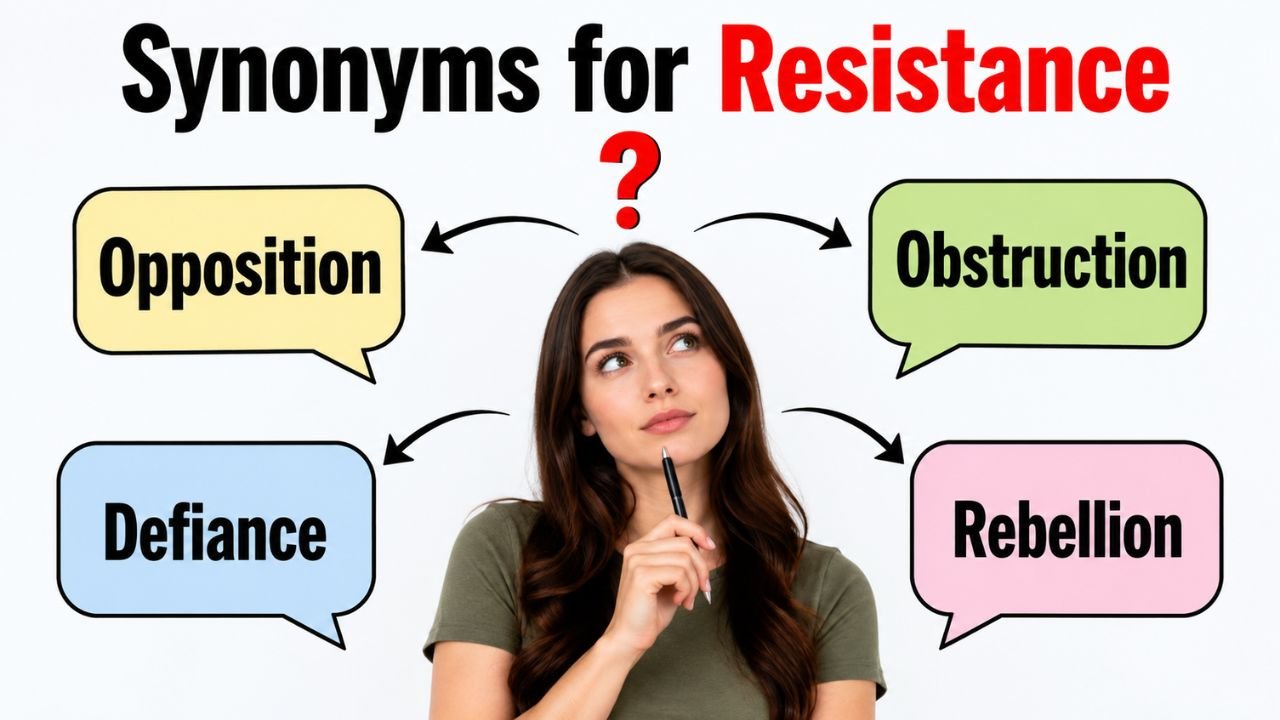
Quick Answer: The best synonyms for resistance include opposition, defiance, refusal, objection, dissent, pushback, obstruction, resilience, immunity, and impedance. Use opposition for general disagreement, defiance for bold refusal, objection for a stated concern, and dissent for formal differences of opinion. Pushback suits conversational and workplace contexts, while obstruction describes something that blocks progress. Resilience refers to the ability to withstand pressure, immunity describes protection from disease, and impedance is useful in technical discussions. The best choice depends on whether resistance means disagreement, refusal, protection, endurance, or physical opposition.
Pronunciation and Word Details
Word: Resistance.
Pronunciation: /rɪˈzɪstəns/
Part of Speech: Noun.
Meaning: Resistance means opposition to an action, force, idea, change, disease, or influence.
US Pronunciation:
UK Pronunciation:
What Does “Resistance” Mean?
Resistance means the act of opposing, refusing, blocking, or withstanding something. It is a noun that can describe disagreement with an idea, refusal to follow authority, difficulty caused by a physical force, or protection against disease and damage.
In social and political contexts, resistance often refers to organized opposition against control, rules, or injustice.
In personal situations, resistance can describe reluctance to accept change, advice, responsibility, or an unfamiliar experience.
In physical science, resistance describes a force that slows movement or limits the flow of electrical current.
In health and biology, resistance may describe the ability of a person, plant, or organism to avoid harm from disease.
The exact meaning becomes clear through the surrounding sentence.
Meaning, Tone, and Context of “Resistance”
Resistance is generally a neutral word, but its tone changes according to the situation.
In formal writing, resistance may describe opposition to laws, policies, social changes, authority, or established systems. Words such as opposition, dissent, objection, and noncompliance often work well in these contexts.
In conversational language, resistance may describe someone who is unwilling to accept a suggestion or change. Pushback, reluctance, and unwillingness can sound more natural in everyday speech.
Resistance can also have a strong or emotional tone. Defiance, rebellion, revolt, and protest suggest active or determined opposition.
In technical writing, resistance has precise scientific meanings. It can refer to electrical resistance, air resistance, water resistance, or the ability of a material to withstand heat, pressure, or damage.
In health contexts, resistance can refer to immunity, tolerance, or protection against infection and disease.
When and How to Use “Resistance”
For General Opposition: Use resistance when people disagree with or act against an idea, plan, policy, or decision.
Example: The proposal faced strong resistance from local residents.
For Refusal to Cooperate: Use resistance when someone refuses to obey instructions, authority, or expectations.
Example: His resistance to the new rules created tension within the group.
For Reluctance to Change: Use resistance when someone feels uncomfortable accepting a new process, habit, or situation.
Example: Some employees showed resistance to the updated working system.
For Physical Opposition: Use resistance when a force slows, blocks, or limits movement.
Example: The shape of the vehicle reduces air resistance.
For Electrical Measurement: Use resistance when discussing how strongly a material opposes the flow of electric current.
Example: The technician measured the resistance in the circuit.
For Health Protection: Use resistance when describing the ability to avoid or fight disease.
Example: Regular care can improve the plant’s resistance to infection.
For Emotional Strength: Use resistance when describing the ability to withstand pressure, influence, or hardship.
Example: Her resistance to criticism helped her remain focused.
For Damage Prevention: Use resistance when explaining how well an object withstands heat, water, wear, or impact.
Example: The material offers strong resistance to heat and moisture.
Best Synonyms for Resistance
Opposition: Disagreement with or action against an idea, plan, or authority.
Example: The development project received opposition from nearby communities.
Defiance: Bold and determined refusal to obey or accept control.
Example: Her defiance surprised everyone who expected her to remain silent.
Refusal: A clear decision not to accept, do, or allow something.
Example: His refusal to cooperate delayed the investigation.
Objection: A reason or statement expressing disagreement.
Example: Several members raised an objection to the proposed change.
Dissent: Formal disagreement with a widely accepted opinion or decision.
Example: The final report included a written statement of dissent.
Pushback: Negative reaction or resistance to a suggestion, decision, or change.
Example: The manager expected some pushback after announcing the new schedule.
Obstruction: Something that blocks action, movement, or progress.
Example: Poor communication became a serious obstruction to progress.
Resilience: The ability to withstand difficulty and recover from pressure.
Example: The community showed remarkable resilience after the disaster.
Immunity: Protection against a disease or harmful biological condition.
Example: The treatment helped the body develop immunity to the infection.
Impedance: Opposition to the flow of electrical current in a circuit.
Example: The engineer calculated the impedance of the electrical system.
50 Synonyms for Resistance with Short Meanings
- Opposition: Disagreement with or action against something.
- Defiance: Bold refusal to obey or accept control.
- Refusal: A decision not to accept or do something.
- Objection: A stated reason for disagreement.
- Dissent: Formal disagreement with an accepted opinion.
- Protest: An expression or action showing opposition.
- Pushback: A negative reaction against a plan or change.
- Reluctance: Unwillingness or hesitation to act.
- Unwillingness: Lack of desire to cooperate or agree.
- Noncompliance: Failure or refusal to follow a rule.
- Disobedience: Refusal to obey instructions or authority.
- Rebellion: Organized resistance against control or authority.
- Revolt: Active opposition against a ruling power.
- Insubordination: Refusal to obey someone in authority.
- Recalcitrance: Stubborn resistance to control or instruction.
- Intransigence: Refusal to change a position or compromise.
- Obstinacy: Stubborn determination not to change.
- Stubbornness: Persistent refusal to change an opinion.
- Rejection: Refusal to accept an idea, offer, or proposal.
- Denial: Refusal to recognize or accept something.
- Challenge: An action that questions or opposes authority.
- Contestation: Formal disagreement or dispute.
- Obstruction: Something that blocks action or progress.
- Interference: Action that prevents a process from continuing normally.
- Hindrance: Something that makes progress difficult.
- Impediment: A condition or object that slows progress.
- Barrier: Something that prevents movement, access, or success.
- Obstacle: A difficulty that must be overcome.
- Blockage: Something that prevents movement or flow.
- Restraint: A force or condition that limits action.
- Counteraction: Action taken to oppose another action.
- Counterforce: A force that acts against another force.
- Friction: A force or disagreement that creates resistance.
- Drag: A force that slows movement through air or liquid.
- Impedance: Opposition to electrical current.
- Reactance: Opposition to changing electrical current.
- Defense: Protection against attack, pressure, or harm.
- Protection: The act of keeping something safe from damage.
- Endurance: The ability to withstand difficulty for a long time.
- Resilience: The ability to recover after pressure or hardship.
- Toughness: Strength that allows something to withstand damage.
- Durability: The ability to remain strong over time.
- Strength: The power to resist pressure or influence.
- Immunity: Protection from a disease or infection.
- Tolerance: The ability to withstand a substance or condition.
- Insusceptibility: The condition of not being easily affected.
- Imperviousness: The ability to prevent something from entering or causing harm.
- Deterrence: Action that discourages or prevents another action.
- Fortitude: Mental strength during pain or difficulty.
- Hardiness: The ability to survive difficult conditions.
Read Also:
Synonyms for Marginalized

Synonyms for Resistance by Context
When Resistance Means Opposition
Opposition, dissent, objection, protest, and pushback describe disagreement with an idea, policy, decision, or action.
Opposition is the broadest choice. Dissent often appears in formal or political writing. Objection describes a particular concern, while protest suggests a visible expression of disagreement. Pushback sounds more conversational.
Example With Opposition: The proposal faced strong opposition from residents.
Example With Dissent: One committee member expressed dissent during the meeting.
Example With Objection: She raised an objection to the revised contract.
Example With Pushback: The sudden change caused immediate pushback from employees.
When Resistance Means Refusal to Obey
Defiance, noncompliance, disobedience, insubordination, and rebellion describe refusal to follow authority, instructions, or rules.
Defiance suggests courage or boldness. Noncompliance is neutral and formal. Disobedience is common in personal and educational contexts. Insubordination is often used when someone refuses an order from a person in authority.
Example With Defiance: He stood in defiance of the unfair command.
Example With Noncompliance: Continued noncompliance may lead to further action.
Example With Insubordination: The supervisor addressed the employee’s repeated insubordination.
When Resistance Means Reluctance
Reluctance, unwillingness, hesitation, obstinacy, and intransigence describe a person who does not easily accept a change or request.
Reluctance suggests uncertainty rather than open conflict. Unwillingness is more direct. Obstinacy and intransigence suggest a stubborn refusal to change.
Example With Reluctance: She showed reluctance to discuss the problem.
Example With Unwillingness: His unwillingness to compromise prolonged the disagreement.
Example With Intransigence: Their intransigence prevented a peaceful settlement.
When Resistance Means an Obstacle
Obstruction, hindrance, impediment, barrier, obstacle, and blockage describe something that slows or prevents progress.
Obstruction often suggests active blocking. A hindrance makes progress difficult but not impossible. An impediment may be a condition, weakness, or practical difficulty. A barrier can be physical or abstract.
Example With Obstruction: The fallen tree caused an obstruction on the road.
Example With Hindrance: Limited funding became a major hindrance.
Example With Barrier: Language was a barrier to effective communication.
When Resistance Means Strength
Resilience, endurance, toughness, durability, fortitude, and hardiness describe the ability to withstand pressure, damage, or difficulty.
Resilience includes recovery after hardship. Endurance emphasizes lasting through a difficult experience. Durability is usually used for objects and materials. Fortitude describes mental and emotional strength.
Example With Resilience: Her resilience helped her rebuild her life.
Example With Endurance: The long journey tested their endurance.
Example With Durability: The material is valued for its durability.
When Resistance Means Protection
Immunity, tolerance, defense, protection, insusceptibility, and imperviousness describe safety from disease, damage, influence, or harmful conditions.
Immunity is most common in health contexts. Tolerance describes the ability to withstand a substance or condition. Imperviousness describes something that cannot easily be penetrated or affected.
Example With Immunity: The body gradually developed immunity.
Example With Tolerance: This plant has a high tolerance for heat.
Example With Imperviousness: The surface is valued for its imperviousness to water.
When Resistance Has a Technical Meaning
Friction, drag, impedance, reactance, and counterforce describe forms of physical or electrical opposition.
Friction occurs when surfaces move against one another. Drag slows an object moving through air or liquid. Impedance and reactance appear mainly in electrical discussions.
Example With Friction: Friction between the surfaces slowed the object.
Example With Drag: The design reduces drag during movement.
Example With Impedance: The technician checked the circuit’s impedance.
Another Word for Resistance
Opposition is usually the best general replacement for resistance. It clearly describes disagreement with an idea, action, decision, or authority. However, the best alternative depends on the intended meaning.
Use defiance for bold refusal, reluctance for hesitation, obstruction for something that blocks progress, resilience for emotional strength, and immunity for protection from disease.
Original: The plan met resistance from the local community.
Better Option: The plan met opposition from the local community.
Original: She showed resistance to following the unfair command.
Better Option: She showed defiance by refusing to follow the unfair command.
Original: His resistance to the new process slowed its introduction.
Better Option: His reluctance to accept the new process slowed its introduction.
Original: The material has excellent resistance to damage.
Better Option: The material has excellent durability.
When Not to Use “Resistance”
Resistance is broad and may sound unclear when a more precise word is available. Avoid using it repeatedly without identifying the exact type of resistance being discussed.
Use opposition for disagreement, reluctance for hesitation, defiance for open refusal, obstruction for blocked progress, and resilience for the ability to endure difficulty.
Weak: There was resistance to the proposal.
Better: There was strong opposition to the proposal.
Weak: She felt resistance about starting the new job.
Better: She felt reluctance about starting the new job.
Weak: The broken equipment created resistance to the project.
Better: The broken equipment created a serious obstacle for the project.
Weak: His resistance helped him recover after the crisis.
Better: His resilience helped him recover after the crisis.
Resistance may also sound too formal in simple conversation.
Weak: The child demonstrated resistance to eating vegetables.
Better: The child refused to eat the vegetables.
Do not replace resistance with rebellion unless the situation involves active and serious opposition to authority. Rebellion is much stronger and may suggest organized action.
Words Commonly Confused With Resistance
Resistance vs Opposition: Resistance can describe disagreement, physical force, endurance, or protection. Opposition mainly refers to disagreement or action against something.
Resistance vs Defiance: Resistance is a broad term for opposing something. Defiance is a bold and often visible refusal to obey.
Resistance vs Reluctance: Resistance may involve active opposition. Reluctance describes hesitation or unwillingness without necessarily involving conflict.
Resistance vs Resilience: Resistance is the ability or act of opposing pressure. Resilience is the ability to recover after pressure, difficulty, or damage.
Resistance vs Immunity: Resistance may provide partial protection against disease or harm. Immunity usually refers to a stronger state of biological protection.
Resistance vs Obstruction: Resistance may slow or oppose an action. Obstruction specifically blocks movement, activity, or progress.
Resistance vs Friction: Resistance is a general term. Friction is a particular force between surfaces or a state of tension between people.
Resistance vs Refusal: Resistance may be gradual, indirect, or unspoken. Refusal is a clear decision not to accept or do something.
Which Synonym Should You Choose?
Choose opposition when describing general disagreement with an idea, plan, policy, or authority.
Choose defiance when someone openly and boldly refuses to obey.
Choose refusal when a person directly says no to a request, offer, or instruction.
Choose objection when someone provides a specific reason for disagreeing.
Choose dissent in formal writing about opinions, decisions, politics, or institutions.
Choose pushback in workplace communication or casual discussion about negative reactions to change.
Choose reluctance when someone hesitates or feels uncertain rather than actively opposing something.
Choose obstruction when an object, action, or person blocks progress.
Choose resilience when discussing emotional recovery, strength, or the ability to survive hardship.
Choose durability when describing an object or material that withstands damage over time.
Choose immunity when discussing protection against disease.
Choose friction or drag when describing physical forces that slow movement.
Choose impedance when writing about electrical opposition in a technical report.
Choose noncompliance in formal documents about failure to follow rules or requirements.
Choose rebellion or revolt only when the opposition is serious, organized, and directed against authority.
Real Life Examples of “Resistance” in Sentences
Original: The new policy faced resistance from several employees.
Better Option: The new policy faced pushback from several employees.
Original: Her resistance to the command was obvious.
Better Option: Her defiance of the command was obvious.
Original: The residents organized resistance to the construction plan.
Better Option: The residents organized opposition to the construction plan.
Original: His resistance to change affected the entire project.
Better Option: His reluctance to accept change affected the entire project.
Original: The damaged road created resistance to the delivery process.
Better Option: The damaged road created an obstacle to the delivery process.
Original: She developed greater resistance after experiencing several difficulties.
Better Option: She developed greater resilience after experiencing several difficulties.
Original: The coating provides resistance to water.
Better Option: The coating provides protection from water.
Original: The medicine improved the body’s resistance to the infection.
Better Option: The medicine strengthened the body’s immunity to the infection.
Original: The vehicle’s shape lowers wind resistance.
Better Option: The vehicle’s shape lowers aerodynamic drag.
Original: Resistance within the circuit affected its performance.
Better Option: Impedance within the circuit affected its performance.
Synonym Groups and Usage Differences
Opposition Group
Opposition, dissent, objection, protest, and contestation describe disagreement with ideas, policies, or decisions. Opposition is general, while dissent and contestation sound more formal.
Example: Public opposition encouraged officials to reconsider the proposal.
Refusal Group
Defiance, refusal, noncompliance, disobedience, and insubordination describe failure or refusal to obey. Defiance is bold, while noncompliance is more neutral and suitable for official writing.
Example: Her refusal to sign the document ended the discussion.
Reluctance Group
Reluctance, unwillingness, stubbornness, obstinacy, and intransigence describe hesitation or refusal to change. Reluctance is mild, while intransigence suggests a firm unwillingness to compromise.
Example: His reluctance to speak came from uncertainty rather than disagreement.
Obstruction Group
Obstruction, interference, hindrance, impediment, barrier, and obstacle describe anything that prevents smooth progress. Obstruction and blockage suggest stronger prevention than hindrance.
Example: A lack of reliable information became a barrier to effective planning.
Strength Group
Resilience, endurance, toughness, durability, fortitude, and hardiness describe the ability to withstand pressure. Resilience often applies to people and communities, while durability usually applies to materials and products.
Example: The team’s resilience became clear during the difficult period.
Protection Group
Immunity, tolerance, defense, protection, and imperviousness describe safety from harmful conditions. Immunity is common in biology, while imperviousness often describes materials or emotional protection.
Example: The plant has a natural tolerance for dry conditions.
Physical Force Group
Friction, drag, counterforce, impedance, and reactance describe forces or conditions that oppose movement or flow. Their exact meanings depend on the scientific field.
Example: The rough surface created enough friction to slow the object.
Antonyms of Resistance
The opposite of resistance depends on whether the word refers to disagreement, refusal, strength, physical force, or protection.
Acceptance: Willingness to receive or approve something.
Agreement: A shared opinion or decision.
Approval: A positive judgment or permission.
Consent: Willing agreement to an action or request.
Compliance: Willingness to follow rules or instructions.
Cooperation: Working willingly with other people.
Submission: Acceptance of another person’s authority.
Obedience: Willing action according to an instruction.
Support: Help or approval given to an idea or person.
Assistance: Help that makes progress easier.
Vulnerability: The condition of being open to harm or damage.
Susceptibility: The likelihood of being affected by something.
Weakness: A lack of strength or ability to withstand pressure.
Conductivity: The ability to allow electrical current to flow.
Yielding: Giving way under force, pressure, or persuasion.
Comparison: Resistance vs Related Words
Resistance vs Opposition
Resistance has a wider range of meanings. It may describe disagreement, physical force, protection, or emotional strength. Opposition mainly describes disagreement or action against something.
Example With Resistance: The material offers resistance to extreme heat.
Example With Opposition: The proposal received opposition from several groups.
Resistance vs Defiance
Resistance may be passive, gradual, or indirect. Defiance is open, bold, and deliberate.
Example With Resistance: She showed resistance to changing her routine.
Example With Defiance: She ignored the order in an act of defiance.
Resistance vs Reluctance
Resistance can involve active opposition. Reluctance usually involves uncertainty, hesitation, or lack of enthusiasm.
Example With Resistance: The group organized resistance to the new rule.
Example With Reluctance: He accepted the new role with reluctance.
Resistance vs Resilience
Resistance describes opposition to pressure or influence. Resilience describes recovery after difficulty or damage.
Example With Resistance: The structure provides resistance against strong winds.
Example With Resilience: The community demonstrated resilience after the storm.
Resistance vs Refusal
Resistance may be expressed through behavior, delay, or disagreement. Refusal is a direct decision not to accept or perform something.
Example With Resistance: The proposal encountered resistance during the meeting.
Example With Refusal: Her refusal to approve the proposal ended the discussion.
Resistance vs Obstruction
Resistance may slow or oppose progress. Obstruction directly blocks movement, communication, or action.
Example With Resistance: Internal resistance delayed the organizational change.
Example With Obstruction: Fallen rocks caused an obstruction on the road.
Resistance vs Immunity
Resistance can mean an ability to limit the effects of disease. Immunity suggests protection that prevents or strongly reduces infection.
Example With Resistance: The plant has some resistance to the disease.
Example With Immunity: Previous exposure gave the organism immunity.
Common Phrases and Expressions With Resistance
Strong Resistance: Powerful opposition to an idea, force, or action.
Active Resistance: Direct action taken to oppose something.
Passive Resistance: Opposition shown without direct force or confrontation.
Public Resistance: Opposition expressed by members of the public.
Internal Resistance: Opposition arising inside a person, group, or organization.
Resistance to Change: Unwillingness to accept a new situation or method.
Disease Resistance: The ability to avoid or limit infection.
Water Resistance: The ability to prevent water from entering or causing damage.
Heat Resistance: The ability to withstand high temperatures.
Air Resistance: A force that slows an object moving through air.
Electrical Resistance: Opposition to the flow of electric current.
Armed Resistance: Organized opposition involving weapons or force.
Natural Resistance: Protection or strength that exists without artificial support.
Build Resistance: To develop greater protection or strength against something.
Overcome Resistance: To successfully reduce or defeat opposition.
Common Mistakes to Avoid
A common mistake is using resistance when a more precise word would communicate the meaning more clearly.
Use reluctance for hesitation, defiance for bold refusal, opposition for disagreement, and obstruction for blocked progress.
Another mistake is treating resistance and resilience as interchangeable. Resistance is the ability or act of opposing pressure. Resilience is the ability to recover after experiencing pressure.
Writers also confuse resistance with immunity. Disease resistance may be partial, while immunity generally suggests stronger protection.
Avoid using rebellion for minor disagreement. Rebellion describes serious opposition to authority and often involves organized action.
Do not use technical synonyms outside their proper fields. Impedance belongs mainly in electrical contexts, while drag and friction describe particular physical forces.
Repetition can also weaken writing. When resistance appears several times in one paragraph, replace some uses with more specific alternatives.
Repetitive: The resistance to the policy increased because the resistance of employees encouraged further resistance.
Improved: Opposition to the policy increased because employee pushback encouraged further protest.
Avoid vague phrases such as resistance problem when you can identify the actual issue.
Vague: The team has a resistance problem.
Clear: The team is reluctant to adopt the new process.
Finally, check whether the replacement preserves the intended strength. Objection is milder than rebellion, and reluctance is less forceful than defiance.
Conclusion
The most useful synonyms for resistance include opposition, defiance, refusal, objection, dissent, pushback, obstruction, resilience, immunity, and impedance. Opposition is the best general choice for disagreement, while defiance expresses bold refusal. Reluctance suits hesitation, obstruction describes blocked progress, and resilience refers to strength during difficulty. In scientific or health contexts, friction, drag, impedance, tolerance, and immunity may be more accurate. Choosing a synonym according to context makes sentences clearer, more precise, and easier to understand.
FAQs About Synonyms for Resistance
What Is the Best Synonym for Resistance?
Opposition is the best general synonym when resistance means disagreement with an idea, action, plan, or authority.
What Is a Stronger Word for Resistance?
Defiance is stronger when someone openly refuses to obey. Rebellion is even stronger and describes organized opposition to authority.
What Is Another Word for Resistance to Change?
Reluctance, unwillingness, hesitation, stubbornness, and intransigence can describe resistance to change.
Are Resistance and Resilience Synonyms?
They are related but not exact synonyms. Resistance means opposing pressure, while resilience means recovering after pressure or difficulty.
What Is a Formal Synonym for Resistance?
Opposition, dissent, objection, noncompliance, contestation, and intransigence are suitable for formal writing.
What Is a Casual Synonym for Resistance?
Pushback is a natural conversational alternative, especially when describing a negative reaction to a decision or change.
What Is a Synonym for Physical Resistance?
Friction, drag, counterforce, and impedance may replace resistance in physical or technical contexts, depending on the type of force involved.
