
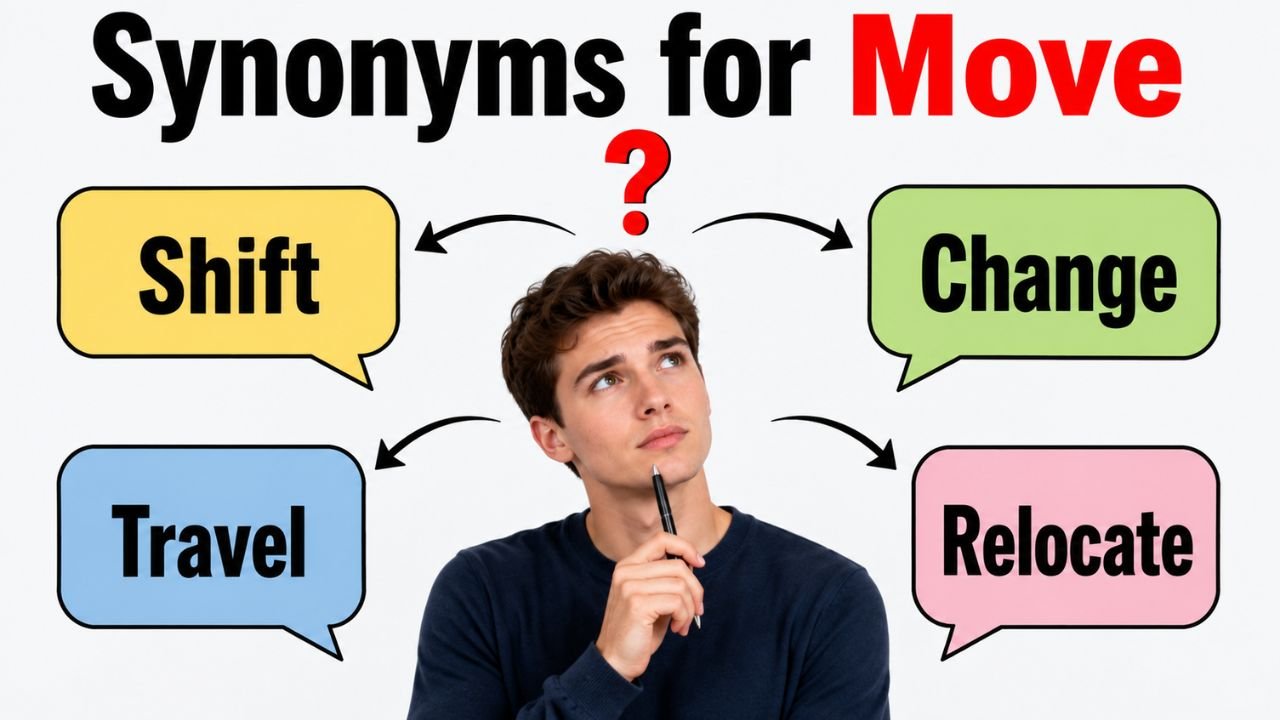
Quick Answer: The best synonyms for move include shift, relocate, transfer, advance, proceed, travel, act, maneuver, stir, and inspire. Use shift when changing position, relocate when changing where someone lives or works, transfer when sending something elsewhere, advance when making progress, and proceed when continuing an activity. Act and maneuver describe decisions or planned actions. Stir, touch, and inspire work when something causes an emotional reaction. These synonyms for move help make formal writing, casual conversation, reports, essays, and descriptions more precise.
Pronunciation and Word Details
Word: Move.
Pronunciation: /muːv/
Part of Speech: Verb and noun.
Meaning: Move means to change position, travel somewhere, take action, make progress, or cause an emotional reaction.
US Pronunciation:
UK Pronunciation:
What Does “Move” Mean?
Move means to change position, go from one place to another, or cause something to change location. It is commonly used as both a verb and a noun.
As a verb, move can describe physical motion.
Example: Please move the chair closer to the table.
It can also describe relocation from one home, office, or city to another.
Example: The family plans to move next month.
Move can refer to progress, action, or a decision.
Example: The committee must move quickly to solve the problem.
As a noun, move means an action, choice, or change in position.
Example: Expanding the business was a sensible move.
The word also has an emotional meaning. A speech, story, or experience can move someone by creating feelings of sympathy, joy, sadness, or inspiration.
Example: Her honest words moved the audience.
Meaning, Tone, and Context of “Move”
Move is a neutral and flexible word. It appears naturally in casual conversation, formal writing, instructions, reports, narratives, and professional communication.
In everyday speech, move often describes changing physical position or location.
Example: Could you move your bag?
In professional writing, move can refer to progress, decisions, transfers, and strategic actions.
Example: The organization decided to move into a new market.
In academic or analytical writing, more precise alternatives such as advance, relocate, transfer, proceed, or transition may communicate the intended meaning more clearly.
Move can also carry an emotional tone when it describes a powerful reaction.
Example: The documentary moved many viewers.
The noun form is especially common when discussing decisions, games, negotiations, careers, and strategies.
Example: Accepting the offer was a bold career move.
When and How to Use “Move”
For Changing Position
Use move when a person or object changes its physical position.
Example: Move the lamp closer to the window.
For Going Somewhere
Use move when someone travels or changes from one location to another.
Example: The crowd moved toward the exit.
For Relocation
Use move when someone changes their home, office, or place of work.
Example: They will move to a larger apartment in August.
For Making Progress
Use move when a project, discussion, or process advances.
Example: The negotiations are beginning to move in the right direction.
For Taking Action
Use move when a person or group begins doing something.
Example: The manager moved quickly to address the complaint.
For Making a Decision
Use move as a noun for an action, choice, or strategic step.
Example: Reducing unnecessary costs was a practical move.
For Emotional Effect
Use move when something creates a strong emotional response.
Example: The kindness of the volunteers moved everyone present.
For Giving a Signal
Use move when describing a gesture or signal that encourages another person to act.
Example: She moved her hand toward the empty chair.
Best Synonyms for Move
Shift
Synonym: Shift means to change position slightly or move from one condition to another.
Example: Shift the table a little closer to the wall.
Relocate
Synonym: Relocate means to move to a different home, workplace, building, or area.
Example: The company will relocate its main office next year.
Transfer
Synonym: Transfer means to move a person, object, responsibility, or information from one place to another.
Example: Please transfer the files to the shared folder.
Advance
Synonym: Advance means to move forward physically or make progress.
Example: The research team advanced to the next stage.
Proceed
Synonym: Proceed means to continue moving or continue with an activity.
Example: After reviewing the instructions, we proceeded with the test.
Travel
Synonym: Travel means to move from one location to another, usually over some distance.
Example: They traveled across the region by train.
Act
Synonym: Act means to take action instead of remaining inactive.
Example: The authorities acted immediately after receiving the warning.
Maneuver
Synonym: Maneuver means to move carefully, skillfully, or strategically.
Example: The driver maneuvered the vehicle through the narrow entrance.
Stir
Synonym: Stir means to move slightly or create an emotional reaction.
Example: The powerful story stirred feelings of hope.
Inspire
Synonym: Inspire means to move someone emotionally and encourage thought or action.
Example: Her determination inspired the entire team.
50 Synonyms for Move with Short Meanings
- Relocate: To change to a new place.
- Shift: To change position or direction slightly.
- Transfer: To send or move something elsewhere.
- Transport: To carry people or goods between places.
- Carry: To take something from one location to another.
- Convey: To transport or communicate something.
- Reposition: To place something in a different position.
- Displace: To move something from its usual position.
- Migrate: To move from one region to another.
- Travel: To go from one place to another.
- Go: To leave one place and travel elsewhere.
- Proceed: To continue forward or continue an activity.
- Advance: To move forward or make progress.
- Progress: To develop or move toward improvement.
- Continue: To keep moving or doing something.
- Depart: To leave a place.
- Leave: To go away from a location.
- Walk: To move on foot.
- Step: To move by lifting and placing a foot.
- March: To walk forward steadily or formally.
- Wander: To move without a fixed direction.
- Slide: To move smoothly across a surface.
- Glide: To move smoothly and easily.
- Roll: To move by turning over repeatedly.
- Turn: To change direction or position.
- Rotate: To move around a central point.
- Swing: To move backward and forward.
- Sway: To move gently from side to side.
- Rock: To move repeatedly backward and forward.
- Stir: To move slightly or awaken an emotion.
- Budge: To move even a small distance.
- Shake: To move rapidly backward and forward.
- Vibrate: To move quickly with small repeated motions.
- Act: To take action.
- Respond: To act after an event or request.
- Operate: To function or control movement.
- Maneuver: To move carefully or strategically.
- Motion: To signal through physical movement.
- Gesture: To communicate through a movement.
- Action: Something done to produce a result.
- Decision: A choice that determines what happens next.
- Tactic: A planned action for achieving a goal.
- Strategy: A broader plan involving deliberate actions.
- Transition: A change from one state or stage to another.
- Change: To become or make something different.
- Relocation: The act of moving to a new place.
- Movement: A change in position or location.
- Journey: An act of traveling from one place to another.
- Inspire: To emotionally encourage someone to act.
- Touch: To create a strong emotional response.
Read Also:
Synonyms for Resistance

Synonyms for Move by Context
When Move Means Change Position
Shift, reposition, displace, slide, turn, rotate, and budge describe a physical change in position.
Use shift for a small adjustment.
Example: Shift the screen slightly to the left.
Use reposition when something is deliberately placed in a better location.
Example: The photographer repositioned the lights.
Use displace when something is forced from its original position.
Example: The impact displaced several stones.
Use budge when movement is small or difficult.
Example: The heavy cabinet would not budge.
When Move Means Travel or Relocate
Relocate, migrate, travel, depart, leave, transfer, and journey relate to changing location.
Use relocate for a permanent or organized change of residence or workplace.
Example: The family relocated to a quieter area.
Use migrate for seasonal or large scale movement between regions.
Example: Many birds migrate during colder months.
Use travel for movement across a distance.
Example: She travels frequently for work.
Use depart when describing the moment someone leaves.
Example: The train departed at noon.
When Move Means Make Progress
Advance, progress, proceed, continue, and develop describe forward movement in a process.
Use advance for noticeable forward progress.
Example: The project advanced after the funding was approved.
Use proceed when continuing after permission or preparation.
Example: The team proceeded with the planned changes.
Use progress when gradual improvement is important.
Example: The patient progressed steadily during recovery.
Use continue when an activity does not stop.
Example: The discussion continued after lunch.
When Move Means Take Action
Act, respond, maneuver, decide, and intervene can replace move when it refers to taking action.
Use act when immediate action is needed.
Example: We must act before the situation becomes worse.
Use respond when the action follows a request or event.
Example: The department responded to the concerns.
Use maneuver for careful physical or strategic action.
Example: She maneuvered through the difficult negotiation successfully.
When Move Means Affect Emotion
Touch, stir, inspire, affect, and influence describe emotional or mental impact.
Use touch when something creates a warm, sympathetic, or personal feeling.
Example: His thoughtful message touched her deeply.
Use stir for emotions that become active or intense.
Example: The announcement stirred excitement among the students.
Use inspire when emotion encourages positive action.
Example: The teacher inspired the class to work harder.
Another Word for Move
Shift is one of the most useful general replacements for move because it can describe a change in position, direction, focus, or condition. However, the best alternative depends on whether the sentence refers to physical movement, relocation, progress, action, or emotion.
Original: Move the chair closer to the desk.
Better Option: Shift the chair closer to the desk.
Original: They plan to move to another city.
Better Option: They plan to relocate to another city.
Original: We need to move to the next stage.
Better Option: We need to proceed to the next stage.
Original: Her speech moved the audience.
Better Option: Her speech inspired the audience.
When Not to Use “Move”
Move can sound vague when the exact type of movement matters. A more specific verb often creates a clearer image or communicates the action more accurately.
When Describing a Precise Action
Weak: He moved across the icy floor.
Better: He slid across the icy floor.
Slide explains how the movement happened.
When Discussing Permanent Relocation
Weak: The organization moved its headquarters.
Better: The organization relocated its headquarters.
Relocated sounds more precise and professional.
When Explaining Progress
Weak: The research moved well this month.
Better: The research progressed well this month.
Progressed clearly communicates development.
When Describing a Transfer
Weak: She moved the payment into another account.
Better: She transferred the payment into another account.
Transferred is the accurate financial term.
When Describing Emotion
Weak: The story moved me in a good way.
Better: The story inspired me.
Inspired identifies the type of emotional response.
When Move Becomes Repetitive
Weak: She moved the box, moved the chair, and moved the table.
Better: She carried the box, shifted the chair, and repositioned the table.
Specific verbs prevent repetition and help readers picture each action.
Words Commonly Confused With Move
Move vs Shift: Move is a broad word for any change in position. Shift usually describes a small adjustment or a change in direction, focus, or opinion.
Move vs Relocate: Move can describe any physical motion. Relocate specifically describes changing to a new home, office, building, or area.
Move vs Transfer: Move is general. Transfer means sending a person, object, responsibility, money, or information from one place or owner to another.
Move vs Motion: Move can function as a verb or noun. Motion usually refers to movement as a concept, a formal proposal, or a physical signal.
Move vs Movement: Move can describe one particular action. Movement describes the process, pattern, or general act of changing position.
Move vs Advance: Move can occur in any direction. Advance specifically means moving forward or making progress.
Move vs Stir: Move usually refers to a change in position. Stir can mean slight physical movement or the awakening of emotions.
Which Synonym Should You Choose?
Choose shift when describing a small physical adjustment, a change in attention, or a change in opinion.
Choose relocate when someone or something changes to a new home, office, building, or region.
Choose transfer when moving money, files, duties, employees, ownership, or information.
Choose advance when discussing forward progress, professional development, research, or a planned process.
Choose proceed when an activity continues after preparation, approval, or interruption.
Choose travel when describing movement over a distance.
Choose maneuver when movement requires control, skill, or strategic thinking.
Choose act when a person or organization takes action.
Choose stir when something awakens feelings, memories, or reactions.
Choose inspire when an emotional experience encourages positive thought or action.
In formal reports, relocate, transfer, advance, proceed, and transition are often clearer than move. In essays, the strongest choice depends on the exact meaning. In casual speech, move, go, shift, and leave usually sound natural.
Real Life Examples of “Move” in Sentences
Original: Please move your car away from the entrance.
Better Option: Please reposition your car away from the entrance.
Original: The family will move to a new neighborhood.
Better Option: The family will relocate to a new neighborhood.
Original: She moved the documents to another folder.
Better Option: She transferred the documents to another folder.
Original: The hikers moved toward the river.
Better Option: The hikers proceeded toward the river.
Original: The company is moving into international markets.
Better Option: The company is expanding into international markets.
Original: The discussion moved to a different subject.
Better Option: The discussion shifted to a different subject.
Original: The team moved forward with the proposal.
Better Option: The team proceeded with the proposal.
Original: His thoughtful gesture moved everyone.
Better Option: His thoughtful gesture touched everyone.
Original: The driver moved around the fallen branch.
Better Option: The driver maneuvered around the fallen branch.
Original: The campaign moved people to support the cause.
Better Option: The campaign inspired people to support the cause.
Synonym Groups and Usage Differences
Position Group
Shift, reposition, displace, slide, turn, rotate, and budge describe changes in physical position. The correct choice depends on the direction, distance, and manner of movement.
Example: She repositioned the mirror to reflect more light.
Travel Group
Travel, go, depart, leave, migrate, relocate, and journey describe movement between places. Relocate suggests a lasting change, while travel usually suggests a temporary journey.
Example: The researchers traveled to several remote areas.
Progress Group
Advance, progress, proceed, continue, and transition describe movement through stages, tasks, or conditions. These words are useful in essays, reports, and professional communication.
Example: The application advanced to the final review stage.
Action Group
Act, respond, maneuver, tactic, strategy, and decision relate to actions or choices. They are especially useful when move functions as a noun.
Example: Offering flexible hours was a thoughtful strategic move.
Smooth Movement Group
Slide, glide, roll, sway, and swing explain how something moves. They create clearer visual descriptions than the general word move.
Example: The boat glided quietly across the water.
Emotional Effect Group
Touch, inspire, stir, and affect describe emotional influence. Touch often suggests sympathy, while inspire suggests encouragement and motivation.
Example: The reunion scene touched many viewers.
Antonyms of Move
The opposite of move depends on whether move refers to physical motion, relocation, progress, action, or emotion.
Stay: To continue being in the same place.
Remain: To keep the same position or condition.
Stop: To end movement or activity.
Halt: To bring movement or progress to an end.
Settle: To remain permanently in a place or position.
Pause: To stop briefly before continuing.
Freeze: To become completely still.
Stagnate: To stop developing or progressing.
Resist: To oppose pressure to change or act.
Rest: To remain inactive for a period.
Calm: To reduce emotional activity or excitement.
Ignore: To remain emotionally unaffected by something.
Comparison: Move vs Related Words
Move vs Shift
Move is general and can describe any change in position. Shift usually describes a smaller adjustment or a change in direction, focus, or opinion.
Example With Move: Move the sofa into the other room.
Example With Shift: Shift the sofa a few inches to the right.
Move vs Relocate
Move can describe temporary or permanent movement. Relocate usually describes a planned and lasting change of residence or workplace.
Example With Move: We moved the chairs outside.
Example With Relocate: We relocated our office to the city center.
Move vs Transfer
Move focuses on changing position or location. Transfer emphasizes sending something between people, places, systems, or accounts.
Example With Move: Move the books to the upper shelf.
Example With Transfer: Transfer the records to the new department.
Move vs Advance
Move can happen in any direction. Advance means to move forward or reach a more developed stage.
Example With Move: The vehicle moved slowly through traffic.
Example With Advance: The candidate advanced to the final interview.
Move vs Proceed
Move often describes physical action. Proceed means to continue with a journey, process, or planned activity.
Example With Move: The group moved toward the hall.
Example With Proceed: The group proceeded with the scheduled presentation.
Move vs Stir
Move commonly describes visible physical motion. Stir can describe slight movement or the awakening of feelings.
Example With Move: The curtains moved in the breeze.
Example With Stir: The memory stirred feelings of gratitude.
Common Phrases and Expressions With “Move”
Move Forward: To make progress or continue after difficulty.
Make a Move: To take action or begin doing something.
Move On: To leave a situation behind and continue with life.
Move Away: To increase distance from a person, object, or place.
Move In: To begin living or working in a place.
Move Out: To leave a home, office, or building permanently.
Move Up: To reach a higher position, level, or rank.
Move Aside: To change position so someone or something can pass.
Move Quickly: To act or travel without delay.
Move Freely: To change position without restriction.
Move in the Right Direction: To make useful progress toward a goal.
Move Someone Deeply: To create a powerful emotional response.
Common Mistakes to Avoid
Repeating Move Too Often
Using move several times in one paragraph can make writing sound flat.
Repetitive: He moved toward the door, moved the box, and moved outside.
Improved: He walked toward the door, lifted the box, and stepped outside.
Choosing a Synonym With the Wrong Meaning
Not every synonym works in every context. Relocate describes changing residence or workplace, while transfer describes sending something between places, people, or systems.
Incorrect: She relocated the money to another account.
Correct: She transferred the money to another account.
Using Move When the Direction Matters
Move does not explain whether something rises, falls, slides, turns, or advances.
Vague: The ball moved across the floor.
Clear: The ball rolled across the floor.
Confusing Move and Movement
Move often describes one action. Movement usually describes the process or pattern of motion.
Correct Use of Move: That was a sensible move.
Correct Use of Movement: The camera detected movement near the door.
Using an Unnatural Formal Synonym
A formal word may sound awkward in casual instructions.
Unnatural: Relocate your cup from the table.
Natural: Move your cup from the table.
Ignoring the Emotional Meaning
When move refers to emotion, physical synonyms such as shift or transfer will not work.
Incorrect: The speech transferred the audience.
Correct: The speech inspired the audience.
Being Vague About Strategic Action
When move functions as a noun, explain the type of decision whenever possible.
Vague: The company made a move.
Clear: The company made a strategic decision to reduce costs.
Conclusion
The most useful synonyms for move depend on the intended meaning. Use shift or reposition for physical changes, relocate for a new home or workplace, transfer for files or responsibilities, and advance or proceed for progress. Act and maneuver describe deliberate action, while stir, touch, and inspire express emotional impact. Choosing a precise alternative makes instructions, essays, reports, descriptions, and conversations clearer. Always consider the direction, purpose, distance, and emotional effect before replacing move with another word.
FAQs About Synonyms for Move
What Is the Best Synonym for Move?
Shift is a useful general synonym, but the best choice depends on context. Relocate, transfer, advance, proceed, and inspire express more specific meanings.
What Is Another Word for Moving to a New Place?
Relocating is the best choice when someone changes their home, office, or workplace. Migrating can describe movement between regions.
What Is a Formal Synonym for Move?
Relocate, transfer, proceed, advance, transition, and reposition are useful formal alternatives.
What Is a Synonym for Move Forward?
Advance, progress, proceed, develop, and continue can replace move forward depending on the sentence.
What Is a Synonym for an Emotional Move?
Touch, inspire, stir, affect, and influence describe something that creates an emotional response.
Can Move Be Both a Verb and a Noun?
Yes. As a verb, move describes action or motion. As a noun, it describes a decision, step, tactic, or change in position.
What Is the Difference Between Move and Relocate?
Move is a broad word for changing position or location. Relocate usually describes a planned change to a new home, office, building, or region.
