
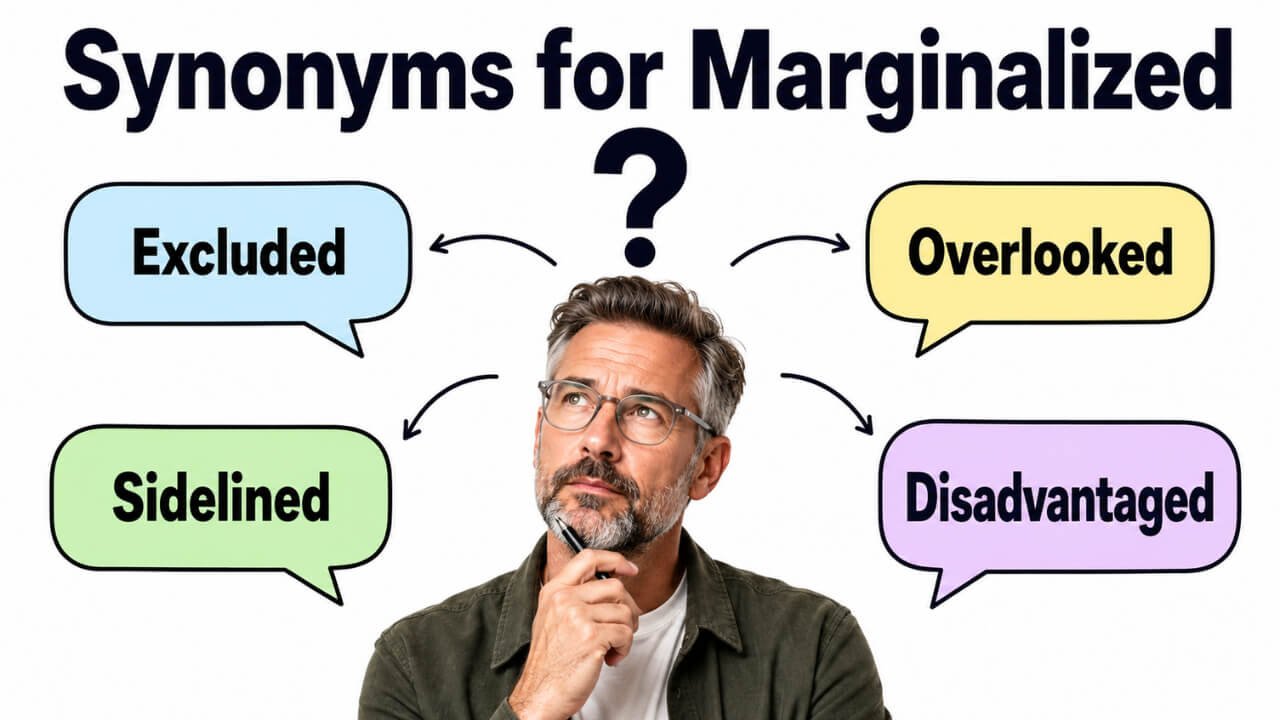
Quick Answer: The best synonyms for marginalized include excluded, disadvantaged, oppressed, disenfranchised, underserved, underrepresented, sidelined, neglected, stigmatized, and alienated. Use excluded when people are prevented from participating, disadvantaged when they lack opportunities or resources, and oppressed when powerful systems control or mistreat them. Disenfranchised is best for lost political rights, while underserved fits communities with limited access to essential services. Underrepresented works well when people lack visibility or influence in institutions.
Pronunciation and Word Details
Word: Marginalized.
Pronunciation: /ˈmɑːr.dʒɪ.nə.laɪzd/
Part of Speech: Adjective and past participle.
Meaning: Treated as unimportant, excluded from participation, or placed outside the main social, political, cultural, or economic system.
US Pronunciation:
UK Pronunciation:
What Does “Marginalized” Mean?
Marginalized means treated as less important or pushed outside the main areas of society, influence, opportunity, or decision making.
The word is commonly used as an adjective to describe people, communities, voices, or groups that have limited access to power, resources, representation, education, health care, employment, or public participation.
It can also be the past participle of the verb marginalize.
Adjective Use: Marginalized communities often face barriers to education and employment.
Verb Form: The policy marginalized people who could not meet its strict requirements.
The meaning can change slightly according to context. A politically marginalized group may lack voting power, while an economically marginalized community may have limited access to jobs, housing, or financial resources.
Meaning, Tone, and Context of “Marginalized”
Marginalized has a serious, formal, and often academic tone. It is frequently used in discussions about social inclusion, inequality, human rights, public policy, education, health, economics, representation, and community development.
The word is generally neutral in grammar, but its meaning carries emotional and social weight. It suggests that exclusion or disadvantage is not always accidental. Social rules, institutions, attitudes, policies, or unequal power structures may contribute to marginalization.
Formal Context: Researchers examined barriers affecting marginalized populations.
Academic Context: The essay discusses how language can marginalize certain communities.
Social Context: Marginalized people may struggle to have their concerns heard.
Political Context: The reform was intended to give marginalized voters greater representation.
Economic Context: Marginalized workers often have fewer employment protections.
The term should be used carefully and specifically. Rather than simply calling a group marginalized, strong writing explains how the group is excluded and what barriers it experiences.
When and How to Use “Marginalized”
For Social Exclusion
Use marginalized when people are prevented from participating fully in social institutions, activities, or communities.
Example: The program creates safe spaces for socially marginalized young people.
For Limited Political Power
Use marginalized when a group has little influence over laws, policies, leadership, or public decisions.
Example: The organization encourages marginalized citizens to participate in local government.
For Unequal Access to Services
Use marginalized when communities have limited access to education, health care, housing, transportation, or other essential services.
Example: Mobile clinics were introduced to support marginalized rural communities.
For Lack of Representation
Use marginalized when people or viewpoints are missing from leadership, media, education, research, or decision making.
Example: The committee invited marginalized voices into the planning process.
For Economic Disadvantage
Use marginalized when people have limited access to employment, income, financial support, or economic security.
Example: The training program helps marginalized workers develop valuable professional skills.
For Cultural Isolation
Use marginalized when traditions, languages, identities, or cultural experiences are ignored or treated as unimportant.
Example: The exhibition highlights art created by culturally marginalized communities.
For Institutional Barriers
Use marginalized when rules or systems place certain people at a continuing disadvantage.
Example: Complicated registration procedures can leave vulnerable residents marginalized.
Best Synonyms for Marginalized
Excluded: Prevented from joining, participating, or receiving an opportunity.
Example: Several residents felt excluded from the consultation process.
Disadvantaged: Placed in an unfavorable position because of limited opportunities or resources.
Example: The scholarship supports students from disadvantaged backgrounds.
Oppressed: Controlled or treated unfairly by a powerful person, group, or system.
Example: The movement demanded justice for oppressed communities.
Disenfranchised: Deprived of voting rights, political influence, or meaningful participation.
Example: The campaign focused on politically disenfranchised citizens.
Underserved: Receiving fewer services, resources, or opportunities than needed.
Example: The clinic provides affordable care to underserved neighborhoods.
Underrepresented: Present in smaller numbers or with less influence than expected.
Example: Women remained underrepresented in senior leadership positions.
Sidelined: Prevented from having an active, central, or influential role.
Example: Local residents felt sidelined during the development process.
Neglected: Not given enough care, attention, protection, or support.
Example: The funding will help neglected communities repair essential infrastructure.
Stigmatized: Treated negatively because of prejudice, shame, or an unfavorable social label.
Example: Stigmatized individuals may avoid seeking necessary assistance.
Alienated: Made to feel separated, unwanted, or disconnected from a group or society.
Example: Unfair treatment left many employees feeling alienated.
50 Synonyms for Marginalized with Short Meanings
- Excluded: Prevented from participating or belonging.
- Disadvantaged: Lacking equal opportunities or resources.
- Oppressed: Unfairly controlled by greater power.
- Disenfranchised: Deprived of rights or political influence.
- Underserved: Given fewer services than needed.
- Underrepresented: Insufficiently represented in a group or institution.
- Sidelined: Moved away from an important role.
- Neglected: Not given proper care or attention.
- Overlooked: Not noticed, considered, or valued.
- Alienated: Made to feel separated or unwanted.
- Isolated: Separated from others or wider society.
- Stigmatized: Judged negatively because of prejudice.
- Vulnerable: Exposed to harm, disadvantage, or exploitation.
- Voiceless: Lacking influence or the ability to be heard.
- Powerless: Having little control or authority.
- Suppressed: Prevented from speaking, acting, or developing freely.
- Subordinated: Placed in a lower position of power.
- Peripheral: Positioned outside the main area of attention.
- Forgotten: No longer considered or supported.
- Ignored: Deliberately given no attention.
- Ostracized: Deliberately rejected by a group.
- Shut Out: Prevented from entering or participating.
- Pushed Aside: Treated as less important than others.
- Deprived: Denied necessary resources, rights, or opportunities.
- Dispossessed: Deprived of property, land, status, or power.
- Persecuted: Repeatedly mistreated because of identity or belief.
- Discriminated Against: Treated unfairly because of prejudice.
- Segregated: Kept separate from other people or groups.
- Relegated: Moved to a lower or less important position.
- Dismissed: Treated as unworthy of serious attention.
- Disregarded: Ignored when choices or decisions are made.
- Silenced: Prevented from expressing ideas or concerns.
- Disempowered: Deprived of control, confidence, or authority.
- Downtrodden: Treated badly by powerful people or systems.
- Outcast: Rejected or excluded from a community.
- Underprivileged: Lacking social, educational, or economic advantages.
- Unheard: Not listened to or considered.
- Invisible: Present but rarely noticed or acknowledged.
- Devalued: Treated as less worthy or important.
- Subjugated: Brought under unfair control or domination.
- Impoverished: Made poor or deprived of resources.
- Abandoned: Left without necessary help or protection.
- Unsupported: Not provided with assistance or encouragement.
- Unprotected: Lacking safety, rights, or legal protection.
- Unacknowledged: Not recognized or openly accepted.
- Excluded From Participation: Prevented from taking part in an activity or process.
- Denied Access: Prevented from using resources or opportunities.
- Denied a Voice: Prevented from influencing decisions or expressing concerns.
- Left Behind: Not included in progress, growth, or improvement.
- Pushed to the Margins: Moved outside the center of society or influence.
Read Also:
Synonyms for Excitement

Synonyms for Marginalized by Context
When Marginalized Means Socially Excluded
Useful synonyms include excluded, ostracized, isolated, alienated, shut out, and outcast. These words describe separation from a community, institution, or social group.
Example: The new center offers support to young people who feel socially excluded.
Example: Repeated rejection left him feeling alienated from the wider community.
When Marginalized Means Economically Disadvantaged
Useful alternatives include disadvantaged, deprived, underprivileged, impoverished, underserved, and left behind. These words focus on limited money, services, employment, education, or material resources.
Example: The grant provides training for economically disadvantaged workers.
Example: Affordable transportation can help underserved communities access employment.
When Marginalized Means Politically Powerless
Useful synonyms include disenfranchised, powerless, voiceless, silenced, disempowered, and subordinated. These alternatives emphasize limited rights, authority, influence, or representation.
Example: The reforms gave disenfranchised citizens greater political participation.
Example: Community meetings allowed previously silenced residents to express their concerns.
When Marginalized Means Underrepresented
Useful alternatives include underrepresented, overlooked, invisible, unheard, unacknowledged, and disregarded. These words describe people or viewpoints that receive insufficient attention or representation.
Example: The study includes perspectives from underrepresented communities.
Example: The exhibition brings overlooked artists into public view.
When Marginalized Means Unfairly Treated
Useful synonyms include oppressed, persecuted, stigmatized, discriminated against, subjugated, and segregated. These words are stronger because they suggest active mistreatment, prejudice, or control.
Example: The law was introduced to protect groups that had been discriminated against.
Example: Stigmatized patients may delay treatment because they fear judgment.
When Marginalized Means Treated as Unimportant
Useful alternatives include sidelined, neglected, dismissed, disregarded, devalued, relegated, and pushed aside. These words describe reduced importance or influence.
Example: Local concerns were sidelined during the national debate.
Example: Employees felt their suggestions had been dismissed without consideration.
Another Word for Marginalized
Excluded is often the clearest single replacement for marginalized. However, the best alternative depends on whether the sentence refers to participation, power, resources, representation, prejudice, or social acceptance.
Original: Marginalized residents were not included in the planning meetings.
Better Option: Excluded residents were not included in the planning meetings.
Original: The project supports marginalized neighborhoods with limited medical facilities.
Better Option: The project supports underserved neighborhoods with limited medical facilities.
Original: Marginalized voters had little influence over local decisions.
Better Option: Disenfranchised voters had little influence over local decisions.
Original: Marginalized perspectives were missing from the report.
Better Option: Underrepresented perspectives were missing from the report.
When Not to Use “Marginalized”
Do not use marginalized when a more precise word can explain the exact problem. The word may sound vague when the sentence does not identify whether people lack services, rights, money, representation, protection, or social acceptance.
Weak: The organization helps marginalized people.
Better: The organization provides legal assistance to workers who have been denied employment protections.
Do not use marginalized as a general synonym for unpopular, uncommon, different, or part of a numerical minority. A group can be small without being excluded or disadvantaged.
Weak: People who prefer quiet offices are marginalized.
Better: People who prefer quiet offices may feel overlooked in noisy workplaces.
Avoid using the term when people were only temporarily left out of one minor activity.
Weak: I was marginalized because I missed the lunch invitation.
Better: I felt excluded because I was not invited to lunch.
Do not use oppressed unless the context involves serious, continuing control or injustice.
Weak: The customers were oppressed by the long waiting time.
Better: The customers were frustrated by the long waiting time.
Avoid repeating marginalized several times in one paragraph. Use specific alternatives to improve clarity.
Weak: Marginalized residents said marginalized workers in marginalized districts needed support.
Better: Excluded residents said underserved workers in neglected districts needed greater support.
Words Commonly Confused With Marginalized
Marginalized vs Minority: Minority usually describes a group that is smaller in number. Marginalized describes a group that lacks power, access, recognition, or equal participation. A minority group is not automatically marginalized.
Marginalized vs Disadvantaged: Marginalized focuses on exclusion from influence or participation. Disadvantaged focuses more directly on limited opportunities, resources, or favorable conditions.
Marginalized vs Oppressed: Marginalized can involve subtle or indirect exclusion. Oppressed suggests stronger and more systematic control, cruelty, or injustice.
Marginalized vs Underrepresented: Marginalized has a broader meaning that can include economic, political, social, and cultural exclusion. Underrepresented specifically concerns insufficient presence, visibility, or influence.
Marginalized vs Vulnerable: Marginalized describes a position outside the center of power or participation. Vulnerable describes exposure to harm, danger, exploitation, or loss.
Marginalized vs Excluded: Excluded usually refers to being prevented from joining or participating. Marginalized can describe a broader and longer process of being pushed away from influence and opportunity.
Marginalized vs Stigmatized: Marginalized focuses on exclusion or reduced power. Stigmatized focuses on shame, prejudice, negative judgment, or damaging social labels.
Which Synonym Should You Choose?
Choose excluded when people are prevented from joining, participating, or receiving an opportunity.
Choose disadvantaged when discussing limited education, employment, income, housing, or social opportunities.
Choose oppressed when a powerful group or system repeatedly controls or mistreats people.
Choose disenfranchised when discussing voting rights, political participation, or lack of public influence.
Choose underserved when writing about communities that receive insufficient health care, education, transportation, financial support, or public services.
Choose underrepresented when people or perspectives are not adequately present in leadership, institutions, research, education, or decision making.
Choose sidelined when someone is moved away from an active or influential role.
Choose neglected when a community, issue, or person has not received enough care, funding, attention, or protection.
Choose stigmatized when prejudice or shame causes negative treatment.
Choose alienated when someone feels emotionally or socially disconnected.
Choose overlooked in reports, essays, and professional writing when the main issue is insufficient attention.
Choose shut out in casual speech when someone is prevented from participating.
Choose silenced when people are prevented from expressing their experiences, concerns, or opinions.
Choose disempowered when a policy, situation, or institution reduces personal control or authority.
Real Life Examples of “Marginalized” in Sentences
Original: The charity provides meals to marginalized families.
Better Option: The charity provides meals to economically disadvantaged families.
Original: Marginalized residents were not invited to the meeting.
Better Option: Excluded residents were not invited to the meeting.
Original: The research focuses on marginalized communities with limited medical care.
Better Option: The research focuses on underserved communities with limited medical care.
Original: Marginalized voices were missing from the public discussion.
Better Option: Underrepresented voices were missing from the public discussion.
Original: The law affected marginalized voters.
Better Option: The law affected disenfranchised voters.
Original: Marginalized employees rarely received leadership opportunities.
Better Option: Sidelined employees rarely received leadership opportunities.
Original: The campaign challenged beliefs that marginalized certain patients.
Better Option: The campaign challenged beliefs that stigmatized certain patients.
Original: Marginalized workers had few legal protections.
Better Option: Disempowered workers had few legal protections.
Original: The museum displayed work from marginalized artists.
Better Option: The museum displayed work from overlooked artists.
Original: Years of discrimination left the community marginalized.
Better Option: Years of discrimination left the community socially excluded.
Synonym Groups and Usage Differences
Social Exclusion Group
Excluded, alienated, ostracized, isolated, outcast, and shut out describe separation from social participation or acceptance. Excluded is the broadest and most neutral option, while ostracized suggests deliberate rejection.
Example: She felt ostracized after other members refused to speak with her.
Economic Disadvantage Group
Disadvantaged, deprived, underprivileged, impoverished, underserved, and left behind describe limited resources or opportunities. Underserved is especially useful for communities lacking essential services.
Example: The initiative brings reliable transportation to underserved neighborhoods.
Power and Rights Group
Oppressed, disenfranchised, powerless, subordinated, subjugated, and disempowered describe limited authority, freedom, or political influence. Oppressed and subjugated are stronger than powerless.
Example: The reform gave disenfranchised citizens a greater role in public decisions.
Representation Group
Underrepresented, overlooked, unheard, invisible, disregarded, and unacknowledged describe insufficient visibility or consideration. Underrepresented is especially useful in reports and institutional discussions.
Example: The panel included speakers from underrepresented professional backgrounds.
Voice and Expression Group
Voiceless, silenced, suppressed, dismissed, and denied a voice describe limited ability to communicate concerns or influence decisions. Silenced often suggests that another person or institution actively prevented expression.
Example: The inquiry allowed previously silenced witnesses to share their experiences.
Social Position Group
Sidelined, peripheral, relegated, pushed aside, devalued, and pushed to the margins describe a movement away from central importance. Sidelined often refers to participation, while peripheral describes position.
Example: Environmental concerns were relegated to a minor section of the report.
Prejudice and Mistreatment Group
Stigmatized, persecuted, segregated, discriminated against, and oppressed describe harmful treatment. Stigmatized focuses on negative judgment, while persecuted suggests repeated and serious mistreatment.
Example: Public education can reduce the fear experienced by stigmatized patients.
Antonyms of Marginalized
The opposite of marginalized depends on whether the sentence concerns inclusion, power, representation, resources, or social acceptance.
Included: Allowed to participate or belong.
Integrated: Fully connected with a wider group or system.
Represented: Given a voice or presence in decisions.
Empowered: Given authority, confidence, resources, or control.
Privileged: Possessing social, economic, or political advantages.
Advantaged: Placed in a favorable position.
Supported: Given help, protection, or encouragement.
Valued: Treated as important and worthy.
Recognized: Publicly acknowledged or accepted.
Influential: Able to affect decisions or opinions.
Enfranchised: Given voting rights or political participation.
Protected: Defended from harm, discrimination, or exploitation.
Visible: Clearly noticed and acknowledged.
Central: Positioned near the main area of importance.
Heard: Listened to and seriously considered.
Comparison: Marginalized vs Related Words
Marginalized vs Excluded
Marginalized describes a broad condition in which people are pushed away from power, resources, recognition, or participation. Excluded usually refers to a clearer act of being prevented from joining something.
Example With Marginalized: The policy had long term effects on marginalized rural residents.
Example With Excluded: Rural residents were excluded from the final meeting.
Marginalized vs Disadvantaged
Marginalized emphasizes social position and limited participation. Disadvantaged emphasizes unfavorable conditions or limited resources.
Example With Marginalized: Marginalized workers had little influence over workplace rules.
Example With Disadvantaged: Disadvantaged workers lacked access to professional training.
Marginalized vs Oppressed
Marginalized may result from neglect, prejudice, institutional barriers, or limited representation. Oppressed suggests stronger control and continuing injustice imposed by those with power.
Example With Marginalized: The study examines marginalized communities in urban areas.
Example With Oppressed: The movement challenged laws used to control oppressed citizens.
Marginalized vs Underrepresented
Marginalized covers many forms of exclusion. Underrepresented specifically refers to insufficient presence, visibility, or influence.
Example With Marginalized: Marginalized families faced barriers to housing and education.
Example With Underrepresented: Rural families were underrepresented on the advisory board.
Marginalized vs Underserved
Marginalized refers to reduced social position or influence. Underserved refers to receiving inadequate services or resources.
Example With Marginalized: Marginalized residents were rarely consulted about public policy.
Example With Underserved: Underserved residents lacked nearby medical facilities.
Marginalized vs Stigmatized
Marginalized means pushed away from participation or power. Stigmatized means judged negatively because of prejudice or shame.
Example With Marginalized: Marginalized patients had limited access to specialist care.
Example With Stigmatized: Stigmatized patients feared being judged when seeking treatment.
Common Phrases and Expressions With “Marginalized”
Marginalized Communities: Communities with limited access to power, resources, opportunities, or representation.
Marginalized Groups: Groups treated as less important or excluded from full participation.
Marginalized People: Individuals who experience social, political, cultural, or economic exclusion.
Marginalized Voices: Opinions and experiences that are rarely heard or considered.
Marginalized Populations: Groups facing continuing barriers within society or public institutions.
Socially Marginalized: Excluded from social acceptance, relationships, or community participation.
Economically Marginalized: Limited by poverty, unemployment, low income, or restricted financial opportunities.
Politically Marginalized: Given little influence over government, laws, leadership, or public decisions.
Historically Marginalized: Excluded or disadvantaged over a long period of history.
Culturally Marginalized: Having traditions, languages, identities, or experiences treated as less important.
Common Mistakes to Avoid
Using Marginalized Without Explanation
Marginalized can sound vague when the writer does not explain the type of exclusion.
Unclear: The policy affected marginalized people.
Clearer: The policy reduced access to affordable housing for low income residents.
Treating Minority as an Exact Synonym
A minority group is smaller in number, but it is not necessarily excluded, powerless, or disadvantaged. Use marginalized only when there is evidence of unequal access, treatment, representation, or influence.
Choosing an Overly Strong Synonym
Oppressed, persecuted, and subjugated describe serious mistreatment. Do not use them when the situation only involves limited attention or temporary exclusion.
Confusing Underserved With Underrepresented
Underserved concerns insufficient services or resources. Underrepresented concerns insufficient presence or influence.
Incorrect: The neighborhood was underrepresented by medical clinics.
Better: The neighborhood was underserved by medical clinics.
Repeating Marginalized Too Often
Repeated use can make writing sound mechanical. Replace it with more precise words when the context is clear.
Repetitive: Marginalized students from marginalized areas discussed marginalized experiences.
Improved: Disadvantaged students from underserved areas discussed experiences of social exclusion.
Using the Word as a Permanent Identity
Marginalized describes social conditions and treatment. It should not suggest that exclusion is a fixed personal quality.
Less Careful: They are naturally marginalized people.
Better: They have been marginalized by unequal policies and limited access to services.
Hiding the Cause of Exclusion
Passive wording may fail to explain who created or maintained the barrier.
Vague: The residents were marginalized.
Specific: Restrictive housing policies excluded residents from affordable neighborhoods.
Conclusion
Synonyms for marginalized should be selected according to the exact type of exclusion being described. Excluded is the clearest general alternative, while disadvantaged focuses on limited opportunities and underserved describes inadequate services. Use disenfranchised for political rights, underrepresented for missing representation, and oppressed for serious systematic mistreatment. Words such as sidelined, neglected, stigmatized, alienated, and silenced express different experiences. Precise word choice helps readers understand how people lack access, influence, recognition, protection, or participation.
FAQs About Synonyms for Marginalized
What Is the Best Synonym for Marginalized?
Excluded is the best general synonym. However, disadvantaged, underserved, underrepresented, or disenfranchised may be more accurate in specific contexts.
Is Marginalized the Same as Oppressed?
No. Marginalized means pushed away from power or participation. Oppressed suggests stronger and more systematic control or mistreatment.
Is Marginalized a Formal Word?
Yes. Marginalized is common in formal, academic, political, social, and professional writing.
Can Marginalized Describe One Person?
Yes. A person can be marginalized when they are excluded, ignored, silenced, or denied equal opportunities.
What Is the Difference Between Marginalized and Disadvantaged?
Marginalized focuses on exclusion from influence or participation. Disadvantaged focuses on limited resources, opportunities, or favorable conditions.
Which Synonym Is Best for Lack of Representation?
Underrepresented is usually the best choice when people, groups, or viewpoints do not have enough presence or influence.
Can Excluded Always Replace Marginalized?
No. Excluded may describe one specific act, while marginalized can describe a wider and continuing condition involving power, access, resources, and social position.
