
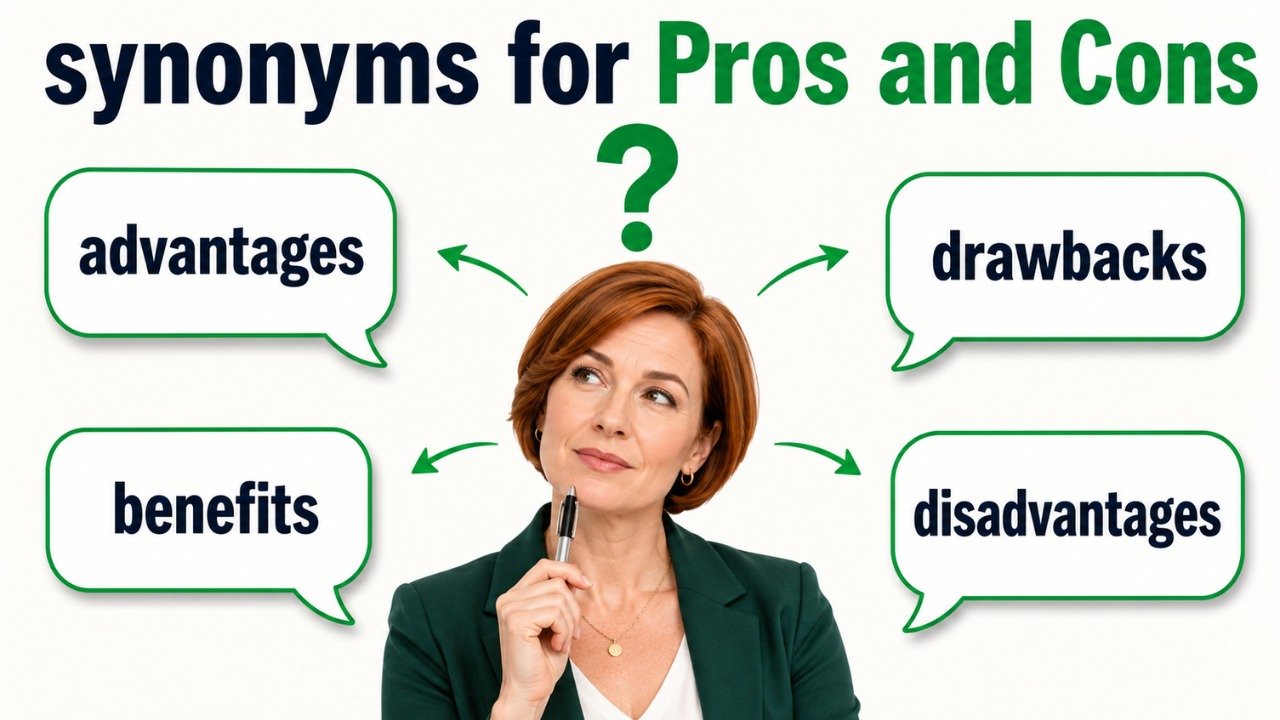
Quick Answer: The best synonyms for pros and cons include advantages and disadvantages, benefits and drawbacks, strengths and weaknesses, positives and negatives, merits and demerits, upsides and downsides, gains and losses, risks and rewards, arguments for and against, and costs and benefits. Use advantages and disadvantages in formal or general writing, benefits and drawbacks in practical evaluations, strengths and weaknesses in performance reviews, risks and rewards in business decisions, and upsides and downsides in casual conversation. The best choice among synonyms for pros and cons depends on whether you are comparing qualities, outcomes, costs, risks, or opposing arguments.
Pronunciation and Word Details
Word: Pros and cons.
Pronunciation: /ˌproʊz ən ˈkɑːnz/.
Part of Speech: Plural noun phrase.
Meaning: The favorable and unfavorable aspects of a decision, idea, product, situation, or action.
US Pronunciation:
UK Pronunciation:
What Does “Pros and Cons” Mean?
Pros and cons means the positive and negative aspects of something. The phrase is used when people want to evaluate both sides of a choice, idea, plan, product, argument, or situation.
The word pros refers to the advantages, benefits, strengths, or favorable points. The word cons refers to the disadvantages, drawbacks, weaknesses, risks, or unfavorable points.
Example: We discussed the pros and cons of moving to a larger office.
In this sentence, the phrase refers to the reasons supporting and opposing the move.
Pros and cons is a plural noun phrase. It commonly appears after verbs such as consider, compare, discuss, list, examine, evaluate, analyze, and weigh.
Example: Before making a decision, consider the pros and cons carefully.
The phrase can describe practical benefits and problems.
Example: The main pro is convenience, while the main con is cost.
It can also describe arguments in a debate.
Example: The class examined the pros and cons of the proposed rule.
Pros and cons is useful because it encourages balanced thinking. Instead of focusing only on benefits or only on problems, it presents both sides of an issue.
Meaning, Tone, and Context of “Pros and Cons”
Pros and cons has a neutral, practical, and conversational tone. It is widely understood and commonly used in everyday discussions, decision making, reviews, comparisons, planning, education, and workplace communication.
The phrase is suitable for general writing.
Example: The article explains the pros and cons of working from home.
It also works naturally in conversation.
Example: Let us talk about the pros and cons before we decide.
In highly formal reports, academic essays, or professional evaluations, alternatives such as advantages and disadvantages, benefits and limitations, costs and benefits, or arguments for and against may sound more precise.
General: We compared the pros and cons of each option.
Formal: We evaluated the advantages and disadvantages of each option.
Pros and cons is usually objective rather than emotional. It signals that both favorable and unfavorable information will be considered.
The phrase can be used in many contexts, including personal choices, business planning, education, technology, health decisions, financial choices, product comparisons, travel planning, and policy discussions.
Writers should choose a more specific alternative when the exact type of comparison matters. Risks and rewards is better for uncertain outcomes, while strengths and weaknesses is better for evaluating performance or ability.
When and How to Use “Pros and Cons”
For Making a Decision
Use pros and cons when comparing the positive and negative results of different choices.
Example: We listed the pros and cons of renting and buying before choosing a home.
This use is common in personal decisions, planning, and problem solving.
For Comparing Options
The phrase helps readers examine how two or more choices differ.
Example: The manager compared the pros and cons of three possible schedules.
A clear comparison may include cost, convenience, time, quality, and risk.
For Evaluating a Product or Service
Use pros and cons when describing useful features and possible limitations.
Example: The review explained the pros and cons of the new scheduling system.
Benefits and drawbacks is another suitable phrase in this context.
For Business Planning
Pros and cons can help teams examine the effects of a proposal or strategy.
Example: The team considered the pros and cons of entering a new market.
In formal business writing, advantages and risks or opportunities and challenges may be more specific.
For Academic Discussion
Use the phrase when presenting different sides of a topic.
Example: The essay discusses the pros and cons of online education.
Arguments for and against may sound more academic when the topic involves debate rather than practical features.
For Performance Evaluation
Pros and cons can describe what a person, plan, or method does well and where it falls short.
Example: The report reviewed the pros and cons of the current training method.
Strengths and weaknesses is usually more natural in formal evaluations.
For Risk Assessment
Use pros and cons when a choice includes both possible benefits and possible harm.
Example: Investors examined the pros and cons of the opportunity.
Risks and rewards is more precise when uncertainty and potential gain are central.
For Casual Conversation
Pros and cons sounds natural when people are informally discussing a choice.
Example: What are the pros and cons of taking the earlier flight?
Upsides and downsides is another relaxed and conversational alternative.
For Balanced Writing
The phrase signals that a discussion will not focus on only one side.
Example: A useful comparison should explain both the pros and cons.
This approach improves clarity and helps readers make informed decisions.
Best Synonyms for Pros and Cons
Advantages and Disadvantages: The favorable and unfavorable qualities or results of something.
Example: The report compares the advantages and disadvantages of flexible working hours.
Benefits and Drawbacks: The helpful effects and possible problems of a choice.
Example: We examined the benefits and drawbacks of the new process.
Strengths and Weaknesses: The areas in which something performs well or poorly.
Example: The evaluation identifies the strengths and weaknesses of the proposal.
Positives and Negatives: The good and bad aspects of a situation.
Example: The discussion covered the positives and negatives of moving abroad.
Merits and Demerits: The qualities that make something worthy or unworthy of approval.
Example: The students discussed the merits and demerits of the policy.
Upsides and Downsides: The favorable and unfavorable parts of something in casual language.
Example: There are several upsides and downsides to sharing an apartment.
Risks and Rewards: The possible dangers and possible gains connected with a choice.
Example: Every investment has risks and rewards.
Arguments for and Against: The reasons supporting and opposing an idea.
Example: The debate presented arguments for and against the proposed change.
Costs and Benefits: The resources required and the value gained from a decision.
Example: The committee reviewed the costs and benefits of the project.
Opportunities and Challenges: The possible advantages and difficulties within a situation.
Example: The expansion creates new opportunities and challenges.
50 Synonyms for Pros and Cons with Short Meanings
- Advantages and Disadvantages: The positive and negative qualities of something.
- Benefits and Drawbacks: The helpful results and possible problems.
- Strengths and Weaknesses: The areas of strong and poor performance.
- Positives and Negatives: The good and bad aspects of a situation.
- Merits and Demerits: The qualities supporting or reducing value.
- Upsides and Downsides: The favorable and unfavorable sides in casual language.
- Gains and Losses: The things obtained and the things given up.
- Risks and Rewards: The possible dangers and potential benefits.
- Opportunities and Risks: The chances for success and possible harm.
- Favorable and Unfavorable Points: The details that support or oppose something.
- Arguments for and Against: The reasons supporting and opposing an idea.
- Reasons for and Against: The explanations favoring or rejecting a choice.
- Supporting and Opposing Points: The ideas on both sides of an issue.
- Benefits and Limitations: The useful features and practical restrictions.
- Advantages and Limitations: The favorable qualities and boundaries.
- Strengths and Limitations: The positive capabilities and restricted areas.
- Benefits and Risks: The possible gains and dangers.
- Advantages and Risks: The favorable outcomes and uncertain problems.
- Merits and Drawbacks: The valuable qualities and disadvantages.
- Positive and Negative Aspects: The favorable and unfavorable features.
- Good and Bad Points: The useful and problematic details.
- Favorable and Unfavorable Aspects: The helpful and unhelpful parts.
- Helpful and Harmful Effects: The positive and damaging results.
- Benefits and Costs: The value gained and resources required.
- Costs and Benefits: The required expense and expected value.
- Assets and Liabilities: The useful qualities and possible burdens.
- Gains and Sacrifices: The benefits received and things given up.
- Rewards and Consequences: The positive outcomes and possible results.
- Advantages and Challenges: The benefits and difficulties involved.
- Benefits and Challenges: The useful results and obstacles.
- Strengths and Challenges: The strong qualities and areas of difficulty.
- Possibilities and Problems: The potential opportunities and difficulties.
- Opportunities and Obstacles: The chances for progress and barriers to success.
- Favorable and Adverse Factors: The conditions helping or harming an outcome.
- Supporting and Limiting Factors: The conditions that encourage or restrict success.
- Positive and Negative Features: The useful and undesirable characteristics.
- Beneficial and Harmful Effects: The helpful and damaging consequences.
- Desirable and Undesirable Qualities: The appealing and unappealing characteristics.
- Appealing and Unappealing Aspects: The attractive and unattractive parts.
- Reasons to Accept and Reject: The points supporting approval or refusal.
- Reasons to Choose and Avoid: The factors encouraging or discouraging selection.
- Case for and Case Against: The complete reasoning supporting each side.
- Arguments in Favor and Arguments Against: The claims supporting and opposing a position.
- Points in Favor and Points Against: The details supporting each side of a decision.
- Advantages and Trade Offs: The benefits and compromises required.
- Benefits and Compromises: The positive results and concessions involved.
- Value and Cost: The usefulness gained and expense required.
- Potential and Risk: The possibility of success and chance of failure.
- Promise and Danger: The hopeful possibilities and possible harm.
- Pluses and Minuses: An informal expression for positive and negative points.
Read Also:
Synonyms for Review
Synonyms for Pros and Cons by Context
When Pros and Cons Means Advantages and Disadvantages
Advantages and disadvantages is the most direct formal replacement for pros and cons. It works well in essays, reports, comparisons, reviews, and professional communication.
Example With Pros and Cons: The report explains the pros and cons of the proposal.
Example With Advantages and Disadvantages: The report explains the advantages and disadvantages of the proposal.
Advantages and disadvantages has a more formal tone, while pros and cons sounds more conversational.
When Pros and Cons Means Benefits and Drawbacks
Benefits and drawbacks focuses on helpful results and practical problems.
Example With Pros and Cons: We considered the pros and cons of the new timetable.
Example With Benefits and Drawbacks: We considered the benefits and drawbacks of the new timetable.
This alternative is useful when discussing policies, systems, services, methods, and lifestyle choices.
When Pros and Cons Means Strengths and Weaknesses
Strengths and weaknesses is best when evaluating performance, quality, ability, or design.
Example With Pros and Cons: The review identifies the pros and cons of the training program.
Example With Strengths and Weaknesses: The review identifies the strengths and weaknesses of the training program.
This phrase is common in performance evaluations, project reviews, and analytical writing.
When Pros and Cons Means Risks and Rewards
Risks and rewards emphasizes uncertainty, possible loss, and possible gain.
Example With Pros and Cons: The investors studied the pros and cons of the opportunity.
Example With Risks and Rewards: The investors studied the risks and rewards of the opportunity.
Use this alternative for investments, business decisions, career changes, and uncertain opportunities.
When Pros and Cons Means Arguments for and Against
Arguments for and against is suitable when the discussion involves opposing opinions or positions.
Example With Pros and Cons: The class discussed the pros and cons of the proposed rule.
Example With Arguments for and Against: The class discussed the arguments for and against the proposed rule.
This phrase works well in debates, essays, policy discussions, and persuasive writing.
When Pros and Cons Means Costs and Benefits
Costs and benefits is useful when comparing the resources required with the value gained.
Example With Pros and Cons: The committee examined the pros and cons of expanding the building.
Example With Costs and Benefits: The committee examined the costs and benefits of expanding the building.
Costs may include money, time, effort, resources, or lost opportunities.
When Pros and Cons Means Opportunities and Challenges
Opportunities and challenges focuses on future possibilities and likely difficulties.
Example With Pros and Cons: The report describes the pros and cons of international expansion.
Example With Opportunities and Challenges: The report describes the opportunities and challenges of international expansion.
This phrase has a constructive and professional tone.
When Pros and Cons Means Upsides and Downsides
Upsides and downsides is a casual alternative used in conversation and informal writing.
Example With Pros and Cons: What are the pros and cons of living in a small town?
Example With Upsides and Downsides: What are the upsides and downsides of living in a small town?
Both phrases are natural, but upsides and downsides sounds slightly more relaxed.
When Pros and Cons Means Positives and Negatives
Positives and negatives provides a simple and flexible way to discuss favorable and unfavorable aspects.
Example With Pros and Cons: We reviewed the pros and cons of each design.
Example With Positives and Negatives: We reviewed the positives and negatives of each design.
This alternative works in both speech and general writing.
Another Word for Pros and Cons
Advantages and disadvantages is the best direct replacement for pros and cons in most formal and general contexts. However, the best alternative depends on what is being evaluated. Use benefits and drawbacks for practical results, strengths and weaknesses for performance, risks and rewards for uncertainty, and arguments for and against for debates.
Original: The report discusses the pros and cons of remote work.
Better Option: The report discusses the advantages and disadvantages of remote work.
Original: We reviewed the pros and cons of the new software.
Better Option: We reviewed the benefits and drawbacks of the new software.
Original: The interview focused on the candidate’s pros and cons.
Better Option: The interview focused on the candidate’s strengths and weaknesses.
Original: Investors must understand the pros and cons of the opportunity.
Better Option: Investors must understand the risks and rewards of the opportunity.
When Not to Use “Pros and Cons”
Pros and cons is clear and familiar, but another phrase may be more accurate in formal, technical, or specialized contexts.
In Highly Formal Academic Writing
The phrase may sound too conversational in a formal essay or research paper.
Weak: This section examines the pros and cons of the policy.
Better: This section examines the advantages and disadvantages of the policy.
When Specific Risks Must Be Identified
Pros and cons may be too general when safety, financial loss, or uncertainty is important.
Weak: The report describes the pros and cons of the investment.
Better: The report describes the expected returns and financial risks of the investment.
When Evaluating Performance
Strengths and weaknesses is more precise when discussing a person, team, method, or organization.
Weak: The review explains the employee’s pros and cons.
Better: The review explains the employee’s strengths and areas for improvement.
When Discussing a Debate
Arguments for and against is clearer when the subject involves competing opinions.
Weak: The essay presents the pros and cons of the proposed law.
Better: The essay presents the arguments for and against the proposed law.
When Comparing Financial Value
Costs and benefits is more specific when a decision involves expenses and measurable returns.
Weak: The committee studied the pros and cons of the renovation.
Better: The committee studied the costs and benefits of the renovation.
When the Sentence Is One Sided
Do not promise to discuss pros and cons if the content covers only advantages or only disadvantages.
Weak: The article explains the pros and cons, but it lists only benefits.
Better: The article explains the main benefits of the approach.
When the Phrase Is Repeated Too Often
Frequent repetition can make an article sound basic or mechanical.
Weak: We listed the pros and cons. The pros and cons showed that the pros were stronger than the cons.
Better: We listed the advantages and disadvantages. The comparison showed that the benefits outweighed the drawbacks.
When Greater Detail Is Needed
Pros and cons may be too vague when readers need specific categories.
Weak: The plan has several pros and cons.
Better: The plan offers lower costs and greater flexibility, but it also creates scheduling and communication challenges.
Words Commonly Confused With Pros and Cons
Pros and Cons vs Advantages and Disadvantages: Both describe positive and negative aspects. Pros and cons is more conversational, while advantages and disadvantages is more formal.
Pros and Cons vs Benefits and Drawbacks: Pros and cons is broad. Benefits and drawbacks focuses more directly on useful results and practical problems.
Pros and Cons vs Strengths and Weaknesses: Pros and cons evaluates favorable and unfavorable aspects. Strengths and weaknesses usually evaluates quality, performance, or ability.
Pros and Cons vs Risks and Rewards: Pros and cons can cover any positive or negative point. Risks and rewards specifically focuses on uncertainty, danger, and possible gain.
Pros and Cons vs Costs and Benefits: Pros and cons is general. Costs and benefits compares the resources required with the value received.
Pros and Cons vs Arguments for and Against: Pros and cons may describe features or outcomes. Arguments for and against refers to opposing reasons in a discussion or debate.
Pros and Cons vs Opportunities and Challenges: Pros and cons is neutral. Opportunities and challenges often sounds more constructive and future focused.
Pros and Cons vs Trade Offs: Pros and cons lists separate positives and negatives. A trade off describes a situation in which gaining one benefit requires giving up another.
Pros and Cons vs Pluses and Minuses: Both have an informal tone, but pluses and minuses sounds more conversational and less suitable for formal writing.
Which Synonym Should You Choose?
Choose advantages and disadvantages for formal essays, reports, comparisons, and professional documents.
Choose benefits and drawbacks when evaluating a product, service, process, policy, or practical decision.
Choose strengths and weaknesses when discussing performance, ability, quality, or effectiveness.
Choose positives and negatives for clear general writing and everyday conversation.
Choose merits and demerits when discussing the value or quality of an idea in formal or academic language.
Choose upsides and downsides for casual speech and informal explanations.
Choose risks and rewards when uncertainty, possible harm, and potential gain are central to the decision.
Choose arguments for and against when presenting opposing positions in an essay, debate, or policy discussion.
Choose costs and benefits when comparing money, time, effort, or resources with expected value.
Choose opportunities and challenges when discussing future growth, change, development, or strategy.
Choose benefits and limitations when you want a balanced but less negative professional tone.
Choose advantages and trade offs when a benefit requires a compromise or sacrifice.
Choose favorable and adverse factors in technical, analytical, or formal evaluations.
Real Life Examples of “Pros and Cons” in Sentences
Original: We discussed the pros and cons of moving to another city.
Better Option: We discussed the advantages and disadvantages of moving to another city.
Original: The review explains the pros and cons of the new application.
Better Option: The review explains the benefits and drawbacks of the new application.
Original: The manager evaluated the pros and cons of the current team.
Better Option: The manager evaluated the team’s strengths and weaknesses.
Original: Investors considered the pros and cons of the project.
Better Option: Investors considered the risks and rewards of the project.
Original: The essay presents the pros and cons of the proposed policy.
Better Option: The essay presents the arguments for and against the proposed policy.
Original: The committee compared the pros and cons of rebuilding the facility.
Better Option: The committee compared the costs and benefits of rebuilding the facility.
Original: Every career change has pros and cons.
Better Option: Every career change has upsides and downsides.
Original: The report describes the pros and cons of rapid expansion.
Better Option: The report describes the opportunities and challenges of rapid expansion.
Original: Let us list the pros and cons before choosing.
Better Option: Let us list the positives and negatives before choosing.
Original: The proposal has several pros and cons.
Better Option: The proposal offers several benefits but also has important limitations.
Synonym Groups and Usage Differences
General Comparison Group
This group includes advantages and disadvantages, positives and negatives, good and bad points, and favorable and unfavorable aspects.
These alternatives work in broad discussions where no specialized meaning is required.
Example: The guide explains the advantages and disadvantages of each option.
Practical Evaluation Group
This group includes benefits and drawbacks, benefits and limitations, advantages and challenges, and positive and negative features.
These phrases are useful when evaluating products, services, methods, systems, and plans.
Example: The review identifies the benefits and limitations of the new process.
Performance Group
This group includes strengths and weaknesses, strengths and limitations, assets and liabilities, and desirable and undesirable qualities.
These alternatives evaluate ability, quality, design, performance, or effectiveness.
Example: The assessment highlights the method’s strengths and weaknesses.
Risk Group
This group includes risks and rewards, benefits and risks, opportunities and risks, potential and risk, and promise and danger.
These phrases are useful when outcomes are uncertain.
Example: The team carefully evaluated the risks and rewards of entering the new market.
Debate Group
This group includes arguments for and against, reasons for and against, supporting and opposing points, and case for and case against.
These alternatives are useful in essays, discussions, debates, and policy analysis.
Example: The speaker presented a strong case for and case against the proposal.
Financial Group
This group includes costs and benefits, value and cost, gains and losses, and benefits and costs.
These phrases compare resources, expenses, returns, and value.
Example: The analysis compares the costs and benefits of replacing the equipment.
Growth and Strategy Group
This group includes opportunities and challenges, opportunities and obstacles, supporting and limiting factors, and favorable and adverse factors.
These alternatives are common in planning, strategy, development, and business writing.
Example: The report describes the opportunities and challenges created by expansion.
Informal Group
This group includes upsides and downsides, pluses and minuses, and good and bad points.
These phrases sound natural in casual conversation and simple explanations.
Example: We talked about the upsides and downsides of changing the schedule.
Compromise Group
This group includes advantages and trade offs, benefits and compromises, and gains and sacrifices.
These phrases emphasize that receiving one benefit may require accepting a disadvantage.
Example: Greater flexibility offers clear benefits and compromises.
Antonyms of Pros and Cons
Pros and cons has no exact single antonym because it represents a balanced evaluation of positive and negative points. However, several words and phrases describe an opposing approach.
One Sided View: An opinion that considers only one side of an issue.
Unqualified Approval: Complete support without considering disadvantages.
Unqualified Criticism: Complete disapproval without recognizing benefits.
Blind Acceptance: Agreement without careful evaluation.
Blanket Rejection: Refusal without considering possible advantages.
Bias: An unfair preference for one side.
Partiality: Support for one position without balanced judgment.
Certainty: A condition in which no meaningful advantages and disadvantages need comparison.
Indifference: A lack of interest in either side.
Single Perspective: Consideration of only one viewpoint.
Unbalanced Assessment: An evaluation that gives unfair attention to one side.
Fixed Opinion: A belief maintained without examining opposing evidence.
Comparison: Pros and Cons vs Related Words
Pros and Cons vs Advantages and Disadvantages
Both phrases describe positive and negative aspects. Pros and cons is shorter and more conversational. Advantages and disadvantages is more suitable for formal writing.
Example With Pros and Cons: We discussed the pros and cons of the proposal.
Example With Advantages and Disadvantages: We analyzed the advantages and disadvantages of the proposal.
Pros and Cons vs Benefits and Drawbacks
Pros and cons can describe any favorable or unfavorable point. Benefits and drawbacks focuses on useful effects and practical problems.
Example With Pros and Cons: The guide lists the pros and cons of the service.
Example With Benefits and Drawbacks: The guide explains the benefits and drawbacks of the service.
Pros and Cons vs Strengths and Weaknesses
Pros and cons evaluates a decision or situation. Strengths and weaknesses evaluates quality, performance, ability, or design.
Example With Pros and Cons: We considered the pros and cons of the training method.
Example With Strengths and Weaknesses: We assessed the strengths and weaknesses of the training method.
Pros and Cons vs Risks and Rewards
Pros and cons has a broad meaning. Risks and rewards emphasizes uncertainty, possible loss, and possible gain.
Example With Pros and Cons: The partners reviewed the pros and cons of the investment.
Example With Risks and Rewards: The partners reviewed the risks and rewards of the investment.
Pros and Cons vs Costs and Benefits
Pros and cons may include any positive or negative detail. Costs and benefits specifically compares required resources with expected value.
Example With Pros and Cons: The council examined the pros and cons of the new road.
Example With Costs and Benefits: The council examined the costs and benefits of the new road.
Pros and Cons vs Arguments for and Against
Pros and cons can refer to features, results, or experiences. Arguments for and against refers to reasons supporting opposing positions.
Example With Pros and Cons: The class discussed the pros and cons of the rule.
Example With Arguments for and Against: The class presented arguments for and against the rule.
Pros and Cons vs Opportunities and Challenges
Pros and cons has a neutral tone. Opportunities and challenges sounds constructive and focuses on future possibilities and difficulties.
Example With Pros and Cons: The report describes the pros and cons of growth.
Example With Opportunities and Challenges: The report describes the opportunities and challenges associated with growth.
Pros and Cons vs Trade Offs
Pros and cons lists separate advantages and disadvantages. Trade offs describes compromises between competing benefits.
Example With Pros and Cons: The design has several pros and cons.
Example With Trade Offs: The design involves trade offs between speed and accuracy.
Common Phrases and Expressions With “Pros and Cons”
Weigh the Pros and Cons: Carefully compare the advantages and disadvantages before deciding.
Example: We should weigh the pros and cons before signing the agreement.
Consider the Pros and Cons: Think about both the favorable and unfavorable points.
Example: Consider the pros and cons of each option carefully.
List the Pros and Cons: Write or state the positive and negative aspects separately.
Example: She listed the pros and cons in two columns.
Discuss the Pros and Cons: Talk about both sides of a subject.
Example: The group discussed the pros and cons of the plan.
Compare the Pros and Cons: Examine how the advantages and disadvantages differ.
Example: Compare the pros and cons of the available courses.
Evaluate the Pros and Cons: Judge the importance of each positive and negative point.
Example: The committee evaluated the pros and cons of the proposal.
Analyze the Pros and Cons: Study both sides in detail.
Example: The report analyzes the pros and cons of the system.
Balance the Pros and Cons: Decide whether the benefits are greater than the drawbacks.
Example: It is important to balance the pros and cons before acting.
Examine the Pros and Cons: Look closely at every favorable and unfavorable aspect.
Example: The team examined the pros and cons of changing suppliers.
Understand the Pros and Cons: Become aware of both the advantages and disadvantages.
Example: Buyers should understand the pros and cons before making a purchase.
Common Mistakes to Avoid
Using Pros and Cons in Very Formal Writing
The phrase may sound too conversational in a formal academic or technical document.
Less Formal: The report examines the pros and cons of the method.
More Formal: The report examines the advantages and limitations of the method.
Treating Every Synonym as Interchangeable
Different alternatives emphasize different types of comparison.
Incorrect Choice: The employee’s risks and rewards were reviewed.
Better Choice: The employee’s strengths and weaknesses were reviewed.
Use risks and rewards for uncertain outcomes, not personal performance.
Giving an Unbalanced List
A pros and cons section should genuinely include both positive and negative points.
Weak: The advantages are detailed, but the disadvantages are barely mentioned.
Better: Give each side enough explanation to support a fair comparison.
Repeating the Phrase Too Often
Overusing pros and cons can reduce variety and readability.
Repetitive: The pros and cons section explains the pros and cons so readers can compare the pros and cons.
Improved: The comparison explains the main benefits and drawbacks so readers can evaluate both sides.
Using Vague Points
Broad statements such as it is good or it is bad provide little value.
Vague: One pro is that the plan is good.
Specific: One advantage is that the plan reduces monthly expenses.
Confusing Cons With Consequences
Cons means disadvantages or opposing points. It does not simply mean consequences.
Incorrect: The cons of the decision included both positive and negative results.
Correct: The consequences included positive and negative results.
Using Pros and Cons for a Single Quality
The phrase requires at least one positive and one negative aspect.
Weak: The only pro and con is that the room is large.
Better: One advantage is the large space, while one disadvantage is the higher cost.
Mixing Comparison Categories
Keep similar factors together when evaluating choices.
Unclear: One advantage is low cost, while one disadvantage is that the color is blue.
Better: Compare cost with cost, quality with quality, and convenience with convenience.
Ignoring Importance
Not every positive or negative point has equal value. A minor benefit should not be treated as equal to a serious risk.
Advice: Rank each point according to importance, likelihood, and effect.
Using an Unnatural Singular Form
The phrase usually appears in the plural because it refers to multiple positive and negative points.
Unnatural: What is the pro and con of this plan?
Natural: What are the pros and cons of this plan?
Conclusion
The best synonyms for pros and cons depend on the purpose of the comparison. Use advantages and disadvantages for formal writing, benefits and drawbacks for practical evaluations, strengths and weaknesses for performance, and risks and rewards for uncertain decisions. Arguments for and against works well in debates, while costs and benefits suits financial analysis. Casual alternatives include upsides and downsides or pluses and minuses. Choosing the right phrase makes comparisons clearer, more precise, and more useful for readers.
FAQs About Synonyms for Pros and Cons
What Is the Best Synonym for Pros and Cons?
Advantages and disadvantages is the best general replacement. It has the same basic meaning and works well in formal and general writing.
What Is a Formal Alternative to Pros and Cons?
Advantages and disadvantages, benefits and limitations, and favorable and adverse factors are suitable formal alternatives.
Can Strengths and Weaknesses Replace Pros and Cons?
Yes, when evaluating performance, quality, ability, or effectiveness. It is less suitable for financial risks or opposing arguments.
Are Benefits and Drawbacks the Same as Pros and Cons?
They have a similar meaning. Benefits and drawbacks focuses more specifically on helpful results and practical problems.
What Is an Informal Synonym for Pros and Cons?
Upsides and downsides or pluses and minuses are natural informal alternatives.
What Should I Use in an Essay?
Use advantages and disadvantages for a general comparison. Use arguments for and against when presenting opposing opinions or positions.
What Is the Difference Between Pros and Cons and Risks and Rewards?
Pros and cons covers any positive and negative aspects. Risks and rewards specifically focuses on possible harm and potential gain.
