
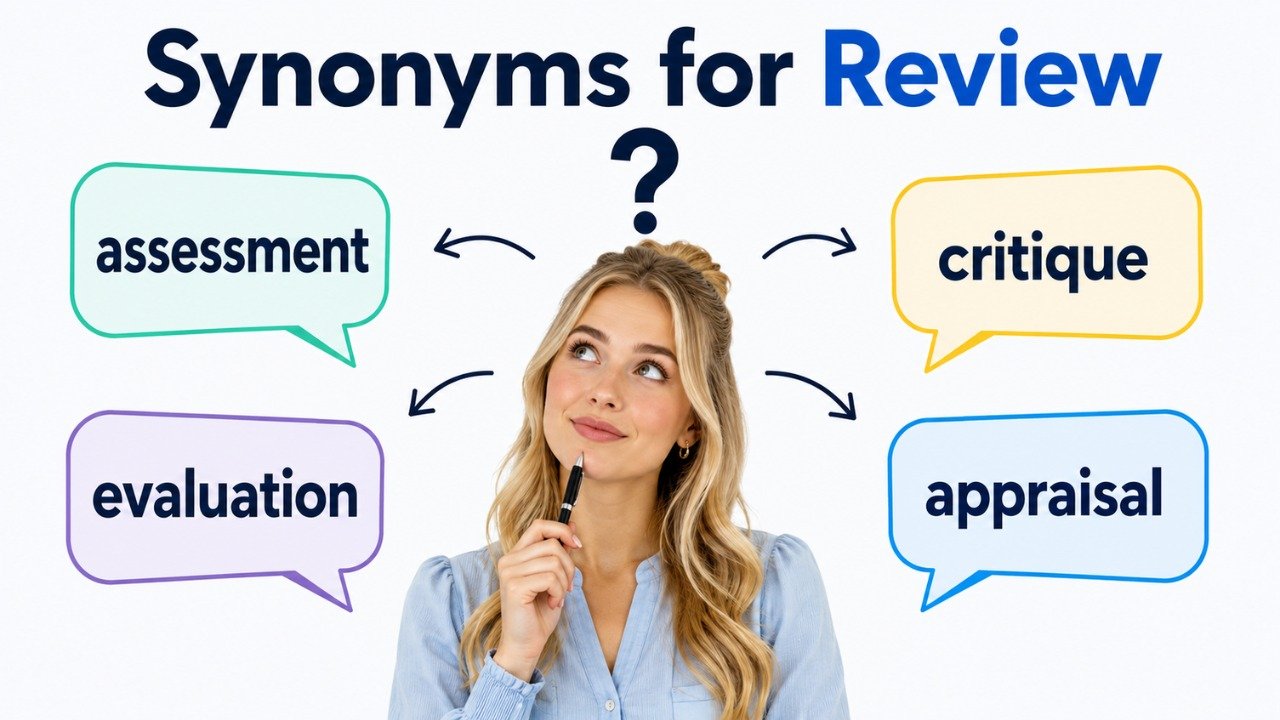
Quick Answer: The best synonyms for review include assessment, evaluation, examination, analysis, appraisal, critique, inspection, audit, recap, and reconsideration. Use assessment or evaluation in formal writing about performance, quality, or results. Choose examination for careful study, analysis for detailed investigation, and inspection for checking physical condition or compliance. Critique is best for discussing strengths and weaknesses in creative work. Recap suits a short summary, while reconsideration describes looking at a decision again.
Pronunciation and Word Details
Word: Review.
Pronunciation: /rɪˈvjuː/.
Part of Speech: Noun and verb.
Meaning: Review means to examine, evaluate, summarize, or reconsider something.
US Pronunciation:
UK Pronunciation:
What Does “Review” Mean?
Review means to examine something carefully, judge its quality, summarize its main points, or consider it again.
As a verb, review describes the act of looking at information, work, performance, or a decision.
Example: The manager will review the report before approving it.
As a noun, review can mean an examination, evaluation, written opinion, summary, or reconsideration.
Example: The employee received a positive performance review.
The word can refer to checking documents, evaluating products, studying lessons, assessing progress, summarizing events, inspecting processes, or reconsidering decisions.
In academic contexts, review often means studying material again or examining existing research. In professional contexts, it commonly refers to evaluating performance, documents, policies, or results. In everyday conversation, it can describe looking over something before making a choice.
Meaning, Tone, and Context of “Review”
Review has a neutral and flexible tone. It works naturally in formal, academic, professional, technical, and conversational settings.
In formal writing, review often refers to an organized evaluation or examination.
Example: The committee completed a review of the safety procedures.
In academic writing, it may refer to studying research, summarizing literature, or preparing for an examination.
Example: The student reviewed the chapter before class.
In professional communication, it is commonly used for reports, performance, applications, contracts, plans, and policies.
Example: Please review the agreement and provide your comments.
In casual conversation, review can simply mean looking at something again.
Example: Let me review my notes before I answer.
The tone becomes more critical when review means judging quality. It becomes more analytical when it refers to careful study. It becomes more practical when it means checking information for errors or accuracy.
When and How to Use “Review”
For Evaluating Quality
Use review when judging the quality, value, success, or effectiveness of something.
Example: The panel will review the completed projects.
For Checking Documents
Use review when reading a document carefully before approval, correction, or submission.
Example: Please review the final draft before sending it.
For Assessing Performance
Use review when discussing an employee, student, team, system, or project.
Example: The supervisor reviewed the employee’s progress.
For Studying Material Again
Use review when returning to information in order to remember or understand it better.
Example: She reviewed her vocabulary before the test.
For Summarizing Information
Use review when presenting the main ideas, events, or developments from a period or subject.
Example: The report provides a review of the year’s major achievements.
For Reconsidering a Decision
Use review when an authority or individual looks at a decision again.
Example: The board agreed to review its earlier decision.
For Checking Accuracy
Use review when information must be checked for mistakes, omissions, or inconsistencies.
Example: The editor reviewed the article for factual errors.
For Giving an Opinion
Use review when someone provides an evaluation of a book, film, service, event, or performance.
Example: The critic wrote a thoughtful review of the play.
Best Synonyms for Review
Assessment
Synonym: A careful judgment of quality, condition, ability, or performance.
Example: The teacher completed an assessment of each student’s progress.
Evaluation
Synonym: A formal judgment based on evidence, standards, or results.
Example: The program requires a detailed evaluation of its effectiveness.
Examination
Synonym: A careful and detailed study of something.
Example: The document is undergoing a thorough examination.
Analysis
Synonym: A detailed study of parts, patterns, causes, or meaning.
Example: The researcher presented an analysis of the survey results.
Appraisal
Synonym: A professional judgment of value, quality, or performance.
Example: The employee received an annual appraisal.
Critique
Synonym: A detailed discussion of strengths, weaknesses, and quality.
Example: The class prepared a critique of the short story.
Inspection
Synonym: A careful check of physical condition, safety, or compliance.
Example: The building passed its safety inspection.
Audit
Synonym: An official examination of records, procedures, or performance.
Example: The organization completed an audit of its financial records.
Recap
Synonym: A short summary of the main information or events.
Example: The presenter gave a quick recap of the previous meeting.
Reconsideration
Synonym: The act of thinking about a decision, opinion, or plan again.
Example: The new evidence led to reconsideration of the decision.
50 Synonyms for Review with Short Meanings
- Assessment: A judgment of quality, ability, or condition.
- Evaluation: A formal judgment based on evidence or standards.
- Examination: A detailed and careful study.
- Analysis: A close study of parts, patterns, or meaning.
- Appraisal: A professional estimate of value or performance.
- Critique: A discussion of strengths and weaknesses.
- Inspection: A careful check of condition or compliance.
- Audit: An official examination of records or procedures.
- Scrutiny: Very close and careful attention.
- Check: A simple examination for accuracy or problems.
- Reassessment: A new evaluation of something previously judged.
- Reconsideration: Careful thought about a decision again.
- Reappraisal: A fresh judgment of value or importance.
- Reexamination: Another careful examination.
- Verification: Confirmation that information is correct.
- Survey: A broad examination of a subject or situation.
- Study: Careful attention given to understanding something.
- Overview: A general description of the main points.
- Summary: A short statement of essential information.
- Recap: A brief restatement of key events or ideas.
- Synopsis: A condensed account of the main content.
- Digest: A shortened collection or summary of information.
- Retrospective: A look back at past events or work.
- Commentary: An explanation or opinion about a subject.
- Feedback: Comments intended to judge or improve something.
- Criticism: Judgment that identifies faults or weaknesses.
- Report: An organized account of findings or events.
- Account: A description of an event, experience, or subject.
- Discussion: A detailed consideration of ideas or issues.
- Reflection: Careful thought about experience or meaning.
- Revisit: To return to a subject for more consideration.
- Recheck: To check something again.
- Rereading: Reading something again for understanding or accuracy.
- Proofreading: Checking writing for language and typing errors.
- Editing: Improving and correcting written material.
- Revision: Reconsidering or changing material to improve it.
- Checking: Examining something for correctness or problems.
- Assessing: Judging quality, ability, condition, or progress.
- Evaluating: Measuring value or effectiveness.
- Examining: Looking at something closely and carefully.
- Analyzing: Studying details, causes, parts, or patterns.
- Appraising: Judging value, quality, or performance.
- Critiquing: Discussing strengths and weaknesses in detail.
- Inspecting: Checking condition, safety, or quality carefully.
- Auditing: Officially examining records or processes.
- Revisiting: Returning to an idea, place, or decision.
- Reconsidering: Thinking about a choice or opinion again.
- Summarizing: Presenting the main points briefly.
- Recapping: Restating key information or events.
- Reflecting: Thinking carefully about meaning or experience.
Read Also:
Synonyms for Thus
Synonyms for Review by Context
When Review Means Evaluate
When review means judging quality, ability, value, or effectiveness, useful synonyms include assessment, evaluation, appraisal, critique, and judgment.
Review: The supervisor completed a review of the employee’s performance.
Assessment: The supervisor completed an assessment of the employee’s performance.
Evaluation: The supervisor completed an evaluation of the employee’s performance.
Appraisal: The supervisor completed an appraisal of the employee’s performance.
Assessment is broad and practical. Evaluation often follows formal standards. Appraisal is common when discussing professional performance or value. Critique focuses on strengths and weaknesses.
When Review Means Examine Carefully
When review means studying something closely, use examination, analysis, scrutiny, inspection, study, or check.
Review: The lawyer conducted a review of the contract.
Examination: The lawyer conducted an examination of the contract.
Analysis: The lawyer conducted an analysis of the contract.
Scrutiny: The contract came under close scrutiny.
Examination emphasizes careful attention. Analysis focuses on meaning, structure, or consequences. Scrutiny suggests especially close or critical attention.
When Review Means Check for Errors
When review means checking accuracy, use check, verification, proofreading, editing, inspection, or recheck.
Review: Please review the document for mistakes.
Check: Please check the document for mistakes.
Proofread: Please proofread the document for mistakes.
Edit: Please edit the document to correct any mistakes.
Check is simple and general. Proofread is best for spelling, grammar, and typing errors. Edit means correcting and improving the content. Verification focuses on confirming facts or accuracy.
When Review Means Summarize
When review means presenting the main points, choose overview, summary, recap, synopsis, digest, or retrospective.
Review: The article gives a review of recent developments.
Overview: The article gives an overview of recent developments.
Summary: The article gives a summary of recent developments.
Recap: The article gives a recap of recent developments.
Overview offers a broad picture. Summary condenses the essential information. Recap reminds readers of earlier events. Retrospective looks back at a longer period.
When Review Means Reconsider
When review means thinking about something again, use reconsider, reassess, revisit, reexamine, reappraise, or reflect on.
Review: The committee will review the decision next week.
Reconsider: The committee will reconsider the decision next week.
Reassess: The committee will reassess the decision next week.
Reexamine: The committee will reexamine the decision next week.
Reconsider is best for decisions and opinions. Reassess suggests using new information or standards. Reexamine emphasizes another detailed investigation.
When Review Means Study Again
When review means preparing for a test or refreshing knowledge, use revise, study, reread, revisit, practice, or go over.
Review: I need to review my notes tonight.
Study: I need to study my notes tonight.
Reread: I need to reread my notes tonight.
Go Over: I need to go over my notes tonight.
Study is a broad alternative. Reread focuses on reading again. Go over is conversational and natural. Revise is common when preparing academic material.
When Review Means Give an Opinion
When review means expressing a judgment about creative work, a service, or a performance, use critique, appraisal, commentary, evaluation, feedback, or criticism.
Review: She wrote a review of the exhibition.
Critique: She wrote a critique of the exhibition.
Commentary: She wrote a commentary on the exhibition.
Evaluation: She wrote an evaluation of the exhibition.
Critique suggests detailed analysis. Commentary may combine explanation and opinion. Evaluation sounds formal and evidence based. Feedback is usually intended to help someone improve.
Another Word for Review
Assessment is often the best single replacement for review when the sentence refers to performance, quality, condition, or progress. However, the best alternative depends on the intended meaning.
Choose examination for close study, evaluation for formal judgment, recap for a short summary, and reconsideration for looking at a decision again.
Original: The manager completed a review of the project.
Better Option: The manager completed an assessment of the project.
Original: The editor will review the final article.
Better Option: The editor will examine the final article.
Original: Let us review what happened during the meeting.
Better Option: Let us recap what happened during the meeting.
Original: The committee agreed to review its decision.
Better Option: The committee agreed to reconsider its decision.
When Not to Use “Review”
Review can be too general when the reader needs to understand exactly what kind of examination, judgment, or summary is involved.
When You Mean Proofread
Use proofread when checking writing specifically for spelling, punctuation, grammar, or typing errors.
Weak: Please review this paragraph for spelling mistakes.
Better: Please proofread this paragraph for spelling mistakes.
When You Mean Evaluate Performance
Use assessment, evaluation, or appraisal when the process is formal and based on clear standards.
Weak: The department completed a review of employee skills.
Better: The department completed an assessment of employee skills.
When You Mean Summarize
Use summary, overview, or recap when you are not judging quality.
Weak: The speaker gave a review of the main events.
Better: The speaker gave a recap of the main events.
When You Mean Inspect Physical Condition
Use inspection when checking equipment, buildings, products, or facilities.
Weak: The technician performed a review of the machine.
Better: The technician performed an inspection of the machine.
When You Mean Analyze Data
Use analysis when studying causes, relationships, trends, or patterns.
Weak: The report contains a review of the results.
Better: The report contains an analysis of the results.
When You Mean Reconsider a Choice
Use reconsider or reassess when a decision is being examined again.
Weak: The board will review whether the rule is still necessary.
Better: The board will reconsider whether the rule is still necessary.
When Review Becomes Repetitive
Repeating review can make writing vague and monotonous.
Weak: We reviewed the report during the review meeting before beginning the final review.
Better: We examined the report during the evaluation meeting before completing the final assessment.
Words Commonly Confused With Review
Review vs Assessment: Review is a broad word for examining, judging, summarizing, or reconsidering. Assessment usually focuses on measuring ability, condition, quality, or progress.
Review vs Evaluation: Review can be informal or formal. Evaluation usually involves judging something according to evidence, criteria, or standards.
Review vs Analysis: Review can give a general examination or opinion. Analysis studies parts, relationships, causes, patterns, and meaning in greater depth.
Review vs Critique: Review may summarize and evaluate. Critique usually gives a detailed discussion of strengths, weaknesses, methods, and quality.
Review vs Summary: Review can include judgment or analysis. Summary only presents the main points in a shorter form.
Review vs Inspection: Review is broad and may concern information or decisions. Inspection usually involves checking physical condition, quality, safety, or compliance.
Review vs Audit: Review may be informal. Audit is generally an organized and official examination of records, systems, procedures, or accounts.
Review vs Revision: Review means examining something. Revision means changing or improving it after examination.
Review vs Feedback: Review may be a complete evaluation. Feedback consists of comments, reactions, or suggestions intended to guide improvement.
Which Synonym Should You Choose?
Choose assessment when judging ability, condition, quality, progress, or needs.
Choose evaluation when the judgment follows formal criteria, evidence, standards, or measurable results.
Choose examination when studying a document, issue, case, or subject carefully.
Choose analysis when exploring details, causes, patterns, relationships, or meaning.
Choose appraisal when judging professional performance, property, value, or quality.
Choose critique when discussing the strengths and weaknesses of writing, art, research, or a performance.
Choose inspection when checking a building, machine, product, facility, or physical condition.
Choose audit when examining accounts, records, procedures, security, or compliance officially.
Choose proofreading when checking writing for spelling, punctuation, grammar, and typing mistakes.
Choose editing when changing writing to improve its clarity, organization, style, and correctness.
Choose recap in casual speech when briefly repeating the main events or ideas.
Choose summary in reports, essays, and emails when presenting essential information without detailed judgment.
Choose overview when giving readers a broad understanding of a subject.
Choose reconsideration when a decision, policy, opinion, or plan may change after another examination.
Choose reassessment when new facts require a fresh judgment.
Choose feedback when offering comments that can help someone improve.
Real Life Examples of “Review” in Sentences
Original: Please review the application before submitting it.
Better Option: Please check the application before submitting it.
Original: The manager will review the employee’s progress.
Better Option: The manager will assess the employee’s progress.
Original: The researcher reviewed the survey data.
Better Option: The researcher analyzed the survey data.
Original: The editor reviewed the article for grammar errors.
Better Option: The editor proofread the article for grammar errors.
Original: The engineer reviewed the damaged equipment.
Better Option: The engineer inspected the damaged equipment.
Original: The teacher asked the class to review the chapter.
Better Option: The teacher asked the class to reread the chapter.
Original: The report reviews the major events of the year.
Better Option: The report summarizes the major events of the year.
Original: The committee will review its earlier decision.
Better Option: The committee will reconsider its earlier decision.
Original: The critic reviewed the new performance.
Better Option: The critic evaluated the new performance.
Original: Let us review the main points before we finish.
Better Option: Let us recap the main points before we finish.
Synonym Groups and Usage Differences
Evaluation Group
This group includes assessment, evaluation, appraisal, judgment, and rating. These words involve deciding how good, valuable, successful, or effective something is.
Assessment focuses on condition, ability, or progress. Evaluation is more formal and criteria based. Appraisal often concerns professional performance or value.
Example: The annual appraisal highlighted her strongest skills.
Examination Group
This group includes examination, analysis, scrutiny, inspection, check, study, and survey.
Examination is broad and careful. Analysis explores deeper patterns and causes. Scrutiny suggests intense attention. Inspection often concerns physical condition or compliance.
Example: The proposal remained under close scrutiny.
Correction Group
This group includes proofreading, editing, checking, verification, revision, and recheck.
Proofreading identifies surface errors. Editing improves clarity and structure. Verification confirms accuracy. Revision changes the material after it has been reviewed.
Example: The document requires editing before publication.
Summary Group
This group includes overview, summary, recap, synopsis, digest, account, and retrospective.
An overview gives a broad picture. A summary condenses essential information. A recap repeats earlier points. A retrospective looks back at events over a period.
Example: The final chapter provides a useful overview of the subject.
Reconsideration Group
This group includes reconsideration, reassessment, reappraisal, reexamination, revisit, and reflection.
These words describe returning to an earlier decision, opinion, idea, or judgment. Reassessment often happens because circumstances or evidence have changed.
Example: The unexpected results led to a reassessment of the strategy.
Opinion Group
This group includes critique, commentary, criticism, feedback, appraisal, and evaluation.
Critique offers detailed analysis. Commentary explains or discusses a subject. Criticism often focuses on faults. Feedback usually aims to support improvement.
Example: The writer received helpful feedback from the editor.
Study Group
This group includes study, rereading, revision, practice, reflection, and revisiting.
These alternatives are useful when review means learning material again or refreshing knowledge.
Example: A careful rereading of the chapter clarified the main argument.
Antonyms of Review
The opposite of review depends on whether the word means examine, evaluate, summarize, reconsider, or correct.
Neglect: Failure to give proper attention.
Ignore: To deliberately avoid considering something.
Overlook: To fail to notice or examine something.
Disregard: To pay no attention to information or advice.
Dismiss: To reject something without enough consideration.
Accept: To approve something without another examination.
Approve: To officially agree to something as it stands.
Confirm: To keep a decision or judgment unchanged.
Finalize: To complete something so no further changes are expected.
Forget: To fail to remember previously learned information.
Skip: To leave something out without examining it.
Abandon: To stop considering or working on something.
Rush: To act too quickly for careful examination.
Assume: To accept something as true without checking it.
Preserve: To keep something unchanged rather than revise it.
Comparison of Review and Related Words
Review vs Assessment
Review is a general examination or evaluation. Assessment focuses more specifically on measuring condition, ability, quality, progress, or need.
Example With Review: The manager conducted a review of the project.
Example With Assessment: The manager conducted an assessment of the project’s risks.
Review vs Evaluation
Review may involve reading, checking, summarizing, or reconsidering. Evaluation primarily involves judging value, quality, or effectiveness.
Example With Review: The committee reviewed the proposal.
Example With Evaluation: The committee evaluated the proposal against the required standards.
Review vs Analysis
Review may provide a general examination. Analysis breaks a subject into parts to understand causes, patterns, relationships, or meaning.
Example With Review: The report reviews recent sales results.
Example With Analysis: The report analyzes the causes of changing sales results.
Review vs Critique
A review may summarize and give an opinion. A critique usually examines strengths, weaknesses, methods, and effectiveness in greater detail.
Example With Review: She wrote a review of the novel.
Example With Critique: She wrote a critique of the novel’s structure and character development.
Review vs Inspection
Review can concern information, performance, or decisions. Inspection usually focuses on physical condition, safety, quality, or compliance.
Example With Review: The manager reviewed the maintenance records.
Example With Inspection: The technician inspected the equipment.
Review vs Audit
Review can be informal or limited. Audit usually describes an official and systematic examination of records, systems, or procedures.
Example With Review: The team reviewed the monthly expenses.
Example With Audit: The auditors examined the annual financial records.
Review vs Summary
Review may contain judgment, criticism, or analysis. Summary presents the main ideas without extensive evaluation.
Example With Review: The article reviews the strengths and weaknesses of the policy.
Example With Summary: The article summarizes the main points of the policy.
Review vs Revision
Review means examining material. Revision means changing it to correct, update, or improve it.
Example With Review: Please review the first draft.
Example With Revision: Please revise the first draft after reading the comments.
Common Phrases and Expressions With Review
Under Review: Currently being examined or evaluated.
Performance Review: A formal evaluation of someone’s work and progress.
Annual Review: An examination completed once each year.
Peer Review: Evaluation by people with knowledge of the same subject.
Literature Review: A structured examination of existing research and writing.
Product Review: An evaluation of a product’s quality, features, or usefulness.
Book Review: A summary and evaluation of a book.
Review Process: The organized steps used to examine or evaluate something.
Review Meeting: A meeting held to discuss performance, progress, results, or plans.
Subject to Review: Open to later examination, evaluation, or change.
Common Mistakes to Avoid
Using Review When You Mean Revise
Review means examine. Revise means make changes.
Incorrect: Please review the paragraph by changing the final sentence.
Better: Please revise the paragraph by changing the final sentence.
Using Review for Every Type of Examination
A precise synonym often tells the reader what action is required.
Vague: The specialist will review the machine.
Precise: The specialist will inspect the machine.
Confusing a Review With a Summary
A review may contain judgment. A summary only presents the key points.
Unclear: Write a review that only lists the main events.
Better: Write a summary that lists the main events.
Confusing Review With Feedback
Feedback consists of comments or suggestions. A review may be a complete evaluation.
Unclear: The teacher gave me a review on one sentence.
Better: The teacher gave me feedback on one sentence.
Repeating Review Too Often
Use context specific alternatives to improve clarity and variety.
Repetitive: The review team reviewed the review document before the final review.
Better: The evaluation team examined the report before the final assessment.
Choosing an Overly Formal Synonym
Audit, appraisal, and scrutiny may sound too strong for a simple check.
Unnatural: I completed an audit of my shopping list.
Better: I checked my shopping list.
Using Critique as a Fully Negative Word
A critique can discuss both strengths and weaknesses. It does not always mean harsh criticism.
Incorrect Idea: A critique only points out mistakes.
Correct Idea: A critique examines quality, strengths, weaknesses, and effectiveness.
Failing to State What Is Being Reviewed
Review should have a clear object or subject.
Unclear: The committee will review tomorrow.
Clear: The committee will review the revised policy tomorrow.
Conclusion
The most useful synonyms for review depend on the purpose of the sentence. Choose assessment or evaluation for formal judgments, examination or analysis for careful study, inspection for physical checks, and proofreading for written errors. Recap and summary work when presenting key points, while reconsideration and reassessment fit decisions examined again. Understanding these differences helps you use synonyms for review accurately in reports, essays, emails, professional discussions, academic work, and everyday conversation.
FAQs About Synonyms for Review
What Is the Best Synonym for Review?
Assessment is a strong general synonym when review means judging quality, ability, progress, or condition. Examination is better when the focus is careful study.
What Is a Formal Synonym for Review?
Evaluation, assessment, examination, appraisal, audit, and scrutiny are useful formal synonyms. The best choice depends on what is being examined.
What Is a Casual Synonym for Review?
Check, look over, recap, and go over are natural casual alternatives. Check is best for accuracy, while recap is best for summarizing.
Can Assessment Replace Review?
Assessment can replace review when the sentence involves judging performance, quality, ability, condition, progress, or needs. It does not normally replace review when the meaning is summary.
What Is Another Word for Reviewing a Document?
Examining, checking, proofreading, editing, and analyzing are useful alternatives. Choose proofreading for language errors and editing for broader improvements.
What Is the Difference Between Review and Critique?
A review may summarize and evaluate something. A critique usually gives a more detailed analysis of strengths, weaknesses, methods, and quality.
What Is a Synonym for Reviewing a Decision?
Reconsidering, reassessing, reexamining, and revisiting are strong choices. Reconsidering is usually the clearest option for a decision that may change.
