
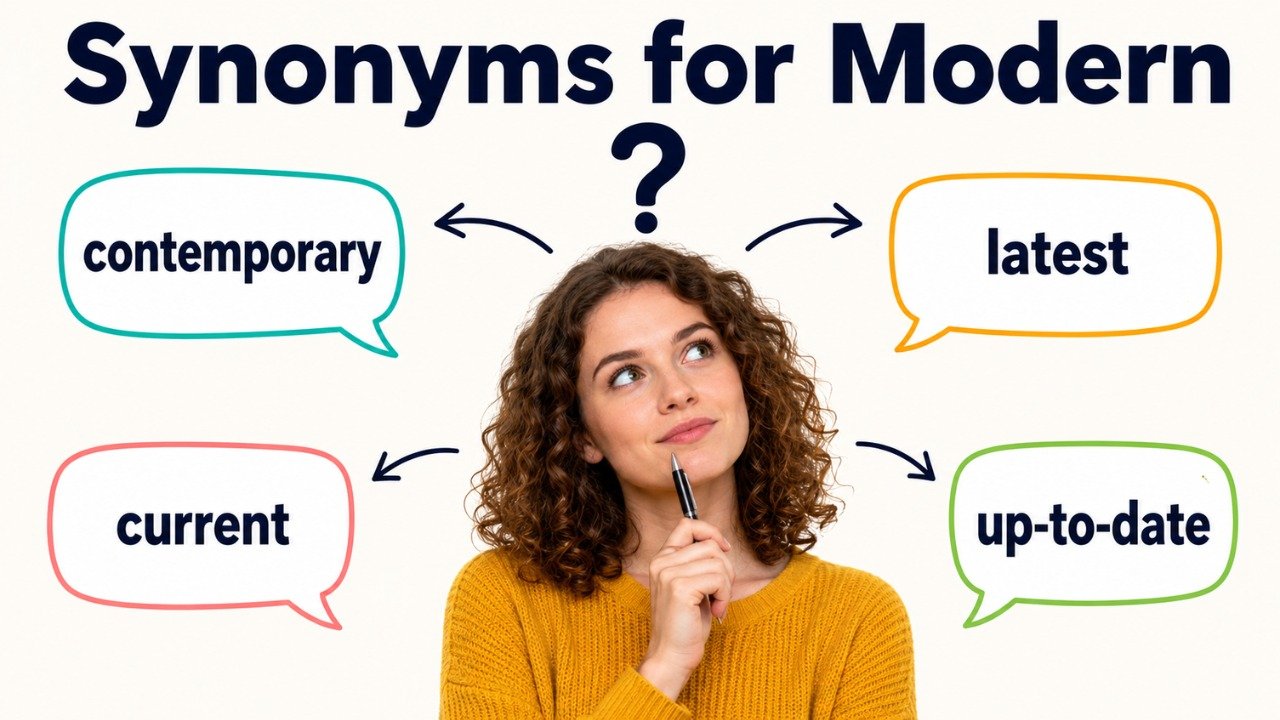
Quick Answer: The best synonyms for modern include contemporary, current, present day, recent, advanced, innovative, fashionable, sleek, progressive, and up to date. Use contemporary for people, culture, art, architecture, and ideas connected with the present period. Choose current for information, conditions, and policies that exist now. Advanced works best for technology and systems, while innovative emphasizes original methods or ideas. Fashionable, stylish, and sleek describe modern appearance. Up to date is useful for knowledge, equipment, records, and practices that reflect recent developments.
Pronunciation and Word Details
Word: Modern.
Pronunciation: /ˈmɒdərn/.
Part of Speech: Adjective and noun.
Meaning: Modern means belonging to the present or recent period, or using current styles, ideas, and technology.
US Pronunciation:
UK Pronunciation:
What Does “Modern” Mean?
Modern means connected with the present or a relatively recent period rather than the distant past.
The word is mainly used as an adjective. It can describe buildings, technology, clothing, art, ideas, lifestyles, methods, equipment, and social conditions.
Example: The office has a modern design.
Modern can also describe something that uses recent knowledge, methods, or technology.
Example: Modern equipment has improved the production process.
In discussions of history, art, and culture, modern may refer to a particular period or movement rather than simply meaning new.
Example: The course explores modern European history.
As a noun, a modern can refer to a person living in modern times or someone whose ideas and tastes reflect the present age. This noun use is less common in everyday language.
The meaning of modern changes slightly with context. It can mean present day, technologically advanced, recently designed, fashionable, progressive, or different from traditional forms.
Meaning, Tone, and Context of “Modern”
Modern usually has a neutral or positive tone. It often suggests freshness, progress, convenience, efficiency, or attractive design.
In everyday conversation, modern commonly describes homes, furniture, clothing, appliances, technology, and lifestyles.
Example: They renovated the kitchen with a modern look.
In formal and academic writing, modern may refer to a historical period, current society, recent methods, or contemporary thought.
Example: The essay examines the development of modern education.
In technical writing, modern often suggests that equipment, systems, or processes use recent technology.
Example: The laboratory relies on modern testing methods.
In design, modern can suggest clean lines, simple forms, open spaces, and limited decoration. However, modern and contemporary are not always identical design terms.
The word may sound approving when it describes an advanced system, but it can remain purely descriptive when identifying a period or style.
When and How to Use “Modern”
For the Present Period
Use modern when describing society, life, culture, or conditions associated with the present or recent era.
Example: Modern life depends heavily on rapid communication.
For Technology and Equipment
Use modern when something uses current knowledge, engineering, tools, or digital systems.
Example: The hospital contains modern diagnostic equipment.
For Interior Design
Use modern for spaces that have clean forms, simple decoration, practical layouts, and a fresh appearance.
Example: The apartment combines modern furniture with neutral walls.
For Architecture
Use modern when describing buildings influenced by recent materials, construction methods, or simplified forms.
Example: The library has a striking modern structure.
For Fashion
Use modern when clothing, accessories, or styling reflects current tastes.
Example: Her modern outfit balanced comfort and elegance.
For Ideas and Attitudes
Use modern when a belief, approach, or attitude reflects present values or newer ways of thinking.
Example: The organization adopted a modern approach to flexible work.
For Updated Methods
Use modern when a process has replaced older practices with newer and more effective ones.
Example: Farmers are using modern methods to reduce water waste.
For Academic Periods
Use modern when referring to a recognized historical, literary, artistic, or cultural period.
Example: The students compared ancient and modern political systems.
Best Synonyms for Modern
Contemporary
Synonym: Belonging to or reflecting the present period.
Example: The gallery displays contemporary art.
Current
Synonym: Existing, happening, or being used now.
Example: The report explains current economic conditions.
Present Day
Synonym: Connected with the world or time as it exists now.
Example: Present day communication is faster than earlier forms.
Recent
Synonym: Happening, created, or introduced not long ago.
Example: Recent developments have changed the industry.
Advanced
Synonym: Using highly developed knowledge, methods, or technology.
Example: The facility contains advanced medical equipment.
Innovative
Synonym: Introducing original ideas, designs, or methods.
Example: The company adopted an innovative production process.
Fashionable
Synonym: Popular and admired according to current style.
Example: The restaurant has a fashionable interior.
Sleek
Synonym: Smooth, stylish, and attractively designed.
Example: The device has a sleek appearance.
Progressive
Synonym: Supporting change, improvement, or new ideas.
Example: The school follows a progressive teaching philosophy.
Up to Date
Synonym: Including the newest information, features, or methods.
Example: The guide contains up to date safety advice.
50 Synonyms for Modern with Short Meanings
- Contemporary: Belonging to the present period.
- Current: Existing or being used now.
- Present Day: Connected with the world as it exists today.
- Recent: Created, introduced, or happening not long ago.
- New: Recently made, discovered, or introduced.
- Latest: Most recent in a series or development.
- Up to Date: Reflecting the newest information or methods.
- Updated: Changed to include recent improvements or information.
- Advanced: Using highly developed knowledge or technology.
- Innovative: Introducing original ideas or methods.
- Progressive: Favoring improvement, reform, or new thinking.
- Futuristic: Appearing unusually advanced or connected with the future.
- Forward Looking: Planning for future needs and developments.
- Forward Thinking: Open to new ideas and future possibilities.
- Cutting Edge: Using the newest and most advanced developments.
- State of the Art: Representing the highest current level of development.
- High Tech: Using advanced technology.
- Digital: Using electronic systems and computerized technology.
- New Generation: Belonging to a newer stage of development.
- Current Generation: Designed for the present generation of users.
- Twenty First Century: Reflecting the practices and needs of the current century.
- Fashionable: Popular according to current tastes.
- Stylish: Attractive and showing good current taste.
- Trendy: Following a style that is currently popular.
- Chic: Fashionable, elegant, and sophisticated.
- Modish: Following recent fashion or style.
- Sleek: Smooth, polished, and modern in appearance.
- Streamlined: Designed with simple, efficient forms.
- Minimalist: Using simple forms and limited decoration.
- Sophisticated: Refined, advanced, and carefully developed.
- Refined: Improved and made more elegant or precise.
- Polished: Finished to a high and attractive standard.
- Smart: Stylish, efficient, or technologically capable.
- Fresh: New, lively, and different from older styles.
- Novel: New, original, or unusual.
- Original: Not copied and based on fresh thinking.
- Inventive: Showing creativity and new ideas.
- Pioneering: Introducing methods or ideas that others may follow.
- Groundbreaking: Introducing an important new development.
- Revolutionary: Causing major change through a new approach.
- Redesigned: Given a new structure, form, or appearance.
- Renovated: Improved by repairing or updating an older space.
- Renewed: Made fresh, active, or effective again.
- Upgraded: Improved with newer features or technology.
- Improved: Made better than an earlier version.
- Developed: Brought to a more advanced stage.
- Evolved: Gradually changed into a newer or more advanced form.
- Unconventional: Different from traditional or expected methods.
- Avant Garde: Experimental and unusually original in style.
- Cosmopolitan: Modern, cultured, and influenced by many places.
Read Also:
Synonyms for Pros and Cons

Synonyms for Modern by Context
When Modern Means Contemporary
When modern refers to the present age, useful synonyms include contemporary, current, present day, recent, and twenty first century.
Modern: The book explores modern social issues.
Contemporary: The book explores contemporary social issues.
Current: The book explores current social issues.
Present Day: The book explores present day social issues.
Contemporary is especially useful for art, literature, culture, society, and ideas. Current is more direct when describing conditions, information, or events that exist now. Present day clearly contrasts the present with an earlier period.
When Modern Means Technologically Advanced
When modern describes technology, systems, machines, or methods, use advanced, high tech, cutting edge, state of the art, digital, or new generation.
Modern: The clinic uses modern equipment.
Advanced: The clinic uses advanced equipment.
State of the Art: The clinic uses state of the art equipment.
High Tech: The clinic uses high tech equipment.
Advanced is the most flexible formal choice. State of the art suggests the highest available level of development. High tech is less formal and emphasizes technology.
When Modern Means Fashionable
When modern describes appearance or style, choose fashionable, stylish, trendy, chic, modish, sleek, or fresh.
Modern: She chose a modern dress for the event.
Stylish: She chose a stylish dress for the event.
Fashionable: She chose a fashionable dress for the event.
Chic: She chose a chic dress for the event.
Fashionable means popular according to current taste. Stylish suggests attractive taste without requiring widespread popularity. Chic suggests elegant simplicity.
When Modern Means Simple in Design
When modern describes clean and uncluttered design, use sleek, streamlined, minimalist, polished, or refined.
Modern: The office has a modern interior.
Sleek: The office has a sleek interior.
Minimalist: The office has a minimalist interior.
Streamlined: The office has a streamlined interior.
Sleek emphasizes a smooth and polished appearance. Minimalist emphasizes simplicity and limited decoration. Streamlined suggests efficiency and clean form.
When Modern Means Innovative
When modern describes ideas, products, or methods that introduce change, use innovative, inventive, pioneering, groundbreaking, revolutionary, or original.
Modern: The team developed a modern solution.
Innovative: The team developed an innovative solution.
Inventive: The team developed an inventive solution.
Groundbreaking: The team developed a groundbreaking solution.
Innovative is a strong general choice. Groundbreaking suggests an important advance. Revolutionary suggests a major transformation rather than a small improvement.
When Modern Means Progressive
When modern describes attitudes, values, policies, or organizations, use progressive, forward looking, forward thinking, open minded, or unconventional.
Modern: The school follows a modern educational philosophy.
Progressive: The school follows a progressive educational philosophy.
Forward Thinking: The school follows a forward thinking educational philosophy.
Unconventional: The school follows an unconventional educational philosophy.
Progressive emphasizes reform and improvement. Forward thinking emphasizes preparation for future needs. Unconventional simply means different from traditional practice.
When Modern Means Updated
When modern describes something improved from an older version, choose updated, upgraded, redesigned, renovated, renewed, improved, or evolved.
Modern: The building now has a modern entrance.
Redesigned: The building now has a redesigned entrance.
Renovated: The building now has a renovated entrance.
Updated: The building now has an updated entrance.
Updated is broad. Redesigned focuses on form or structure. Renovated is best for buildings and physical spaces.
Another Word for Modern
Contemporary is often the best single replacement for modern when describing culture, society, art, architecture, literature, or ideas connected with the present period.
The best alternative still depends on context. Current is better for information and conditions. Advanced is stronger for technology. Stylish or sleek may be better for appearance, while innovative suits original ideas and methods.
Original: The museum displays modern paintings.
Better Option: The museum displays contemporary paintings.
Original: The factory uses modern equipment.
Better Option: The factory uses advanced equipment.
Original: The apartment has a modern interior.
Better Option: The apartment has a sleek interior.
Original: The team proposed a modern solution.
Better Option: The team proposed an innovative solution.
When Not to Use “Modern”
Modern can sound vague when the reader needs to know whether something is recent, fashionable, advanced, progressive, or simply different from tradition.
When You Mean Current
Use current when discussing information, rules, prices, conditions, or office holders that exist now.
Weak: The document explains modern regulations.
Better: The document explains current regulations.
When You Mean Newly Created
Use new or recent when age or timing is the main point.
Weak: The researcher examined a modern report published yesterday.
Better: The researcher examined a recent report published yesterday.
When You Mean Technologically Advanced
Use advanced, digital, or state of the art when the technology itself matters.
Weak: The laboratory owns modern testing equipment.
Better: The laboratory owns advanced testing equipment.
When You Mean Fashionable
Use fashionable, stylish, trendy, or chic when describing current taste.
Weak: She wore a modern coat.
Better: She wore a stylish coat.
When You Mean Minimalist
Modern does not always mean simple or undecorated.
Weak: The room has a modern design with very little decoration.
Better: The room has a minimalist design with very little decoration.
When Discussing a Specific Historical Period
Modern may have a specialized academic meaning. Give dates or a named period when precision is important.
Weak: The event happened during modern history.
Better: The event happened during the early modern period.
When Modern Becomes Repetitive
Repeated use can make a description sound empty.
Weak: The modern home has modern furniture and modern lighting.
Better: The contemporary home has sleek furniture and updated lighting.
Words Commonly Confused With Modern
Modern vs Contemporary: Modern generally means connected with recent times or newer ideas. Contemporary means belonging to the same time or the present period. In design and art, the words can refer to different styles.
Modern vs Current: Modern describes the wider present or recent age. Current refers specifically to what exists, happens, or applies now.
Modern vs Recent: Modern may describe a broad period, style, or method. Recent refers to something that happened or appeared not long ago.
Modern vs New: Modern suggests present ideas, styles, or technology. New simply means recently created, obtained, or introduced.
Modern vs Advanced: Modern means connected with present times. Advanced means highly developed in knowledge, skill, or technology.
Modern vs Innovative: Modern may describe an existing current style. Innovative means introducing an original method, idea, or design.
Modern vs Fashionable: Modern can describe technology, culture, design, or thought. Fashionable specifically means popular according to current taste.
Modern vs Futuristic: Modern belongs to the present. Futuristic appears connected with an imagined or highly advanced future.
Modern vs Minimalist: Modern is a broad design description. Minimalist specifically uses simplicity, open space, and limited decoration.
Which Synonym Should You Choose?
Choose contemporary when writing about present culture, society, art, literature, architecture, or ideas.
Choose current when discussing information, policies, conditions, trends, events, records, or practices that exist now.
Choose present day when contrasting current life or society with an earlier historical period.
Choose recent when something happened, appeared, or was created not long ago.
Choose advanced when writing about technology, medicine, science, engineering, systems, or equipment.
Choose innovative when a method, idea, product, or solution introduces something original.
Choose cutting edge when emphasizing the newest level of technological or professional development.
Choose fashionable when describing something popular according to current taste.
Choose stylish when the focus is an attractive and tasteful appearance.
Choose trendy when describing something popular for a limited period.
Choose sleek when describing smooth, polished, and simple visual design.
Choose minimalist when a room, building, product, or design uses few decorative elements.
Choose progressive when discussing ideas, attitudes, education, policies, or social reform.
Choose forward thinking when praising planning that considers future needs.
Choose updated when an older document, system, design, or piece of equipment has received recent improvements.
Choose renovated when an older building or room has been repaired and refreshed.
Choose redesigned when the structure, layout, or appearance has been changed.
Choose futuristic when something appears more advanced than ordinary present day designs.
Real Life Examples of “Modern” in Sentences
Original: The hospital uses modern medical equipment.
Better Option: The hospital uses advanced medical equipment.
Original: The article examines modern family life.
Better Option: The article examines contemporary family life.
Original: The office follows modern safety rules.
Better Option: The office follows current safety rules.
Original: They selected modern furniture for the living room.
Better Option: They selected sleek furniture for the living room.
Original: She prefers modern clothing.
Better Option: She prefers stylish clothing.
Original: The team introduced a modern way to organize the records.
Better Option: The team introduced an innovative way to organize the records.
Original: The school promotes modern teaching methods.
Better Option: The school promotes progressive teaching methods.
Original: The hotel has a modern entrance.
Better Option: The hotel has a redesigned entrance.
Original: The software provides modern security features.
Better Option: The software provides up to date security features.
Original: The vehicle has a very modern appearance.
Better Option: The vehicle has a futuristic appearance.
Synonym Groups and Usage Differences
Present Time Group
This group includes contemporary, current, present day, recent, latest, and twenty first century.
Contemporary refers broadly to the present period. Current focuses on what applies now. Recent describes something that appeared not long ago. Latest identifies the newest available example.
Example: The course discusses contemporary political thought.
Technology Group
This group includes advanced, cutting edge, state of the art, high tech, digital, and new generation.
Advanced is formal and flexible. Cutting edge emphasizes the newest development. State of the art suggests the highest available standard. Digital specifically involves electronic or computerized technology.
Example: The laboratory uses state of the art testing equipment.
Fashion Group
This group includes fashionable, stylish, trendy, chic, modish, and smart.
Fashionable and trendy describe current popularity. Stylish suggests lasting good taste. Chic suggests elegance and sophistication. Modish is more literary and less common in conversation.
Example: The restaurant has a chic dining area.
Design Group
This group includes sleek, streamlined, minimalist, sophisticated, refined, polished, and fresh.
Sleek emphasizes smooth visual form. Streamlined combines simplicity with efficiency. Minimalist limits decoration. Sophisticated suggests careful development and elegance.
Example: The device has a streamlined design.
Innovation Group
This group includes innovative, inventive, original, pioneering, groundbreaking, and revolutionary.
Innovative is a general word for new ideas. Pioneering describes something among the first of its kind. Groundbreaking signals an important advance. Revolutionary suggests major change.
Example: The researchers introduced a pioneering technique.
Progress Group
This group includes progressive, forward looking, forward thinking, developed, and evolved.
Progressive often refers to policies, beliefs, or methods that support improvement. Forward looking focuses on future plans. Evolved suggests gradual development.
Example: The organization adopted a forward looking strategy.
Renewal Group
This group includes updated, upgraded, redesigned, renovated, renewed, and improved.
Updated means brought into line with recent needs. Upgraded suggests better features or performance. Renovated refers mainly to buildings and spaces. Redesigned means the form or structure has changed.
Example: The renovated library provides more study space.
Antonyms of Modern
The opposite of modern depends on whether the word describes time, technology, fashion, ideas, or design.
Ancient: Belonging to the distant past.
Old: Existing for a long time.
Traditional: Following customs or methods used for many years.
Historic: Connected with an important past period or event.
Past: Belonging to an earlier time.
Former: Existing or holding a position previously.
Outdated: No longer suitable because newer information or methods exist.
Obsolete: No longer used because something newer has replaced it.
Archaic: Extremely old and no longer common.
Old Fashioned: Based on styles or attitudes from an earlier period.
Conventional: Following established and familiar methods.
Antiquated: Very old and no longer practical.
Primitive: Belonging to an early or undeveloped stage.
Unfashionable: Not popular according to current taste.
Retro: Deliberately copying or celebrating an earlier style.
Vintage: Belonging to an earlier period and valued for its age or style.
Dated: Appearing connected with an earlier time.
Traditionalist: Favoring established ideas and customs over newer ones.
Comparison: Modern vs Related Words
Modern vs Contemporary
Modern broadly describes the present or recent age and things influenced by newer ideas. Contemporary means belonging to the same period or to the present time.
Example With Modern: The building uses modern construction methods.
Example With Contemporary: The gallery specializes in contemporary art.
Modern vs Current
Modern describes a broad period, style, or level of development. Current refers specifically to what exists or applies now.
Example With Modern: Modern communication is often immediate.
Example With Current: The current policy will remain in effect this year.
Modern vs Recent
Modern can refer to a long and broadly defined period. Recent refers to something that happened or appeared a short time ago.
Example With Modern: The course examines modern history.
Example With Recent: The course examines recent political changes.
Modern vs Advanced
Modern means associated with present times. Advanced means highly developed in ability, knowledge, or technology.
Example With Modern: The building has a modern heating system.
Example With Advanced: The building has an advanced energy control system.
Modern vs Innovative
Modern can describe something commonly used today. Innovative describes something original that introduces a new approach.
Example With Modern: The office uses modern communication tools.
Example With Innovative: The office introduced an innovative communication method.
Modern vs Fashionable
Modern has broad meanings related to time, ideas, technology, and style. Fashionable means currently popular or admired.
Example With Modern: The apartment has a modern kitchen.
Example With Fashionable: The restaurant is located in a fashionable neighborhood.
Modern vs Sleek
Modern describes an overall current style. Sleek specifically describes a smooth, polished, and uncluttered appearance.
Example With Modern: She purchased a modern desk.
Example With Sleek: She purchased a sleek glass desk.
Modern vs Futuristic
Modern belongs to the present. Futuristic looks unusually advanced or appears inspired by the future.
Example With Modern: The station has a modern design.
Example With Futuristic: The station has a futuristic design with curved glass walls.
Modern vs Minimalist
Modern can include many design approaches. Minimalist specifically avoids unnecessary decoration and uses simple forms.
Example With Modern: They selected a modern living room design.
Example With Minimalist: They selected a minimalist living room with simple furniture.
Common Phrases and Expressions With Modern
Modern Life: Daily life shaped by current society, technology, and habits.
Modern Society: Society as it exists in the present age.
Modern Technology: Technology based on recent knowledge and development.
Modern Design: A style associated with clean forms and newer materials.
Modern Architecture: Architecture influenced by recent building ideas and methods.
Modern Art: Art connected with newer ideas or a recognized artistic period.
Modern Medicine: Medical knowledge, treatments, and practices developed in recent times.
Modern World: The present global society and its conditions.
Modern Lifestyle: A way of living shaped by current habits and conveniences.
Modern Approach: A method based on recent ideas, needs, or practices.
Common Mistakes to Avoid
Treating Modern and Contemporary as Always Identical
The words overlap in general use, but they may identify different periods or styles in art, architecture, and design.
Unclear: Every contemporary building follows modern design principles.
Better: Some contemporary buildings use principles associated with modern design.
Using Modern When You Mean Current
Current is more precise for rules, facts, information, and conditions that apply now.
Vague: Check the modern requirements before applying.
Better: Check the current requirements before applying.
Using Modern When You Mean New
Something can be new without having a modern style.
Vague: They purchased a modern wooden table made in a traditional style.
Better: They purchased a new wooden table made in a traditional style.
Using Modern When You Mean Advanced
A product may be modern because it is recent, but advanced emphasizes its technical capabilities.
Vague: The device contains modern measurement tools.
Better: The device contains advanced measurement tools.
Assuming Modern Always Means Better
Modern describes time, style, or development. It does not automatically prove greater quality, safety, beauty, or usefulness.
Weak: The modern method is clearly superior.
Better: The updated method is faster and produces more consistent results.
Repeating Modern in Descriptions
Use more specific alternatives to explain appearance, technology, or values.
Repetitive: The modern office has modern furniture and modern equipment.
Better: The contemporary office has sleek furniture and advanced equipment.
Choosing Trendy for Formal Writing
Trendy may sound casual and can suggest temporary popularity.
Casual: The building has a trendy design.
Formal: The building has a contemporary design.
Calling Every Simple Design Minimalist
A modern design may include simple forms, but minimalist specifically involves reducing decoration and unnecessary elements.
Unclear: The colorful room is minimalist because it looks modern.
Better: The colorful room is contemporary, but its many decorative elements prevent it from being minimalist.
Conclusion
The best synonyms for modern depend on whether you are describing time, technology, design, fashion, or ideas. Contemporary and current work well for the present period, while advanced and cutting edge suit technology. Stylish, sleek, and minimalist describe appearance, and innovative or progressive emphasizes new thinking. Updated, upgraded, and redesigned are useful for improved versions of older things. Choosing context specific synonyms for modern makes descriptions clearer, more accurate, and more useful in essays, reports, emails, and everyday communication.
FAQs About Synonyms for Modern
What Is the Best Synonym for Modern?
Contemporary is often the best general synonym for modern. Current is better for information or conditions, while advanced suits technology.
What Is a Formal Synonym for Modern?
Contemporary, current, advanced, progressive, innovative, and present day are useful formal alternatives. The best word depends on the context.
What Is a Synonym for Modern Design?
Sleek, contemporary, minimalist, streamlined, sophisticated, and refined can describe modern design. Each word highlights a different visual quality.
Can Contemporary Replace Modern?
Contemporary can replace modern when referring to present culture, society, art, architecture, or ideas. The two words may have different specialized meanings in design and history.
What Is a Synonym for Modern Technology?
Advanced, cutting edge, state of the art, high tech, digital, and new generation are strong alternatives for modern technology.
What Is the Difference Between Modern and Current?
Modern describes a broad present or recent period. Current refers specifically to something that exists, applies, or happens now.
Is Modern the Opposite of Traditional?
Modern and traditional can be opposites when comparing newer and established styles, methods, or beliefs. However, something can combine modern features with traditional influences.
