
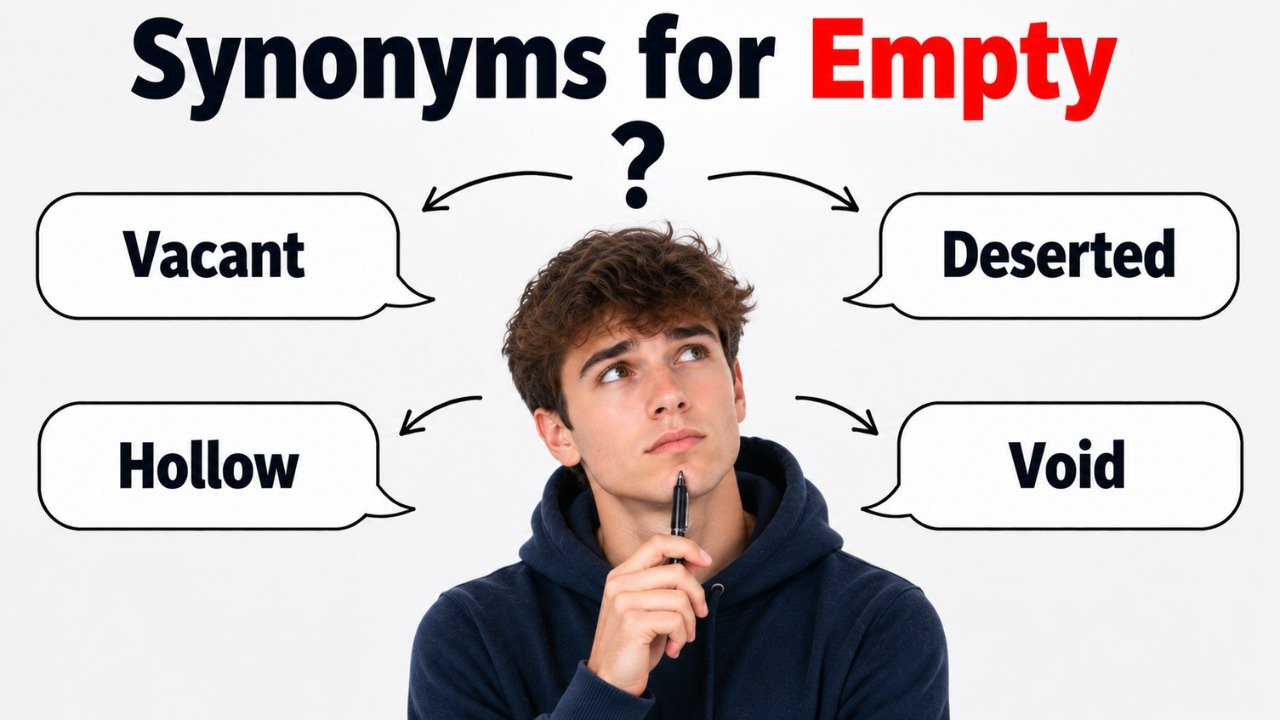
Quick Answer: The best synonyms for empty include vacant, blank, bare, hollow, void, unoccupied, deserted, depleted, unfilled, and meaningless. Use vacant for rooms, seats, and positions, blank for pages or expressions, and bare for places without furniture or decoration. Hollow describes something with an open interior, while depleted suits supplies, energy, or resources. Void is more formal and emphasizes complete absence. Meaningless and hollow work when empty describes words, promises, emotions, or experiences that lack value or sincerity.
Pronunciation and Word Details
Word: Empty.
Pronunciation: /ˈemp.ti/.
Part of Speech: Adjective and verb.
Meaning: Containing nothing, lacking people or purpose, or removing all contents from something.
US Pronunciation:
UK Pronunciation:
What Does “Empty” Mean?
Empty means containing nothing or lacking the people, objects, information, emotion, or value normally expected. It most commonly functions as an adjective, but it can also be used as a verb.
As an adjective, empty describes a container, room, space, page, road, stomach, promise, expression, or feeling.
Container: The bottle was empty.
Place: The office remained empty after sunset.
Page: She stared at the empty page.
Expression: His face looked empty and distant.
Promise: Their assurances sounded empty.
As a verb, empty means to remove all or most of the contents from something.
Example: Please empty the basket before returning it.
The meaning changes according to context. An empty glass contains no liquid. An empty room contains no people or furniture. An empty promise lacks sincerity or action. An empty feeling describes emotional numbness, loneliness, or lack of fulfillment.
Empty can also describe something that is available. An empty seat, vacant position, or open room may be ready for someone to use.
Meaning, Tone, and Context of “Empty”
Empty is a common and neutral word, but its emotional strength depends on what it describes. It can be practical, descriptive, negative, emotional, or figurative.
Neutral Context: The box is empty.
Practical Context: Empty the drawer before moving the desk.
Negative Context: The shelves were empty after the rush.
Emotional Context: She felt empty after the long and difficult week.
Critical Context: His apology sounded empty.
Literary Context: The empty streets created a feeling of isolation.
Formal Context: The property remained unoccupied for several months.
Technical Context: The tank must be fully drained before inspection.
In everyday conversation, empty is direct and natural. In formal writing, a more exact synonym may be better. Vacant works for rooms, positions, and properties. Unoccupied describes places with no people. Depleted refers to reduced resources. Blank suits pages, screens, and expressions.
The word can also carry emotional meaning. Hollow, numb, unfulfilled, and joyless may describe a person who feels empty. Meaningless, insincere, and hollow may describe empty words or promises.
When and How to Use “Empty”
For Containers With Nothing Inside
Use empty when a bottle, box, bag, cup, drawer, or other container has no contents.
Example: The container was empty when the package arrived.
For Rooms and Buildings
Use empty when a room, house, office, or building contains no people, furniture, or activity.
Example: The house stood empty for several years.
For Seats and Positions
Use empty when a seat, job, or place is available because nobody is using or holding it.
Example: There was one empty seat near the window.
For Pages and Screens
Use empty when a page, field, screen, or document contains no writing, image, or information.
Example: The form cannot be submitted with an empty field.
For Supplies and Resources
Use empty when food, fuel, money, energy, or other resources have been completely used.
Example: The fuel tank was almost empty.
For Places Without People
Use empty when a road, shop, park, or public space has no visitors or activity.
Example: The normally busy street was empty before sunrise.
For Emotional Feelings
Use empty when someone feels numb, lonely, purposeless, or emotionally drained.
Example: He felt empty after reaching a goal that had once seemed important.
For Words and Promises
Use empty when words, promises, praise, or apologies lack sincerity, evidence, or action.
Example: The repeated promises began to sound empty.
For Removing Contents
Use empty as a verb when taking everything out of a container or space.
Example: She emptied the shopping bag onto the table.
For Lack of Meaning
Use empty when an experience, activity, or statement lacks value, purpose, or substance.
Example: The speech was full of impressive phrases but felt empty.
Best Synonyms for Empty
Vacant
Synonym: Not occupied or currently being used.
Example: The apartment has remained vacant since March.
Blank
Synonym: Containing no writing, image, answer, or visible expression.
Example: Leave the final section blank if it does not apply.
Bare
Synonym: Without furniture, decoration, covering, or expected contents.
Example: The walls looked bare after the pictures were removed.
Hollow
Synonym: Having an open interior or lacking real meaning and sincerity.
Example: The wooden figure was hollow inside.
Void
Synonym: Completely lacking something or containing nothing.
Example: The room seemed void of warmth and personality.
Unoccupied
Synonym: Not being used, lived in, or held by anyone.
Example: The meeting room is currently unoccupied.
Deserted
Synonym: Empty because people have left or are absent.
Example: The station appeared deserted late at night.
Depleted
Synonym: Reduced until little or nothing remains.
Example: The emergency supplies were badly depleted.
Unfilled
Synonym: Not occupied, completed, supplied, or filled.
Example: Several positions remained unfilled.
Meaningless
Synonym: Lacking value, purpose, significance, or useful content.
Example: A promise without action can become meaningless.
50 Synonyms for Empty with Short Meanings
- Vacant: Not occupied or being used.
- Blank: Containing no writing, image, or answer.
- Bare: Lacking furniture, covering, or decoration.
- Hollow: Empty inside or lacking sincerity.
- Void: Completely lacking contents or a particular quality.
- Unoccupied: Not being used by a person.
- Deserted: Empty because everyone has left.
- Abandoned: Left behind and no longer used or cared for.
- Uninhabited: Having no people living there.
- Unused: Not currently being used.
- Unfurnished: Containing little or no furniture.
- Clear: Free from objects, people, or obstructions.
- Vacuous: Lacking thought, intelligence, or meaningful content.
- Devoid: Entirely without a particular thing or quality.
- Barren: Empty of growth, productivity, or useful features.
- Desolate: Empty, lonely, and without activity.
- Unpopulated: Containing few or no people.
- Depopulated: Having lost most or all of its population.
- Tenantless: Having no person renting or occupying it.
- Unladen: Carrying no goods, weight, or load.
- Unloaded: Having had its contents or cargo removed.
- Drained: Emptied of liquid, energy, or strength.
- Depleted: Reduced until little remains.
- Exhausted: Completely used up.
- Spent: Used until no strength or supply remains.
- Dry: Containing no liquid or moisture.
- Unfilled: Not filled, occupied, or completed.
- Unstocked: Containing no supplies or goods.
- Cleared: Having had objects or people removed.
- Vacated: Left empty by a former occupant.
- Emptied: Having had all contents removed.
- Unclaimed: Not taken, collected, or accepted by anyone.
- Unassigned: Not given to a person, purpose, or position.
- Available: Free and ready for use.
- Unreserved: Not booked or set aside.
- Unbooked: Not reserved for a person or event.
- Open: Free, available, or not occupied.
- Free: Not occupied, blocked, or in use.
- Lacking: Missing something expected or necessary.
- Missing: Not present where expected.
- Absent: Not present or included.
- Bereft: Completely lacking something important.
- Hollowed Out: Made empty inside.
- Meaningless: Lacking significance, purpose, or value.
- Lifeless: Without activity, energy, or spirit.
- Soulless: Lacking warmth, personality, or emotional depth.
- Joyless: Lacking happiness or pleasure.
- Unfulfilled: Lacking satisfaction, achievement, or completion.
- Numb: Emotionally unable to feel or respond.
- Purposeless: Lacking a clear reason, goal, or direction.
Read Also:
Synonyms for Violence
Synonyms for Empty by Context
When Empty Means Containing Nothing
Use these alternatives for containers, rooms, shelves, cupboards, or other physical spaces.
Vacant: Free from people or occupants.
Example: The office remained vacant throughout the afternoon.
Bare: Without expected objects, decoration, or covering.
Example: The cupboard was completely bare.
Clear: Free from objects or obstructions.
Example: Keep the doorway clear at all times.
Unfilled: Not containing the expected material.
Example: Several storage boxes remained unfilled.
When Empty Means Unoccupied
These words describe places, seats, positions, and properties that nobody is using.
Unoccupied: Not currently used by anyone.
Example: The room was unoccupied when the alarm sounded.
Vacant: Available because no person is using or holding it.
Example: A vacant desk was available near the entrance.
Unused: Not currently serving a purpose.
Example: The unused office was converted into a study room.
Tenantless: Without a renter or resident.
Example: The building remained tenantless during the repairs.
When Empty Means Deserted
Use these alternatives when a place lacks people, movement, or activity.
Deserted: Empty because people have gone away.
Example: The market was deserted after the storm warning.
Abandoned: Left and no longer cared for or used.
Example: They discovered an abandoned house near the road.
Desolate: Empty, lonely, and often unpleasant.
Example: The landscape looked desolate in winter.
Uninhabited: Having no permanent residents.
Example: The island remained uninhabited for many years.
When Empty Means Blank
These choices work for pages, screens, forms, expressions, and answers.
Blank: Containing no writing or visible information.
Example: The final page was blank.
Clear: Free from writing, markings, or displayed information.
Example: The screen became clear after the message disappeared.
Vacuous: Showing little thought or intelligence.
Example: His vacuous expression suggested that he had not understood the question.
Absent: Missing from a place where something is expected.
Example: Important details were absent from the report.
When Empty Means Hollow
These terms describe objects with open interiors or statements that lack substance.
Hollow: Having nothing inside or lacking sincerity.
Example: The metal pole was hollow.
Void: Completely lacking contents or qualities.
Example: The room felt void of character.
Hollowed Out: Made empty inside by removing material.
Example: The tree trunk had been hollowed out by decay.
Devoid: Entirely without a named quality.
Example: The response was devoid of useful detail.
When Empty Means Depleted
Use these alternatives for fuel, supplies, money, energy, or strength.
Depleted: Reduced until very little remains.
Example: The medical supplies were nearly depleted.
Drained: Emptied of liquid, energy, or emotion.
Example: She felt drained after the long meeting.
Exhausted: Completely used up.
Example: The reserve fund was exhausted by unexpected repairs.
Spent: Used until nothing useful remains.
Example: By evening, his energy was spent.
When Empty Means Emotionally Hollow
These words describe loneliness, numbness, lack of fulfillment, or absence of joy.
Numb: Unable to feel or respond emotionally.
Example: She felt numb after hearing the unexpected news.
Unfulfilled: Lacking satisfaction or a sense of achievement.
Example: He remained unfulfilled despite his professional success.
Joyless: Without happiness or pleasure.
Example: The routine had become repetitive and joyless.
Soulless: Lacking warmth, emotion, or personality.
Example: The newly renovated room looked polished but soulless.
When Empty Means Meaningless
Use these synonyms for words, promises, actions, experiences, and statements that lack purpose or sincerity.
Meaningless: Having no clear value, purpose, or significance.
Example: Praise becomes meaningless when it is not sincere.
Vacuous: Lacking meaningful thought or useful content.
Example: The article was filled with vacuous claims.
Purposeless: Having no clear goal or reason.
Example: The repeated task began to feel purposeless.
Hollow: Sounding impressive but lacking sincerity or substance.
Example: His apology sounded hollow.
When Empty Means Available
These alternatives describe a place, time, seat, or position that is ready for use.
Available: Ready to be used or occupied.
Example: One appointment is available tomorrow morning.
Open: Not occupied or already taken.
Example: There is an open position in the department.
Free: Not being used or reserved.
Example: Is this chair free?
Unreserved: Not booked or set aside.
Example: The unreserved tables are available to all visitors.
When Empty Means To Remove Contents
These alternatives are useful when empty functions as a verb.
Clear: Remove objects from a place.
Example: Please clear the table after dinner.
Drain: Remove liquid from a container or system.
Example: Drain the tank before beginning the repair.
Unload: Remove goods, luggage, or cargo.
Example: The workers unloaded the truck before noon.
Vacate: Leave a room, building, or position empty.
Example: Residents were asked to vacate the building.
Another Word for Empty
The best general replacement for empty is vacant when describing a room, seat, position, or property. However, blank works better for pages and screens, depleted suits supplies, and hollow describes objects or words that lack substance.
The correct alternative depends on what is missing and why the thing is empty.
Original: The apartment has been empty for months.
Better Option: The apartment has been vacant for months.
Original: The page was empty.
Better Option: The page was blank.
Original: The shelves were empty after the sale.
Better Option: The shelves were completely bare after the sale.
Original: His promise sounded empty.
Better Option: His promise sounded hollow and insincere.
When Not to Use “Empty”
Empty can sound vague when a more specific word would explain what is absent. It may also sound repetitive, emotionally exaggerated, or unnatural in formal writing.
When Describing a Vacant Property
Weak: The building has been empty since January.
Better: The building has been vacant since January.
Vacant is more precise for property and rooms.
When Describing a Blank Document
Weak: The form contained an empty page.
Better: The form contained a blank page.
Blank clearly refers to a page without writing or images.
When Describing Low Supplies
Weak: The hospital supplies were empty.
Better: The hospital supplies were severely depleted.
Depleted is more natural for resources and stock.
When Describing a Deserted Place
Weak: The village looked empty after the evacuation.
Better: The village looked deserted after the evacuation.
Deserted emphasizes the absence of people and activity.
When Discussing Emotional Exhaustion
Weak: She was empty after working all night.
Better: She felt physically and emotionally drained after working all night.
Drained explains the condition more accurately.
When Describing Meaningless Words
Weak: His speech was empty.
Better: His speech was vague and lacking in substance.
The improved sentence explains why the speech felt empty.
When Repetition Weakens the Writing
Weak: The room was empty, the shelves were empty, and the cupboards were empty.
Better: The room was vacant, while the shelves and cupboards were bare.
Using related synonyms creates variety and precision.
When Empty Sounds Too Emotional
Weak: I felt empty because my favorite cup broke.
Better: I felt disappointed because my favorite cup broke.
Empty may sound too strong for a minor inconvenience.
Words Commonly Confused With Empty
Empty vs Vacant: Empty means containing nothing or lacking expected contents. Vacant usually describes a room, property, seat, or position that nobody occupies.
Empty vs Blank: Empty can describe many kinds of absence. Blank mainly refers to pages, screens, spaces, expressions, or unanswered fields.
Empty vs Bare: Empty means nothing is inside. Bare means lacking covering, furniture, decoration, or expected items.
Empty vs Hollow: Empty describes something with no contents. Hollow describes an object with an open interior or words and feelings that lack sincerity.
Empty vs Void: Empty is common and conversational. Void is more formal and emphasizes total absence.
Empty vs Deserted: Empty may describe any place with no people or objects. Deserted suggests that people have left or abandoned the place.
Empty vs Depleted: Empty means nothing remains. Depleted means the supply has been greatly reduced, although a small amount may still remain.
Empty vs Clear: Empty means lacking contents. Clear means free from obstacles, objects, people, or confusion.
Empty vs Barren: Empty is broad and neutral. Barren commonly describes land without growth or a situation without productive results.
Empty vs Meaningless: Empty may describe a lack of contents or value. Meaningless specifically describes something without purpose, importance, or understandable meaning.
Which Synonym Should You Choose?
Choose vacant when describing an unoccupied room, property, seat, or job position.
Choose blank when referring to a page, screen, expression, form, or unanswered field.
Choose bare when a room, shelf, wall, cupboard, or surface lacks expected objects or decoration.
Choose hollow when describing something with an open interior or words that lack sincerity.
Choose void for formal writing that emphasizes complete absence.
Choose unoccupied for reports, notices, and formal descriptions of rooms or buildings.
Choose deserted when a place has no people or activity because everyone has left.
Choose abandoned when a place or object has been left without care or use.
Choose depleted when writing about supplies, money, fuel, energy, or natural resources.
Choose drained when describing a loss of liquid, strength, energy, or emotion.
Choose exhausted when a supply or resource has been completely used.
Choose unfilled when describing forms, containers, positions, or spaces that have not been completed or occupied.
Choose available when the empty space, time, seat, or position is ready for use.
Choose clear when an area has no objects, people, or obstructions.
Choose meaningless when describing words, actions, or experiences that lack value or purpose.
Choose hollow for promises, praise, apologies, or statements that lack sincerity.
Choose numb when describing a temporary inability to feel emotion.
Choose unfulfilled when someone lacks satisfaction or purpose.
Choose lifeless when a place, performance, or design lacks energy and activity.
Choose soulless when something lacks warmth, character, or emotional depth.
Real Life Examples of “Empty” in Sentences
Original: The room was empty when we arrived.
Better Option: The room was unoccupied when we arrived.
Original: The bottle was empty.
Better Option: The bottle had been completely drained.
Original: The page remained empty.
Better Option: The page remained blank.
Original: The streets were empty after midnight.
Better Option: The streets were deserted after midnight.
Original: The cupboard was empty.
Better Option: The cupboard was bare.
Original: The fuel supply was almost empty.
Better Option: The fuel supply was almost depleted.
Original: His apology sounded empty.
Better Option: His apology sounded hollow.
Original: She felt empty after the event ended.
Better Option: She felt emotionally drained after the event ended.
Original: The job remained empty for several weeks.
Better Option: The position remained unfilled for several weeks.
Original: Please empty the container.
Better Option: Please remove all contents from the container.
Synonym Groups and Usage Differences
Physical Space Group
This group includes vacant, unoccupied, clear, unused, and free. These words describe rooms, seats, areas, or spaces without people or objects.
Vacant often describes property and positions. Unoccupied focuses on the absence of a user. Clear means free from obstruction. Free may mean available.
Example: The conference room is currently unoccupied.
Container Group
This group includes empty, drained, unloaded, unladen, cleared, and emptied.
Drained works for liquids and energy. Unloaded refers to cargo or goods. Unladen means carrying no load. Cleared means objects have been removed.
Example: The tank was drained before the inspection.
Blankness Group
This group includes blank, clear, absent, and unfilled.
Blank is best for pages and screens. Absent means missing. Unfilled often describes spaces, forms, or positions.
Example: Leave the answer field blank if you are unsure.
Desertion Group
This group includes deserted, abandoned, desolate, uninhabited, and depopulated.
Deserted emphasizes the absence of people. Abandoned suggests neglect. Desolate adds loneliness. Uninhabited means nobody lives there.
Example: The abandoned building had not been used for years.
Supply Group
This group includes depleted, exhausted, spent, dry, and unstocked.
Depleted means greatly reduced. Exhausted means completely used. Spent refers to used energy or resources. Unstocked describes a place without supplies.
Example: The emergency fund was nearly exhausted.
Emotional Group
This group includes numb, hollow, unfulfilled, joyless, and bereft.
Numb means unable to feel. Hollow describes a lack of emotional substance. Unfulfilled means lacking satisfaction. Bereft suggests painful absence.
Example: He felt unfulfilled despite achieving his original goal.
Meaning Group
This group includes meaningless, vacuous, hollow, purposeless, and soulless.
Meaningless lacks value or significance. Vacuous lacks thought. Hollow lacks sincerity. Purposeless lacks direction. Soulless lacks warmth.
Example: The statement sounded impressive but remained vacuous.
Availability Group
This group includes available, open, free, unreserved, and unbooked.
Available is the broadest term. Open often describes positions or appointment times. Free is conversational. Unreserved and unbooked refer to places not already claimed.
Example: One table is still available for tonight.
Antonyms of Empty
The opposite of empty depends on whether the word refers to contents, people, emotion, meaning, or resources.
Full: Containing as much as possible.
Filled: Made complete with contents or material.
Occupied: Being used by a person.
Crowded: Containing many people or objects.
Furnished: Supplied with furniture.
Stocked: Supplied with goods or materials.
Loaded: Carrying goods, contents, or weight.
Populated: Containing residents or inhabitants.
Complete: Having all required parts.
Abundant: Existing in large quantities.
Plentiful: Available in a generous amount.
Meaningful: Having value, purpose, or significance.
Substantial: Having real importance, quantity, or content.
Lively: Full of activity, energy, or interest.
Fulfilled: Satisfied by achievement, purpose, or experience.
Contented: Feeling satisfied and at peace.
Emotional: Showing or containing strong feelings.
Productive: Producing useful or valuable results.
Occupied: Filled by a person, activity, or purpose.
Packed: Completely or heavily filled.
Comparison: Empty vs Related Words
Empty vs Vacant
Empty means containing nothing or lacking expected contents. Vacant usually describes a room, property, seat, or position that is not occupied.
Example With Empty: The storage box was empty.
Example With Vacant: The apartment remained vacant for six months.
Empty vs Blank
Empty is broad and can describe containers, rooms, feelings, and promises. Blank mainly describes pages, screens, expressions, or spaces without information.
Example With Empty: The drawer was empty.
Example With Blank: The final page was blank.
Empty vs Bare
Empty means nothing is inside. Bare means lacking covering, furniture, decoration, or expected objects.
Example With Empty: The cupboard was empty.
Example With Bare: The walls were bare after the artwork was removed.
Empty vs Hollow
Empty means having no contents. Hollow means having an open space inside or lacking sincerity and substance.
Example With Empty: The jar was empty.
Example With Hollow: The wooden tube was hollow.
Empty vs Void
Empty is natural in everyday speech. Void is more formal and often describes complete absence.
Example With Empty: The room was empty.
Example With Void: The statement was void of useful information.
Empty vs Deserted
Empty simply means no people or objects are present. Deserted suggests that people have left a place that is normally occupied.
Example With Empty: The classroom was empty.
Example With Deserted: The town appeared deserted after the warning.
Empty vs Depleted
Empty means nothing remains. Depleted means most of a supply has been used, although a small amount may remain.
Example With Empty: The tank was empty.
Example With Depleted: The water reserves were severely depleted.
Empty vs Unoccupied
Empty may describe an absence of people or objects. Unoccupied specifically means that nobody is using a place, seat, or property.
Example With Empty: The room was empty of furniture.
Example With Unoccupied: The room was unoccupied during the inspection.
Empty vs Barren
Empty is a general term for absence. Barren often describes land without vegetation, a person or animal unable to produce offspring, or an effort without results.
Example With Empty: The field was empty.
Example With Barren: The dry land was barren and unable to support crops.
Empty vs Meaningless
Empty may describe physical or figurative absence. Meaningless specifically refers to a lack of purpose, value, or significance.
Example With Empty: His words sounded empty.
Example With Meaningless: The repeated statement had become meaningless.
Common Phrases and Expressions With “Empty”
Empty Room: A room without people, furniture, or contents.
Example: Their footsteps echoed through the empty room.
Empty Space: An area containing nothing or available for use.
Example: Place the table in the empty space near the wall.
Empty Seat: A seat that nobody is using.
Example: She placed her bag beside the empty seat.
Empty Page: A page without writing or images.
Example: He struggled to begin writing on the empty page.
Empty Stomach: A condition in which a person has not eaten recently.
Example: The instructions advised against taking the medicine on an empty stomach.
Empty Promise: A promise made without sincerity or action.
Example: Residents were tired of hearing empty promises.
Empty Words: Statements that lack sincerity, meaning, or evidence.
Example: Without action, the apology was only empty words.
Empty Threat: A warning that the speaker does not intend or cannot carry out.
Example: Everyone soon realized that the warning was an empty threat.
Empty Handed: Without obtaining or carrying anything.
Example: The search team returned empty handed.
Empty Feeling: A sense of numbness, loneliness, or lack of purpose.
Example: Completing the project left him with an unexpected empty feeling.
Common Mistakes to Avoid
Using Empty for Every Type of Absence
Empty is broad, but more specific words often improve meaning.
Vague: The office is empty.
Clear: The office is vacant and currently available for rent.
Confusing Empty With Vacant
Vacant usually describes spaces or positions that nobody occupies.
Less Precise: The job is empty.
Better: The position is vacant.
Confusing Empty With Blank
Blank is the natural word for pages, forms, screens, and expressions.
Unnatural: The document contains an empty page.
Natural: The document contains a blank page.
Confusing Empty With Depleted
Depleted means greatly reduced, not necessarily completely gone.
Incorrect: The supplies were empty.
Correct: The supplies were depleted.
Also Correct: The supply cabinet was empty.
Using Empty as a Countable Noun
Empty is normally an adjective or verb, not a standard countable noun in formal writing.
Incorrect: There were several empties in the room.
Correct: There were several empty containers in the room.
Choosing an Overly Emotional Synonym
Words such as soulless, bereft, and desolate carry strong emotional meanings.
Exaggerated: The unused chair looked desolate.
Better: The chair was vacant.
Using Hollow for Every Empty Object
Hollow describes an object with an open interior, but it does not always mean completely empty.
Incorrect: The empty glass was hollow.
Correct: The glass was empty.
Correct Use: The metal pipe was hollow.
Repeating Empty Too Often
Use precise synonyms to improve variety.
Repetitive: The room was empty, the desk was empty, and the shelves were empty.
Improved: The room was unoccupied, the desk was clear, and the shelves were bare.
Using Empty When Missing Is Better
Missing describes something that should be present but is not.
Unnatural: The final page number was empty.
Better: The final page number was missing.
Ignoring the Verb Meaning
Empty can be a verb meaning to remove contents.
Correct: Empty the bin before leaving.
Incorrect: Empty out from the bin before leaving.
The word out is optional in many sentences and may be unnecessary.
Conclusion
Synonyms for empty include vacant, blank, bare, hollow, void, unoccupied, deserted, depleted, unfilled, and meaningless. Choose vacant for rooms and positions, blank for pages and screens, and bare for spaces without furniture or contents. Depleted works for supplies, while drained suits energy or liquid. Hollow and meaningless are useful for insincere words or emotional absence. Selecting the right alternative makes descriptions clearer by showing exactly what is missing, unused, unavailable, or lacking in value.
FAQs About Synonyms for Empty
What Is the Best Synonym for Empty?
Vacant is a strong general alternative for rooms, seats, properties, and positions. Blank, bare, hollow, and depleted are better in other contexts.
What Is a Formal Synonym for Empty?
Unoccupied, vacant, devoid, depleted, and void are suitable formal alternatives. The correct choice depends on what is absent.
What Is Another Word for an Empty Room?
Vacant, unoccupied, bare, unused, and deserted may describe an empty room. Vacant and unoccupied are the most neutral choices.
What Is Another Word for Feeling Empty?
Hollow, numb, unfulfilled, joyless, and emotionally drained can describe feeling empty. Each word expresses a slightly different emotional condition.
What Is the Difference Between Empty and Vacant?
Empty means containing nothing. Vacant usually means not occupied by a person, tenant, or holder.
Can Blank Be a Synonym for Empty?
Yes. Blank is a synonym for empty when describing pages, screens, forms, expressions, or spaces without information.
What Is the Opposite of Empty?
Full is the most direct opposite. Other antonyms include filled, occupied, stocked, crowded, meaningful, abundant, and fulfilled.
