
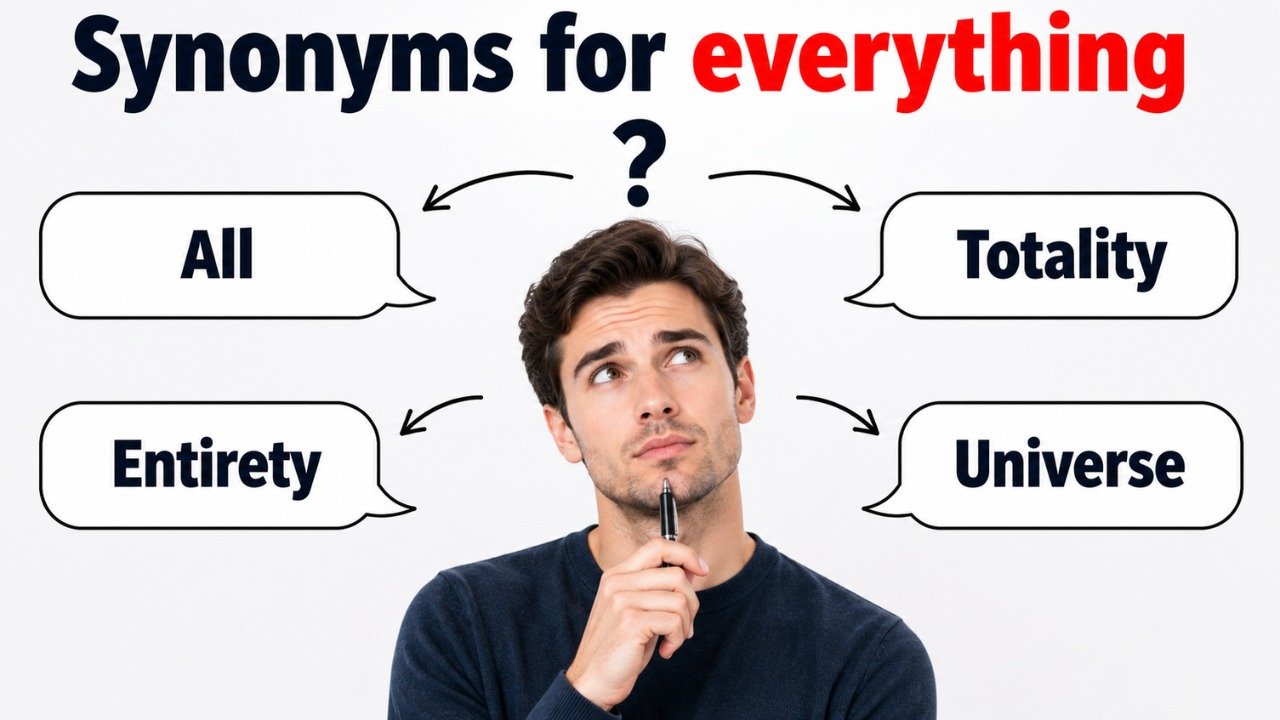
Quick Answer: The best synonyms for everything include all, all things, the whole, the entirety, the totality, every part, every detail, the whole lot, the full range, and the whole picture. Use all for a short and natural replacement, the entirety for formal writing, the totality for academic or technical contexts, and the whole lot for casual speech. Every detail emphasizes complete information, while the whole picture refers to a complete understanding of a situation.
Pronunciation and Word Details
Word: Everything.
Pronunciation: /ˈev.ri.θɪŋ/.
Part of Speech: Indefinite pronoun.
Meaning: All things, all parts, or the complete amount of something.
US Pronunciation:
UK Pronunciation:
What Does “Everything” Mean?
Everything means all things, all parts, or every item included in a particular situation. It is an indefinite pronoun because it refers broadly to things without naming each one individually.
Everything can describe physical objects, information, experiences, responsibilities, conditions, or the complete contents of something.
Physical Objects: Everything was packed into three boxes.
Information: She told me everything about the meeting.
Complete Situation: Everything changed after the announcement.
Responsibilities: He manages everything in the office.
General Existence: Some people wonder how everything began.
Although everything refers to many things collectively, it takes a singular verb.
Correct: Everything is ready.
Incorrect: Everything are ready.
The word may refer to a complete group within a limited context rather than literally every object in existence. In the sentence “I packed everything,” the meaning is usually everything needed for the trip, not every possession the speaker owns.
Meaning, Tone, and Context of “Everything”
Everything is a neutral and widely used word. It appears naturally in casual conversation, professional communication, descriptive writing, stories, instructions, and general explanations.
Tone: Usually neutral, but it can sound emotional, dramatic, reassuring, or absolute depending on the sentence.
Casual Context: I have everything I need.
Professional Context: Please confirm that everything has been completed.
Emotional Context: You mean everything to me.
Dramatic Context: Everything changed in a single moment.
Reassuring Context: Everything will be fine.
Absolute Context: Everything in the building was inspected.
In formal reports, everything may sound too broad when the writer needs to identify specific items, records, measurements, or procedures. Terms such as the full range, the entire collection, every requirement, or the totality may communicate the meaning more precisely.
In academic or technical writing, the totality and the entirety often sound more exact than everything. In everyday speech, all, all of it, and the whole lot usually sound more natural.
When and How to Use “Everything”
For Complete Inclusion
Use everything when all objects, parts, facts, or tasks within a situation are included.
Example: Everything on the checklist has been completed.
For Complete Information
Use everything when someone knows, explains, remembers, or reveals all relevant details.
Example: Please tell me everything you remember about the event.
For Personal Importance
Use everything to show that a person, goal, relationship, or achievement has extremely high emotional value.
Example: Her family means everything to her.
For Major Change
Use everything when a development affects the complete situation.
Example: The new evidence changed everything.
For General Conditions
Use everything to describe the overall state of a place, plan, event, or arrangement.
Example: Everything appears calm this morning.
For Possessions
Use everything when referring collectively to all belongings within a particular context.
Example: They packed everything they needed for the journey.
For Responsibilities
Use everything when one person manages all parts of a task, business, event, or household.
Example: He organized everything for the celebration.
For Broad Existence
Use everything when discussing all that exists, especially in philosophical, scientific, or reflective contexts.
Example: The theory attempts to explain how everything began.
Best Synonyms for Everything
All
Synonym: The complete quantity or number of things being discussed.
Example: All was ready before the guests arrived.
All Things
Synonym: Every object, subject, matter, or idea within a broad group.
Example: She tries to consider all things before making a decision.
The Whole
Synonym: The complete thing rather than only one part.
Example: We examined the whole before focusing on individual details.
The Entirety
Synonym: The complete amount, form, or extent of something.
Example: The committee reviewed the document in its entirety.
The Totality
Synonym: All parts considered together as one complete unit.
Example: The totality of the evidence supported the conclusion.
Every Part
Synonym: Each individual section or component without exception.
Example: Every part of the machine was inspected.
Every Detail
Synonym: All pieces of information, including small or specific points.
Example: She remembered every detail of the conversation.
The Whole Lot
Synonym: All the people or things in a group, usually in casual speech.
Example: They sold the whole lot at the weekend market.
The Full Range
Synonym: All available types, levels, choices, or possibilities.
Example: The guide explains the full range of available options.
The Whole Picture
Synonym: A complete understanding of all facts and circumstances.
Example: We need more information before we can see the whole picture.
50 Synonyms for Everything with Short Meanings
- All: The complete amount or number.
- All Things: Every object, matter, or subject.
- The Whole: The complete thing rather than a part.
- The Entirety: The complete form, amount, or extent.
- The Totality: All parts viewed together.
- The Whole Lot: Every item or person in a group.
- The Lot: The complete group or collection.
- The Sum Total: The complete amount after everything is combined.
- The Full Amount: The entire quantity available or required.
- The Complete Amount: The whole quantity with nothing missing.
- The Full Extent: The complete degree, size, or scope.
- The Entire Thing: The complete object, matter, or situation.
- The Entire Amount: All of a particular quantity.
- Every Part: Each section or component.
- Every Item: Each individual object on a list or in a group.
- Every Detail: All information, including small points.
- Every Aspect: Each feature, side, or element.
- Each Thing: Every individual object or matter.
- Each Part: Every separate section of a whole.
- Every Single Thing: All things without any exception.
- One and All: Everyone or everything within a group.
- The Works: Everything available or included, especially in casual speech.
- The Whole Package: All features, qualities, or parts together.
- The Full Package: The complete set of features or services.
- The Whole Picture: A complete understanding of a situation.
- All of It: The complete thing or amount.
- All There Is: The entire available amount or extent.
- All That Exists: Every existing thing.
- The Universe: All space, matter, energy, and existence.
- Creation: Everything that exists or has been created.
- Existence: All that is real or present.
- Reality: Everything that truly exists or happens.
- The World: All people, places, and things considered broadly.
- The Cosmos: The universe viewed as an ordered whole.
- The Full Range: All available types or possibilities.
- The Complete Range: Every type, level, or choice included.
- The Entire Range: The whole collection of available possibilities.
- The Full Collection: Every item belonging to a collection.
- The Entire Collection: All items in a particular group.
- The Complete Set: Every required or related item.
- The Full Set: All members or parts of a set.
- The Entire Set: The complete group with nothing excluded.
- The Whole Assortment: Every type or item in a varied collection.
- The Entire Contents: Everything contained inside something.
- The Full Contents: All material or objects within a container or document.
- The Complete Contents: Every included item, section, or piece of information.
- The Whole Business: The complete matter or situation.
- The Whole Matter: Every relevant part of an issue.
- The Entire Situation: All circumstances surrounding an event.
- The Full Story: All relevant facts and details about an event.
Read Also:
Synonyms for Government

Synonyms for Everything by Context
When Everything Means All Things
Use these alternatives when referring broadly to every object, issue, idea, or matter within a context.
All: A short and common replacement.
Example: All was prepared before the ceremony began.
All Things: A broad expression covering every relevant matter.
Example: All things considered, the plan was successful.
Every Single Thing: A strongly emphasized expression meaning nothing is excluded.
Example: She checked every single thing before leaving.
All of It: A conversational alternative referring to the complete amount.
Example: I read all of it before responding.
When Everything Means Every Part
These alternatives emphasize the individual parts that form a complete object, process, or system.
Every Part: Each separate section without exception.
Example: Every part of the building was inspected.
Each Part: Each component considered individually.
Example: Each part must be cleaned before assembly.
The Whole: The complete unit formed by all its parts.
Example: The whole is stronger when the sections work together.
The Entire Thing: The complete object or matter.
Example: We had to replace the entire thing.
When Everything Means Every Detail
Use these expressions when referring to complete information or knowledge.
Every Detail: All information, including minor points.
Example: He explained every detail of the agreement.
Every Aspect: All sides, features, or elements of a subject.
Example: The review covered every aspect of the proposal.
The Full Story: All important facts about an event.
Example: We did not learn the full story until the following day.
The Whole Picture: Complete understanding based on all available information.
Example: One report cannot show the whole picture.
When Everything Means the Complete Amount
These choices work well for quantities, collections, contents, and totals.
The Entirety: The complete amount with no part omitted.
Example: She donated the entirety of the prize.
The Totality: All parts or amounts considered together.
Example: The decision was based on the totality of the evidence.
The Sum Total: The final complete amount.
Example: That figure represents the sum total of our expenses.
The Full Amount: The complete quantity due, available, or needed.
Example: The full amount must be paid by Friday.
When Everything Means the Complete Range
Use these terms when discussing options, levels, products, abilities, or possibilities.
The Full Range: All available choices or types.
Example: The course covers the full range of basic writing skills.
The Complete Range: Every category or variation.
Example: The report examines the complete range of possible outcomes.
The Entire Range: All levels or options from beginning to end.
Example: Participants represented the entire range of experience levels.
The Whole Assortment: Every item within a varied collection.
Example: The shop displayed the whole assortment near the entrance.
When Everything Means All That Exists
These alternatives are suitable for philosophical, scientific, spiritual, or literary contexts.
The Universe: All space, matter, energy, and existence.
Example: Scientists continue to study the origins of the universe.
The Cosmos: The universe understood as a complete and ordered system.
Example: The book explores humanity’s place in the cosmos.
Creation: Everything that exists or has been brought into existence.
Example: The poem celebrates the beauty of creation.
Existence: All that is real or present.
Example: The question concerns the nature of existence.
Reality: Everything that actually exists or occurs.
Example: Our understanding of reality changes as knowledge grows.
When Everything Means the Complete Situation
Use these alternatives when discussing circumstances, events, plans, or problems.
The Entire Situation: All surrounding circumstances.
Example: We reviewed the entire situation before making a decision.
The Whole Matter: Every relevant part of an issue.
Example: The manager promised to investigate the whole matter.
The Whole Business: The complete issue or process, often in conversation.
Example: She found the whole business confusing.
The Whole Picture: A complete understanding of all circumstances.
Example: The final interview helped us understand the whole picture.
Another Word for Everything
The best single replacement for everything is often all. It is short, natural, and useful in both speech and writing. However, everything and all do not always follow the same grammar.
Everything functions independently as a pronoun, while all often appears before a noun or with another pronoun.
Original: Everything in the room was covered.
Better Option: All the furniture in the room was covered.
Original: She explained everything about the process.
Better Option: She explained every detail of the process.
Original: Everything in the report supports the conclusion.
Better Option: The totality of the evidence in the report supports the conclusion.
Original: We need to understand everything before deciding.
Better Option: We need to understand the whole picture before deciding.
The entirety works well in formal writing, every detail emphasizes complete information, and the whole lot is suitable for relaxed conversation.
When Not to Use “Everything”
Everything may sound vague when readers need to know exactly which objects, facts, tasks, or requirements are included.
When Specific Details Are Required
Weak: Everything was checked.
Better: Every safety control, electrical connection, and emergency exit was checked.
The better sentence identifies what the inspection included.
When Writing About Data
Weak: Everything increased during the final quarter.
Better: Revenue, customer demand, and operating costs increased during the final quarter.
Data writing should name the measurements being discussed.
When Referring to a Limited Collection
Weak: Everything in the collection was valuable.
Better: Every painting in the collection was valuable.
The specific noun makes the sentence clearer.
When the Word Is Repeated
Weak: Everything was arranged, everything was cleaned, and everything was checked.
Better: The room was arranged, cleaned, and carefully checked.
Repeated use can make writing sound flat and unnecessarily broad.
When Making an Unsupported Absolute Claim
Weak: This method solves everything.
Better: This method solves several common scheduling problems.
Everything can create an exaggerated claim when exceptions are possible.
When Formal Precision Is Needed
Weak: Everything in the evidence was considered.
Better: The totality of the evidence was considered.
The totality sounds more precise in formal analysis.
When a Person Is Intended
Weak: Everything attended the meeting.
Better: Everyone attended the meeting.
Everything refers to things, while everyone refers to people.
Words Commonly Confused With Everything
Everything vs Anything: Everything means all things within a context. Anything means any one thing, no particular thing, or a thing of any kind. “She remembered everything” means she remembered all details. “She could not remember anything” means she remembered no details.
Everything vs Something: Everything refers to all things, while something refers to one unspecified thing. “Everything changed” describes a complete change. “Something changed” describes an unidentified or limited change.
Everything vs All: Everything is an independent pronoun, while all can function as a pronoun, determiner, or adverb. “Everything is ready” is complete by itself. “All documents are ready” places all before a noun.
Everything vs Everyone: Everything refers to objects, ideas, facts, or situations. Everyone refers to every person. “Everything is prepared” concerns things or arrangements. “Everyone is prepared” concerns people.
Everything vs Everywhere: Everything refers to all things. Everywhere refers to all places. “Everything was quiet” describes all things or conditions. “It was quiet everywhere” describes all locations.
Everything vs Every Thing: Everything is the standard pronoun meaning all things. Every thing is a less common two word phrase that gives separate emphasis to each individual object. “Everything was inspected” is natural in most contexts. “Every single thing was inspected” is usually clearer than “every thing was inspected.”
Everything vs The Whole: Everything refers to all things in a group or situation. The whole refers to one complete object, amount, or unit. “Everything was damaged” may describe several objects. “The whole building was damaged” describes one complete structure.
Everything vs Totality: Everything is neutral and conversational. Totality is more formal and often refers to all evidence, conditions, effects, or parts considered together.
Which Synonym Should You Choose?
Choose all when you need a short, flexible, and natural alternative.
Choose all things when discussing broad matters, ideas, or circumstances.
Choose the whole when referring to one complete object, amount, or unit.
Choose the entirety for formal writing about a complete document, amount, performance, or period.
Choose the totality when discussing evidence, circumstances, effects, or information in academic, analytical, or legal style writing.
Choose every part when emphasizing all components of a machine, system, building, or process.
Choose every detail when referring to complete information, memory, instructions, or descriptions.
Choose the full range when discussing all choices, levels, possibilities, or categories.
Choose the whole picture when referring to complete understanding rather than physical objects.
Choose the whole lot for informal conversation about an entire group of items.
Choose the full story when referring to all facts surrounding an event.
Choose the universe or cosmos when discussing all space, matter, and existence.
Choose the entire contents when referring to everything inside a container, document, building, or package.
Choose the complete set when every required or related item is included.
Choose all of it when you want a conversational replacement that refers to a previously mentioned subject.
Real Life Examples of “Everything” in Sentences
Original: Everything is ready for the presentation.
Better Option: All the materials are ready for the presentation.
Original: She told me everything about the interview.
Better Option: She told me every detail about the interview.
Original: Everything in the apartment was damaged by water.
Better Option: The entire contents of the apartment were damaged by water.
Original: We considered everything before accepting the proposal.
Better Option: We considered every aspect before accepting the proposal.
Original: Everything changed after the final result was announced.
Better Option: The entire situation changed after the final result was announced.
Original: He packed everything into the car.
Better Option: He packed the whole lot into the car.
Original: Everything in the report must be reviewed.
Better Option: The report must be reviewed in its entirety.
Original: One photograph cannot show everything.
Better Option: One photograph cannot show the whole picture.
Original: The investigation examined everything connected to the complaint.
Better Option: The investigation examined the totality of the circumstances connected to the complaint.
Original: This guide explains everything you need to know.
Better Option: This guide explains the full range of information you need.
Synonym Groups and Usage Differences
Completeness Group
This group includes all, the whole, the entirety, the totality, and the sum total. These words express completeness, but they differ in grammar and tone.
All is the most flexible. The whole usually describes one complete unit. The entirety is formal and often follows “in its.” The totality is analytical, while the sum total emphasizes a combined amount.
Example: The committee examined the proposal in its entirety.
Individual Parts Group
This group includes every part, each part, every item, each thing, and every single thing. These alternatives emphasize the separate components within a complete group.
Every part is useful for structures and systems. Every item works well for lists and collections. Every single thing adds strong emphasis.
Example: Every single thing on the list was completed.
Information Group
This group includes every detail, every aspect, the full story, and the whole picture. They refer to knowledge, facts, and understanding.
Every detail focuses on specific information. Every aspect covers different sides of a subject. The full story refers to all facts about an event. The whole picture means complete understanding.
Example: The second report helped us see the whole picture.
Collection Group
This group includes the complete set, the full collection, the entire collection, the whole assortment, and the entire contents.
A complete set contains all related or required pieces. A collection contains gathered items. An assortment contains different types of items. Contents refers to what is inside something.
Example: The library displayed the entire collection.
Range Group
This group includes the full range, the complete range, and the entire range. These phrases describe all available levels, choices, types, or possibilities.
Example: The program supports the full range of beginner and advanced skills.
Conversational Group
This group includes all of it, the whole lot, the lot, the works, and the whole business. These expressions are common in relaxed speech.
The whole lot and the lot refer to a complete group. The works means everything available or included. The whole business describes an entire situation or process.
Example: We ordered the works for the family meal.
Existence Group
This group includes the universe, the cosmos, creation, existence, reality, and the world. These words can replace everything only when the context concerns all that exists.
The universe is scientific and general. The cosmos is often literary or philosophical. Creation may carry cultural or reflective meaning. Reality refers to what truly exists.
Example: The documentary explores the structure of the universe.
Antonyms of Everything
The opposite of everything changes according to context. Nothing is the most direct antonym, but other opposites may be more accurate when the intended contrast involves quantity, completeness, inclusion, or importance.
Nothing: Not a single thing.
Something: One unspecified thing rather than all things.
One Thing: A single item, fact, or matter.
A Part: One section rather than the complete whole.
A Portion: A limited amount of a larger quantity.
A Fragment: A small or incomplete piece.
A Few Things: A limited number rather than all things.
An Exception: A person or thing excluded from a general statement.
An Omission: Something that has been left out.
An Absence: A condition in which something is missing.
A Selection: Only chosen items rather than the complete group.
A Minority: The smaller part of a group.
Incomplete Information: Only part of the available facts.
Limited Scope: A narrow range rather than complete coverage.
Partial Knowledge: Some understanding but not complete understanding.
Comparison: Everything vs Related Words
Everything vs All
Everything is an indefinite pronoun that refers to all things collectively. All can be a pronoun, determiner, or adverb and often appears before a noun.
Example With Everything: Everything is ready for the event.
Example With All: All the decorations are ready for the event.
Use everything when the noun is understood. Use all when you want to name the group directly.
Everything vs Anything
Everything means all things. Anything can mean any one thing, no particular thing, or a thing of any kind.
Example With Everything: She understood everything in the lesson.
Example With Anything: She did not understand anything in the lesson.
Everything is complete and inclusive. Anything is open, indefinite, or commonly used in questions and negative sentences.
Everything vs Something
Everything refers to all things in a context. Something refers to one unidentified thing or a limited matter.
Example With Everything: Everything in the schedule has changed.
Example With Something: Something in the schedule has changed.
The first sentence describes a complete change. The second describes an unspecified change.
Everything vs The Whole
Everything often refers to multiple things collectively. The whole usually refers to one complete object or unit.
Example With Everything: Everything in the building was inspected.
Example With The Whole: The whole building was inspected.
The meanings can overlap, but the sentence structure is different.
Everything vs The Entirety
Everything is common in conversation and general writing. The entirety is more formal and emphasizes completeness.
Example With Everything: I watched everything.
Example With The Entirety: I watched the performance in its entirety.
Use the entirety when discussing a complete work, document, event, amount, or period.
Everything vs Totality
Everything is broad and neutral. Totality is formal and focuses on all parts, facts, or conditions considered together.
Example With Everything: We considered everything before deciding.
Example With Totality: We considered the totality of the evidence before deciding.
Totality is especially useful in analytical writing.
Everything vs Every Detail
Everything can refer to objects, actions, information, or circumstances. Every detail specifically refers to complete information.
Example With Everything: She explained everything.
Example With Every Detail: She explained every detail of the procedure.
Every detail is clearer when the sentence concerns information or instructions.
Everything vs The Whole Picture
Everything may refer to all available facts. The whole picture refers specifically to a complete understanding of a situation.
Example With Everything: We do not know everything yet.
Example With The Whole Picture: We do not have the whole picture yet.
The whole picture sounds more focused when discussing understanding or analysis.
Common Phrases and Expressions With “Everything”
Everything Else: All remaining things not already mentioned.
Example: Pack your documents first and organize everything else later.
Everything Possible: Every action or option that can reasonably be attempted.
Example: The team did everything possible to solve the problem.
Everything Included: All items, features, or services are part of the total.
Example: The price covers accommodation, meals, and everything included in the package.
Everything at Once: All tasks or events happening at the same time.
Example: Trying to complete everything at once can cause mistakes.
Everything You Need: All necessary items, facts, or resources.
Example: The folder contains everything you need for the application.
Everything About: All information connected to a particular subject.
Example: She wanted to learn everything about the new process.
Everything From A to Z: Every part of a subject from beginning to end.
Example: The manual explains everything from A to Z.
Everything Under the Sun: Almost every possible thing or subject.
Example: They discussed everything under the sun during the journey.
Everything Considered: After all relevant facts and circumstances have been examined.
Example: Everything considered, postponing the event was the safest choice.
Everything in Sight: All visible or nearby objects.
Example: The children decorated everything in sight.
Everything and the Kitchen Sink: An informal expression meaning nearly every possible item has been included.
Example: He packed everything and the kitchen sink for a two day trip.
Everything Is Fine: A reassuring expression meaning there is no serious problem.
Example: Do not worry because everything is fine.
Common Mistakes to Avoid
Using a Plural Verb
Everything is grammatically singular, even though it refers to multiple things.
Incorrect: Everything are in the correct place.
Correct: Everything is in the correct place.
Writing “Every Thing” Instead of “Everything”
Everything is normally written as one word when it means all things.
Incorrect: Every thing has been prepared.
Correct: Everything has been prepared.
Use every single thing when you want to emphasize each object separately.
Confusing Everything With Everyone
Everything refers to things, ideas, information, and situations. Everyone refers to people.
Incorrect: Everything in the class completed the test.
Correct: Everyone in the class completed the test.
Using Everything When a Specific Noun Is Clearer
Broad wording can weaken instructions, reports, and formal explanations.
Vague: Everything must be submitted by Monday.
Clear: The application form, identification document, and payment receipt must be submitted by Monday.
Making Exaggerated Claims
Everything can make a statement sound absolute and difficult to support.
Weak: This strategy improves everything.
Better: This strategy can improve planning, communication, and time management.
Repeating Everything Too Often
Frequent repetition makes paragraphs sound monotonous.
Repetitive: Everything was planned, everything was purchased, and everything was arranged.
Improved: The event was carefully planned, supplied, and arranged.
Choosing an Unnatural Formal Synonym
Formal alternatives cannot replace everything in every sentence.
Unnatural: The entirety is ready for lunch.
Natural: Everything is ready for lunch.
The entirety works best when attached to a specific object, amount, document, performance, or period.
Using All With the Wrong Structure
All usually needs a noun, pronoun, or clear reference.
Incorrect: All is in the boxes, when referring to several possessions in casual speech.
Natural: Everything is in the boxes.
Also Correct: All the equipment is in the boxes.
Creating a Double Negative
Anything is usually more natural than everything after a negative verb.
Unnatural: I did not understand everything, when the intended meaning is that nothing was understood.
Correct: I did not understand anything.
“I did not understand everything” has a different meaning. It means some parts were understood, but not all of them.
Using Everything Without a Clear Context
Readers should be able to identify the group or situation that everything represents.
Unclear: Everything was discussed.
Clear: Every concern raised during the meeting was discussed.
Conclusion
Synonyms for everything include all, the whole, the entirety, the totality, every part, every detail, the whole lot, and the full range. Choose all for a short everyday replacement, the entirety for formal completeness, and the totality for evidence or analytical writing. Every detail works best for information, while the whole picture expresses complete understanding. The right alternative depends on whether you are discussing objects, facts, quantities, situations, possibilities, or all that exists.
FAQs About Synonyms for Everything
What Is the Best Synonym for Everything?
All is usually the best general synonym for everything. However, the grammar may need to change because all often appears before a noun, as in “all the documents.”
What Is a Formal Word for Everything?
The entirety and the totality are formal alternatives. Use the entirety for a complete object, document, amount, or event. Use the totality for all facts, evidence, or circumstances considered together.
Can “All” Replace “Everything”?
All can often replace everything, but the sentence structure may change. “Everything is ready” can become “All the materials are ready.”
What Is a Casual Synonym for Everything?
The whole lot, all of it, the lot, and the works are casual alternatives. The best choice depends on whether you are discussing a group, amount, or complete package.
What Is Another Word for Knowing Everything?
Knowing every detail, having complete knowledge, being fully informed, and understanding the whole picture are useful alternatives. Choose the phrase that matches the level and type of knowledge.
Is “Everything” Singular or Plural?
Everything is grammatically singular. It takes a singular verb, as in “Everything is complete” and “Everything looks correct.”
What Is the Difference Between Everything and Anything?
Everything means all things within a context. Anything means any one thing, no particular thing, or a thing of any kind. Everything is inclusive, while anything is indefinite.
