
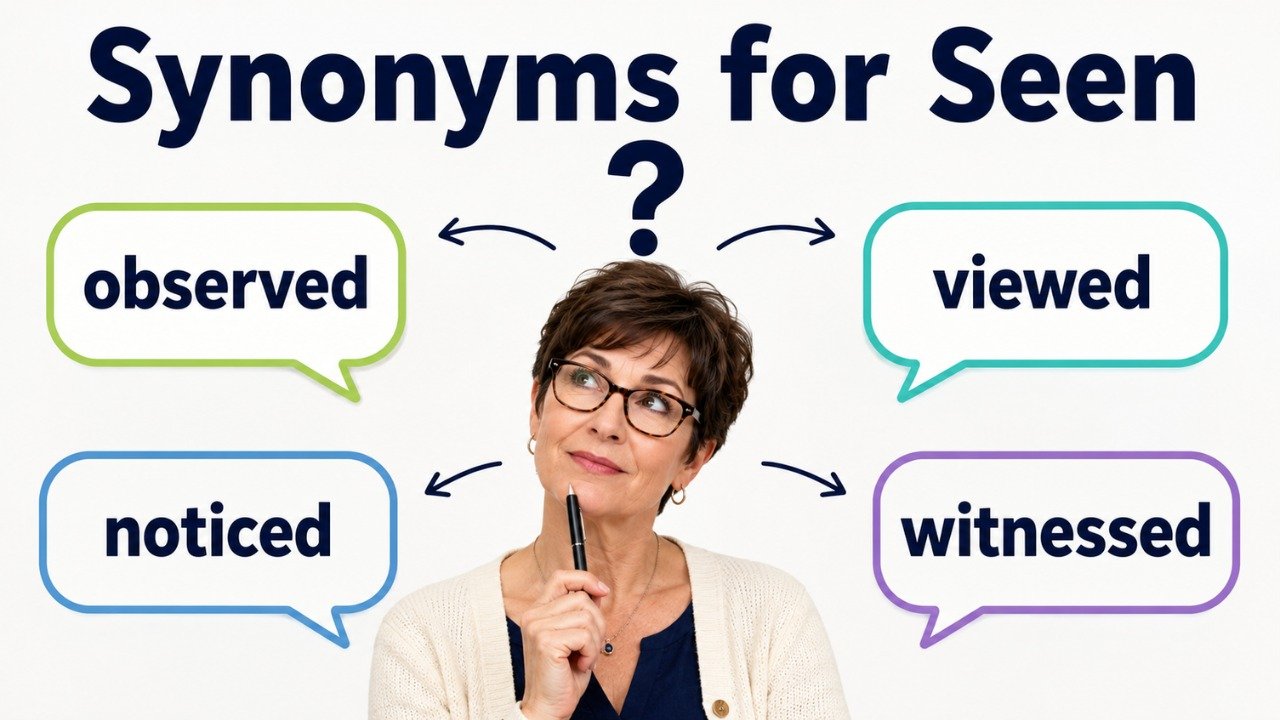
Quick Answer: The best synonyms for seen include observed, noticed, viewed, watched, witnessed, perceived, recognized, regarded, encountered, and experienced. Use observed in formal writing when something has been visually examined. Choose noticed for something that attracted attention, viewed for something deliberately looked at, and witnessed for an event personally observed. Perceived works for impressions or senses, recognized for identification, regarded for opinions, and experienced for events or situations someone has personally gone through.
Pronunciation and Word Details
Word: Seen.
Pronunciation: /siːn/.
Part of Speech: Past participle of the verb see and an adjective in limited contexts.
Meaning: Observed with the eyes, noticed, understood, experienced, or considered in a particular way.
US Pronunciation:
UK Pronunciation:
What Does “Seen” Mean?
Seen means observed with the eyes, noticed, understood, experienced, or considered in a certain way.
Seen is the past participle of the verb see. It normally appears with helping verbs such as have, has, had, is, was, were, or been.
Example: I have seen that building before.
Example: The missing vehicle was seen near the station.
Seen can describe direct visual observation, but its meaning is not limited to eyesight. It may also refer to understanding, experience, public reputation, or interpretation.
When someone says, “I have seen the problem,” the word may mean that the person has noticed or understood it. In “She is seen as a capable leader,” seen means regarded or considered.
Seen can also describe something experienced personally.
Example: The city has seen major growth.
In this sentence, seen means experienced.
The simple past form of see is saw, while seen is the past participle. In standard English, seen usually needs a helping verb.
Correct: I saw him yesterday.
Correct: I have seen him before.
Incorrect: I seen him yesterday.
Meaning, Tone, and Context of “Seen”
Seen is a neutral and widely used word. It appears in everyday conversation, formal writing, academic discussion, reports, descriptions, news writing, instructions, and storytelling.
When seen refers to visual observation, it has a neutral tone.
Example: The bird was seen near the lake.
When seen refers to evidence or an important event, it can sound more serious.
Example: The accident was seen by several people.
In academic and professional writing, seen often means observed, identified, demonstrated, or found.
Example: Similar results were seen in the second test.
In descriptions of reputation or public opinion, seen means regarded, considered, or perceived.
Example: The new policy is seen as a positive change.
Seen can also express experience.
Example: The organization has seen steady improvement.
In casual speech, seen is common in phrases such as have you seen, never seen before, and seen it all. In formal writing, more specific words such as observed, identified, recorded, or experienced may provide greater clarity.
The tone depends largely on the synonym chosen. Observed sounds formal and objective. Spotted sounds casual. Witnessed sounds serious. Beheld sounds literary. Perceived may sound academic or analytical.
When and How to Use “Seen”
For Visual Observation
Use seen when someone has looked at a person, object, place, or image.
Example: I have seen that painting several times.
For Noticing Something
Use seen when something has attracted attention or become noticeable.
Example: Have you seen the mark on the wall?
In this context, noticed may be more precise.
For Witnessing an Event
Use seen when someone personally observed an event happen.
Example: Several residents had seen the storm damage occur.
Witnessed is often stronger when the event is important, unusual, or serious.
For Identifying a Person or Object
Use seen when someone recognizes something from an earlier experience.
Example: I have seen this symbol before.
Recognized or identified may provide a more exact meaning.
For Understanding an Idea
Use seen when someone becomes aware of a fact, reason, or problem.
Example: She has finally seen why the original plan failed.
Understood or realized may be clearer in this context.
For Expressing an Opinion
Use seen as part of the phrase seen as when describing how a person, object, or idea is regarded.
Example: He is seen as an expert in the subject.
For Describing Experience
Use seen when a person, place, business, or period has experienced something.
Example: The region has seen several major changes.
For Reporting Findings
Use seen in reports when a result, pattern, or change has been observed.
Example: A similar pattern was seen in both groups.
Observed, recorded, or identified may sound more precise in formal reports.
For Passive Sentences
Use seen with a form of be when the person doing the seeing is unknown or less important.
Example: The animal was seen near the forest.
For Completed Experience
Use seen with have, has, or had when discussing something experienced before a particular time.
Example: We have seen this type of problem before.
Best Synonyms for Seen
Observed: Looked at, noticed, or studied carefully.
Example: The researcher observed a change in the participants’ behavior.
Noticed: Became aware of something through sight or attention.
Example: She noticed a small crack near the window.
Viewed: Looked at something deliberately.
Example: The committee viewed the presentation before making a decision.
Watched: Looked at something continuously for a period of time.
Example: We watched the birds build their nest.
Witnessed: Personally observed an event as it happened.
Example: Several passengers witnessed the incident.
Perceived: Became aware of something through the senses or mind.
Example: The change was perceived as a major improvement.
Recognized: Identified someone or something already known.
Example: He recognized the voice immediately.
Regarded: Considered or thought about in a particular way.
Example: The method is regarded as reliable.
Encountered: Met, found, or experienced something.
Example: The team encountered several difficulties during the project.
Experienced: Personally went through an event, feeling, or situation.
Example: The town experienced rapid growth during the decade.
50 Synonyms for Seen with Short Meanings
- Observed: Looked at or noticed carefully.
- Noticed: Became aware of something.
- Viewed: Looked at deliberately.
- Watched: Looked at continuously over time.
- Witnessed: Personally observed an event.
- Perceived: Became aware through the senses or mind.
- Spotted: Noticed suddenly or from a distance.
- Glimpsed: Saw briefly or partially.
- Detected: Discovered something that was difficult to notice.
- Discovered: Found or became aware of something previously unknown.
- Recognized: Identified something already familiar.
- Identified: Established the identity or nature of something.
- Discerned: Recognized something with careful attention.
- Examined: Looked at closely to learn more.
- Inspected: Checked something carefully for problems or details.
- Surveyed: Looked over an area or situation broadly.
- Studied: Observed something with focused attention.
- Reviewed: Examined something again or evaluated it.
- Regarded: Considered in a particular way.
- Considered: Thought about or judged in a certain manner.
- Deemed: Formally considered to have a particular quality.
- Judged: Formed an opinion or conclusion about something.
- Understood: Recognized the meaning or reason.
- Realized: Became fully aware of a fact.
- Comprehended: Understood something completely.
- Interpreted: Understood something in a particular way.
- Acknowledged: Accepted or recognized the existence of something.
- Registered: Became consciously aware of something.
- Encountered: Came across a person, object, or difficulty.
- Experienced: Personally went through an event or situation.
- Visited: Went to and saw a place.
- Attended: Was present at an event.
- Met: Came into contact with a person.
- Found: Discovered or noticed something.
- Noted: Observed and remembered something important.
- Recorded: Documented something that was observed.
- Documented: Created a written or visual record of something.
- Monitored: Watched something regularly over time.
- Read: Looked at and understood written information.
- Beheld: Saw something, usually in literary writing.
- Looked At: Directed the eyes toward something.
- Caught Sight Of: Noticed something briefly or suddenly.
- Laid Eyes On: Saw someone or something directly.
- Came Across: Found or encountered unexpectedly.
- Made Out: Managed to see or identify something unclear.
- Taken In: Observed and mentally absorbed something.
- Sighted: Saw or detected a person, object, or animal.
- Visualized: Formed a mental image of something.
- Visible: Able to be seen.
- Evident: Clearly noticeable or understandable.
Read Also:
Synonyms for Right
Synonyms for Seen by Context
When Seen Means Observed
Observed, viewed, watched, examined, inspected, studied, surveyed, and monitored can replace seen when someone deliberately looks at something.
Observed is suitable for formal reports and objective descriptions. Viewed describes deliberate looking. Watched suggests continued attention. Examined and inspected suggest careful checking.
Example: The behavior was observed throughout the experiment.
Example: The inspector examined the damaged equipment.
Example: Staff monitored the system throughout the night.
When Seen Means Noticed
Noticed, spotted, detected, glimpsed, sighted, and caught sight of work when someone becomes aware of something visually.
Noticed is the broadest option. Spotted suggests quick recognition. Glimpsed means something was seen only briefly. Detected suggests that the detail was difficult to find.
Example: She noticed a change in his expression.
Example: We spotted the missing sign near the entrance.
Example: The technician detected a small leak.
When Seen Means Witnessed
Witnessed, observed, attended, and experienced can describe being present when an event happened.
Witnessed is best for important, unusual, or serious events. Attended means someone was present at an organized event. Experienced emphasizes personal involvement.
Example: Several people witnessed the collision.
Example: She attended the graduation ceremony.
Example: The community experienced severe flooding.
When Seen Means Recognized
Recognized, identified, discerned, detected, and made out are useful when seen means that someone successfully identified a person, object, pattern, or detail.
Recognized suggests previous familiarity. Identified involves establishing identity. Discerned means recognizing something through careful thought or observation.
Example: She recognized the handwriting immediately.
Example: Investigators identified the source of the noise.
Example: He could barely make out the figure in the darkness.
When Seen Means Understood
Understood, realized, comprehended, registered, and acknowledged can replace seen when it refers to mental awareness.
Understood refers to meaning. Realized suggests a new awareness. Registered means that something entered conscious thought. Acknowledged means accepting that something exists or is true.
Example: He finally understood the reason for the delay.
Example: She realized that the figures were incomplete.
Example: The seriousness of the warning had not registered.
When Seen Means Regarded
Regarded, considered, perceived, deemed, interpreted, and judged are useful when describing an opinion or reputation.
Regarded and considered are neutral. Perceived focuses on how something appears to people. Deemed is more formal. Interpreted describes the meaning someone gives to an action or statement.
Example: The proposal is regarded as practical.
Example: His silence was interpreted as disagreement.
Example: The building was deemed unsafe.
When Seen Means Experienced
Experienced, encountered, faced, undergone, and lived through are useful when seen refers to events, changes, problems, or conditions.
Experienced is the most direct formal replacement. Encountered often describes problems or unexpected situations. Lived through emphasizes personal survival or endurance.
Example: The industry experienced significant growth.
Example: The team encountered several technical problems.
Example: The residents lived through a difficult winter.
When Seen Means Visited
Visited, explored, toured, attended, and traveled through can replace seen when discussing places or events.
Visited is the clearest option for going to a place. Explored suggests detailed discovery. Toured suggests visiting several parts of a location.
Example: We visited the historic district.
Example: The group explored the old building.
Example: They toured several coastal towns.
When Seen Means Shown or Visible
Visible, evident, apparent, displayed, shown, and noticeable work when the meaning is that something can be seen or is clearly present.
Visible refers directly to eyesight. Evident and apparent may describe facts, emotions, or patterns that are easy to recognize.
Example: The damage was clearly visible.
Example: Her disappointment was evident.
Example: A steady improvement was apparent in the results.
Another Word for Seen
Observed is often the best general replacement for seen when the meaning involves visual awareness. However, the strongest alternative depends on what was seen and how it was noticed.
Use noticed for a small detail, viewed for deliberate looking, witnessed for an event, recognized for identification, regarded for an opinion, and experienced for a situation.
Original: A strange light was seen above the building.
Better Option: A strange light was observed above the building.
Original: She had seen the spelling error in the document.
Better Option: She had noticed the spelling error in the document.
Original: The accident was seen by several drivers.
Better Option: The accident was witnessed by several drivers.
Original: The program is seen as a useful learning tool.
Better Option: The program is regarded as a useful learning tool.
When Not to Use “Seen”
Seen may sound vague when the sentence needs to explain exactly how something was noticed, understood, experienced, or judged.
When You Mean Careful Observation
Observed or examined may be clearer in formal reports.
Weak: A change was seen in the second group.
Better: A change was observed in the second group.
When You Mean Brief Notice
Spotted, glimpsed, or noticed may communicate the action more clearly.
Weak: She had seen someone near the gate.
Better: She had spotted someone near the gate.
When You Mean Personal Witness
Witnessed is stronger when someone was present during an event.
Weak: Several residents had seen the incident.
Better: Several residents had witnessed the incident.
When You Mean Understanding
Understood or realized is clearer when no visual action is involved.
Weak: He finally saw that the plan was unrealistic.
Better: He finally realized that the plan was unrealistic.
When You Mean Public Opinion
Regarded, perceived, or considered is often better than seen as in repeated formal writing.
Weak: The policy is seen as fair by most employees.
Better: The policy is regarded as fair by most employees.
When You Mean Experience
Experienced or encountered is more precise when describing change, difficulty, or growth.
Weak: The business has seen several challenges.
Better: The business has encountered several challenges.
When Seen Is Repeated
Too many uses of seen can make a paragraph sound basic or unclear.
Weak: The pattern was seen in one test and was also seen in another test.
Better: The pattern was observed in one test and identified again in another.
When Seen Is Used Without a Helping Verb
Do not use seen alone as the simple past form of see in standard English.
Weak: I seen the message yesterday.
Better: I saw the message yesterday.
Words Commonly Confused With Seen
Seen vs Saw: Saw is the simple past form of see. Seen is the past participle and usually appears with have, has, had, is, was, were, or been.
Example With Saw: I saw the document yesterday.
Example With Seen: I have seen the document before.
Seen vs Scene: Seen relates to the verb see. Scene is a noun referring to a place, setting, event, or section of a performance.
Example With Seen: She has seen the building before.
Example With Scene: The final scene took place inside the building.
Seen vs Observed: Seen is broad and neutral. Observed often suggests deliberate, careful, or formal attention.
Seen vs Noticed: Seen means something entered a person’s vision. Noticed means it attracted conscious attention.
A person may have seen an object without noticing an important detail.
Seen vs Viewed: Seen can happen accidentally. Viewed usually describes deliberate looking.
Seen vs Watched: Seen may refer to a brief visual experience. Watched suggests continuous attention over time.
Seen vs Witnessed: Seen is general. Witnessed means someone personally observed an event as it happened.
Seen vs Perceived: Seen usually refers to sight. Perceived may involve sight, sound, thought, opinion, or interpretation.
Seen vs Recognized: Seen means visually observed. Recognized means correctly identified as familiar.
Seen vs Regarded: Seen as and regarded as both describe opinions. Regarded often sounds more formal and deliberate.
Which Synonym Should You Choose?
Choose observed for formal reports, research, objective descriptions, and careful visual examination.
Choose noticed when a detail attracts someone’s attention.
Choose viewed when someone deliberately looks at an image, document, presentation, property, or object.
Choose watched when the action continues over a period of time.
Choose witnessed when someone personally observes an event, accident, ceremony, or important moment.
Choose spotted in casual speech when something is noticed quickly or from a distance.
Choose glimpsed when something is visible for only a brief moment.
Choose detected when the detail is hidden, slight, or difficult to discover.
Choose recognized when someone identifies a familiar person, voice, object, or pattern.
Choose identified when the identity, cause, type, or source has been established.
Choose perceived when writing about impressions, opinions, senses, or public attitudes.
Choose regarded when describing how someone or something is generally considered.
Choose deemed in formal, legal, administrative, or official writing.
Choose understood when seen refers to meaning or comprehension.
Choose realized when someone becomes newly aware of a fact.
Choose experienced when a person, organization, location, or period goes through an event or change.
Choose encountered when discussing difficulties, people, objects, or situations found unexpectedly.
Choose visited when seen refers to traveling to a place.
Choose monitored when something is watched regularly over time.
Choose beheld only in literary or dramatic writing.
Real Life Examples of “Seen” in Sentences
Original: I have seen that building many times.
Better Option: I have viewed that building many times.
Original: She had seen a small error in the form.
Better Option: She had noticed a small error in the form.
Original: A rare bird was seen near the river.
Better Option: A rare bird was spotted near the river.
Original: The accident was seen by three passengers.
Better Option: The accident was witnessed by three passengers.
Original: A similar result was seen in the final test.
Better Option: A similar result was observed in the final test.
Original: He had seen the cause of the problem.
Better Option: He had identified the cause of the problem.
Original: The decision is seen as reasonable.
Better Option: The decision is regarded as reasonable.
Original: The town has seen rapid development.
Better Option: The town has experienced rapid development.
Original: We have seen several difficulties this month.
Better Option: We have encountered several difficulties this month.
Original: She had seen why the instructions were confusing.
Better Option: She had understood why the instructions were confusing.
Synonym Groups and Usage Differences
Visual Observation Group
Observed, viewed, watched, looked at, and beheld all involve using the eyes.
Observed often suggests focused or formal attention. Viewed suggests deliberate looking. Watched involves continued attention. Beheld creates a literary or dramatic tone.
Example: The researchers observed the animals from a safe distance.
Brief Notice Group
Noticed, spotted, glimpsed, sighted, and caught sight of describe quick or limited visual awareness.
Spotted suggests successful detection. Glimpsed emphasizes a short view. Sighted is common when reporting the appearance of a person, animal, vehicle, or distant object.
Example: She glimpsed a figure through the window.
Careful Examination Group
Examined, inspected, studied, surveyed, reviewed, and monitored suggest close or organized attention.
Examined is broad. Inspected often involves checking for faults. Monitored means observing repeatedly over time.
Example: The engineer inspected the structure for damage.
Evidence and Witness Group
Witnessed, documented, recorded, and noted are useful when observation becomes evidence or part of a formal account.
Witnessed emphasizes personal presence. Documented and recorded create a permanent account. Noted means the detail was observed and considered important.
Example: The unusual behavior was documented in the final report.
Recognition Group
Recognized, identified, discerned, detected, and made out describe successful identification.
Recognized often involves familiarity. Identified establishes exactly what something is. Discerned suggests careful perception.
Example: She recognized the speaker by his voice.
Understanding Group
Understood, realized, comprehended, registered, and acknowledged describe mental awareness rather than physical sight.
Realized often marks a new discovery. Comprehended means fully understood. Registered suggests that information reached conscious awareness.
Example: He realized that the original calculation was incorrect.
Opinion Group
Regarded, considered, perceived, deemed, judged, and interpreted describe how something is understood or evaluated.
Regarded and considered are neutral. Perceived focuses on impressions. Deemed sounds formal and official.
Example: The solution was deemed acceptable.
Experience Group
Experienced, encountered, attended, visited, met, and came across describe personal contact with people, places, situations, or events.
Experienced emphasizes going through something. Encountered often describes unexpected contact. Came across has a more casual tone.
Example: The travelers encountered heavy rain during the journey.
Visibility Group
Visible, evident, apparent, and noticeable describe something that can be seen or easily recognized.
Visible relates directly to sight. Evident and apparent can also describe facts, feelings, or patterns.
Example: The difference was evident in the final results.
Antonyms of Seen
The opposite of seen depends on whether the word refers to visibility, attention, recognition, understanding, experience, or public opinion.
Unseen: Not observed or visible.
Invisible: Unable to be seen.
Hidden: Kept out of sight.
Concealed: Deliberately prevented from being seen.
Unnoticed: Not attracting attention.
Overlooked: Seen but not properly noticed or considered.
Missed: Not seen, noticed, or understood.
Ignored: Deliberately given no attention.
Undetected: Not discovered or noticed.
Unobserved: Not watched or examined.
Unwitnessed: Not personally observed by another person.
Unknown: Not recognized or understood.
Unrecognized: Not identified as familiar.
Unidentified: Not successfully named or classified.
Misunderstood: Understood incorrectly.
Unacknowledged: Not accepted or recognized.
Unrecorded: Not written down or documented.
Unexplored: Not visited or examined.
Obscured: Made difficult to see.
Imperceptible: Too slight or unclear to be perceived.
Comparison: Seen vs Related Words
Seen vs Observed
Seen is general and may describe accidental or casual visual awareness. Observed usually suggests careful, purposeful, or formal attention.
Example With Seen: A change was seen in the second sample.
Example With Observed: A change was observed in the second sample.
Seen vs Noticed
Seen means something entered a person’s vision. Noticed means the person became consciously aware of it.
Example With Seen: I had seen the sign before entering.
Example With Noticed: I noticed that the sign contained an error.
Seen vs Viewed
Seen may happen accidentally. Viewed usually means someone deliberately looked at something.
Example With Seen: The image has been seen by many visitors.
Example With Viewed: The committee viewed the image during the meeting.
Seen vs Watched
Seen may refer to a momentary look. Watched describes continued attention.
Example With Seen: I have seen the birds near the window.
Example With Watched: I watched the birds build a nest.
Seen vs Witnessed
Seen is a broad term for visual experience. Witnessed suggests that someone personally observed an event as it happened.
Example With Seen: The incident was seen by several people.
Example With Witnessed: Several people witnessed the incident.
Seen vs Spotted
Seen is neutral. Spotted suggests something was noticed quickly, unexpectedly, or from a distance.
Example With Seen: The vehicle was seen near the bridge.
Example With Spotted: The vehicle was spotted near the bridge.
Seen vs Perceived
Seen mainly relates to eyesight. Perceived may refer to the senses, thoughts, impressions, or opinions.
Example With Seen: The change could be seen clearly.
Example With Perceived: The change was perceived as beneficial.
Seen vs Recognized
Seen means visually observed. Recognized means identified as someone or something already known.
Example With Seen: I had seen the woman at the entrance.
Example With Recognized: I recognized the woman from the previous meeting.
Seen vs Regarded
Seen can describe sight or opinion. Regarded specifically describes how someone or something is considered.
Example With Seen: She is seen as a strong candidate.
Example With Regarded: She is regarded as a strong candidate.
Seen vs Saw
Saw is the simple past form of see. Seen is the past participle and requires a helping verb in standard English.
Example With Saw: We saw the building yesterday.
Example With Seen: We have seen the building before.
Common Phrases and Expressions With “Seen”
Have Seen: Experienced or observed something before now.
Has Been Seen: Has been observed by someone.
Seen Before: Previously observed or experienced.
Never Seen Before: Completely new or unfamiliar.
Last Seen: Most recently observed at a particular time or place.
Seen As: Regarded or considered in a certain way.
Seen In: Observed or found within a place, group, document, or result.
Seen Through: Recognized the truth behind an action or deception.
Seen Better Days: No longer in a good condition.
Seen It All: Experienced many unusual or difficult situations.
To Be Seen: Still uncertain or waiting to become clear.
Seen and Heard: Noticed and given an opportunity to express an opinion.
Rarely Seen: Not often observed.
Frequently Seen: Commonly observed.
Widely Seen: Observed or accepted by many people.
Common Mistakes to Avoid
Using Seen Instead of Saw
Seen should not normally stand alone as the simple past form.
Incorrect: I seen her at the store yesterday.
Correct: I saw her at the store yesterday.
Correct: I have seen her at the store before.
Forgetting the Helping Verb
Seen normally needs have, has, had, is, was, were, or another appropriate helping verb.
Incorrect: We seen the results already.
Correct: We have seen the results already.
Confusing Seen With Scene
Seen is related to sight. Scene is a noun describing a setting, location, event, or part of a performance.
Incorrect: The final seen was emotional.
Correct: The final scene was emotional.
Using Watched for a Brief Look
Watched suggests continued attention. Use saw, noticed, spotted, or glimpsed for a brief visual experience.
Unnatural: I watched a flash of light for one second.
Better: I glimpsed a flash of light.
Using Witnessed for Ordinary Viewing
Witnessed may sound too serious for simple objects or casual activities.
Unnatural: I witnessed a new chair in the office.
Better: I noticed a new chair in the office.
Using Seen When No Visual Meaning Exists
Seen can express understanding or opinion, but a more precise synonym may improve clarity.
Vague: She had seen the importance of the warning.
Clearer: She had understood the importance of the warning.
Repeating Seen Too Often
Use different synonyms when sentences describe different kinds of observation.
Repetitive: The error was seen by the editor and later seen by the manager.
Improved: The error was noticed by the editor and later identified by the manager.
Choosing a Synonym With the Wrong Tone
Beheld is literary and may sound unnatural in everyday communication. Deemed is formal and may sound too official in casual conversation.
Choose a synonym that matches the audience, purpose, and situation.
Confusing Visibility With Attention
Something can be visible without being noticed.
Example: The warning was visible, but no one noticed it.
Using Seen As a Noun
Seen is not normally a noun. Use sight, view, scene, observation, or experience depending on the intended meaning.
Conclusion
The best synonyms for seen depend on whether the word refers to visual observation, attention, recognition, understanding, opinion, or experience. Use observed for formal reports, noticed for small details, viewed for deliberate looking, witnessed for important events, and recognized for identification. Regarded and perceived work well for opinions, while understood and realized express mental awareness. Experienced and encountered describe situations someone has gone through. Choosing a precise alternative makes writing clearer, more natural, and more informative.
FAQs About Synonyms for Seen
What Is the Best Synonym for Seen?
Observed is the best general formal synonym for seen. Noticed, viewed, witnessed, recognized, or experienced may be better depending on the context.
What Is Another Word for Seen in Formal Writing?
Observed, identified, recorded, documented, perceived, and regarded are useful formal alternatives.
What Is a Synonym for Seen When Describing an Event?
Witnessed is the strongest choice when someone personally observed an event as it happened.
What Is a Synonym for Seen As?
Regarded as, considered, perceived as, viewed as, and deemed are useful alternatives to seen as.
What Is the Difference Between Seen and Saw?
Saw is the simple past form of see. Seen is the past participle and usually requires a helping verb such as have, has, or had.
Can Noticed Replace Seen?
Noticed can replace seen when the sentence means that someone became consciously aware of a detail. It does not work in every visual context.
What Is the Opposite of Seen?
Common opposites include unseen, unnoticed, hidden, invisible, undetected, and overlooked. The best antonym depends on the sentence.
