
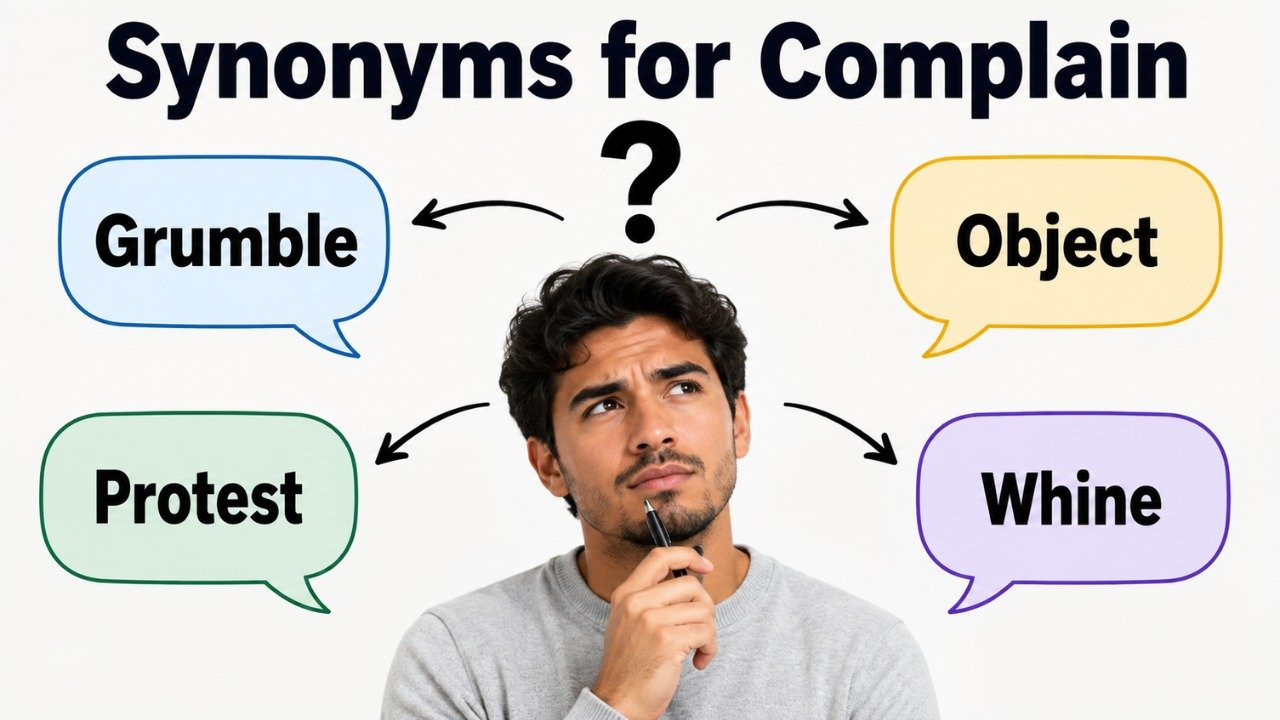
Quick Answer: The best synonyms for complain include protest, object, grumble, gripe, moan, criticize, lament, report, raise concerns, and lodge a complaint. Use protest or object for formal disagreement, lodge a complaint for an official concern, report for a specific problem, grumble or gripe in casual speech, moan or whine for repeated dissatisfaction, criticize when identifying faults, and lament when expressing sadness. The most suitable choice depends on the seriousness, purpose, tone, and setting of the complaint.
Pronunciation and Word Details
Word: Complain.
Pronunciation: /kəmˈpleɪn/.
Part of Speech: Verb.
Meaning: To express dissatisfaction, annoyance, pain, concern, or disagreement about something.
US Pronunciation:
UK Pronunciation:
What Does “Complain” Mean?
Complain means to express dissatisfaction, annoyance, discomfort, concern, or disagreement. It is a verb used when someone says that a situation, action, service, decision, or condition is unacceptable or unpleasant.
A person may complain casually about a minor inconvenience, formally report a serious problem, or express pain and discomfort. The word can therefore sound neutral, reasonable, emotional, critical, or negative depending on the situation.
Dissatisfaction: The residents complained about the constant noise.
Formal Concern: She complained to the supervisor about the incorrect charge.
Physical Discomfort: He complained of pain in his shoulder.
Disagreement: Several employees complained that the new schedule was unfair.
Complain often appears with about, of, to, or that. Each form has a different grammatical purpose.
Complain About: Used for the subject or situation causing dissatisfaction.
Example: They complained about the slow response.
Complain Of: Commonly used for pain, illness, or physical symptoms.
Example: The patient complained of severe headaches.
Complain To: Identifies the person or organization receiving the complaint.
Example: She complained to the building manager.
Complain That: Introduces a complete statement explaining the problem.
Example: The students complained that the room was too cold.
Meaning, Tone, and Context of “Complain”
Complain can be neutral, formal, emotional, conversational, or critical. Its tone depends on why the person is speaking and how the concern is expressed.
Neutral Tone: Complain can simply mean reporting that something is wrong.
Example: Several passengers complained that the information was unclear.
Formal Tone: It is often used for official concerns involving services, decisions, conduct, policies, or workplace conditions.
Example: The employee formally complained about unsafe equipment.
Conversational Tone: In everyday speech, complain often describes frustration with minor problems.
Example: He always complains about the weather.
Emotional Tone: The word may communicate anger, disappointment, discomfort, or helplessness.
Example: She complained bitterly about the unfair treatment.
Negative Tone: When someone complains repeatedly without seeking a solution, the word may suggest negativity or impatience.
Example: He complained throughout the entire journey.
Constructive Tone: A complaint can be reasonable and useful when it identifies a genuine problem and requests action.
Example: Customers complained that the instructions were difficult to understand.
Medical Context: Complain of is commonly used to describe pain or symptoms.
Example: The patient complained of dizziness and nausea.
Professional Context: In reports and workplace communication, raise concerns, report an issue, or lodge a complaint may sound more precise than complain.
Example: Several team members raised concerns about the deadline.
The word itself is not always negative. A complaint may be justified, necessary, and helpful when it is clear, factual, and directed toward solving a problem.
When and How to Use “Complain”
For General Dissatisfaction
Use complain when someone is unhappy with a situation, product, decision, experience, or condition.
Example: The visitors complained about the lack of clear signs.
For Formal Objections
Use complain when someone officially challenges unfair treatment, poor conduct, or an unacceptable decision.
Example: She complained to the department about the way her application was handled.
For Service Problems
Use complain when a customer or user reports that a service did not meet reasonable expectations.
Example: Several customers complained that their orders arrived incomplete.
For Workplace Concerns
Use complain when an employee expresses dissatisfaction about workload, treatment, safety, communication, or working conditions.
Example: The staff complained about being given too little time to complete the project.
For Physical Pain
Use complain of when describing symptoms, pain, or discomfort.
Example: He complained of a sharp pain in his lower back.
For Unfair Treatment
Use complain when someone believes that a rule, action, or decision is unreasonable.
Example: The residents complained that the new fee was unfair.
For Repeated Annoyance
Use complain when a person continually expresses dissatisfaction, especially about minor matters.
Example: She complained all evening about the crowded room.
For Constructive Feedback
Use complain when identifying a real problem that needs correction, although raise concerns or report an issue may sound more constructive.
Example: The users complained that the form was confusing and difficult to complete.
For Public Disagreement
Use complain when a group openly objects to a decision, policy, or change.
Example: Local businesses complained about the sudden increase in costs.
Best Synonyms for Complain
Protest
Synonym: Protest means to express strong disagreement or opposition, often openly or formally.
Example: The residents protested against the proposed restriction.
Object
Synonym: Object means to state that you disagree with or oppose something.
Example: Several members objected to the final proposal.
Grumble
Synonym: Grumble means to complain quietly or repeatedly in an annoyed manner.
Example: He grumbled about having to work late.
Gripe
Synonym: Gripe means to complain informally about something irritating.
Example: She griped about the long waiting time.
Moan
Synonym: Moan means to complain repeatedly in an unhappy or irritating way.
Example: He moaned about the difficult assignment all morning.
Criticize
Synonym: Criticize means to identify faults, weaknesses, or mistakes in someone or something.
Example: The reviewer criticized the report for lacking clear evidence.
Lament
Synonym: Lament means to express sadness, regret, or disappointment about a situation.
Example: The residents lamented the loss of the old community garden.
Report
Synonym: Report means to formally provide information about a problem, fault, violation, or concern.
Example: She reported the broken equipment to the supervisor.
Raise Concerns
Synonym: Raise concerns means to express worries or reservations in a constructive or professional way.
Example: Several employees raised concerns about the new safety procedure.
Lodge a Complaint
Synonym: Lodge a complaint means to make a formal or official statement of dissatisfaction.
Example: The customer lodged a complaint about the unexpected charge.
50 Synonyms for Complain with Short Meanings
- Protest: To express strong opposition or disagreement.
- Object: To state that something is unacceptable or wrong.
- Grumble: To complain quietly in an irritated manner.
- Gripe: To complain informally about an annoying issue.
- Moan: To express unhappiness repeatedly.
- Whine: To complain in a weak, childish, or irritating voice.
- Lament: To express sadness or regret about something.
- Criticize: To point out faults or weaknesses.
- Murmur: To express dissatisfaction quietly.
- Grouse: To complain repeatedly about minor matters.
- Carp: To complain continuously or find unnecessary faults.
- Kvetch: To complain persistently in an informal way.
- Remonstrate: To protest or object strongly and formally.
- Bemoan: To express disappointment or sorrow about a situation.
- Bewail: To express deep sorrow or regret.
- Deplore: To express strong disapproval or sadness.
- Rail: To complain or criticize angrily.
- Rant: To complain loudly and emotionally.
- Vent: To express strong frustration or anger.
- Fuss: To complain or worry excessively about a small matter.
- Nag: To complain or criticize someone repeatedly.
- Quibble: To complain or argue about small details.
- Cavil: To raise minor or unnecessary objections.
- Mutter: To complain in a low and unclear voice.
- Bellyache: To complain continuously about minor problems.
- Beef: To complain informally about something.
- Snivel: To complain in a weak or tearful manner.
- Whimper: To complain softly or fearfully.
- Find Fault: To look for reasons to criticize or complain.
- Voice Dissatisfaction: To clearly express unhappiness with something.
- Express Discontent: To communicate dissatisfaction or unhappiness.
- Voice Displeasure: To state that something has caused annoyance.
- Raise Concerns: To express worries in a constructive way.
- Express Concern: To communicate worry about a problem.
- Raise an Objection: To state a reason for opposing something.
- Lodge a Complaint: To submit a formal statement of dissatisfaction.
- Make a Complaint: To tell someone officially that a problem exists.
- File a Complaint: To submit a complaint through an official process.
- Report a Problem: To inform the responsible person about an issue.
- Report an Issue: To describe a fault that requires attention.
- Air a Grievance: To openly express a complaint about unfair treatment.
- Register a Protest: To formally communicate opposition.
- Speak Out: To openly express disagreement or concern.
- Take Issue: To disagree with or challenge a statement or action.
- Protest Against: To express opposition to a decision or condition.
- Cry Out Against: To object strongly and publicly.
- Denounce: To criticize or condemn openly and strongly.
- Condemn: To express complete disapproval of something.
- Challenge: To question or oppose a decision, claim, or action.
- Kick Up a Fuss: To complain loudly or create a strong disturbance.
Read Also:
Synonyms for Melancholy
Synonyms for Complain by Context
When Complain Means Express Dissatisfaction
Grumble, gripe, moan, grouse, murmur, and voice displeasure work when someone is unhappy with an experience or condition.
Example With Complain: The passengers complained about the uncomfortable seats.
Example With Grumble: The passengers grumbled about the uncomfortable seats.
Example With Gripe: The passengers griped about the uncomfortable seats.
Grumble suggests quiet annoyance. Gripe is informal and direct. Moan often suggests repeated or irritating dissatisfaction.
When Complain Means Formally Report a Problem
Lodge a complaint, file a complaint, report a problem, report an issue, and raise concerns are suitable for professional or official situations.
Example With Complain: She complained about the incorrect payment.
Example With Lodge a Complaint: She lodged a complaint about the incorrect payment.
Example With Report an Issue: She reported an issue with the payment.
Lodge a complaint and file a complaint describe an official process. Report an issue sounds practical and solution focused.
When Complain Means Object to a Decision
Protest, object, remonstrate, challenge, take issue, and raise an objection work when someone disagrees with a decision, rule, or statement.
Example With Complain: Several members complained about the new rule.
Example With Object: Several members objected to the new rule.
Example With Protest: Several members protested against the new rule.
Object is controlled and direct. Protest is stronger and may involve public opposition. Remonstrate is formal and forceful.
When Complain Means Speak Repeatedly About Minor Problems
Whine, moan, grouse, carp, kvetch, bellyache, and fuss describe frequent or irritating complaints.
Example With Complain: He complained about every part of the journey.
Example With Whine: He whined about every part of the journey.
Example With Grouse: He groused about every part of the journey.
Whine can sound judgmental and insulting. Grouse and gripe are informal but less childish. Bellyache is highly informal.
When Complain Means Express Sadness or Regret
Lament, bemoan, bewail, and deplore are useful when the complaint is connected to loss, disappointment, or sorrow.
Example With Complain: The residents complained about the disappearance of local traditions.
Example With Lament: The residents lamented the disappearance of local traditions.
Example With Bemoan: The residents bemoaned the disappearance of local traditions.
Lament is appropriate for serious sadness. Bemoan can express both sadness and criticism. Bewail is more dramatic and literary.
When Complain Means Criticize Strongly
Criticize, rail, rant, denounce, condemn, and cry out against are stronger alternatives.
Example With Complain: The speaker complained about the unfair decision.
Example With Denounce: The speaker denounced the unfair decision.
Example With Rail: The speaker railed against the unfair decision.
Denounce and condemn communicate strong public disapproval. Rail and rant focus more on an angry style of expression.
When Complain Means Express a Constructive Concern
Raise concerns, express concern, report an issue, and voice dissatisfaction are appropriate in reports, essays, emails, and professional conversations.
Example With Complain: The team complained that the deadline was unrealistic.
Example With Raise Concerns: The team raised concerns about the unrealistic deadline.
Raise concerns sounds professional and constructive. It focuses attention on the problem without suggesting unnecessary negativity.
Another Word for Complain
The best single replacement for complain is often protest when someone openly disagrees with a decision, action, or condition. However, the ideal alternative depends on the context.
Use grumble for minor casual annoyance, report for a practical problem, object for formal disagreement, lament for sadness, and lodge a complaint for an official process.
Original: The residents complained about the sudden increase in fees.
Better Option: The residents protested against the sudden increase in fees.
Original: She complained that the computer was not working.
Better Option: She reported that the computer was not working.
Original: He complained about having to wait ten minutes.
Better Option: He grumbled about having to wait ten minutes.
Original: The employee complained about the unfair decision.
Better Option: The employee formally objected to the unfair decision.
When Not to Use “Complain”
Do not use complain when a more precise verb explains the purpose or seriousness of the message.
When Making an Official Report
Use lodge a complaint, file a complaint, or report an issue when the person follows a formal process.
Weak: She complained about the unsafe working conditions.
Better: She filed a complaint about the unsafe working conditions.
When Describing a Specific Fault
Use report when someone provides practical information so that a problem can be corrected.
Weak: He complained that the emergency light was broken.
Better: He reported that the emergency light was broken.
When Expressing Formal Opposition
Use object or protest when the main meaning is disagreement rather than general dissatisfaction.
Weak: The committee complained about the proposal.
Better: The committee objected to the proposal.
When Expressing Grief or Regret
Use lament or bemoan when the emotion is sadness rather than irritation.
Weak: The author complained about the decline of the old tradition.
Better: The author lamented the decline of the old tradition.
When Giving Constructive Professional Feedback
Raise concerns often sounds more balanced and solution focused than complain.
Weak: The employees complained about the lack of training.
Better: The employees raised concerns about the lack of training.
When the Complaint Is Minor and Casual
Use grumble, gripe, or moan if the sentence needs to show the manner of complaining.
Weak: He complained quietly about the early meeting.
Better: He grumbled about the early meeting.
When Strong Public Criticism Is Intended
Use denounce or condemn when someone expresses forceful moral or public disapproval.
Weak: The community leaders complained about the violent conduct.
Better: The community leaders condemned the violent conduct.
When the Meaning Is Too Vague
Complain can be unclear unless the sentence identifies the issue, audience, or desired action.
Weak: She complained about everything.
Better: She objected to the schedule and reported several safety concerns.
Words Commonly Confused With Complain
Complain vs Criticize: Complain expresses dissatisfaction with a situation or experience. Criticize identifies faults in a person, action, argument, or piece of work.
Example With Complain: The guests complained about the cold food.
Example With Criticize: The reviewer criticized the meal for lacking flavor.
Complain vs Protest: Complain can be private, casual, or formal. Protest expresses stronger and more deliberate opposition.
Example With Complain: The residents complained about the new restriction.
Example With Protest: The residents protested against the new restriction.
Complain vs Object: Complain expresses unhappiness. Object directly states disagreement with a proposal, decision, or action.
Example With Complain: She complained that the plan was unfair.
Example With Object: She objected to the plan because it was unfair.
Complain vs Report: Complain emphasizes dissatisfaction. Report focuses on providing information about a problem.
Example With Complain: He complained about the damaged door.
Example With Report: He reported the damaged door to the maintenance team.
Complain vs Lament: Complain usually expresses annoyance or dissatisfaction. Lament expresses sadness, regret, or grief.
Example With Complain: She complained about the cancelled event.
Example With Lament: She lamented the loss of the annual tradition.
Complain vs Whine: Complain may be reasonable and justified. Whine suggests that the complaint is weak, childish, repetitive, or irritating.
Example With Complain: The workers complained about unsafe conditions.
Example With Whine: He whined because his preferred seat was unavailable.
Complain vs Grumble: Complain is a general word. Grumble describes quiet, low, or reluctant complaining.
Example With Complain: They complained about the extra work.
Example With Grumble: They grumbled quietly about the extra work.
Complain vs Complaint: Complain is a verb, while complaint is a noun.
Verb: Customers complained about the delay.
Noun: The company received several complaints about the delay.
Which Synonym Should You Choose?
Choose protest when expressing strong opposition to a decision, rule, policy, or action.
Choose object when stating formal or controlled disagreement in meetings, discussions, essays, or professional communication.
Choose grumble when describing quiet annoyance about a minor inconvenience.
Choose gripe for casual speech about an irritating situation.
Choose moan when someone complains repeatedly and unhappily.
Choose whine when the complaint sounds childish, weak, unnecessary, or irritating. Use this word carefully because it expresses judgment.
Choose criticize when evaluating faults, mistakes, weaknesses, arguments, or performance.
Choose lament when expressing sadness, regret, or disappointment about a loss or change.
Choose report when communicating a practical problem that needs attention or correction.
Choose raise concerns in professional emails, meetings, reports, and formal discussions where a constructive tone matters.
Choose voice dissatisfaction when describing unhappiness in neutral or formal writing.
Choose lodge a complaint when someone officially reports unacceptable treatment, conduct, or service.
Choose file a complaint when referring to a defined administrative or legal process.
Choose remonstrate in formal writing when someone protests strongly and directly.
Choose denounce when expressing powerful public disapproval.
Choose rant when describing a loud, emotional, and uncontrolled complaint.
Choose vent when someone releases frustration without necessarily requesting a solution.
Choose quibble when the person argues about small or unimportant details.
Choose bemoan when expressing sadness mixed with dissatisfaction.
Real Life Examples of “Complain” in Sentences
Original: The residents complained about the noise from the construction work.
Better Option: The residents raised concerns about the noise from the construction work.
Original: She complained that her payment had not been processed.
Better Option: She reported that her payment had not been processed.
Original: Several members complained about the proposed rule.
Better Option: Several members objected to the proposed rule.
Original: He complained about the early starting time.
Better Option: He grumbled about the early starting time.
Original: The customers complained about the unexpected charge.
Better Option: The customers lodged complaints about the unexpected charge.
Original: She complained about the disappearance of the old park.
Better Option: She lamented the disappearance of the old park.
Original: The speaker complained angrily about the decision.
Better Option: The speaker railed against the decision.
Original: The workers complained that the equipment was unsafe.
Better Option: The workers reported that the equipment was unsafe.
Original: He complained continuously about the long journey.
Better Option: He moaned continuously about the long journey.
Original: The students complained that the instructions were unclear.
Better Option: The students voiced dissatisfaction with the unclear instructions.
Synonym Groups and Usage Differences
Casual Complaint Group
Grumble, gripe, grouse, moan, bellyache, beef, and kvetch are commonly used for informal complaints.
Grumble usually sounds quiet and irritated. Gripe and beef are conversational. Grouse and kvetch suggest repeated complaints.
Example: He griped about the slow traffic during the entire journey.
Formal Objection Group
Object, protest, remonstrate, challenge, take issue, and raise an objection express disagreement with a rule, decision, claim, or action.
Object is controlled and professional. Protest is stronger. Remonstrate is formal and forceful.
Example: Several committee members objected to the proposed change.
Official Complaint Group
Lodge a complaint, file a complaint, make a complaint, report a problem, and register a protest describe formal actions.
These phrases are useful when documenting a concern or requesting official action.
Example: The tenant filed a complaint about the unresolved safety problem.
Constructive Concern Group
Raise concerns, express concern, report an issue, and voice dissatisfaction sound neutral and solution focused.
They are appropriate in professional emails, reports, meetings, and workplace discussions.
Example: The team raised concerns about the limited testing period.
Repeated Complaint Group
Whine, moan, carp, nag, fuss, and bellyache suggest persistent or irritating dissatisfaction.
Whine often sounds childish. Nag usually involves repeatedly criticizing or requesting something from another person.
Example: He moaned about every small change in the schedule.
Sadness and Regret Group
Lament, bemoan, bewail, and deplore express sorrow, disappointment, or regret.
Lament is the most widely useful. Bewail is more dramatic. Deplore often includes strong disapproval.
Example: Many residents lamented the loss of the historic building.
Strong Criticism Group
Criticize, rail, rant, denounce, condemn, and cry out against express forceful disapproval.
Criticize can be measured and analytical. Denounce and condemn are stronger and more public. Rant focuses on emotional delivery.
Example: The editorial condemned the misuse of public resources.
Minor Objection Group
Quibble, cavil, find fault, and fuss describe complaints about small details.
These terms can suggest that the objection is unnecessary or overly particular.
Example: She quibbled over a minor change in the wording.
Antonyms of Complain
The antonyms of complain generally describe approval, acceptance, praise, gratitude, or satisfaction.
Praise: To express approval or admiration.
Compliment: To say something positive about someone or something.
Commend: To formally praise a person, decision, or action.
Approve: To consider something acceptable or satisfactory.
Accept: To receive or agree to something without objection.
Agree: To share the same opinion or support a proposal.
Support: To express approval or provide assistance.
Endorse: To publicly or formally approve something.
Applaud: To strongly praise or approve an action.
Appreciate: To recognize the value or positive qualities of something.
Celebrate: To express happiness about an event or achievement.
Thank: To express gratitude.
Reassure: To provide comfort or confidence rather than dissatisfaction.
Be Satisfied: To feel that something meets expectations.
Be Content: To accept a situation with satisfaction.
Comparison: Complain vs Related Words
Complain vs Protest
Complain expresses dissatisfaction, while protest communicates deliberate and often stronger opposition. A complaint may be private, but a protest is frequently open or formal.
Example With Complain: The residents complained about the new parking rule.
Example With Protest: The residents protested against the new parking rule.
Complain vs Object
Complain focuses on unhappiness or dissatisfaction. Object focuses on disagreement with a specific proposal, claim, or action.
Example With Complain: She complained that the decision was unfair.
Example With Object: She objected to the decision on fairness grounds.
Complain vs Criticize
Complain describes an unpleasant experience or condition. Criticize examines and points out faults.
Example With Complain: The readers complained about the confusing layout.
Example With Criticize: The editor criticized the layout for lacking a clear structure.
Complain vs Grumble
Complain is neutral and general. Grumble suggests quiet, reluctant, or irritated speech.
Example With Complain: He complained about working late.
Example With Grumble: He grumbled under his breath about working late.
Complain vs Whine
Complain can describe a serious and justified concern. Whine implies that the complaint is weak, immature, repetitive, or annoying.
Example With Complain: The patient complained of severe pain.
Example With Whine: The child whined about having to wait a few minutes.
Complain vs Report
Complain emphasizes dissatisfaction. Report emphasizes giving accurate information so that someone can investigate or solve the issue.
Example With Complain: She complained about the damaged equipment.
Example With Report: She reported the damaged equipment to the supervisor.
Complain vs Lament
Complain usually communicates annoyance. Lament communicates sadness or regret.
Example With Complain: They complained about the cancelled program.
Example With Lament: They lamented the end of the successful program.
Complain vs Vent
Complain may seek action or correction. Vent mainly means releasing strong feelings or frustration.
Example With Complain: He complained to the manager about the delay.
Example With Vent: He vented to a friend about the stressful delay.
Complain vs Raise Concerns
Complain can sound emotional or negative. Raise concerns sounds constructive, neutral, and professional.
Example With Complain: The employees complained about the new procedure.
Example With Raise Concerns: The employees raised concerns about the new procedure.
Common Phrases and Expressions With Complain
Complain About: To express dissatisfaction with a person, action, event, or condition.
Example: She complained about the excessive noise.
Complain Of: To report pain, illness, discomfort, or symptoms.
Example: He complained of pain in his left knee.
Complain To Someone: To tell a person in authority about a problem.
Example: They complained to the building manager.
Complain That: To introduce a complete statement explaining the problem.
Example: The students complained that the room was overcrowded.
Formally Complain: To report dissatisfaction through an official process.
Example: She formally complained about the inappropriate conduct.
Complain Bitterly: To express strong anger, resentment, or disappointment.
Example: The residents complained bitterly about the unexpected fee.
Constantly Complain: To express dissatisfaction very frequently.
Example: He constantly complains about minor inconveniences.
Have Reason to Complain: To possess a valid cause for dissatisfaction.
Example: The customers had reason to complain about the repeated errors.
Nothing to Complain About: Used to say that a situation is satisfactory.
Example: The room was clean, quiet, and comfortable, so we had nothing to complain about.
Complain Loudly: To express dissatisfaction openly and forcefully.
Example: Several passengers complained loudly about the delay.
Common Mistakes to Avoid
Using Complain Without the Correct Preposition
Use complain about for a problem, complain to for the person receiving the complaint, and complain of for symptoms.
Incorrect: She complained the noise.
Correct: She complained about the noise.
Incorrect: He complained about the manager about the delay.
Correct: He complained to the manager about the delay.
Confusing Complain and Complaint
Complain is a verb. Complaint is a noun.
Incorrect: She made a complain about the service.
Correct: She made a complaint about the service.
Correct: She complained about the service.
Using “Complain For”
Complain for is usually unnatural when identifying the subject of dissatisfaction.
Incorrect: They complained for the long waiting time.
Correct: They complained about the long waiting time.
Using Whine for a Serious Concern
Whine sounds dismissive and judgmental. Do not use it for legitimate safety, health, legal, or workplace concerns.
Insensitive: The workers whined about dangerous equipment.
Better: The workers reported concerns about dangerous equipment.
Using Complain When Report Is More Accurate
When the purpose is to provide factual information and solve a problem, report may be clearer.
Less Precise: She complained that the alarm was not working.
More Precise: She reported that the alarm was not working.
Using a Strong Synonym for a Minor Complaint
Denounce and condemn are too strong for ordinary inconveniences.
Unnatural: He condemned the slightly uncomfortable chair.
Natural: He complained about the slightly uncomfortable chair.
Repeating Complain Too Often
Repeated use can make writing sound dull or overly negative.
Repetitive: Customers complained about delays, complained about errors, and complained about unclear instructions.
Better: Customers reported delays, criticized the repeated errors, and raised concerns about the unclear instructions.
Failing to Identify the Problem
A vague complaint does not help the reader understand what happened.
Vague: The staff complained about everything.
Clear: The staff objected to the schedule and reported several equipment problems.
Confusing Dissatisfaction With Disagreement
Use object when the person opposes an idea. Use complain when the person expresses unhappiness with an experience or condition.
Less Precise: She complained to the proposal.
Correct: She objected to the proposal.
Using an Overly Casual Synonym in Formal Writing
Gripe, beef, bellyache, and kvetch are usually unsuitable for formal reports, academic essays, and professional correspondence.
Too Casual: Employees griped about the safety procedure.
Formal: Employees raised concerns about the safety procedure.
Conclusion
The most useful synonyms for complain include protest, object, grumble, gripe, criticize, lament, report, raise concerns, and lodge a complaint. Choose protest or object for disagreement, grumble or gripe for casual annoyance, report for practical problems, and lament for sadness. In professional communication, raise concerns often sounds more constructive than complain. Understanding the tone and purpose of each alternative helps you select precise synonyms for complain without making a reasonable concern sound too weak, emotional, or aggressive.
FAQs About Synonyms for Complain
What Is the Best Synonym for Complain?
Protest is a strong general alternative when someone openly disagrees. Grumble works for minor annoyance, while report is better for a specific problem.
What Is a Formal Synonym for Complain?
Object, protest, remonstrate, voice dissatisfaction, raise concerns, and lodge a complaint are suitable formal alternatives.
What Is a Casual Synonym for Complain?
Grumble, gripe, grouse, moan, and beef are common casual alternatives.
What Is a Polite Way to Say Complain?
Raise concerns, express concern, report an issue, or provide feedback can sound more polite and constructive.
What Is the Difference Between Complain and Criticize?
Complain expresses dissatisfaction with a situation. Criticize identifies particular faults or weaknesses in someone or something.
Is Whine the Same as Complain?
Whine is a type of complaining, but it suggests that the complaint sounds childish, weak, repetitive, or irritating. Complain is more neutral.
Which Synonym Should Be Used in a Professional Email?
Raise concerns, report an issue, voice dissatisfaction, or lodge a complaint usually work best, depending on the seriousness and formality of the situation.
