
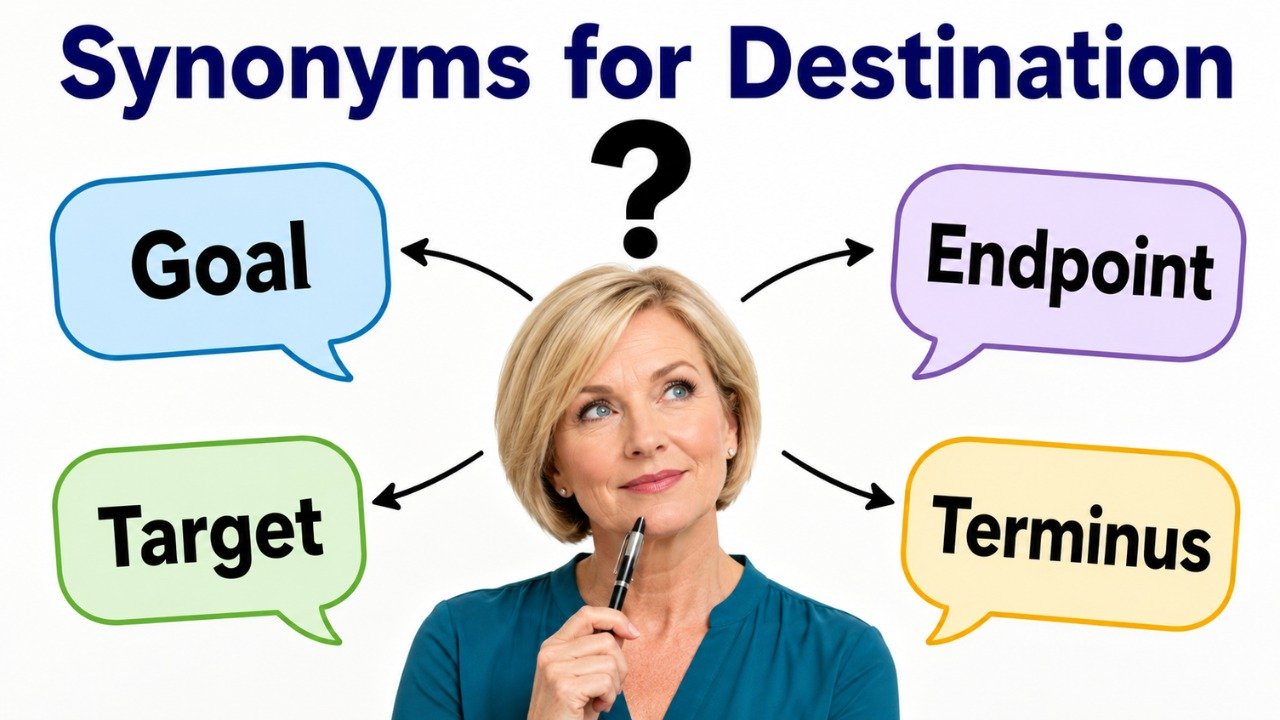
Quick Answer: The best synonyms for destination include place, location, endpoint, terminus, final stop, arrival point, goal, objective, target, and port of call. Use location for a general physical place, endpoint for the final point of a route or process, terminus for the last station on a transport line, and port of call for a place visited during a journey. Goal, objective, and target work best when destination has a figurative meaning related to achievement or future progress.
Pronunciation and Word Details
Word: Destination.
Pronunciation: /ˌdes.təˈneɪ.ʃən/.
Part of Speech: Noun.
Meaning: A place, point, or goal that someone or something is traveling toward or trying to reach.
US Pronunciation:
UK Pronunciation:
What Does “Destination” Mean?
Destination means the place, point, or goal that someone or something is moving toward. It is a noun commonly used in travel, transportation, shipping, technology, planning, and figurative language.
In its most common sense, destination refers to the final place reached after a journey.
Example: The coastal village was our final destination.
It can also describe a popular place that people visit for holidays, recreation, business, or special events.
Example: The island has become a popular travel destination.
In transportation, destination identifies where a passenger, vehicle, package, or shipment is supposed to arrive.
Example: Check the destination before placing the parcel on the truck.
In technical contexts, destination can refer to the location where information, data, or a file is sent.
Example: Select the destination folder before saving the document.
Destination can also have a figurative meaning. It may describe a goal, outcome, or final stage that someone hopes to reach.
Example: Success is not one destination but a continuing process of improvement.
The exact meaning depends on whether the sentence discusses a physical journey, a delivery, a digital transfer, or a personal objective.
Meaning, Tone, and Context of “Destination”
Destination usually has a neutral and practical tone. It can sound conversational, formal, descriptive, promotional, technical, or figurative depending on the context.
Neutral Tone: Destination simply names the place where a journey ends.
Example: Please confirm your destination before the trip begins.
Travel Context: The word commonly describes cities, countries, resorts, natural areas, and other places people visit.
Example: The mountain town is a peaceful holiday destination.
Formal Context: Destination appears in schedules, tickets, travel plans, shipping documents, reports, and official instructions.
Example: Every package must display a complete destination address.
Conversational Context: In everyday speech, people use destination when discussing trips and future plans.
Example: What is your next destination?
Descriptive Context: Writers use destination to present a place as attractive, memorable, relaxing, or culturally interesting.
Example: The quiet valley is an ideal destination for nature lovers.
Technical Context: Destination can identify the receiving location of data, files, messages, or electronic information.
Example: The system sends the file to the selected destination.
Figurative Context: Destination can represent a goal, outcome, or desired future state.
Example: Financial independence became her long term destination.
The word is generally more purposeful than place or location because it suggests movement toward a particular endpoint.
When and How to Use “Destination”
For a Travel Location
Use destination when referring to the place where a traveler intends to arrive.
Example: The historic city was the final destination on their journey.
For a Holiday Location
Use destination for a place selected for rest, recreation, sightseeing, or a special experience.
Example: The lakeside village is a relaxing holiday destination.
For a Route or Journey
Use destination when describing the final point on a route.
Example: The driver entered the destination before leaving the parking area.
For Public Transportation
Use destination to identify the last stop or intended arrival point of a bus, train, or other form of transport.
Example: The front display showed the vehicle’s destination.
For Shipping and Delivery
Use destination for the address, city, warehouse, or receiving point where an item should be delivered.
Example: The parcel reached its destination two days later.
For Digital Files and Data
Use destination when referring to the location where a file, message, or data is sent or stored.
Example: Choose a destination folder for the copied files.
For an Event Location
Use destination when people travel specifically to attend a celebration, meeting, or planned occasion.
Example: The garden estate became the destination for the family celebration.
For a Final Goal
Use destination figuratively when discussing a desired result, ambition, or life objective.
Example: Leadership was not his original destination, but it became an important goal.
For a Popular Visitor Location
Use destination when describing a place that attracts visitors because of its scenery, culture, activities, or facilities.
Example: The region is becoming a popular destination for outdoor activities.
Best Synonyms for Destination
Place
Synonym: Place means a particular physical area, position, or location.
Example: This quiet place is perfect for a weekend visit.
Location
Synonym: Location means the specific position or area where something exists or happens.
Example: They selected a convenient location for the conference.
Endpoint
Synonym: Endpoint means the final point of a route, process, or period.
Example: The river marks the endpoint of the walking trail.
Terminus
Synonym: Terminus means the final station or stopping point on a transport route.
Example: Everyone left the train at the northern terminus.
Final Stop
Synonym: Final stop means the last place reached on a journey or route.
Example: The museum was the final stop on our tour.
Arrival Point
Synonym: Arrival point means the place where someone or something is expected to arrive.
Example: The main gate will serve as the arrival point for visitors.
Port of Call
Synonym: Port of call means a place visited during a journey, especially one of several planned stops.
Example: The coastal town was the first port of call on the trip.
Goal
Synonym: Goal means a result or state that someone wants to reach.
Example: Completing the training became her immediate goal.
Objective
Synonym: Objective means a specific result that a person or group intends to achieve.
Example: Improving customer communication was the main objective.
Target
Synonym: Target means a particular result, level, place, or outcome someone aims to reach.
Example: The team reached its performance target ahead of schedule.
50 Synonyms for Destination with Short Meanings
- Place: A particular physical area or position.
- Location: The specific place where something is found.
- Site: A place where an activity, building, or event exists.
- Locale: A place considered in relation to its surroundings or character.
- Locality: A particular area, neighborhood, or district.
- Area: A part of a town, region, country, or larger space.
- Region: A broad geographical area with shared features.
- City: A large populated place that may be a travel destination.
- Town: A populated place smaller than a city.
- Country: A nation visited or reached during international travel.
- Venue: The place where an event or activity happens.
- Address: The exact place where a person, building, or delivery is located.
- Stop: A place where a journey pauses or ends.
- Station: A place where passengers begin, continue, or end a journey.
- Terminal: A transport building or final facility for arrivals and departures.
- Terminus: The last station or endpoint of a route.
- Endpoint: The final point of a route, process, or journey.
- Final Point: The last position or stage reached.
- Final Stop: The last place visited on a route.
- Arrival Point: The place where a journey ends.
- Point of Arrival: The exact place where someone or something arrives.
- Journey’s End: The place or stage where a journey finishes.
- Port of Call: A place visited as part of a longer journey.
- Waypoint: An intermediate point used to guide a route.
- Landing Place: The location where a person or vehicle lands.
- Disembarkation Point: The place where passengers leave a vehicle or vessel.
- Drop Off Point: A location where passengers or goods are left.
- Port: A place where vessels arrive, depart, or load goods.
- Harbor: A protected place where vessels can arrive and remain safely.
- Resort: A place designed for holidays, rest, or recreation.
- Retreat: A quiet place visited for rest, privacy, or reflection.
- Getaway: A place chosen for a short relaxing trip.
- Vacation Spot: A place visited for a holiday.
- Holiday Spot: A location selected for leisure and travel.
- Travel Spot: A place that people visit during a trip.
- Tourist Site: A location visited for cultural, natural, or historical interest.
- Tourist Attraction: A place that draws visitors because of a special feature.
- Haven: A safe, peaceful, or welcoming place.
- Home Base: A central place from which journeys or activities begin.
- Chosen Location: A place selected for a specific purpose.
- Desired Place: A location that someone wants to reach.
- Goal: A result or state that someone aims to achieve.
- Objective: A clearly defined result someone intends to reach.
- Target: A specific result, level, or point being pursued.
- Aim: A purpose or result someone hopes to accomplish.
- Purpose: The reason or intended result behind an action.
- Outcome: The final result of a process or effort.
- Ambition: A strong personal goal or desired achievement.
- End Goal: The final result someone ultimately wants to reach.
- Finish Line: A figurative or literal point marking completion.
Read Also:
Synonyms for Complain

Synonyms for Destination by Context
When Destination Means a Travel Place
Place, location, locale, city, country, resort, getaway, vacation spot, and holiday spot work when discussing travel.
Example With Destination: The island is a peaceful destination for families.
Example With Resort: The island is a peaceful resort for families.
Example With Getaway: The island is a peaceful getaway for families.
Location is neutral and general. Resort suggests facilities for relaxation and recreation. Getaway usually describes a short, refreshing trip.
When Destination Means the End of a Route
Endpoint, terminus, final stop, arrival point, final point, and journey’s end describe the end of a journey.
Example With Destination: The central station is the train’s destination.
Example With Terminus: The central station is the train’s terminus.
Example With Final Stop: The central station is the train’s final stop.
Terminus is most precise for transport routes. Endpoint can describe physical and abstract routes. Final stop is natural in everyday speech.
When Destination Means a Place Along a Journey
Port of call, waypoint, stop, station, and landing place describe places visited or used during travel.
Example With Destination: The coastal village was one destination on the route.
Example With Port of Call: The coastal village was one port of call on the route.
Example With Waypoint: The coastal village served as a waypoint on the route.
Port of call suggests a planned visit. Waypoint is a navigational point that may not be the final destination.
When Destination Means a Delivery Location
Address, drop off point, arrival point, site, and receiving location are useful for packages, goods, and transport.
Example With Destination: Confirm the destination before sending the parcel.
Example With Address: Confirm the address before sending the parcel.
Example With Drop Off Point: Confirm the drop off point before sending the parcel.
Address is best when exact street details matter. Drop off point identifies where an item or person should be left.
When Destination Means a Digital Location
Endpoint, address, target, location, and destination folder can describe where data or files are sent.
Example With Destination: Choose the destination for the copied document.
Example With Location: Choose the location for the copied document.
Example With Target: Choose the target for the copied document.
Endpoint is common when discussing the receiving point in a system. Location is easier for general readers.
When Destination Means a Goal
Goal, objective, target, aim, ambition, outcome, and end goal work when destination is figurative.
Example With Destination: Personal confidence became her destination.
Example With Goal: Personal confidence became her goal.
Example With Objective: Building personal confidence became her main objective.
Goal is the most natural general replacement. Objective is more formal and specific. Ambition suggests a strong personal desire.
Another Word for Destination
The best single replacement for destination is usually location when the sentence refers to a physical place. However, the best alternative depends on the type of destination.
Use terminus for the final station of a route, endpoint for the end of a process, resort for a holiday place, and goal for a figurative destination.
Original: The mountain village was our final destination.
Better Option: The mountain village was our final stop.
Original: This city is a popular destination for cultural travelers.
Better Option: This city is a popular travel location for cultural travelers.
Original: The northern station is the destination of the route.
Better Option: The northern station is the terminus of the route.
Original: Professional independence became her destination.
Better Option: Professional independence became her goal.
When Not to Use “Destination”
Do not use destination when a more precise word would make the sentence clearer.
When Referring to Any General Place
Destination suggests that someone or something is moving toward the place. Use location when no journey is involved.
Weak: The meeting destination is on the second floor.
Better: The meeting location is on the second floor.
When Naming an Event Site
Use venue when the sentence focuses on where an event takes place.
Weak: They selected a destination for the conference.
Better: They selected a venue for the conference.
When Giving an Exact Delivery Detail
Use address when a street name, building number, or precise delivery location is required.
Weak: Write the destination on the parcel.
Better: Write the delivery address on the parcel.
When Referring to a Final Transport Station
Use terminus when the sentence specifically describes the last station on a route.
Weak: The western destination closes at midnight.
Better: The western terminus closes at midnight.
When Discussing a Measurable Goal
Use objective or target when the desired result is specific and measurable.
Weak: Increasing monthly sales is our destination.
Better: Increasing monthly sales is our target.
When Describing an Intermediate Route Point
A waypoint or stop is not always the final destination.
Weak: The rest area was our destination before continuing north.
Better: The rest area was our next stop before continuing north.
When the Meaning Becomes Repetitive
Avoid repeating destination several times in one paragraph.
Weak: The destination was popular because the destination had several attractions, and visitors found the destination easy to reach.
Better: The location was popular because it offered several attractions and was easy to reach.
When “Place” Is Enough
Destination can sound unnecessarily formal in simple conversation.
Weak: This is a nice destination to eat lunch.
Better: This is a nice place to eat lunch.
Words Commonly Confused With Destination
Destination vs Destiny: Destination is a place or goal being reached. Destiny is a future believed to be predetermined or unavoidable.
Example With Destination: The village was their final destination.
Example With Destiny: She believed it was her destiny to become a teacher.
Destination vs Location: Destination emphasizes movement toward a place. Location simply identifies where something exists.
Example With Destination: Our destination is twenty miles away.
Example With Location: The office location is beside the library.
Destination vs Journey: Destination is where someone is going. Journey is the process of traveling there.
Example With Destination: The coast was our destination.
Example With Journey: The journey to the coast took several hours.
Destination vs Endpoint: Destination often refers to travel. Endpoint can describe the final point of a route, process, system, or period.
Example With Destination: The airport was their destination.
Example With Endpoint: The final approval was the endpoint of the process.
Destination vs Goal: Destination can be a physical place or a figurative result. Goal usually refers to an achievement or desired outcome.
Example With Destination: The capital was our destination.
Example With Goal: Completing the course was our goal.
Destination vs Venue: Destination is a place someone travels toward. Venue is the place where an event occurs.
Example With Destination: The city was their destination.
Example With Venue: The theater was the event venue.
Destination vs Address: Destination is a general arrival place. Address gives the exact details needed to locate a building or recipient.
Example With Destination: The package has reached its destination city.
Example With Address: The package was sent to the wrong address.
Which Synonym Should You Choose?
Choose place for a simple and natural reference to a physical area.
Choose location when identifying where something exists, happens, or will be found.
Choose site when referring to a building, project, attraction, or activity area.
Choose locale when describing a place together with its atmosphere or surroundings.
Choose venue for conferences, ceremonies, performances, meetings, and other events.
Choose address when exact delivery or building details are important.
Choose endpoint when describing the final point of a route, process, system, or period.
Choose terminus for the final station on a bus, rail, or transport route.
Choose final stop in everyday conversation when discussing the last place on a journey.
Choose arrival point when instructions need to identify where travelers should meet or enter.
Choose port of call for one of several planned places visited during a journey.
Choose waypoint for an intermediate navigational point rather than the final destination.
Choose resort for a place designed for holidays, recreation, or relaxation.
Choose getaway for a short and enjoyable break from normal routines.
Choose tourist attraction for a specific place that visitors come to see.
Choose goal for a general personal or professional result.
Choose objective for a clearly defined result in reports, essays, plans, and formal writing.
Choose target for a measurable level, number, result, or deadline.
Choose ambition for a strong personal desire to achieve something important.
Choose outcome when focusing on the final result rather than the effort used to reach it.
Real Life Examples of “Destination” in Sentences
Original: The coastal town was our destination for the weekend.
Better Option: The coastal town was our getaway for the weekend.
Original: The driver confirmed the destination before starting the journey.
Better Option: The driver confirmed the arrival point before starting the journey.
Original: The northern station is the destination of this route.
Better Option: The northern station is the terminus of this route.
Original: The museum was the final destination on our walking tour.
Better Option: The museum was the final stop on our walking tour.
Original: The parcel reached its destination safely.
Better Option: The parcel reached the correct delivery address safely.
Original: The village is becoming a popular tourist destination.
Better Option: The village is becoming a popular tourist attraction.
Original: Choose a destination for the saved document.
Better Option: Choose a location for the saved document.
Original: Academic success became her main destination.
Better Option: Academic success became her main goal.
Original: The harbor was their first destination after leaving the island.
Better Option: The harbor was their first port of call after leaving the island.
Original: The final destination of the project is improved efficiency.
Better Option: The final objective of the project is improved efficiency.
Synonym Groups and Usage Differences
General Place Group
Place, location, site, locale, locality, area, and region describe physical spaces.
Place is the broadest choice. Location is more precise. Locale emphasizes atmosphere or surroundings. Region refers to a larger geographical area.
Example: The region is known as a peaceful location for nature based travel.
Journey Ending Group
Endpoint, terminus, final point, final stop, arrival point, and journey’s end describe where movement finishes.
Terminus is strongly associated with transport routes. Endpoint also works for processes and systems. Journey’s end sounds more descriptive or literary.
Example: The old station marks the journey’s end.
Intermediate Travel Group
Stop, station, port of call, waypoint, landing place, and harbor describe points used during a journey.
A stop may be temporary. A waypoint helps guide a route. A port of call is a planned visit during a longer trip.
Example: The mountain village served as a waypoint before the travelers continued south.
Holiday Place Group
Resort, retreat, getaway, vacation spot, holiday spot, and travel spot describe places selected for leisure.
Resort suggests organized facilities. Retreat suggests privacy or calm. Getaway often refers to a short break.
Example: The quiet cabin became their favorite weekend retreat.
Visitor Attraction Group
Tourist site, tourist attraction, city, town, and country describe places visited for culture, history, scenery, or activities.
Tourist attraction usually refers to one specific feature. Destination may refer to the entire surrounding area.
Example: The ancient bridge is the town’s best known tourist attraction.
Delivery and Logistics Group
Address, drop off point, arrival point, site, and terminal are useful when transporting people or goods.
Address provides exact location details. Drop off point explains where something should be left. Terminal identifies a transport facility.
Example: The driver received the correct drop off point before leaving.
Goal and Achievement Group
Goal, objective, target, aim, ambition, outcome, and end goal describe figurative destinations.
Goal is broad and natural. Objective is planned and specific. Target is measurable. Ambition describes a strong personal desire.
Example: Building a stable career remained her main ambition.
Antonyms of Destination
The opposites of destination depend on whether the word describes travel, position, or a figurative goal.
Origin: The place where a journey begins.
Starting Point: The first position on a route or process.
Departure Point: The place from which someone or something leaves.
Source: The place, person, or thing from which something comes.
Beginning: The first stage of a journey, process, or period.
Starting Place: The location where movement begins.
Point of Departure: The exact place or idea from which something starts.
Launch Point: The place or stage from which an activity begins.
Home: A place from which someone leaves and may later return.
Base: A central place from which travel or operations begin.
Origin Address: The location from which a parcel or message is sent.
Uncertainty: The absence of a clear goal or intended endpoint.
Aimlessness: Movement or activity without a clear destination.
Detour: A route that moves away from the direct path.
Interruption: A pause that prevents immediate progress toward an endpoint.
Comparison: Destination vs Related Words
Destination vs Location
Destination is the place being traveled toward. Location identifies where something currently exists or where an event happens.
Example With Destination: The mountain lodge is our destination.
Example With Location: The lodge’s location offers a clear view of the valley.
Destination vs Endpoint
Destination usually describes an arrival place. Endpoint is broader and can describe the conclusion of a route, process, system, or period.
Example With Destination: The airport was the travelers’ destination.
Example With Endpoint: Final approval was the endpoint of the review process.
Destination vs Terminus
Destination can be any intended arrival place. Terminus specifically refers to the final point or station of a route.
Example With Destination: The city center was our destination.
Example With Terminus: The city center station was the line’s terminus.
Destination vs Goal
Destination often refers to a place, while goal refers to something a person wants to achieve.
Example With Destination: The coastal city was their destination.
Example With Goal: Saving enough money for the trip was their goal.
Destination vs Venue
Destination describes where someone travels. Venue describes where a particular event occurs.
Example With Destination: The capital was the group’s destination.
Example With Venue: The central hall was the conference venue.
Destination vs Stop
Destination is normally the intended endpoint. A stop may only be a temporary pause along the route.
Example With Destination: The lake was our final destination.
Example With Stop: The village was a short stop on the way to the lake.
Destination vs Port of Call
Destination may be the final place reached. A port of call is one place visited during a journey with several stops.
Example With Destination: The southern island was the final destination.
Example With Port of Call: The northern island was the first port of call.
Destination vs Destiny
Destination refers to a physical place or desired goal. Destiny refers to events believed to be determined by fate.
Example With Destination: The school was his destination that morning.
Example With Destiny: He believed helping others was his destiny.
Common Phrases and Expressions With Destination
Final Destination: The last place reached at the end of a journey.
Example: The capital was the train’s final destination.
Travel Destination: A place selected or promoted for travel.
Example: The valley is becoming a popular travel destination.
Holiday Destination: A place chosen for a vacation or period of leisure.
Example: The island is a peaceful holiday destination.
Tourist Destination: A place that attracts visitors for culture, scenery, history, or recreation.
Example: The old city is a major tourist destination.
Dream Destination: A place someone strongly hopes to visit.
Example: The remote mountain region was her dream destination.
Popular Destination: A place frequently selected by travelers or visitors.
Example: The lakeside town is a popular destination during summer.
Destination Address: The address where a package, message, or traveler is intended to arrive.
Example: Check the destination address before sending the parcel.
Destination Wedding: A wedding held in a place that requires many guests to travel.
Example: They planned a destination wedding in a quiet coastal town.
Reach Your Destination: To arrive at the intended place or achieve a desired goal.
Example: Careful planning will help you reach your destination safely.
Destination Point: The exact place intended as the end of a journey or transfer.
Example: The driver confirmed the destination point before departure.
Common Mistakes to Avoid
Confusing Destination With Destiny
Destination is a place or goal. Destiny refers to a future believed to be determined by fate.
Incorrect: The airport was our destiny.
Correct: The airport was our destination.
Using Destination for Every Type of Place
Not every place is a destination. Use location when no journey or movement is involved.
Unnatural: The printer’s destination is beside the window.
Natural: The printer’s location is beside the window.
Writing “Destination Place”
Destination already refers to a place, so destination place is often repetitive.
Repetitive: The village is a beautiful destination place.
Better: The village is a beautiful destination.
Better: The village is a beautiful place to visit.
Confusing a Stop With a Final Destination
A stop may be temporary, while a destination is usually the intended endpoint.
Unclear: The café was our destination before we continued to the coast.
Better: The café was our next stop before we continued to the coast.
Using Destination Instead of Venue
Use venue for the specific place where an event occurs.
Less Precise: The hotel is the conference destination.
More Precise: The hotel is the conference venue.
Using Destination Instead of Address
Use address when exact delivery details are required.
Vague: Please write your destination on the form.
Clear: Please write your delivery address on the form.
Choosing a Physical Synonym for a Figurative Meaning
Place, city, and station do not normally replace destination when it means goal.
Incorrect: Financial security became her station.
Correct: Financial security became her goal.
Using Goal for a Physical Place
Goal usually describes an achievement rather than a travel location.
Unnatural: The airport is our goal.
Natural: The airport is our destination.
Repeating Destination Too Often
Vary the vocabulary when the meaning remains clear.
Repetitive: Our destination was a historic destination with several attractions that made the destination memorable.
Better: Our destination was a historic city with several attractions that made the visit memorable.
Using an Unclear Figurative Destination
When destination is metaphorical, explain the desired result clearly.
Vague: Improvement is our destination.
Clear: Consistent improvement is our long term objective.
Conclusion
The most useful synonyms for destination include location, place, endpoint, terminus, final stop, arrival point, port of call, goal, objective, and target. Choose location for a general physical place, terminus for the last station on a route, and endpoint for the conclusion of a journey or process. Resort and getaway suit leisure travel, while goal and objective fit figurative meanings. Understanding these differences helps you select synonyms for destination that sound clear, natural, and accurate in every context.
FAQs About Synonyms for Destination
What Is the Best Synonym for Destination?
Location is the best general synonym for a physical destination. Goal is the best choice when destination has a figurative meaning.
What Is a Formal Synonym for Destination?
Endpoint, terminus, objective, arrival point, and point of arrival are useful formal alternatives.
What Is Another Word for a Travel Destination?
Place, location, resort, getaway, holiday spot, travel spot, and tourist site can replace travel destination depending on the context.
What Is the Difference Between Destination and Location?
Destination is a place someone or something is moving toward. Location simply identifies where something exists or happens.
Can Goal Be a Synonym for Destination?
Yes. Goal is a suitable synonym when destination refers figuratively to a desired result, achievement, or future state.
Are Destination and Destiny the Same?
No. Destination means an arrival place or goal. Destiny means a future believed to be determined by fate.
What Is a Synonym for Final Destination?
Final stop, endpoint, terminus, arrival point, journey’s end, and final point are strong alternatives.
