
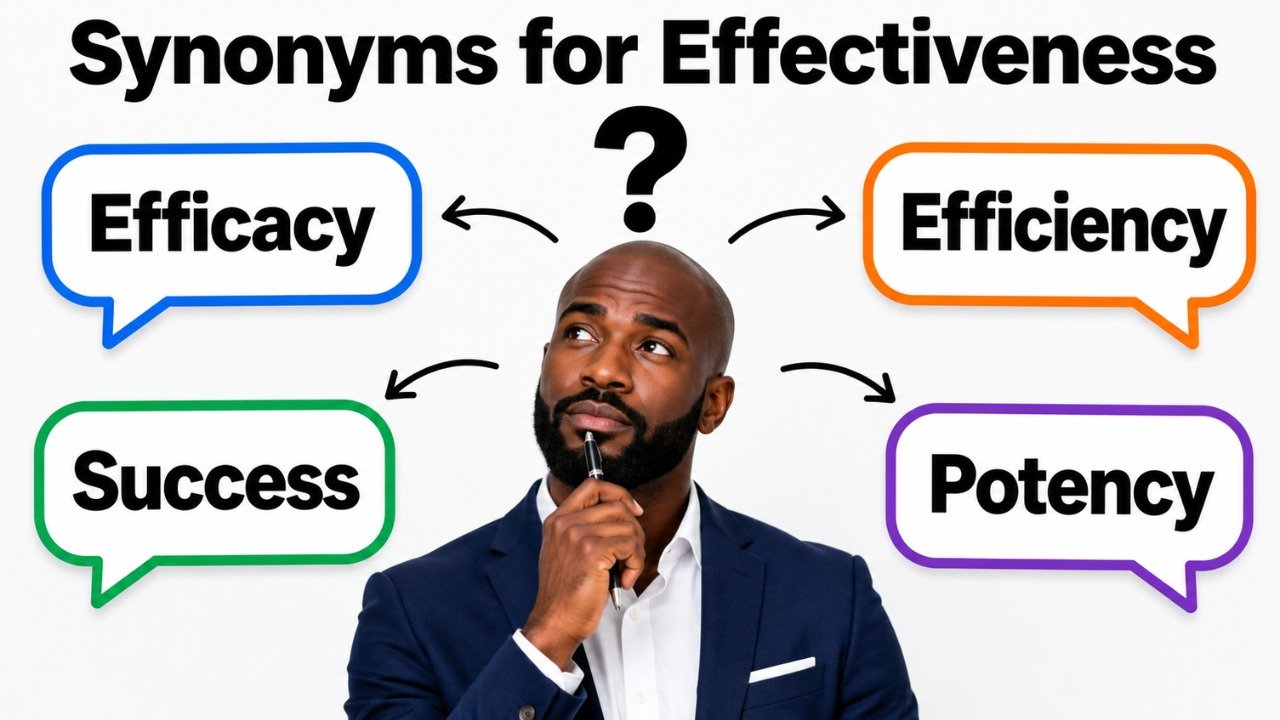
Quick Answer: Synonyms for effectiveness include efficacy, efficiency, success, impact, usefulness, utility, potency, performance, productivity, and capability. Efficacy is the strongest formal alternative when describing the ability of a method, treatment, or plan to produce its intended result. Efficiency is better when time, money, or resources matter. Impact describes a noticeable influence, while usefulness and utility focus on practical value. Performance works well in reports and evaluations, productivity suits work output, and success is the most natural choice in everyday conversation.
Pronunciation and Word Details
Word: Effectiveness.
Pronunciation: /ɪˈfek.tɪv.nəs/
Part of Speech: Noun.
Meaning: The ability to produce the intended, desired, or successful result.
US Pronunciation:
UK Pronunciation:
What Does “Effectiveness” Mean?
Effectiveness means the ability of a person, method, action, system, or product to produce the result that was intended.
It is an abstract noun formed from the adjective effective. The word does not simply describe activity. It describes whether an activity actually works and achieves its purpose.
Effectiveness can refer to the success of a plan, the usefulness of a tool, the influence of communication, the performance of a team, or the results produced by a process.
In a work context: Effectiveness describes how successfully a person or team completes important goals.
In a technical context: Effectiveness measures whether a system or process performs its intended function.
In a medical context: Effectiveness describes how well a treatment works in ordinary practical conditions.
In communication: Effectiveness refers to how clearly and successfully a message reaches its audience.
In education: Effectiveness describes how well a teaching method supports learning and understanding.
The word is often followed by the preposition of.
Example: The effectiveness of the new training method was measured through student performance.
It can also follow a possessive noun or adjective.
Example: The team improved its overall effectiveness.
Example: Researchers examined long term effectiveness.
Meaning, Tone, and Context of “Effectiveness”
Effectiveness has a neutral and professional tone. It is common in academic writing, business reports, technical discussions, education, healthcare, management, public policy, and formal evaluations.
The word is neither strongly emotional nor highly casual. It focuses on results, outcomes, and achievement. For this reason, it is useful when a writer wants to sound objective and analytical.
In everyday conversation, effectiveness is correct, but simpler words such as success, usefulness, or impact may sound more natural.
Formal tone: The effectiveness of the procedure will be reviewed.
Natural conversation: We need to see whether the procedure actually works.
Academic context: The study examined the effectiveness of different learning strategies.
Professional context: The manager evaluated the effectiveness of the new workflow.
Technical context: Engineers tested the effectiveness of the safety system.
Persuasive context: The speaker improved the effectiveness of her argument by adding clear evidence.
Effectiveness usually answers one central question. Did the person, plan, method, or system achieve the intended purpose?
When and How to Use “Effectiveness”
For Measuring Results
Use effectiveness when discussing whether an action or method achieves its goal.
Example: The organization measured the effectiveness of the training program through employee performance.
For Evaluating a Method
Use the word when comparing techniques, strategies, or procedures.
Example: The researchers compared the effectiveness of three study methods.
For Describing Communication
Effectiveness can show how successfully a message informs, persuades, or guides people.
Example: Clear examples increased the effectiveness of the presentation.
For Discussing Work Performance
Use effectiveness when evaluating how well a person or team completes important responsibilities.
Example: Better planning improved the effectiveness of the entire department.
For Assessing Practical Value
The word can describe whether a tool, product, or solution works well in actual use.
Example: Users questioned the effectiveness of the complicated scheduling system.
For Reviewing Policies or Programs
Effectiveness is appropriate when examining whether a policy or program produces its intended outcomes.
Example: The committee reviewed the effectiveness of the community support program.
For Describing Treatments
Effectiveness can describe how well a treatment produces beneficial results in normal conditions.
Example: The doctor discussed the effectiveness of the treatment with the patient.
For Comparing Strategies
Use effectiveness when the main concern is successful results rather than cost or speed.
Example: The team compared the effectiveness of direct instruction and independent practice.
Best Synonyms for Effectiveness
Efficacy
Synonym: The ability to produce the intended result, especially in formal, scientific, or technical contexts.
Example: The research team tested the efficacy of the new procedure.
Efficiency
Synonym: The ability to produce good results while minimizing wasted time, money, or effort.
Example: Automation improved the efficiency of the ordering process.
Success
Synonym: The achievement of a desired goal or result.
Example: The success of the campaign depended on clear communication.
Impact
Synonym: A strong or noticeable effect on a person, situation, or outcome.
Example: The workshop had a positive impact on employee confidence.
Usefulness
Synonym: The quality of being helpful or suitable for a practical purpose.
Example: Students recognized the usefulness of the revision guide.
Utility
Synonym: Practical value or the ability to serve a useful purpose.
Example: The utility of the tool became clear during the emergency.
Potency
Synonym: The strength or power of something to produce a particular effect.
Example: Heat can reduce the potency of certain substances.
Performance
Synonym: How successfully a person, machine, system, or method completes its function.
Example: Regular maintenance improved the performance of the equipment.
Productivity
Synonym: The ability to produce useful work, goods, or results.
Example: Better scheduling increased workplace productivity.
Capability
Synonym: The ability or power to perform a task successfully.
Example: The update improved the system’s capability to process large amounts of information.
50 Synonyms for Effectiveness with Short Meanings
- Efficacy: The ability to produce an intended result.
- Efficiency: Successful performance with minimal waste.
- Success: Achievement of a desired outcome.
- Impact: A strong or noticeable effect.
- Usefulness: The quality of being practically helpful.
- Utility: Practical value for a particular purpose.
- Potency: Strength in producing an effect.
- Performance: The quality of completing a function successfully.
- Productivity: The ability to produce valuable results.
- Capability: The ability to perform successfully.
- Capacity: The potential to achieve or produce something.
- Power: The ability to cause an effect or change.
- Strength: The degree of force or effectiveness something has.
- Influence: The power to affect decisions or outcomes.
- Force: The power behind an action or effect.
- Value: The importance or usefulness of something.
- Benefit: A helpful or favorable result.
- Advantage: A quality that improves the chance of success.
- Reliability: The ability to perform consistently and dependably.
- Competence: The ability to complete a task properly.
- Proficiency: A high level of skill and ability.
- Adequacy: The quality of being sufficient for a purpose.
- Sufficiency: The state of being enough to meet a need.
- Functionality: The ability to perform an intended function.
- Practicality: Suitability for real and useful application.
- Workability: The ability of an idea or plan to succeed in practice.
- Viability: The ability to work successfully over time.
- Soundness: The quality of being reliable, sensible, and effective.
- Suitability: The quality of being right for a particular purpose.
- Fitness: The quality of being appropriate for an intended use.
- Appropriateness: The quality of being suitable in a specific situation.
- Persuasiveness: The ability to convince someone.
- Convincing Power: The strength of an idea or argument to gain agreement.
- Credibility: The quality of being believable and trustworthy.
- Fruitfulness: The ability to produce useful or successful results.
- Productiveness: The quality of producing meaningful outcomes.
- Accomplishment: The successful completion of an objective.
- Achievement: The act or result of reaching a goal.
- Attainment: The successful reaching of a desired result.
- Results: The outcomes produced by an action or process.
- Outcome: The final result of an activity or situation.
- Effect: A change produced by an action or cause.
- Payoff: A valuable or beneficial result.
- Yield: The amount of useful output or benefit produced.
- Success Rate: The proportion of attempts that achieve the intended goal.
- Goal Attainment: The successful completion of an objective.
- Operational Success: Effective performance during practical operation.
- Practical Value: Usefulness in a real situation.
- Problem Solving Ability: The capacity to resolve difficulties successfully.
- Capacity to Deliver: The ability to produce the promised or expected result.
Read Also:
Synonyms for Destination
Synonyms for Effectiveness by Context
When Effectiveness Means Producing the Intended Result
Efficacy is the closest formal synonym when the focus is whether something works. Success, accomplishment, achievement, and goal attainment are useful when the desired result has been reached.
Efficacy Example: The study examined the efficacy of the teaching method.
Success Example: The success of the teaching method was evident in the final results.
Achievement Example: Improved reading ability was the greatest achievement of the program.
Goal Attainment Example: Weekly assessments helped measure goal attainment.
When Effectiveness Means Practical Usefulness
Usefulness, utility, practicality, functionality, and practical value describe how helpful something is in actual use.
Usefulness Example: The usefulness of the checklist became clear during the inspection.
Utility Example: The device has considerable utility in small workspaces.
Practicality Example: The committee questioned the practicality of the proposed schedule.
Functionality Example: The update improved the functionality of the system.
When Effectiveness Means Strong Influence
Impact, influence, power, force, and strength describe the ability to create a noticeable change.
Impact Example: The speech had a lasting impact on the audience.
Influence Example: Her advice had a strong influence on the final decision.
Power Example: The image increased the emotional power of the message.
Strength Example: Clear evidence added strength to the argument.
When Effectiveness Means Good Performance
Performance, efficiency, productivity, reliability, competence, and proficiency are useful when discussing work, systems, machines, or professional ability.
Performance Example: The manager reviewed the team’s performance.
Efficiency Example: The new process increased efficiency without reducing quality.
Productivity Example: Fewer interruptions improved employee productivity.
Reliability Example: Regular testing confirmed the reliability of the equipment.
When Effectiveness Means Persuasive Ability
Persuasiveness, convincing power, credibility, and influence are suitable when discussing arguments, speeches, advertisements, instructions, or written messages.
Persuasiveness Example: Relevant evidence increased the persuasiveness of the essay.
Convincing Power Example: Specific examples gave the argument greater convincing power.
Credibility Example: Accurate details improved the credibility of the report.
Influence Example: The speaker’s calm tone increased her influence over the audience.
When Effectiveness Means Long Term Workability
Viability, workability, soundness, suitability, and adequacy describe whether a plan or solution can continue working successfully.
Viability Example: The financial review confirmed the viability of the project.
Workability Example: The team tested the workability of the proposed schedule.
Soundness Example: Experts questioned the soundness of the original plan.
Suitability Example: The interview assessed her suitability for the position.
Another Word for Effectiveness
Efficacy is often the best single replacement for effectiveness, especially in academic, scientific, medical, and technical writing. However, the most accurate alternative depends on what kind of effectiveness is being described.
Use efficiency when discussing resource use, impact when describing influence, usefulness when discussing practical value, and success when referring to the achievement of a goal.
Original: The researchers measured the effectiveness of the new method.
Better Option: The researchers measured the efficacy of the new method.
Original: The company wanted to improve the effectiveness of its daily operations.
Better Option: The company wanted to improve the efficiency of its daily operations.
Original: The teacher discussed the effectiveness of visual examples.
Better Option: The teacher discussed the impact of visual examples.
Original: We were surprised by the effectiveness of the simple checklist.
Better Option: We were surprised by the usefulness of the simple checklist.
When Not to Use “Effectiveness”
Effectiveness is useful, but it can sound broad or unclear when a more precise word is available.
Do not use effectiveness when you specifically mean speed, low cost, or reduced waste. Efficiency is more accurate in that context.
Weak: The effectiveness of the machine reduced electricity use.
Better: The efficiency of the machine reduced electricity use.
Avoid effectiveness when discussing the strength of a chemical substance or active ingredient. Potency may be clearer.
Weak: Heat reduced the effectiveness of the substance.
Better: Heat reduced the potency of the substance.
Do not overuse effectiveness in reports. Repeating it can make writing sound mechanical.
Weak: The report examined the effectiveness of the plan and the effectiveness of the team.
Better: The report examined the efficacy of the plan and the performance of the team.
Use impact when the main idea is a noticeable influence or change.
Weak: The effectiveness of the speech remained with the audience.
Better: The impact of the speech remained with the audience.
Use success when writing informally about whether something achieved its goal.
Weak: We were pleased with the effectiveness of the event.
Better: We were pleased with the success of the event.
Use persuasiveness when discussing the ability of an argument to convince readers.
Weak: The evidence improved the effectiveness of the argument.
Better: The evidence improved the persuasiveness of the argument.
Words Commonly Confused With Effectiveness
Effectiveness vs Efficiency: Effectiveness means achieving the intended result. Efficiency means achieving a result while minimizing wasted time, money, effort, or materials. A process can be effective but inefficient if it works but uses too many resources.
Effectiveness vs Efficacy: Both words describe the ability to produce a desired result. Efficacy is more formal and is often used in scientific, medical, technical, or controlled settings. Effectiveness is broader and more common in practical situations.
Effectiveness vs Impact: Effectiveness focuses on whether a goal was achieved. Impact focuses on the strength or importance of the change that occurred.
Effectiveness vs Success: Effectiveness is the quality or degree of producing a desired result. Success is the actual achievement of that result.
Effectiveness vs Productivity: Effectiveness concerns whether the correct result was achieved. Productivity concerns how much useful output was produced.
Effectiveness vs Performance: Effectiveness evaluates whether something works. Performance describes how well a person, machine, system, or method completes its function.
Effectiveness vs Usefulness: Effectiveness relates to producing a desired outcome. Usefulness relates to being helpful or valuable for a purpose.
Effectiveness vs Potency: Effectiveness describes overall ability to work. Potency describes strength or concentration in producing an effect.
Which Synonym Should You Choose?
Choose efficacy when writing formally about whether a method, treatment, policy, or process produces its intended result.
Choose efficiency when discussing time, money, energy, materials, labor, or other resources.
Choose success when describing the achievement of a goal in everyday writing or conversation.
Choose impact when emphasizing a strong, noticeable, or lasting influence.
Choose usefulness when describing how helpful something is in practice.
Choose utility when discussing practical value in formal, academic, or technical writing.
Choose potency when describing the strength of a substance, argument, influence, or active force.
Choose performance when evaluating a person, team, machine, system, or process.
Choose productivity when focusing on the amount of useful work or output produced.
Choose capability when discussing whether a person or system has the ability to complete a task.
Choose reliability when consistent and dependable performance is most important.
Choose viability when evaluating whether a plan, project, or solution can work successfully over time.
Choose persuasiveness when discussing the ability of an argument, speech, or message to convince people.
Choose practicality when deciding whether an idea can be applied easily in real conditions.
Choose goal attainment when reports require a measurable description of completed objectives.
Real Life Examples of “Effectiveness” in Sentences
Original: The school evaluated the effectiveness of the new reading program.
Better Option: The school evaluated the efficacy of the new reading program.
Original: Regular feedback improved the effectiveness of the team.
Better Option: Regular feedback improved the performance of the team.
Original: We questioned the effectiveness of the complicated tool.
Better Option: We questioned the usefulness of the complicated tool.
Original: The manager measured the effectiveness of the new schedule.
Better Option: The manager measured the efficiency of the new schedule.
Original: Clear statistics increased the effectiveness of the report.
Better Option: Clear statistics increased the credibility of the report.
Original: The effectiveness of the speech surprised the audience.
Better Option: The impact of the speech surprised the audience.
Original: Researchers studied the effectiveness of the treatment.
Better Option: Researchers studied the efficacy of the treatment.
Original: The effectiveness of the machine depends on regular maintenance.
Better Option: The performance of the machine depends on regular maintenance.
Original: The review confirmed the effectiveness of the proposed solution.
Better Option: The review confirmed the viability of the proposed solution.
Original: Specific examples improved the effectiveness of her argument.
Better Option: Specific examples improved the persuasiveness of her argument.
Synonym Groups and Usage Differences
Results Group
Efficacy, success, achievement, accomplishment, attainment, and goal attainment focus on whether an intended result has been reached.
Efficacy describes the ability to work. Success and achievement describe the result that was actually reached.
Example: The efficacy of the program led to strong student achievement.
Practical Value Group
Usefulness, utility, practicality, functionality, and practical value describe whether something helps people in real situations.
Usefulness is natural in everyday language. Utility is more formal. Practicality considers whether an idea can realistically be applied.
Example: The tool’s simple design increased its usefulness in busy workplaces.
Performance Group
Performance, efficiency, productivity, capability, competence, and proficiency describe successful work or operation.
Performance is broad. Efficiency focuses on limited waste. Productivity focuses on output. Competence and proficiency describe personal ability.
Example: Training improved employee competence and overall team performance.
Influence Group
Impact, influence, power, force, strength, and potency describe the ability to cause change.
Impact emphasizes a noticeable result. Influence often describes gradual change. Potency highlights strength.
Example: The speaker’s calm delivery increased the impact of her message.
Reliability Group
Reliability, soundness, adequacy, sufficiency, and functionality describe dependable or acceptable operation.
Reliability means consistent performance. Adequacy and sufficiency mean something is good enough for the purpose.
Example: Repeated testing confirmed the reliability of the safety system.
Planning Group
Viability, workability, suitability, fitness, and appropriateness describe whether a plan or option can succeed in a specific situation.
Viability often refers to long term success. Workability focuses on practical operation. Suitability focuses on whether something matches a particular need.
Example: The review confirmed the viability and workability of the proposal.
Persuasion Group
Persuasiveness, credibility, convincing power, authority, and influence relate to the ability to gain trust or agreement.
Persuasiveness focuses on convincing people. Credibility focuses on believability. Authority gives a message greater weight.
Example: Reliable evidence improved the credibility and persuasiveness of the essay.
Antonyms of Effectiveness
The opposite of effectiveness depends on whether the sentence refers to failure, weakness, poor performance, or lack of practical value.
Ineffectiveness: The inability to produce the intended result.
Inefficacy: A formal term for failure to produce the desired effect.
Failure: The lack of success in achieving a goal.
Uselessness: The quality of having no practical value.
Futility: The state of being unable to produce a useful result.
Weakness: A lack of strength, power, or influence.
Inefficiency: Poor use of time, money, effort, or resources.
Inadequacy: The quality of not being sufficient for a purpose.
Insufficiency: The state of not having enough ability, quantity, or strength.
Unreliability: The inability to perform consistently.
Impracticality: The quality of being difficult or impossible to apply.
Unproductiveness: The failure to produce valuable output or results.
Powerlessness: The inability to influence events or produce change.
Incompetence: A lack of the necessary ability or skill.
Failure to Deliver: The inability to produce a promised or expected result.
Comparison: Effectiveness vs Related Words
Effectiveness vs Efficacy
Effectiveness describes how well something works in practical or ordinary conditions. Efficacy often describes whether something can produce its intended result under controlled, formal, or carefully observed conditions.
Example With Effectiveness: The review examined the effectiveness of the program in local schools.
Example With Efficacy: The controlled study tested the efficacy of the teaching method.
Effectiveness vs Efficiency
Effectiveness means doing something that achieves the desired goal. Efficiency means achieving the goal with minimal waste.
Example With Effectiveness: The strategy was effective because it increased customer satisfaction.
Example With Efficiency: The new system improved efficiency by reducing processing time.
Effectiveness vs Impact
Effectiveness asks whether something worked. Impact asks how strongly or widely it changed a situation.
Example With Effectiveness: The effectiveness of the lesson was measured through test results.
Example With Impact: The lesson had a lasting impact on the students.
Effectiveness vs Success
Effectiveness is a quality that can exist in different degrees. Success is the achievement of a particular objective.
Example With Effectiveness: The effectiveness of the plan improved after several revisions.
Example With Success: The plan was a success because every target was reached.
Effectiveness vs Performance
Effectiveness measures whether the intended result was achieved. Performance describes how well a person, system, or machine completed its function.
Example With Effectiveness: The effectiveness of the safety procedure was carefully reviewed.
Example With Performance: The performance of the safety equipment met the required standard.
Effectiveness vs Productivity
Effectiveness concerns the value and correctness of results. Productivity concerns the amount of output produced.
Example With Effectiveness: The team improved effectiveness by focusing on its most important goals.
Example With Productivity: The team improved productivity by completing more tasks each day.
Effectiveness vs Usefulness
Effectiveness means being able to produce a desired result. Usefulness means being helpful for a practical purpose.
Example With Effectiveness: The effectiveness of the reminder system was measured by attendance.
Example With Usefulness: The usefulness of the reminder system became clear during busy weeks.
Common Phrases and Expressions With Effectiveness
Overall Effectiveness: The total degree to which something achieves its purpose.
Operational Effectiveness: The ability of a system or organization to perform its main activities successfully.
Organizational Effectiveness: The ability of an organization to achieve its goals.
Communication Effectiveness: The success of a message in informing, guiding, or persuading people.
Teaching Effectiveness: The ability of teaching methods to support learning.
Treatment Effectiveness: The degree to which a treatment produces beneficial results.
Program Effectiveness: The ability of a program to achieve its intended objectives.
Policy Effectiveness: The degree to which a policy produces the desired change.
Cost Effectiveness: The ability to produce valuable results at a reasonable cost.
Long Term Effectiveness: The ability to continue producing successful results over an extended period.
Proven Effectiveness: Effectiveness supported by reliable evidence or repeated results.
Limited Effectiveness: A low or restricted ability to produce the intended result.
Measure Effectiveness: To evaluate how successfully something works.
Improve Effectiveness: To increase the ability to achieve a desired result.
Evaluate Effectiveness: To examine results and determine whether an action or method works.
Common Mistakes to Avoid
Confusing Effectiveness With Efficiency
Writers often use effectiveness and efficiency as though they mean the same thing. They are related but different.
Effectiveness means achieving the correct result. Efficiency means achieving a result without wasting resources.
Incorrect: The method was effective because it used less time.
Better: The method was efficient because it used less time.
Using Efficacy in Very Casual Conversation
Efficacy is accurate but may sound overly technical in an informal sentence.
Unnatural: I am unsure about the efficacy of this simple cleaning tip.
Natural: I am unsure whether this cleaning tip works.
Repeating Effectiveness Too Often
Repeated use can make a paragraph sound dull and mechanical.
Repetitive: The effectiveness of the plan improved the effectiveness of the team.
Better: The efficacy of the plan improved the team’s performance.
Using Impact When No Noticeable Change Occurred
Impact suggests a meaningful or noticeable influence. Do not use it for a very small or uncertain result.
Unclear: The change had an impact, but nothing was different.
Better: The change produced little measurable effect.
Choosing Productivity When Quality Matters More
Productivity focuses on quantity of output. It does not always show whether the work was valuable or accurate.
Weak: The teacher improved productivity by helping students understand difficult ideas.
Better: The teacher improved instructional effectiveness by helping students understand difficult ideas.
Using Potency for General Performance
Potency usually refers to strength. It is not the best choice for ordinary work performance.
Unnatural: The potency of the office team improved this month.
Better: The performance of the office team improved this month.
Leaving Effectiveness Vague
Explain what result was expected and how it was measured.
Vague: The effectiveness improved.
Clear: The effectiveness of the training improved, as shown by fewer errors and faster completion times.
Using an Adjective Where a Noun Is Needed
Effective is an adjective. Effectiveness is a noun.
Incorrect: The manager evaluated the effective of the strategy.
Correct: The manager evaluated the effectiveness of the strategy.
Using a Noun Where an Adjective Is Needed
Incorrect: The strategy was effectiveness.
Correct: The strategy was effective.
Assuming Activity Proves Effectiveness
A person or system may be busy without producing useful results. Effectiveness must relate to a goal or outcome.
Weak: The team attended many meetings, proving its effectiveness.
Better: The team completed every major target, demonstrating its effectiveness.
Conclusion
Synonyms for effectiveness include efficacy, efficiency, success, impact, usefulness, performance, productivity, and capability. Efficacy is the best formal alternative when the focus is whether something produces its intended result. Efficiency is more accurate when time, cost, or resources matter. Impact emphasizes noticeable influence, while usefulness and utility describe practical value. Performance and productivity work well in professional evaluations. Choosing the right synonym makes your meaning clearer and helps readers understand exactly what kind of successful result you are describing.
FAQs About Synonyms for Effectiveness
What Is the Best Synonym for Effectiveness?
Efficacy is usually the closest formal synonym. Success, impact, usefulness, and performance may be better in specific contexts.
Are Effectiveness and Efficiency the Same?
No. Effectiveness means achieving the intended result. Efficiency means achieving a result while minimizing wasted resources.
Can Success Replace Effectiveness?
Success can replace effectiveness when the sentence refers to achieving a goal. It may not work when discussing the degree to which a method produces results.
What Is a Formal Word for Effectiveness?
Efficacy is the most common formal alternative. Utility, viability, and operational success may also fit formal writing.
What Is a Casual Synonym for Effectiveness?
Success, usefulness, and impact are natural choices in everyday conversation.
What Is the Difference Between Efficacy and Effectiveness?
Efficacy often describes whether something works under controlled or ideal conditions. Effectiveness usually describes how well it works in normal practical conditions.
Which Synonym Is Best for Business Writing?
Performance suits evaluations, efficiency suits resource use, productivity suits output, and operational effectiveness suits broader organizational results.
