
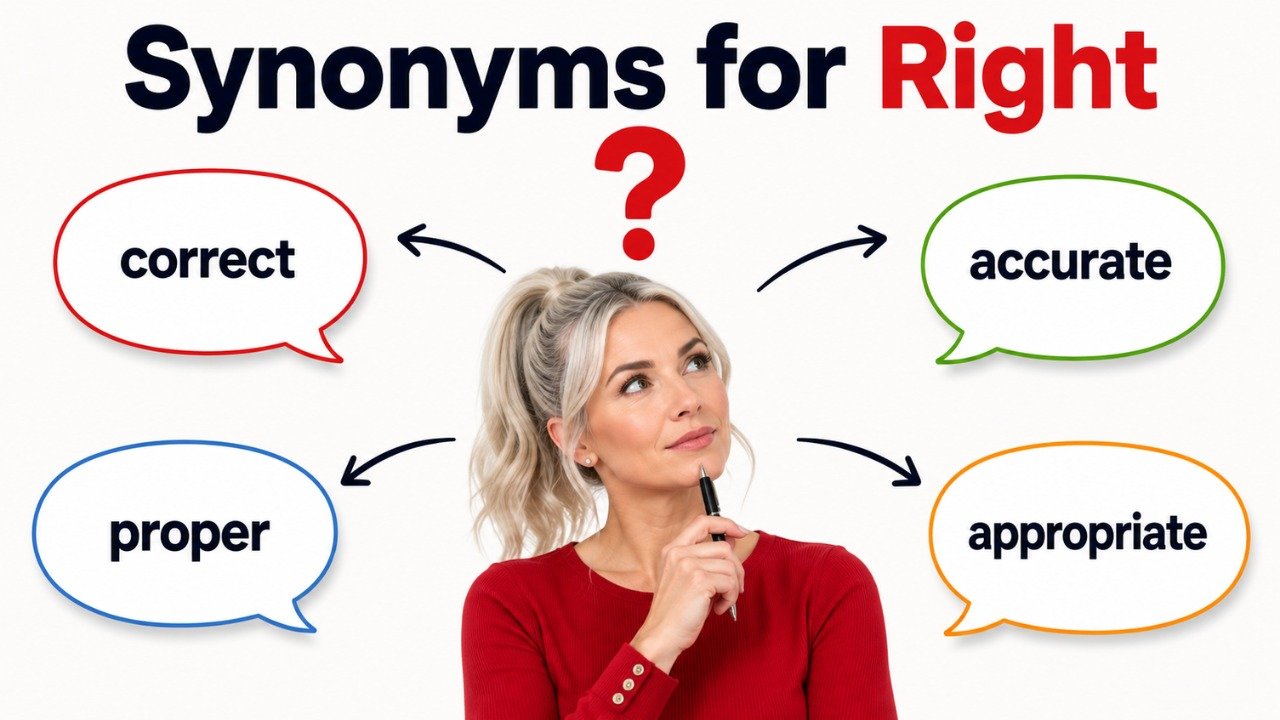
Quick Answer: The best synonyms for right include correct, accurate, proper, appropriate, suitable, fair, just, lawful, precise, and valid. Use correct when an answer or decision has no error. Choose accurate for facts, measurements, descriptions, and data. Proper, appropriate, and suitable describe something that fits a situation. Fair and just relate to equal or moral treatment. Lawful is best for legal contexts, while precise works for exact details, numbers, directions, or instructions.
Pronunciation and Word Details
Word: Right.
Pronunciation: /raɪt/.
Part of Speech: Adjective, adverb, noun, and verb.
Meaning: Correct, suitable, morally fair, legally allowed, positioned opposite the left side, or something a person is entitled to have.
US Pronunciation:
UK Pronunciation:
What Does “Right” Mean?
Right means correct, suitable, fair, legally permitted, or located on the side opposite the left.
As an adjective, right can describe an accurate answer, a suitable choice, a fair action, or a particular direction. For example, someone may give the right answer, choose the right clothing, make the right decision, or turn toward the right side.
As an adverb, right can mean immediately, exactly, completely, or directly. Phrases such as right now, right here, and right through use this meaning.
As a noun, right refers to a legal, moral, or social entitlement. Freedom, privacy, safety, and fair treatment may all be described as rights.
As a verb, right means to correct a mistake, restore balance, or repair an injustice. Someone may right a wrong or right an overturned object.
The meaning of right depends strongly on its sentence context. A right answer is correct, the right person is suitable, a legal right is an entitlement, and the right side is a direction.
Meaning, Tone, and Context of “Right”
Right is a common and neutral word used in formal writing, casual speech, academic discussion, legal language, instructions, and everyday conversation.
When right means correct, its tone is usually clear and neutral. It can describe answers, facts, methods, decisions, and opinions.
When right means suitable or appropriate, it expresses judgment about what fits a particular situation. The right time, right person, and right approach may vary according to circumstances.
When right refers to fairness or morality, it can sound stronger and more emotional. Saying that an action is right often suggests that it is ethical, fair, or responsible.
In legal and political contexts, right is a formal noun referring to an entitlement protected by rules or law. In these situations, the word has a precise meaning that should not be replaced carelessly.
In directions, right is neutral and practical. It identifies the side opposite the left.
Right is also conversational when used for emphasis or confirmation. Expressions such as right now, right there, and that is right are common in everyday communication.
When and How to Use “Right”
For Correctness
Use right when an answer, statement, calculation, or belief is correct.
Example: Your answer to the final question is right.
For Accuracy
Use right when information matches the facts, although accurate is often more precise in formal writing.
Example: The figures in the report appear to be right.
For Suitability
Use right when something fits a person, purpose, occasion, or situation.
Example: This is the right tool for repairing the damaged chair.
For Decisions
Use right when a choice seems sensible, beneficial, or responsible.
Example: Leaving early was the right decision because the roads became crowded.
For Morality
Use right when an action is fair, ethical, or morally acceptable.
Example: Telling the truth was the right thing to do.
For Legal Entitlement
Use right as a noun when discussing something a person is legally or socially entitled to receive or do.
Example: Every employee has the right to a safe working environment.
For Direction
Use right to describe the side opposite the left.
Example: Turn right after passing the entrance.
For Immediate Action
Use right before words such as now or away to show that something should happen immediately.
Example: Please send the completed form right away.
For Exact Position
Use right to emphasize an exact place or location.
Example: The missing document was right beside the computer.
For Confirmation
Use right to show that a statement, answer, or understanding is correct.
Example: You are right about the meeting time.
Best Synonyms for Right
Correct: Free from mistakes or errors.
Example: The correct answer is written at the bottom of the page.
Accurate: Matching the facts, measurements, or actual situation.
Example: The researcher provided an accurate description of the results.
Proper: Suitable, accepted, or performed according to established rules.
Example: Please follow the proper procedure when submitting the application.
Appropriate: Suitable for a particular purpose, person, or situation.
Example: Formal clothing is appropriate for the ceremony.
Suitable: Having the qualities needed for a particular use or situation.
Example: This room is suitable for a small meeting.
Fair: Treating people equally and reasonably.
Example: The manager reached a fair decision after hearing both sides.
Just: Morally correct and based on fairness.
Example: Everyone deserves a just outcome.
Lawful: Permitted by law.
Example: The officers followed a lawful process.
Precise: Exact, detailed, and clearly defined.
Example: The instructions contain precise measurements.
Valid: Logically, legally, or factually acceptable.
Example: She presented a valid reason for changing the schedule.
50 Synonyms for Right with Short Meanings
- Correct: Free from error or mistake.
- Accurate: Consistent with facts or measurements.
- True: Agreeing with reality or fact.
- Exact: Completely correct in every detail.
- Precise: Clearly defined and highly accurate.
- Factual: Based on real and proven information.
- Valid: Acceptable according to logic, facts, or rules.
- Sound: Sensible, reliable, and well supported.
- Faultless: Containing no mistakes or defects.
- Flawless: Perfectly correct or without faults.
- Proper: Correct according to rules or accepted behavior.
- Appropriate: Suitable for a particular situation.
- Suitable: Well matched to a need or purpose.
- Fitting: Appropriate for the circumstances.
- Advisable: Sensible and worth recommending.
- Acceptable: Good enough or allowed in a situation.
- Reasonable: Fair, logical, and sensible.
- Sensible: Showing practical and careful judgment.
- Wise: Based on good judgment and understanding.
- Beneficial: Producing a helpful or positive result.
- Fair: Treating people equally and honestly.
- Just: Morally fair and correct.
- Equitable: Fair to everyone involved.
- Impartial: Not favoring one person or side.
- Ethical: Following accepted moral principles.
- Moral: Considered good according to standards of behavior.
- Lawful: Permitted by the law.
- Legal: Recognized or allowed by law.
- Legitimate: Lawful, reasonable, or properly justified.
- Justified: Supported by a good reason or evidence.
- Rightful: Legally or morally belonging to someone.
- Deserved: Earned through actions, effort, or circumstances.
- Due: Owed or properly belonging to someone.
- Authorized: Officially permitted or approved.
- Honorable: Morally good and deserving respect.
- Genuine: Real, authentic, and not false.
- Direct: Moving toward something without unnecessary changes.
- Immediate: Happening without delay.
- Exactly: In a precise place, manner, or degree.
- Completely: Fully and without exception.
- Perfectly: In a completely correct or suitable way.
- Precisely: With exactness and careful detail.
- Rightward: Moving or facing toward the right side.
- Starboard: The right side of a vessel when facing forward.
- Clockwise: Moving in the direction followed by clock hands.
- Entitlement: A legal or accepted right to something.
- Privilege: A special right, benefit, or advantage.
- Claim: A recognized demand or right to something.
- Rectify: To correct a mistake or problem.
- Redress: To correct or compensate for an injustice.
Read Also:
Synonyms for Modern

Synonyms for Right by Context
When Right Means Correct
Correct, accurate, true, exact, precise, factual, valid, sound, faultless, and flawless can replace right when discussing answers, information, calculations, or facts.
Correct is the most direct replacement. Accurate is better for data and descriptions. Precise emphasizes exact detail, while valid describes something logically or officially acceptable.
Example: You selected the correct answer.
Example: Her description of the incident was accurate.
Example: The technician recorded the precise measurements.
When Right Means Appropriate
Proper, appropriate, suitable, fitting, advisable, acceptable, reasonable, and sensible work when right describes something that fits a situation.
Appropriate is useful in formal writing. Suitable emphasizes practical fitness. Proper often refers to rules, manners, or established procedures.
Example: This is an appropriate response to the complaint.
Example: The larger room is suitable for the workshop.
Example: They followed the proper safety procedure.
When Right Means Fair or Moral
Fair, just, equitable, impartial, ethical, moral, honorable, and justified relate to fairness, justice, or good behavior.
Fair focuses on equal treatment. Just has a stronger moral meaning. Ethical refers to accepted principles of conduct.
Example: The judge reached a just decision.
Example: Every applicant received fair consideration.
Example: Reporting the mistake was the ethical choice.
When Right Means Legal or Permitted
Lawful, legal, legitimate, authorized, rightful, and valid can describe something permitted by rules or law.
Lawful and legal focus directly on the law. Authorized means officially approved. Rightful describes something that properly belongs to a person.
Example: The organization completed a lawful transfer.
Example: Only authorized staff may enter the room.
Example: She was recognized as the rightful owner.
When Right Means a Sensible Choice
Wise, sensible, sound, reasonable, advisable, and beneficial describe a decision that is likely to produce a good result.
Wise suggests good judgment. Sound means well supported and reliable. Beneficial emphasizes a positive effect.
Example: Saving part of the income was a wise decision.
Example: The committee presented a sound plan.
Example: Regular revision is beneficial for long term learning.
When Right Means a Direction
Rightward, starboard, and clockwise are useful in specific directional contexts.
Rightward means moving toward the right side. Starboard is used for the right side of a vessel. Clockwise describes circular movement in the direction of clock hands.
Example: Move the handle rightward.
Example: The lights appeared on the starboard side.
Example: Turn the dial clockwise.
When Right Means Immediately or Exactly
Immediately, directly, exactly, precisely, completely, and perfectly can replace right in expressions of time, location, or emphasis.
Immediately can replace right away. Exactly and precisely can replace right when identifying a specific location. Completely can work when right adds emphasis.
Example: Please respond immediately.
Example: The chair was positioned exactly beside the door.
Example: The water passed completely through the filter.
When Right Means an Entitlement
Entitlement, privilege, claim, due, and freedom can express something a person is permitted to have, receive, or do.
Entitlement is often based on law, policy, or agreement. Privilege is a special benefit rather than something available to everyone. Claim refers to a demand that may need to be proved.
Example: Paid leave is part of the employee’s entitlement.
Example: Access to the private room is a privilege.
Example: The customer made a valid claim for compensation.
When Right Means Correcting a Wrong
Rectify, correct, repair, remedy, and redress can replace right when it is used as a verb.
Rectify and correct apply to mistakes. Remedy applies to problems. Redress is commonly used for injustice or unfair treatment.
Example: The company acted quickly to rectify the error.
Example: New measures were introduced to remedy the problem.
Example: The policy was designed to redress unfair treatment.
Another Word for Right
Correct is usually the best general replacement for right when the word means free from error. However, the strongest alternative depends on the intended meaning.
Use accurate for facts and data, appropriate for social situations, fair for equal treatment, lawful for legal matters, and suitable for practical choices.
Original: She gave the right answer.
Better Option: She gave the correct answer.
Original: The report contains the right figures.
Better Option: The report contains accurate figures.
Original: This is the right clothing for the event.
Better Option: This is appropriate clothing for the event.
Original: The committee made the right decision for everyone.
Better Option: The committee made a fair decision for everyone.
When Not to Use “Right”
Right can be too broad when the sentence requires a more exact meaning. A reader may not know whether right means correct, suitable, legal, moral, or directional.
When Discussing Data
Accurate is clearer than right when referring to measurements, facts, statistics, or recorded information.
Weak: The numbers in the report are right.
Better: The numbers in the report are accurate.
When Describing Formal Procedures
Proper is more precise when referring to rules, methods, or accepted procedures.
Weak: Follow the right process for submitting the form.
Better: Follow the proper process for submitting the form.
When Discussing Social Suitability
Appropriate is clearer when describing behavior, language, clothing, or responses.
Weak: That comment was not right for the meeting.
Better: That comment was not appropriate for the meeting.
When Discussing Fair Treatment
Fair, just, or equitable communicates the intended meaning more clearly.
Weak: The final decision was right for both employees.
Better: The final decision was fair to both employees.
When Discussing Legal Permission
Legal, lawful, authorized, or permitted is stronger than right.
Weak: The action was right under the agreement.
Better: The action was lawful under the agreement.
When Giving Directions
Right can be unclear when the listener’s position is unknown. Give a reference point when possible.
Weak: Move the box to the right.
Better: Move the box to the right side of the doorway.
When Right Is Repeated
Using right several times in one paragraph can make the writing sound basic or repetitive.
Weak: The right person made the right choice at the right time.
Better: The suitable person made a wise choice at the ideal time.
Words Commonly Confused With Right
Right vs Correct: Right and correct can both mean free from error. Correct is more specific and often sounds clearer in academic or formal writing.
Right vs Accurate: Right is a general word for correctness. Accurate describes information, measurements, reports, and descriptions that closely match reality.
Right vs Proper: Right may mean generally suitable. Proper often refers to accepted rules, behavior, methods, or procedures.
Right vs Appropriate: Right is broad and conversational. Appropriate specifically describes something suitable for a particular person, place, purpose, or occasion.
Right vs Fair: Right can describe a correct answer or moral action. Fair focuses on equal, honest, and unbiased treatment.
Right vs Just: Right may describe correctness or suitability. Just usually carries a stronger meaning of moral fairness.
Right vs Lawful: Right can mean morally acceptable. Lawful means specifically permitted by law.
Right vs Entitlement: Right can be an entitlement, but entitlement specifically names something a person is officially allowed to receive or do.
Right vs Privilege: A right normally belongs to every eligible person under a law or principle. A privilege is a special advantage that may be limited or withdrawn.
Right vs Write: Right means correct, fair, or a direction. Write means to form words, record information, or create written content.
Right vs Rite: Right describes correctness, direction, or entitlement. Rite refers to a formal ceremony or traditional practice.
Which Synonym Should You Choose?
Choose correct when discussing answers, statements, spelling, calculations, or decisions that contain no error.
Choose accurate when writing about facts, measurements, reports, descriptions, statistics, or results.
Choose precise when exact details, times, locations, instructions, or quantities matter.
Choose proper when referring to accepted procedures, behavior, methods, grammar, or formal rules.
Choose appropriate when discussing language, clothing, conduct, responses, or choices suited to an occasion.
Choose suitable when something meets a practical need or purpose.
Choose valid when discussing arguments, reasons, tickets, documents, agreements, or logical conclusions.
Choose sound when an idea, argument, plan, or decision is reliable and well supported.
Choose fair when the focus is equal and reasonable treatment.
Choose just when discussing moral fairness, justice, or ethical outcomes.
Choose lawful or legal when an action is permitted by law.
Choose ethical when discussing professional conduct or moral principles.
Choose wise or sensible when describing a decision based on good judgment.
Choose immediate when right means without delay.
Choose exact or precise when right identifies a specific place or position.
Choose rightward when describing movement toward the right side.
Choose entitlement when referring to a benefit or protection that someone is officially allowed to receive.
Choose rectify when right is a verb meaning to correct a problem or mistake.
Real Life Examples of “Right” in Sentences
Original: You gave the right answer to the question.
Better Option: You gave the correct answer to the question.
Original: We need the right information before making a decision.
Better Option: We need accurate information before making a decision.
Original: This is the right method for cleaning the equipment.
Better Option: This is the proper method for cleaning the equipment.
Original: Her clothing was right for the formal dinner.
Better Option: Her clothing was appropriate for the formal dinner.
Original: This apartment is right for a small family.
Better Option: This apartment is suitable for a small family.
Original: The manager made the right decision for both teams.
Better Option: The manager made a fair decision for both teams.
Original: Reporting the safety problem was the right action.
Better Option: Reporting the safety problem was the ethical action.
Original: The company had the right permission to begin the work.
Better Option: The company had legal authorization to begin the work.
Original: Send the documents right away.
Better Option: Send the documents immediately.
Original: The error appeared right below the heading.
Better Option: The error appeared directly below the heading.
Synonym Groups and Usage Differences
Correctness Group
Correct, accurate, exact, precise, true, factual, and valid all relate to correctness.
Correct is the broadest option. Accurate focuses on closeness to facts. Exact and precise emphasize detail. Valid means logically or officially acceptable.
Example: The analyst provided an accurate summary of the data.
Suitability Group
Proper, appropriate, suitable, fitting, acceptable, and advisable describe something that works well in a particular context.
Proper often relates to standards. Appropriate relates to circumstances. Suitable focuses on practical fitness. Advisable describes a recommended action.
Example: A written response would be more appropriate in this situation.
Judgment Group
Wise, sensible, reasonable, sound, and beneficial describe decisions based on good judgment.
Wise suggests experience and understanding. Sensible emphasizes practical thinking. Sound means reliable and well supported.
Example: Delaying the launch was a sensible decision.
Justice Group
Fair, just, equitable, impartial, ethical, and moral describe fairness or good conduct.
Fair and equitable focus on equal treatment. Impartial means free from favoritism. Ethical and moral refer to standards of right behavior.
Example: The organization introduced a more equitable payment system.
Legal Group
Legal, lawful, legitimate, authorized, rightful, and valid relate to laws, rules, permission, or official recognition.
Legal and lawful mean permitted by law. Authorized means officially approved. Rightful describes proper ownership or entitlement.
Example: Only authorized users can access the records.
Direction Group
Rightward, starboard, and clockwise describe movement or position.
Rightward is the general directional term. Starboard is used in navigation. Clockwise describes circular movement.
Example: Move the lever rightward until it reaches the marked position.
Entitlement Group
Right, entitlement, privilege, claim, and due describe access to something, but they are not always interchangeable.
An entitlement is officially guaranteed. A privilege is a special benefit. A claim is a demand that may require evidence. Due refers to something properly owed.
Example: The payment was recognized as money due to the contractor.
Correction Group
Rectify, correct, remedy, repair, and redress describe the act of making something right.
Rectify applies to errors and problems. Remedy focuses on solving a difficulty. Redress often refers to correcting injustice.
Example: The revised policy helped redress the unfair treatment.
Antonyms of Right
The opposite of right changes according to its meaning. Wrong is the most general antonym, but more precise opposites may be needed.
Wrong: Not correct, suitable, or morally acceptable.
Incorrect: Containing an error or mistake.
Inaccurate: Not matching the facts or measurements.
False: Not true or based on reality.
Improper: Not suitable or not following accepted rules.
Inappropriate: Unsuitable for a particular situation.
Unsuitable: Not meeting the needs of a purpose or person.
Unreasonable: Not fair, logical, or sensible.
Unwise: Showing poor judgment.
Unfair: Not treating people equally or honestly.
Unjust: Not morally fair.
Biased: Unfairly favoring one side or person.
Unethical: Not following accepted moral principles.
Immoral: Considered wrong according to moral standards.
Illegal: Forbidden by law.
Unlawful: Not permitted by law.
Unauthorized: Lacking official permission.
Invalid: Not logically, legally, or officially acceptable.
Undeserved: Not properly earned or justified.
Left: The direction opposite right.
Delayed: Not happening immediately.
Comparison of Right and Related Words
Right vs Correct
Right is a broad everyday word that can mean correct, suitable, fair, or directional. Correct specifically means free from error.
Example With Right: You chose the right answer.
Example With Correct: You chose the correct answer.
Correct is usually clearer in exams, instructions, formal writing, and academic work.
Right vs Accurate
Right means generally correct. Accurate means closely matching facts, measurements, or reality.
Example With Right: The information in the document is right.
Example With Accurate: The information in the document is accurate.
Accurate is better for data, records, reports, descriptions, and measurements.
Right vs Precise
Right indicates correctness. Precise emphasizes exactness and careful detail.
Example With Right: She gave the right location.
Example With Precise: She gave the precise location.
Precise is better when small details or exact positions matter.
Right vs Proper
Right can mean suitable or correct. Proper often means accepted according to a rule, method, custom, or standard.
Example With Right: Use the right procedure.
Example With Proper: Use the proper procedure.
Proper sounds more specific in instructions, formal processes, and discussions of behavior.
Right vs Appropriate
Right is general and conversational. Appropriate means suitable for a specific situation or audience.
Example With Right: That language is not right for the classroom.
Example With Appropriate: That language is not appropriate for the classroom.
Appropriate is clearer when discussing conduct, clothing, wording, or social situations.
Right vs Suitable
Right can describe a good match. Suitable focuses on whether something meets a practical need.
Example With Right: This software is right for the task.
Example With Suitable: This software is suitable for the task.
Suitable is often better in formal recommendations and evaluations.
Right vs Fair
Right may refer to correctness or morality. Fair specifically concerns equal and reasonable treatment.
Example With Right: The manager made the right decision.
Example With Fair: The manager made a fair decision.
Use fair when the effect on different people is important.
Right vs Just
Right has several meanings. Just strongly emphasizes moral fairness and justice.
Example With Right: Everyone hoped for the right outcome.
Example With Just: Everyone hoped for a just outcome.
Just is stronger in legal, ethical, and moral discussions.
Right vs Lawful
Right may mean morally acceptable. Lawful specifically means permitted by law.
Example With Right: They believed the action was right.
Example With Lawful: The court confirmed that the action was lawful.
Something can be lawful without being considered morally right.
Right vs Privilege
A right is an entitlement supported by law, policy, or principle. A privilege is a special benefit or advantage.
Example With Right: Every worker has the right to fair treatment.
Example With Privilege: Flexible access to the private office is a privilege.
Rights are generally protected, while privileges may depend on permission or status.
Common Phrases and Expressions With “Right”
Right Answer: A correct response to a question.
Right Choice: The most suitable or beneficial option.
Right Decision: A correct, sensible, fair, or responsible decision.
Right Time: The most suitable moment for an action.
Right Place: The correct or most suitable location.
Right Person: Someone suitable for a task, role, or relationship.
Right Direction: A correct route or a useful course of action.
Right Away: Immediately and without delay.
Right Now: At the present moment or immediately.
Right Here: In this exact location.
Right There: In that exact location.
Right Side: The side opposite the left.
Right on Time: Arriving or happening at the expected time.
Right to Know: An entitlement to receive important information.
Right Thing to Do: The most ethical, responsible, or sensible action.
All Right: Acceptable, satisfactory, safe, or agreed.
Right a Wrong: Correct an injustice or harmful action.
Rightfully Belongs: Properly or legally belongs to a particular person.
Common Mistakes to Avoid
Using Right for Every Type of Correctness
Right is useful, but it may be too general for formal or detailed writing. Select a more exact synonym when possible.
Use accurate for information, correct for answers, proper for procedures, and appropriate for situations.
Confusing Correctness With Suitability
A choice can be suitable without being the only correct option.
Incorrect Use: This is the correct shirt for the event.
Improved Use: This is an appropriate shirt for the event.
Correct suggests that alternatives are wrong, while appropriate allows more than one acceptable choice.
Confusing Moral Right With Legal Permission
Moral approval and legal permission are different ideas.
An action may be legal but considered unethical. Another action may be morally justified even when its legal status is disputed.
Use lawful for legal permission and ethical or just for moral judgment.
Using Right When the Reference Is Unclear
Directional instructions can become confusing when the speaker and listener face different directions.
State a clear reference point, such as the right side of the entrance or the right side of the page.
Repeating Right Too Often
Repeated use can make writing sound vague.
Repetitive: We hired the right person, made the right plan, and chose the right time.
Improved: We hired a suitable person, developed a sound plan, and chose an appropriate time.
Choosing an Unnatural Synonym
Not every synonym works in every sentence.
Accurate can describe information, but it does not usually describe clothing. Fair can describe treatment, but it does not replace right in directions.
Always match the synonym to the intended meaning.
Confusing Right With Write
Right relates to correctness, fairness, direction, or entitlement. Write refers to producing words or recording information.
Correct: Please write your answer on the page.
Correct: Please choose the right answer.
Confusing Right With Rite
Rite refers to a ceremony, formal practice, or traditional act.
Correct: The ceremony included an ancient rite.
Correct: Everyone has the right to express an opinion respectfully.
Using More Precise Words Incorrectly
Precise and accurate are related but not identical. Precise describes consistency or exact detail, while accurate describes closeness to the correct value or facts.
A measurement can be precise because it is consistently recorded, yet inaccurate because it does not match the true value.
Conclusion
The best synonyms for right depend on the intended meaning. Use correct for answers, accurate for facts, precise for details, proper for procedures, and appropriate or suitable for situations. Fair and just describe equal or moral treatment, while lawful and legal belong in legal contexts. Right can also refer to direction, immediate action, or an entitlement. Choosing a specific alternative makes sentences clearer, avoids repetition, and helps readers understand exactly what kind of correctness, suitability, fairness, or permission you mean.
FAQs About Synonyms for Right
What Is the Best Synonym for Right?
Correct is the best general synonym when right means free from error. However, appropriate, fair, lawful, or accurate may be better in specific contexts.
What Is Another Word for Right in an Answer?
Correct, accurate, exact, or valid can describe an answer. Correct is the most natural general option.
What Is a Formal Synonym for Right?
Appropriate, correct, accurate, proper, valid, lawful, and justified are useful formal alternatives. The best choice depends on the sentence.
What Is a Synonym for Right When Describing a Decision?
Wise, sensible, sound, reasonable, proper, or justified can describe a good decision.
What Is a Synonym for Right When Discussing Fairness?
Fair, just, equitable, impartial, and ethical are strong alternatives when right refers to fairness or morality.
What Is a Synonym for Right in Legal Writing?
Lawful, legal, legitimate, authorized, rightful, and valid are useful in legal contexts. They have different meanings, so choose according to the specific rule or entitlement.
Can Accurate Always Replace Right?
No. Accurate works for facts, measurements, reports, and descriptions. It does not normally replace right when discussing fairness, direction, suitability, or legal entitlement.
