
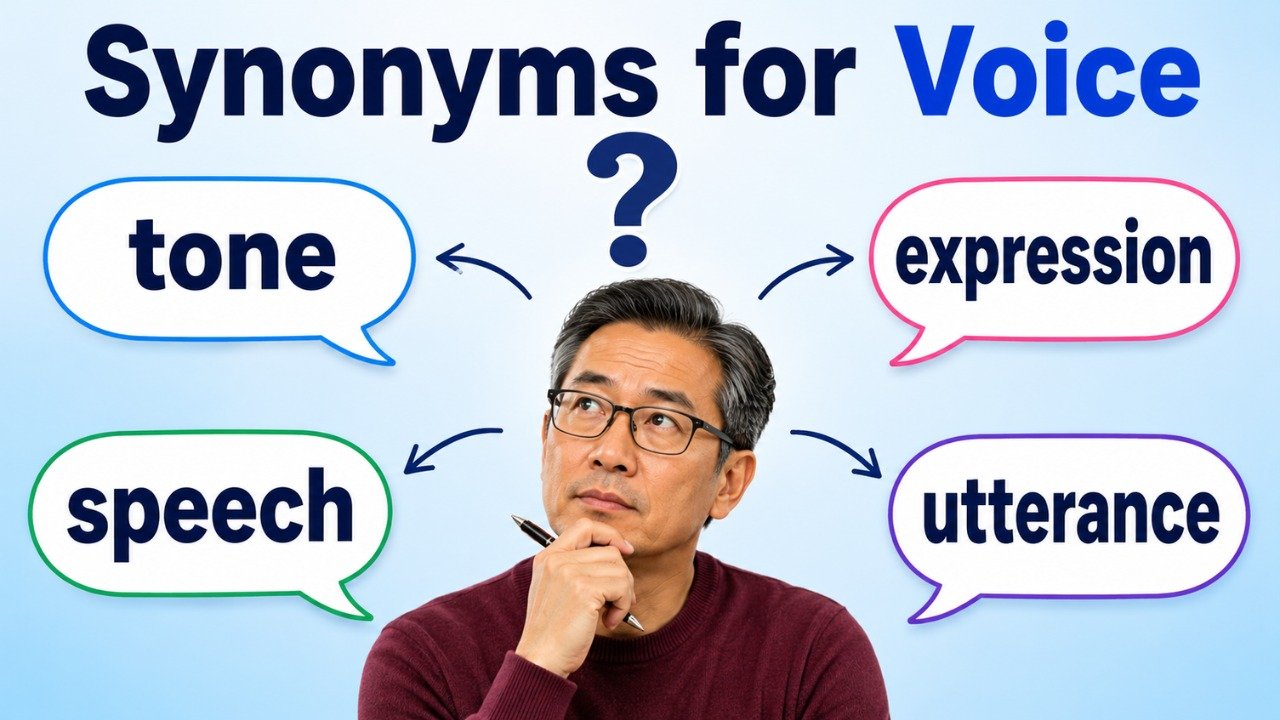
Quick Answer: The best synonyms for voice include tone, speech, sound, expression, opinion, viewpoint, utterance, narration, perspective, and say. Among these synonyms for voice, tone works best when describing the quality of someone’s speaking sound, speech suits spoken communication, expression fits the communication of thoughts or feelings, opinion and viewpoint work for ideas, narration fits storytelling, and say is useful when voice means influence or participation in a decision.
Pronunciation and Word Details
Word: Voice.
Pronunciation: /vɔɪs/
Part of Speech: Noun and verb.
Meaning: Voice means the sound produced when a person speaks or sings, or the ability to express an opinion, idea, feeling, or position.
US Pronunciation:
UK Pronunciation:
What Does “Voice” Mean?
Voice means the sound a person produces when speaking or singing, but it can also mean the expression of thoughts, feelings, opinions, or influence.
As a noun, voice commonly refers to a person’s speaking sound. A person may have a soft voice, deep voice, calm voice, or powerful voice. In this sense, words such as tone, sound, speech, and vocalization may work as alternatives.
Voice can also describe the way someone expresses ideas. A writer may develop a distinctive voice, a community may demand a voice in a decision, or a person may voice an opinion.
As a verb, voice means to express something openly through words.
Example: She voiced her concerns during the discussion.
In writing, voice may refer to a recognizable style or personality expressed through language.
Example: The author has a warm and conversational voice.
The correct synonym therefore depends on whether voice refers to sound, speaking, writing style, opinion, influence, representation, or expression.
Meaning, Tone, and Context of “Voice”
Voice is generally a neutral and highly flexible word. It appears naturally in casual conversation, formal writing, academic discussion, literature, communication, music, public speaking, and professional settings.
When referring to physical speech, voice is descriptive rather than emotional.
Example: His voice became quieter as the meeting continued.
When referring to opinions or influence, voice can carry a stronger sense of participation, representation, or personal freedom.
Example: Every member should have a voice in the decision.
In writing and literature, voice describes the distinctive personality or style communicated through words.
Example: Her writing voice is direct and energetic.
In professional contexts, voice can describe a person’s ability to contribute ideas.
Example: Employees were encouraged to have a voice in the planning process.
As a verb, voice is somewhat more formal than expressions such as say or speak about.
Example: Several participants voiced concerns about the proposal.
Overall, voice can be neutral, expressive, formal, emotional, artistic, or conversational depending on its use.
When and How to Use “Voice”
For Speaking Sound
Use voice when referring to the sound created by someone speaking or singing.
Example: Her voice was clear enough for everyone to hear.
For Tone and Vocal Quality
Use voice when describing how a person sounds.
Example: His voice sounded calm despite the pressure.
For Expressing an Opinion
Use voice when someone communicates a belief, concern, preference, or idea.
Example: She used the meeting to voice her opinion.
For Participation
Voice can describe a person’s right or ability to influence a decision.
Example: Local residents wanted a greater voice in the project.
For Writing Style
Use voice to describe the personality or character that appears in someone’s writing.
Example: The essay has a confident and personal voice.
For Representation
Voice can describe a person or group that speaks on behalf of others.
Example: The organization became a voice for local artists.
For Storytelling
Voice can refer to the person or perspective through which a story is told.
Example: The narrator’s voice gives the story an informal feeling.
For Open Expression
As a verb, voice means to communicate something openly.
Example: He voiced his concerns politely.
Best Synonyms for Voice
Tone: The quality or character of a speaking sound.
Example: Her warm tone made the conversation feel friendly.
Speech: Spoken communication or the act of speaking.
Example: His speech became clearer after a few minutes.
Sound: Something that can be heard, especially the audible quality of speech.
Example: The familiar sound of her words caught his attention.
Expression: The communication of thoughts, feelings, or ideas.
Example: Writing gave her a powerful form of expression.
Opinion: A personal belief or judgment.
Example: Everyone was invited to share an opinion.
Viewpoint: A particular way of thinking about an issue.
Example: His viewpoint added a useful perspective to the discussion.
Utterance: A spoken word, phrase, or sound.
Example: Her quiet utterance was difficult to hear.
Narration: Spoken or written storytelling.
Example: The narration gives the documentary a calm atmosphere.
Perspective: A particular way of seeing or understanding something.
Example: The article presents a different perspective on the problem.
Say: The opportunity or ability to influence a decision.
Example: Each team member had a say in the final choice.
50 Synonyms for Voice with Short Meanings
- Tone: The quality or character of a speaking sound.
- Speech: Spoken communication.
- Sound: Something heard through the ears.
- Expression: Communication of thoughts or feelings.
- Opinion: A personal belief or judgment.
- Viewpoint: A particular way of thinking.
- Perspective: A way of seeing or understanding something.
- Utterance: A spoken word, phrase, or sound.
- Narration: Spoken or written storytelling.
- Say: Influence or participation in a decision.
- View: An opinion about a subject.
- Stance: A stated position on an issue.
- Position: A particular opinion or attitude.
- Statement: A clear spoken or written expression.
- Remark: A brief spoken comment.
- Declaration: A clear or formal statement.
- Message: An idea communicated to others.
- Comment: A spoken or written observation.
- Commentary: Spoken or written explanation or opinion.
- Articulation: Clear expression through speech.
- Delivery: The manner in which words are spoken.
- Diction: Choice and pronunciation of words.
- Phrasing: The way words are arranged or expressed.
- Wording: The specific words used to communicate something.
- Language: Words and expressions used for communication.
- Vocalization: The production of sound with the voice.
- Call: A loud vocal sound used to attract attention.
- Cry: A loud or emotional vocal sound.
- Shout: A loud spoken expression.
- Whisper: Very quiet speech.
- Murmur: Low and quiet speech.
- Accent: A distinctive way of pronouncing words.
- Inflection: A change in vocal pitch or tone.
- Cadence: The rhythm and flow of speech.
- Timbre: The distinctive quality of a sound.
- Resonance: Depth and richness of sound.
- Register: A particular range or style of vocal sound.
- Pronunciation: The way words are spoken.
- Speaker: A person who speaks.
- Narrator: A person or voice that tells a story.
- Spokesperson: Someone who communicates for a group.
- Representative: Someone who speaks or acts for others.
- Advocate: Someone who speaks in support of a cause.
- Mouthpiece: A person who expresses another person’s or group’s views.
- Agency: The power to act and express personal choices.
- Input: Ideas or opinions contributed to a discussion.
- Participation: Involvement in discussion or decision making.
- Authority: The power or recognized right to speak or decide.
- Style: A distinctive manner of expression.
- Personality: Individual character communicated through speech or writing.
Read Also:
Synonyms for Conduct

Synonyms for Voice by Context
When Voice Means Speaking Sound
When voice refers to the audible sound produced during speaking, useful alternatives include tone, sound, speech, vocalization, register, timbre, and resonance.
Example: Her voice was unusually soft.
Alternative: Her tone was unusually soft.
Tone is especially useful when the sentence describes emotional or expressive vocal quality.
Example: His reassuring tone helped everyone relax.
Sound is broader and works when the focus is simply on what is heard.
Example: The sound of his speech came from the next room.
When Voice Means Opinion
When voice means an opinion or expressed belief, useful synonyms include opinion, viewpoint, view, stance, position, perspective, and statement.
Example: Everyone should be able to express their voice on the issue.
Alternative: Everyone should be able to express their opinion on the issue.
Opinion works for personal beliefs, while stance and position are stronger choices when describing a clearly defined view.
Example: The committee explained its position clearly.
When Voice Means Influence
When voice means the ability to participate in a decision, useful alternatives include say, input, influence, agency, participation, and representation.
Example: Parents wanted a stronger voice in the decision.
Alternative: Parents wanted a greater say in the decision.
Say is one of the most natural alternatives in everyday English.
Example: Everyone deserves a say in matters that affect them.
When Voice Means Expression
When voice refers to the expression of ideas or feelings, useful alternatives include expression, articulation, message, statement, language, and wording.
Example: Poetry became a voice for her emotions.
Alternative: Poetry became a form of expression for her emotions.
Expression is usually the broadest replacement in artistic or emotional contexts.
When Voice Means Writing Style
In writing, voice can describe an author’s recognizable personality, tone, or manner of expression. Useful alternatives include style, tone, personality, language, diction, and phrasing.
Example: The writer has a distinctive voice.
Alternative: The writer has a distinctive style.
Style is broader, while tone usually describes the writer’s attitude toward the subject or audience.
When Voice Means a Representative
Voice may refer to someone who speaks for a person, group, cause, or community. Useful alternatives include spokesperson, representative, advocate, speaker, and mouthpiece.
Example: She became a respected voice for the community.
Alternative: She became a respected advocate for the community.
Advocate emphasizes active support, while spokesperson emphasizes official communication.
Another Word for Voice
The best single replacement for voice is often tone when referring to speaking sound, but there is no single synonym that works in every sentence.
When voice refers to an opinion, opinion or viewpoint may be better. When it refers to influence, say is often the clearest option. When it refers to writing, style may be more precise.
Original: Her voice sounded nervous.
Better Option: Her tone sounded nervous.
Original: Everyone should have a voice in the decision.
Better Option: Everyone should have a say in the decision.
Original: The writer developed a unique voice.
Better Option: The writer developed a unique style.
Original: He voiced his disagreement politely.
Better Option: He expressed his disagreement politely.
When Not to Use “Voice”
Voice is useful, but another word may be clearer when the intended meaning is highly specific.
Avoid voice when the sentence concerns a measurable vocal quality that a more exact term can describe.
Weak: Her voice had an unusual quality.
Better: Her voice had a deep resonance.
Avoid voice when opinion is the exact meaning.
Weak: He shared his voice about the new plan.
Better: He shared his opinion about the new plan.
Avoid voice when describing formal participation if input is more precise.
Weak: The committee requested his voice before making a decision.
Better: The committee requested his input before making a decision.
Avoid repeating voice several times in the same paragraph.
Weak: Her voice was calm, and her voice gave the presentation a reassuring voice.
Better: Her voice was calm, and her reassuring tone strengthened the presentation.
Avoid using voice for every aspect of writing style because tone, diction, perspective, or style may communicate the intended meaning more precisely.
Words Commonly Confused With Voice
Voice vs Tone: Voice can refer to a person’s physical speaking sound or distinctive style, while tone describes the emotional quality or attitude expressed through that sound or writing.
Voice vs Speech: Voice is the sound or expressive identity of a speaker, while speech is the act or content of speaking.
Voice vs Sound: Voice is specifically associated with vocal communication, while sound includes anything that can be heard.
Voice vs Opinion: Voice can represent someone’s ability to express ideas, while opinion is the actual belief or judgment being expressed.
Voice vs Viewpoint: Voice is the means or ability to express ideas, while viewpoint is the particular perspective being expressed.
Voice vs Style: Voice often describes a recognizable personality in communication, while style is a broader term covering structure, language, presentation, and technique.
Voice vs Perspective: Perspective describes how someone sees an issue, while voice describes how that perspective is communicated.
Voice vs Say: Voice can mean influence generally, while say usually means a direct opportunity to participate in a particular decision.
Which Synonym Should You Choose?
Choose tone when describing the emotional or audible quality of someone’s speech.
Choose speech when referring to spoken communication or the act of speaking.
Choose sound when the focus is simply on what is heard.
Choose expression when discussing the communication of emotions, ideas, or identity.
Choose opinion when referring to a personal belief or judgment.
Choose viewpoint when describing a specific way of thinking about an issue.
Choose perspective when discussing a broader way of understanding a subject.
Choose say when someone has influence in a decision.
Choose input when ideas or feedback are being requested in a professional discussion.
Choose stance when describing a clearly defined position on an issue.
Choose narration when discussing storytelling or a spoken account.
Choose style when voice refers to a writer’s distinctive manner of expression.
Choose spokesperson when referring to someone officially speaking for a group.
Choose advocate when someone actively speaks in support of another person, group, or cause.
Choose articulation when clear expression is the main idea.
For essays and reports, opinion, perspective, position, expression, and viewpoint are often more precise than voice.
For emails and professional communication, input, position, feedback, expression, and perspective may sound clearer.
For casual conversation, tone, say, opinion, and sound are usually natural choices.
Real Life Examples of “Voice” in Sentences
Original: Her voice became softer when she entered the room.
Better Option: Her tone became softer when she entered the room.
Original: Everyone deserves a voice in the final decision.
Better Option: Everyone deserves a say in the final decision.
Original: He used the meeting to voice his concerns.
Better Option: He used the meeting to express his concerns.
Original: The author has a recognizable voice.
Better Option: The author has a recognizable style.
Original: Her voice showed that she was excited.
Better Option: Her tone showed that she was excited.
Original: The students wanted their voices to be heard.
Better Option: The students wanted their opinions to be heard.
Original: The group needed a strong voice to represent its interests.
Better Option: The group needed a strong representative to protect its interests.
Original: His voice added emotion to the story.
Better Option: His narration added emotion to the story.
Original: She finally found the confidence to voice her position.
Better Option: She finally found the confidence to state her position.
Original: The project gave younger members a voice.
Better Option: The project gave younger members greater participation.
Synonym Groups and Usage Differences
Sound Group
Tone, sound, timbre, resonance, register, inflection, and vocalization all relate to audible qualities.
Tone focuses on emotional quality. Timbre describes the distinctive character of a sound. Resonance suggests richness or depth. Inflection describes changes in pitch.
Example: Her gentle tone made the message sound reassuring.
Opinion Group
Opinion, view, viewpoint, stance, position, and perspective describe beliefs or ways of thinking.
Opinion is broad and neutral. Stance and position often describe a stronger or more formal view. Perspective emphasizes the way someone understands an issue.
Example: His perspective changed after hearing the other side.
Expression Group
Expression, articulation, statement, declaration, message, wording, and language describe ways of communicating ideas.
Expression is broad, while articulation emphasizes clear communication. Statement is useful for a clearly communicated idea.
Example: The essay provides a clear expression of her beliefs.
Influence Group
Say, input, agency, participation, and authority relate to having influence or control.
Say is natural in everyday communication. Input is common when someone contributes ideas. Agency refers more broadly to the ability to make choices and act independently.
Example: Every department had input into the final plan.
Writing Group
Style, tone, personality, diction, phrasing, perspective, and narration can replace voice in discussions of writing.
Style is the broadest alternative. Tone describes attitude. Diction focuses on word choice. Narration concerns storytelling.
Example: The author’s conversational style makes the book easy to read.
Representation Group
Spokesperson, representative, advocate, speaker, and mouthpiece describe people who communicate for others.
Spokesperson is appropriate for official representation. Advocate emphasizes support. Mouthpiece can sometimes carry a negative suggestion that someone merely repeats another person’s ideas.
Example: She served as an advocate for families affected by the change.
Antonyms of Voice
The opposite of voice depends on which meaning is intended.
Silence: The absence of speech or vocal sound.
Quiet: A state with little or no sound.
Speechlessness: The inability or unwillingness to speak.
Suppression: The prevention of expression or communication.
Silencing: The act of preventing someone from expressing an opinion.
Voicelessness: A lack of power, representation, or opportunity to speak.
Powerlessness: Lack of influence or control.
Exclusion: Being prevented from participating.
Inarticulateness: Difficulty expressing thoughts clearly.
Withdrawal: Choosing not to participate or communicate.
Comparison: Voice vs Related Words
Voice vs Tone
Voice refers broadly to a speaking sound or distinctive manner of expression. Tone describes the emotional quality or attitude communicated through that voice.
Example With Voice: I recognized her voice immediately.
Example With Tone: Her tone became more serious.
Voice vs Speech
Voice refers to the sound produced while speaking, while speech refers to the act, ability, or content of spoken communication.
Example With Voice: His voice sounded tired.
Example With Speech: His speech was clear and carefully organized.
Voice vs Opinion
Voice can refer to the ability to express a belief, while opinion is the belief itself.
Example With Voice: Employees wanted a stronger voice in company decisions.
Example With Opinion: Employees were asked for their opinion about the proposal.
Voice vs Perspective
Voice concerns expression, while perspective concerns the position from which someone understands an issue.
Example With Voice: The essay gives marginalized characters a stronger voice.
Example With Perspective: The essay presents the issue from a historical perspective.
Voice vs Style
Voice often describes the distinctive personality that readers sense in writing. Style is broader and includes vocabulary, structure, sentence patterns, and presentation.
Example With Voice: Her voice feels warm and personal.
Example With Style: Her writing style uses short sentences and simple vocabulary.
Voice vs Say
Voice is a broader concept involving expression or influence. Say usually refers specifically to having influence in a decision.
Example With Voice: Residents wanted a stronger voice in local planning.
Example With Say: Residents wanted more say in how the area was developed.
Voice vs Expression
Voice may describe the individual identity behind communication, while expression describes the act or result of communicating thoughts and feelings.
Example With Voice: Poetry helped him discover his creative voice.
Example With Expression: Poetry became an important form of emotional expression.
Common Phrases and Expressions With “Voice”
Find Your Voice: Develop confidence or a distinctive way of expressing yourself.
Raise Your Voice: Speak more loudly or forcefully.
Lower Your Voice: Speak more quietly.
Lose Your Voice: Become temporarily unable to speak normally.
Have a Voice: Have an opportunity to express an opinion or influence a decision.
Give Voice to Something: Express a thought, feeling, concern, or experience openly.
Voice an Opinion: State what you think about something.
Voice a Concern: Express worry or disagreement.
Speaking Voice: The normal sound someone uses when speaking.
Distinctive Voice: A recognizable style or sound that differs from others.
Common Mistakes to Avoid
One common mistake is assuming that every synonym for voice is interchangeable. Tone cannot always replace opinion, and opinion cannot replace sound.
Use a synonym that matches the exact meaning of the sentence.
Incorrect Choice: Everyone should have a tone in the decision.
Better Choice: Everyone should have a say in the decision.
Avoid confusing voice with tone. Voice is broader, while tone usually communicates emotional quality or attitude.
Unclear: His voice was angry.
More Precise: His tone was angry.
The original sentence is grammatically correct, but tone identifies the emotional quality more precisely.
Avoid overusing voice when discussing writing. Style, tone, perspective, diction, and narration can create more precise sentences.
Repetitive: The writer’s voice uses a serious voice that gives the story a formal voice.
Better: The writer’s formal style and serious tone give the story a distinctive character.
Do not use a formal alternative when simple language is clearer.
Unnatural: Everyone should possess participatory agency in choosing the location.
Natural: Everyone should have a say in choosing the location.
Avoid using sound when opinion is intended.
Incorrect: She shared her sound on the issue.
Correct: She shared her opinion on the issue.
Be careful with mouthpiece because it may suggest that a person simply repeats the ideas of someone else rather than expressing independent views.
Finally, consider whether voice refers to sound, expression, opinion, writing style, influence, or representation before selecting a synonym.
Conclusion
The best synonyms for voice depend on what voice means in the sentence. Use tone, sound, speech, timbre, or resonance for vocal qualities. Choose opinion, viewpoint, stance, or perspective for beliefs and ideas. Say, input, and participation work well when voice means influence, while expression and articulation suit communication. In writing, style, tone, diction, and narration may be more precise. Understanding these synonyms for voice helps you choose clearer, more natural words for conversation, essays, reports, and creative writing.
FAQs About Synonyms for Voice
What Is the Best Synonym for Voice?
The best synonym depends on context. Tone is excellent for speaking quality, opinion for personal beliefs, say for influence, and style for writing.
What Is Another Word for Someone’s Voice?
Tone, sound, speech, vocalization, timbre, and resonance can describe someone’s voice. Tone is especially useful when describing emotion or manner.
What Is a Synonym for Voice Meaning Opinion?
Opinion, viewpoint, perspective, stance, view, and position are useful alternatives when voice refers to someone’s beliefs or ideas.
What Is Another Word for Having a Voice?
Having a say, having input, participating, having influence, and having representation can all express the idea of having a voice in a decision.
What Is a Synonym for Voice in Writing?
Style is often the best replacement. Tone, personality, diction, perspective, phrasing, and narration may also work depending on what aspect of writing is being discussed.
What Is the Difference Between Voice and Tone?
Voice is the broader sound or expressive identity of a speaker or writer. Tone describes the attitude, emotion, or feeling communicated through that voice.
Can Expression Be a Synonym for Voice?
Yes. Expression works well when voice means communicating thoughts, feelings, identity, or creativity, although it does not usually replace voice when referring specifically to physical speaking sound.
