
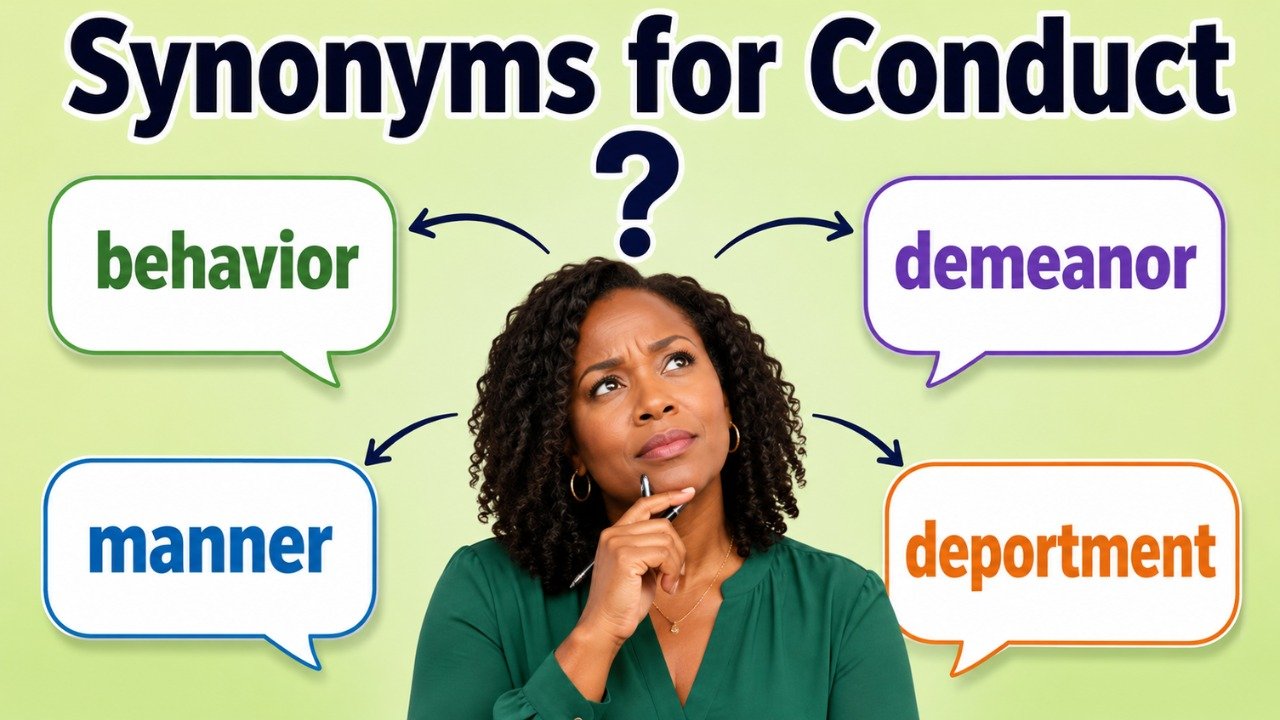
Quick Answer: The best synonyms for conduct include behavior, behavior, actions, management, direction, operation, performance, handling, guidance, and administration. When conduct means the way someone behaves, behavior is usually the clearest choice. For formal or professional writing, management, administration, and direction work well when referring to organizing activities. Use carry out or perform when conduct is a verb describing an action, investigation, test, meeting, or task. The best synonym depends on whether conduct refers to behavior, leadership, organization, performance, or carrying out an activity.
Pronunciation and Word Details
Word: Conduct.
Pronunciation: Noun /ˈkɒndʌkt/ and verb /kənˈdʌkt/.
Part of Speech: Noun and verb.
Meaning: Conduct can mean the way a person behaves or the act of organizing, directing, or carrying out an activity.
US Pronunciation:
UK Pronunciation:
What Does “Conduct” Mean?
Conduct means behavior or the way someone acts, or it can mean to organize, direct, manage, or carry out an activity.
As a noun, conduct usually describes a person’s actions, manners, or behavior. For example, a school may have rules about student conduct, while a workplace may expect professional conduct from employees.
As a verb, conduct means to lead, manage, organize, or perform something. A researcher may conduct an experiment, a manager may conduct a meeting, or an organization may conduct an investigation.
The meaning therefore depends strongly on sentence context. When discussing human actions, conduct is close to behavior. When discussing tasks, studies, meetings, or operations, conduct is closer to perform, carry out, manage, lead, or organize.
Meaning, Tone, and Context of “Conduct”
Conduct is generally a neutral to formal word. It appears frequently in professional, academic, educational, legal, organizational, and administrative writing.
When used as a noun, conduct often has a formal tone because it refers to behavior according to expected standards. Phrases such as professional conduct, ethical conduct, proper conduct, and unacceptable conduct are common in formal settings.
When used as a verb, conduct often describes an organized or deliberate activity. Researchers conduct studies, officials conduct investigations, teachers conduct assessments, and managers conduct meetings.
In casual conversation, words such as behave, do, run, lead, or handle may sound more natural.
Conduct can therefore communicate several related ideas, including behavior, management, leadership, performance, organization, and execution.
When and How to Use “Conduct”
For Behavior: Use conduct when describing how someone acts, especially when behavior is being judged according to rules or standards.
Example: Her professional conduct earned the respect of her colleagues.
For Professional Standards: Conduct works well when discussing acceptable or unacceptable behavior in a workplace or institution.
Example: Employees are expected to maintain appropriate conduct during meetings.
For Research: Use conduct when describing an organized study, experiment, survey, assessment, or investigation.
Example: The researchers conducted several tests before reaching a conclusion.
For Meetings: Conduct can describe leading or managing an organized discussion.
Example: The director conducted the meeting efficiently.
For Investigations: Use conduct for formally carrying out an examination or inquiry.
Example: The committee conducted a detailed investigation into the complaint.
For Operations: Conduct can describe managing or performing an organized process.
Example: The team conducted the operation according to the established plan.
For Leadership: Conduct may describe guiding or directing people through an activity.
Example: She conducted the training session with confidence.
For Performance: Conduct can mean carrying out a task according to a particular method.
Example: The inspection was conducted carefully.
Best Synonyms for Conduct
Behavior: The way a person acts or responds.
Example: His respectful behavior created a positive atmosphere.
Actions: Things a person does.
Example: Her actions showed that she took the responsibility seriously.
Management: The organization and control of people, tasks, or resources.
Example: Effective management helped the project stay organized.
Direction: Guidance or leadership given to an activity or group.
Example: The project succeeded under her direction.
Performance: The act of carrying out a task or responsibility.
Example: The performance of the inspection followed strict procedures.
Handling: The way a situation, responsibility, or task is managed.
Example: His careful handling of the complaint prevented further confusion.
Administration: The process of organizing and managing activities or responsibilities.
Example: The administration of the program required careful planning.
Operation: The process of performing or managing an organized activity.
Example: The operation of the facility follows clear safety procedures.
Execution: The process of carrying out a plan, task, or action.
Example: The successful execution of the strategy required teamwork.
Guidance: Advice, leadership, or direction that helps someone act or proceed.
Example: The group completed the project under experienced guidance.
50 Synonyms for Conduct with Short Meanings
- Behavior: The way someone acts.
- Behaviour: The way a person acts or responds.
- Actions: Things someone does.
- Manners: Socially noticeable ways of behaving.
- Demeanor: A person’s outward manner or appearance.
- Comportment: The way someone behaves or carries themselves.
- Bearing: A person’s manner, posture, or behavior.
- Deportment: A person’s manner of behaving, especially in formal settings.
- Performance: The act of carrying out a task.
- Management: The act of organizing and controlling something.
- Administration: The organization and supervision of activities.
- Direction: Leadership or guidance over an activity.
- Guidance: Help or direction given to someone.
- Supervision: Oversight of people or activities.
- Leadership: The act of directing or guiding others.
- Control: Authority over how something is managed.
- Handling: The way a task or situation is managed.
- Operation: The process of running or performing something.
- Execution: The act of carrying out a plan.
- Implementation: The process of putting a plan into action.
- Performance: The carrying out of a duty or activity.
- Procedure: An established way of doing something.
- Practice: A customary or repeated way of acting.
- Activity: Something that is done or carried out.
- Management: Organized control of work or resources.
- Organization: The arrangement and coordination of activities.
- Coordination: The organization of different parts to work together.
- Superintendence: Formal oversight or management.
- Governance: The process of directing or controlling an organization.
- Regulation: Control according to rules or standards.
- Oversight: Supervision of an activity or process.
- Stewardship: Responsible management or supervision.
- Direct: To control or guide an activity.
- Lead: To guide people or an activity.
- Manage: To organize and control something.
- Run: To manage or operate something.
- Handle: To deal with or manage a situation.
- Perform: To carry out an action or task.
- Execute: To carry out a plan or instruction.
- Implement: To put a plan or decision into effect.
- Carry Out: To complete or perform an activity.
- Undertake: To begin and perform a responsibility or task.
- Administer: To manage or supervise something formally.
- Oversee: To supervise an activity or process.
- Coordinate: To organize different activities effectively.
- Organize: To arrange and manage an activity.
- Guide: To direct someone or something.
- Supervise: To watch over and manage an activity.
- Operate: To manage or control a system or process.
- Facilitate: To help an activity or process happen effectively.
Read Also:
Synonyms for Karma

Synonyms for Conduct by Context
When Conduct Means Behavior
When conduct refers to how someone acts, the best synonyms include behavior, actions, manners, demeanor, comportment, bearing, and deportment.
Behavior: The most flexible synonym for a person’s actions.
Example: His behavior during the discussion remained professional.
Demeanor: Best when describing a person’s outward manner.
Example: Her calm demeanor helped reassure the group.
Comportment: A formal word for the way someone carries or behaves themselves.
Example: His respectful comportment impressed the interviewers.
Manners: Best when conduct involves politeness or social behavior.
Example: Her excellent manners made a positive impression.
When Conduct Means Carry Out
When conduct describes doing a study, investigation, test, assessment, or other organized task, useful synonyms include perform, carry out, execute, undertake, and implement.
Perform: Suitable for completing a task or procedure.
Example: The technician performed several safety checks.
Carry Out: A natural replacement for completing an organized activity.
Example: The team carried out a detailed review.
Execute: Best when following a planned procedure or strategy.
Example: The staff executed the plan successfully.
Undertake: Useful when emphasizing responsibility for beginning a task.
Example: The organization undertook a complete evaluation.
When Conduct Means Manage
When conduct refers to managing an activity, process, meeting, or organization, useful synonyms include manage, administer, run, supervise, oversee, and coordinate.
Manage: A broad choice for controlling tasks or resources.
Example: She managed the project efficiently.
Administer: A formal synonym for managing a program, process, or responsibility.
Example: The department administered the program carefully.
Oversee: Best when emphasizing supervision rather than direct performance.
Example: He oversaw the entire process.
Run: A more conversational word for managing something.
Example: She runs the weekly meeting.
When Conduct Means Lead or Direct
Conduct may also describe leading people through an organized activity.
Useful synonyms include lead, direct, guide, supervise, coordinate, and facilitate.
Lead: A natural choice when someone is responsible for a group.
Example: She led the discussion confidently.
Direct: Best when someone gives instructions or controls the process.
Example: He directed the training exercise.
Guide: Useful when leadership involves support and instruction.
Example: She guided the participants through the activity.
Facilitate: Best when helping a discussion or process progress smoothly.
Example: He facilitated the workshop effectively.
Another Word for Conduct
Another word for conduct is behavior when conduct is a noun describing how someone acts. When conduct is a verb, carry out, perform, manage, or lead may be better alternatives depending on the activity.
There is no single replacement that works in every sentence because conduct has several meanings.
Original: His conduct during the ceremony was respectful.
Better Option: His behavior during the ceremony was respectful.
Original: The researchers conducted an experiment.
Better Option: The researchers performed an experiment.
Original: She conducted the meeting.
Better Option: She led the meeting.
Original: The organization conducted an investigation.
Better Option: The organization carried out an investigation.
When Not to Use “Conduct”
Conduct is useful, but it may sound overly formal or vague in some situations.
Avoid using conduct when a simpler word communicates the meaning more clearly.
Weak: We conducted lunch at noon.
Better: We had lunch at noon.
Conduct sounds unnatural because ordinary meals are not usually described as activities that are conducted.
Avoid conduct when a more precise verb explains what actually happened.
Weak: The manager conducted the problem.
Better: The manager handled the problem.
Use behavior rather than conduct when writing conversationally about someone’s everyday actions.
Weak: His conduct at dinner was funny.
Better: His behavior at dinner was funny.
Avoid repeating conduct several times in the same paragraph.
Weak: The team conducted a study and conducted interviews before conducting an analysis.
Better: The team carried out a study, completed interviews, and performed an analysis.
Use lead rather than conduct when the main idea is leadership.
Weak: She conducted the discussion with confidence.
Better: She led the discussion with confidence.
Both sentences are correct, but the second is simpler and more direct.
Words Commonly Confused With Conduct
Conduct vs Behavior: Conduct and behavior can both describe the way someone acts. Conduct is usually more formal and often relates to standards or expectations, while behavior is broader and works naturally in everyday language.
Conduct vs Perform: Conduct can mean organizing and carrying out an activity, while perform usually focuses more directly on completing the task itself.
Conduct vs Manage: Conduct can refer to managing an organized activity, while manage has a wider meaning that includes controlling people, resources, schedules, or problems.
Conduct vs Lead: Conduct may involve guiding an organized event or activity, while lead emphasizes responsibility for directing people.
Conduct vs Execute: Conduct refers broadly to carrying out or organizing something. Execute usually emphasizes completing a specific plan, instruction, or procedure.
Conduct vs Administer: Conduct may involve leading or performing an activity, while administer usually refers to managing an organized system, program, service, or responsibility.
Conduct vs Operate: Conduct can mean carrying out an activity, while operate usually refers to running a system, machine, organization, or process.
Conduct vs Facilitate: Conduct may mean leading an activity directly, while facilitate means helping the activity happen smoothly without necessarily controlling it.
Which Synonym Should You Choose?
Choose behavior when discussing how a person acts in general.
Choose actions when you want to emphasize specific things someone has done.
Choose demeanor when describing someone’s outward manner, appearance, or emotional presentation.
Choose comportment for formal descriptions of behavior and personal bearing.
Choose perform when referring to completing a test, task, procedure, or duty.
Choose carry out when describing the completion of a study, investigation, survey, review, or plan.
Choose manage when discussing control of people, responsibilities, resources, or projects.
Choose lead when the main meaning involves directing a meeting, discussion, team, or activity.
Choose administer for formal writing about programs, policies, services, systems, or responsibilities.
Choose execute when emphasizing careful completion of a specific strategy, procedure, or plan.
Choose oversee when someone supervises an activity without performing every part personally.
Choose coordinate when different people, tasks, or resources must be organized together.
Choose run in casual or conversational writing when describing management of a meeting, activity, business, or program.
Real Life Examples of “Conduct” in Sentences
Original: The school expects respectful conduct from every student.
Better Option: The school expects respectful behavior from every student.
Original: The researchers conducted several experiments.
Better Option: The researchers performed several experiments.
Original: The committee conducted an investigation into the complaint.
Better Option: The committee carried out an investigation into the complaint.
Original: She conducted the meeting professionally.
Better Option: She led the meeting professionally.
Original: His conduct impressed the interview panel.
Better Option: His demeanor impressed the interview panel.
Original: The organization conducted a detailed review of its procedures.
Better Option: The organization carried out a detailed review of its procedures.
Original: The supervisor conducted the training session.
Better Option: The supervisor led the training session.
Original: The team conducted the project according to the agreed plan.
Better Option: The team managed the project according to the agreed plan.
Original: Officials conducted an inspection of the building.
Better Option: Officials performed an inspection of the building.
Original: Her conduct throughout the difficult situation remained professional.
Better Option: Her behavior throughout the difficult situation remained professional.
Synonym Groups and Usage Differences
Behavior Group
Behavior, actions, manners, demeanor, comportment, bearing, and deportment belong to the behavior group.
These words describe the way a person acts, responds, or presents themselves. Behavior is the broadest choice, while demeanor and bearing focus more on outward appearance and manner.
Example: His professional behavior helped build trust.
Performance Group
Perform, carry out, execute, undertake, and implement describe completing an activity, responsibility, plan, or procedure.
Perform is particularly useful for tests, procedures, and duties. Carry out works well with research and investigations. Execute emphasizes careful completion of a plan.
Example: The team carried out the inspection carefully.
Management Group
Manage, administer, run, handle, oversee, and operate relate to controlling or organizing activities.
Manage is broad and flexible. Administer is more formal, while run is more conversational.
Example: She manages the program effectively.
Leadership Group
Lead, direct, guide, supervise, and facilitate relate to guiding people or activities.
Lead emphasizes responsibility. Direct emphasizes control and instruction. Guide often suggests support, while facilitate focuses on making a process easier.
Example: She led the discussion toward a practical solution.
Organization Group
Coordinate, organize, administer, manage, and supervise relate to arranging people or activities so that work happens effectively.
Coordinate is particularly useful when multiple people or tasks must work together.
Example: He coordinated the activities of several teams.
Antonyms of Conduct
The opposite of conduct depends on which meaning is intended.
When conduct means proper behavior, antonyms describe poor or unacceptable behavior.
Misconduct: Improper or unacceptable behavior.
Misbehavior: Behavior that breaks rules or expectations.
Disobedience: Refusal to follow rules or instructions.
Impropriety: Behavior that is unsuitable or inappropriate.
Disorder: Lack of proper organization or controlled behavior.
When conduct means manage or direct, opposites may involve neglecting or abandoning responsibility.
Neglect: Failure to give proper attention or care.
Abandon: To leave a responsibility or activity unfinished.
Disregard: Failure to consider or follow something properly.
Ignore: To give no attention to a responsibility or matter.
Mismanage: To manage something badly or inefficiently.
When conduct means carry out, opposite ideas include stopping, preventing, or failing to complete an activity.
Cancel: To decide that an activity will not happen.
Halt: To stop an activity or process.
Prevent: To stop something from happening.
Discontinue: To stop doing or providing something.
Comparison: Conduct vs Related Words
Conduct vs Behavior
Conduct is generally more formal than behavior. It often refers to behavior judged according to professional, social, ethical, or institutional standards.
Behavior is broader and more natural in everyday communication.
Example With Conduct: His conduct during the hearing remained professional.
Example With Behavior: His behavior during the discussion remained calm.
Conduct vs Perform
Conduct may involve organizing, directing, and carrying out an activity. Perform focuses primarily on completing or doing the activity.
Example With Conduct: The researchers conducted a detailed experiment.
Example With Perform: The researchers performed several tests.
Conduct vs Carry Out
Conduct and carry out can both describe organized activities, but carry out usually emphasizes completing the activity rather than directing it.
Example With Conduct: The organization conducted an investigation.
Example With Carry Out: The organization carried out an investigation.
Conduct vs Manage
Conduct often refers to leading a specific activity, while manage can refer to broader responsibility for people, resources, schedules, and operations.
Example With Conduct: She conducted the meeting.
Example With Manage: She manages the entire department.
Conduct vs Lead
Conduct can mean directing an organized event, while lead more directly emphasizes leadership.
Example With Conduct: He conducted the training session.
Example With Lead: He led the training session.
Conduct vs Administer
Conduct usually emphasizes carrying out or directing an activity. Administer emphasizes formal management or supervision.
Example With Conduct: They conducted an assessment.
Example With Administer: They administered the assessment to all participants.
Conduct vs Execute
Conduct has a broader meaning, while execute often implies carrying out a prepared plan or procedure accurately.
Example With Conduct: The team conducted the operation.
Example With Execute: The team executed the strategy successfully.
Conduct vs Oversee
Conduct can suggest direct involvement in an activity. Oversee mainly means supervising the work of others.
Example With Conduct: She conducted the review personally.
Example With Oversee: She oversaw the review conducted by her team.
Common Phrases and Expressions With “Conduct”
Professional Conduct: Behavior that meets expected workplace or professional standards.
Proper Conduct: Behavior considered appropriate for a situation.
Ethical Conduct: Behavior that follows accepted moral principles.
Personal Conduct: The way an individual behaves.
Unacceptable Conduct: Behavior that does not meet expected standards.
Code of Conduct: A set of rules describing expected behavior.
Conduct an Investigation: To organize and carry out a formal inquiry.
Conduct Research: To perform organized study or investigation.
Conduct a Meeting: To lead or manage a formal discussion.
Conduct an Experiment: To organize and perform a scientific or practical test.
Common Mistakes to Avoid
One common mistake is assuming that every synonym for conduct can replace it in every sentence. Conduct has several meanings, so the correct alternative depends on context.
When conduct describes human actions, behavior is usually more accurate than management or performance.
Another mistake is using conduct where a simpler verb sounds more natural. Saying someone conducted lunch or conducted a conversation may sound unnecessarily formal unless the activity was formally organized.
Writers should also avoid excessive repetition.
Instead of writing that researchers conducted a study, conducted interviews, and conducted tests, vary the verbs naturally. They can carry out a study, complete interviews, and perform tests.
Be careful when choosing between lead and manage. Leading usually emphasizes guiding people, while managing includes wider responsibilities such as resources, planning, scheduling, and control.
Do not confuse conduct with misconduct. Conduct itself is neutral and can describe either good or bad behavior. Misconduct specifically refers to improper behavior.
Avoid vague usage when a more precise verb explains the action. Instead of saying a person conducted an issue, explain whether they handled, managed, investigated, discussed, or resolved it.
Conclusion
The best synonyms for conduct depend on whether the word refers to behavior or to carrying out an activity. Use behavior, actions, demeanor, or comportment when describing how someone acts. Choose perform, carry out, or execute for tasks, tests, research, and investigations. Use manage, administer, oversee, or coordinate when organization and control are important. For meetings and group activities, lead, direct, or guide may be clearer. Understanding these differences helps you choose a natural and precise alternative for every context.
FAQs About Synonyms for Conduct
What Is the Best Synonym for Conduct?
The best general synonym for conduct as a noun is behavior. As a verb, the best replacement may be perform, carry out, manage, or lead depending on the sentence.
What Is Another Word for Conduct as Behavior?
Behavior, actions, manners, demeanor, comportment, bearing, and deportment can all replace conduct when describing how a person acts.
What Is Another Word for Conduct an Investigation?
Carry out an investigation and perform an investigation are useful alternatives. Undertake an investigation can also work in formal writing.
What Is Another Word for Conduct a Meeting?
Lead, run, manage, facilitate, or direct a meeting can replace conduct a meeting. Lead is usually the clearest general alternative.
Is Conduct a Formal Word?
Yes. Conduct often has a formal or professional tone, especially when discussing behavior, research, investigations, meetings, procedures, or institutional standards.
Can Behavior Replace Conduct?
Behavior can replace conduct when the word refers to how a person acts. It cannot usually replace conduct when conduct means to perform, organize, manage, or carry out something.
What Is the Difference Between Conduct and Perform?
Conduct can involve organizing, managing, or directing an activity as well as carrying it out. Perform mainly focuses on doing or completing the activity itself.
