
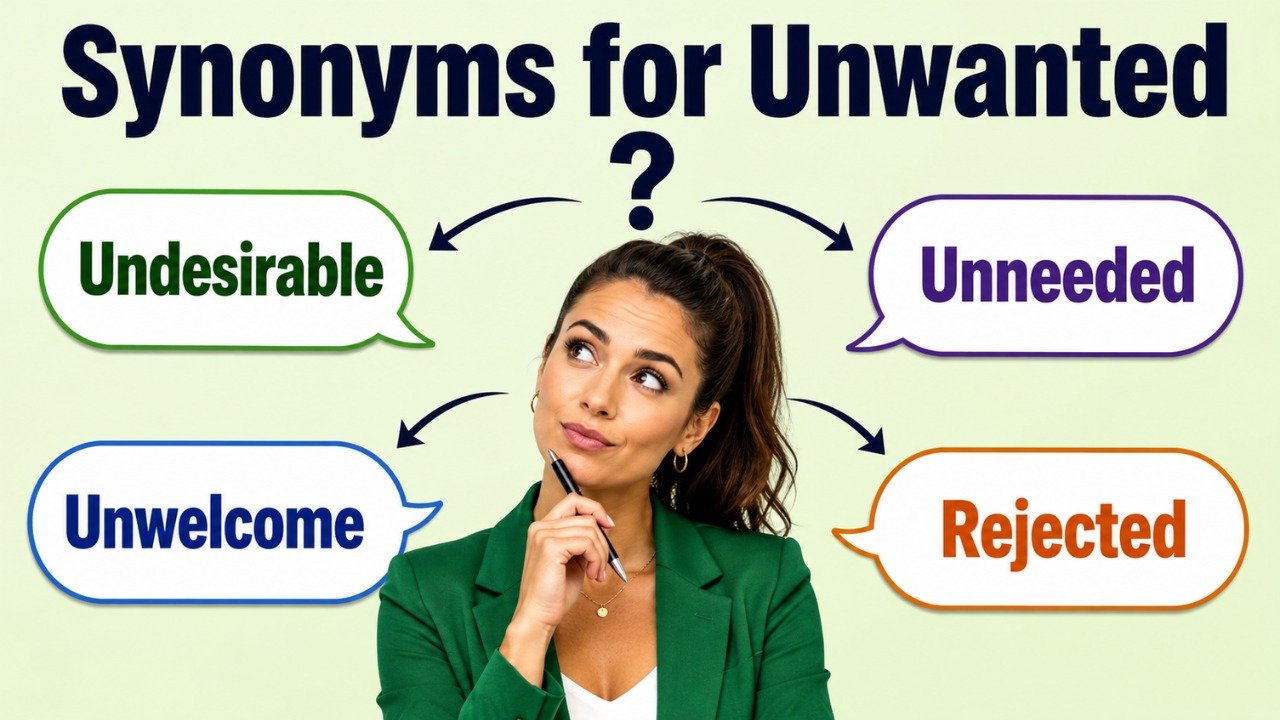
Quick Answer: The best synonyms for unwanted include undesired, unwelcome, uninvited, unsolicited, unneeded, unnecessary, intrusive, objectionable, undesirable, and rejected. Among these synonyms for unwanted, undesired is the most flexible formal replacement. Use unwelcome for attention, visitors, or comments, unsolicited for messages and advice, uninvited for guests, unnecessary for objects or actions with no useful purpose, intrusive for privacy concerns, and undesirable for negative conditions or results.
Pronunciation and Word Details
Word: Unwanted
Pronunciation: /ʌnˈwɒntɪd/
Part of Speech: Adjective
Meaning: Not desired, needed, requested, welcomed, or approved.
US Pronunciation:
UK Pronunciation:
What Does “Unwanted” Mean?
Unwanted means not desired, requested, needed, or welcomed.
The word is an adjective. It describes a person, object, action, message, feeling, event, or result that someone does not wish to have.
When unwanted describes an object, it means the object is no longer needed or desired.
Example: She donated several unwanted books.
When it describes attention, contact, advice, or messages, it means the person did not ask for or welcome them.
Example: He received unwanted messages throughout the week.
Unwanted can also describe a guest, visitor, or presence that is not welcomed.
Example: The noise attracted unwanted visitors to the area.
In discussions of behavior, unwanted means unwelcome, inappropriate, or uncomfortable for the person affected.
Example: Employees should report any unwanted conduct.
When unwanted describes an outcome, effect, or consequence, it means undesirable or unfavorable.
Example: The change produced several unwanted results.
The word can also describe feelings or thoughts that a person would prefer not to experience.
Example: The memory brought back unwanted feelings of anxiety.
Unwanted is broader than many related words. The most precise synonym depends on whether something was not requested, not needed, not welcomed, rejected, or considered harmful.
Meaning, Tone, and Context of “Unwanted”
Unwanted has a neutral to negative tone. It communicates that something is not desired, but the emotional strength changes according to context.
The word can sound mild when referring to household items, but serious when describing attention, contact, behavior, or intrusion.
Neutral Tone: Unwanted can simply describe something that is no longer needed.
Example: The charity collected unwanted furniture.
Negative Tone: The word may describe something annoying, inconvenient, harmful, or unacceptable.
Example: The update caused unwanted changes to the document.
Emotional Tone: When unwanted describes a person or feeling, it may suggest rejection, isolation, discomfort, or sadness.
Example: No child should be made to feel unwanted.
Formal Tone: Unwanted is suitable for policies, reports, instructions, academic writing, and professional communication.
Example: The procedure is designed to reduce unwanted effects.
Conversational Tone: The word is also common in everyday speech.
Example: I cleared the unwanted files from my computer.
Technical Tone: In science, medicine, computing, engineering, and research, unwanted may describe effects, signals, reactions, data, or outcomes that interfere with a desired result.
Example: The filter removes unwanted noise from the recording.
Polite Tone: Unwanted can be more neutral than strongly emotional words such as offensive, intolerable, or disturbing.
Example: Please remove any unwanted items from the room.
Strong Tone: In discussions of personal boundaries, unwanted may carry a serious meaning because it indicates that an action or contact was not welcomed.
Example: Unwanted physical contact should never be ignored.
The word is useful because it is broad, but a more specific alternative often improves accuracy. Unsolicited, intrusive, unnecessary, uninvited, undesirable, and objectionable each communicate a clearer type of rejection.
When and How to Use “Unwanted”
For Objects That Are No Longer Needed
Use unwanted for possessions, clothing, furniture, books, files, or materials that someone no longer wishes to keep.
Example: The family donated its unwanted household items.
For Messages and Communication
Use unwanted when messages, calls, advertisements, or requests were not asked for.
Example: The settings can block unwanted messages.
For Unwelcome Attention
Unwanted can describe attention that makes someone uncomfortable or invades personal boundaries.
Example: She wanted the unwanted attention to stop.
For Visitors and Guests
Use unwanted for people who arrive without being invited or welcomed.
Example: The open window allowed unwanted visitors to enter.
For Advice and Opinions
Unwanted can describe suggestions, criticism, or opinions that were not requested.
Example: He kept offering unwanted advice about her career.
For Negative Results
Use unwanted for effects, consequences, or outcomes that were not intended.
Example: The decision created several unwanted complications.
For Technical Problems
Unwanted may describe noise, signals, files, code, data, movement, or reactions that interfere with normal operation.
Example: The technician removed unwanted data from the system.
For Inappropriate Behavior
Use unwanted when conduct, comments, or contact are not welcomed by the person receiving them.
Example: The policy explains how to report unwanted behavior.
For Feelings and Thoughts
Unwanted can describe emotions, memories, thoughts, or reactions a person would prefer not to experience.
Example: The conversation brought back unwanted memories.
For Social Rejection
Use unwanted carefully when describing a person who feels unaccepted or excluded.
Example: The supportive group made sure that no member felt unwanted.
Best Synonyms for Unwanted
Undesired: Not wished for or intended.
Example: The medicine caused an undesired reaction.
Unwelcome: Not received with pleasure, approval, or comfort.
Example: His comment was an unwelcome interruption.
Uninvited: Present without having received an invitation.
Example: Several uninvited guests arrived at the gathering.
Unsolicited: Given, sent, or offered without being requested.
Example: She received unsolicited advice from a stranger.
Unneeded: Not required for a particular purpose.
Example: The editor removed several unneeded sentences.
Unnecessary: Not essential, useful, or required.
Example: The delay created unnecessary confusion.
Intrusive: Entering someone’s space, privacy, or attention in an unwelcome way.
Example: The repeated questions felt intrusive.
Objectionable: Offensive, inappropriate, or deserving disapproval.
Example: The report contained several objectionable remarks.
Undesirable: Likely to cause an unfavorable or unpleasant result.
Example: Poor ventilation can create undesirable working conditions.
Rejected: Refused, dismissed, or no longer wanted.
Example: The rejected materials were removed from the production area.
50 Synonyms for Unwanted with Short Meanings
- Undesired: Not wanted or wished for.
- Unwelcome: Not received with pleasure or approval.
- Uninvited: Present without being asked to attend.
- Unsolicited: Offered or sent without being requested.
- Unrequested: Not asked for by the receiver.
- Unneeded: Not necessary for a particular purpose.
- Unnecessary: Not required or useful.
- Undesirable: Unpleasant or likely to cause a negative result.
- Objectionable: Offensive, inappropriate, or unacceptable.
- Unacceptable: Not satisfactory or suitable.
- Intrusive: Entering someone’s privacy or space without welcome.
- Bothersome: Causing annoyance, discomfort, or difficulty.
- Troublesome: Creating problems or inconvenience.
- Annoying: Causing irritation or frustration.
- Inconvenient: Causing difficulty at an unsuitable time.
- Disliked: Not regarded with pleasure or approval.
- Rejected: Refused or dismissed as unsuitable.
- Refused: Not accepted or agreed to.
- Discarded: Thrown away because it is no longer wanted.
- Abandoned: Left behind or given up.
- Forsaken: Deserted or left without support.
- Excluded: Prevented from being included.
- Avoided: Deliberately kept away from.
- Shunned: Intentionally rejected or avoided.
- Unpopular: Not liked or supported by many people.
- Unfavored: Not preferred or approved.
- Unloved: Not treated with affection or care.
- Unappreciated: Not valued or recognized.
- Unapproved: Not officially accepted or permitted.
- Unauthorized: Lacking official permission.
- Unwarranted: Not justified or necessary.
- Uncalled For: Unnecessary, inappropriate, or unjustified.
- Inappropriate: Unsuitable for the situation.
- Unsuitable: Not right for a particular purpose.
- Improper: Not correct, suitable, or socially acceptable.
- Offensive: Causing anger, discomfort, or insult.
- Disturbing: Causing worry, discomfort, or emotional upset.
- Unpleasant: Not enjoyable, comfortable, or agreeable.
- Adverse: Harmful or unfavorable in effect.
- Unfavorable: Producing or expressing a negative result.
- Regrettable: Unfortunate and worthy of regret.
- Needless: Having no useful purpose or necessity.
- Redundant: No longer necessary because it is repeated or replaced.
- Superfluous: More than is needed or useful.
- Extraneous: Unrelated or unnecessary to the main purpose.
- Surplus: Greater in amount than what is needed.
- Excess: More than the required or desirable amount.
- Dispensable: Able to be removed without serious loss.
- Avoidable: Capable of being prevented or escaped.
- Unwished For: Not desired or hoped for.
Read Also:
Synonyms for Formal

Synonyms for Unwanted by Context
When Unwanted Means Not Desired
Undesired is the strongest formal synonym when something was not intended or wished for.
Example: The treatment produced an undesired effect.
Undesirable describes something likely to be unpleasant, harmful, or unfavorable.
Example: The policy may create undesirable consequences.
Unwished for has a more personal or emotional tone.
Example: The news brought an unwished for change to their plans.
Unfavored means not preferred when compared with other choices.
Example: The proposal became the unfavored option after the review.
When Unwanted Means Not Welcomed
Unwelcome describes a person, event, comment, or situation received without pleasure.
Example: The sudden interruption was unwelcome.
Unpopular describes something that many people do not like or support.
Example: The new restriction proved unpopular with residents.
Disliked is direct and suitable when someone has a negative opinion.
Example: The character was widely disliked because of his dishonesty.
Shunned is stronger and suggests deliberate social avoidance.
Example: He was shunned after repeatedly breaking the group’s rules.
When Unwanted Means Not Requested
Unsolicited is best for advice, messages, calls, offers, applications, or material that was not requested.
Example: The office does not review unsolicited submissions.
Unrequested is more direct and can describe any item or action that was not asked for.
Example: An unrequested service was added to the bill.
Uninvited applies to guests, visitors, participants, or involvement.
Example: An uninvited visitor interrupted the meeting.
Intrusive describes unrequested attention or involvement that crosses personal boundaries.
Example: The questions became increasingly intrusive.
When Unwanted Means Not Needed
Unneeded describes something that has no current purpose.
Example: The storage room contained many unneeded supplies.
Unnecessary means something is not required.
Example: The extra meeting created unnecessary work.
Needless often suggests that something could easily have been avoided.
Example: The argument caused needless tension.
Dispensable means something can be removed without causing serious harm.
Example: Several minor details were dispensable.
When Unwanted Means Excessive
Surplus describes an amount greater than what is required.
Example: The farm sold its surplus produce.
Excess means more than the appropriate or necessary amount.
Example: Excess packaging increased the cost.
Superfluous describes something added beyond what is useful.
Example: The editor removed superfluous descriptions.
Redundant describes repeated information, roles, or parts that are no longer necessary.
Example: The updated system made several steps redundant.
When Unwanted Means Inappropriate
Objectionable describes something offensive or deserving criticism.
Example: The speaker removed the objectionable language.
Unacceptable is appropriate when something fails to meet a rule, standard, or expectation.
Example: Disrespectful conduct is unacceptable.
Inappropriate describes behavior, language, clothing, or actions that do not suit the situation.
Example: The comment was inappropriate for a formal meeting.
Uncalled for suggests that a remark or action was unnecessary and often rude.
Example: His personal criticism was completely uncalled for.
When Unwanted Means Harmful
Adverse is common in formal, medical, scientific, and professional writing.
Example: The change had an adverse effect on performance.
Unfavorable describes a negative condition, judgment, or outcome.
Example: The report presented an unfavorable assessment.
Troublesome describes something that repeatedly creates difficulty.
Example: The leak became a troublesome maintenance issue.
Disturbing describes something that causes worry or emotional discomfort.
Example: The investigation revealed several disturbing details.
When Unwanted Means Rejected
Rejected means actively refused or judged unsuitable.
Example: The rejected application was returned to the sender.
Discarded describes an object or idea thrown away because it is no longer wanted.
Example: The team reviewed the discarded proposal again.
Abandoned describes something left behind or given up completely.
Example: The abandoned equipment remained in the warehouse.
Excluded means deliberately prevented from being included.
Example: Irrelevant information was excluded from the final report.
Another Word for Unwanted
The best single replacement for unwanted is undesired. It works naturally in formal writing and clearly communicates that something was not wished for or intended.
However, the best alternative depends on context. Use unwelcome for people or attention, unsolicited for messages and advice, unnecessary for items or actions with no purpose, and undesirable for negative results.
Original: The update caused unwanted changes to the file.
Better Option: The update caused undesired changes to the file.
Original: She received unwanted advice from several people.
Better Option: She received unsolicited advice from several people.
Original: An unwanted guest arrived during dinner.
Better Option: An uninvited guest arrived during dinner.
Original: The process included several unwanted steps.
Better Option: The process included several unnecessary steps.
When Not to Use “Unwanted”
Unwanted can sound vague when the sentence does not explain why something is not wanted. A precise synonym often communicates the issue more clearly.
Weak: The report contained unwanted information.
Better: The report contained irrelevant and unnecessary information.
Do not use unwanted when unsolicited is the established word for messages, advice, applications, or offers that were not requested.
Weak: She received unwanted professional advice.
Better: She received unsolicited professional advice.
Avoid unwanted when uninvited is more accurate for a guest or visitor.
Weak: An unwanted visitor joined the private event.
Better: An uninvited visitor joined the private event.
Do not use unwanted when unnecessary is the main meaning.
Weak: The form contains several unwanted questions.
Better: The form contains several unnecessary questions.
Unwanted can sound too mild for offensive or harmful behavior.
Weak: The manager made an unwanted remark about the employee.
Better: The manager made an inappropriate and offensive remark.
Avoid describing a person as unwanted unless the emotional meaning is necessary and handled carefully. The word can sound rejecting or dehumanizing.
Weak: The shelter moved the unwanted people elsewhere.
Better: The shelter helped residents find more suitable accommodation.
Do not use unwanted when rejected describes an active decision.
Weak: The unwanted proposal was returned after the vote.
Better: The rejected proposal was returned after the vote.
Avoid repeating unwanted throughout a paragraph.
Weak: The unwanted program created unwanted changes and unwanted costs.
Better: The unnecessary program created disruptive changes and additional costs.
Words Commonly Confused With Unwanted
Unwanted vs Undesired: Unwanted is broad and conversational. Undesired sounds more formal and often describes effects, outcomes, or changes that were not intended.
Unwanted vs Unwelcome: Unwanted means not desired. Unwelcome emphasizes that someone or something was not received with pleasure or approval.
Unwanted vs Uninvited: Unwanted may describe any person or thing that is not desired. Uninvited specifically describes someone who was not asked to attend.
Unwanted vs Unsolicited: Unwanted is general. Unsolicited applies to something sent, offered, or given without being requested.
Unwanted vs Unnecessary: Unwanted describes preference. Unnecessary describes lack of need. Something may be necessary even if a person does not want it.
Unwanted vs Undesirable: Unwanted expresses that something is not desired. Undesirable suggests that it has negative qualities or consequences.
Unwanted vs Intrusive: Unwanted means not desired. Intrusive means entering someone’s privacy, space, or affairs in an unwelcome way.
Unwanted vs Rejected: Unwanted describes a condition or feeling. Rejected indicates an active refusal or decision not to accept something.
Unwanted vs Objectionable: Unwanted may be harmless but not desired. Objectionable suggests that something is offensive, improper, or worthy of criticism.
Unwanted vs Redundant: Unwanted relates to desire. Redundant means unnecessary because something is repeated, replaced, or no longer useful.
Which Synonym Should You Choose?
Choose undesired when describing an effect, result, change, or response that was not intended.
Choose unwelcome when referring to attention, comments, visitors, news, or interruptions.
Choose uninvited when someone attends or enters without receiving an invitation.
Choose unsolicited when advice, messages, offers, calls, or submissions were not requested.
Choose unrequested when you need a direct description of something that nobody asked for.
Choose unneeded when an object, detail, or resource has no current purpose.
Choose unnecessary when an action, cost, step, or explanation is not required.
Choose intrusive when attention, questioning, contact, or involvement crosses personal boundaries.
Choose objectionable when behavior, language, or material deserves disapproval.
Choose unacceptable when something violates a rule, standard, expectation, or boundary.
Choose undesirable when describing a condition or result that should be avoided.
Choose rejected when a person or group has actively refused something.
Choose discarded when an object or idea has been thrown away or abandoned.
Choose redundant when information, work, or equipment is repeated or no longer needed.
Choose superfluous when formal writing requires a word for something beyond what is useful.
Choose adverse when discussing harmful effects in reports, research, or professional writing.
For formal writing, choose undesired, undesirable, unsolicited, objectionable, or adverse.
For academic essays, choose unnecessary, undesirable, extraneous, adverse, or unwarranted.
For reports, choose unrequested, unauthorized, redundant, avoidable, or unfavorable.
For emails, choose unnecessary, unrequested, unwelcome, or not required.
For casual conversation, choose unwanted, annoying, not needed, or unwelcome.
For personal boundaries, choose unwanted, unwelcome, intrusive, inappropriate, or uninvited.
For technical writing, choose undesired, extraneous, redundant, excess, or adverse.
Real Life Examples of “Unwanted” in Sentences
Original: She deleted the unwanted messages from her inbox.
Better Option: She deleted the unsolicited messages from her inbox.
Original: The medicine caused an unwanted reaction.
Better Option: The medicine caused an adverse reaction.
Original: They donated their unwanted furniture.
Better Option: They donated their unneeded furniture.
Original: The conversation attracted unwanted attention.
Better Option: The conversation attracted unwelcome attention.
Original: An unwanted guest entered the private room.
Better Option: An uninvited guest entered the private room.
Original: The editor removed unwanted details from the paragraph.
Better Option: The editor removed extraneous details from the paragraph.
Original: The new rule created unwanted complications.
Better Option: The new rule created undesirable complications.
Original: He continued giving unwanted advice.
Better Option: He continued giving unsolicited advice.
Original: The software produced unwanted copies of the file.
Better Option: The software produced unnecessary copies of the file.
Original: The employee reported unwanted conduct.
Better Option: The employee reported inappropriate conduct.
Synonym Groups and Usage Differences
Desire and Preference Group
Undesired, unwished for, unfavored, disliked, and unpopular describe something that people do not want or prefer.
Undesired is formal and neutral. Unwished for feels more personal. Unfavored describes a less preferred choice. Unpopular refers to weak public support.
Example: The decision produced an undesired outcome.
Reception and Welcome Group
Unwelcome, uninvited, intrusive, and bothersome describe people, attention, comments, or events that are not welcomed.
Unwelcome is broad. Uninvited relates to attendance. Intrusive emphasizes invasion of privacy. Bothersome focuses on irritation.
Example: The repeated questions became intrusive and unwelcome.
Request and Permission Group
Unsolicited, unrequested, unapproved, and unauthorized describe things given or done without a request or permission.
Unsolicited is common for communication and advice. Unapproved means official approval is missing. Unauthorized suggests that permission was required but not granted.
Example: The system blocked unauthorized access and unsolicited messages.
Necessity Group
Unneeded, unnecessary, needless, and dispensable describe things that are not essential.
Unneeded refers to something with no current purpose. Unnecessary is broad. Needless often suggests avoidable waste or harm. Dispensable means something can be removed.
Example: The revised plan removed several unnecessary steps.
Excess Group
Surplus, excess, superfluous, extraneous, and redundant describe more material or information than is required.
Surplus often refers to quantities. Excess means too much. Superfluous is formal. Extraneous describes irrelevant additions. Redundant describes repetition.
Example: The editor deleted redundant and extraneous material.
Disapproval Group
Objectionable, unacceptable, inappropriate, improper, and offensive describe behavior or material that should not be approved.
Objectionable means worthy of criticism. Unacceptable means below a standard. Inappropriate means unsuitable for the context. Offensive means likely to insult or upset.
Example: The complaint described inappropriate and objectionable behavior.
Harm and Consequence Group
Adverse, unfavorable, undesirable, disturbing, and troublesome describe negative effects or conditions.
Adverse is formal and often used for harmful effects. Unfavorable is common in evaluations. Disturbing causes concern. Troublesome creates repeated problems.
Example: The change had an adverse effect on service quality.
Rejection Group
Rejected, refused, discarded, abandoned, excluded, and shunned describe active rejection or removal.
Rejected and refused involve a decision. Discarded applies to objects or ideas. Excluded means left out. Shunned suggests deliberate social avoidance.
Example: The committee rejected the proposal and discarded the earlier draft.
Antonyms of Unwanted
The opposites of unwanted describe things that are desired, welcomed, requested, necessary, approved, or valued.
Wanted: Desired or wished for.
Desired: Strongly wished for or intended.
Welcome: Received with pleasure or approval.
Invited: Asked to attend or participate.
Requested: Asked for directly.
Solicited: Formally requested or invited.
Needed: Required for a purpose.
Necessary: Essential or required.
Useful: Able to serve a valuable purpose.
Valuable: Important, beneficial, or worth keeping.
Appreciated: Recognized and valued positively.
Loved: Treated with deep affection.
Accepted: Received or approved willingly.
Approved: Officially judged to be suitable.
Authorized: Given official permission.
Suitable: Appropriate for a particular purpose.
Desirable: Worth having or achieving.
Favorable: Positive, helpful, or approving.
Popular: Liked or supported by many people.
Essential: Completely necessary.
Comparison: Unwanted vs Related Words
Unwanted vs Undesired
Unwanted is common in everyday language and can describe people, things, attention, or results. Undesired sounds more formal and often describes effects or outcomes.
Example With Unwanted: She removed the unwanted items from the desk.
Example With Undesired: The change produced an undesired result.
Unwanted vs Unwelcome
Unwanted focuses on a lack of desire. Unwelcome focuses on a negative reception.
Example With Unwanted: The file contained unwanted information.
Example With Unwelcome: The announcement brought unwelcome news.
Unwanted vs Unsolicited
Unwanted is broad. Unsolicited specifically means not requested.
Example With Unwanted: He deleted the unwanted messages.
Example With Unsolicited: He deleted the unsolicited promotional messages.
Unwanted vs Uninvited
Unwanted can describe any person or thing. Uninvited specifically applies to someone who was not asked to attend.
Example With Unwanted: The event attracted unwanted visitors.
Example With Uninvited: Several uninvited guests entered the event.
Unwanted vs Unnecessary
Unwanted concerns preference. Unnecessary concerns need or purpose.
Example With Unwanted: She gave away her unwanted clothes.
Example With Unnecessary: She removed unnecessary details from the form.
Unwanted vs Undesirable
Unwanted means not desired by a person. Undesirable means having qualities or effects that make something worth avoiding.
Example With Unwanted: The package contained an unwanted item.
Example With Undesirable: The policy may create undesirable consequences.
Unwanted vs Intrusive
Unwanted describes something not desired. Intrusive describes something that enters private space or personal affairs without welcome.
Example With Unwanted: She received unwanted attention.
Example With Intrusive: The reporter asked intrusive questions about her family.
Unwanted vs Rejected
Unwanted describes a lack of desire. Rejected communicates an active refusal.
Example With Unwanted: The unwanted materials remained in storage.
Example With Rejected: The rejected materials were returned to the supplier.
Unwanted vs Objectionable
Unwanted can be harmless but unnecessary. Objectionable suggests a clear reason for moral, social, or professional disapproval.
Example With Unwanted: The document contained unwanted notes.
Example With Objectionable: The document contained objectionable language.
Common Phrases and Expressions With Unwanted
Unwanted Attention: Notice or interest that a person did not seek or welcome.
Example: The public argument attracted unwanted attention.
Unwanted Advice: Suggestions or opinions given without being requested.
Example: She became tired of receiving unwanted advice.
Unwanted Contact: Communication or physical interaction that is not welcomed.
Example: The policy provides a process for reporting unwanted contact.
Unwanted Guest: A visitor who is not desired or welcomed.
Example: An unwanted guest appeared at the private gathering.
Unwanted Message: A communication that the recipient did not request.
Example: The filter placed the unwanted message in a separate folder.
Unwanted Noise: Sound that is distracting, unpleasant, or unnecessary.
Example: Thick curtains helped reduce unwanted noise.
Unwanted Behavior: Conduct that another person does not welcome or approve.
Example: The supervisor addressed the unwanted behavior immediately.
Unwanted Item: An object that someone no longer needs or desires.
Example: Residents donated unwanted items to a local collection.
Unwanted Consequence: A negative result that was not intended.
Example: The rushed decision had an unwanted consequence.
Unwanted Change: A difference or alteration that someone did not request or desire.
Example: The automatic update caused an unwanted change to the settings.
Common Mistakes to Avoid
Using Unwanted When Unsolicited Is More Precise
Use unsolicited for messages, advice, offers, applications, and material that were not requested.
Incorrect: He sent unwanted advice to the entire group.
Better: He sent unsolicited advice to the entire group.
Using Unwanted When Uninvited Is More Precise
Use uninvited for a person who attends without an invitation.
Incorrect: Several unwanted guests entered the ceremony.
Better: Several uninvited guests entered the ceremony.
Confusing Unwanted With Unnecessary
Something can be unwanted but still necessary. A medical procedure may be unwanted but essential.
Incorrect: The safety inspection was unnecessary because the owner did not want it.
Better: The safety inspection was unwanted by the owner but legally necessary.
Confusing Unwanted With Undesirable
Unwanted describes personal preference. Undesirable often describes objectively negative qualities or results.
Weak: The study found several unwanted social effects.
Better: The study found several undesirable social effects.
Using Unwanted for Serious Misconduct
Unwanted may be too general when behavior is offensive, inappropriate, or abusive. Use the most accurate term available.
Weak: The complaint concerned unwanted workplace behavior.
Better: The complaint concerned inappropriate and intimidating workplace behavior.
Describing People Carelessly
Calling a person unwanted can sound cruel or dehumanizing. Use language that describes the situation rather than reducing the person to a label.
Insensitive: The program removes unwanted people from the building.
Better: The program helps unauthorized visitors leave the restricted area safely.
Repeating Unwanted Too Often
Repetition makes writing less precise and less engaging.
Repetitive: The unwanted update created unwanted files and unwanted errors.
Improved: The unnecessary update created duplicate files and unexpected errors.
Using the Wrong Synonym for Technical Content
Choose extraneous for unrelated data, redundant for repeated information, adverse for harmful effects, and undesired for unintended outcomes.
Vague: The device produced unwanted signals.
Precise: The device produced extraneous signals that interfered with the measurement.
Confusing Unwanted With Unwonted
Unwanted means not desired. Unwonted means unusual or not customary.
Incorrect: The unwanted silence surprised everyone.
Correct: The unwonted silence surprised everyone because the room was usually noisy.
Correct: The unwanted noise disturbed everyone in the room.
Forgetting the Emotional Meaning
Unwanted may describe deep feelings of rejection when applied to a person. Use it thoughtfully in personal and social contexts.
Harsh: He was unwanted by everyone.
Better: He felt excluded and unsupported within the group.
Conclusion
The most useful synonyms for unwanted include undesired, unwelcome, unsolicited, uninvited, unnecessary, intrusive, undesirable, and rejected. Choose undesired for unintended effects, unwelcome for attention or visitors, unsolicited for messages and advice, and unnecessary for actions or items with no useful purpose. Intrusive suits privacy concerns, while objectionable describes offensive behavior. Using these synonyms for unwanted helps you express rejection, discomfort, excess, lack of permission, and negative consequences with greater accuracy.
FAQs About Synonyms for Unwanted
What Is the Best Synonym for Unwanted?
Undesired is the best general synonym for unwanted. Unwelcome, unsolicited, unnecessary, and uninvited may be more accurate in specific contexts.
What Is Another Word for Unwanted Attention?
Unwelcome attention and intrusive attention are useful alternatives. Intrusive is stronger because it suggests a violation of privacy or personal boundaries.
What Is a Formal Synonym for Unwanted?
Formal alternatives include undesired, undesirable, unsolicited, objectionable, extraneous, unwarranted, and adverse.
What Is a Synonym for Unwanted Messages?
Unsolicited messages, unrequested messages, unwelcome messages, and intrusive communications are suitable alternatives.
Is Unnecessary the Same as Unwanted?
No. Unnecessary means not needed, while unwanted means not desired. Something can be unwanted but still necessary.
What Is the Opposite of Unwanted?
Common opposites include wanted, desired, welcome, invited, requested, needed, valued, approved, and appreciated.
What Is the Difference Between Unwanted and Unwelcome?
Unwanted means not desired. Unwelcome means not received with pleasure or approval. Unwelcome is especially useful for guests, news, attention, and comments.
