
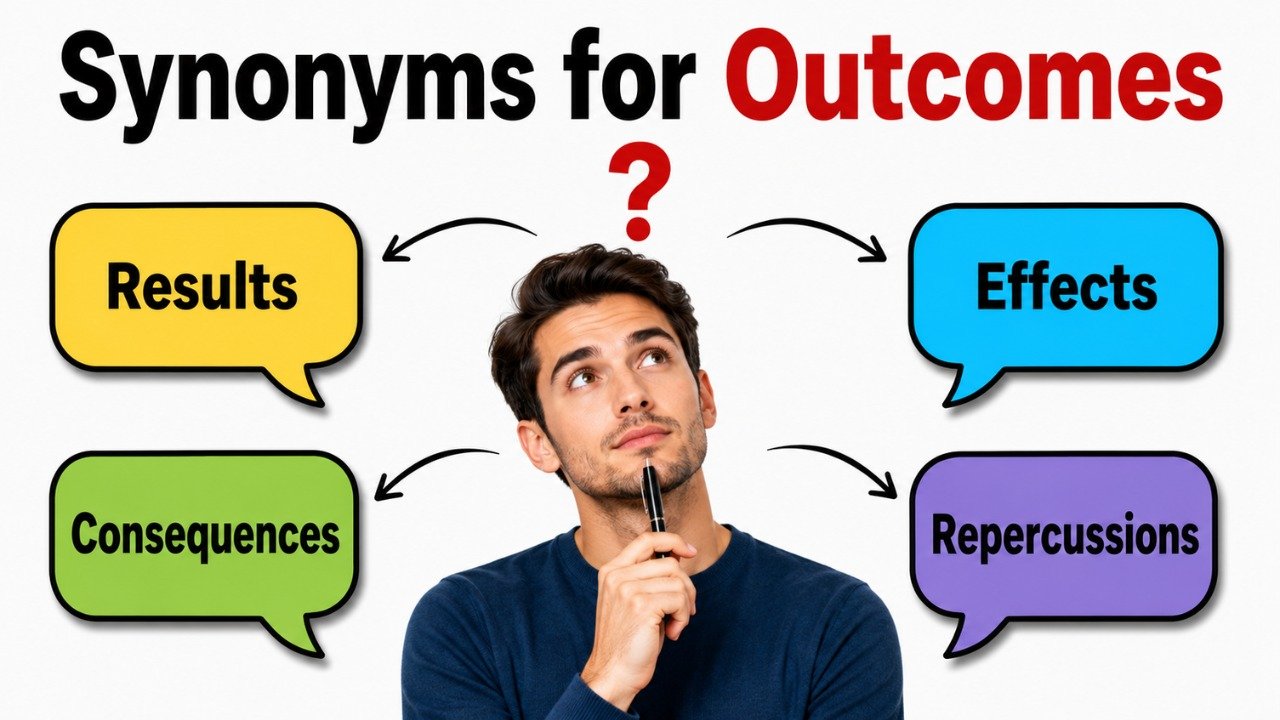
Quick Answer: The best synonyms for outcomes include results, consequences, effects, impacts, findings, conclusions, resolutions, developments, end results, and final results. Among these synonyms for outcomes, results is the most flexible choice for general, academic, and professional writing. Use consequences for effects caused by an action, findings for research evidence, impacts for significant changes, resolutions for settled problems, conclusions for final judgments, and developments for changes that emerge over time.
Pronunciation and Word Details
Word: Outcomes.
Pronunciation: /ˈaʊt.kʌmz/
Part of Speech: Plural noun.
Meaning: The final results, effects, or consequences of actions, events, processes, or decisions.
US Pronunciation:
UK Pronunciation:
What Does “Outcomes” Mean?
Outcomes means the final results, effects, or consequences produced by actions, decisions, events, processes, or situations. It is the plural form of the countable noun outcome.
An outcome explains what happened after something was attempted, completed, experienced, or decided.
Example: The researchers compared the outcomes of the two treatments.
In this sentence, outcomes refers to the results produced by the treatments.
The word can describe positive, negative, expected, unexpected, measurable, or uncertain results.
Example: Careful planning can improve project outcomes.
Outcomes is commonly used in education, research, health care, business, public policy, project management, law, economics, and everyday conversation.
In education, learning outcomes describe what students should know or be able to do after completing a lesson or course.
Example: The teacher explained the learning outcomes at the beginning of the class.
In business, outcomes may refer to sales growth, customer satisfaction, efficiency, cost savings, or completed goals.
Example: The team reviewed the outcomes of its new strategy.
In everyday language, outcomes can refer to possible endings or consequences.
Example: We discussed the possible outcomes before making a decision.
The word usually focuses on what finally happens rather than the steps that produced it.
Meaning, Tone, and Context of “Outcomes”
Outcomes has a neutral, formal, and analytical tone. It is especially common in professional, academic, scientific, medical, educational, and administrative writing.
The word does not automatically suggest success or failure. An outcome may be positive, negative, mixed, uncertain, or unexpected.
Positive Context: The training program produced strong employment outcomes.
Negative Context: Delayed action led to poor financial outcomes.
Neutral Context: The report compares the outcomes of three different approaches.
Academic Context: The study measured learning outcomes across several age groups.
Professional Context: Managers evaluated whether the project achieved its intended outcomes.
Outcomes sounds more formal than what happened or how things turned out. In casual conversation, results, effects, or endings may sound more natural.
Formal: The discussion produced several possible outcomes.
Casual: The discussion could lead to several different results.
The word is often used when evaluating performance, progress, effectiveness, risk, or success. It is useful because it can cover both direct and indirect results.
However, outcomes can become vague when writers do not explain what was measured. Specific terms such as sales growth, test scores, recovery rates, findings, or cost savings may provide greater clarity.
When and How to Use “Outcomes”
For General Results
Use outcomes when referring to the final results of an action, event, process, or decision.
Example: The committee reviewed the outcomes of the policy change.
For Research
Use outcomes when measuring the effects of a study, experiment, treatment, or intervention.
Example: The researchers recorded several positive outcomes.
For Education
Use outcomes when describing the knowledge, skills, or abilities students should develop.
Example: Each lesson includes clear learning outcomes.
For Business Performance
Use outcomes when discussing whether a strategy, investment, campaign, or project achieved its goals.
Example: The company compared the outcomes of its two sales plans.
For Health and Treatment
Use outcomes when discussing recovery, symptoms, quality of life, or treatment effectiveness.
Example: Early support may improve patient outcomes.
For Decisions
Use outcomes when considering what may happen after a choice is made.
Example: The leaders examined all possible outcomes before approving the plan.
For Projects
Use outcomes when describing the changes or benefits created by completed work.
Example: The project outcomes included faster service and lower costs.
For Public Programs
Use outcomes when evaluating whether a program created meaningful change.
Example: The report measured employment and education outcomes.
For Risk Assessment
Use outcomes when comparing possible positive and negative consequences.
Example: The team considered the likely outcomes of delaying the launch.
For Personal Choices
Use outcomes when discussing the final effects of habits, plans, or decisions.
Example: Different study routines can produce different outcomes.
Best Synonyms for Outcomes
Results: The things produced or achieved by an action or process.
Example: The team presented the results of the investigation.
Consequences: The effects that follow an action, event, or decision.
Example: The policy may have serious economic consequences.
Effects: The changes caused by a particular action or influence.
Example: Researchers examined the effects of regular exercise.
Impacts: Strong or noticeable effects on people, systems, or situations.
Example: The report describes the environmental impacts of construction.
Findings: Information or facts discovered through research or investigation.
Example: The findings support the original argument.
Conclusions: Final judgments formed after considering evidence or information.
Example: The committee reached several important conclusions.
Resolutions: Final solutions or settled endings to problems or disagreements.
Example: Both sides worked toward peaceful resolutions.
Developments: New events, changes, or stages that emerge over time.
Example: Recent developments changed the direction of the project.
End Results: The final conditions or products of an activity.
Example: The end results were better than the team expected.
Final Results: The confirmed results available after a process is complete.
Example: The final results will be announced next week.
50 Synonyms for Outcomes with Short Meanings
- Results: Things produced or achieved by an action.
- Consequences: Effects that follow actions or decisions.
- Effects: Changes caused by a particular influence.
- Impacts: Strong or noticeable effects on a situation.
- Findings: Facts discovered through research or investigation.
- Conclusions: Final judgments based on evidence or thought.
- End Results: Final products or conditions after a process.
- Final Results: Confirmed results at the end of an activity.
- Resolutions: Settled endings or solutions to problems.
- Developments: Changes or events that emerge over time.
- Products: Things produced by work, activity, or thought.
- Outputs: Work, information, or material produced by a system.
- Returns: Benefits or gains received from an investment or effort.
- Yields: Amounts or benefits produced by an activity.
- Gains: Positive improvements, increases, or benefits.
- Losses: Negative reductions, failures, or disadvantages.
- Benefits: Helpful or favorable results.
- Repercussions: Indirect effects, often negative or serious.
- Ramifications: Complex consequences of an action or decision.
- Implications: Possible effects or meanings suggested by something.
- Aftereffects: Effects that continue after an event has ended.
- Fallout: Unpleasant consequences following an event or decision.
- Aftermath: The situation that exists after a major event.
- Upshots: Final results or main consequences of a situation.
- Endpoints: Final stages or points in a process.
- Endings: Ways in which situations, stories, or processes finish.
- Finales: Final parts or concluding events.
- Decisions: Final choices made after consideration.
- Verdicts: Formal decisions or judgments.
- Settlements: Agreements that end disputes or claims.
- Answers: Solutions or responses to questions and problems.
- Solutions: Ways of resolving problems or difficulties.
- Achievements: Successful results gained through effort.
- Accomplishments: Tasks or goals completed successfully.
- Successes: Favorable results or completed goals.
- Failures: Unsuccessful results or unmet goals.
- Changes: Differences produced by actions or events.
- Transformations: Major changes in form, condition, or character.
- Improvements: Changes that make something better.
- Responses: Reactions produced by actions or conditions.
- Reactions: Effects or behaviors caused by an event.
- Performance Results: Measures showing how well something worked.
- Test Results: Information produced by an examination or test.
- Research Findings: Facts discovered through systematic study.
- Consequences of Action: Effects produced by a specific decision or behavior.
- End States: Final conditions reached after a process.
- Final Positions: Conditions or viewpoints reached at the end.
- Deliverables: Completed items produced by a project.
- Payoffs: Benefits or rewards gained from effort or risk.
- Byproducts: Secondary results produced alongside the main result.
Read Also:
Synonyms for Fan

Synonyms for Outcomes by Context
When Outcomes Means General Results
Results, end results, final results, upshots, and products are useful when referring to what an action or process produced.
Example With Outcomes: The outcomes of the meeting were encouraging.
Example With Results: The results of the meeting were encouraging.
Results is usually the simplest and most flexible replacement. End results emphasizes the final stage, while upshots has a more conversational tone.
When Outcomes Means Consequences
Consequences, repercussions, ramifications, fallout, aftereffects, and aftermath describe what happens because of an action or event.
Example With Outcomes: The decision may create unexpected outcomes.
Example With Consequences: The decision may create unexpected consequences.
Consequences can be positive or negative, although it often sounds negative. Repercussions and fallout usually suggest harmful or difficult effects.
When Outcomes Means Research Evidence
Findings, research findings, test results, conclusions, and evidence are useful in studies, reports, experiments, and investigations.
Example With Outcomes: The outcomes confirmed the original theory.
Example With Findings: The findings supported the original theory.
Findings refers to discovered information. Conclusions refers to judgments formed from that information.
When Outcomes Means Strong Effects
Impacts, effects, changes, transformations, and responses describe how something influences people, systems, or conditions.
Example With Outcomes: The program created positive outcomes for local families.
Example With Impacts: The program created positive impacts for local families.
Impacts works well when the changes are significant. Effects is broader and more neutral.
When Outcomes Means Successful Achievements
Achievements, accomplishments, successes, gains, benefits, and improvements emphasize favorable results.
Example With Outcomes: The project produced several important outcomes.
Example With Achievements: The project produced several important achievements.
Achievements usually result from effort. Benefits are helpful results, while gains often involve measurable improvement.
When Outcomes Means Final Decisions
Decisions, verdicts, resolutions, settlements, conclusions, and final positions refer to judgments or agreements reached after discussion.
Example With Outcomes: The legal outcomes were announced in the afternoon.
Example With Verdicts: The legal verdicts were announced in the afternoon.
Verdict is best for a formal legal judgment. Resolution works for settled disputes, while decision is the broadest term.
When Outcomes Means Project Products
Outputs, deliverables, products, performance results, and end products describe things created or completed by a project.
Example With Outcomes: The team submitted all required outcomes.
Example With Deliverables: The team submitted all required deliverables.
Deliverables refers to specific items that a team must complete. Outcomes refers to the broader changes created by those items.
When Outcomes Means Possible Endings
Endings, endpoints, finales, end states, and resolutions describe how stories, situations, or processes finish.
Example With Outcomes: The story has several possible outcomes.
Example With Endings: The story has several possible endings.
Ending is more natural for stories. End state works better for systems, plans, or technical processes.
Another Word for Outcomes
Results is usually the best single replacement for outcomes because it works in general, professional, educational, and academic contexts. However, the best alternative depends on what the sentence emphasizes.
Use consequences when discussing effects caused by actions, findings for discoveries from research, impacts for major changes, and resolutions for settled problems.
Original: The team discussed the outcomes of the new strategy.
Better Option: The team discussed the results of the new strategy.
Original: The study reported several unexpected outcomes.
Better Option: The study reported several unexpected findings.
Original: The decision may have serious outcomes for employees.
Better Option: The decision may have serious consequences for employees.
Original: The program created positive outcomes in the community.
Better Option: The program created positive impacts in the community.
When Not to Use “Outcomes”
Outcomes is useful but can sound vague, repetitive, overly formal, or less precise than another word.
When Specific Results Are Available
Use the exact result instead of the broad word outcomes.
Weak: The training created positive outcomes.
Better: The training improved employee accuracy and reduced delays.
When Referring to Research Discoveries
Findings may be more precise than outcomes when describing information discovered during a study.
Weak: The research outcomes revealed a connection between sleep and concentration.
Better: The research findings revealed a connection between sleep and concentration.
When Referring to Direct Consequences
Consequences may explain the relationship between an action and its effects more clearly.
Weak: Ignoring the warning produced serious outcomes.
Better: Ignoring the warning produced serious consequences.
When Discussing Project Items
Deliverables or outputs may be more accurate when referring to completed documents, products, or reports.
Weak: The project outcomes included a report and a training guide.
Better: The project deliverables included a report and a training guide.
In Casual Conversation
Outcomes can sound overly formal when results or what happened would sound more natural.
Weak: We will see what outcomes occur after the game.
Better: We will see what happens after the game.
When Repeating the Word
Frequent repetition makes analytical writing sound mechanical.
Weak: The project outcomes improved health outcomes and education outcomes.
Better: The project results improved health conditions and educational achievement.
When the Outcome Has Not Happened Yet
Use expectations, predictions, possibilities, or goals when discussing something that remains uncertain.
Weak: The outcomes for next year include higher sales.
Better: The goals for next year include higher sales.
When Describing Causes
Outcomes are results, not reasons or causes.
Weak: Poor planning was one of the outcomes of the delay.
Better: Poor planning was one of the causes of the delay.
Words Commonly Confused With Outcomes
Outcomes vs Results: Outcomes and results often overlap. Results usually refers to what was produced, while outcomes may emphasize broader or longer lasting changes.
Outcomes vs Outputs: Outputs are the immediate products created by an activity. Outcomes are the effects or changes produced by those outputs.
Outcomes vs Consequences: Outcomes can be positive, negative, or neutral. Consequences often emphasizes the effects caused by a choice or action.
Outcomes vs Impacts: Outcomes are final or observed results. Impacts are often broader, stronger, or longer lasting effects.
Outcomes vs Findings: Outcomes are results produced by an event or process. Findings are facts discovered through research or investigation.
Outcomes vs Conclusions: Outcomes describe what happened. Conclusions describe what people decide or believe after reviewing evidence.
Outcomes vs Objectives: Outcomes are the results actually produced. Objectives are the goals people intend to achieve.
Outcomes vs Predictions: Outcomes are what finally happens. Predictions are statements about what may happen.
Outcomes vs Deliverables: Outcomes are changes or benefits created by a project. Deliverables are specific items the project must produce.
Outcomes vs Achievements: Outcomes may be positive or negative. Achievements are successful results gained through effort.
Which Synonym Should You Choose?
For General Writing: Choose results because it is direct, familiar, and widely understood.
For Formal Writing: Choose outcomes, consequences, findings, conclusions, or impacts depending on the meaning.
For Casual Speech: Choose results, effects, endings, or what happened.
For Research: Choose findings for discovered evidence, results for measured data, and conclusions for final interpretations.
For Reports: Choose outcomes for broad changes, results for measured performance, and impacts for significant effects.
For Essays: Choose consequences when discussing cause and effect, findings when discussing evidence, and conclusions when presenting final judgments.
For Business: Choose results for performance, returns for investment benefits, gains for improvement, and deliverables for completed project items.
For Education: Choose learning outcomes for expected skills and results for test performance.
For Health Writing: Choose health outcomes for broad patient changes, effects for treatment influence, and results for test information.
For Legal Writing: Choose verdicts for court judgments, settlements for agreements, and resolutions for settled disputes.
For Emails: Choose results in ordinary professional messages and outcomes in formal planning or evaluation messages.
For Conversation: Choose results when discussing what happened and consequences when warning about future effects.
For Positive Emphasis: Choose benefits, gains, achievements, successes, or improvements.
For Negative Emphasis: Choose consequences, repercussions, fallout, losses, or failures.
Real Life Examples of “Outcomes” in Sentences
Original: The manager reviewed the outcomes of the training program.
Better Option: The manager reviewed the results of the training program.
Original: The researchers published the outcomes of the experiment.
Better Option: The researchers published the findings of the experiment.
Original: The decision created several negative outcomes.
Better Option: The decision created several negative consequences.
Original: The charity measured the outcomes of its community work.
Better Option: The charity measured the impacts of its community work.
Original: The project outcomes included two reports and a guide.
Better Option: The project deliverables included two reports and a guide.
Original: Students achieved better outcomes after receiving support.
Better Option: Students achieved better results after receiving support.
Original: The discussion produced peaceful outcomes.
Better Option: The discussion produced peaceful resolutions.
Original: The investment generated strong financial outcomes.
Better Option: The investment generated strong financial returns.
Original: The policy outcomes affected several departments.
Better Option: The policy effects influenced several departments.
Original: The story allows readers to imagine different outcomes.
Better Option: The story allows readers to imagine different endings.
Synonym Groups and Usage Differences
General Result Group
Results, end results, final results, upshots, products, and end states describe what finally happens or is produced.
Results is the broadest and most natural choice. End results emphasizes completion, while upshots often summarizes the main consequence.
Example: The final results showed a clear improvement in performance.
Cause and Effect Group
Consequences, effects, repercussions, ramifications, aftereffects, fallout, and aftermath describe what follows an action or event.
Consequences is broad. Repercussions and fallout usually suggest negative effects. Aftermath refers to the situation remaining after a major event.
Example: The company considered the possible consequences of closing the office.
Research Group
Findings, research findings, test results, conclusions, answers, and evidence are common in studies and investigations.
Findings presents discovered information. Conclusions interprets that information. Test results refers to measured or recorded data.
Example: The research findings identified several patterns in customer behavior.
Change Group
Impacts, changes, transformations, developments, improvements, responses, and reactions describe how a condition changes.
Impact suggests a meaningful effect. Transformation describes major change. Development may be positive, negative, or neutral.
Example: The program created lasting improvements in reading ability.
Success Group
Achievements, accomplishments, successes, gains, benefits, returns, yields, and payoffs emphasize positive outcomes.
Achievements and accomplishments involve completed goals. Returns often relates to investment, while yields describes what an activity produces.
Example: Increased confidence was one of the main benefits of the course.
Negative Result Group
Losses, failures, fallout, repercussions, and adverse effects describe unfavorable outcomes.
Failures refers to unmet goals. Losses often involve money, resources, opportunities, or performance.
Example: Poor preparation resulted in financial losses.
Decision Group
Decisions, verdicts, settlements, resolutions, final positions, and conclusions describe choices or judgments reached at the end of a process.
Verdict is mainly legal. Settlement ends a dispute through agreement. Resolution may refer to either a solution or a formal decision.
Example: Both parties accepted the final settlement.
Project Group
Outputs, deliverables, products, performance results, and achievements are useful in project management.
Outputs are immediate products. Deliverables are required items. Outcomes are broader changes created by the project.
Example: The final deliverables included a report, a guide, and a presentation.
Antonyms of Outcomes
Outcomes has no single exact antonym because it refers to results. However, several words express contrasting ideas such as causes, beginnings, plans, or inputs.
Causes: Events or conditions that produce results.
Inputs: Resources, information, or effort put into a process.
Beginnings: Points at which events or processes start.
Origins: Sources from which something begins.
Intentions: Plans or purposes behind actions.
Objectives: Goals intended to be achieved.
Plans: Proposed methods for future action.
Expectations: Beliefs about what may happen.
Predictions: Statements about possible future events.
Assumptions: Ideas accepted before results are known.
Processes: Steps through which results are produced.
Methods: Ways used to perform tasks or reach goals.
Efforts: Work performed in pursuit of a result.
Actions: Things done before consequences occur.
Possibilities: Events that may happen but are not yet confirmed.
Comparison: Outcomes vs Related Words
Outcomes vs Results
Outcomes often describes broad changes or final effects. Results can refer to any direct product, measurement, or achievement.
Example With Outcomes: The program improved long term employment outcomes.
Example With Results: The test results were available the next morning.
Outcomes vs Consequences
Outcomes can be positive, negative, or neutral. Consequences emphasizes effects caused by actions and often carries a negative tone.
Example With Outcomes: The meeting produced several useful outcomes.
Example With Consequences: Breaking the rules may have serious consequences.
Outcomes vs Effects
Outcomes refers to final results. Effects refers to changes caused by something and may occur throughout a process.
Example With Outcomes: The final outcomes were encouraging.
Example With Effects: The researchers studied the effects of stress on sleep.
Outcomes vs Impacts
Outcomes describes observable results. Impacts usually suggests broader, stronger, or more lasting influence.
Example With Outcomes: The course produced positive learning outcomes.
Example With Impacts: The new school had a lasting impact on the community.
Outcomes vs Findings
Outcomes refers to what happens after an action or process. Findings refers to facts discovered through investigation or research.
Example With Outcomes: The treatment outcomes were positive.
Example With Findings: The findings revealed a connection between diet and energy levels.
Outcomes vs Conclusions
Outcomes are the results that occur. Conclusions are judgments formed after reviewing evidence.
Example With Outcomes: The policy produced mixed outcomes.
Example With Conclusions: The researchers reached cautious conclusions.
Outcomes vs Outputs
Outputs are immediate products or quantities produced. Outcomes are the wider changes or benefits resulting from those outputs.
Example With Outcomes: The training improved workplace outcomes.
Example With Outputs: The team completed five project outputs.
Outcomes vs Objectives
Outcomes are actual or expected results. Objectives are goals established before work begins.
Example With Outcomes: The project outcomes included lower processing times.
Example With Objectives: One project objective was to reduce processing times.
Common Phrases and Expressions With Outcomes
Positive Outcomes: Favorable or beneficial results.
Negative Outcomes: Harmful or unfavorable results.
Expected Outcomes: Results that are predicted or planned.
Desired Outcomes: Results that people hope to achieve.
Possible Outcomes: Different results that may occur.
Measurable Outcomes: Results that can be evaluated using clear evidence.
Learning Outcomes: Knowledge or skills students should gain.
Health Outcomes: Changes in health, recovery, or quality of life.
Project Outcomes: Changes, benefits, or results produced by a project.
Final Outcomes: Confirmed results reached at the end of a process.
Common Mistakes to Avoid
Confusing Outcomes With Outputs: Outputs are immediate products, while outcomes are broader effects or changes.
Incorrect: The report and training guide were the main outcomes.
Better: The report and training guide were the main outputs.
Using Outcomes Too Vaguely: Explain what the outcomes actually were.
Vague: The program created better outcomes.
Clearer: The program increased graduation rates and improved attendance.
Treating Outcomes as Always Positive: Outcomes can be positive, negative, mixed, or neutral.
Incorrect: Every outcome means a successful result.
Correct: An outcome may represent success, failure, or an unexpected effect.
Confusing Outcomes With Objectives: Objectives are intended goals. Outcomes are the results that occur.
Incorrect: The project outcomes are to reduce costs and improve speed.
Better: The project objectives are to reduce costs and improve speed.
Using Findings for Every Type of Outcome: Findings are mainly facts discovered through research or investigation.
Weak: The meeting findings included a new schedule.
Better: The meeting outcomes included a new schedule.
Repeating Outcomes Too Often: Replace repeated uses with precise words such as results, effects, findings, or consequences.
Repetitive: The study outcomes showed that treatment outcomes improved health outcomes.
Improved: The study results showed that treatment effects improved patient health.
Using Outcome When the Result Is Not Final: Use possibility, expectation, prediction, or goal for events that have not occurred.
Weak: Increased sales are the outcome for next year.
Better: Increased sales are the goal for next year.
Ignoring Singular and Plural Forms: Outcome refers to one result. Outcomes refers to two or more results.
Singular: The most likely outcome is a delay.
Plural: The plan may produce several outcomes.
Conclusion
The most useful synonyms for outcomes include results, consequences, effects, impacts, findings, conclusions, resolutions, and developments. Results is the best general replacement, while consequences suits cause and effect writing. Use findings for research, impacts for significant change, resolutions for settled problems, and deliverables for completed project items. Choosing synonyms for outcomes according to the exact context makes reports, essays, emails, and conversations clearer, more precise, and easier to understand.
FAQs About Synonyms for Outcomes
What Is the Best Synonym for Outcomes?
Results is the best general synonym because it works in everyday, academic, and professional writing.
What Is a Formal Synonym for Outcomes?
Consequences, findings, conclusions, impacts, resolutions, and final results are useful formal alternatives.
Are Outcomes and Results the Same?
They often overlap, but outcomes may describe broader or longer lasting changes. Results can refer to any direct measurement or product.
What Is Another Word for Positive Outcomes?
Benefits, gains, achievements, successes, improvements, and favorable results are strong alternatives.
What Is Another Word for Negative Outcomes?
Consequences, repercussions, losses, failures, fallout, and adverse effects can describe negative outcomes.
What Is the Difference Between Outcomes and Outputs?
Outputs are the immediate products created by an activity. Outcomes are the broader changes or benefits produced by those outputs.
What Is a Synonym for Outcomes in Research?
Findings, results, conclusions, effects, and research findings are suitable choices depending on the sentence.
