
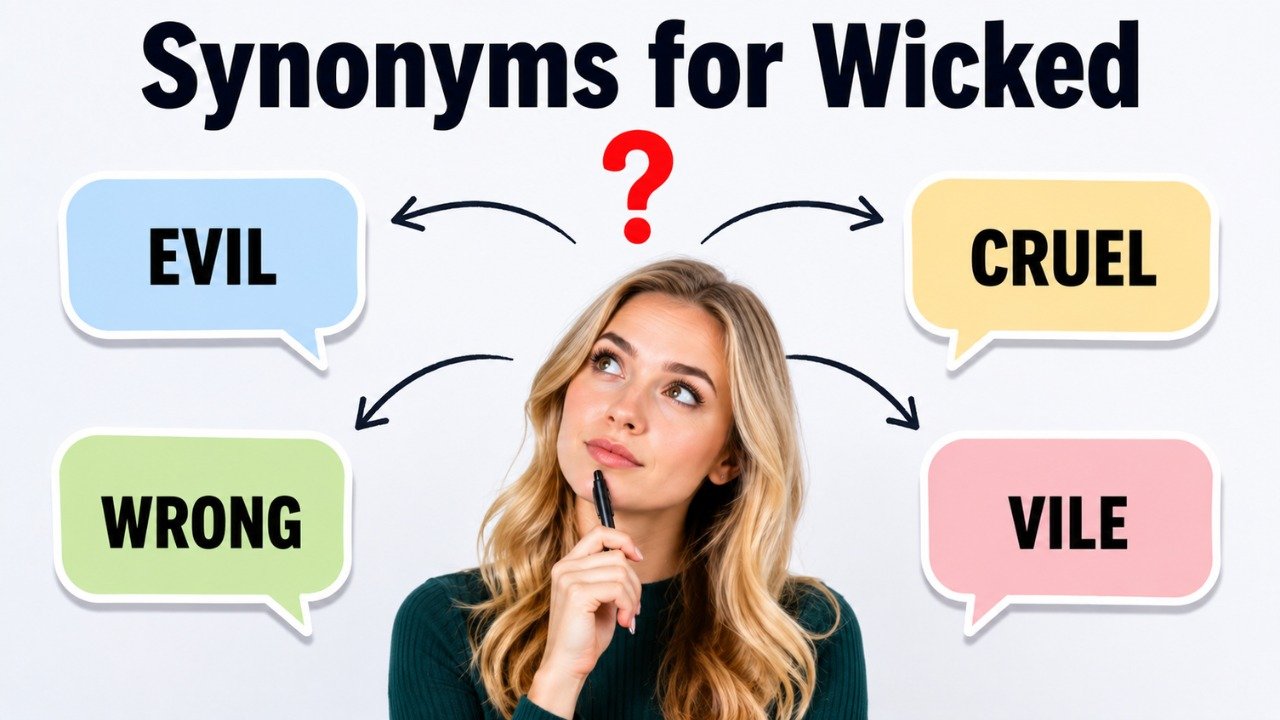
Quick Answer: The best synonyms for wicked include evil, immoral, malicious, cruel, sinister, vile, mischievous, terrible, severe, and excellent. Evil is the strongest general replacement when wicked describes moral wrongdoing. Malicious works for harmful intentions, while cruel suits behavior that causes suffering. Mischievous is better for playful bad behavior. Terrible and severe fit unpleasant or intense conditions. In casual speech, wicked can also mean excellent, impressive, or extremely enjoyable.
Pronunciation and Word Details
Word: Wicked.
Pronunciation: /ˈwɪk.ɪd/
Part of Speech: Adjective.
Meaning: Morally bad, harmful, mischievous, extremely unpleasant, or impressively good in informal speech.
US Pronunciation:
UK Pronunciation:
What Does “Wicked” Mean?
Wicked means morally bad, deliberately harmful, cruel, or deeply unpleasant. It is an adjective used to describe people, actions, intentions, conditions, problems, and experiences.
The most traditional meaning of wicked is evil or morally wrong. A wicked person may knowingly harm, deceive, or mistreat others. A wicked act is one that violates accepted moral standards.
The word can also describe playful or disobedient behavior. In this sense, wicked may mean naughty or mischievous rather than truly evil.
Wicked sometimes strengthens a negative description. A wicked storm may be violent, while a wicked headache may be extremely painful.
In informal positive speech, wicked can mean excellent, impressive, exciting, or highly enjoyable. Context determines whether the word is negative or positive.
Moral Wrongdoing: The story describes a wicked ruler who mistreats innocent people.
Harmful Intention: She discovered the villain’s wicked plan.
Cruel Behavior: It was wicked to frighten the child deliberately.
Mischievous Behavior: The puppy gave a wicked look before stealing the sock.
Severe Condition: A wicked storm damaged several trees.
Informal Praise: He played a wicked guitar solo.
Because wicked has several meanings, writers should choose surrounding words that make the intended sense clear.
Meaning, Tone, and Context of “Wicked”
Wicked usually has a strong, negative, and emotional tone. It can express moral judgment, anger, fear, or disapproval. However, its tone changes significantly in playful and informal contexts.
Moral Tone: Wicked strongly condemns a person, action, plan, or intention as evil or morally wrong.
Emotional Tone: The word can express shock, anger, disgust, or fear.
Literary Tone: Wicked commonly appears in stories, legends, dramatic descriptions, and character portrayals.
Conversational Tone: In everyday speech, it may describe someone as naughty, troublesome, or playfully mischievous.
Intensifying Tone: Wicked can emphasize the severity of pain, weather, speed, difficulty, or another condition.
Informal Positive Tone: In casual conversation, wicked may mean excellent, impressive, exciting, or highly skilled.
Formal Context: In reports, essays, and professional writing, words such as immoral, malicious, unethical, or cruel are often more precise.
Creative Context: Wicked is effective in fiction, storytelling, advertising language, dialogue, and dramatic descriptions because it creates a vivid emotional impression.
The word is not usually neutral. Even when it means excellent, it has an energetic and strongly approving tone.
When and How to Use “Wicked”
Use wicked when you want to describe serious moral wrongdoing, harmful intentions, mischievous behavior, severe conditions, or something impressive in informal speech.
For Moral Evil: Use wicked when a person or action is deeply immoral.
Example: The wicked leader ordered the punishment of innocent villagers.
For Harmful Intentions: Use wicked when someone deliberately plans to hurt, deceive, or exploit another person.
Example: The character developed a wicked scheme to steal the inheritance.
For Cruel Behavior: Use wicked when an action causes suffering and deserves strong condemnation.
Example: It was wicked to abandon the animals without food.
For Dishonest Conduct: Use wicked when deception or corruption is presented as morally serious.
Example: The official used wicked methods to hide the truth.
For Mischievous Behavior: Use wicked in a lighter way when someone is playfully disobedient or troublesome.
Example: The child gave a wicked smile before hiding behind the curtain.
For Severe Pain: Use wicked informally to emphasize intense physical discomfort.
Example: I developed a wicked headache after the long journey.
For Dangerous Weather: Use wicked to describe violent or extremely unpleasant conditions.
Example: A wicked wind shook the windows throughout the night.
For Difficult Problems: Use wicked informally when a task or problem is unusually challenging.
Example: The final puzzle contained a wicked question.
For Impressive Skill: Use wicked casually to praise a performance, ability, or achievement.
Example: She has a wicked singing voice.
For Exciting Experiences: Use wicked informally to mean highly enjoyable or impressive.
Example: We had a wicked time at the celebration.
Best Synonyms for Wicked
Evil
Synonym: Morally bad and willing to cause serious harm.
Example: The story follows an evil ruler who controls the region through fear.
Evil is the closest general synonym when wicked refers to deep moral wrongdoing.
Immoral
Synonym: Contrary to accepted principles of right and wrong.
Example: The committee condemned the immoral treatment of vulnerable workers.
Immoral is useful in formal writing, ethical discussions, and serious criticism.
Malicious
Synonym: Intending to cause harm, pain, or trouble.
Example: The message contained several malicious accusations.
Malicious focuses on harmful intention rather than general moral character.
Cruel
Synonym: Willing to cause pain or suffering without concern.
Example: The cruel ruler ignored the suffering of his people.
Cruel is the best choice when wicked behavior directly harms another person or animal.
Sinister
Synonym: Suggesting danger, evil, or harmful intentions.
Example: A sinister figure waited near the abandoned building.
Sinister describes something that appears threatening or connected with hidden danger.
Vile
Synonym: Extremely unpleasant, morally disgusting, or shameful.
Example: The witness described the attack as a vile act.
Vile expresses strong disgust and condemnation.
Mischievous
Synonym: Playfully troublesome or disobedient.
Example: The mischievous child replaced the labels on the jars.
Mischievous is more suitable than wicked when the behavior is playful rather than seriously harmful.
Terrible
Synonym: Extremely bad, unpleasant, or distressing.
Example: The region experienced terrible weather throughout the week.
Terrible works when wicked describes an unpleasant condition rather than moral evil.
Severe
Synonym: Very serious, intense, or harsh.
Example: She experienced severe pain in her shoulder.
Severe is a precise choice for pain, weather, punishment, damage, or difficulty.
Excellent
Synonym: Extremely good or impressive.
Example: The musician gave an excellent performance.
Excellent replaces wicked when the word is used as informal praise.
50 Synonyms for Wicked with Short Meanings
- Evil: Morally bad and deliberately harmful.
- Immoral: Contrary to accepted moral principles.
- Sinful: Considered wrong according to moral or religious standards.
- Corrupt: Dishonest and willing to misuse power.
- Depraved: Morally damaged in an extreme way.
- Vile: Morally disgusting or deeply unpleasant.
- Villainous: Characteristic of an evil person in a story or real situation.
- Malevolent: Having or showing a desire to cause harm.
- Malicious: Intending to hurt, damage, or trouble someone.
- Nefarious: Criminal, evil, or morally shocking.
- Sinister: Suggesting hidden danger or evil intention.
- Diabolical: Extremely evil, cruel, or difficult.
- Devilish: Evil, troublesome, or playfully mischievous.
- Demonic: Extremely evil or frightening.
- Fiendish: Cruel, evil, or extremely difficult.
- Cruel: Willing to cause pain or suffering.
- Heartless: Showing no sympathy or compassion.
- Ruthless: Willing to harm others to achieve a goal.
- Brutal: Extremely cruel, violent, or harsh.
- Merciless: Showing no kindness toward someone who is suffering.
- Savage: Fierce, violent, or cruel.
- Barbaric: Shockingly cruel or uncivilized.
- Callous: Emotionally insensitive to pain or suffering.
- Hateful: Full of strong dislike or deserving intense disapproval.
- Despicable: So bad that it deserves contempt.
- Abhorrent: Morally offensive and strongly disliked.
- Atrocious: Extremely cruel, bad, or unpleasant.
- Unethical: Not following accepted professional or moral standards.
- Unscrupulous: Willing to act dishonestly for personal advantage.
- Dishonest: Likely to deceive, cheat, or hide the truth.
- Criminal: Connected with unlawful or seriously wrongful behavior.
- Lawless: Ignoring or rejecting legal control.
- Bad: Morally wrong, harmful, or unpleasant.
- Wrong: Not morally acceptable or correct.
- Mischievous: Playfully troublesome or disobedient.
- Naughty: Behaving badly in a mild or playful way.
- Troublesome: Causing difficulty, annoyance, or disorder.
- Wayward: Difficult to control and unwilling to follow expectations.
- Disobedient: Refusing to follow rules or instructions.
- Dangerous: Likely to cause harm or serious trouble.
- Harmful: Causing injury, damage, or negative effects.
- Destructive: Causing serious damage or ruin.
- Terrible: Extremely bad or unpleasant.
- Dreadful: Very bad, frightening, or distressing.
- Awful: Extremely unpleasant or poor.
- Severe: Very serious, intense, or harsh.
- Fierce: Extremely strong, violent, or intense.
- Excellent: Extremely good or impressive.
- Impressive: Producing strong admiration.
- Brilliant: Exceptionally good, clever, or skillful.
Read Also:
Synonyms for Accepted
Synonyms for Wicked by Context
When Wicked Means Morally Evil
Use evil, immoral, sinful, corrupt, depraved, vile, villainous, or nefarious when describing serious moral wrongdoing.
Evil Example: The evil ruler ordered the destruction of the village.
Immoral Example: The investigation revealed immoral business practices.
Corrupt Example: The corrupt official accepted money in exchange for favors.
Nefarious Example: The group carried out a nefarious scheme.
Evil is the broadest replacement. Immoral sounds more formal, while nefarious creates a dramatic or literary tone.
When Wicked Means Deliberately Harmful
Use malicious, malevolent, sinister, harmful, or destructive when someone intends to cause pain, damage, or fear.
Malicious Example: The article contained malicious claims about several employees.
Malevolent Example: The character watched them with a malevolent expression.
Sinister Example: The note carried a sinister warning.
Malicious is best for harmful words, actions, rumors, or intentions. Sinister suggests hidden danger rather than direct action.
When Wicked Means Cruel
Use cruel, heartless, ruthless, brutal, merciless, callous, or savage when the main idea is causing suffering without compassion.
Cruel Example: It was cruel to mock him during a difficult moment.
Heartless Example: The heartless decision left several families without support.
Ruthless Example: The ruthless leader removed anyone who challenged his authority.
Merciless Example: The merciless attack continued throughout the night.
Cruel is the most flexible option. Ruthless often describes behavior driven by ambition or power.
When Wicked Means Morally Disgusting
Use vile, despicable, abhorrent, atrocious, or hateful when expressing strong disgust or condemnation.
Vile Example: The court described the act as vile and deliberate.
Despicable Example: Taking advantage of frightened people was despicable.
Abhorrent Example: The community rejected the abhorrent behavior.
These words are emotionally strong and should be used when serious condemnation is intended.
When Wicked Means Mischievous
Use mischievous, naughty, troublesome, wayward, or disobedient when the behavior is annoying or playful rather than evil.
Mischievous Example: The kitten made a mischievous attempt to open the cupboard.
Naughty Example: The naughty child drew pictures on the wall.
Troublesome Example: The troublesome puppy kept pulling the blanket from the bed.
Mischievous often sounds affectionate. Naughty is common for children or pets, while troublesome emphasizes inconvenience.
When Wicked Means Severe or Intense
Use severe, fierce, terrible, dreadful, awful, or intense when describing weather, pain, speed, difficulty, or another powerful condition.
Severe Example: He experienced severe pain after the fall.
Fierce Example: Fierce winds damaged the roof.
Dreadful Example: They faced dreadful conditions during the journey.
These alternatives are clearer than wicked in reports, instructions, and formal descriptions.
When Wicked Means Dangerous
Use dangerous, harmful, destructive, fierce, or threatening when the word describes something capable of causing injury or damage.
Dangerous Example: The hikers were caught in dangerous weather.
Destructive Example: The destructive storm damaged roads and buildings.
Harmful Example: The substance may have harmful effects.
Choose the word that identifies the exact type of danger.
When Wicked Means Excellent
Use excellent, impressive, brilliant, remarkable, superb, amazing, or outstanding when wicked expresses informal approval.
Excellent Example: She gave an excellent performance.
Impressive Example: He demonstrated impressive control of the instrument.
Brilliant Example: That was a brilliant idea.
Excellent works in most contexts. Brilliant and amazing sound more enthusiastic, while impressive focuses on admiration.
Another Word for Wicked
The best single replacement for wicked is evil when the word describes serious moral wrongdoing. However, wicked has several meanings, so the most accurate alternative depends on context.
Choose malicious for harmful intention, cruel for behavior that causes suffering, mischievous for playful wrongdoing, severe for intense conditions, and excellent for informal praise.
Original: The wicked ruler punished innocent citizens.
Better Option: The evil ruler punished innocent citizens.
Original: She received a wicked message intended to frighten her.
Better Option: She received a malicious message intended to frighten her.
Original: The puppy had a wicked habit of hiding shoes.
Better Option: The puppy had a mischievous habit of hiding shoes.
Original: He performed a wicked guitar solo.
Better Option: He performed an impressive guitar solo.
When Not to Use “Wicked”
Wicked is expressive, but it may be vague, overly dramatic, too informal, or inaccurate in certain contexts.
When You Need a Precise Moral Description
Wicked is broad. Formal writing often benefits from a more exact word such as immoral, corrupt, unethical, or criminal.
Weak: The report identified wicked conduct among senior officials.
Better: The report identified corrupt conduct among senior officials.
When The Behavior Is Only Playful
Calling mild misbehavior wicked may sound too serious unless the tone is clearly humorous.
Weak: The child made a wicked joke about hiding the keys.
Better: The child made a mischievous joke about hiding the keys.
When Describing Professional Misconduct
Use unethical, dishonest, fraudulent, or corrupt when discussing workplace or business behavior.
Weak: The manager used wicked hiring practices.
Better: The manager used unethical hiring practices.
When Describing Physical Pain
Severe, intense, sharp, or persistent is clearer in formal or medical communication.
Weak: She reported a wicked pain in her back.
Better: She reported severe pain in her back.
When Describing Weather Formally
Dangerous, violent, severe, or destructive gives clearer information.
Weak: The report warned residents about wicked weather.
Better: The report warned residents about severe weather.
When The Positive Meaning Could Be Misunderstood
Wicked can mean excellent in informal speech, but readers may interpret it negatively.
Weak: The candidate gave a wicked presentation.
Better: The candidate gave an excellent presentation.
When The Word Sounds Too Emotional
In objective reports and academic essays, strong moral language can weaken neutrality.
Weak: The policy produced wicked results.
Better: The policy produced harmful results.
When Repetition Makes The Writing Dramatic
Repeated use of wicked can make a paragraph sound exaggerated.
Weak: The wicked leader made a wicked plan with wicked consequences.
Better: The cruel leader developed a malicious plan with destructive consequences.
Words Commonly Confused With Wicked
Wicked vs Evil: Evil describes serious moral wrongdoing. Wicked can mean evil, mischievous, severe, or excellent depending on context.
Wicked vs Immoral: Wicked is emotional and broad. Immoral is more formal and specifically refers to behavior that violates moral standards.
Wicked vs Malicious: Wicked may describe a person’s entire character. Malicious focuses on an intention to cause harm.
Wicked vs Cruel: Wicked can involve many types of wrongdoing. Cruel specifically describes causing or ignoring suffering.
Wicked vs Sinister: Wicked directly describes evil or badness. Sinister suggests that something appears threatening or hides harmful intentions.
Wicked vs Mischievous: Wicked can be seriously negative. Mischievous usually describes playful trouble that causes limited harm.
Wicked vs Naughty: Wicked is stronger and may suggest evil. Naughty usually refers to mild disobedience, especially by children or pets.
Wicked vs Terrible: Wicked may involve morality, danger, intensity, or praise. Terrible simply means extremely bad or unpleasant.
Wicked vs Severe: Wicked is vivid and informal when describing pain or weather. Severe is more precise and suitable for formal communication.
Wicked vs Excellent: Wicked can mean excellent in casual speech, but excellent is clearer and appropriate in both formal and informal writing.
Which Synonym Should You Choose?
Choose evil when describing a deeply immoral person, action, plan, or force.
Choose immoral when discussing behavior that violates accepted principles of right and wrong.
Choose unethical for professional, academic, medical, or business conduct that breaks accepted standards.
Choose corrupt when someone misuses authority, money, or influence for personal advantage.
Choose malicious when a person deliberately intends to hurt, embarrass, deceive, or damage someone.
Choose malevolent when formal or literary writing requires a strong word for harmful intention.
Choose cruel when behavior causes physical or emotional suffering.
Choose heartless when the main issue is a lack of compassion.
Choose ruthless when someone pursues power or success without concern for others.
Choose vile or despicable when expressing strong moral disgust.
Choose sinister when something appears dangerous, threatening, or secretly evil.
Choose mischievous for playful behavior that causes minor trouble.
Choose naughty for mild disobedience in casual conversation.
Choose troublesome when someone or something repeatedly causes practical difficulty.
Choose severe for pain, weather, punishment, damage, or another intense condition.
Choose dangerous when the possibility of injury or harm matters most.
Choose destructive when something causes major physical, social, or emotional damage.
Choose terrible, dreadful, or awful for generally unpleasant experiences.
Choose excellent in reports, essays, emails, and professional praise.
Choose brilliant, impressive, or amazing for energetic praise in casual conversation.
Real Life Examples of “Wicked” in Sentences
Original: The wicked character deceived everyone in the village.
Better Option: The villainous character deceived everyone in the village.
Original: He created a wicked plan to damage his rival’s reputation.
Better Option: He created a malicious plan to damage his rival’s reputation.
Original: The ruler made a wicked decision that caused widespread suffering.
Better Option: The ruler made a cruel decision that caused widespread suffering.
Original: The company was accused of wicked business practices.
Better Option: The company was accused of unethical business practices.
Original: The child gave a wicked smile before hiding the toy.
Better Option: The child gave a mischievous smile before hiding the toy.
Original: We faced a wicked storm during the journey.
Better Option: We faced a severe storm during the journey.
Original: She woke with a wicked headache.
Better Option: She woke with an intense headache.
Original: The final question was wicked.
Better Option: The final question was extremely difficult.
Original: He has a wicked sense of humor.
Better Option: He has a mischievous sense of humor.
Original: The band gave a wicked performance.
Better Option: The band gave an outstanding performance.
Synonym Groups and Usage Differences
Moral Evil Group
Evil, immoral, sinful, depraved, corrupt, and villainous describe behavior or character that violates serious moral standards.
Evil is broad and powerful. Immoral is more formal. Corrupt often involves dishonesty and misuse of power, while depraved suggests extreme moral decline.
Example: The corrupt official used public money for private expenses.
Harmful Intention Group
Malicious, malevolent, sinister, nefarious, and diabolical relate to harmful plans or intentions.
Malicious directly identifies the desire to cause harm. Malevolent sounds formal, while sinister suggests hidden or approaching danger.
Example: The investigation uncovered a malicious effort to spread false information.
Cruelty Group
Cruel, heartless, ruthless, brutal, merciless, savage, and callous describe different forms of suffering and lack of compassion.
Cruel is the most flexible. Heartless emphasizes emotional coldness. Ruthless describes behavior that ignores harm while pursuing a goal.
Example: The heartless decision ignored the needs of vulnerable families.
Moral Disgust Group
Vile, despicable, abhorrent, atrocious, and hateful express strong disapproval.
These words do more than describe something as wrong. They communicate disgust, rejection, or contempt.
Example: The judge called the deliberate deception despicable.
Mischief Group
Mischievous, naughty, troublesome, wayward, disobedient, and devilish describe behavior that breaks rules or causes minor trouble.
Mischievous is often playful. Naughty is mild and conversational. Wayward suggests resistance to guidance over a longer period.
Example: The mischievous dog carried the gardener’s glove into the house.
Intensity Group
Severe, fierce, terrible, dreadful, awful, and intense describe powerful or unpleasant conditions.
Severe is precise and formal. Fierce often relates to weather, competition, or strength. Dreadful and awful express emotional reaction.
Example: Fierce winds made travel unsafe.
Danger and Damage Group
Dangerous, harmful, destructive, threatening, and lawless describe risk, injury, or disorder.
Dangerous emphasizes the possibility of harm. Destructive emphasizes the damage that occurs.
Example: The destructive fire damaged several buildings.
Positive Informal Group
Excellent, impressive, brilliant, amazing, superb, outstanding, and remarkable express approval.
These words replace wicked when it means extremely good. Excellent is the safest formal choice, while amazing and brilliant sound more enthusiastic.
Example: The speaker delivered an impressive presentation.
Antonyms of Wicked
The opposite of wicked depends on whether the word means evil, cruel, mischievous, severe, or excellent.
Good: Morally right or generally positive.
Moral: Following accepted principles of right and wrong.
Virtuous: Showing high moral standards.
Righteous: Acting in a morally correct way.
Honorable: Deserving respect because of honest and ethical behavior.
Ethical: Following accepted moral or professional standards.
Honest: Truthful and free from deception.
Kind: Caring about the needs and feelings of others.
Compassionate: Showing concern for suffering.
Merciful: Willing to forgive or reduce punishment.
Gentle: Calm, mild, and not harsh.
Benevolent: Kind and willing to help others.
Harmless: Unlikely to cause injury or damage.
Obedient: Willing to follow rules or instructions.
Well Behaved: Acting politely and following expectations.
Mild: Not severe, intense, or violent.
Pleasant: Enjoyable or agreeable.
Safe: Free from serious danger.
Poor: Not good or impressive in the positive informal sense.
Unimpressive: Failing to create admiration.
Comparison: Wicked vs Related Words
Wicked vs Evil
Wicked and evil can both describe serious moral wrongdoing. Evil is more direct and consistently negative. Wicked has additional meanings, including mischievous, severe, and excellent.
Example With Wicked: The wicked ruler planned to silence every critic.
Example With Evil: The evil ruler deliberately harmed innocent citizens.
Wicked vs Immoral
Wicked carries strong emotion and condemnation. Immoral sounds more formal and focuses on violation of moral standards.
Example With Wicked: The story portrays him as a wicked man.
Example With Immoral: The report criticized the organization’s immoral practices.
Wicked vs Malicious
Wicked may describe general character or behavior. Malicious specifically refers to the intention to cause harm.
Example With Wicked: The wicked character frightened the villagers.
Example With Malicious: She made a malicious attempt to damage his reputation.
Wicked vs Cruel
Wicked is broad and may involve dishonesty, evil, danger, or mischief. Cruel specifically involves causing suffering or showing no concern for it.
Example With Wicked: The wicked ruler abused his authority.
Example With Cruel: The cruel ruler denied food to the prisoners.
Wicked vs Sinister
Wicked directly describes something as morally bad. Sinister describes something that seems threatening, frightening, or connected with hidden evil.
Example With Wicked: They uncovered the wicked plan.
Example With Sinister: A sinister shadow appeared behind the curtain.
Wicked vs Vile
Wicked describes moral badness in a broad way. Vile expresses strong disgust and suggests that something is shameful or morally repulsive.
Example With Wicked: The character committed a wicked act.
Example With Vile: The attack was a vile act of cruelty.
Wicked vs Mischievous
Wicked can suggest serious evil or playful trouble. Mischievous normally refers to playful behavior that causes annoyance but not major harm.
Example With Wicked: The child wore a wicked grin before hiding the keys.
Example With Mischievous: The mischievous child hid the keys as a joke.
Wicked vs Naughty
Wicked is stronger and more dramatic. Naughty describes mild rule breaking or bad behavior.
Example With Wicked: The puppy developed a wicked habit of stealing socks.
Example With Naughty: The naughty puppy stole a sock from the basket.
Wicked vs Severe
Wicked is informal and expressive when describing pain, weather, or difficulty. Severe is precise and more appropriate in formal writing.
Example With Wicked: He had a wicked headache after the flight.
Example With Severe: He experienced a severe headache after the flight.
Wicked vs Excellent
Wicked can mean extremely good in informal speech. Excellent is clearer, more neutral, and suitable for professional contexts.
Example With Wicked: She gave a wicked performance.
Example With Excellent: She gave an excellent performance.
Common Phrases and Expressions With Wicked
Wicked Person: Someone considered deeply immoral or harmful.
Wicked Act: An action that is morally wrong or cruel.
Wicked Plan: A harmful, dishonest, or evil scheme.
Wicked Intentions: A desire to cause harm or commit wrongdoing.
Wicked Smile: An expression suggesting mischief, secret knowledge, or harmful intent.
Wicked Sense of Humor: A bold, playful, dark, or mischievous style of humor.
Wicked Storm: An extremely violent or unpleasant storm.
Wicked Headache: A very painful headache in informal speech.
Wicked Problem: An extremely difficult or complicated problem.
Wicked Performance: An excellent or impressive performance in casual speech.
Common Mistakes to Avoid
Ignoring The Multiple Meanings
Wicked does not always mean evil. It can also mean mischievous, severe, difficult, or excellent.
Unclear: The singer was wicked.
Clearer: The singer was exceptionally talented.
Using A Positive Meaning in Formal Writing
The positive meaning of wicked is informal and may confuse readers.
Informal: She delivered a wicked speech.
Formal: She delivered an outstanding speech.
Calling Mild Mischief Evil
Use mischievous or naughty when the behavior is playful and causes little harm.
Too Strong: The wicked child moved the teacher’s chair as a joke.
Better: The mischievous child moved the teacher’s chair as a joke.
Using Wicked Instead of A Precise Ethical Term
Formal writing often requires immoral, unethical, corrupt, dishonest, or criminal.
Vague: The organization followed wicked procedures.
Precise: The organization followed unethical procedures.
Confusing Cruelty With General Evil
Cruel is more precise when someone directly causes suffering.
General: It was wicked to leave the injured animal alone.
Precise: It was cruel to leave the injured animal alone.
Using Wicked for Every Intense Experience
Wicked is informal when describing pain, weather, speed, or difficulty.
Informal: The region experienced wicked rainfall.
Formal: The region experienced severe rainfall.
Repeating The Same Strong Word
Too much repetition reduces impact.
Repetitive: The wicked ruler created a wicked law with wicked consequences.
Improved: The cruel ruler created an unjust law with destructive consequences.
Using An Unnatural Noun Form
Wicked is an adjective. Wickedness is the related noun.
Incorrect: The story describes the wicked of the ruler.
Better: The story describes the wickedness of the ruler.
Confusing Wicked With Wickedly
Wicked describes a noun, while wickedly is an adverb that modifies a verb or adjective.
Incorrect: She smiled wicked.
Better: She smiled wickedly.
Alternative: She gave a wicked smile.
Forgetting Context
A sentence should make clear whether wicked is negative, playful, intense, or positive.
Unclear: That was wicked.
Clearer: That was a wickedly clever solution.
Alternative: That was an excellent solution.
Conclusion
The best synonyms for wicked depend on its intended meaning. Choose evil or immoral for moral wrongdoing, malicious for harmful intentions, and cruel for behavior that causes suffering. Mischievous and naughty suit playful misbehavior, while severe, fierce, or terrible describe intense conditions. When wicked means extremely good in casual speech, excellent, impressive, or brilliant provides greater clarity. Understanding these differences helps you select natural synonyms for wicked in essays, stories, reports, emails, and everyday conversation.
FAQs About Synonyms for Wicked
What Is the Best Synonym for Wicked?
Evil is the best general synonym when wicked means morally bad. The most accurate choice still depends on the sentence and intended tone.
Is Wicked Another Word for Evil?
Yes, wicked can mean evil or deeply immoral. However, it can also mean mischievous, severe, difficult, or excellent.
What Is a Formal Synonym for Wicked?
Immoral, unethical, malicious, corrupt, or nefarious may work in formal writing. Choose the word that identifies the exact type of wrongdoing.
What Is a Mild Synonym for Wicked?
Mischievous or naughty is suitable when wicked describes playful or minor misbehavior rather than serious evil.
What Is a Stronger Word Than Wicked?
Depraved, diabolical, nefarious, vile, or malevolent may sound stronger in specific contexts. These words should be used only when serious wrongdoing is intended.
Can Wicked Mean Excellent?
Yes. In informal speech, wicked can mean excellent, impressive, exciting, or highly skilled. This meaning may not be suitable for formal writing.
What Is the Opposite of Wicked?
Good is the broadest opposite. Other useful antonyms include moral, virtuous, ethical, kind, compassionate, harmless, and well behaved.
