
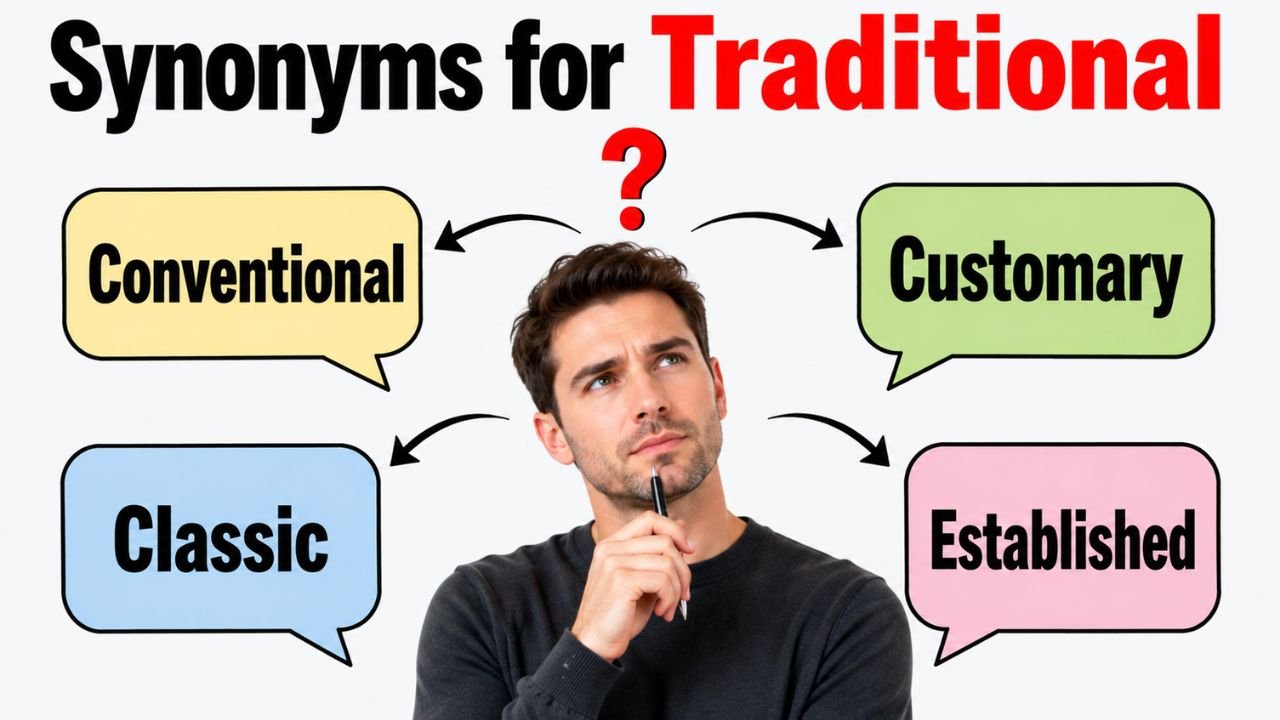
Quick Answer: Synonyms for traditional include conventional, customary, established, classic, orthodox, time honored, longstanding, ancestral, inherited, and historic. Choose customary when describing a community practice, conventional for an accepted method, classic for a lasting style, orthodox for established beliefs, and ancestral for customs passed through generations. Time honored adds respect and approval, while old fashioned may suggest that something feels outdated. The best replacement depends on whether traditional refers to culture, behavior, design, beliefs, clothing, food, or methods.
Pronunciation and Word Details
Word: Traditional.
Pronunciation: /trəˈdɪʃ.ən.əl/
Part of Speech: Adjective.
Meaning: Following customs, beliefs, styles, or methods that have existed for a long time.
US Pronunciation:
UK Pronunciation:
What Does “Traditional” Mean?
Traditional means connected with customs, beliefs, practices, or methods that have continued for a long time and are often passed from one generation to another.
Traditional is mainly used as an adjective. It describes a noun by showing that something belongs to an established custom, familiar practice, inherited belief, or older style.
Cultural Example: The dancers wore traditional clothing during the ceremony.
Method Example: The baker used a traditional method to prepare the bread.
Belief Example: The community continues to follow traditional values.
Design Example: The house has a traditional interior with carved furniture and patterned fabrics.
Food Example: The family served a traditional meal during the celebration.
The word can describe something respected and meaningful, but it can also describe something that is less modern or less flexible.
In a positive context, traditional may suggest heritage, authenticity, stability, respect, and cultural identity.
Example: The village is known for its traditional craftsmanship.
In a neutral context, it simply identifies an established way of doing something.
Example: The school uses a traditional classroom arrangement.
In a critical context, traditional may suggest resistance to change or dependence on outdated practices.
Example: The traditional process was too slow for the growing business.
Meaning, Tone, and Context of “Traditional”
Traditional usually has a neutral or positive tone. Its exact effect depends on the subject and the writer’s attitude.
Neutral Tone: Traditional can objectively describe a familiar or established practice.
Example: The restaurant serves traditional dishes from the region.
Positive Tone: It can communicate admiration for heritage, skill, continuity, and cultural meaning.
Example: Local artists preserve traditional weaving techniques.
Formal Tone: Traditional is appropriate in essays, reports, academic writing, professional communication, and historical descriptions.
Example: The study compares traditional teaching methods with newer approaches.
Conversational Tone: It is also common in daily speech when discussing food, clothing, families, celebrations, and design.
Example: We usually prepare a traditional dinner for the holiday.
Cultural Tone: Traditional often describes practices connected with a particular community, country, region, or family.
Example: Music is an important part of the traditional ceremony.
Critical Tone: Traditional may sound limiting when it describes ideas that do not allow change or individual choice.
Example: Some employees found the traditional management structure restrictive.
Traditional is commonly used in discussions about culture, religion, education, art, architecture, fashion, food, family life, ceremonies, business, law, and social behavior.
When and How to Use “Traditional”
For Cultural Customs
Use traditional when describing practices, celebrations, stories, music, or behavior that belong to a community or culture.
Example: The festival includes traditional songs and dances.
For Clothing and Dress
Use traditional for clothing that represents the history, identity, or customs of a group.
Example: The performers appeared in traditional dress.
For Food and Cooking
Use traditional when a dish, recipe, or cooking method has been used for many years.
Example: The soup is prepared according to a traditional family recipe.
For Ceremonies and Celebrations
Use traditional when an event follows familiar rituals or established customs.
Example: They chose a traditional wedding ceremony.
For Established Methods
Use traditional when referring to a familiar method that existed before newer alternatives.
Example: Traditional farming methods are still used in the valley.
For Beliefs and Values
Use traditional when describing ideas or standards that have been accepted for a long time.
Example: His grandparents held traditional views about family responsibilities.
For Art and Craftsmanship
Use traditional when artistic skills, materials, or designs have been passed through generations.
Example: The workshop teaches traditional pottery techniques.
For Architecture and Interior Design
Use traditional when a building or room uses established design features rather than modern ones.
Example: The living room combines traditional furniture with soft neutral fabrics.
For Education
Use traditional when describing familiar teaching practices, classroom structures, or learning methods.
Example: The course combines traditional instruction with practical activities.
For Business and Professional Practices
Use traditional when referring to established business structures or older ways of working.
Example: The company is moving away from traditional advertising methods.
Best Synonyms for Traditional
Conventional
Synonym: Following methods, ideas, or behavior generally accepted by most people.
Example: The researcher used a conventional method to collect the information.
Customary
Synonym: Commonly practiced according to the customs of a group or place.
Example: It is customary to greet every guest at the entrance.
Established
Synonym: Accepted and used successfully for a long period.
Example: The team followed an established procedure.
Classic
Synonym: Representing a lasting, widely admired, or familiar style.
Example: She selected a classic design for the dining room.
Orthodox
Synonym: Following officially accepted or firmly established beliefs and practices.
Example: The teacher presented the orthodox interpretation of the text.
Time Honored
Synonym: Respected because it has been practiced successfully for many years.
Example: The family continues a time honored holiday tradition.
Longstanding
Synonym: Existing or continuing for a long period.
Example: The event reflects a longstanding community custom.
Ancestral
Synonym: Connected with ancestors or inherited cultural history.
Example: The villagers returned to their ancestral homeland.
Inherited
Synonym: Received from previous generations rather than newly created.
Example: The artist uses techniques inherited from her grandparents.
Historic
Synonym: Connected with the history, character, or importance of the past.
Example: The town is working to protect its historic buildings.
50 Synonyms for Traditional with Short Meanings
- Conventional: Following generally accepted ideas or methods.
- Customary: Based on the usual customs of a community.
- Established: Accepted and practiced for a long time.
- Classic: Representing a lasting and familiar style.
- Orthodox: Following officially accepted beliefs or practices.
- Time Honored: Respected because of long use or history.
- Longstanding: Existing or continuing for many years.
- Inherited: Passed from an earlier generation.
- Ancestral: Connected with ancestors and family heritage.
- Historic: Related to important people, places, or practices from the past.
- Historical: Connected with a past period or historical development.
- Habitual: Done regularly as an established habit.
- Usual: Commonly done or normally expected.
- Standard: Accepted as the normal method or form.
- Accepted: Generally approved or recognized by a group.
- Familiar: Well known because it has been experienced often.
- Ceremonial: Connected with formal customs or rituals.
- Ritual: Performed according to a fixed ceremonial practice.
- Folk: Connected with the customs, stories, music, or art of ordinary people.
- Vernacular: Native or characteristic of a particular region or community.
- Age Old: Existing for a very long time.
- Old Established: Firmly recognized through long use.
- Handed Down: Passed from one generation to another.
- Hereditary: Transmitted through family lines or generations.
- Conservative: Favoring established customs over major change.
- Old Fashioned: Belonging to an earlier style or way of thinking.
- Formal: Following recognized rules, customs, or ceremony.
- Canonical: Accepted as an official or authoritative form.
- Classical: Connected with an established artistic or historical tradition.
- Mainstream: Accepted or practiced by the majority.
- Routine: Performed regularly in a familiar way.
- Regular: Happening according to an established pattern.
- Common: Frequently practiced or widely recognized.
- Typical: Showing the usual qualities of a group or style.
- Normal: Following the expected or ordinary pattern.
- Recognized: Officially or widely accepted as valid.
- Approved: Accepted as suitable according to existing standards.
- Sanctioned: Formally accepted or permitted by authority or custom.
- Prescribed: Required by rules, custom, or established practice.
- Fixed: Set in a form that is not easily changed.
- Entrenched: Firmly established and difficult to alter.
- Deep Rooted: Strongly established through history or belief.
- Enduring: Continuing successfully over a long period.
- Immemorial: Existing for longer than people can remember.
- Native: Naturally belonging to a particular place or culture.
- Local: Connected with the customs of a particular area.
- Rustic: Reflecting a simple rural or countryside tradition.
- Heritage: Connected with cultural practices preserved from the past.
- Old World: Reflecting the customs, charm, or style of earlier societies.
- Traditionalist: Favoring and following established customs or beliefs.
Read Also:
Synonyms for Eerie

Synonyms for Traditional by Context
When Traditional Means Customary
Customary, usual, habitual, regular, routine, and common describe something that people normally do according to habit or custom.
Customary Example: It is customary to remove outdoor shoes before entering the room.
Usual Example: They arrived at the usual meeting place.
Habitual Example: His habitual morning walk began before sunrise.
Routine Example: The inspection is part of the routine safety process.
Customary is especially useful for social practices, ceremonies, manners, and community behavior. Usual and routine are broader and may not carry a cultural meaning.
When Traditional Means Conventional
Conventional, standard, accepted, mainstream, normal, and typical describe methods or ideas that follow widely recognized expectations.
Conventional Example: The architect rejected a conventional floor plan.
Standard Example: The laboratory followed the standard testing procedure.
Accepted Example: This explanation reflects the accepted view.
Mainstream Example: The design is more restrained than most mainstream styles.
Conventional often contrasts with innovative, unusual, or experimental. Standard is useful for rules and procedures, while mainstream refers to ideas or practices accepted by most people.
When Traditional Means Connected With Heritage
Ancestral, inherited, hereditary, heritage, native, local, and handed down describe customs or knowledge passed through families and communities.
Ancestral Example: The family maintains a strong connection to its ancestral village.
Inherited Example: She protects the inherited knowledge of natural dyes.
Heritage Example: The museum celebrates the region’s heritage crafts.
Handed Down Example: The recipe was handed down through several generations.
These words emphasize cultural identity, family history, and continuity. Ancestral has a strong connection with ancestors, while inherited may refer to objects, knowledge, beliefs, or practices.
When Traditional Means Old and Respected
Time honored, age old, longstanding, enduring, immemorial, and old established describe practices valued because of their long history.
Time Honored Example: The guests participated in a time honored ceremony.
Age Old Example: The story reflects an age old struggle between duty and freedom.
Longstanding Example: The town continues its longstanding spring celebration.
Enduring Example: The building represents an enduring architectural style.
Time honored has a positive and respectful tone. Age old and immemorial emphasize great age, while longstanding simply means that something has existed for a long period.
When Traditional Means Classic in Style
Classic, classical, historic, historical, old world, rustic, and vernacular describe artistic, architectural, decorative, or literary styles associated with the past.
Classic Example: A classic wooden table anchors the room.
Classical Example: The building includes classical columns and balanced proportions.
Historic Example: The neighborhood contains several historic homes.
Rustic Example: The kitchen has a rustic country style.
Classic often describes a lasting and admired design. Classical usually refers to a specific artistic tradition. Historic relates to historical importance, while rustic suggests simple countryside character.
When Traditional Means Strictly Established
Orthodox, canonical, prescribed, sanctioned, fixed, and entrenched describe beliefs, rules, or systems that follow accepted authority.
Orthodox Example: His interpretation remained orthodox and closely followed established teaching.
Canonical Example: Students examined the canonical works of the period.
Prescribed Example: The ceremony followed the prescribed order.
Entrenched Example: The organization struggled to change its entrenched practices.
Orthodox is common in discussions of beliefs and established thinking. Canonical refers to officially accepted works or forms. Entrenched often has a negative tone because it suggests resistance to change.
When Traditional Means Conservative
Conservative, old fashioned, fixed, familiar, and traditionalist describe a preference for older values, methods, or social expectations.
Conservative Example: The institution takes a conservative approach to change.
Old Fashioned Example: Some readers considered the advice old fashioned.
Fixed Example: His fixed ideas left little room for discussion.
Traditionalist Example: The traditionalist group opposed the proposed reform.
Conservative can be neutral or critical. Old fashioned often suggests that something is outdated, while traditionalist describes a person or group that actively supports established customs.
Another Word for Traditional
Conventional is often the best general replacement for traditional when describing a familiar method, approach, structure, or idea. However, the most accurate alternative depends on context.
Use customary for social practices, classic for lasting styles, ancestral for inherited culture, orthodox for established beliefs, and time honored for respected customs.
Original: The school follows a traditional teaching method.
Better Option: The school follows a conventional teaching method.
Original: Guests observed the traditional greeting.
Better Option: Guests observed the customary greeting.
Original: The room features traditional furniture.
Better Option: The room features classic furniture.
Original: The village continues its traditional harvest ceremony.
Better Option: The village continues its time honored harvest ceremony.
When Not to Use “Traditional”
Traditional is a useful word, but it may be too broad, repetitive, vague, or emotionally unclear in some sentences.
When a Specific Cultural Term Is Available
Traditional may hide the exact cultural meaning of an object or practice.
Weak: The dancers wore traditional clothes.
Better: The dancers wore ceremonial clothing associated with their community.
The better sentence explains why the clothing is important instead of treating all cultural clothing as the same.
When You Mean Common Rather Than Historical
Traditional may suggest a long cultural history when the sentence only means normal or widely used.
Weak: The office uses a traditional filing system.
Better: The office uses a standard filing system.
When You Mean Respected and Lasting
Classic or time honored may communicate admiration more clearly.
Weak: She chose a traditional black dress.
Better: She chose a classic black dress.
When You Mean Outdated
Traditional can sound respectful or neutral. Old fashioned is more accurate when criticism is intended.
Weak: The policy reflects traditional thinking that no longer suits the workplace.
Better: The policy reflects old fashioned thinking that no longer suits the workplace.
When You Mean Officially Accepted
Orthodox, canonical, prescribed, or established may be more precise in academic or formal writing.
Weak: The article presents the traditional interpretation.
Better: The article presents the orthodox interpretation.
When the Word Becomes Repetitive
Using traditional many times in one paragraph weakens the writing.
Weak: The restaurant offers traditional food, traditional music, traditional decorations, and traditional entertainment.
Better: The restaurant offers customary dishes, folk music, heritage decorations, and local entertainment.
When the Meaning Is Too Vague
Explain what makes something traditional.
Weak: They followed a traditional process.
Better: They followed a process that had been used by local craftspeople for generations.
Words Commonly Confused With Traditional
Traditional vs Conventional: Traditional emphasizes history, customs, or inheritance. Conventional emphasizes what is generally accepted or normally done.
Traditional vs Customary: Traditional often describes practices passed through generations. Customary describes behavior normally expected within a group or situation.
Traditional vs Classic: Traditional relates to established customs or older styles. Classic describes something admired because its quality or style remains valuable over time.
Traditional vs Old Fashioned: Traditional can sound respectful or neutral. Old fashioned often suggests that something is outdated or no longer suitable.
Traditional vs Cultural: Traditional describes practices continued over time. Cultural is broader and includes ideas, language, art, behavior, and values shared by a group.
Traditional vs Historical: Traditional describes a continuing practice or style. Historical describes something related to the past, even when it is no longer practiced.
Traditional vs Historic: Traditional refers to established custom. Historic describes something important in history.
Traditional vs Orthodox: Traditional is broad and can describe food, clothing, design, or customs. Orthodox usually refers to established beliefs, interpretations, or approved practices.
Traditional vs Ancestral: Traditional refers to a custom or established method. Ancestral specifically connects something with ancestors or inherited family history.
Traditional vs Conservative: Traditional describes an established practice. Conservative describes a preference for preserving older systems and limiting major change.
Which Synonym Should You Choose?
Choose conventional when discussing generally accepted methods, structures, procedures, or behavior.
Choose customary when describing manners, greetings, social practices, ceremonies, and community expectations.
Choose established when writing about reliable procedures, recognized systems, or practices that have existed for a long time.
Choose classic when discussing clothing, furniture, literature, art, architecture, or design with lasting appeal.
Choose orthodox when writing about officially accepted beliefs, interpretations, or academic positions.
Choose time honored when you want to show respect for a practice that has continued for generations.
Choose ancestral when discussing family origins, inherited land, cultural identity, or practices connected with ancestors.
Choose inherited when describing knowledge, customs, skills, objects, or beliefs received from earlier generations.
Choose historic when describing a place, building, event, or object with historical importance.
Choose historical when something relates to a past period but is not necessarily important or still practiced.
Choose old fashioned when describing a method, idea, or style that appears outdated.
Choose standard when writing reports, instructions, professional emails, policies, or technical documents.
Choose folk when discussing community stories, music, art, dance, or cultural expression.
Choose ceremonial when describing formal clothing, events, objects, or actions used in a ritual.
Choose conservative when discussing a cautious approach that favors established systems over major change.
Real Life Examples of “Traditional” in Sentences
Original: The family prepared a traditional meal for the celebration.
Better Option: The family prepared a customary meal for the celebration.
Original: The company still uses a traditional management structure.
Better Option: The company still uses a conventional management structure.
Original: The bride chose a traditional dress for the ceremony.
Better Option: The bride chose a ceremonial dress for the occasion.
Original: The room has a traditional appearance.
Better Option: The room has a classic appearance.
Original: The villagers practice traditional methods of weaving.
Better Option: The villagers practice time honored methods of weaving.
Original: The professor explained the traditional interpretation.
Better Option: The professor explained the orthodox interpretation.
Original: The museum displays traditional tools from the region.
Better Option: The museum displays heritage tools from the region.
Original: The school follows a traditional lesson format.
Better Option: The school follows a standard lesson format.
Original: The singer performs traditional music.
Better Option: The singer performs folk music.
Original: The community protects its traditional lands.
Better Option: The community protects its ancestral lands.
Synonym Groups and Usage Differences
Custom Group
Customary, habitual, usual, routine, and regular describe actions repeated according to habit or social expectation.
Customary is the strongest choice for cultural behavior and social manners. Habitual focuses on repeated personal behavior. Routine and regular are useful for predictable schedules and procedures.
Example: It is customary for the host to welcome each guest personally.
Convention Group
Conventional, standard, mainstream, accepted, and normal describe methods or ideas widely recognized by society or a professional group.
Conventional contrasts with innovative or unusual. Standard is especially useful for official procedures. Mainstream refers to ideas accepted by most people.
Example: The builder used conventional materials throughout the property.
Heritage Group
Ancestral, inherited, heritage, hereditary, handed down, native, and local connect practices with family history or cultural identity.
Ancestral emphasizes a relationship with earlier generations. Heritage refers to customs and knowledge preserved from the past. Native and local connect something with a particular place.
Example: The craft reflects knowledge handed down through the family.
Longevity Group
Time honored, longstanding, age old, enduring, old established, and immemorial emphasize how long something has existed.
Time honored communicates respect. Longstanding is neutral and works well in professional writing. Immemorial creates a stronger literary sense of great age.
Example: The ceremony preserves a time honored community practice.
Style Group
Classic, classical, rustic, vernacular, historic, and old world describe visual, artistic, architectural, or decorative traditions.
Classic suggests lasting appeal. Classical refers to a recognized artistic tradition. Rustic emphasizes rural simplicity. Vernacular describes a style native to a region.
Example: The cottage combines rustic materials with vernacular architecture.
Belief Group
Orthodox, canonical, prescribed, sanctioned, and recognized describe ideas or practices accepted by authority or tradition.
Orthodox is useful for established beliefs. Canonical often relates to texts, art, or recognized works. Prescribed describes something required by rules or ceremony.
Example: The essay challenges the orthodox explanation of the event.
Resistance to Change Group
Conservative, fixed, entrenched, deep rooted, old fashioned, and traditionalist can suggest a preference for established ways.
Conservative may describe caution rather than complete opposition to change. Entrenched and fixed are usually more critical. Deep rooted may be positive or negative depending on context.
Example: The organization found it difficult to replace its entrenched procedures.
Antonyms of Traditional
The opposite of traditional changes according to whether the word describes age, style, methods, beliefs, or social behavior.
Modern: Belonging to the present period or using current ideas.
Contemporary: Existing or developing in the current time.
Innovative: Introducing a new and creative idea or method.
Unconventional: Different from what is normally accepted or expected.
Experimental: Testing new ideas, methods, or styles.
Progressive: Supporting development, reform, or social change.
Original: Newly created rather than copied from an established form.
Novel: New, unusual, or previously unfamiliar.
Alternative: Offering a different choice from the usual method.
Nontraditional: Not following established customs or expectations.
Modernized: Updated to suit present needs or conditions.
Revolutionary: Producing a major change in ideas, methods, or systems.
Flexible: Able to change rather than following a fixed practice.
Informal: Relaxed and not governed by strict ceremony or convention.
Individualistic: Based on personal choice rather than group tradition.
Comparison: Traditional vs Related Words
Traditional vs Conventional
Traditional emphasizes history, customs, and practices passed through generations. Conventional emphasizes what is widely accepted or commonly done.
Example With Traditional: The family served a traditional dish during the celebration.
Example With Conventional: The company used a conventional approach to staff training.
Traditional vs Customary
Traditional often describes something inherited from the past. Customary describes something normally expected in a particular group or situation.
Example With Traditional: They performed a traditional dance.
Example With Customary: It is customary to thank the host before leaving.
Traditional vs Classic
Traditional refers to established customs or styles. Classic refers to something admired because it remains attractive or valuable over time.
Example With Traditional: The house contains traditional wooden furniture.
Example With Classic: She selected a classic chair with balanced proportions.
Traditional vs Old Fashioned
Traditional may carry respect and cultural meaning. Old fashioned often suggests that something feels outdated.
Example With Traditional: The village preserves traditional farming knowledge.
Example With Old Fashioned: The office replaced its old fashioned filing system.
Traditional vs Cultural
Traditional focuses on practices that continue over time. Cultural includes the broader beliefs, language, art, behavior, and identity of a group.
Example With Traditional: The ceremony includes traditional music.
Example With Cultural: The exhibition explores the cultural identity of the region.
Traditional vs Historical
Traditional describes a continuing custom, belief, or method. Historical simply connects something with the past.
Example With Traditional: The community still prepares bread using a traditional method.
Example With Historical: The museum contains historical records about local farming.
Traditional vs Historic
Traditional relates to established practices. Historic describes something important or influential in history.
Example With Traditional: The performers wore traditional clothing.
Example With Historic: The agreement was signed in a historic building.
Traditional vs Orthodox
Traditional is broad and can describe customs, design, food, and behavior. Orthodox refers more specifically to officially accepted beliefs or interpretations.
Example With Traditional: The restaurant offers traditional regional dishes.
Example With Orthodox: The scholar defended the orthodox interpretation.
Traditional vs Ancestral
Traditional describes an established custom or style. Ancestral emphasizes a connection with ancestors or inherited origins.
Example With Traditional: They celebrated with traditional songs.
Example With Ancestral: They returned to their ancestral village.
Traditional vs Conservative
Traditional describes something based on long established practice. Conservative describes a preference for preserving existing systems and avoiding rapid change.
Example With Traditional: The ceremony followed a traditional format.
Example With Conservative: The committee adopted a conservative approach to reform.
Common Phrases and Expressions With Traditional
Traditional Values: Long established beliefs about proper behavior, family, society, or morality.
Example: The speech focused on traditional values and community responsibility.
Traditional Culture: Customs, beliefs, arts, and practices preserved by a community.
Example: The festival celebrates traditional culture through music and dance.
Traditional Dress: Clothing associated with the history or customs of a group.
Example: Participants wore traditional dress during the ceremony.
Traditional Cuisine: Foods and cooking practices associated with a particular region or culture.
Example: The menu includes traditional cuisine prepared with local ingredients.
Traditional Method: An established way of completing a task.
Example: The craftsman used a traditional method to shape the wood.
Traditional Approach: A familiar or established way of handling a subject or problem.
Example: The teacher combined a traditional approach with practical exercises.
Traditional Ceremony: A formal event that follows established customs or rituals.
Example: The couple chose a traditional ceremony attended by their families.
Traditional Family: A family structure based on long established social expectations.
Example: The novel examines changing ideas about the traditional family.
Traditional Craftsmanship: Skills and production methods passed through generations.
Example: The furniture displays remarkable traditional craftsmanship.
Traditional Style: A design based on familiar historical forms and details.
Example: The bedroom has a traditional style with carved wood and patterned fabrics.
Common Mistakes to Avoid
Using Traditional as an Exact Synonym for Old
Something can be old without being traditional. Traditional requires a connection with an established custom, style, practice, or belief.
Incorrect: The broken chair is traditional because it is old.
Correct: The chair has a traditional design based on an established regional style.
Assuming Traditional Always Means Positive
Traditional can suggest cultural value, but it may also describe methods that are rigid or outdated.
Unclear: The business maintains a traditional structure.
Clear: The business maintains an established structure that offers stability but limits flexibility.
Using Traditional for Every Cultural Detail
Repeatedly calling cultural objects traditional can remove important detail.
Weak: The room contained traditional art, traditional fabric, and traditional tools.
Improved: The room contained folk paintings, locally woven fabric, and heritage tools.
Confusing Traditional With Historical
Historical describes something related to the past. Traditional usually describes a custom or method that continues or remains recognized.
Incorrect: The book provides a traditional account of the war.
Correct: The book provides a historical account of the war.
Confusing Traditional With Historic
Historic means important in history, not simply old or customary.
Incorrect: The family prepared a historic meal every winter.
Correct: The family prepared a traditional meal every winter.
Choosing an Overly Negative Synonym
Do not replace traditional with old fashioned unless the sentence is meant to criticize.
Incorrect: The community protects its old fashioned songs and ceremonies.
Improved: The community protects its traditional songs and ceremonies.
Choosing a Synonym That Is Too Formal
Orthodox and canonical may sound unnatural in casual sentences about food, clothing, or home design.
Unnatural: She prepared an orthodox cake for the celebration.
Natural: She prepared a traditional cake for the celebration.
Repeating Traditional Too Often
Use contextual alternatives to create clearer and more varied writing.
Repetitive: The traditional festival included traditional music, traditional clothing, and traditional food.
Improved: The heritage festival included folk music, ceremonial clothing, and customary dishes.
Using Traditional Without Context
Explain the tradition, region, period, or community whenever the information matters.
Vague: The restaurant serves traditional food.
Clear: The restaurant serves regional dishes prepared from recipes passed through local families.
Conclusion
Synonyms for traditional help describe customs, styles, methods, and beliefs with greater accuracy. Use customary for social practices, conventional for accepted methods, classic for lasting design, ancestral for inherited culture, and orthodox for established beliefs. Time honored expresses respect, while old fashioned suggests that something may be outdated. Choosing the right alternative allows readers to understand whether a subject is culturally inherited, widely accepted, historically important, visually classic, or resistant to change.
FAQs About Synonyms for Traditional
What Is the Best Synonym for Traditional?
Conventional is the best general synonym for traditional. Customary, classic, established, and time honored may be more accurate in specific contexts.
What Is a Formal Synonym for Traditional?
Established, conventional, orthodox, longstanding, customary, and canonical are suitable for formal writing.
What Is Another Word for Traditional Culture?
Heritage culture, customary culture, ancestral culture, folk culture, and native culture may work depending on the intended meaning.
Are Traditional and Conventional the Same?
They are similar, but traditional emphasizes history and inherited customs. Conventional emphasizes what is generally accepted or normally done.
Is Classic a Synonym for Traditional?
Classic can replace traditional when discussing design, fashion, literature, architecture, or a lasting style. It does not usually replace traditional when describing customs or rituals.
What Is a Negative Synonym for Traditional?
Old fashioned, entrenched, fixed, and conservative can express a negative view when established practices prevent useful change.
What Is the Opposite of Traditional?
Common opposites include modern, contemporary, innovative, unconventional, experimental, progressive, and nontraditional.
