
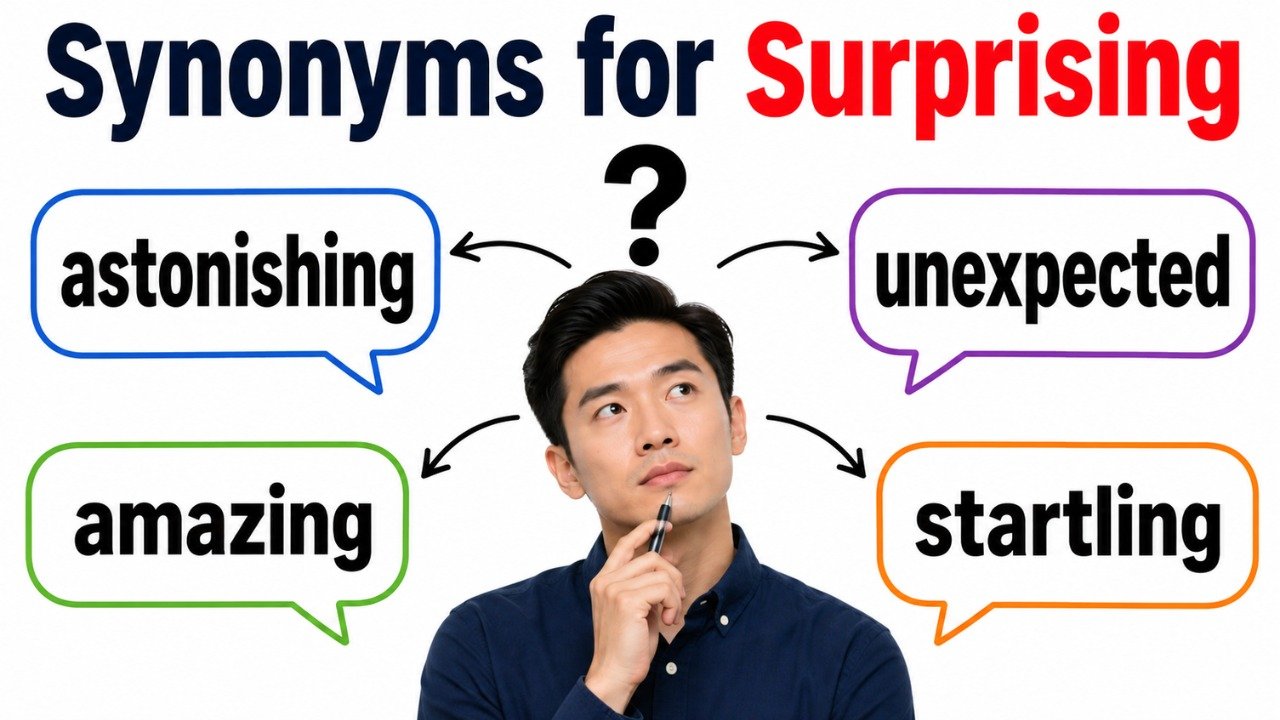
Quick Answer: The best synonyms for surprising include unexpected, astonishing, amazing, startling, shocking, remarkable, unforeseen, astounding, striking, and unusual. When choosing among synonyms for surprising, use unexpected for something not anticipated, astonishing or astounding for strong amazement, startling for a sudden reaction, shocking for something disturbing, remarkable for formal or positive writing, and unforeseen for events that could not reasonably be predicted.
Pronunciation and Word Details
Word: Surprising.
Pronunciation: /sərˈpraɪzɪŋ/
Part of Speech: Adjective.
Meaning: Causing surprise because something is unexpected, unusual, impressive, or difficult to predict.
US Pronunciation:
UK Pronunciation:
What Does “Surprising” Mean?
Surprising means causing someone to feel surprise because something is unexpected, unusual, impressive, or different from what was anticipated.
Surprising is mainly used as an adjective. It describes events, facts, results, decisions, behavior, discoveries, changes, and experiences that people did not expect.
Example: The final result was surprising.
In this sentence, surprising describes a result that differed from expectations.
The word can describe positive experiences.
Example: The restaurant offered a surprising variety of dishes.
It can also describe negative or concerning events.
Example: The sudden decline in attendance was surprising.
Surprising does not automatically mean good or bad. Its emotional meaning depends on the surrounding context.
Meaning, Tone, and Context of “Surprising”
Surprising is a neutral and flexible adjective. It works naturally in casual speech, professional communication, academic writing, reports, essays, descriptions, and everyday conversation.
The word expresses a reaction to something unexpected without necessarily showing whether that reaction is positive or negative.
In formal writing, surprising may sometimes be replaced by unexpected, remarkable, unforeseen, notable, or extraordinary when greater precision is needed.
In conversational language, amazing, startling, unbelievable, or incredible may express a stronger emotional reaction.
Surprising is generally less intense than astonishing, astounding, or shocking.
Neutral Tone: The results were surprising.
Positive Tone: Her rapid improvement was a surprising achievement.
Negative Tone: The sudden loss was surprising and concerning.
Formal Tone: The study produced an unexpected result.
Emotional Tone: The ending was absolutely astonishing.
When and How to Use “Surprising”
For Unexpected Events
Use surprising when something happens differently from what people expected.
Example: The sudden change in weather was surprising.
For Unexpected Results
Surprising is useful when results differ from predictions or assumptions.
Example: The final test results were surprising.
For Impressive Achievements
The word can describe an achievement that exceeds expectations.
Example: Her progress during the course was surprising.
For Unusual Behavior
Use surprising when someone’s action or decision seems unusual or unexpected.
Example: His decision to leave early was surprising.
For New Discoveries
Surprising can describe information that changes what people previously believed.
Example: The research revealed a surprising connection between the two factors.
For Sudden Reactions
Use stronger alternatives such as startling when something causes an immediate reaction.
Example: The sudden sound was startling.
For Strong Emotional Impact
Astonishing, astounding, or shocking may be more suitable when the reaction is especially powerful.
Example: The scale of the damage was shocking.
Best Synonyms for Surprising
Unexpected
Synonym: Unexpected means not anticipated or predicted.
Example: We received an unexpected response to the proposal.
Astonishing
Synonym: Astonishing means extremely surprising or impressive.
Example: Her recovery was astonishing.
Amazing
Synonym: Amazing means causing great surprise or admiration.
Example: The performance was amazing.
Startling
Synonym: Startling means causing sudden and strong surprise.
Example: The report revealed a startling increase in costs.
Shocking
Synonym: Shocking means causing strong surprise, often because something is disturbing or unacceptable.
Example: The condition of the abandoned building was shocking.
Remarkable
Synonym: Remarkable means unusual enough to deserve attention or admiration.
Example: The team achieved remarkable progress.
Unforeseen
Synonym: Unforeseen means not predicted or expected beforehand.
Example: Unforeseen circumstances delayed the project.
Astounding
Synonym: Astounding means extremely surprising or impressive.
Example: The athlete showed astounding endurance.
Striking
Synonym: Striking means noticeable and impressive in an unusual way.
Example: There was a striking difference between the two results.
Unusual
Synonym: Unusual means different from what is normal, common, or expected.
Example: The unusual response attracted everyone’s attention.
50 Synonyms for Surprising with Short Meanings
- Unexpected: Not anticipated or predicted.
- Astonishing: Extremely surprising.
- Amazing: Causing great surprise or admiration.
- Startling: Producing sudden surprise.
- Shocking: Causing strong and often unpleasant surprise.
- Remarkable: Unusual enough to attract attention.
- Unforeseen: Not predicted beforehand.
- Astounding: Extremely impressive or surprising.
- Striking: Noticeably unusual or impressive.
- Unusual: Different from what is normally expected.
- Extraordinary: Far beyond what is ordinary.
- Incredible: Very difficult to believe because it is so unusual.
- Unbelievable: So surprising that it seems difficult to accept as true.
- Stunning: Causing very strong surprise or admiration.
- Eye Opening: Revealing unexpected information or understanding.
- Revealing: Showing something previously unknown or unnoticed.
- Unanticipated: Not expected in advance.
- Unpredicted: Not forecast or expected beforehand.
- Unplanned: Happening without prior intention or preparation.
- Sudden: Happening quickly and unexpectedly.
- Abrupt: Occurring unexpectedly and without gradual change.
- Curious: Unusual in a way that attracts interest.
- Odd: Different from what seems normal.
- Strange: Unusual or difficult to explain.
- Peculiar: Noticeably unusual or distinctive.
- Exceptional: Unusually impressive or uncommon.
- Notable: Worth attention because it is unusual or important.
- Impressive: Causing admiration because of unusual quality or achievement.
- Spectacular: Extremely impressive and attention grabbing.
- Dramatic: Striking or sudden in effect.
- Sensational: Causing strong interest or excitement.
- Breathtaking: So impressive that it causes intense amazement.
- Mind Blowing: Extremely surprising or impressive.
- Improbable: Unlikely to happen or be true.
- Unlikely: Not expected to happen.
- Rare: Uncommon and therefore potentially surprising.
- Novel: New or unusual in an interesting way.
- Fresh: New and different from what is familiar.
- Distinctive: Noticeably different from others.
- Uncommon: Not frequently seen or experienced.
- Out of the Ordinary: Different from normal experience.
- Unlooked For: Not expected or anticipated.
- Unimagined: Not previously considered possible.
- Unthinkable: Extremely difficult to imagine or expect.
- Bewildering: So surprising that it causes confusion.
- Perplexing: Surprising in a way that is difficult to understand.
- Disconcerting: Unexpected in a way that causes unease.
- Jarring: Unexpectedly harsh or disturbing.
- Dumbfounding: Causing someone to be temporarily unable to respond because of surprise.
- Flabbergasting: Causing extreme surprise or amazement.
Read Also:
Synonyms for Indeed
Synonyms for Surprising by Context
When Surprising Means Unexpected
When surprising describes something that was not anticipated, the strongest alternatives include unexpected, unforeseen, unanticipated, unpredicted, unlikely, and unlooked for.
Example: The announcement was surprising.
Alternative: The announcement was unexpected.
Unexpected is usually the safest and most neutral replacement when the main meaning is lack of anticipation.
When Surprising Means Astonishing
When something produces a stronger feeling of amazement, useful synonyms include astonishing, astounding, stunning, incredible, amazing, and breathtaking.
Example: Her improvement was surprising.
Alternative: Her improvement was astonishing.
Astonishing expresses a stronger emotional response than surprising.
When Surprising Means Startling
When an event creates a sudden and immediate reaction, use startling, jarring, abrupt, sudden, or shocking.
Example: The sudden increase was surprising.
Alternative: The sudden increase was startling.
Startling is particularly suitable for unexpected facts, sounds, changes, or discoveries.
When Surprising Means Remarkable
When the surprise comes from unusual excellence, achievement, or importance, suitable synonyms include remarkable, exceptional, notable, impressive, extraordinary, and striking.
Example: The student made surprising progress.
Alternative: The student made remarkable progress.
Remarkable often sounds more polished in formal and professional writing.
When Surprising Means Strange or Unusual
When something feels surprising because it differs from normal expectations, use unusual, odd, strange, peculiar, curious, uncommon, or distinctive.
Example: His reaction was surprising.
Alternative: His reaction was unusual.
Unusual focuses more on difference from the norm than on the emotional reaction of surprise.
When Surprising Means Disturbing
If the unexpected event creates concern or discomfort, use shocking, disconcerting, jarring, bewildering, or startling.
Example: The sudden decline was surprising.
Alternative: The sudden decline was shocking.
Shocking is much stronger and should be used only when the event creates a powerful negative reaction.
Another Word for Surprising
Another word for surprising is unexpected when the main idea is that something was not anticipated. However, the best single replacement changes according to tone and context.
Use astonishing for extreme surprise, remarkable for positive achievement, startling for sudden surprise, and shocking for disturbing information.
Original: The final result was surprising.
Better Option: The final result was unexpected.
Original: Her improvement was surprising.
Better Option: Her improvement was remarkable.
Original: The increase in complaints was surprising.
Better Option: The increase in complaints was startling.
Original: The amount of damage was surprising.
Better Option: The amount of damage was shocking.
When Not to Use “Surprising”
Surprising is useful, but it can sound vague when the writer knows exactly why something caused surprise.
Weak: The findings were surprising.
Better: The findings were unexpected because they contradicted the original prediction.
A stronger synonym may be better when the reaction is intense.
Weak: The discovery was very surprising.
Better: The discovery was astonishing.
Avoid surprising when you simply mean unusual rather than emotionally unexpected.
Weak: The building has a surprising design.
Better: The building has an unusual design.
In formal reports, unexpected or unforeseen may provide greater precision.
Weak: The project faced surprising problems.
Better: The project faced unforeseen problems.
Avoid repeating surprising several times in the same paragraph.
Weak: The surprising result followed a surprising change and created another surprising outcome.
Better: The unexpected result followed a remarkable change and produced an astonishing outcome.
Words Commonly Confused With Surprising
Surprising vs Unexpected: Surprising describes something that causes surprise, while unexpected means it was not anticipated. Something unexpected is often surprising, but the words emphasize different ideas.
Surprising vs Astonishing: Astonishing is much stronger than surprising. Use astonishing when the reaction involves intense amazement.
Surprising vs Amazing: Amazing often carries a positive sense of admiration, while surprising can be positive, negative, or neutral.
Surprising vs Startling: Startling suggests sudden and immediate surprise. Surprising is broader and does not necessarily describe an instant reaction.
Surprising vs Shocking: Shocking normally suggests a much stronger and often negative reaction. Surprising is more neutral.
Surprising vs Remarkable: Remarkable emphasizes something noteworthy or impressive, while surprising emphasizes an unexpected reaction.
Surprising vs Unusual: Unusual describes something different from what is normal. Surprising describes the reaction that this difference may produce.
Surprising vs Unforeseen: Unforeseen focuses on something that was not predicted in advance. Surprising describes how people react when it happens.
Which Synonym Should You Choose?
Choose unexpected when something simply was not anticipated.
Choose unforeseen in formal writing when an event or difficulty could not reasonably be predicted beforehand.
Choose astonishing when you want to express extremely strong surprise.
Choose astounding when the result or achievement seems almost difficult to believe.
Choose amazing in casual speech when surprise is combined with admiration.
Choose remarkable in essays, reports, professional writing, and formal descriptions of impressive achievements.
Choose startling when information, statistics, sounds, or changes create a sudden reaction.
Choose shocking when something is disturbing, offensive, alarming, or deeply unexpected.
Choose striking when an unexpected difference or feature is highly noticeable.
Choose unusual when something differs from what is normal but does not necessarily create strong emotion.
Choose exceptional when something is surprisingly good or uncommon.
Choose disconcerting when an unexpected event creates discomfort or uncertainty.
Real Life Examples of “Surprising” in Sentences
Original: The test results were surprising.
Better Option: The test results were unexpected.
Original: Her progress during the first month was surprising.
Better Option: Her progress during the first month was remarkable.
Original: The sudden noise was surprising.
Better Option: The sudden noise was startling.
Original: The final scene was surprising.
Better Option: The final scene was astonishing.
Original: The number of errors was surprising.
Better Option: The number of errors was shocking.
Original: He gave a surprising answer.
Better Option: He gave an unusual answer.
Original: The research produced a surprising finding.
Better Option: The research produced an unexpected finding.
Original: The difference between the two groups was surprising.
Better Option: The difference between the two groups was striking.
Original: Her ability to solve the problem so quickly was surprising.
Better Option: Her ability to solve the problem so quickly was impressive.
Original: The project encountered several surprising difficulties.
Better Option: The project encountered several unforeseen difficulties.
Synonym Groups and Usage Differences
Unexpectedness Group
Unexpected, unforeseen, unanticipated, unpredicted, unlikely, unlooked for, and unimagined describe situations that people did not expect.
These words focus more on prediction than emotional reaction.
Example: The team faced several unforeseen difficulties.
Strong Surprise Group
Astonishing, astounding, stunning, incredible, unbelievable, and breathtaking express intense surprise.
These words are stronger than surprising and work best when the effect is genuinely powerful.
Example: The final performance was astonishing.
Sudden Reaction Group
Startling, shocking, jarring, abrupt, and sudden describe surprise that happens quickly or strongly.
Startling is usually neutral or mildly negative, while shocking often suggests distress or concern.
Example: The report revealed a startling increase in expenses.
Positive Achievement Group
Remarkable, exceptional, impressive, extraordinary, spectacular, and notable describe achievements or qualities that exceed normal expectations.
These are useful when surprise is connected with admiration.
Example: The students made remarkable progress.
Unusualness Group
Unusual, strange, odd, peculiar, uncommon, distinctive, and curious describe something that differs from normal patterns.
These words focus on difference rather than the emotional experience of surprise.
Example: The experiment produced an unusual pattern.
Confusion Group
Bewildering, perplexing, disconcerting, and dumbfounding describe surprise mixed with confusion or uncertainty.
Example: The conflicting results were perplexing.
Antonyms of Surprising
The opposites of surprising generally describe something expected, ordinary, predictable, or familiar.
Antonym: Expected. Happening in a way that was anticipated.
Antonym: Predictable. Easy to foresee in advance.
Antonym: Unsurprising. Not causing surprise.
Antonym: Ordinary. Normal and not unusual.
Antonym: Common. Frequently seen or experienced.
Antonym: Familiar. Well known through previous experience.
Antonym: Typical. Showing the usual characteristics of something.
Antonym: Conventional. Following established or normal practices.
Antonym: Normal. Consistent with usual expectations.
Antonym: Routine. Regular and expected.
Antonym: Anticipated. Expected before it happened.
Antonym: Foreseeable. Possible to predict in advance.
Comparison: Surprising vs Related Words
Surprising vs Unexpected
Surprising describes the effect something has on a person, while unexpected describes the fact that it was not anticipated.
Example With Surprising: The sudden improvement was surprising.
Example With Unexpected: The sudden improvement was unexpected.
Surprising vs Astonishing
Surprising is moderate in strength. Astonishing expresses much greater amazement.
Example With Surprising: Her answer was surprising.
Example With Astonishing: Her ability to remember every detail was astonishing.
Surprising vs Amazing
Surprising is emotionally neutral, while amazing often expresses admiration or positive excitement.
Example With Surprising: The result was surprising.
Example With Amazing: Her performance was amazing.
Surprising vs Startling
Surprising can describe any unexpected reaction. Startling usually involves sudden or immediate surprise.
Example With Surprising: The final conclusion was surprising.
Example With Startling: The sudden crash was startling.
Surprising vs Shocking
Shocking is much stronger and often carries a negative emotional meaning.
Example With Surprising: The decline in attendance was surprising.
Example With Shocking: The extent of the damage was shocking.
Surprising vs Remarkable
Surprising focuses on unexpectedness, while remarkable emphasizes something worthy of attention or admiration.
Example With Surprising: Her rapid progress was surprising.
Example With Remarkable: Her rapid progress was remarkable.
Surprising vs Unusual
Surprising describes a reaction, while unusual describes something that differs from what is normal.
Example With Surprising: His response was surprising.
Example With Unusual: His response was unusual for someone in his position.
Common Phrases and Expressions With “Surprising”
Surprising Result: An outcome that was not expected.
Surprising Discovery: A finding that reveals unexpected information.
Surprising Change: A development that happens differently from expectations.
Surprising Decision: A choice that people did not anticipate.
Surprising Outcome: A final result that differs from predictions.
Surprising Fact: Information that causes unexpected interest or amazement.
Surprising Difference: A contrast that is greater or more unusual than expected.
Surprising Development: A new event that was difficult to predict.
Surprising Amount: A quantity that is larger, smaller, or different from expectations.
Surprising Turn: An unexpected change in events or direction.
Common Mistakes to Avoid
One common mistake is assuming that all synonyms for surprising have the same emotional strength. They do not.
Unexpected is neutral, while astonishing and astounding express much greater amazement. Shocking often carries a negative tone, so it should not automatically replace surprising in positive sentences.
Another mistake is confusing surprising with surprised. Surprising describes the person, event, fact, or thing that causes the emotion. Surprised describes the person who experiences the emotion.
Incorrect: I was very surprising by the result.
Correct: I was very surprised by the result.
Correct: The result was very surprising.
Writers should also avoid adding very before strong words unnecessarily. Astonishing, astounding, and stunning already express a high degree of surprise.
Avoid using shocking when the situation is merely unexpected. The word can make a sentence sound more dramatic than intended.
In academic or professional writing, replace vague uses of surprising with more precise alternatives when possible. Unexpected, unforeseen, remarkable, notable, and statistically unusual may express the intended meaning more clearly depending on context.
Finally, avoid unnecessary repetition. A paragraph containing surprising several times can sound weak. Use appropriate alternatives based on whether the sentence emphasizes prediction, emotion, unusualness, achievement, or concern.
Conclusion
Understanding synonyms for surprising helps you express different levels and types of unexpectedness more accurately. Unexpected is the best neutral alternative, while astonishing and astounding show intense amazement. Startling suits sudden discoveries, shocking fits disturbing events, remarkable highlights impressive achievements, and unforeseen works well for unpredicted circumstances. Unusual and striking are useful when something differs noticeably from expectations. Choosing the right synonym makes your writing more precise, natural, expressive, and appropriate for its context.
FAQs About Synonyms for Surprising
What is the best synonym for surprising?
Unexpected is the best general synonym for surprising when something happens differently from what was anticipated. Astonishing, remarkable, startling, and shocking work better in stronger or more specific contexts.
What is another word for surprising in formal writing?
Unexpected, unforeseen, remarkable, notable, striking, and extraordinary are useful choices for formal writing. The best option depends on whether the sentence emphasizes prediction, importance, or achievement.
What is a stronger word than surprising?
Astonishing, astounding, stunning, and shocking can all be stronger than surprising. Shocking normally has a more negative meaning.
What is a positive synonym for surprising?
Amazing, remarkable, impressive, extraordinary, astonishing, and exceptional can describe positive forms of surprise.
What is a synonym for a surprising result?
Unexpected result, remarkable result, startling result, astonishing result, or unforeseen outcome may work depending on the strength and tone of the sentence.
Are surprising and unexpected the same?
They are closely related but not identical. Unexpected means something was not anticipated, while surprising describes something that causes a feeling of surprise.
What is the difference between surprising and surprised?
Surprising describes something that causes surprise, while surprised describes the person experiencing that feeling. A surprising result can make someone feel surprised.
