
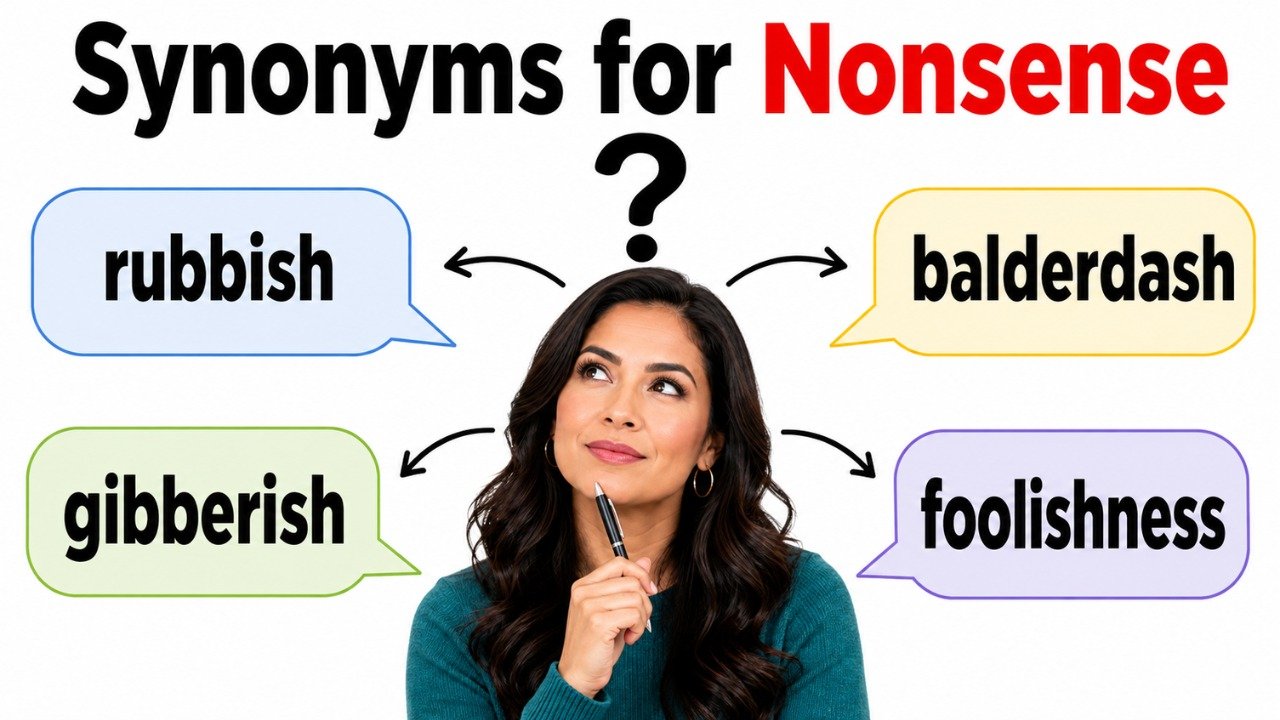
Quick Answer: Common synonyms for nonsense include absurdity, foolishness, rubbish, gibberish, babble, drivel, balderdash, irrationality, silliness, and twaddle. The best alternative depends on context. Use absurdity or irrationality in formal writing, rubbish or foolishness in everyday conversation, gibberish for speech that is impossible to understand, drivel for worthless talk or writing, and silliness when the idea is merely foolish rather than completely meaningless.
Pronunciation and Word Details
Word: Nonsense.
Pronunciation: /ˈnɑːnsens/
Part of Speech: Noun.
Meaning: Nonsense means words, ideas, statements, or behavior that lack meaning, logic, truth, or good sense.
US Pronunciation:
UK Pronunciation:
What Does “Nonsense” Mean?
Nonsense means speech, writing, ideas, or behavior that makes little sense, lacks logic, or seems foolish.
The word is primarily a noun. It can describe meaningless words, an unreasonable claim, a ridiculous suggestion, foolish behavior, or information that a speaker believes is untrue.
For example, someone may call an argument nonsense when it has no logical basis. A sentence may be nonsense because its words do not form a meaningful idea. A person may also say “Nonsense!” as a strong reaction when rejecting a claim.
The exact meaning changes with context. In one sentence, nonsense can mean gibberish. In another, it may mean absurdity, foolishness, rubbish, or an unfounded claim.
Meaning, Tone, and Context of “Nonsense”
Nonsense is a common and flexible word with a generally negative tone. It can sound neutral, dismissive, humorous, irritated, or strongly critical depending on how it is used.
In casual conversation, nonsense often means something foolish, untrue, or unreasonable.
In formal writing, alternatives such as absurdity, irrationality, incoherence, illogic, or unfounded claim may be more precise.
When referring to incomprehensible speech, gibberish, babble, or unintelligible language may work better.
Nonsense can also sound emotionally strong when used to reject another person’s idea. Calling someone’s statement nonsense may imply that the speaker believes it deserves little serious consideration. In polite or professional contexts, wording such as unsupported, inaccurate, illogical, or unsubstantiated may therefore be more appropriate.
When and How to Use “Nonsense”
For Meaningless Speech: Use nonsense when words or statements are impossible or difficult to understand.
Example: The damaged recording contained several minutes of nonsense.
For Illogical Ideas: Use nonsense when an argument lacks sound reasoning.
Example: The claim that no preparation was necessary seemed like complete nonsense.
For False Claims: Nonsense can reject information that appears clearly untrue.
Example: She dismissed the rumor as nonsense.
For Foolish Behavior: Use nonsense for actions that seem silly or unreasonable.
Example: The teacher asked the students to stop the nonsense and focus.
For Strong Disagreement: Nonsense can work as a direct rejection of a statement.
Example: “Nonsense,” he replied. “There is no evidence for that conclusion.”
For Lighthearted Silliness: The word can describe amusing or deliberately foolish ideas without strong criticism.
Example: The children spent the afternoon inventing cheerful nonsense stories.
Best Synonyms for Nonsense
Absurdity
Synonym: An idea or situation that is unreasonable, illogical, or ridiculous.
Example: The absurdity of the proposal became obvious after closer examination.
Foolishness
Synonym: Behavior, thinking, or speech that shows poor judgment or little sense.
Example: She regretted the foolishness of making a decision without checking the facts.
Rubbish
Synonym: Worthless, foolish, or untrue talk or ideas.
Example: He dismissed the accusation as complete rubbish.
Gibberish
Synonym: Speech or writing that is meaningless or impossible to understand.
Example: The corrupted message appeared as gibberish on the screen.
Babble
Synonym: Confused, rapid, or meaningless speech.
Example: His nervous explanation became an incoherent babble.
Drivel
Synonym: Foolish, boring, or meaningless speech or writing.
Example: The article was criticized as sentimental drivel.
Irrationality
Synonym: A lack of logical or reasonable thinking.
Example: The irrationality of the argument weakened the entire discussion.
Silliness
Synonym: Foolish or unserious behavior, speech, or ideas.
Example: Everyone laughed at the harmless silliness of the game.
Balderdash
Synonym: Foolish or meaningless talk presented as if it were sensible.
Example: She described the exaggerated claim as balderdash.
Twaddle
Synonym: Silly, trivial, or worthless talk or writing.
Example: The speaker ignored the facts and continued with empty twaddle.
50 Synonyms for Nonsense with Short Meanings
- Absurdity: Something completely unreasonable or ridiculous.
- Foolishness: Lack of good judgment or sense.
- Rubbish: Worthless or foolish ideas or statements.
- Gibberish: Meaningless or unintelligible speech or writing.
- Babble: Confused or meaningless speech.
- Drivel: Foolish or worthless talk or writing.
- Irrationality: Lack of logical reasoning.
- Silliness: Foolish or unserious behavior or ideas.
- Balderdash: Foolish or meaningless talk.
- Twaddle: Trivial and foolish speech or writing.
- Claptrap: Pretentious or foolish talk.
- Bunk: Foolish or untrue information.
- Hogwash: Ideas or statements considered completely foolish.
- Poppycock: Foolish or untrue talk.
- Mumbo jumbo: Confusing or meaningless language.
- Double talk: Deliberately confusing or deceptive language.
- Gobbledegook: Complicated language that is difficult to understand.
- Jabber: Rapid speech that is hard to understand.
- Prattle: Foolish or unimportant continuous talk.
- Chatter: Casual talk that may lack importance or substance.
- Rambling: Speech or writing that lacks clear organization.
- Incoherence: Lack of logical or understandable connection.
- Illogic: Absence of sound reasoning.
- Senselessness: Lack of meaning, purpose, or reason.
- Meaninglessness: Absence of clear meaning or significance.
- Ridiculousness: The quality of being unreasonable or laughable.
- Folly: Foolish thinking or behavior.
- Stupidity: Lack of sensible judgment or thought.
- Idiocy: Extremely foolish behavior or thinking.
- Inanity: Complete lack of sense or meaning.
- Triviality: Something lacking seriousness or importance.
- Nonsensicality: The quality of making no sense.
- Confusion: Lack of clarity or understandable order.
- Unreason: Absence of rational thinking.
- Delusion: A false belief held despite contrary evidence.
- Fantasy: An imagined idea that may have little basis in reality.
- Fabrication: A false story or invented claim.
- Falsehood: A statement that is not true.
- Lie: A deliberately false statement.
- Misconception: An incorrect understanding or belief.
- Fallacy: A mistaken idea or faulty line of reasoning.
- Incoherent talk: Speech without clear logical connection.
- Empty talk: Speech lacking useful meaning or substance.
- Idle talk: Unimportant or pointless conversation.
- Foolish talk: Speech that lacks good sense.
- Meaningless talk: Speech without understandable content.
- Pointless talk: Speech serving little useful purpose.
- Nonsense talk: Speech regarded as irrational or meaningless.
- Unfounded claim: A statement lacking evidence or support.
- Ridiculous claim: A statement considered unreasonable or absurd.
Read Also:
Synonyms for Surprising
Synonyms for Nonsense by Context
When Nonsense Means Meaningless Speech
Gibberish, babble, jabber, mumbo jumbo, gobbledegook, and incoherent talk work well when speech or writing cannot easily be understood.
Example: The damaged document contained pages of nonsense.
Alternative: The damaged document contained pages of gibberish.
Gibberish is especially useful when words appear meaningless rather than merely incorrect.
When Nonsense Means a Foolish Idea
Absurdity, foolishness, silliness, folly, ridiculousness, and inanity describe ideas that lack good sense.
Example: His suggestion that preparation was unnecessary was nonsense.
Alternative: His suggestion that preparation was unnecessary was absurdity.
Absurdity is more formal and stronger than silliness.
When Nonsense Means False Information
Rubbish, bunk, hogwash, falsehood, fabrication, and unfounded claim can describe statements believed to be untrue.
Example: She dismissed the rumor as nonsense.
Alternative: She dismissed the rumor as a fabrication.
Fabrication is best when the information was deliberately invented.
When Nonsense Means Bad Reasoning
Illogic, irrationality, fallacy, unreason, and senselessness are useful when criticizing reasoning rather than language.
Example: The argument was based on nonsense rather than evidence.
Alternative: The argument was based on illogic rather than evidence.
When Nonsense Means Worthless Talk
Drivel, twaddle, prattle, claptrap, empty talk, and idle talk emphasize speech or writing with little value or substance.
Example: He filled the discussion with nonsense instead of useful details.
Alternative: He filled the discussion with empty talk instead of useful details.
When Nonsense Means Harmless Silliness
Silliness, foolishness, playful talk, and triviality can fit situations that are unserious without being harmful.
Example: The children laughed at their own nonsense.
Alternative: The children laughed at their own silliness.
Another Word for Nonsense
The best single replacement for nonsense is often absurdity when referring to an unreasonable idea. However, the strongest alternative changes according to context. Gibberish works for meaningless speech, rubbish for casual rejection, and illogic for faulty reasoning.
Original: The explanation sounded like nonsense.
Better Option: The explanation sounded like gibberish.
Original: The proposal was complete nonsense.
Better Option: The proposal was complete absurdity.
Original: He dismissed the rumor as nonsense.
Better Option: He dismissed the rumor as rubbish.
Original: The argument was based on nonsense.
Better Option: The argument was based on illogic.
When Not to Use “Nonsense”
Nonsense is broad and can be too vague when a more precise word explains the problem better.
Weak: The report contained nonsense.
Better: The report contained several unsupported claims.
Avoid nonsense in highly formal writing when you need an objective tone.
Weak: The opposing argument is nonsense.
Better: The opposing argument relies on faulty reasoning.
Do not use nonsense when the real issue is unclear language.
Weak: The technical instructions are nonsense.
Better: The technical instructions are confusing and poorly organized.
Nonsense may also sound unnecessarily insulting when discussing another person’s opinion.
Weak: Your explanation is nonsense.
Better: Your explanation does not address the available evidence.
Avoid using gibberish as a replacement when an idea is understandable but irrational.
Weak: The proposal is gibberish because it would cost too much.
Better: The proposal is unreasonable because it would cost too much.
Words Commonly Confused With Nonsense
Nonsense vs Gibberish: Nonsense can describe foolish ideas, false claims, or meaningless speech. Gibberish specifically emphasizes language that cannot be understood.
Nonsense vs Absurdity: Nonsense is broader and more conversational. Absurdity usually describes something extremely unreasonable or logically ridiculous.
Nonsense vs Rubbish: Both can reject a statement as foolish or untrue. Rubbish is more conversational and may sound strongly dismissive.
Nonsense vs Foolishness: Nonsense often describes words, ideas, or claims. Foolishness commonly describes poor judgment or behavior.
Nonsense vs Drivel: Drivel refers mainly to foolish, boring, or worthless speech and writing. Nonsense can also describe behavior, reasoning, or claims.
Nonsense vs Fallacy: A fallacy is specifically an error in reasoning. Nonsense may have no logical structure at all.
Nonsense vs Falsehood: Falsehood means something is untrue. Nonsense may be false, but it can also simply be meaningless or unreasonable.
Nonsense vs Babble: Babble usually refers to continuous speech that is confused, rapid, or difficult to understand. Nonsense has a wider meaning.
Which Synonym Should You Choose?
Choose absurdity for formal writing when an idea is extremely unreasonable.
Choose irrationality in academic, analytical, or serious writing when the problem is a lack of logical reasoning.
Choose gibberish when words or sentences cannot be understood.
Choose rubbish in casual conversation when rejecting a claim as foolish or untrue.
Choose drivel when criticizing worthless or boring speech or writing.
Choose silliness when the behavior or idea is foolish but relatively harmless.
Choose fallacy in essays, reports, or debates when referring to a specific error in reasoning.
Choose fabrication when a claim appears to have been deliberately invented.
Choose unfounded claim in professional writing when a statement lacks supporting evidence.
Choose nonsense when you need a broad, familiar word that can describe foolish ideas, meaningless language, or unreasonable behavior.
Real Life Examples of “Nonsense” in Sentences
Original: His explanation was complete nonsense.
Better Option: His explanation was complete gibberish.
Original: The idea that preparation does not matter is nonsense.
Better Option: The idea that preparation does not matter is absurdity.
Original: She dismissed the accusation as nonsense.
Better Option: She dismissed the accusation as rubbish.
Original: The argument contained too much nonsense to be convincing.
Better Option: The argument contained too much faulty reasoning to be convincing.
Original: The children spent an hour talking nonsense.
Better Option: The children spent an hour enjoying harmless silliness.
Original: The document was filled with technical nonsense.
Better Option: The document was filled with confusing jargon.
Original: He refused to listen to any more nonsense.
Better Option: He refused to listen to any more drivel.
Original: The rumor turned out to be nonsense.
Better Option: The rumor turned out to be a fabrication.
Original: Her claim was dismissed as nonsense because it lacked evidence.
Better Option: Her claim was dismissed as unfounded because it lacked evidence.
Original: The speech became nonsense toward the end.
Better Option: The speech became incoherent toward the end.
Synonym Groups and Usage Differences
Meaningless Language Group
Gibberish, babble, jabber, mumbo jumbo, gobbledegook, and incoherence describe words or language that are difficult or impossible to understand.
Gibberish is strongest when the language has no recognizable meaning. Babble suggests confused or continuous speech. Gobbledegook often refers to complicated language that is unnecessarily difficult.
Example: The corrupted text looked like gibberish.
Foolish Idea Group
Absurdity, foolishness, silliness, folly, inanity, and ridiculousness describe ideas or behavior lacking good sense.
Absurdity suggests an extreme lack of reason. Silliness is milder and often less judgmental.
Example: Everyone quickly recognized the absurdity of the proposal.
Worthless Talk Group
Drivel, twaddle, prattle, claptrap, empty talk, and idle talk describe speech or writing with little value.
Drivel strongly criticizes content as foolish or worthless. Prattle often suggests continuous talk about unimportant matters.
Example: The discussion became empty talk without any practical suggestions.
Faulty Reasoning Group
Illogic, irrationality, fallacy, unreason, and senselessness focus on problems with thought and reasoning.
Fallacy usually refers to a particular mistake in reasoning, while irrationality describes reasoning that lacks a sensible basis.
Example: The conclusion resulted from a basic fallacy in the argument.
False Information Group
Falsehood, fabrication, lie, misconception, bunk, and unfounded claim concern ideas that are untrue or unsupported.
Fabrication suggests invention, while misconception usually refers to an incorrect belief rather than deliberate deception.
Example: The supposed fact was actually a common misconception.
Antonyms of Nonsense
The opposite of nonsense depends on whether nonsense means meaningless language, false information, or unreasonable thinking.
Sense: Clear and reasonable meaning.
Logic: Sound and consistent reasoning.
Reason: Rational thought or justification.
Truth: Information that agrees with reality.
Fact: Information that can be shown to be true.
Meaning: Clear significance or understandable content.
Coherence: Logical and understandable connection between ideas.
Wisdom: Sound judgment and sensible thinking.
Rationality: The quality of thinking logically and reasonably.
Clarity: The quality of being easy to understand.
Accuracy: Correctness and freedom from factual error.
Substance: Meaningful or important content.
Evidence: Information supporting a claim or conclusion.
Validity: The quality of being logically or factually sound.
Comparison: Nonsense vs Related Words
Nonsense vs Gibberish
Nonsense is a broad term for foolish, meaningless, or unreasonable content. Gibberish specifically refers to language that is impossible or extremely difficult to understand.
Example With Nonsense: His claim about the results was nonsense.
Example With Gibberish: The damaged file displayed a page of gibberish.
Nonsense vs Absurdity
Nonsense can describe meaningless words or foolish ideas. Absurdity focuses more strongly on something being extremely unreasonable or ridiculous.
Example With Nonsense: She dismissed the suggestion as nonsense.
Example With Absurdity: Everyone recognized the absurdity of expecting one person to complete the entire project overnight.
Nonsense vs Rubbish
Both words can dismiss something as worthless, foolish, or untrue. Rubbish is generally more conversational.
Example With Nonsense: That rumor is nonsense.
Example With Rubbish: He said the entire rumor was rubbish.
Nonsense vs Foolishness
Nonsense often refers to ideas or speech, while foolishness more often describes poor judgment, actions, or behavior.
Example With Nonsense: The argument was full of nonsense.
Example With Foolishness: He later admitted the foolishness of his decision.
Nonsense vs Drivel
Nonsense is broad, while drivel specifically criticizes speech or writing as foolish, worthless, or boring.
Example With Nonsense: The statement sounded like nonsense.
Example With Drivel: The long article was filled with repetitive drivel.
Nonsense vs Fallacy
Nonsense may lack meaningful reasoning entirely. A fallacy is a recognizable mistake in logic or argument.
Example With Nonsense: The explanation was nonsense from beginning to end.
Example With Fallacy: The conclusion depended on a common logical fallacy.
Nonsense vs Falsehood
Nonsense may be meaningless, unreasonable, or untrue. Falsehood specifically means a statement that is not true.
Example With Nonsense: The wild prediction was dismissed as nonsense.
Example With Falsehood: The witness admitted that the statement was a falsehood.
Nonsense vs Incoherence
Nonsense describes the content itself as meaningless or foolish. Incoherence describes a lack of logical or understandable connection.
Example With Nonsense: The claim was obvious nonsense.
Example With Incoherence: The incoherence of the speech made it difficult to follow.
Common Phrases and Expressions With Nonsense
Complete Nonsense: Something considered entirely meaningless or unreasonable.
Absolute Nonsense: A strong expression for something viewed as completely foolish or false.
Pure Nonsense: Something having no reasonable basis or value.
Talk Nonsense: Speak foolishly or say things that make little sense.
Talking Nonsense: The act of saying unreasonable or meaningless things.
No Nonsense: Serious, practical, and unwilling to tolerate foolish behavior.
Nonsense Words: Invented or meaningless words without ordinary definitions.
Nonsense Talk: Speech that lacks sense, logic, or useful meaning.
Stop This Nonsense: A command asking someone to end foolish or unreasonable behavior.
Dismiss as Nonsense: Reject an idea or claim as foolish, false, or unreasonable.
Common Mistakes to Avoid
A common mistake is using nonsense for every kind of incorrect statement. Something can be false without being meaningless. Use falsehood, error, misconception, or inaccurate claim when truth is the main issue.
Avoid replacing nonsense with gibberish when the sentence is understandable but unreasonable. Gibberish refers mainly to unintelligible language.
Do not use fallacy as a general synonym for meaningless speech. A fallacy is specifically an error in reasoning.
Be careful with strong informal alternatives such as hogwash, poppycock, or claptrap in formal writing. Absurdity, irrationality, incoherence, or unsupported claim may be more appropriate.
Avoid repeatedly calling ideas nonsense when explaining why they are wrong would be more helpful. Precise language strengthens professional and academic writing.
Nonsense can also sound personally dismissive. When discussing another person’s argument, criticize the reasoning or evidence rather than the person.
Finally, choose synonyms according to meaning rather than simply varying vocabulary. Gibberish, foolishness, falsehood, absurdity, and drivel are related, but each describes a different kind of problem.
Conclusion
The best synonyms for nonsense depend on what makes something nonsensical. Use gibberish for meaningless language, absurdity for unreasonable ideas, rubbish for casual rejection, drivel for worthless speech, irrationality for poor reasoning, and silliness for harmless foolishness. Fallacy works for logical errors, while fabrication or falsehood fits untrue information. Choosing a precise alternative helps readers understand whether you mean confusion, foolishness, falsehood, weak reasoning, or meaningless language.
FAQs About Synonyms for Nonsense
What is the best synonym for nonsense?
Absurdity is a strong general alternative when nonsense means an unreasonable idea. Gibberish is better when the problem is meaningless language.
What is another word for nonsense in casual conversation?
Rubbish, bunk, hogwash, silliness, and foolishness can work in casual contexts, depending on the intended tone.
What is a formal synonym for nonsense?
Absurdity, irrationality, incoherence, illogic, senselessness, and fallacy are useful formal alternatives.
Are nonsense and gibberish the same?
Not exactly. Gibberish mainly refers to language that cannot be understood, while nonsense can also describe foolish ideas, false claims, or unreasonable behavior.
What synonym for nonsense means false information?
Falsehood, fabrication, lie, bunk, and unfounded claim can describe information that is untrue or unsupported.
What is a polite alternative to nonsense?
Unsupported claim, inaccurate statement, questionable reasoning, or illogical argument can sound more respectful in professional or formal discussion.
What is the opposite of nonsense?
Sense, logic, reason, truth, coherence, clarity, and rationality are useful opposites, depending on the context.
