
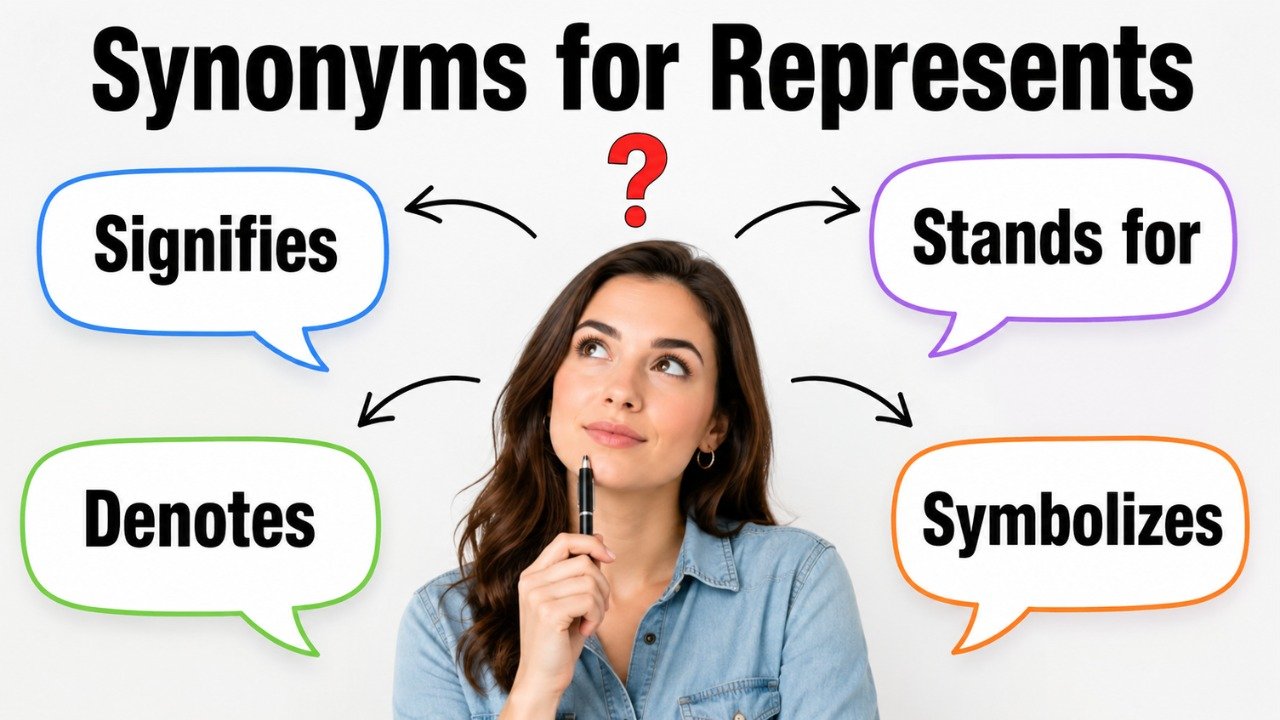
Quick Answer: Useful synonyms for represents include symbolizes, signifies, denotes, indicates, embodies, portrays, depicts, reflects, expresses, and stands for. The best choice depends on context. Use symbolizes for ideas or symbolic meaning, signifies for meaning or importance, denotes for precise definitions, indicates for evidence or signs, embodies for qualities, portrays or depicts for descriptions and images, reflects for showing characteristics, expresses for communicating ideas, and stands for when one thing has an accepted meaning or association.
Pronunciation and Word Details
Word: Represents.
Pronunciation: /ˌreprɪˈzents/
Part of Speech: Verb, third person singular form of represent.
Meaning: Shows, symbolizes, describes, stands for, or acts on behalf of someone or something.
US Pronunciation:
UK Pronunciation:
What Does “Represents” Mean?
Represents means shows what something means, symbolizes something, describes something, or acts on behalf of a person, group, idea, or organization.
The word is a verb and is the third person singular form of represent. It is commonly used when one thing has a symbolic relationship with another, when information shows a particular fact, when an image depicts something, or when a person speaks or acts for others.
For example, a color can represent an emotion, a chart can represent data, a character can represent an idea, and a person can represent a group.
The exact meaning changes according to sentence context. In descriptive writing, represents can mean depicts or portrays. In academic writing, it may mean indicates, signifies, or denotes. In symbolic contexts, it often means symbolizes or stands for. In situations involving people or groups, it may mean speaks for or acts for.
Meaning, Tone, and Context of “Represents”
Represents is generally a neutral and versatile word. It works naturally in formal, academic, professional, technical, and everyday contexts.
In formal writing, represents is often used to describe data, percentages, categories, ideas, and relationships. A researcher might say that a percentage represents part of a total.
In academic writing, the word can explain symbolism, concepts, themes, or evidence. A writer may explain that a particular image represents freedom, conflict, or change.
In creative and descriptive writing, represents can describe what a character, object, image, or event symbolizes.
In conversation, represents is also natural when describing meaning or identity. However, simpler alternatives such as means, shows, or stands for may sound more direct in casual speech.
Its tone is usually neutral rather than emotional. The specific synonym you choose can make the sentence more precise, formal, vivid, or analytical.
When and How to Use “Represents”
For Symbolism: Use represents when an object, color, image, person, or action has a deeper meaning.
Example: The white flower represents peace and remembrance.
For Meaning: Use represents when something has a particular meaning or interpretation.
Example: This symbol represents a new beginning.
For Data: Use represents when a number, percentage, graph, or figure shows a quantity or category.
Example: The shaded area represents twenty percent of the total.
For Description: Use represents when an image, story, or description shows a person, place, event, or idea.
Example: The painting represents a peaceful countryside scene.
For Qualities: Use represents when someone or something demonstrates particular characteristics.
Example: Her leadership represents courage and determination.
For Communication: Use represents when words, actions, or images communicate an idea.
Example: The gesture represents respect and appreciation.
For Acting on Behalf of Others: Use represents when someone speaks, performs duties, or makes decisions for another person or group.
Example: The attorney represents the client during the hearing.
For Examples or Categories: Use represents when one person or thing serves as an example of a wider group or concept.
Example: This case represents a common problem faced by new learners.
Best Synonyms for Represents
Symbolizes: Shows or expresses a deeper symbolic meaning.
Example: The rising sun symbolizes hope and renewal.
Signifies: Indicates or communicates a particular meaning.
Example: The green light signifies permission to continue.
Denotes: Refers to or means something in an exact or defined way.
Example: The abbreviation denotes a specific measurement.
Indicates: Shows that something exists, is true, or is likely.
Example: The sudden change indicates a possible problem.
Embodies: Expresses or contains the essential qualities of something.
Example: Her behavior embodies patience and kindness.
Portrays: Describes or presents someone or something in a particular way.
Example: The novel portrays village life with remarkable detail.
Depicts: Shows something through an image, description, or artistic presentation.
Example: The mural depicts an important historical event.
Reflects: Shows or reveals a quality, condition, attitude, or situation.
Example: His decision reflects careful thinking.
Expresses: Communicates an idea, emotion, opinion, or meaning.
Example: The poem expresses deep gratitude.
Stands For: Has a particular meaning, association, or symbolic value.
Example: The dove stands for peace in many contexts.
50 Synonyms for Represents with Short Meanings
- Symbolizes: Shows a deeper symbolic meaning.
- Signifies: Communicates or indicates meaning.
- Denotes: Refers to something precisely.
- Indicates: Shows evidence of something.
- Embodies: Contains or expresses essential qualities.
- Portrays: Presents something in a particular way.
- Depicts: Shows through words or images.
- Reflects: Reveals a quality or condition.
- Expresses: Communicates an idea or feeling.
- Stands For: Has a particular meaning or symbolic value.
- Shows: Makes something clear or visible.
- Means: Has a particular definition or significance.
- Conveys: Communicates meaning or information.
- Illustrates: Explains or demonstrates through an example or image.
- Demonstrates: Clearly shows a quality, fact, or idea.
- Exemplifies: Serves as a strong example of something.
- Typifies: Shows the usual qualities of a type.
- Personifies: Represents a quality in human form.
- Characterizes: Shows the distinctive qualities of something.
- Describes: Gives an account or picture of something.
- Displays: Shows something clearly.
- Reveals: Makes a fact, quality, or condition known.
- Communicates: Transfers or expresses meaning.
- Connotes: Suggests an additional associated meaning.
- Designates: Identifies something by a particular term or role.
- Identifies: Shows what someone or something is.
- Marks: Indicates a particular point, quality, or distinction.
- Signals: Gives a sign of something.
- Suggests: Gives an indirect indication of something.
- Implies: Communicates a meaning without stating it directly.
- Evokes: Brings an idea, feeling, or image to mind.
- Mirrors: Closely reflects a quality or situation.
- Reproduces: Presents or creates a copy of something.
- Renders: Presents, expresses, or portrays something.
- Presents: Shows or describes something for consideration.
- Captures: Successfully expresses an important quality or feeling.
- Illustrates: Makes an idea clearer through an example.
- Models: Serves as an example or representation.
- Corresponds To: Matches or is equivalent to something.
- Equates To: Has the same value, meaning, or significance.
- Amounts To: Has the effect or meaning of something.
- Constitutes: Forms or makes up something.
- Serves As: Functions as a particular example or symbol.
- Acts For: Performs duties on behalf of another.
- Speaks For: Expresses the interests or opinions of others.
- Advocates For: Supports or speaks on behalf of someone or something.
- Appears For: Acts officially on behalf of another person.
- Substitutes For: Takes the place of something else.
- Symbolically Expresses: Communicates meaning through symbolism.
- Makes Evident: Clearly shows or reveals something.
Read Also:
Synonyms for Ending

Synonyms for Represents by Context
When Represents Means Symbolizes
When represents describes a symbolic relationship, strong alternatives include symbolizes, stands for, signifies, embodies, personifies, and connotes.
Example: The flame represents hope.
Alternative: The flame symbolizes hope.
Symbolizes is often the clearest option when an object, image, color, or action carries a deeper meaning.
When Represents Means Shows
When represents simply means shows or reveals something, useful alternatives include indicates, demonstrates, reflects, reveals, displays, and illustrates.
Example: The increase represents stronger demand.
Alternative: The increase indicates stronger demand.
Indicates works particularly well when evidence or data points toward a conclusion.
When Represents Means Depicts
For art, literature, photography, descriptions, diagrams, and visual material, strong choices include portrays, depicts, illustrates, presents, renders, and captures.
Example: The painting represents rural life.
Alternative: The painting depicts rural life.
Depicts is particularly natural for visual descriptions, while portrays is useful for both visual and written presentations.
When Represents Means Embodies
When a person or thing demonstrates a quality or ideal, useful synonyms include embodies, exemplifies, typifies, personifies, characterizes, and reflects.
Example: Her work represents dedication.
Alternative: Her work exemplifies dedication.
Embodies is especially effective when someone or something seems to contain the essential qualities of an idea.
When Represents Means Means or Denotes
For definitions, symbols, labels, abbreviations, and technical meanings, use means, denotes, designates, signifies, or corresponds to.
Example: The letter represents temperature.
Alternative: The letter denotes temperature.
Denotes is especially suitable for precise academic, scientific, mathematical, or technical contexts.
When Represents Means Acts for Someone
When a person represents another individual or group, alternatives include acts for, speaks for, advocates for, appears for, or serves as a representative of.
Example: She represents the residents at the meeting.
Alternative: She speaks for the residents at the meeting.
The best option depends on whether the person is communicating views, providing formal representation, or performing official duties.
Another Word for Represents
A strong general replacement for represents is symbolizes, especially when something carries a deeper meaning. However, the best alternative depends on what the sentence is trying to communicate.
Use indicates for evidence, depicts for visual representation, embodies for qualities, and speaks for when discussing representation of people.
Original: The red flower represents love.
Better Option: The red flower symbolizes love.
Original: The graph represents a steady increase in demand.
Better Option: The graph indicates a steady increase in demand.
Original: The illustration represents a busy city street.
Better Option: The illustration depicts a busy city street.
Original: Her behavior represents true professionalism.
Better Option: Her behavior embodies true professionalism.
When Not to Use “Represents”
Represents is useful, but it can become vague when a more precise verb would explain the exact relationship.
If you are describing visual art, depicts may be clearer. If evidence points toward a conclusion, indicates is usually more precise. If something has symbolic meaning, symbolizes can create a stronger sentence.
Avoid repeating represents several times in a short paragraph when different relationships are being described.
Weak: The picture represents a village, and the river represents change, while the dark sky represents danger.
Better: The picture depicts a village, the river symbolizes change, and the dark sky suggests danger.
Represents may also sound unnecessarily formal in very simple conversation.
Weak: That sign represents that parking is prohibited.
Better: That sign means parking is prohibited.
Avoid using represents when you really mean resembles. Representing something does not necessarily mean looking similar to it.
Weak: The child represents his father physically.
Better: The child resembles his father physically.
Words Commonly Confused With Represents
Represents vs Symbolizes: Represents has a broad meaning, while symbolizes specifically suggests symbolic or deeper meaning.
Represents vs Indicates: Represents can show, symbolize, describe, or act for something, while indicates mainly points to evidence, information, or a sign.
Represents vs Depicts: Represents is broad, while depicts usually describes how something is shown visually or descriptively.
Represents vs Reflects: Represents can stand for something directly, while reflects often reveals or shows qualities, attitudes, or conditions.
Represents vs Embodies: Represents may simply stand for an idea, while embodies suggests possessing the essential qualities of that idea.
Represents vs Denotes: Represents can be general or symbolic, while denotes is more precise and often used for definitions, symbols, and technical meanings.
Represents vs Resembles: Represents means stands for or portrays something, while resembles means looks or seems similar to something.
Represents vs Expresses: Represents may symbolize or depict something, while expresses focuses on communicating an idea, emotion, or opinion.
Which Synonym Should You Choose?
Choose symbolizes when an object, image, color, or action carries deeper meaning.
Choose signifies when something communicates meaning, importance, or a particular condition.
Choose denotes for precise definitions, symbols, technical terminology, mathematical notation, or academic explanations.
Choose indicates when facts, evidence, data, or signs point toward a conclusion.
Choose depicts when describing photographs, paintings, diagrams, illustrations, or visual scenes.
Choose portrays when explaining how a person, situation, event, or character is presented.
Choose embodies when a person or thing strongly demonstrates the qualities of an idea or value.
Choose reflects when something reveals an attitude, characteristic, condition, or trend.
Choose expresses when the focus is communication of thoughts, emotions, opinions, or ideas.
Choose stands for in everyday conversation or when explaining what a symbol or abbreviation means.
Choose speaks for when a person communicates the opinions or interests of other people.
For essays and academic writing, signifies, denotes, indicates, embodies, and demonstrates often provide greater precision.
For reports and data, indicates, shows, reflects, and corresponds to are usually natural choices.
For everyday conversation, means, shows, and stands for are simple and clear.
Real Life Examples of “Represents” in Sentences
Original: The blue section represents thirty percent of the total.
Better Option: The blue section denotes thirty percent of the total.
Original: The image represents a peaceful future.
Better Option: The image symbolizes a peaceful future.
Original: The graph represents a decline in attendance.
Better Option: The graph indicates a decline in attendance.
Original: The sculpture represents human strength.
Better Option: The sculpture embodies human strength.
Original: The photograph represents life in the countryside.
Better Option: The photograph depicts life in the countryside.
Original: Her response represents growing concern among residents.
Better Option: Her response reflects growing concern among residents.
Original: The main character represents courage and loyalty.
Better Option: The main character exemplifies courage and loyalty.
Original: The spokesperson represents the entire group.
Better Option: The spokesperson speaks for the entire group.
Original: The abbreviation represents a technical term.
Better Option: The abbreviation denotes a technical term.
Original: His speech represents gratitude toward everyone involved.
Better Option: His speech expresses gratitude toward everyone involved.
Synonym Groups and Usage Differences
Symbolism Group
Symbolizes, signifies, stands for, embodies, connotes, and personifies belong to the symbolism group.
These words work when something carries meaning beyond its literal form.
Example: The open door symbolizes opportunity.
Symbolizes is direct, while connotes suggests an associated meaning rather than an exact definition.
Evidence and Indication Group
Indicates, shows, reveals, signals, suggests, demonstrates, and makes evident are useful when something provides evidence.
Example: The sudden rise indicates increased interest.
Indicates is stronger when evidence points toward a conclusion, while suggests is more cautious.
Description and Portrayal Group
Depicts, portrays, illustrates, presents, renders, describes, and captures are useful when describing how something appears in art, writing, or other forms of communication.
Example: The illustration depicts a crowded marketplace.
Depicts is especially effective for images, while portrays can describe both artistic and written presentations.
Quality and Example Group
Embodies, exemplifies, typifies, characterizes, reflects, and personifies describe qualities or characteristics.
Example: Her patience exemplifies strong leadership.
Exemplifies means serves as a clear example, while embodies suggests possessing the quality itself.
Meaning and Definition Group
Means, denotes, designates, signifies, corresponds to, and equates to are useful for explaining definitions or relationships.
Example: The symbol denotes temperature.
Denotes is precise, while means is simpler and more conversational.
Communication Group
Expresses, conveys, communicates, signals, and suggests focus on transmitting ideas or feelings.
Example: His expression conveys disappointment.
Conveys emphasizes communication, while expresses often focuses more directly on thoughts and emotions.
Representation of People Group
Speaks for, acts for, advocates for, appears for, and serves as describe situations in which someone performs a role for another person or group.
Example: The elected member speaks for the local community.
These alternatives should be chosen according to the exact responsibility involved.
Antonyms of Represents
The opposite of represents depends on which meaning is intended. A word that opposes symbolic representation may not work as an opposite for acting on behalf of someone.
Conceals: Keeps meaning, information, or qualities hidden.
Hides: Prevents something from being seen or understood.
Obscures: Makes meaning or information difficult to recognize.
Misrepresents: Presents something inaccurately or misleadingly.
Distorts: Changes information so it no longer reflects the original accurately.
Contradicts: Expresses an idea that conflicts with another.
Opposes: Acts against an idea, position, person, or group.
Disguises: Changes or hides the true appearance or meaning.
Suppresses: Prevents something from being shown or expressed.
Withholds: Keeps information or expression from being communicated.
Comparison: Represents vs Related Words
Represents vs Symbolizes
Represents is broader and may mean symbolizes, depicts, indicates, or acts for someone. Symbolizes specifically focuses on symbolic meaning.
Example With Represents: The statue represents the city’s history.
Example With Symbolizes: The statue symbolizes resilience and unity.
Represents vs Indicates
Represents can describe meaning or identity, while indicates points toward evidence, a sign, or a conclusion.
Example With Represents: The number represents the total population.
Example With Indicates: The number indicates that the population has increased.
Represents vs Depicts
Represents can work in many contexts, while depicts usually describes a visual or descriptive presentation.
Example With Represents: The artwork represents life near the sea.
Example With Depicts: The artwork depicts fishermen returning home.
Represents vs Embodies
Represents may stand for an idea without actually having its qualities. Embodies suggests that someone or something displays those qualities strongly.
Example With Represents: The award represents excellence.
Example With Embodies: Her work embodies excellence.
Represents vs Reflects
Represents may directly stand for something, while reflects usually reveals an existing quality, attitude, condition, or situation.
Example With Represents: The symbol represents unity.
Example With Reflects: The decision reflects the group’s priorities.
Represents vs Denotes
Represents is flexible, while denotes is more exact and commonly used when explaining definitions or formal symbols.
Example With Represents: The letter represents a particular value.
Example With Denotes: The letter denotes temperature in the formula.
Represents vs Portrays
Represents is broad, while portrays emphasizes the way someone or something is presented.
Example With Represents: The story represents life during a difficult period.
Example With Portrays: The story portrays families facing difficult choices.
Common Phrases and Expressions With “Represents”
Represents a Change: Shows or signifies that a change has occurred.
Represents an Opportunity: Signifies a useful or favorable possibility.
Represents a Challenge: Indicates a difficult situation or problem.
Represents a Significant Part: Makes up an important portion of something.
Represents the Majority: Accounts for more than half or the largest group.
Represents the Best: Serves as an example of the highest quality.
Represents a Symbol: Stands for an idea, value, or concept.
Represents the Interests Of: Acts or speaks on behalf of a person or group.
Represents a Shift: Indicates a noticeable change in direction, opinion, or behavior.
Represents an Example Of: Serves as a clear instance of a particular type or category.
Common Mistakes to Avoid
One common mistake is using represents repeatedly when a more specific verb would improve clarity. Words such as symbolizes, indicates, depicts, reflects, and embodies can make writing more precise.
Another mistake is assuming every synonym can replace represents in every sentence. For example, depicts works well with an image but usually does not work when someone acts on behalf of a group.
Writers also sometimes confuse represents with resembles. Represents means stands for, shows, or acts for something. Resembles means looks or seems similar to something.
Avoid unnatural phrasing when explaining simple meanings. If means or shows communicates the idea clearly, a more formal word may be unnecessary.
Be careful with denotes and connotes. Denotes refers to a direct or defined meaning, while connotes refers to an associated or suggested meaning.
Finally, consider the relationship you are describing before choosing a synonym. Ask whether the sentence concerns symbolism, evidence, description, communication, qualities, definition, or acting on behalf of others.
Conclusion
Understanding synonyms for Represents helps you choose clearer and more precise language for different situations. Use symbolizes or stands for when discussing symbolic meaning, indicates for evidence or data, depicts and portrays for descriptions, embodies for qualities, reflects for characteristics, and denotes for precise definitions. When someone acts on behalf of others, speaks for or acts for may be more accurate. The best synonym depends on what represents means in the particular sentence, so always consider context before replacing it.
FAQs About Synonyms for Represents
What is the best synonym for represents?
Symbolizes is one of the strongest alternatives when represents refers to symbolic meaning. In other contexts, indicates, depicts, embodies, or reflects may be more accurate.
What is another word for represents in writing?
Useful alternatives include portrays, depicts, illustrates, reflects, conveys, and expresses. The best choice depends on what the writing is showing.
What is a formal synonym for represents?
Signifies, denotes, embodies, exemplifies, and indicates are strong formal alternatives. Denotes is especially useful for definitions and technical contexts.
What is a synonym for represents when discussing symbols?
Symbolizes and stands for are the clearest choices. Signifies can also work when the symbol communicates a particular meaning.
What is a synonym for represents in data?
Indicates, shows, denotes, reflects, corresponds to, and constitutes can work depending on the relationship between the data and what it describes.
What is the difference between represents and symbolizes?
Represents is broader and can mean shows, depicts, indicates, or acts for someone. Symbolizes specifically refers to carrying or expressing symbolic meaning.
Can depicts replace represents?
Yes, when represents means shows something visually or descriptively. Depicts is especially natural for paintings, photographs, illustrations, scenes, and written descriptions.
