
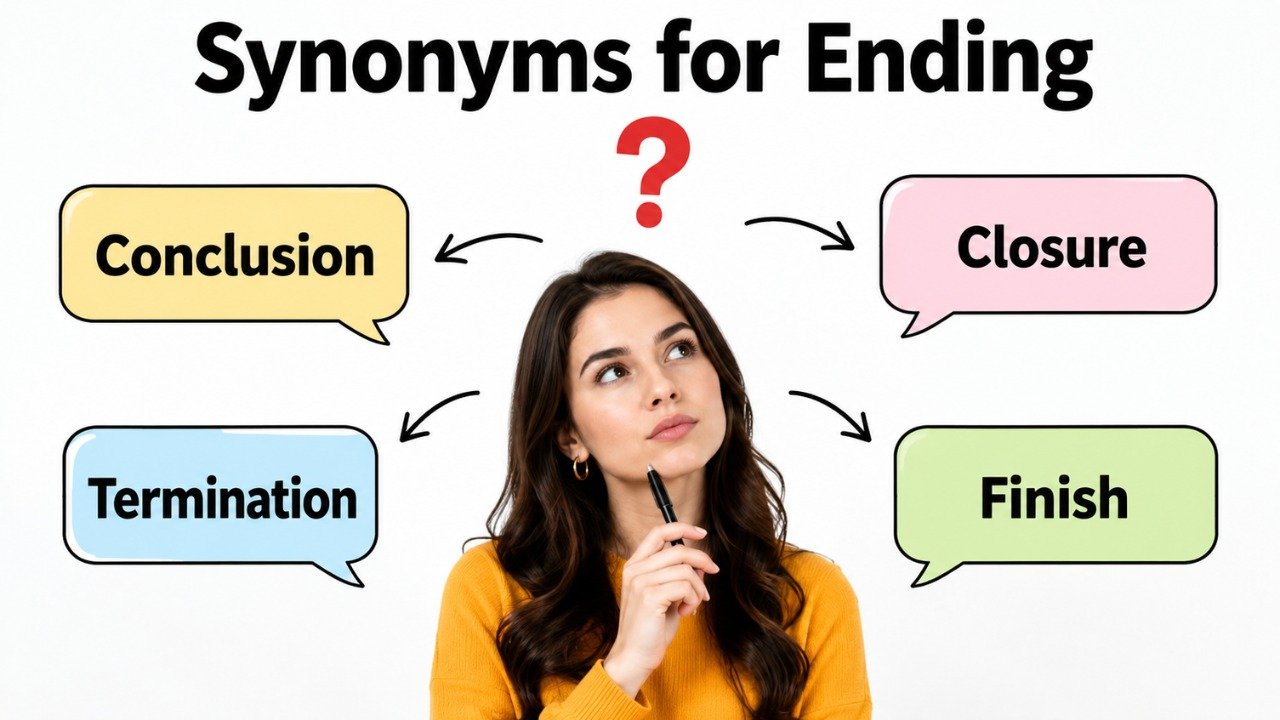
Quick Answer: Useful synonyms for ending include conclusion, finish, close, termination, completion, finale, outcome, resolution, expiration, and cessation. The best choice depends on context. Use conclusion for the final part of writing or discussion, finish for everyday speech, termination for formal or technical situations, completion for finished tasks, finale for performances or dramatic events, resolution for stories or conflicts, expiration for time limits, and cessation for the stopping of an activity.
Pronunciation and Word Details
Word: Ending.
Pronunciation: /ˈendɪŋ/
Part of Speech: Noun, and present participle of the verb end.
Meaning: The final part of something or the point at which an event, activity, story, period, or process stops.
US Pronunciation:
UK Pronunciation:
What Does “Ending” Mean?
Ending means the final part, result, or stopping point of something. As a noun, it can describe the last part of a story, movie, relationship, event, process, period, or activity.
The word can also function as the present participle of the verb end, as in “The meeting is ending.”
In storytelling, an ending describes how a narrative finishes. In everyday conversation, it can describe the completion of an event or relationship. In formal contexts, words such as conclusion, termination, completion, or cessation may express the idea more precisely.
Story Context: The ending reveals what finally happens to the characters.
Time Context: The ending of the season brought cooler weather.
Relationship Context: Their friendship had a peaceful ending.
Process Context: The project is nearing its ending, although completion is often more natural in this situation.
Meaning, Tone, and Context of “Ending”
Ending is generally a neutral and widely understood word. It works in both casual and formal communication, although more specific synonyms may sound better in professional, academic, literary, or technical writing.
In casual conversation, ending commonly refers to the final part of a movie, story, event, or relationship. In literary discussion, it describes the final section of a narrative. In business or technical contexts, completion, conclusion, termination, expiration, or cessation may provide greater precision.
The emotional tone of ending depends on the situation. An ending can be happy, sad, unexpected, satisfying, disappointing, peaceful, or dramatic.
Neutral Tone: The ending of the meeting was brief.
Emotional Tone: The ending of their long friendship was painful.
Literary Tone: The novel has a surprising ending.
Formal Tone: The agreement reached its conclusion after several months of negotiation.
When and How to Use “Ending”
For Stories: Use ending for the final events or scenes of a story, novel, movie, or play.
Example: The ending of the mystery surprised everyone.
For Events: Use ending when describing the final stage or moment of an event.
Example: The ending of the ceremony included a short speech.
For Relationships: Ending can describe the conclusion of a friendship, partnership, or romantic relationship.
Example: Their relationship had an unexpected ending.
For Time Periods: Ending can refer to the final part of a season, year, era, or stage.
Example: The ending of summer brought cooler evenings.
For Processes: Ending may describe the point when an activity or process stops.
Example: The ending of the investigation brought relief to the community.
For Creative Writing: Ending is useful when discussing how a narrative closes.
Example: A powerful ending can make a story memorable.
Best Synonyms for Ending
Conclusion: The final part or closing stage of something.
Example: The conclusion of the report summarizes the main findings.
Finish: The point where something comes to an end.
Example: The race had an exciting finish.
Close: The final stage or moment of an event or period.
Example: The conference came to a successful close.
Termination: The formal stopping or ending of something.
Example: The contract allows termination under specific conditions.
Completion: The point at which a task, process, or project is fully finished.
Example: Completion of the project took six months.
Finale: The last and often dramatic part of a performance or event.
Example: The concert ended with an impressive finale.
Resolution: The point where a problem, conflict, or story is settled.
Example: The novel reaches a satisfying resolution.
Outcome: The final result of an event, process, or situation.
Example: Nobody predicted the outcome of the competition.
Expiration: The point when a fixed period of validity ends.
Example: Check the expiration of the agreement before renewing it.
Cessation: The stopping of an action, activity, or condition.
Example: The cessation of construction reduced the noise.
50 Synonyms for Ending with Short Meanings
- Conclusion: The final part of something.
- Finish: The point at which something stops.
- Close: The final stage of an event or period.
- Completion: The state of being fully finished.
- Termination: A formal or deliberate ending.
- Finale: The final and often dramatic part.
- Resolution: The settling or concluding part of something.
- Outcome: The final result of a situation.
- Cessation: The act of stopping something.
- Expiration: The end of a fixed period of validity.
- Closure: A sense or act of bringing something to an end.
- Finality: The quality of being complete and irreversible.
- End: The final point or part.
- Stopping: The act of bringing activity to an end.
- Discontinuation: The act of ending an activity, service, or practice.
- Concluding: The process of bringing something to an end.
- Finishing: The act of completing something.
- Ceasing: The act of stopping an activity.
- Wrapping Up: Bringing something to completion.
- Windup: The final stage of an activity or process.
- Climax: The most intense point before a conclusion.
- Denouement: The final resolution of a story.
- Last Part: The final section of something.
- Final Part: The section occurring at the end.
- Final Stage: The last phase of a process.
- Closing Stage: The period immediately before completion.
- Closing: The act or process of finishing something.
- Endpoint: The final point in a process or sequence.
- Limit: The point beyond which something does not continue.
- Boundary: A point marking where something stops.
- Expiry: The end of a period of validity.
- Dissolution: The formal ending of an organization, agreement, or relationship.
- Cancellation: The act of stopping something planned.
- Abandonment: The act of leaving something unfinished or ending involvement.
- Retirement: The ending of a working career or active role.
- Dismissal: The ending of employment or removal from a position.
- Departure: The act of leaving, sometimes marking the end of involvement.
- Breakup: The ending of a personal relationship or group.
- Separation: The act of ending or reducing a connection.
- Parting: The act of separating or saying goodbye.
- Farewell: A final goodbye before leaving.
- Curtain: A figurative term for the end of a performance or event.
- Last Act: The final section of a dramatic work or event.
- Final Chapter: The concluding section of a story or period.
- Last Scene: The final scene of a performance or narrative.
- Closing Moment: The final moment of an event.
- Last Phase: The final period of a process.
- Fulfillment: The achievement or completion of an intended purpose.
- Accomplishment: The successful completion of a task or objective.
- Consequence: A result that follows from an action or event.
Read Also:
Synonyms for Defiant
Synonyms for Ending by Context
When Ending Means the Final Part of a Story
Conclusion, finale, denouement, resolution, final chapter, last scene, and last act work well when discussing stories and creative works.
Example: The ending of the novel was emotional.
Alternative: The conclusion of the novel was emotional.
Example: The play has a dramatic ending.
Alternative: The play has a dramatic finale.
When Ending Means Completion
Completion, finish, conclusion, accomplishment, fulfillment, and close are useful when something has been successfully finished.
Example: The ending of the project brought relief to the team.
Alternative: The completion of the project brought relief to the team.
When Ending Means Stopping
Termination, cessation, discontinuation, cancellation, and closing are useful when an activity, service, agreement, or process stops.
Example: The ending of the service affected several customers.
Alternative: The discontinuation of the service affected several customers.
When Ending Means the Result
Outcome, result, consequence, resolution, and conclusion can refer to what happens at the end of a process or event.
Example: Nobody expected that ending.
Alternative: Nobody expected that outcome.
When Ending Means a Relationship Is Over
Breakup, separation, parting, dissolution, closure, and farewell may describe different kinds of personal or formal endings.
Example: The ending of their partnership was peaceful.
Alternative: The dissolution of their partnership was peaceful.
When Ending Means a Time Period Has Finished
Expiration, expiry, close, final stage, last phase, and conclusion can describe the final point of a defined period.
Example: The ending of the agreement is approaching.
Alternative: The expiration of the agreement is approaching.
Another Word for Ending
Another word for ending is conclusion. It is one of the most flexible alternatives because it can describe the final part of writing, discussion, events, stories, and processes. However, the best replacement depends on what is actually ending.
Use completion when a task is successfully finished, termination when something is formally stopped, finale when a performance reaches its last part, and resolution when a story or conflict is settled.
Original: The ending of the report summarizes the findings.
Better Option: The conclusion of the report summarizes the findings.
Original: We celebrated the ending of the project.
Better Option: We celebrated the completion of the project.
Original: The ending of the concert was spectacular.
Better Option: The finale of the concert was spectacular.
Original: The ending of the conflict brought relief.
Better Option: The resolution of the conflict brought relief.
When Not to Use “Ending”
Ending is clear, but it can sometimes sound too general. A more precise synonym often improves professional, academic, literary, or technical writing.
Avoid ending when the sentence requires a specific type of final event.
Weak: The ending of the contract happened in June.
Better: The termination of the contract occurred in June.
Completion is better when discussing successful tasks or projects.
Weak: The ending of construction is expected next month.
Better: The completion of construction is expected next month.
Expiration is more accurate for licenses, memberships, deadlines, and agreements with fixed validity periods.
Weak: The ending of the permit is approaching.
Better: The expiration of the permit is approaching.
Finale works better for a dramatic final performance.
Weak: The ending of the performance received loud applause.
Better: The finale of the performance received loud applause.
Words Commonly Confused With Ending
Ending vs Conclusion: Ending is a broad term for the final part of anything, while conclusion often suggests a deliberate final section or a reasoned final judgment.
Ending vs Completion: Ending simply means something stops or reaches its final point. Completion implies that something has been fully accomplished.
Ending vs Outcome: Ending describes the final point or portion, while outcome describes the final result.
Ending vs Finale: Ending is general, while finale usually refers to the final and often impressive part of a performance, show, or dramatic event.
Ending vs Resolution: Ending describes how something finishes. Resolution suggests that conflicts, questions, or problems have been settled.
Ending vs Termination: Ending is neutral and general. Termination is more formal and often refers to contracts, employment, agreements, services, or processes.
Ending vs Closure: Ending describes something finishing, while closure may also refer to emotional acceptance or a sense of final resolution.
Which Synonym Should You Choose?
Choose conclusion when writing about reports, essays, discussions, speeches, or stories.
Choose finish in everyday conversation or when describing competitions, races, and ordinary activities.
Choose completion when a task, project, construction process, or assignment has been successfully finished.
Choose termination when discussing contracts, employment, formal agreements, services, or technical processes.
Choose finale when describing the final part of a concert, performance, show, or dramatic event.
Choose resolution when a conflict, problem, mystery, or storyline reaches a settled conclusion.
Choose outcome when you are interested in the result rather than the final moment itself.
Choose expiration when discussing licenses, permits, subscriptions, deadlines, or agreements with a defined validity period.
Choose cessation when writing formally about an activity, behavior, process, or condition stopping.
Choose closure when the ending provides emotional or practical finality.
Real Life Examples of “Ending” in Sentences
Original: The ending of the movie surprised everyone.
Better Option: The conclusion of the movie surprised everyone.
Original: The ending of the project was celebrated by the entire team.
Better Option: The completion of the project was celebrated by the entire team.
Original: The ending of the concert was unforgettable.
Better Option: The finale of the concert was unforgettable.
Original: The ending of the agreement created several questions.
Better Option: The termination of the agreement created several questions.
Original: The ending of the conflict brought peace to the region.
Better Option: The resolution of the conflict brought peace to the region.
Original: Nobody expected the ending of the competition.
Better Option: Nobody expected the outcome of the competition.
Original: The ending of the permit is scheduled for September.
Better Option: The expiration of the permit is scheduled for September.
Original: The ending of the service disappointed customers.
Better Option: The discontinuation of the service disappointed customers.
Original: The ending of their friendship was difficult for both of them.
Better Option: The breakup of their friendship was difficult for both of them.
Original: The ending of the meeting included a summary of the decisions.
Better Option: The close of the meeting included a summary of the decisions.
Synonym Groups and Usage Differences
Completion Group
Completion, finish, accomplishment, fulfillment, and conclusion emphasize reaching the end of a task, goal, or process.
Completion is especially useful when something has been successfully carried out.
Example: The completion of the renovation took several months.
Story Group
Conclusion, finale, denouement, resolution, final chapter, last act, and last scene describe different kinds of narrative endings.
Denouement is especially associated with the final part of a story where remaining questions are resolved.
Example: The denouement explains what happened to each character.
Stopping Group
Termination, cessation, discontinuation, cancellation, and closing emphasize an activity or process being stopped.
Termination is formal, while cessation often appears in formal descriptions of actions or conditions.
Example: The cessation of traffic allowed pedestrians to cross safely.
Result Group
Outcome, consequence, resolution, and conclusion can describe what results from a situation.
Outcome is usually the most neutral choice when discussing a final result.
Example: The outcome depended on several factors.
Relationship Group
Breakup, separation, parting, dissolution, farewell, and closure describe endings involving people, partnerships, or connections.
The exact choice depends on whether the relationship is personal, emotional, professional, or legal.
Example: The dissolution of the partnership was officially announced.
Time Limit Group
Expiration, expiry, close, endpoint, and final stage describe the end of a defined period.
Expiration is particularly useful for documents or permissions that remain valid only until a certain date.
Example: Renewal is required before the expiration of the license.
Antonyms of Ending
The opposite of ending depends on whether you mean beginning, continuation, or ongoing activity.
Beginning: The first point or part of something.
Start: The moment when something begins.
Opening: The first part of an event, story, or performance.
Commencement: A formal word for the beginning of something.
Introduction: The opening section of a text, speech, or presentation.
Initiation: The act of starting a process or activity.
Launch: The beginning of a project, activity, or product.
Continuation: The process of continuing rather than stopping.
Persistence: The state of continuing over time.
Renewal: The act of starting something again or extending its validity.
Continuation Example: The ending of the program was cancelled, allowing its continuation.
Comparison: Ending vs Related Words
Ending vs Conclusion
Ending is the broadest term and can describe almost anything that finishes. Conclusion often sounds more deliberate or structured.
Example With Ending: The ending of the story was unexpected.
Example With Conclusion: The conclusion of the report summarizes the evidence.
Ending vs Finish
Finish is often more conversational and can describe the final point in a race, activity, or physical process.
Example With Ending: The ending of the event was peaceful.
Example With Finish: The runners approached the finish.
Ending vs Completion
Completion emphasizes that a task has been fully accomplished.
Example With Ending: The ending of the work brought relief.
Example With Completion: The completion of the work brought relief.
Ending vs Termination
Termination is more formal and usually refers to deliberately stopping an agreement, position, service, or process.
Example With Ending: The ending of the agreement was unexpected.
Example With Termination: The termination of the agreement was unexpected.
Ending vs Outcome
Ending refers to the final part, while outcome refers to the result produced.
Example With Ending: The ending of the match was dramatic.
Example With Outcome: The outcome of the match surprised the spectators.
Ending vs Resolution
Resolution suggests that a conflict, mystery, or problem has been settled.
Example With Ending: The ending of the story felt sudden.
Example With Resolution: The resolution of the mystery answered every major question.
Ending vs Finale
Finale usually describes a memorable or dramatic final section of entertainment or performance.
Example With Ending: The ending of the show was enjoyable.
Example With Finale: The finale of the show received enthusiastic applause.
Common Phrases and Expressions With Ending
Happy Ending: A conclusion in which events turn out positively.
Sad Ending: A conclusion involving loss, disappointment, or unhappiness.
Surprise Ending: A conclusion containing an unexpected development.
Unexpected Ending: A final result that readers or viewers did not predict.
Perfect Ending: A conclusion that feels especially satisfying or appropriate.
Different Ending: An alternative way for a story or situation to conclude.
Story Ending: The final part of a narrative.
Movie Ending: The final scenes or events in a movie.
Ending Scene: The final scene of a dramatic or visual work.
Ending Point: The place, stage, or moment where something stops.
Common Mistakes to Avoid
One common mistake is using ending repeatedly when a more precise word would improve the sentence. If you are discussing a project, completion may be better. For a contract, termination or expiration may be more accurate.
Another mistake is treating all synonyms as interchangeable. Outcome is not always the same as ending because outcome refers specifically to a result.
Writers also sometimes use finale for ordinary tasks. Finale usually suggests a performance, entertainment event, or dramatic final section.
Avoid using termination when the tone should be casual. It may sound unnecessarily formal in everyday speech.
Do not confuse completion with cancellation. Completion means something was fully finished, while cancellation means it was stopped before it happened or before it was completed.
Be careful with closure as well. Closure can mean an ending, but it often carries an additional sense of emotional or practical resolution.
Choose synonyms according to the exact meaning rather than replacing ending mechanically.
Conclusion
Synonyms for ending include conclusion, finish, completion, close, termination, finale, resolution, outcome, expiration, and cessation. Conclusion works well for writing and structured discussions, while completion suits finished tasks and projects. Finale is ideal for performances, resolution fits settled stories or conflicts, and termination is useful in formal situations. Choosing the right alternative makes your sentence clearer because different endings can describe a final section, a completed task, a stopped activity, an expired period, or a final result.
FAQs About Synonyms for Ending
What is the best synonym for ending?
The best general synonym is conclusion. However, completion, finish, finale, termination, resolution, and outcome may be better depending on context.
What is another word for ending a story?
Conclusion, resolution, denouement, finale, final chapter, and last scene can describe the ending of a story.
What is a formal synonym for ending?
Termination, conclusion, cessation, completion, and expiration are common formal alternatives, depending on what is ending.
Is conclusion the same as ending?
They are similar, but conclusion often suggests a deliberate or structured final part. Ending is broader and can describe almost anything that stops or finishes.
What synonym for ending is best for a project?
Completion is usually the best choice because it indicates that the project has been fully finished.
What is a synonym for a relationship ending?
Breakup, separation, parting, dissolution, and closure may work. The best choice depends on the type of relationship and the intended tone.
What is the difference between ending and outcome?
Ending refers to the final point or section of something. Outcome refers to the final result produced by an event, decision, or process.
