
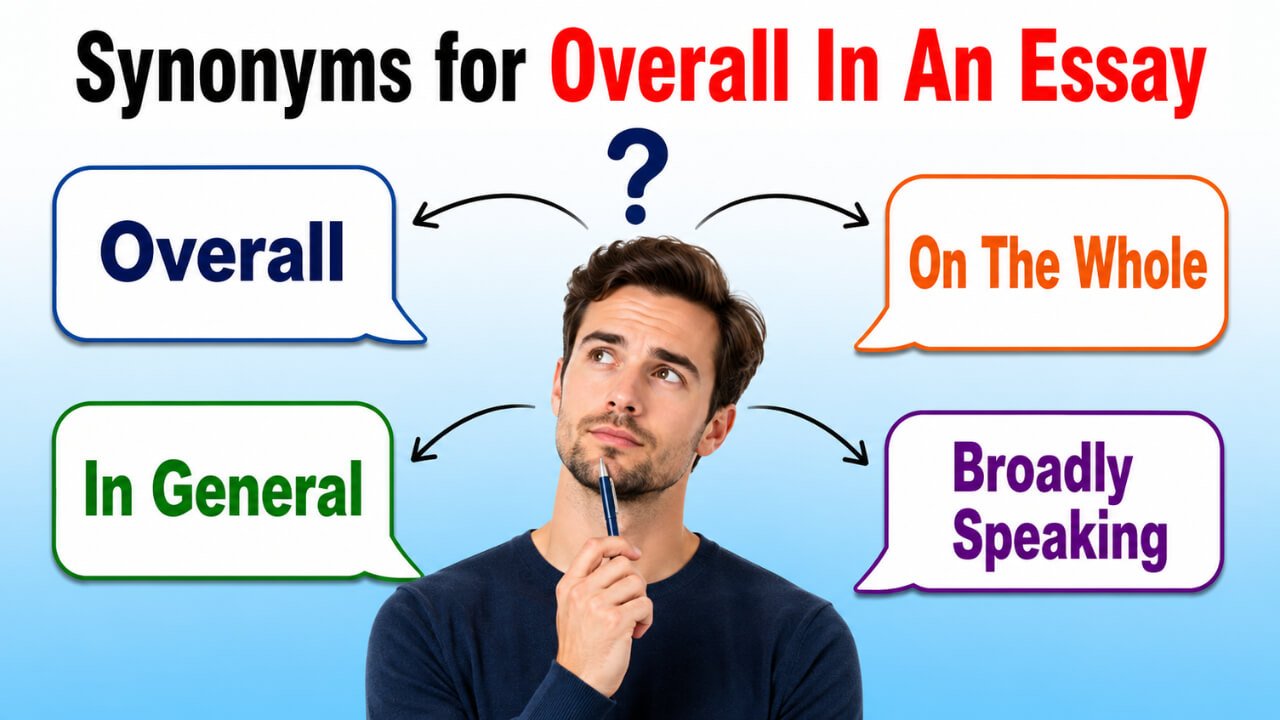
Quick Answer: The best synonyms for overall in an essay are generally, on the whole, all things considered, in general, broadly, taken together, collectively, in summary, ultimately, and as a whole. Use generally or broadly when making a general observation. Choose all things considered or on the whole when evaluating several factors. Use taken together when combining evidence, in summary when reviewing key points, and ultimately when presenting a final judgment. For an adjective, comprehensive, total, or general may replace overall depending on the sentence.
Pronunciation and Word Details
Word: Overall
Pronunciation: /ˌoʊvərˈɔːl/
Part of Speech: Adverb and adjective
Meaning: Considering every part, fact, result, or aspect of something together.
US Pronunciation:
UK Pronunciation:
What Does “Overall” Mean?
Overall means considering all parts, facts, effects, or results together rather than focusing on one detail. In essay writing, it commonly introduces a general evaluation, summary, conclusion, or final judgment.
As an adverb, overall often appears at the beginning of a sentence.
Example: Overall, the policy produced more benefits than disadvantages.
As an adjective, overall describes something that includes every important part.
Example: The overall effect of the policy was positive.
The word can help writers move from individual details to a wider conclusion. It is especially useful after evidence, examples, comparisons, survey results, or several supporting arguments have already been discussed.
However, overall does not always mean the same thing. In one sentence, it may mean generally. In another, it may mean total, complete, combined, or comprehensive. The correct synonym depends on the grammatical role and intended meaning.
Meaning, Tone, and Context of “Overall”
Overall has a neutral and moderately formal tone. It is appropriate for essays, reports, reviews, evaluations, academic discussions, business writing, and everyday conversation.
In formal writing, overall often introduces a balanced judgment based on several points.
Example: Overall, the findings support the original argument.
In analytical writing, it can show that separate pieces of evidence lead to one broad conclusion.
Example: Overall, the data indicates a gradual improvement in performance.
In descriptive writing, overall may refer to the complete impression created by something.
Example: The overall atmosphere of the setting is tense and uncertain.
The word is not strongly emotional. It usually communicates evaluation, summary, scope, or total effect in a calm and objective manner.
Overall is also flexible. It may describe a result, effect, impression, argument, structure, quality, trend, performance, meaning, or conclusion. When used too often, however, it can make an essay sound repetitive or vague. More precise alternatives can show whether the writer is summarizing, generalizing, combining evidence, or reaching a final conclusion.
When and How to Use “Overall”
For a General Evaluation
Use overall when you want to express a judgment based on the complete situation rather than one individual detail.
Example: Overall, the new system has improved the learning experience.
For Summarizing Evidence
Use overall after discussing several facts, examples, studies, or arguments that point toward a shared conclusion.
Example: Overall, the evidence suggests that regular practice improves long term performance.
For Combining Different Results
Overall can show that separate results should be considered together.
Example: Overall, the three experiments produced similar outcomes.
For Describing a Total Effect
As an adjective, overall can describe the complete effect created by several causes.
Example: The overall effect of the changes was beneficial.
For Presenting a Final Judgment
Use overall when giving a balanced opinion after considering both advantages and disadvantages.
Example: Overall, the proposal is practical, although several details require revision.
For Discussing a Broad Pattern
Overall can describe a general trend even when a few exceptions exist.
Example: Overall, participation increased throughout the semester.
Best Synonyms for Overall
Generally
Synonym: Generally means in most cases or when considering the situation broadly.
Example: Generally, students performed better after receiving detailed feedback.
On the Whole
Synonym: On the whole means after considering every important aspect.
Example: On the whole, the program achieved its main objectives.
All Things Considered
Synonym: All things considered introduces a balanced judgment based on several factors.
Example: All things considered, the benefits outweigh the potential risks.
In General
Synonym: In general means broadly or without focusing on every exception.
Example: In general, the results support the proposed explanation.
Broadly
Synonym: Broadly means from a wide perspective rather than in precise detail.
Example: Broadly, the two theories share the same central principle.
Taken Together
Synonym: Taken together means that several facts or pieces of evidence are being considered as one group.
Example: Taken together, these findings reveal a consistent pattern.
Collectively
Synonym: Collectively means as a combined group rather than separately.
Example: Collectively, the studies provide strong evidence for the claim.
In Summary
Synonym: In summary introduces a brief review of the most important points.
Example: In summary, effective communication depends on clarity, purpose, and audience awareness.
Ultimately
Synonym: Ultimately means after all relevant facts or developments have been considered.
Example: Ultimately, the success of the plan depends on careful implementation.
As a Whole
Synonym: As a whole means considering something in its complete form.
Example: The argument, as a whole, is logical and well supported.
50 Synonyms for Overall with Short Meanings
- Generally: In most cases or from a broad perspective.
- In General: Without concentrating on specific exceptions.
- On the Whole: After considering all important aspects.
- All Things Considered: After evaluating every relevant factor.
- Broadly: From a wide and general viewpoint.
- Broadly Speaking: When discussing the main idea rather than details.
- Generally Speaking: As a common or general observation.
- By and Large: Mostly or in most important respects.
- For the Most Part: True in the majority of cases.
- In Most Respects: True when most features are considered.
- Taken Together: Considered as one complete group.
- Collectively: As a combined group.
- As a Whole: In complete form rather than in separate parts.
- Viewed as a Whole: Judged by considering every part together.
- Considering Everything: After examining all relevant details.
- In the Main: Mainly or for the most important part.
- Largely: To a great extent.
- Predominantly: Mainly or more than anything else.
- Mostly: In most cases or to the greatest degree.
- Mainly: More than any other part or reason.
- Chiefly: Primarily or principally.
- Essentially: When reduced to the most important meaning.
- Fundamentally: At the most basic or central level.
- Ultimately: In the end or after everything is considered.
- In the Final Analysis: After all evidence and factors are examined.
- In Summary: As a brief statement of the main points.
- To Summarize: To state the central ideas briefly.
- In Conclusion: As a final statement based on the discussion.
- To Conclude: To present the final judgment or point.
- In Brief: Using only the most important information.
- In Short: Expressed in a few clear words.
- Altogether: With every part included.
- Totally: To the complete degree.
- Entirely: Fully and without exception.
- Completely: Including every necessary part.
- Fully: To the greatest or complete extent.
- Wholly: Entirely or in every part.
- Total: Including the entire amount or result.
- Complete: Containing every important part.
- Comprehensive: Covering all major areas or details.
- General: Relating to the whole rather than a specific part.
- Aggregate: Formed by combining several amounts or results.
- Combined: Created by joining separate parts.
- Cumulative: Increasing or developing through combined additions.
- Inclusive: Including every relevant group, part, or factor.
- Broad: Covering a wide range of ideas or areas.
- Across the Board: Applying to every part or category.
- In Aggregate: Considered as a combined total.
- In Total: With all amounts or elements included.
- Overarching: Including or influencing all major parts.
Read Also:
Synonyms for Chaotic
Synonyms for Overall by Context
When Overall Means Generally
Use these alternatives when presenting a broad statement that allows for some exceptions.
Useful Synonyms: Generally, in general, broadly, generally speaking, by and large, for the most part, and largely.
Example With Overall: Overall, younger participants responded positively to the program.
Example With Generally: Generally, younger participants responded positively to the program.
Generally is often the simplest one word replacement. Broadly works well when discussing a subject from a wide perspective. For the most part is useful when the statement is true in many cases but not every case.
When Overall Means Considering Everything
Use these alternatives when giving a balanced judgment after examining several factors.
Useful Synonyms: On the whole, all things considered, considering everything, in the final analysis, and viewed as a whole.
Example With Overall: Overall, the advantages of the system are greater than its limitations.
Example With All Things Considered: All things considered, the advantages of the system are greater than its limitations.
All things considered emphasizes careful evaluation. On the whole is slightly more concise and works in both formal and conversational writing.
When Overall Means Combining Evidence
Use these expressions when several facts, examples, results, or arguments support one conclusion.
Useful Synonyms: Taken together, collectively, as a whole, in aggregate, and combined.
Example With Overall: Overall, the studies support the same conclusion.
Example With Taken Together: Taken together, the studies support the same conclusion.
Taken together is especially effective in research based essays because it clearly shows that separate pieces of evidence are being evaluated collectively.
When Overall Introduces a Summary
Use these alternatives when reviewing the main points of an essay or section.
Useful Synonyms: In summary, to summarize, in brief, in short, in conclusion, and to conclude.
Example With Overall: Overall, the argument depends on three main principles.
Example With In Summary: In summary, the argument depends on three main principles.
In summary is more direct when the purpose is to review ideas. In conclusion is more suitable when presenting the final section of an essay.
When Overall Means Ultimately
Use these alternatives when presenting the final result, consequence, or judgment.
Useful Synonyms: Ultimately, in the final analysis, fundamentally, and in the end.
Example With Overall: Overall, the decision belongs to the individual.
Example With Ultimately: Ultimately, the decision belongs to the individual.
Ultimately emphasizes the final result or most important conclusion rather than a simple summary.
When Overall Means Total or Complete
Use these alternatives when overall functions as an adjective describing the complete amount, effect, condition, or result.
Useful Synonyms: Total, complete, aggregate, combined, entire, full, and cumulative.
Example With Overall: The overall cost of the project exceeded the original estimate.
Example With Total: The total cost of the project exceeded the original estimate.
Total is best for numbers, costs, scores, quantities, and measurable amounts. Combined is better when separate values are joined.
When Overall Means Broad or Comprehensive
Use these words when describing the full scope, structure, quality, or impression of something.
Useful Synonyms: Comprehensive, general, broad, inclusive, and overarching.
Example With Overall: The essay provides an overall examination of the issue.
Example With Comprehensive: The essay provides a comprehensive examination of the issue.
Comprehensive suggests that the discussion covers all major elements in sufficient detail. Broad suggests wide coverage but not necessarily detailed treatment.
Another Word for Overall
Generally is often the best single word replacement for overall when the word introduces a broad observation. However, the best alternative depends on the intended meaning. On the whole is better for balanced evaluation, taken together is better for combined evidence, ultimately is better for a final judgment, and total is better for an amount or score.
Original: Overall, the students understood the central concept.
Better Option: Generally, the students understood the central concept.
Original: Overall, the evidence supports the main claim.
Better Option: Taken together, the evidence supports the main claim.
Original: Overall, the proposal remains the most practical option.
Better Option: All things considered, the proposal remains the most practical option.
Original: The overall cost was lower than expected.
Better Option: The total cost was lower than expected.
When Not to Use “Overall”
Overall should not be used when a more specific transition would communicate the relationship between ideas more clearly. It may sound weak when the writer is explaining a cause, contrast, example, or direct consequence.
When Introducing a Specific Conclusion
Overall may be too general when the sentence presents the final outcome of an argument.
Weak: Overall, the policy should be revised immediately.
Better: Ultimately, the policy should be revised immediately.
When Combining Research Evidence
Overall does not clearly explain that several findings are being considered together.
Weak: Overall, the three studies demonstrate a similar pattern.
Better: Taken together, the three studies demonstrate a similar pattern.
When Referring to an Exact Total
Overall may be less precise when discussing measurable amounts.
Weak: The overall number of responses was 850.
Better: The total number of responses was 850.
When Summarizing a Section
A direct summary transition may help the reader understand the structure more easily.
Weak: Overall, the section explains three causes of the conflict.
Better: In summary, the section explains three causes of the conflict.
When the Word Has Already Been Repeated
Using overall several times within one paragraph can make the writing sound mechanical.
Weak: Overall, the results were positive. Overall, the participants were satisfied. Overall, the program was successful.
Better: On the whole, the results were positive. Most participants were satisfied, and the program ultimately achieved its objectives.
When Making a Narrow or Specific Point
Overall should not introduce a statement that concerns only one small detail.
Weak: Overall, the second paragraph contains a spelling error.
Better: Specifically, the second paragraph contains a spelling error.
Words Commonly Confused With Overall
Overall vs Generally: Overall considers every major part of a situation, while generally describes what is true in most cases. Overall often presents an evaluation. Generally often presents a broad pattern.
Overall vs Altogether: Overall means considering the complete situation. Altogether usually means entirely, in total, or with everything included.
Overall vs Ultimately: Overall presents a broad judgment based on several parts. Ultimately emphasizes the final result, decision, or consequence.
Overall vs In Conclusion: Overall can appear anywhere a broad evaluation is needed. In conclusion usually signals the final section or closing statement of a text.
Overall vs In Summary: Overall gives a general judgment, while in summary briefly restates the most important points.
Overall vs Comprehensive: Overall may function as an adverb or adjective. Comprehensive is an adjective meaning complete and detailed in scope.
Overall vs Total: Overall may describe a general effect, judgment, or impression. Total is more precise for complete quantities, amounts, costs, scores, and numbers.
Overall vs Broadly: Overall evaluates the complete situation. Broadly introduces a wide perspective without focusing on small details.
Overall vs Collectively: Overall refers to the general result. Collectively emphasizes that separate people, facts, or items are acting or being considered as a group.
Which Synonym Should You Choose?
Choose generally when describing what is true in most cases.
Choose in general when introducing a broad statement that does not apply to every exception.
Choose on the whole when making a balanced judgment after discussing advantages and disadvantages.
Choose all things considered when you want to emphasize that several factors have been carefully evaluated.
Choose taken together when combining studies, examples, arguments, statistics, or pieces of evidence.
Choose collectively when several people, results, or factors act as one group.
Choose broadly when discussing the main idea without examining every detail.
Choose in summary when briefly reviewing the main points of an essay or section.
Choose in conclusion when introducing the closing section of an essay.
Choose ultimately when presenting the final result, consequence, responsibility, or decision.
Choose total when referring to a number, cost, quantity, amount, score, or measurable result.
Choose comprehensive when describing an analysis, review, explanation, or discussion that covers every major area.
Choose overarching when describing a main idea, theme, goal, or principle that connects several smaller parts.
Choose overall when a neutral and flexible general evaluation is clearer than a more specific alternative.
Real Life Examples of “Overall” in Sentences
Original: Overall, the research supports the proposed theory.
Better Option: Taken together, the research supports the proposed theory.
Original: Overall, the course received positive feedback from students.
Better Option: On the whole, the course received positive feedback from students.
Original: Overall, most participants completed the task successfully.
Better Option: Generally, most participants completed the task successfully.
Original: Overall, the benefits are greater than the disadvantages.
Better Option: All things considered, the benefits are greater than the disadvantages.
Original: Overall, the results reveal a steady increase in productivity.
Better Option: In general, the results reveal a steady increase in productivity.
Original: Overall, the essay presents a convincing argument.
Better Option: As a whole, the essay presents a convincing argument.
Original: Overall, the evidence can be divided into three categories.
Better Option: In summary, the evidence can be divided into three categories.
Original: Overall, individual effort determines the final outcome.
Better Option: Ultimately, individual effort determines the final outcome.
Original: The overall cost of the repairs was considerable.
Better Option: The total cost of the repairs was considerable.
Original: The article offers an overall review of the subject.
Better Option: The article offers a comprehensive review of the subject.
Synonym Groups and Usage Differences
Generalization Group
Generally, in general, broadly, largely, mostly, and for the most part belong to the generalization group. These alternatives describe what is commonly true without claiming that the statement applies in every case.
Example: Generally, early preparation leads to stronger results.
Balanced Evaluation Group
On the whole, all things considered, considering everything, and in the final analysis belong to the balanced evaluation group. They are useful after discussing both positive and negative points.
Example: All things considered, the revised plan is more practical than the original proposal.
Evidence Combination Group
Taken together, collectively, as a whole, combined, and in aggregate belong to the evidence combination group. These choices show that separate facts or findings support a shared conclusion.
Example: Taken together, the interviews reveal a widespread concern about access.
Summary Group
In summary, to summarize, in brief, in short, in conclusion, and to conclude belong to the summary group. They help writers review important ideas or introduce a closing statement.
Example: In summary, the problem requires both immediate action and long term planning.
Final Judgment Group
Ultimately, fundamentally, and in the final analysis belong to the final judgment group. They emphasize the final result or deepest conclusion.
Example: Ultimately, meaningful progress depends on consistent effort.
Totality Group
Total, complete, entire, aggregate, cumulative, fully, and wholly belong to the totality group. They refer to the full amount, degree, or combined result.
Example: The total cost includes materials, labor, and transportation.
Scope Group
Comprehensive, broad, general, inclusive, and overarching belong to the scope group. These adjectives describe the range or reach of an idea, analysis, plan, or effect.
Example: The report provides a comprehensive examination of the issue.
Antonyms of Overall
The opposite of overall depends on whether the word means generally, completely, collectively, or broadly.
Antonym: Specifically means in a precise or clearly identified way.
Antonym: Individually means one person or item at a time.
Antonym: Separately means apart from other parts or factors.
Antonym: Partially means only to a limited degree.
Antonym: Narrowly means within a restricted range or perspective.
Antonym: Locally means within one limited place or area.
Antonym: Selectively means including only chosen parts.
Antonym: Incompletely means without every necessary part.
Antonym: In Detail means with attention to individual facts or features.
Antonym: Piece by Piece means by examining each separate part.
Antonym: Limited means restricted in amount, range, or effect.
Antonym: Isolated means separated from the wider context.
Comparison: Overall vs Related Words
Overall vs Generally
Overall expresses a judgment based on the complete situation. Generally expresses what is commonly or usually true.
Example With Overall: Overall, the new approach was successful despite several early difficulties.
Example With Generally: Generally, the new approach works well for experienced learners.
Overall vs On the Whole
These expressions are very close in meaning. Overall is shorter and more flexible, while on the whole often sounds more balanced and deliberate.
Example With Overall: Overall, the project achieved its main goals.
Example With On the Whole: On the whole, the project achieved its main goals.
Overall vs All Things Considered
Overall provides a broad evaluation. All things considered places greater emphasis on weighing several facts, advantages, or disadvantages.
Example With Overall: Overall, the decision was reasonable.
Example With All Things Considered: All things considered, the decision was reasonable.
Overall vs Taken Together
Overall presents the general result. Taken together explicitly shows that several facts or findings are being combined.
Example With Overall: Overall, the results support the hypothesis.
Example With Taken Together: Taken together, the results support the hypothesis.
Overall vs Ultimately
Overall gives a broad assessment. Ultimately focuses on the final outcome, responsibility, or conclusion.
Example With Overall: Overall, the strategy appears effective.
Example With Ultimately: Ultimately, the strategy will succeed only with sufficient support.
Overall vs In Summary
Overall may present an opinion or evaluation. In summary directly signals that key points are being reviewed briefly.
Example With Overall: Overall, the discussion demonstrates the value of early intervention.
Example With In Summary: In summary, the discussion demonstrates the value of early intervention.
Overall vs In Conclusion
Overall does not necessarily indicate the final paragraph. In conclusion clearly signals that the writer is closing the essay or argument.
Example With Overall: Overall, the evidence remains convincing.
Example With In Conclusion: In conclusion, the evidence remains convincing.
Overall vs Total
Overall can describe a complete impression, result, quality, or effect. Total is more exact when referring to a measurable amount.
Example With Overall: The overall effect of the campaign was positive.
Example With Total: The total cost of the campaign was lower than expected.
Overall vs Comprehensive
Overall describes the general or complete nature of something. Comprehensive suggests that every major area has been covered thoroughly.
Example With Overall: The report provides an overall view of the problem.
Example With Comprehensive: The report provides a comprehensive analysis of the problem.
Common Phrases and Expressions With “Overall”
Overall Effect: The complete result produced by several causes or actions.
Overall Result: The final outcome after all individual results are combined.
Overall Impression: The general opinion formed after considering every noticeable feature.
Overall Performance: The complete level of achievement across several tasks or areas.
Overall Quality: The general standard of something when all features are considered.
Overall Meaning: The main idea communicated by an entire text, statement, or situation.
Overall Argument: The central claim supported by the complete essay or discussion.
Overall Structure: The way all sections and parts are organized together.
Overall Conclusion: The broad judgment reached after examining the evidence.
Overall Picture: A complete understanding of a situation rather than one isolated detail.
Common Mistakes to Avoid
Repeating Overall Too Often
Using overall at the beginning of several sentences makes writing sound predictable. Replace some occurrences with generally, on the whole, taken together, or ultimately according to the intended meaning.
Using Overall Without Supporting Evidence
Overall should usually introduce a judgment based on information already presented. Avoid making a broad claim without facts, examples, or reasoning.
Weak: Overall, the method is better.
Better: Taken together, the lower cost, faster completion time, and improved accuracy make the method more effective.
Confusing a Generalization With a Complete Judgment
Generally means that something is true in most cases. Overall means that all important parts have been considered. These words are related, but they are not always interchangeable.
Using a Summary Phrase for a New Idea
In summary and in conclusion should review or close earlier discussion. Do not use them to introduce an unrelated argument or new evidence.
Using Total for a General Impression
Total is suitable for measurable amounts and complete quantities. It may sound unnatural when describing a broad opinion.
Unnatural: The total impression of the novel is hopeful.
Natural: The overall impression of the novel is hopeful.
Using Comprehensive When the Coverage Is Limited
Comprehensive suggests complete and detailed coverage. Do not use it when an essay discusses only a few selected aspects of a broad subject.
Forgetting the Comma After Introductory Overall
When overall introduces a complete sentence, place a comma after it.
Incorrect: Overall the evidence supports the claim.
Correct: Overall, the evidence supports the claim.
Confusing Overall With Over All
Overall is normally written as one word when it means generally or complete.
Correct: Overall, the results were encouraging.
Over all is written as two words only when over functions separately and refers to position or coverage.
Example: A protective cover was placed over all the equipment.
Choosing a Synonym With the Wrong Grammatical Form
Overall can function as an adverb or adjective. Make sure the replacement fits the grammar of the sentence.
Adverb Use: Overall, the results were positive.
Adjective Use: The overall results were positive.
Incorrect Replacement: The generally results were positive.
Correct Replacement: The general results were positive.
Conclusion
Choosing accurate synonyms for overall in an essay can make arguments clearer, more varied, and more precise. Use generally for broad observations, on the whole for balanced evaluations, taken together for combined evidence, in summary for a review of key points, and ultimately for a final judgment. When overall describes a quantity or scope, total, comprehensive, aggregate, or overarching may be more suitable. The strongest choice always depends on the sentence’s meaning, grammatical structure, and purpose.
FAQs About Synonyms for Overall
What Is the Best Synonym for Overall in an Essay?
Generally is a strong one word replacement for a broad observation. On the whole is better for a balanced judgment, while taken together is best when combining evidence.
Can I Use Overall in Formal Writing?
Yes. Overall has a neutral and moderately formal tone. It is suitable for essays, reports, evaluations, reviews, and academic discussions.
What Can I Write Instead of Overall in a Conclusion?
You can use in summary, in conclusion, ultimately, all things considered, or on the whole. Choose the phrase that matches whether you are summarizing or giving a final judgment.
Is Overall the Same as In Conclusion?
No. Overall presents a broad evaluation and can appear in different parts of an essay. In conclusion usually introduces the final section or closing statement.
What Is a More Academic Word for Overall?
Taken together, collectively, in aggregate, broadly, comprehensive, and overarching can sound more precise in academic contexts. The best option depends on the sentence.
Should There Be a Comma After Overall?
Use a comma when overall appears as an introductory adverb at the beginning of a sentence.
Example: Overall, the findings support the main argument.
Can Overall Be Used as an Adjective?
Yes. As an adjective, overall describes the complete result, effect, quality, impression, structure, or scope of something.
Example: The overall quality of the essay is strong.
