
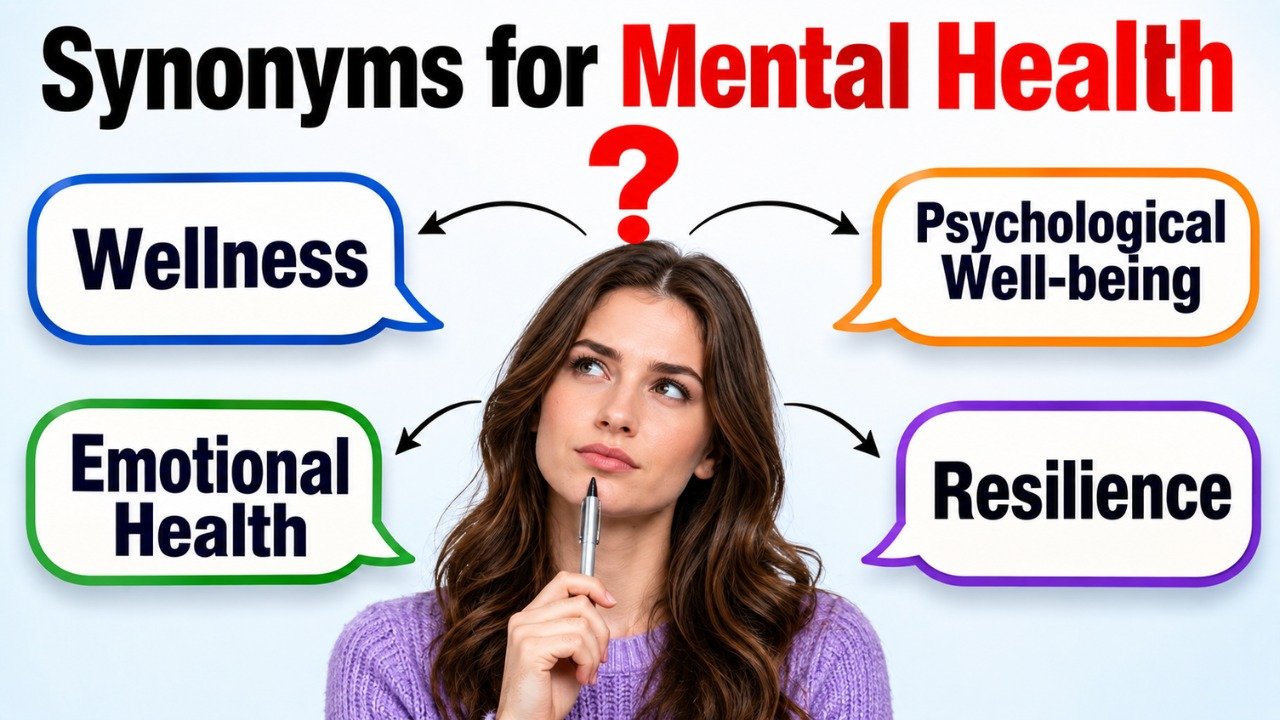
Quick Answer: The best synonyms for mental health include psychological well being, emotional well being, mental wellness, psychological health, emotional health, mental well being, behavioral health, psychosocial well being, mental fitness, and state of mind. Psychological well being is the strongest general alternative in formal or academic writing. Mental wellness works well in positive lifestyle discussions, while behavioral health suits professional services and support. Emotional health focuses on feelings, and state of mind describes a temporary mental or emotional condition.
Pronunciation and Word Details
Word: Mental health.
Pronunciation: /ˌmen.təl ˈhelθ/
Part of Speech: Noun phrase.
Meaning: A person’s emotional, psychological, and social condition, including how they think, feel, cope, and function.
US Pronunciation:
UK Pronunciation:
What Does “Mental Health” Mean?
Mental health means a person’s emotional and psychological condition and their ability to manage thoughts, feelings, relationships, responsibilities, and daily challenges.
Mental health is a noun phrase. It can describe a person’s overall psychological well being, a particular area of personal health, or a field of professional care and study.
The phrase does not refer only to illness or difficulty. Everyone has mental health, just as everyone has physical health. It may be strong, strained, improving, stable, or in need of support.
Example: Regular rest and supportive relationships can contribute to good mental health.
Mental health can describe a general condition.
Example: The organization introduced programs that support employee mental health.
It may also refer to professional services.
Example: The community expanded access to mental health care.
In educational writing, the phrase can include emotional awareness, coping ability, resilience, social connection, and psychological functioning.
Example: The lesson encourages students to understand the importance of mental health.
The best synonym depends on whether the sentence discusses overall well being, emotional balance, professional care, behavior, resilience, or a temporary state of mind.
Meaning, Tone, and Context of “Mental Health”
Mental health is a neutral, respectful, and widely accepted phrase. It appears in everyday conversation, education, professional communication, workplace policies, health discussions, academic writing, and public information.
The tone can change according to the context.
Neutral Context: Mental health can refer to a person’s general emotional and psychological condition.
Example: Sleep can influence mental health and daily concentration.
Positive Context: The phrase may describe habits, relationships, and environments that support well being.
Example: She protects her mental health by maintaining clear personal boundaries.
Professional Context: Mental health may refer to trained services, care, education, or workplace support.
Example: Employees received information about available mental health support.
Academic Context: Researchers and students may use the phrase when discussing emotional, cognitive, behavioral, and social functioning.
Example: The paper explores the connection between social support and mental health.
Conversational Context: In ordinary speech, people often use mental health when discussing stress, emotions, balance, or personal needs.
Example: I need a quiet weekend to take care of my mental health.
Sensitive Context: The phrase should be used with care when discussing another person’s experiences. Avoid assumptions, labels, or disrespectful descriptions.
Example: It is more respectful to ask what support someone needs than to make claims about their mental health.
Mental health is broader than mood. A person may feel sad, worried, or frustrated for a short period without that feeling representing their entire psychological condition.
When and How to Use “Mental Health”
For Overall Psychological Well Being
Use mental health when discussing a person’s general emotional and psychological condition.
Example: Supportive friendships can have a positive influence on mental health.
For Emotional Balance
Use mental health when discussing how someone understands, manages, and expresses emotions.
Example: She developed routines that support her mental health during stressful periods.
For Workplace Support
Use mental health when describing policies, resources, communication, or conditions related to employee well being.
Example: The workplace introduced flexible practices to support staff mental health.
For Educational Discussions
Use mental health in lessons, articles, and essays about emotions, resilience, relationships, stress, or psychological functioning.
Example: The course includes a section on mental health and healthy coping habits.
For Professional Services
Use mental health when referring to qualified support, care, assessment, or treatment.
Example: The center provides mental health services for people seeking professional guidance.
For Personal Boundaries
Use mental health when explaining why someone needs rest, space, support, or a change in routine.
Example: He reduced unnecessary commitments to protect his mental health.
For Community Well Being
Use mental health when discussing social support, access to care, belonging, safety, and healthy environments.
Example: Community connection can play an important role in mental health.
For Healthy Habits
Use mental health when discussing activities that may support emotional and psychological wellness.
Example: Rest, meaningful activity, and social connection may support mental health.
For Difficult Experiences
Use mental health respectfully when discussing emotional distress, psychological strain, or the need for support.
Example: A difficult life event can affect a person’s mental health in different ways.
For Formal Writing
Use psychological well being or psychological health when a report or essay requires more specific wording.
Example: The study examined psychological well being among university students.
Best Synonyms for Mental Health
Psychological Well Being: A person’s overall emotional and psychological quality of life.
Example: The program was designed to support psychological well being.
Emotional Well Being: The ability to understand, express, and manage emotions in healthy ways.
Example: Supportive communication can improve emotional well being.
Mental Wellness: A positive state involving emotional balance, healthy functioning, and supportive habits.
Example: The workshop focused on practical ways to maintain mental wellness.
Psychological Health: The condition of a person’s thoughts, emotions, coping abilities, and psychological functioning.
Example: Long periods of pressure may affect psychological health.
Emotional Health: A person’s ability to recognize, manage, and communicate feelings.
Example: Honest reflection can support emotional health.
Mental Well Being: A broad term for positive mental, emotional, and social functioning.
Example: Meaningful relationships can contribute to mental well being.
Behavioral Health: A broader professional term connecting emotions, behavior, habits, and psychological care.
Example: The clinic offers behavioral health support for individuals and families.
Psychosocial Well Being: Well being related to psychological experience and social relationships.
Example: Community belonging can strengthen psychosocial well being.
Mental Fitness: The ability to maintain focus, emotional strength, adaptability, and healthy mental habits.
Example: Reflection and problem solving can form part of a mental fitness routine.
State of Mind: A person’s mental or emotional condition at a particular time.
Example: A calm environment helped improve her state of mind.
50 Synonyms for Mental Health with Short Meanings
- Psychological Well Being: Overall emotional and psychological quality of life.
- Emotional Well Being: Healthy awareness and management of feelings.
- Mental Well Being: Positive mental, emotional, and social functioning.
- Mental Wellness: A balanced and healthy psychological condition.
- Psychological Health: The condition of a person’s psychological functioning.
- Emotional Health: The ability to recognize and manage emotions.
- Psychological Wellness: A positive and balanced psychological state.
- Emotional Wellness: Healthy emotional awareness, expression, and regulation.
- Behavioral Health: Well being related to behavior, emotions, habits, and psychological care.
- Psychosocial Well Being: Psychological wellness supported by healthy social relationships.
- Cognitive Well Being: Healthy functioning related to thought, attention, and understanding.
- Social and Emotional Well Being: Healthy emotional functioning combined with positive social connection.
- Inner Well Being: A personal sense of emotional and psychological wellness.
- Personal Well Being: A person’s overall sense of health, balance, and satisfaction.
- Overall Well Being: General wellness across several areas of life.
- Holistic Well Being: Wellness considered across mental, emotional, social, and physical areas.
- Positive Mental Health: Healthy psychological functioning and emotional balance.
- Healthy State of Mind: A constructive and balanced mental condition.
- Healthy Mindset: A helpful and adaptable pattern of thinking.
- Soundness of Mind: Clear and stable mental functioning, often used formally.
- Mental Fitness: Strength and flexibility in mental and emotional functioning.
- Emotional Fitness: The ability to manage feelings and respond constructively.
- Psychological Fitness: Readiness to manage psychological demands and challenges.
- Mental Balance: A stable relationship among thoughts, emotions, and daily demands.
- Emotional Balance: The ability to experience emotions without becoming overwhelmed.
- Psychological Balance: Stability across thoughts, emotions, and behavior.
- Inner Balance: A personal sense of emotional calm and steadiness.
- Mental Stability: Consistent and manageable psychological functioning.
- Emotional Stability: The ability to maintain emotional steadiness.
- Psychological Stability: A relatively steady psychological condition.
- Mental Equilibrium: A balanced mental and emotional state.
- Emotional Equilibrium: A calm and balanced emotional condition.
- Psychological Equilibrium: Stability among psychological responses and demands.
- Mental Resilience: The ability to adapt to stress and recover from difficulty.
- Emotional Resilience: The ability to manage and recover from emotional challenges.
- Psychological Resilience: The capacity to adapt after psychological strain.
- Mental Strength: The ability to face challenges with focus and persistence.
- Emotional Strength: The ability to handle difficult feelings constructively.
- Psychological Strength: Inner resources used to manage demands and adversity.
- Mental Vitality: A sense of mental energy, engagement, and alertness.
- Emotional Vitality: Emotional energy, interest, and positive engagement.
- Psychological Vitality: A sense of psychological energy and active involvement in life.
- Mental Functioning: The way a person thinks, feels, and manages daily life.
- Emotional Functioning: The way a person experiences and manages emotions.
- Psychological Functioning: The operation of thoughts, emotions, behavior, and coping abilities.
- Mental State: A person’s mental condition at a particular time.
- Emotional State: The feelings a person experiences at a certain moment.
- Psychological State: A person’s psychological condition at a particular time.
- State of Mind: A temporary pattern of thoughts, feelings, or attitudes.
- Psychological Condition: A general or clinical description of psychological functioning.
Read Also:
Synonyms for Catalyst

Synonyms for Mental Health by Context
When Mental Health Means Overall Well Being
Psychological well being, mental well being, personal well being, overall well being, and holistic well being are useful alternatives when discussing a person’s general quality of life.
Psychological well being is usually the most precise formal alternative.
Example: The survey measured psychological well being among employees.
Mental well being sounds natural in educational and everyday writing.
Example: Rest and supportive relationships can contribute to mental well being.
Overall well being is broader because it may include physical, social, and financial areas.
Example: The program supports overall well being through several practical services.
When Mental Health Means Emotional Wellness
Emotional well being, emotional health, emotional wellness, emotional balance, and emotional fitness work well when the main focus is feelings.
Emotional health emphasizes how someone recognizes, communicates, and manages emotions.
Example: Open communication can support emotional health within a family.
Emotional balance focuses on maintaining steadiness during changing situations.
Example: She uses quiet reflection to restore emotional balance.
Emotional wellness is often used in positive discussions of self awareness and healthy habits.
Example: The class explored habits that support emotional wellness.
When Mental Health Means Psychological Functioning
Psychological health, psychological wellness, psychological functioning, psychological condition, and psychological state are suitable for professional, academic, or analytical contexts.
Psychological functioning is useful when discussing thoughts, emotions, behavior, and daily abilities.
Example: The assessment considered the participant’s psychological functioning.
Psychological condition can sound more clinical, so it should be used carefully.
Example: The report described changes in the patient’s psychological condition.
Psychological wellness has a more positive and preventive tone.
Example: The course promotes psychological wellness through education and support.
When Mental Health Refers to Professional Care
Behavioral health, psychological care, emotional support, mental health care, and psychological services may be appropriate when discussing professional support.
Behavioral health is broader than mental health because it can include habits, actions, emotional difficulties, and related care.
Example: The center provides behavioral health services to the local community.
Psychological care focuses more directly on professional support for emotional and psychological needs.
Example: The family was given information about available psychological care.
Emotional support may come from professionals, friends, family members, or community groups.
Example: She received emotional support during a difficult transition.
When Mental Health Means a Temporary Condition
State of mind, mental state, emotional state, psychological state, and frame of mind describe how someone feels or thinks at a particular time.
State of mind is useful in ordinary conversation.
Example: A short walk helped improve his state of mind.
Emotional state focuses mainly on feelings.
Example: The conversation had a strong effect on her emotional state.
Mental state may sound more formal and can refer to thinking, awareness, or emotional condition.
Example: The interviewer remained attentive to the person’s mental state.
These expressions are narrower than mental health because they often describe a temporary moment rather than long term well being.
When Mental Health Means Balance
Mental balance, emotional balance, psychological balance, inner balance, and mental equilibrium emphasize steadiness and harmony.
Mental balance is useful in general writing.
Example: A manageable routine helped him maintain mental balance.
Psychological equilibrium sounds formal and may suit academic or professional contexts.
Example: Sudden changes can temporarily disturb psychological equilibrium.
Inner balance has a personal and reflective tone.
Example: Quiet time helped her regain a sense of inner balance.
When Mental Health Means Resilience
Mental resilience, emotional resilience, psychological resilience, mental strength, and emotional strength describe the ability to manage difficulty and recover.
Resilience does not mean that a person never struggles. It describes the ability to adapt, seek support, and continue functioning.
Example: Supportive relationships can strengthen emotional resilience.
Mental strength is more conversational and may emphasize persistence.
Example: Asking for help can be an important sign of mental strength.
Psychological resilience works well in formal writing.
Example: The study explored psychological resilience after major life changes.
When Mental Health Means Positive Mental Energy
Mental vitality, emotional vitality, psychological vitality, mental fitness, and healthy mindset describe energy, engagement, and constructive functioning.
Mental vitality emphasizes alertness and active interest.
Example: Meaningful work contributed to her mental vitality.
Mental fitness is often used when discussing habits that support focus, adaptability, and emotional strength.
Example: Learning new skills can be part of maintaining mental fitness.
Healthy mindset refers mainly to patterns of thought and should not replace mental health in every sentence.
Example: A healthy mindset helped him view mistakes as opportunities to learn.
Another Word for Mental Health
Psychological well being is often the best general replacement for mental health. It is clear, respectful, and suitable for formal, educational, and professional writing.
However, the best alternative depends on the intended meaning. Use emotional health when discussing feelings, behavioral health when discussing professional services, state of mind for a temporary condition, and mental wellness for positive habits and prevention.
Original: The program supports student mental health.
Better Option: The program supports student psychological well being.
Original: Open communication can improve mental health.
Better Option: Open communication can improve emotional well being.
Original: The center expanded its mental health services.
Better Option: The center expanded its behavioral health services.
Original: A peaceful morning improved her mental health before the meeting.
Better Option: A peaceful morning improved her state of mind before the meeting.
When Not to Use “Mental Health”
Do not use mental health when a more specific term would explain the situation more accurately.
Mental health is broad. It may be unclear when the sentence is actually about stress, mood, emotions, concentration, a diagnosed condition, or access to professional care.
Weak: The long meeting affected his mental health.
Better: The long meeting left him mentally exhausted.
Do not use mental health to describe one temporary emotion.
Weak: She had bad mental health after hearing the disappointing news.
Better: She felt disappointed and emotionally unsettled after hearing the news.
Avoid using mental health as an exact synonym for mental illness. Mental health belongs to everyone, while mental illness refers to particular health conditions.
Weak: The article lists several types of mental health.
Better: The article discusses several types of mental health conditions.
Do not use mental health when you mean emotional health alone.
Weak: He learned to identify anger and sadness to improve his mental health vocabulary.
Better: He learned to identify anger and sadness to improve his emotional awareness.
Avoid vague claims about another person.
Weak: She clearly has poor mental health because she canceled the meeting.
Better: She canceled the meeting and did not explain the reason.
Do not use disrespectful alternatives that label, shame, or reduce a person to a difficulty.
Weak: His unstable mind made him unreliable.
Better: He was experiencing difficulty and needed appropriate support.
Avoid repeating mental health several times in one paragraph.
Weak: The mental health program teaches mental health habits that improve mental health awareness.
Better: The wellness program teaches supportive habits that improve psychological awareness.
Do not replace mental health with wellness when discussing serious care needs if the softer wording could hide the subject.
Weak: She sought wellness assistance during a serious psychological crisis.
Better: She sought professional mental health support during a serious psychological crisis.
Words Commonly Confused With Mental Health
Mental Health vs Mental Illness: Mental health describes a person’s overall psychological and emotional condition. Mental illness refers to specific health conditions that can affect thoughts, feelings, behavior, or functioning.
Mental Health vs Mental Wellness: Mental health is a broad condition that can range from strong to strained. Mental wellness usually emphasizes positive habits, prevention, balance, and healthy functioning.
Mental Health vs Emotional Health: Mental health includes thoughts, emotions, behavior, coping, and social functioning. Emotional health focuses more specifically on understanding and managing feelings.
Mental Health vs Psychological Health: These expressions are closely related. Psychological health often sounds more formal or academic, while mental health is more common in general communication.
Mental Health vs Behavioral Health: Behavioral health includes mental and emotional well being but may also include habits, behaviors, and related professional services.
Mental Health vs Well Being: Mental health is one part of overall well being. Well being may also include physical, social, occupational, and financial areas.
Mental Health vs State of Mind: Mental health describes a broader and often longer term condition. State of mind usually refers to a person’s temporary thoughts, mood, or attitude.
Mental Health vs Mood: Mental health is broad and ongoing. Mood describes a feeling or emotional condition that may change within a short period.
Mental Health vs Mindset: Mental health includes emotions, functioning, stress, relationships, and psychological condition. Mindset refers mainly to a person’s habitual attitudes and patterns of thought.
Mental Health vs Cognitive Health: Mental health includes emotional and psychological well being. Cognitive health focuses more directly on memory, learning, attention, reasoning, and other thinking abilities.
Which Synonym Should You Choose?
Choose psychological well being for formal essays, reports, educational material, and professional explanations.
Choose emotional well being when discussing feelings, emotional awareness, and healthy emotional expression.
Choose mental wellness for positive lifestyle content, preventive habits, and general wellness discussions.
Choose psychological health when discussing a person’s psychological condition in formal or academic writing.
Choose emotional health when the sentence focuses specifically on recognizing and managing emotions.
Choose behavioral health when discussing professional services involving emotions, behavior, habits, or psychological support.
Choose psychosocial well being when both psychological experience and social relationships are important.
Choose mental fitness when discussing focus, adaptability, resilience, and supportive mental habits.
Choose state of mind when referring to a temporary mood, attitude, or mental condition.
Choose mental resilience when emphasizing adaptation and recovery during difficulty.
Choose psychological functioning when describing how thoughts, feelings, behavior, and coping abilities operate.
Choose mental balance when discussing steadiness across thoughts, emotions, and daily demands.
Choose overall well being when mental health is only one part of a broader discussion.
Choose mental health itself when clarity, familiarity, and respectful communication are more important than variation.
Real Life Examples of “Mental Health” in Sentences
Original: The school introduced new activities to support student mental health.
Better Option: The school introduced new activities to support student psychological well being.
Original: Rest is important for her mental health.
Better Option: Rest is important for her mental wellness.
Original: He speaks openly about his mental health.
Better Option: He speaks openly about his emotional well being.
Original: The workplace offers mental health services.
Better Option: The workplace offers behavioral health services.
Original: The difficult conversation affected her mental health that afternoon.
Better Option: The difficult conversation affected her emotional state that afternoon.
Original: Strong friendships can support mental health.
Better Option: Strong friendships can support psychosocial well being.
Original: He developed routines to strengthen his mental health.
Better Option: He developed routines to strengthen his mental resilience.
Original: The report examined the mental health of the participants.
Better Option: The report examined the psychological well being of the participants.
Original: Quiet reflection helped improve her mental health before the presentation.
Better Option: Quiet reflection helped improve her state of mind before the presentation.
Original: The course explains how stress can influence mental health.
Better Option: The course explains how stress can influence psychological functioning.
Synonym Groups and Usage Differences
Well Being Group
Psychological well being, emotional well being, mental well being, personal well being, and psychosocial well being describe positive functioning and quality of life.
Psychological well being is broad and formal. Emotional well being focuses on feelings, while psychosocial well being includes social connection.
Example: A sense of belonging can support psychosocial well being.
Wellness Group
Mental wellness, psychological wellness, emotional wellness, positive mental health, and holistic well being often appear in positive and preventive discussions.
These terms emphasize supportive habits, balance, self awareness, and healthy functioning.
Example: The workshop offered practical ideas for maintaining emotional wellness.
Health Group
Psychological health, emotional health, behavioral health, and cognitive health describe more specific areas of functioning.
Psychological health is close to mental health. Emotional health focuses on feelings, while behavioral health includes habits and behavior.
Example: The program addresses emotional health through communication and coping skills.
Balance Group
Mental balance, emotional balance, psychological balance, inner balance, and mental equilibrium emphasize stability.
These terms are useful when describing calmness, steadiness, and the ability to manage competing demands.
Example: A predictable routine helped restore her emotional balance.
Resilience Group
Mental resilience, emotional resilience, psychological resilience, mental strength, and emotional strength describe adaptation during difficulty.
Resilience emphasizes recovery and adjustment. Strength emphasizes the personal resources used to face challenges.
Example: Seeking support helped him build emotional resilience.
Fitness and Vitality Group
Mental fitness, emotional fitness, psychological fitness, mental vitality, and emotional vitality describe active, flexible, and energetic functioning.
Fitness often suggests abilities that can be supported through practice. Vitality emphasizes energy and engagement.
Example: Creative activity contributed to her mental vitality.
State Group
Mental state, emotional state, psychological state, state of mind, and psychological condition describe a person’s condition at a particular time.
These expressions can be more temporary or specific than mental health.
Example: The unexpected news changed his emotional state.
Functioning Group
Mental functioning, emotional functioning, psychological functioning, and cognitive well being describe how a person manages thoughts, feelings, attention, behavior, and daily tasks.
These terms are useful in detailed, formal, or professional discussions.
Example: Prolonged stress may influence emotional functioning.
Antonyms of Mental Health
Mental health has no single perfect antonym because it refers to a broad area of human functioning. The most appropriate opposite depends on whether the sentence describes well being, balance, resilience, or current distress.
Poor Mental Health: A reduced level of emotional or psychological well being.
Psychological Distress: Uncomfortable thoughts, feelings, or psychological strain.
Emotional Distress: Significant emotional discomfort or suffering.
Mental Strain: Pressure that places demands on mental and emotional resources.
Psychological Strain: Stress that affects psychological functioning.
Emotional Imbalance: Difficulty maintaining emotional steadiness.
Psychological Imbalance: Disruption in psychological balance or stability.
Reduced Well Being: A lower level of general wellness or life satisfaction.
Mental Exhaustion: A state of severe mental tiredness.
Emotional Exhaustion: Deep emotional tiredness caused by prolonged demands.
Psychological Instability: Difficulty maintaining a steady psychological condition.
Emotional Suffering: Painful or difficult emotional experience.
Severe Stress: Intense pressure that may affect thoughts, emotions, and functioning.
Mental Overload: A condition in which demands exceed available mental capacity.
Psychological Difficulty: A broad term for challenges affecting thoughts, feelings, or functioning.
Mental illness should not automatically be treated as the opposite of mental health. A person with a diagnosed condition can still experience periods of stability, meaningful relationships, effective coping, and positive well being.
Comparison: Mental Health vs Related Words
Mental Health vs Psychological Well Being
Mental health is a broad, familiar term covering emotional and psychological condition. Psychological well being usually emphasizes positive functioning, meaning, relationships, and life satisfaction.
Example With Mental Health: The workplace introduced resources to support employee mental health.
Example With Psychological Well Being: The survey measured employee psychological well being.
Mental Health vs Mental Wellness
Mental health can describe any level of psychological condition, including both strength and difficulty. Mental wellness usually has a positive tone and emphasizes balance, healthy habits, and prevention.
Example With Mental Health: Financial pressure affected his mental health.
Example With Mental Wellness: He developed a routine to support mental wellness.
Mental Health vs Emotional Health
Mental health includes thoughts, emotions, behavior, coping, and relationships. Emotional health focuses more specifically on understanding and managing feelings.
Example With Mental Health: The program addresses several areas of mental health.
Example With Emotional Health: The lesson teaches skills that support emotional health.
Mental Health vs Psychological Health
Mental health and psychological health are close in meaning. Psychological health often sounds more formal, technical, or academic.
Example With Mental Health: The article explains how isolation can affect mental health.
Example With Psychological Health: The report examines the psychological health of remote workers.
Mental Health vs Behavioral Health
Mental health focuses on psychological and emotional well being. Behavioral health also considers actions, habits, lifestyle patterns, and related professional care.
Example With Mental Health: The school increased mental health support.
Example With Behavioral Health: The clinic expanded its behavioral health services.
Mental Health vs State of Mind
Mental health describes a broader condition over time. State of mind usually describes how someone thinks or feels at a particular moment.
Example With Mental Health: Ongoing pressure affected her mental health.
Example With State of Mind: A calm conversation improved her state of mind.
Mental Health vs Mental Fitness
Mental health describes overall psychological condition. Mental fitness emphasizes skills and habits related to focus, flexibility, resilience, and emotional regulation.
Example With Mental Health: Social support can protect mental health.
Example With Mental Fitness: Problem solving activities may strengthen mental fitness.
Mental Health vs Mental Illness
Mental health is something every person has. Mental illness refers to particular conditions that may require professional assessment, support, or treatment.
Example With Mental Health: Everyone can take steps to support their mental health.
Example With Mental Illness: The seminar addressed respectful language about mental illness.
Common Phrases and Expressions With Mental Health
Good Mental Health: A state of healthy psychological and emotional functioning.
Poor Mental Health: Reduced emotional or psychological well being.
Mental Health Awareness: Understanding and recognizing mental health needs and experiences.
Mental Health Support: Help provided for emotional or psychological needs.
Mental Health Care: Professional services related to psychological and emotional health.
Mental Health Services: Organized support, assessment, care, or treatment.
Mental Health Condition: A condition affecting thoughts, emotions, behavior, or functioning.
Mental Health Professional: A trained person who provides psychological or emotional support.
Mental Health Resources: Information, services, or tools that support psychological well being.
Mental Health Education: Learning about emotions, coping, conditions, and available support.
Mental Health Needs: Emotional or psychological needs requiring attention or assistance.
Mental Health Challenges: Difficulties affecting emotions, thoughts, behavior, or daily functioning.
Mental Health Benefits: Positive effects that support emotional or psychological well being.
Mental Health Break: Informal wording for a period of rest taken to reduce strain and recover.
Mental Health Day: A day used for rest, recovery, or attention to psychological well being.
Common Mistakes to Avoid
A common mistake is treating mental health and mental illness as identical terms.
Mental health describes everyone’s psychological and emotional condition. Mental illness refers to particular conditions.
Incorrect: Only people with mental illness have mental health.
Correct: Everyone has mental health, although individual experiences and support needs differ.
Another mistake is using mental health to describe one brief emotion.
Unclear: I had terrible mental health for ten minutes after losing the game.
Clearer: I felt disappointed for several minutes after losing the game.
Avoid assuming that a person’s behavior reveals their mental health condition.
Inappropriate: He missed the appointment, so his mental health must be poor.
Improved: He missed the appointment, but the reason is unknown.
Do not use emotional health, behavioral health, and psychological health as exact replacements in every context. Each term has a different emphasis.
Incorrect: The service treats exercise habits, so emotional health is the only correct term.
Improved: Behavioral health may be more suitable when discussing both habits and emotional well being.
Avoid vague promises that a single activity will fix or cure mental health difficulties.
Weak: Taking one walk will solve your mental health problems.
Better: Gentle activity may support well being for some people, but individual needs differ.
Do not use disrespectful or stigmatizing expressions as synonyms.
Words that mock, insult, or define a person by a difficulty should be avoided.
Disrespectful: She is mentally broken.
Respectful: She is experiencing significant emotional distress and may need support.
Avoid unnecessary repetition.
Repetitive: The mental health lesson provides mental health information for people with mental health concerns.
Improved: The lesson provides practical information for people seeking psychological support.
Use precise language when discussing temporary stress, emotional exhaustion, professional care, diagnosed conditions, or general well being.
Conclusion
The best synonyms for mental health depend on the intended context. Psychological well being is ideal for formal writing, while mental wellness suits positive lifestyle discussions. Emotional health focuses on feelings, behavioral health describes broader professional care, and state of mind refers to a temporary condition. Mental resilience emphasizes recovery during difficulty. By selecting these synonyms for mental health carefully, writers can communicate with greater precision, sensitivity, and respect while avoiding vague or misleading language.
FAQs About Synonyms for Mental Health
What Is the Best Synonym for Mental Health?
Psychological well being is often the best general synonym. It is respectful, clear, and suitable for formal, educational, and professional writing.
Is Mental Wellness the Same as Mental Health?
They are closely related, but not identical. Mental health describes a broad psychological condition, while mental wellness usually emphasizes positive habits, balance, and prevention.
Is Emotional Health a Synonym for Mental Health?
Emotional health is a close alternative when the focus is on feelings. Mental health is broader and can also include thoughts, behavior, coping, and social functioning.
What Is a Formal Synonym for Mental Health?
Psychological well being, psychological health, psychosocial well being, and psychological functioning are useful formal alternatives.
What Is a Positive Alternative to Mental Health?
Mental wellness, positive mental health, emotional wellness, and mental vitality have positive meanings related to balance and healthy functioning.
Can State of Mind Replace Mental Health?
State of mind can replace mental health only when describing a temporary mental or emotional condition. It is usually too narrow for discussions of long term well being or professional care.
Is Behavioral Health Another Word for Mental Health?
Behavioral health is a related and broader term. It may include mental health, emotions, habits, behavior, substance related concerns, and professional support.
