
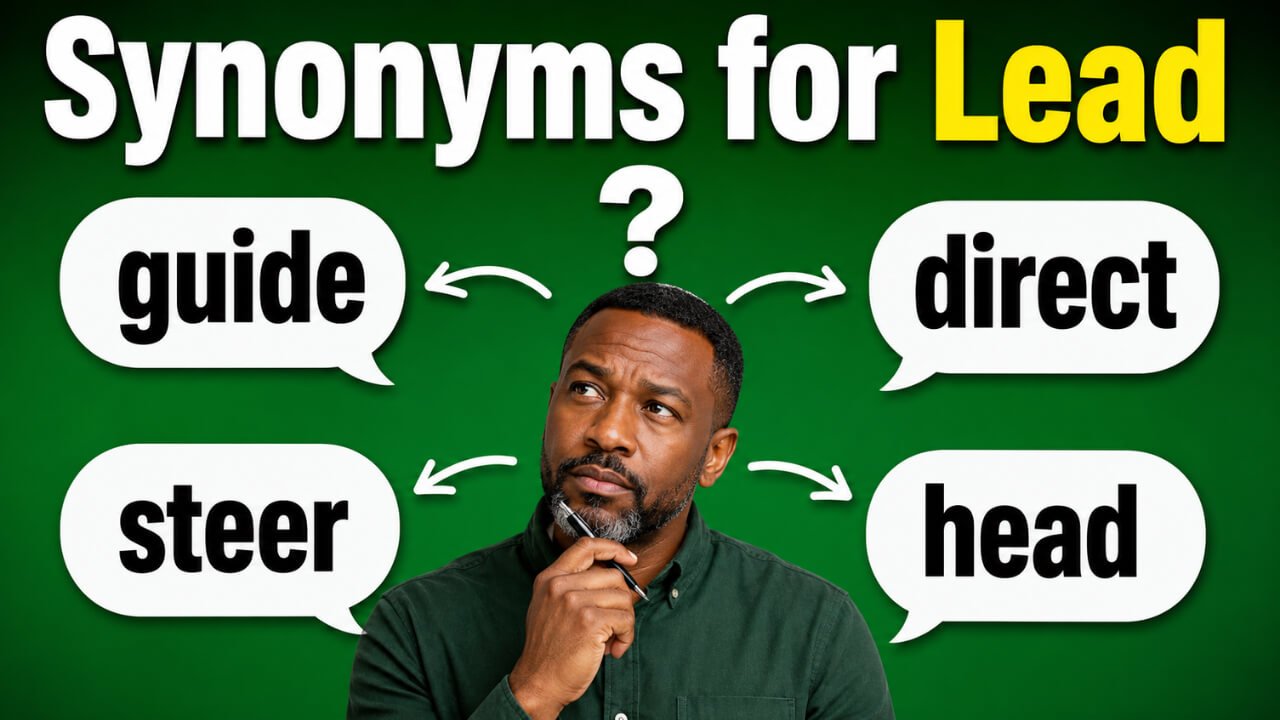
Quick Answer: The best synonyms for lead are guide, direct, manage, head, steer, command, conduct, influence, cause, and result in. Use guide when helping someone move or understand. Use direct for giving instructions. Use manage or head in business and leadership. Use steer when shaping a decision or direction. Use command for strong authority. Use cause or result in when lead means to create an outcome.
Pronunciation and Word Details
Word: Lead.
Pronunciation: /liːd/.
Part of Speech: Verb and noun.
Meaning: Lead means to guide, direct, manage, influence, go first, or cause something to happen.
US Pronunciation:
UK Pronunciation:
What Does “Lead” Mean?
Direct Answer: Lead means to guide someone, control a group, go first, influence a result, or cause something to happen.
Lead can be a verb or a noun. As a verb, it means to show the way, direct people, manage a team, or create an outcome. For example, a teacher can lead a class, a manager can lead a project, and one event can lead to another event.
As a noun, lead can mean a position of advantage, a clue, a possible customer, or the main role in a story or performance. The exact meaning depends on the sentence.
Meaning, Tone, and Context of “Lead”
Meaning: Lead is a flexible word that can show guidance, authority, direction, influence, cause, advantage, or priority.
Tone: Lead is neutral, clear, and useful in both casual and formal English.
Formality: Lead works well in everyday speech, academic writing, business writing, reports, instructions, and professional communication.
Business Context: Lead often means to manage, head, supervise, or direct a team, project, company, campaign, or department.
Academic Context: Lead can mean cause, result in, indicate, or contribute to an outcome.
Conversational Context: Lead can mean guide, show, take someone somewhere, or be ahead in a game.
Technical Context: Lead may describe a signal, clue, first position, cause, or main connection between events.
When and How to Use “Lead”
For Guidance: Use lead when someone shows another person where to go or what to do.
Example: The guide will lead the visitors through the museum.
For Leadership: Use lead when someone manages or controls a group, project, or activity.
Example: She will lead the design team this year.
For Direction: Use lead when something takes a person toward a place, result, or decision.
Example: This road will lead to the main entrance.
For Cause and Effect: Use lead when one action produces another result.
Example: Poor planning can lead to delays.
For Advantage: Use lead when someone is ahead in a race, game, or competition.
Example: Their team has a strong lead at halftime.
For Clues or Information: Use lead as a noun when talking about a clue, tip, or possible opportunity.
Example: The reporter followed a new lead.
For Influence: Use lead when a person, idea, or event shapes behavior or opinion.
Example: Strong values can lead people toward better choices.
Best Synonyms for Lead
Guide: Means to show the way or help someone understand.
Example: A mentor can guide students through difficult choices.
Direct: Means to control, instruct, or point someone toward a goal.
Example: The coach directed the players during practice.
Manage: Means to organize and control people, work, or tasks.
Example: He manages a large customer service team.
Head: Means to be in charge of a group, project, or organization.
Example: She heads the research department.
Steer: Means to guide the direction of something carefully.
Example: The teacher steered the discussion toward the main topic.
Command: Means to lead with strong authority or control.
Example: The officer commanded the unit with confidence.
Conduct: Means to lead or organize an activity, meeting, study, or process.
Example: The scientist conducted the experiment carefully.
Influence: Means to affect what someone thinks, does, or decides.
Example: Her speech influenced the audience.
Cause: Means to make something happen.
Example: Lack of sleep can cause poor concentration.
Result in: Means to produce a specific outcome.
Example: Careful preparation can result in better performance.
50 Synonyms for Lead with Short Meanings
- Guide: Show the way or help someone understand.
- Direct: Give instructions or control movement.
- Manage: Organize and control people or work.
- Head: Be in charge of a group or project.
- Steer: Guide a direction or decision.
- Command: Lead with strong authority.
- Conduct: Organize or carry out an activity.
- Control: Have power over direction or action.
- Oversee: Watch and manage a process.
- Supervise: Direct and monitor people or work.
- Run: Manage or operate something.
- Administer: Manage officially or formally.
- Govern: Control or rule a group or system.
- Captain: Lead a team or group.
- Pilot: Guide a vehicle, plan, or process.
- Shepherd: Carefully guide or protect a group.
- Escort: Accompany and guide someone.
- Accompany: Go with someone as support.
- Show: Help someone see or understand a path.
- Point: Direct attention or movement.
- Influence: Affect decisions, thoughts, or actions.
- Shape: Affect the form, direction, or result.
- Persuade: Lead someone by convincing them.
- Motivate: Encourage someone to act.
- Inspire: Lead by creating energy or belief.
- Cause: Make something happen.
- Create: Bring something into existence.
- Produce: Make or bring about a result.
- Result in: End in a specific outcome.
- Bring about: Cause something to happen.
- Trigger: Start a reaction or event.
- Prompt: Cause someone to act.
- Start: Begin an action or process.
- Begin: Take the first step.
- Initiate: Formally start something.
- Launch: Start a plan, project, or action.
- Pioneer: Be the first to develop or do something.
- Precede: Come before something else.
- Go first: Move before others.
- Be ahead: Have a better position.
- Rank first: Hold the top position.
- Top: Be above others in rank or score.
- Dominate: Control strongly or be most important.
- Surpass: Do better than others.
- Outpace: Move or progress faster than others.
- Clue: Information that helps solve something.
- Tip: Useful information or hint.
- Prospect: A possible customer or opportunity.
- Opportunity: A useful chance or opening.
- Advantage: A better position than others.
Read Also:
Synonyms for Is

Synonyms for Lead by Context
When Lead Means Guide
Use these words when lead means to show the way, help someone move forward, or explain a path.
Guide: Best for helpful direction.
Example: The teacher guided the students through the lesson.
Escort: Best when physically taking someone somewhere.
Example: A staff member escorted the guest to the office.
Shepherd: Best when guiding people carefully through a process.
Example: The advisor shepherded the team through the application process.
When Lead Means Manage
Use these words when lead means to be in charge of people, work, or responsibility.
Manage: Best for organizing tasks and people.
Example: She manages the daily operations.
Head: Best for being the main person in charge.
Example: He heads the finance team.
Oversee: Best for monitoring and directing a process.
Example: The director oversees the training program.
When Lead Means Control or Command
Use these words when lead shows authority, power, or strong direction.
Command: Best for formal or military style authority.
Example: The officer commanded the group.
Control: Best when someone has power over action or direction.
Example: The manager controlled the schedule.
Govern: Best for rules, systems, or official leadership.
Example: Clear policies govern the process.
When Lead Means Cause
Use these words when lead means to make something happen.
Cause: Best for direct cause and effect.
Example: Stress can cause health problems.
Result in: Best when showing the final outcome.
Example: Better planning can result in faster progress.
Bring about: Best for formal writing about change.
Example: The new rule brought about major improvements.
When Lead Means Be Ahead
Use these words when lead means to be in front, rank first, or have an advantage.
Be ahead: Best for casual speech about position.
Example: Their team is ahead by ten points.
Rank first: Best for scores, lists, and results.
Example: The school ranks first in the region.
Outpace: Best when someone progresses faster than others.
Example: The company outpaced its competitors.
When Lead Means Clue or Opportunity
Use these words when lead is a noun meaning useful information, a hint, or a possible chance.
Clue: Best for solving a problem or mystery.
Example: The note gave them a useful clue.
Tip: Best for informal useful information.
Example: The reporter received a helpful tip.
Prospect: Best for business or sales.
Example: The team contacted a new prospect.
Another Word for Lead
Another word for lead depends on the meaning. The best general replacement is guide when lead means to show direction, but manage, direct, cause, result in, or advantage may be better in specific sentences.
Original: She will lead the team.
Better Option: She will manage the team.
Original: This path will lead to the river.
Better Option: This path will guide you to the river.
Original: Poor habits can lead to failure.
Better Option: Poor habits can result in failure.
Original: Their team has the lead.
Better Option: Their team has the advantage.
When Not to Use “Lead”
Do not use lead when a more specific word gives a clearer meaning. Lead can sound vague if the sentence does not show whether it means guide, manage, cause, or be ahead.
Weak: The plan will lead the work.
Better: The plan will guide the work.
Weak: She will lead the files.
Better: She will manage the files.
Weak: The mistake led a problem.
Better: The mistake caused a problem.
Weak: He has a lead in the office.
Better: He has authority in the office.
Avoid using lead when you mean led, which is the past tense of the verb.
Weak: She lead the group yesterday.
Better: She led the group yesterday.
Also avoid using lead as a replacement for every leadership word. In formal writing, direct, manage, oversee, or administer may sound more accurate.
Words Commonly Confused With Lead
Lead vs Led: Lead is the present tense verb, while led is the past tense and past participle.
Lead vs Guide: Lead can mean guide, manage, cause, or be ahead. Guide mainly means to show the way or help someone understand.
Lead vs Manage: Lead focuses on direction and influence. Manage focuses on organizing tasks, people, and responsibilities.
Lead vs Direct: Lead can be broad, while direct means to instruct or control more clearly.
Lead vs Cause: Lead to means cause a result, but cause is more direct.
Lead vs Head: Lead can be an action or position. Head usually means to be in charge of a group or department.
Lead vs Lead Metal: Lead pronounced /liːd/ means guide or manage. Lead pronounced /led/ is a heavy metal and has a different meaning.
Which Synonym Should You Choose?
Choose guide when writing about helping someone move, learn, or understand.
Choose direct when someone gives instructions or controls movement.
Choose manage when writing about business, tasks, teams, or operations.
Choose head when someone is officially in charge of a group, department, or project.
Choose steer when someone shapes the direction of a conversation, plan, or decision.
Choose command when the meaning involves strong authority.
Choose conduct when writing about meetings, research, interviews, or formal activities.
Choose influence when a person or idea affects thoughts, behavior, or choices.
Choose cause when one thing directly makes another thing happen.
Choose result in when you want a formal phrase for outcomes in reports, essays, or analysis.
Choose advantage when lead is a noun meaning a better position in a race, game, or competition.
Choose clue or tip when lead means useful information.
Real Life Examples of “Lead” in Sentences
Original: She will lead the meeting tomorrow.
Better Option: She will conduct the meeting tomorrow.
Original: He leads a small marketing team.
Better Option: He manages a small marketing team.
Original: The guide will lead us to the temple.
Better Option: The guide will escort us to the temple.
Original: Poor communication can lead to confusion.
Better Option: Poor communication can cause confusion.
Original: Extra practice can lead to better results.
Better Option: Extra practice can result in better results.
Original: The captain will lead the players onto the field.
Better Option: The captain will guide the players onto the field.
Original: Their team has a narrow lead.
Better Option: Their team has a narrow advantage.
Original: The detective found a new lead.
Better Option: The detective found a new clue.
Original: Her words led the audience to think differently.
Better Option: Her words influenced the audience to think differently.
Original: The manager leads the training program.
Better Option: The manager oversees the training program.
Synonym Groups and Usage Differences
Guidance Group
This group includes words that show help, direction, or movement. Use guide, escort, show, point, and shepherd when someone helps another person follow a path or process.
Example: The volunteer guided visitors to the entrance.
Leadership Group
This group includes words for responsibility and authority. Use manage, head, oversee, supervise, and run when someone controls work, people, or operations.
Example: She supervises the customer support team.
Authority Group
This group shows stronger control. Use command, govern, control, and administer when leadership is official, strict, or rule based.
Example: The board governs the organization.
Cause Group
This group shows cause and effect. Use cause, result in, bring about, produce, and trigger when one thing creates another outcome.
Example: The new policy produced better results.
Influence Group
This group shows emotional, social, or mental direction. Use influence, persuade, motivate, inspire, and shape when someone affects choices or behavior.
Example: His speech inspired many students.
Advantage Group
This group shows a better position. Use advantage, edge, be ahead, rank first, and outpace when someone is winning or doing better than others.
Example: The early start gave them an advantage.
Information Group
This group is useful when lead is a noun. Use clue, tip, prospect, and opportunity when lead means helpful information or a possible chance.
Example: The sales team followed a strong prospect.
Antonyms of Lead
Follow: Move behind or act after someone else.
Obey: Do what another person commands.
Trail: Stay behind someone in a race or competition.
Lose: Fail to win or keep an advantage.
Fall behind: Move slower or perform worse than others.
Serve: Work under another person’s direction.
Submit: Accept another person’s control or authority.
Hinder: Make progress difficult or slow.
Block: Stop movement, action, or progress.
Prevent: Stop something from happening.
Discourage: Reduce someone’s desire to act.
Confuse: Make direction or meaning unclear.
Comparison: Lead vs Related Words
Lead vs Guide
Lead is broader and can mean manage, cause, guide, or be ahead. Guide mainly means to help someone move or understand.
Example With Lead: She will lead the project.
Example With Guide: She will guide the students through the process.
Lead vs Manage
Lead focuses on direction, influence, and responsibility. Manage focuses more on organizing work and handling details.
Example With Lead: He leads with confidence.
Example With Manage: He manages the schedule carefully.
Lead vs Direct
Lead can be general, while direct usually means to give clear instructions or control an action.
Example With Lead: The coach will lead the team.
Example With Direct: The coach will direct the training session.
Lead vs Command
Lead can be gentle or strong. Command suggests firm authority and control.
Example With Lead: She leads the group calmly.
Example With Command: She commands the unit firmly.
Lead vs Cause
Lead to suggests a result, while cause is more direct and stronger.
Example With Lead: Lack of sleep can lead to mistakes.
Example With Cause: Lack of sleep can cause mistakes.
Lead vs Influence
Lead can involve active direction. Influence means to affect someone’s thoughts, actions, or choices.
Example With Lead: The teacher led the discussion.
Example With Influence: The teacher influenced the students’ opinions.
Lead vs Head
Lead can be a verb or noun. Head usually means to be officially in charge.
Example With Lead: She leads the team.
Example With Head: She heads the department.
Common Phrases and Expressions With Lead
Lead the way: Show others where to go or what to do.
Lead a team: Manage or guide a group of people.
Lead by example: Show others the right behavior through actions.
Take the lead: Become the person in charge or move ahead.
In the lead: Ahead of others in a race, contest, or result.
Lead to: Cause or result in something.
Lead with: Begin with a certain idea, point, or action.
Lead role: Main part or most important position.
Sales lead: A possible customer or business opportunity.
Strong lead: A clear advantage or useful piece of information.
Common Mistakes to Avoid
One common mistake is using lead when the past tense should be led.
Weak: She lead the team last year.
Better: She led the team last year.
Another mistake is using lead vaguely when a clearer verb is available.
Weak: He leads many tasks.
Better: He manages many tasks.
Do not use guide when the meaning is strong authority.
Weak: The officer guided the soldiers in battle.
Better: The officer commanded the soldiers in battle.
Do not use cause when the meaning is only gentle influence.
Weak: Her advice caused him to think differently.
Better: Her advice influenced him to think differently.
Avoid confusing the verb lead with the noun lead that means a metal. The pronunciation and meaning are different.
Weak: The pipe is made of lead pronounced /liːd/.
Better: The pipe is made of lead pronounced /led/.
Use lead when the meaning is broad. Use guide, manage, direct, cause, influence, or advantage when you need more exact meaning.
Conclusion
Synonyms for lead are useful because lead has several meanings. Use guide for help and direction, manage or head for leadership, direct for instruction, command for authority, cause or result in for outcomes, and advantage when lead means being ahead. For writing clarity, always check the sentence context before choosing a replacement. The strongest synonym is the one that matches whether lead means guidance, control, influence, cause, information, or position.
FAQs About Synonyms for Lead
What are the best synonyms for lead?
The best synonyms for lead are guide, direct, manage, head, steer, command, conduct, influence, cause, and result in.
What is another word for lead a team?
Manage, head, supervise, oversee, and direct are strong alternatives for lead a team.
What is a formal synonym for lead?
Formal synonyms for lead include direct, manage, oversee, administer, conduct, and govern.
What is another word for lead to?
Cause, result in, bring about, produce, and trigger are good replacements for lead to.
What is another word for take the lead?
Good alternatives include take charge, go first, move ahead, be in front, and take control.
Is led the same as lead?
Led is the past tense of lead. For example, “She leads today” becomes “She led yesterday.”
What is the noun meaning of lead?
As a noun, lead can mean an advantage, a clue, a tip, a possible customer, or the main role.
