
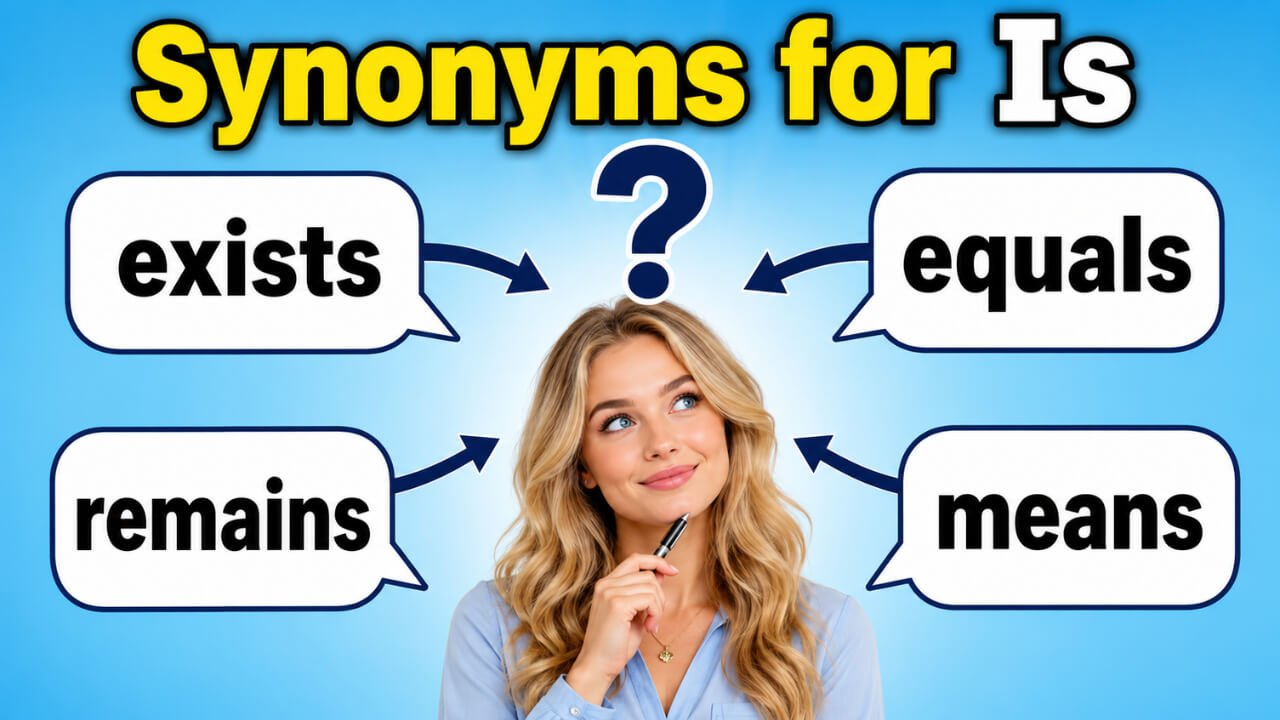
Quick Answer: The best synonyms for is are exists, equals, means, represents, remains, appears, seems, becomes, stands as, and serves as. In grammar, is is a form of the verb be, so it does not always have a perfect replacement. Use exists when talking about reality, equals for math or identity, means for definitions, represents for symbols, remains for an unchanged state, appears or seems for impressions, and serves as for function or purpose.
Pronunciation and Word Details
Word: Is.
Pronunciation: /ɪz/.
Part of Speech: Verb.
Meaning: Is shows existence, identity, condition, location, quality, or state in the present tense.
US Pronunciation:
UK Pronunciation:
What Does “Is” Mean?
Direct Answer: Is means exists, belongs to a state, equals something, or has a certain quality in the present.
Is is a verb and a present tense form of be. It is used with singular subjects such as he, she, it, this, that, and one person or thing. The word can show identity, condition, description, location, time, value, definition, or existence.
For example, in the sentence “The answer is correct,” is connects the subject “answer” with the description “correct.” In “She is a teacher,” it connects a person with an identity. In “The book is on the table,” it shows location.
Meaning, Tone, and Context of “Is”
Meaning: Is is a linking verb that connects a subject with information about that subject.
Tone: Is is neutral, simple, and common in almost every type of writing.
Context: It works in casual speech, academic writing, formal writing, business communication, definitions, descriptions, explanations, instructions, and everyday conversation.
Formality: Is is not too formal or too casual. It is standard English.
Emotional Use: Is has no strong emotional tone by itself. The emotion usually comes from the words around it.
Technical Use: Is appears often in grammar, logic, science, math, definitions, and instructions because it clearly connects ideas.
When and How to Use “Is”
For Identity: Use is when saying what someone or something is.
Example: She is the team leader.
For Description: Use is when describing a quality, condition, or feature.
Example: The room is quiet.
For Location: Use is when showing where someone or something exists.
Example: The file is on the desk.
For Definition: Use is when explaining the meaning of a word, idea, or concept.
Example: Courage is the ability to act despite fear.
For Time: Use is when talking about the present time or date.
Example: It is noon.
For Condition: Use is when describing a current state.
Example: The water is cold.
For Classification: Use is when placing something into a group or category.
Example: A rose is a flower.
For Equality: Use is when showing that two things are the same in meaning, value, or identity.
Example: Two plus two is four.
Best Synonyms for Is
Exists: Means something is real or present.
Example: A simple solution exists for this problem.
Equals: Means something has the same value or meaning.
Example: Ten divided by two equals five.
Means: Explains what something represents or defines.
Example: This word means kindness.
Represents: Shows that one thing stands for another thing.
Example: The symbol represents peace.
Remains: Means something continues to be in the same state.
Example: The rule remains important.
Appears: Means something seems to be true based on what is seen.
Example: The answer appears correct.
Seems: Means something gives a certain impression.
Example: The idea seems useful.
Becomes: Means something changes into a new state.
Example: The task becomes easier with practice.
Stands as: Means something serves as a sign, symbol, or example.
Example: Her success stands as proof of hard work.
Serves as: Means something has a function or purpose.
Example: This guide serves as a useful reference.
50 Synonyms for Is with Short Meanings
- Exists: Has reality or presence.
- Equals: Has the same value or meaning.
- Means: Defines or expresses an idea.
- Represents: Stands for something else.
- Remains: Continues in the same state.
- Appears: Seems true from what is visible.
- Seems: Gives a certain impression.
- Becomes: Changes into a new condition.
- Serves as: Has a role or function.
- Stands as: Acts as a sign or example.
- Functions as: Works in a particular role.
- Acts as: Performs the role of something.
- Works as: Serves in a practical way.
- Lives as: Exists in a certain identity or role.
- Continues as: Stays in the same role or condition.
- Stays: Remains in a place or state.
- Looks: Appears in a certain way.
- Feels: Has a certain condition or impression.
- Sounds: Gives an impression through words or sound.
- Proves: Shows something to be true.
- Indicates: Shows or points to meaning.
- Shows: Makes something clear.
- Reflects: Shows a quality, idea, or condition.
- Suggests: Gives the idea that something may be true.
- Signals: Shows a sign of something.
- Marks: Shows an important point or meaning.
- Forms: Makes up part of something.
- Comprises: Consists of certain parts.
- Contains: Holds or includes something.
- Includes: Has something as part of a whole.
- Belongs to: Is part of a group or category.
- Falls under: Fits into a category.
- Counts as: Is accepted as a certain thing.
- Qualifies as: Meets the standard for something.
- Rates as: Is judged as a certain level.
- Ranks as: Holds a certain position or level.
- Happens to be: Is true by chance or fact.
- Turns out to be: Is discovered to be true.
- Comes across as: Gives a certain impression.
- Reads as: Seems to mean something in writing.
- Amounts to: Is equal in effect or result.
- Corresponds to: Matches or relates to something.
- Matches: Is the same as or fits something.
- Identifies as: Describes oneself as a certain identity.
- Consists of: Is made of certain parts.
- Lies in: Exists within a place, idea, or condition.
- Sits: Is placed or located somewhere.
- Holds: Remains true or valid.
- Relates to: Has a connection with something.
- Constitutes: Formally means makes up or forms something.
Read Also:
Synonyms for Consistent
Synonyms for Is by Context
When Is Means Exists
Use these alternatives when is shows that something has reality, presence, or being.
Exists: A better choice when talking about something real or present.
Example: A problem exists in the system.
Lives: Useful when talking about a person, animal, tradition, or idea that continues.
Example: The tradition lives in many families.
Remains: Useful when something continues to exist.
Example: One question remains.
When Is Means Equals
Use these alternatives when is connects two things with the same value, identity, or result.
Equals: Best for math, value, and exact identity.
Example: Five plus five equals ten.
Amounts to: Best when explaining the result or effect of something.
Example: His silence amounts to agreement.
Corresponds to: Best when one thing matches another.
Example: This code corresponds to that product.
When Is Means Means
Use these alternatives when is explains a definition or meaning.
Means: Best for explaining words, phrases, signs, and ideas.
Example: This phrase means respect.
Represents: Best for symbols or signs.
Example: The color represents hope.
Stands for: Best when explaining abbreviations, symbols, or values.
Example: The letter stands for quality.
When Is Means Seems
Use these alternatives when is describes an impression rather than a proven fact.
Seems: Best for personal judgment or opinion.
Example: The plan seems practical.
Appears: Best for formal or careful writing.
Example: The result appears accurate.
Comes across as: Best for describing how something feels to others.
Example: His message comes across as polite.
When Is Means Serves a Purpose
Use these alternatives when is describes a role, use, or function.
Serves as: Best for purpose or role.
Example: This table serves as a summary.
Functions as: Best for technical or practical roles.
Example: The button functions as a shortcut.
Acts as: Best when one thing performs the role of another.
Example: The wall acts as a barrier.
Another Word for Is
Another word for is depends on the sentence. The best single replacement is often exists when you are talking about reality, but equals, means, represents, seems, and remains may be better in other contexts.
Original: The answer is correct.
Better Option: The answer appears correct.
Original: This symbol is peace.
Better Option: This symbol represents peace.
Original: The total is twenty.
Better Option: The total equals twenty.
Original: The issue is still important.
Better Option: The issue remains important.
When Not to Use “Is”
Avoid using is too often when it makes writing weak, repetitive, or vague. Stronger verbs can make a sentence clearer and more active.
Weak: The article is about grammar.
Better: The article explains grammar.
Weak: The result is a sign of progress.
Better: The result shows progress.
Weak: The rule is important for writers.
Better: The rule helps writers stay clear.
Weak: The symbol is hope.
Better: The symbol represents hope.
You should also avoid replacing is when the sentence needs a simple linking verb. Some alternatives can sound forced or unnatural.
Weak: The room exists quiet.
Better: The room is quiet.
Words Commonly Confused With Is
Is vs Are: Is is used with singular subjects, while are is used with plural subjects.
Example: She is ready. They are ready.
Is vs Was: Is refers to the present, while was refers to the past.
Example: The answer is correct now. The answer was correct yesterday.
Is vs Be: Is is a present tense form of be. Be is the base form used after words such as will, should, can, and must.
Example: He is calm. He should be calm.
Is vs Has: Is shows state or identity, while has shows possession or experience.
Example: She is kind. She has patience.
Is vs Seems: Is states something more directly, while seems suggests an impression or possibility.
Example: The plan is useful. The plan seems useful.
Is vs Means: Is can connect ideas, but means is better for definitions.
Example: Empathy means understanding another person’s feelings.
Which Synonym Should You Choose?
Choose exists when writing about whether something is real, present, or available.
Choose equals when writing about numbers, value, identity, or exact sameness.
Choose means when explaining a word, phrase, rule, or idea.
Choose represents when writing about symbols, signs, values, or images.
Choose remains when something continues in the same condition.
Choose appears when writing carefully about what seems true from evidence.
Choose seems when speaking casually or giving an opinion.
Choose serves as when describing purpose, role, or function.
Choose functions as when writing in a technical, academic, or practical context.
Choose constitutes when formal writing needs a precise word for “forms” or “makes up.”
Real Life Examples of “Is” in Sentences
Original: The answer is correct.
Better Option: The answer appears correct.
Original: The total is fifty dollars.
Better Option: The total equals fifty dollars.
Original: This word is a sign of respect.
Better Option: This word represents respect.
Original: The problem is still serious.
Better Option: The problem remains serious.
Original: The guide is a helpful tool.
Better Option: The guide serves as a helpful tool.
Original: The button is a shortcut.
Better Option: The button functions as a shortcut.
Original: The result is proof of effort.
Better Option: The result shows effort.
Original: The phrase is kindness in action.
Better Option: The phrase means kindness in action.
Original: The house is near the park.
Better Option: The house sits near the park.
Original: The rule is part of the policy.
Better Option: The rule belongs to the policy.
Synonym Groups and Usage Differences
Existence Group
This group shows that something is real, present, or still available. Use exists, remains, lives, and lies in when focusing on presence or reality.
Example: A better answer exists.
Identity Group
This group connects one thing with what it truly is. Use equals, constitutes, qualifies as, counts as, and ranks as when explaining identity, value, or classification.
Example: This behavior qualifies as misconduct.
Meaning Group
This group explains definitions, signs, and symbols. Use means, represents, stands for, indicates, and signals when you want to explain what something expresses.
Example: The symbol represents unity.
Impression Group
This group is useful when something may be true but is not fully proven. Use seems, appears, looks, sounds, and comes across as for careful or opinion based statements.
Example: The explanation seems reasonable.
Function Group
This group describes purpose, role, or use. Use serves as, functions as, acts as, and works as when explaining what something does.
Example: This chart serves as a quick guide.
Continuation Group
This group shows that something does not change. Use remains, stays, continues as, and holds when the meaning is about an ongoing state.
Example: The rule remains valid.
Antonyms of Is
The opposite of is depends on the meaning. Since is shows existence, identity, state, or truth, its antonyms often show absence, difference, change, or nonexistence.
Is not: Shows that something does not have a stated quality.
Does not exist: Means something has no reality or presence.
Differs: Means something is not the same.
Changes: Means something does not remain in the same state.
Disappears: Means something stops being present.
Fails to be: Means something does not meet a condition.
Contradicts: Means something goes against a statement or idea.
Excludes: Means something does not include a part or person.
Lacks: Means something does not have a quality.
Falls short: Means something does not reach a standard.
Comparison: Is vs Related Words
Is vs Exists
Is can describe identity, state, quality, or location. Exists focuses only on reality or presence.
Example With Is: A solution is available.
Example With Exists: A solution exists.
Is vs Equals
Is can connect many kinds of information. Equals is best for exact value, result, or identity.
Example With Is: The result is ten.
Example With Equals: The result equals ten.
Is vs Means
Is can define something, but means is clearer when explaining meaning.
Example With Is: Patience is the ability to wait calmly.
Example With Means: Patience means the ability to wait calmly.
Is vs Represents
Is can connect a symbol with an idea, but represents is more accurate for signs, images, and symbols.
Example With Is: The dove is peace.
Example With Represents: The dove represents peace.
Is vs Seems
Is sounds more certain. Seems sounds less certain and more based on opinion or appearance.
Example With Is: The answer is correct.
Example With Seems: The answer seems correct.
Is vs Remains
Is describes a present state. Remains shows that the state continues over time.
Example With Is: The rule is useful.
Example With Remains: The rule remains useful.
Common Phrases and Expressions With Is
Is able to: Has the ability to do something.
Is going to: Shows a future action or plan.
Is known for: Is recognized because of something.
Is based on: Comes from a source, idea, or reason.
Is made of: Shows material or parts.
Is part of: Belongs to a larger group or whole.
Is responsible for: Has duty or control over something.
Is likely to: Has a strong chance of happening.
Is equal to: Has the same value as something else.
Is similar to: Shares qualities with another thing.
Common Mistakes to Avoid
One common mistake is replacing is with a synonym when the sentence simply needs the verb be. Not every sentence improves with a replacement.
Weak: She seems a doctor.
Better: She is a doctor.
Another mistake is using exists for descriptions. Exists works for reality, not qualities.
Weak: The food exists delicious.
Better: The food is delicious.
Writers also overuse is in sentences that need stronger action verbs.
Weak: The report is about sales growth.
Better: The report explains sales growth.
Avoid using equals outside value, math, or exact sameness.
Weak: Her smile equals beautiful.
Better: Her smile is beautiful.
Avoid choosing appears when you want certainty.
Weak: The sun appears a star.
Better: The sun is a star.
Use is when the sentence needs a clear linking verb. Use stronger alternatives only when they improve meaning.
Conclusion
Synonyms for is can improve writing when you choose them by context. Use exists for reality, equals for value, means for definitions, represents for symbols, remains for continued states, and seems or appears for impressions. Still, is is one of the most useful verbs in English, and many sentences need it. The best approach is not to replace every use, but to choose a clearer alternative when it adds accuracy, variety, or stronger meaning.
FAQs About Synonyms for Is
What are the best synonyms for is?
The best synonyms for is are exists, equals, means, represents, remains, appears, seems, serves as, functions as, and stands as.
Can I always replace is with another word?
No. Is is a basic linking verb, and many sentences sound natural only with is. Replace it only when another word makes the meaning clearer.
What is a formal synonym for is?
Formal alternatives include constitutes, represents, corresponds to, functions as, and serves as. The best choice depends on the sentence.
What is another word for is in definitions?
Means is often the best replacement in definitions. For example, “Respect means treating others with value” sounds clearer than “Respect is treating others with value.”
What is another word for is in math?
Equals is the best replacement for is in math or exact value. For example, “Six plus four equals ten.”
What is another word for is in academic writing?
In academic writing, good alternatives include represents, indicates, constitutes, remains, appears, and suggests. Use them only when they match the meaning.
Why is is hard to replace?
Is is hard to replace because it has many grammar functions. It can show identity, condition, location, description, existence, time, and meaning.
