
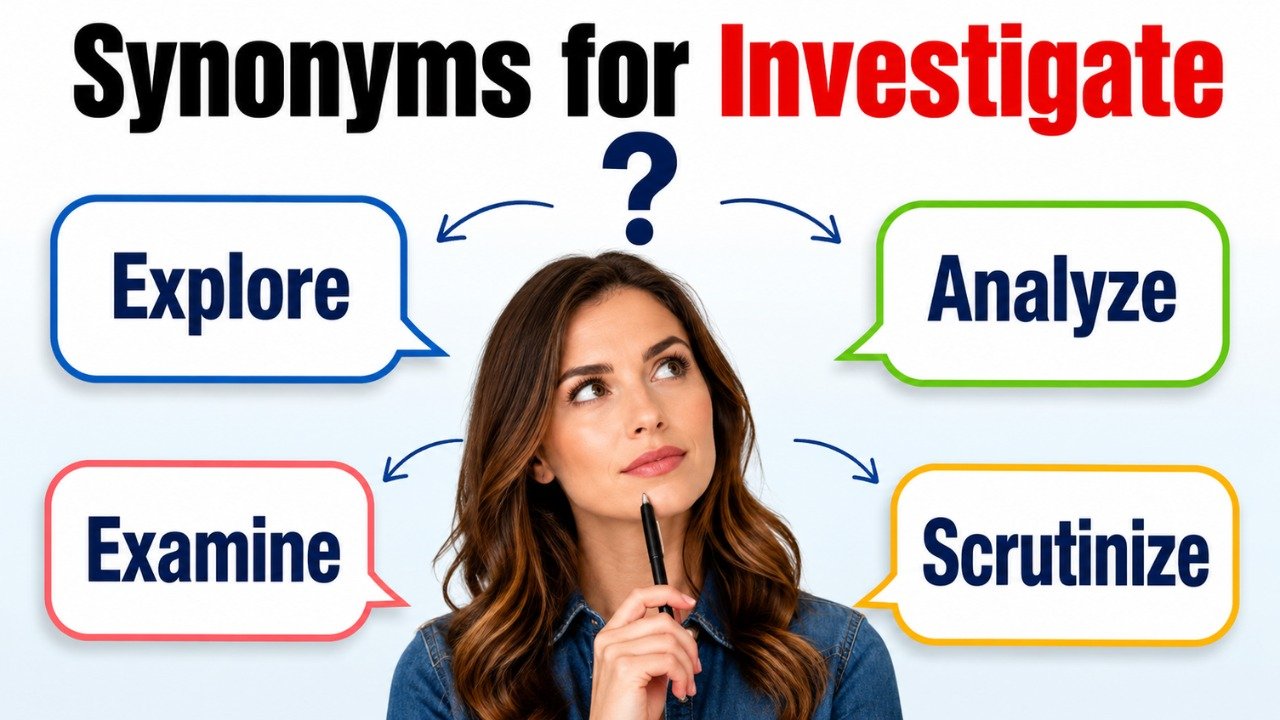
Quick Answer: Synonyms for investigate include examine, inspect, inquire into, research, analyze, explore, probe, scrutinize, study, and look into. Choose examine for a careful general review, inspect for a physical check, research for academic or factual study, analyze for detailed interpretation, and probe for a deep or sensitive inquiry. Look into works naturally in casual speech and emails, while scrutinize suits formal writing when every detail must be checked closely.
Pronunciation and Word Details
Word: Investigate.
Pronunciation: /ɪnˈves.tə.ɡeɪt/
Part of Speech: Verb.
Meaning: To examine a situation, event, claim, or problem carefully in order to discover facts or find an explanation.
US Pronunciation:
UK Pronunciation:
What Does “Investigate” Mean?
Investigate means to examine something carefully in order to discover the truth, identify a cause, solve a problem, or collect reliable information.
Investigate is a verb. It commonly describes a planned and detailed process rather than a quick look.
Legal Context: Officers investigated the circumstances surrounding the incident.
Workplace Context: The manager investigated the employee’s complaint.
Academic Context: The researchers investigated how sleep affects concentration.
Technical Context: The engineer investigated the cause of the system failure.
Everyday Context: I will investigate why the order has not arrived.
The word may refer to examining evidence, interviewing people, reviewing records, testing possible explanations, or studying a subject in depth.
Investigate can be used with a direct object.
Example: The committee will investigate the allegation.
It can also be followed by a question word such as why, how, whether, or what.
Example: The technician investigated why the machine had stopped working.
The noun form is investigation, while the person who performs an investigation may be called an investigator.
Meaning, Tone, and Context of “Investigate”
Investigate has a neutral to formal tone. It suggests careful attention, evidence gathering, and a desire to reach an accurate conclusion.
Formal Tone: Investigate is common in reports, official statements, academic papers, workplace documents, and legal discussions.
Example: The panel was appointed to investigate the complaint.
Professional Tone: The word sounds organized and objective when discussing problems, errors, risks, or claims.
Example: The finance team will investigate the unexpected difference in the records.
Academic Tone: Investigate is often used to introduce research questions, experiments, and studies.
Example: This study investigates the relationship between exercise and memory.
Technical Tone: Engineers, analysts, and specialists use investigate when diagnosing faults or unusual results.
Example: The support team is investigating the connection issue.
Conversational Tone: Investigate may sound more formal than necessary in ordinary conversation. Look into, check, or find out may sound more natural.
Formal Example: I will investigate the reason for the delay.
Casual Example: I will look into the delay.
Investigate does not automatically imply wrongdoing. It can describe a crime inquiry, but it can also describe scientific research, customer service work, technical testing, historical study, or simple fact checking.
When and How to Use “Investigate”
For a Crime or Suspicious Event
Use investigate when authorities examine evidence, witnesses, motives, or events connected with possible wrongdoing.
Example: The officers were asked to investigate the reported theft.
For a Complaint
Use investigate when a business, institution, or organization examines whether a complaint is accurate and what action is needed.
Example: The supervisor promised to investigate the customer’s complaint.
For a Claim or Allegation
Use investigate when the truth of a statement must be established through evidence.
Example: An independent group will investigate the allegation.
For Academic Research
Use investigate when a study examines a question, relationship, effect, or theory.
Example: The experiment investigates how temperature affects plant growth.
For a Technical Problem
Use investigate when specialists search for the cause of a fault, error, or failure.
Example: The engineer is investigating the source of the unusual noise.
For Workplace Issues
Use investigate when managers review behavior, procedures, safety concerns, or policy violations.
Example: Human resources will investigate the workplace incident.
For Financial Records
Use investigate when transactions, accounts, or reports contain unusual information.
Example: The accountant investigated several unexpected charges.
For Historical Questions
Use investigate when someone examines documents, objects, or testimony to understand the past.
Example: The historian investigated the origins of the local custom.
For Everyday Problems
Use investigate when you need to discover why something happened or how to fix it.
Example: I will investigate why the package was returned.
For Evidence and Facts
Use investigate when a decision should be based on verified information rather than assumption.
Example: The journalist investigated the claim before writing the report.
Best Synonyms for Investigate
Examine
Synonym: To look at something carefully in order to understand its condition, meaning, or details.
Example: The doctor examined the injury carefully.
Inspect
Synonym: To check something closely for damage, quality, safety, or compliance.
Example: The officer inspected the building for safety problems.
Inquire Into
Synonym: To seek information about a particular event, claim, or concern.
Example: The committee agreed to inquire into the reported misconduct.
Research
Synonym: To study a subject systematically in order to gain knowledge or discover facts.
Example: The students researched the history of the region.
Analyze
Synonym: To separate information into parts and study how those parts relate.
Example: The analyst examined the data to identify a pattern.
Explore
Synonym: To examine a topic, possibility, or idea openly and in detail.
Example: The report explores several possible causes of the decline.
Probe
Synonym: To investigate deeply, especially when the issue is sensitive or difficult.
Example: The inquiry probed the reasons behind the financial loss.
Scrutinize
Synonym: To inspect every detail with great care.
Example: The editor scrutinized the document before publication.
Study
Synonym: To examine a subject carefully over a period of time.
Example: Scientists studied the effects of reduced sunlight.
Look Into
Synonym: To examine a problem or situation, especially in ordinary conversation.
Example: I will look into the billing error this afternoon.
50 Synonyms for Investigate with Short Meanings
- Examine: To study something carefully.
- Inspect: To check condition, quality, or safety closely.
- Inquire Into: To seek facts about a specific matter.
- Research: To study a subject systematically.
- Analyze: To examine information by separating it into parts.
- Explore: To consider a topic or possibility in detail.
- Probe: To investigate deeply or persistently.
- Scrutinize: To check every detail very carefully.
- Study: To observe or examine something closely.
- Look Into: To examine a matter in a natural, conversational way.
- Review: To examine information again in order to assess it.
- Assess: To judge the nature, quality, or seriousness of something.
- Audit: To formally check financial records, systems, or procedures.
- Check: To examine something for correctness or problems.
- Verify: To confirm that information is true or accurate.
- Question: To ask someone for information or an explanation.
- Interrogate: To question someone formally and intensely.
- Survey: To examine a situation, place, or group broadly.
- Test: To check how something works or whether a claim is correct.
- Trace: To follow the origin, movement, or development of something.
- Uncover: To discover information that was hidden or unknown.
- Search: To look carefully for facts, evidence, or answers.
- Pursue: To continue examining a lead or question.
- Monitor: To observe something over time for changes.
- Observe: To watch carefully in order to gather information.
- Evaluate: To judge information according to evidence or standards.
- Diagnose: To identify the cause of a problem or condition.
- Detect: To discover something that is difficult to notice.
- Discover: To find information that was previously unknown.
- Determine: To establish a fact or reach a conclusion.
- Establish: To prove or confirm something through evidence.
- Examine Closely: To study fine details with care.
- Follow Up: To continue checking after an earlier action or report.
- Delve Into: To study a subject deeply.
- Dig Into: To examine a matter thoroughly in informal language.
- Get to the Bottom of: To discover the real cause or truth.
- Inspect Closely: To perform a detailed physical or visual check.
- Conduct an Inquiry: To carry out a formal examination of facts.
- Conduct Research: To collect and study information systematically.
- Review Evidence: To examine facts or materials related to a question.
- Gather Facts: To collect reliable information about a situation.
- Collect Evidence: To obtain materials that help prove what happened.
- Fact Find: To search for accurate and relevant information.
- Cross Examine: To question a person closely about earlier statements.
- Investigate Thoroughly: To examine every important part of a matter.
- Track Down: To find a person, source, cause, or missing detail.
- Check Into: To make inquiries about a problem or situation.
- Make Inquiries: To ask questions in order to obtain information.
- Review the Matter: To consider the facts of a situation carefully.
- Look Beneath the Surface: To search for deeper causes or hidden details.
Read Also:
Synonyms for Corrupt

Synonyms for Investigate by Context
When Investigate Means Examine Carefully
Examine, inspect, scrutinize, review, check, and assess are useful when something must be studied closely.
Examine Example: The specialist examined the damaged component.
Inspect Example: The safety officer inspected every emergency exit.
Scrutinize Example: The lawyer scrutinized the wording of the agreement.
Review Example: The manager reviewed the evidence before making a decision.
Examine is broad and neutral. Inspect often relates to a physical object, location, or process. Scrutinize suggests an especially detailed and critical examination.
When Investigate Means Conduct Research
Research, study, explore, analyze, survey, and observe work well in academic, scientific, and informational contexts.
Research Example: The students researched the effects of water pollution.
Study Example: The team studied changes in customer behavior.
Explore Example: The article explores the causes of workplace stress.
Analyze Example: Researchers analyzed the results of the experiment.
Research emphasizes systematic information gathering. Analyze focuses on interpreting collected information. Explore is useful when several ideas or explanations remain open.
When Investigate Means Seek the Truth
Probe, inquire into, conduct an inquiry, gather facts, review evidence, and get to the bottom of describe an effort to discover what really happened.
Probe Example: The committee probed the cause of the sudden failure.
Inquire Into Example: Officials agreed to inquire into the complaint.
Gather Facts Example: The reporter gathered facts from several witnesses.
Get to the Bottom of Example: The supervisor wanted to get to the bottom of the missing records.
Probe is strong and formal. Get to the bottom of is conversational and suggests that the truth is difficult to discover.
When Investigate Means Check a Problem
Look into, check into, diagnose, test, monitor, and follow up are useful for practical, technical, or customer service issues.
Look Into Example: The support agent will look into the account problem.
Diagnose Example: The mechanic diagnosed the cause of the engine noise.
Test Example: The technician tested the connection for faults.
Follow Up Example: The manager followed up after receiving the complaint.
Diagnose is best when identifying the cause of a technical, mechanical, or medical problem. Look into is natural in ordinary communication.
When Investigate Means Question Someone
Question, interrogate, cross examine, interview, and make inquiries relate to obtaining information from people.
Question Example: The investigator questioned several witnesses.
Interrogate Example: Officers interrogated the suspect about the missing property.
Cross Examine Example: The lawyer cross examined the witness about the timeline.
Make Inquiries Example: The administrator made inquiries about the missing documents.
Interrogate is strong and usually relates to formal law enforcement questioning. Question and interview are more neutral.
When Investigate Means Find the Source
Trace, track down, detect, uncover, discover, and determine are useful when identifying an origin, cause, person, or hidden fact.
Trace Example: The team traced the error to an incorrect setting.
Track Down Example: The reporter tracked down the original witness.
Detect Example: The test detected a small leak.
Uncover Example: The audit uncovered several recording mistakes.
Trace often follows a sequence back to its starting point. Uncover suggests that hidden information has been revealed.
When Investigate Means Check Compliance
Audit, inspect, review, assess, verify, and evaluate are common in business, finance, safety, and professional settings.
Audit Example: The accountants audited the financial records.
Verify Example: The administrator verified the applicant’s information.
Evaluate Example: The panel evaluated whether the process met the required standard.
Assess Example: The consultant assessed the risks of the proposed plan.
Audit is highly specific and formal. Verify focuses on confirming truth or accuracy. Assess and evaluate involve making a judgment.
Another Word for Investigate
Examine is often the best general replacement for investigate because it works in formal, academic, professional, and everyday contexts. However, the best alternative depends on what is being investigated and why.
Use inspect for physical checks, research for academic study, probe for a deep inquiry, diagnose for technical problems, and look into for conversational communication.
Original: The committee will investigate the complaint.
Better Option: The committee will examine the complaint.
Original: The engineer investigated the faulty machine.
Better Option: The engineer inspected the faulty machine.
Original: The students investigated the causes of soil erosion.
Better Option: The students researched the causes of soil erosion.
Original: I will investigate the delivery problem.
Better Option: I will look into the delivery problem.
When Not to Use “Investigate”
Investigate may sound too formal, too broad, repetitive, or less accurate than a more specific synonym.
When the Situation Is Simple
Investigate can sound unnecessarily serious when someone only needs to perform a quick check.
Weak: I will investigate whether the door is locked.
Better: I will check whether the door is locked.
When You Mean Physical Inspection
Inspect is more precise when someone checks a building, product, machine, or object.
Weak: The mechanic investigated the tires.
Better: The mechanic inspected the tires.
When You Mean Academic Study
Research or study may be clearer when the sentence describes scholarly work rather than an official inquiry.
Weak: The students investigated ancient farming methods for their assignment.
Better: The students researched ancient farming methods for their assignment.
When You Mean Data Interpretation
Analyze is more accurate when information has already been collected and must be interpreted.
Weak: The scientist investigated the test results.
Better: The scientist analyzed the test results.
When You Mean Casual Assistance
Look into sounds friendlier and more natural in customer communication.
Weak: I will investigate your missing refund.
Better: I will look into your missing refund.
When You Mean Formal Questioning
Interrogate or question is more precise when the focus is on asking a person for information.
Weak: The officers investigated the witness.
Better: The officers questioned the witness.
When the Word Is Repeated
Using investigate too often can make a paragraph sound mechanical.
Weak: The team investigated the error, investigated the records, and investigated the employee’s explanation.
Better: The team examined the error, reviewed the records, and questioned the employee.
When the Meaning Is Vague
State what actions are being taken whenever the process matters.
Weak: The group investigated the issue.
Better: The group reviewed the records, interviewed witnesses, and tested the equipment.
Words Commonly Confused With Investigate
Investigate vs Examine: Investigate usually seeks facts, causes, or explanations. Examine means to look at something closely and may be only one part of an investigation.
Investigate vs Inspect: Investigate is broader and may include records, interviews, and analysis. Inspect usually involves a careful physical or visual check.
Investigate vs Research: Investigate can refer to an official inquiry or practical problem. Research usually describes systematic study intended to produce knowledge.
Investigate vs Analyze: Investigate gathers and examines facts. Analyze focuses on interpreting information by studying its parts and relationships.
Investigate vs Explore: Investigate seeks an answer or explanation. Explore considers ideas, possibilities, or subjects without always expecting one final conclusion.
Investigate vs Inquire: Investigate suggests a detailed process. Inquire often means asking for information and may be much simpler.
Investigate vs Interrogate: Investigate describes the entire process of discovering facts. Interrogate means to question a person intensely.
Investigate vs Audit: Investigate is broad. Audit specifically refers to a formal examination of accounts, records, systems, or compliance.
Investigate vs Diagnose: Investigate examines a problem. Diagnose identifies its specific cause or nature.
Investigate vs Verify: Investigate searches for facts. Verify confirms whether a particular statement or detail is accurate.
Which Synonym Should You Choose?
Choose examine when you need a broad and neutral alternative suitable for essays, reports, and formal writing.
Choose inspect when checking a building, machine, product, workplace, or physical object.
Choose research when studying an academic, scientific, historical, or informational topic.
Choose analyze when interpreting data, evidence, results, language, or patterns.
Choose explore when discussing possibilities, themes, ideas, or questions without assuming a single answer.
Choose probe when describing a deep, persistent, or sensitive inquiry.
Choose scrutinize when every detail must be checked carefully and critically.
Choose inquire into for formal investigations involving complaints, conduct, or public concerns.
Choose look into for emails, customer service messages, and casual conversation.
Choose check when the task is simple, quick, or routine.
Choose audit when examining financial records, systems, processes, or compliance.
Choose diagnose when identifying the cause of a medical, mechanical, or technical problem.
Choose verify when confirming names, dates, facts, claims, or documents.
Choose trace when following an error, payment, message, source, or event back to its origin.
Choose interrogate only when describing intense and formal questioning.
Choose gather facts when emphasizing objective information collection.
Real Life Examples of “Investigate” in Sentences
Original: The manager will investigate the customer’s complaint.
Better Option: The manager will look into the customer’s complaint.
Original: The technician investigated the damaged cable.
Better Option: The technician inspected the damaged cable.
Original: The students investigated local water quality.
Better Option: The students researched local water quality.
Original: The analyst investigated the survey results.
Better Option: The analyst analyzed the survey results.
Original: The officers investigated the witness for several hours.
Better Option: The officers questioned the witness for several hours.
Original: The accountant investigated the payment records.
Better Option: The accountant audited the payment records.
Original: The mechanic investigated the cause of the vibration.
Better Option: The mechanic diagnosed the cause of the vibration.
Original: The committee investigated every detail of the report.
Better Option: The committee scrutinized every detail of the report.
Original: The journalist investigated where the document came from.
Better Option: The journalist traced the document to its original source.
Original: The essay investigates several explanations for the event.
Better Option: The essay explores several explanations for the event.
Synonym Groups and Usage Differences
Examination Group
Examine, inspect, scrutinize, review, and check describe careful attention to details.
Examine is the broadest term. Inspect usually involves a physical or visual check. Scrutinize suggests critical attention to every detail. Review often involves information that has already been collected.
Example: The inspector scrutinized the safety records before approving the building.
Research Group
Research, study, explore, survey, and observe describe the collection of knowledge about a subject.
Research suggests a planned and systematic process. Study is broader and may involve reading or observation. Explore allows more open consideration of ideas and possibilities.
Example: The researchers studied how noise affected concentration.
Inquiry Group
Probe, inquire into, conduct an inquiry, make inquiries, and get to the bottom of focus on discovering the truth about a particular matter.
Probe is strong and often used in serious situations. Inquire into sounds formal and official. Get to the bottom of is more conversational.
Example: The panel conducted an inquiry into the reported safety failures.
Evidence Group
Gather facts, collect evidence, review evidence, verify, and establish emphasize proof and factual accuracy.
Verify confirms whether a detail is correct. Establish means to prove something through reliable evidence. Collect evidence often relates to legal or official inquiries.
Example: The investigators collected evidence to establish the sequence of events.
Problem Solving Group
Diagnose, test, check into, follow up, and monitor are useful when investigating practical or technical difficulties.
Diagnose identifies the source of a problem. Test checks whether a system, theory, or solution works. Monitor involves continued observation.
Example: Engineers monitored the system after diagnosing the fault.
Discovery Group
Uncover, detect, discover, determine, and reveal describe finding information that was unknown or hidden.
Detect often refers to something difficult to notice. Uncover suggests that the information was concealed. Determine means reaching a conclusion after examination.
Example: The review uncovered an error in the final calculation.
Tracking Group
Trace, track down, pursue, search, and follow describe efforts to locate a source, person, cause, or lead.
Trace follows a path backward to its origin. Track down emphasizes successfully locating something difficult to find. Pursue means continuing to examine a promising lead.
Example: The team traced the missing payment to an incorrect account number.
Questioning Group
Question, interrogate, interview, and cross examine describe obtaining facts from people.
Question is neutral. Interrogate is intense and official. Interview is organized but usually less confrontational. Cross examine refers to challenging testimony through detailed questions.
Example: The lawyer cross examined the witness about the conflicting statement.
Antonyms of Investigate
The opposite of investigate depends on whether the sentence refers to attention, evidence, curiosity, or action.
Ignore: To give no attention to a matter.
Overlook: To fail to notice or consider something important.
Neglect: To avoid giving proper attention or care.
Dismiss: To reject a concern without examining it fully.
Assume: To accept something as true without checking the evidence.
Disregard: To deliberately pay no attention to information or a warning.
Accept Unquestioningly: To believe a claim without seeking proof.
Abandon: To stop examining a matter before reaching a conclusion.
Avoid: To stay away from a question or problem.
Conceal: To hide facts rather than seek or reveal them.
Suppress: To prevent information from being examined or disclosed.
Leave Unchecked: To allow a matter to remain unexamined.
Guess: To form an answer without enough evidence.
Ignore the Evidence: To refuse to consider available facts.
Close the Inquiry: To officially end an examination of a matter.
Comparison: Investigate vs Related Words
Investigate vs Examine
Investigate seeks facts, causes, or explanations through a process. Examine means to look at something carefully and may not involve a complete inquiry.
Example With Investigate: The committee investigated the cause of the accident.
Example With Examine: The engineer examined the damaged part.
Investigate vs Inspect
Investigate may include interviews, records, testing, and analysis. Inspect usually means checking something physically or visually.
Example With Investigate: Officials investigated the building’s safety failures.
Example With Inspect: Officials inspected the emergency exits.
Investigate vs Research
Investigate is common for practical problems, allegations, crimes, and specific questions. Research is most common for academic or systematic study.
Example With Investigate: The agency investigated the complaint.
Example With Research: The students researched the history of the policy.
Investigate vs Analyze
Investigate gathers and examines information. Analyze interprets information that is already available.
Example With Investigate: The team investigated why sales had fallen.
Example With Analyze: The team analyzed the monthly sales figures.
Investigate vs Explore
Investigate usually aims to reach a factual conclusion. Explore considers a topic or possibility in an open way.
Example With Investigate: The report investigates the cause of the failure.
Example With Explore: The report explores several possible solutions.
Investigate vs Probe
Investigate is neutral and broad. Probe suggests a deeper, persistent, or sensitive inquiry.
Example With Investigate: The committee investigated the complaint.
Example With Probe: The committee probed the senior manager’s involvement.
Investigate vs Scrutinize
Investigate describes the entire fact finding process. Scrutinize focuses on checking details with extreme care.
Example With Investigate: The authorities investigated the financial activity.
Example With Scrutinize: The auditors scrutinized every transaction.
Investigate vs Inquire
Investigate usually involves detailed evidence gathering. Inquire often means asking a question or requesting information.
Example With Investigate: The office investigated the missing records.
Example With Inquire: She inquired about the missing records.
Investigate vs Diagnose
Investigate searches for facts about a problem. Diagnose identifies the exact nature or cause of that problem.
Example With Investigate: The technician investigated the system failure.
Example With Diagnose: The technician diagnosed a damaged power unit.
Investigate vs Verify
Investigate examines a broad matter. Verify checks whether one specific fact or claim is correct.
Example With Investigate: The journalist investigated the entire story.
Example With Verify: The journalist verified the date of the meeting.
Common Phrases and Expressions With Investigate
Investigate a Crime: To examine evidence and events connected with possible illegal activity.
Example: A specialist team was assigned to investigate the crime.
Investigate a Complaint: To examine whether a complaint is accurate and what response is needed.
Example: The manager agreed to investigate the complaint immediately.
Investigate a Claim: To check the truth or accuracy of a statement.
Example: The insurer will investigate the claim before making a decision.
Investigate an Allegation: To examine an accusation through evidence and testimony.
Example: An independent panel will investigate the allegation.
Investigate the Cause: To determine why a problem, event, or failure occurred.
Example: Engineers are working to investigate the cause of the outage.
Investigate the Matter: To examine a particular situation carefully.
Example: The director promised to investigate the matter personally.
Investigate Further: To continue examining a question because more information is needed.
Example: The unusual result gave the team a reason to investigate further.
Investigate Thoroughly: To examine every relevant detail.
Example: Safety concerns must be investigated thoroughly.
Investigate Possible Links: To determine whether two events, people, or facts are connected.
Example: Researchers investigated possible links between diet and energy levels.
Investigate What Happened: To discover the facts surrounding an event.
Example: The supervisor met with everyone involved to investigate what happened.
Common Mistakes to Avoid
Using Investigate for a Simple Check
Investigate may sound too serious when the action is quick and ordinary.
Incorrect: Please investigate whether the lights are off.
Correct: Please check whether the lights are off.
Confusing Investigate With Inspect
Inspect usually relates to physical condition, safety, or quality.
Incorrect: The mechanic investigated the outside of the vehicle.
Correct: The mechanic inspected the outside of the vehicle.
Confusing Investigate With Analyze
Analyze means to interpret information rather than collect it.
Incorrect: The researcher investigated the completed data set.
Correct: The researcher analyzed the completed data set.
Confusing Investigate With Research
Research is often the better verb for academic study.
Incorrect: The essay investigates the complete history of the language.
Correct: The essay researches the history of the language.
Using Interrogate as a Neutral Synonym
Interrogate suggests forceful or official questioning and should not replace investigate in ordinary situations.
Incorrect: The teacher interrogated the reason for the low score.
Correct: The teacher investigated the reason for the low score.
Using Investigate Without an Object
Investigate usually needs a clear matter, problem, event, or question.
Vague: The committee will investigate.
Clear: The committee will investigate the reported safety concern.
Repeating Investigate Too Often
Use more specific verbs to improve clarity.
Repetitive: The officer investigated the scene, investigated the evidence, and investigated the witnesses.
Improved: The officer inspected the scene, reviewed the evidence, and questioned the witnesses.
Using a Weak Synonym in a Serious Context
Check may sound too casual for a formal inquiry.
Weak: The panel will check the allegations of misconduct.
Better: The panel will investigate the allegations of misconduct.
Using a Strong Synonym in a Mild Context
Probe may sound overly dramatic for a routine request.
Unnatural: I will probe why your appointment was moved.
Natural: I will look into why your appointment was moved.
Assuming Investigation Proves Guilt
An investigation seeks facts. It does not automatically confirm that an accusation is true.
Unclear: The employee was investigated, so the employee was responsible.
Clear: The employee was investigated, but the evidence did not establish responsibility.
Conclusion
Synonyms for investigate allow writers to describe different forms of examination more precisely. Use examine for a general review, inspect for physical checks, research for academic study, analyze for interpreting data, and probe for a deep inquiry. Look into works naturally in conversation and emails, while scrutinize suits detailed formal reviews. Choosing the right synonym shows whether someone is gathering evidence, checking a problem, questioning a person, tracing a source, or studying a subject.
FAQs About Synonyms for Investigate
What Is the Best Synonym for Investigate?
Examine is the best general synonym. Look into, inspect, research, analyze, and probe may be more accurate in specific situations.
What Is a Formal Synonym for Investigate?
Examine, inquire into, scrutinize, probe, audit, and conduct an inquiry are suitable formal alternatives.
What Is a Casual Synonym for Investigate?
Look into, check into, dig into, and find out are natural choices for casual speech and everyday messages.
Are Investigate and Research the Same?
Not exactly. Investigate often focuses on a specific event, problem, or claim. Research usually involves systematic study intended to increase knowledge.
What Is the Difference Between Investigate and Inspect?
Investigate is a broad process that may include evidence, interviews, and analysis. Inspect usually means checking the physical condition or quality of something.
What Is a Stronger Word Than Investigate?
Probe and scrutinize can sound stronger. Probe suggests a deep inquiry, while scrutinize suggests extremely careful examination.
What Is the Opposite of Investigate?
Common opposites include ignore, overlook, neglect, dismiss, assume, disregard, and leave unchecked.
