
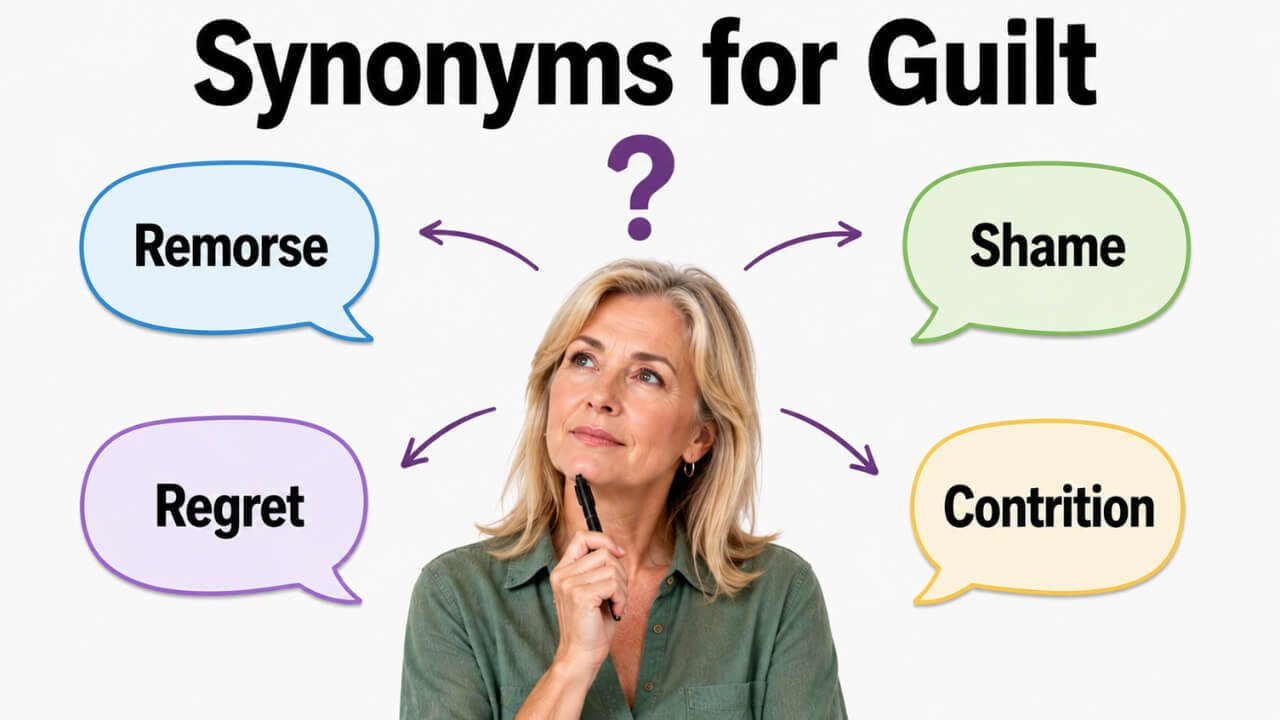
Quick Answer: The best synonyms for guilt include remorse, regret, shame, contrition, compunction, self reproach, culpability, blame, responsibility, and accountability. Use remorse for deep emotional pain after doing something wrong, regret for sadness about a past decision, and shame for embarrassment connected to personal behavior. Contrition is suitable for sincere apologies and formal writing, while culpability refers to legal or moral responsibility. Blame, responsibility, and accountability are better when discussing who caused a mistake, failure, or harmful result.
Pronunciation and Word Details
Word: Guilt.
Pronunciation: /ɡɪlt/.
Part of Speech: Noun and verb.
Meaning: A feeling of sadness or responsibility caused by believing that you have done something wrong.
US Pronunciation:
UK Pronunciation:
What Does “Guilt” Mean?
Guilt means the uncomfortable feeling that arises when someone believes they has acted wrongly, caused harm, or failed to meet an important responsibility.
As a noun, guilt can describe an emotion, moral responsibility, or legal responsibility for an offense. A person may feel guilt after telling a lie, missing an obligation, hurting someone, or making a harmful decision.
Emotional Use: She felt guilt after speaking harshly to her friend.
Moral Use: His guilt came from knowing that he had ignored someone who needed help.
Legal Use: The court must determine the guilt or innocence of the accused person.
As a verb, guilt is commonly used in phrases such as “guilt someone into doing something.” In this use, it means making a person feel responsible or ashamed so that they act in a certain way.
Example: He tried to guilt her into changing her decision.
Meaning, Tone, and Context of “Guilt”
Guilt usually has a serious, emotional, and negative tone. It can describe a private feeling, a moral judgment, or formal responsibility for wrongdoing.
In everyday conversation, guilt often refers to discomfort after disappointing someone or making a poor choice. In emotional discussions, it may describe a lasting burden connected to past behavior. In psychology and personal development, guilt is often discussed as a response to actions that conflict with a person’s values.
In formal, academic, and legal writing, guilt may refer to responsibility for an offense. However, writers should use the word carefully when legal responsibility has not been officially established.
Guilt focuses mainly on an action or failure. Shame often focuses more strongly on how a person views themselves.
When and How to Use “Guilt”
For Personal Regret: Use guilt when someone feels responsible for a past action.
Example: She carried guilt for not visiting her grandmother more often.
For Causing Harm: Use guilt when a person believes their behavior hurt someone.
Example: His guilt increased when he understood how deeply his words had affected her.
For Ignoring a Responsibility: Use guilt when someone fails to complete a duty or promise.
Example: I felt guilt after forgetting an important family event.
For Moral Responsibility: Use guilt when discussing behavior that conflicts with ethical values.
Example: The character struggles with guilt after betraying his closest companion.
For Legal Responsibility: Use guilt when responsibility for a crime or offense is being examined.
Example: The evidence was presented to help the jury determine guilt.
For Social Pressure: Use guilt as a verb when someone creates emotional pressure to influence another person.
Example: They attempted to guilt him into accepting an unfair request.
For Lasting Emotional Pain: Use guilt when regret remains for an extended period.
Example: Years later, she still experienced guilt about the decision.
Best Synonyms for Guilt
Remorse: Deep emotional pain caused by recognizing that one has done something wrong.
Example: He showed genuine remorse for the suffering he had caused.
Regret: Sadness or disappointment about a past action, decision, or missed opportunity.
Example: She expressed regret about leaving without saying goodbye.
Shame: A painful feeling of embarrassment or unworthiness connected to behavior or identity.
Example: He lowered his eyes in shame after admitting the truth.
Contrition: Sincere sorrow for wrongdoing, often accompanied by a desire to apologize or improve.
Example: Her apology revealed true contrition.
Compunction: A sudden feeling of moral discomfort about doing something wrong.
Example: He felt a moment of compunction before repeating the dishonest claim.
Self Reproach: Strong criticism directed at oneself because of a mistake.
Example: She was filled with self reproach after breaking her promise.
Culpability: Formal or legal responsibility for an action, offense, or harmful result.
Example: The investigation examined the manager’s culpability in the incident.
Blame: Responsibility assigned to someone for a mistake or negative result.
Example: Neither employee was willing to accept the blame.
Responsibility: The state of being answerable for an action, decision, or duty.
Example: He accepted responsibility for the damaged equipment.
Accountability: The obligation to explain actions and face their consequences.
Example: Effective leadership requires honesty and accountability.
50 Synonyms for Guilt with Short Meanings
- Remorse: Deep sorrow for doing something wrong.
- Regret: Sadness about a past action or decision.
- Contrition: Sincere sorrow accompanied by a desire to improve.
- Penitence: Regret for wrongdoing and willingness to seek forgiveness.
- Repentance: Honest regret followed by a change in behavior.
- Shame: Painful embarrassment caused by improper behavior.
- Compunction: A sudden feeling of moral unease.
- Self Reproach: Criticism directed at oneself for a mistake.
- Self Blame: The act of holding oneself responsible.
- Remorsefulness: The state of feeling deep regret.
- Regretfulness: Sadness about something done or left undone.
- Rue: Sorrow or regret about a past action.
- Sorrow: Deep sadness connected to loss or wrongdoing.
- Anguish: Severe emotional pain caused by regret or distress.
- Distress: Strong emotional discomfort or suffering.
- Unease: A mild feeling of worry or discomfort.
- Discomfort: An unpleasant emotional feeling about an action.
- Misgiving: Doubt or concern about whether something is right.
- Qualm: A brief feeling of doubt about one’s conduct.
- Pang: A sudden sharp feeling of guilt or regret.
- Twinge: A short and mild feeling of emotional discomfort.
- Conscience: The inner sense that judges right and wrong.
- Guilty Conscience: Awareness that one has acted wrongly.
- Moral Burden: Emotional weight caused by a troubling action.
- Burden of Conscience: Lasting distress about moral responsibility.
- Culpability: Responsibility for wrongdoing or harm.
- Blame: Responsibility for a mistake or negative result.
- Fault: Responsibility for causing a problem.
- Responsibility: The state of being answerable for an action.
- Accountability: The duty to explain actions and accept consequences.
- Liability: Legal responsibility for damage, loss, or wrongdoing.
- Blameworthiness: The quality of deserving criticism or blame.
- Wrongdoing: Behavior that is morally or legally improper.
- Offense: An illegal, harmful, or unacceptable act.
- Transgression: An act that breaks a moral rule or accepted limit.
- Misconduct: Improper or unacceptable behavior.
- Sinfulness: The quality of acting against moral principles.
- Criminality: The state of being connected to criminal behavior.
- Delinquency: Neglect of duty or involvement in improper conduct.
- Complicity: Involvement in another person’s wrongdoing.
- Involvement: Participation in an action or event.
- Responsibility for Harm: Being answerable for causing damage.
- Moral Responsibility: Accountability according to ethical principles.
- Legal Responsibility: Accountability under the law.
- Self Accusation: The act of declaring oneself responsible.
- Self Condemnation: Severe negative judgment of one’s own behavior.
- Self Criticism: Evaluation of one’s own faults or mistakes.
- Disgrace: Loss of respect caused by shameful behavior.
- Humiliation: Painful embarrassment resulting from failure or exposure.
- Mortification: Intense embarrassment or shame about an action.
Read Also:
Synonyms for Shy
Synonyms for Guilt by Context
When Guilt Means Deep Emotional Regret
Remorse, contrition, penitence, and repentance describe serious emotional responses to wrongdoing. These words suggest that a person understands the harm they caused.
Example: His remorse became clear when he offered to repair the damage.
Example: Her contrition made the apology sound sincere.
Remorse is the most natural choice for deep emotional pain. Contrition is more formal and often appears in serious apologies. Repentance suggests both regret and a desire to change.
When Guilt Means Sadness About a Decision
Regret, rue, sorrow, and regretfulness describe sadness about something that happened in the past. These words do not always suggest moral wrongdoing.
Example: She felt regret about refusing the opportunity.
Example: He looked back on the argument with sorrow.
Regret is broader than guilt because a person can regret an unfortunate decision without believing it was morally wrong.
When Guilt Means Shame or Embarrassment
Shame, humiliation, disgrace, and mortification describe painful embarrassment connected to a person’s actions or public image.
Example: He felt shame after his dishonesty was revealed.
Example: The public mistake caused intense mortification.
Shame may affect how someone views themselves, while guilt usually focuses on a particular action.
When Guilt Means Responsibility
Culpability, blame, fault, responsibility, accountability, and liability refer to being answerable for an action or result.
Example: The report examined the company’s culpability.
Example: She accepted responsibility for the error.
Culpability and liability are suitable for formal or legal contexts. Blame and fault are more common in everyday conversation. Accountability is often used in professional and organizational contexts.
When Guilt Means Brief Moral Discomfort
Compunction, qualm, misgiving, pang, and twinge describe short or mild feelings of moral unease.
Example: He felt a pang of guilt when he saw her disappointment.
Example: She had no qualms about reporting the dishonest behavior.
A pang or twinge is usually brief. A misgiving may appear before an action, while guilt usually follows one.
Another Word for Guilt
Remorse is often the best single replacement for guilt when describing deep sadness about wrongdoing. However, the strongest alternative depends on the intended meaning.
Use regret for general sadness, shame for personal embarrassment, and culpability for formal responsibility.
Original: He felt guilt after insulting his colleague.
Better Option: He felt remorse after insulting his colleague.
Original: She expressed guilt about missing the celebration.
Better Option: She expressed regret about missing the celebration.
Original: The report examined the director’s guilt in the failure.
Better Option: The report examined the director’s culpability in the failure.
Original: He accepted his guilt for the scheduling error.
Better Option: He accepted responsibility for the scheduling error.
When Not to Use “Guilt”
Avoid guilt when a more precise word would explain the emotion or responsibility more clearly.
Do not use guilt for every type of sadness. A person may feel disappointed, regretful, worried, or embarrassed without believing they did something morally wrong.
Weak: She felt guilt because the weather ruined the event.
Better: She felt disappointment because the weather ruined the event.
Avoid declaring someone’s legal guilt before responsibility has been established.
Weak: The suspect’s guilt was obvious before the trial began.
Better: The evidence raised serious questions about the suspect’s possible involvement.
Do not use guilt repeatedly when describing several emotional stages.
Weak: He felt guilt, and his guilt created even more guilt.
Better: He felt remorse, and the continuing self reproach affected his confidence.
Avoid guilt when responsibility is the intended meaning in a professional context.
Weak: The supervisor accepted guilt for the reporting mistake.
Better: The supervisor accepted responsibility for the reporting mistake.
Do not use guilt to pressure someone unfairly unless describing manipulative behavior.
Weak: I will guilt her until she agrees.
Better: I will explain my concerns and allow her to decide freely.
Words Commonly Confused With Guilt
Guilt vs Shame: Guilt usually focuses on a wrong action, while shame often affects how a person sees themselves.
Guilt vs Remorse: Guilt is the awareness or feeling of responsibility, while remorse is deep sorrow about the harm caused.
Guilt vs Regret: Guilt suggests wrongdoing or responsibility. Regret can describe sadness about any unfortunate decision or result.
Guilt vs Culpability: Guilt may describe an emotion or legal responsibility. Culpability mainly refers to responsibility for wrongdoing.
Guilt vs Blame: Guilt is often felt internally, while blame is usually assigned by oneself or another person.
Guilt vs Responsibility: Guilt has a stronger emotional or moral meaning. Responsibility can be neutral and may simply indicate who must handle a duty or result.
Guilt vs Accountability: Guilt concerns wrongdoing or emotional discomfort. Accountability concerns the duty to explain actions and accept consequences.
Guilt vs Compunction: Guilt may be strong and lasting. Compunction is often a brief feeling of moral unease.
Which Synonym Should You Choose?
Choose remorse when describing deep emotional pain after causing harm.
Choose regret when discussing sadness about a decision, action, or missed opportunity.
Choose shame when the feeling involves embarrassment, exposure, or damaged self respect.
Choose contrition when writing about a sincere apology or a serious desire for forgiveness.
Choose compunction when describing a brief moment of moral hesitation.
Choose culpability in legal, academic, investigative, or formal writing about responsibility for wrongdoing.
Choose blame in casual conversation when identifying who caused a problem.
Choose fault when referring to responsibility for a mistake, accident, or failure.
Choose responsibility in reports, essays, professional emails, and workplace discussions.
Choose accountability when emphasizing the obligation to explain decisions and accept consequences.
Choose self reproach when describing harsh internal criticism after a mistake.
Real Life Examples of “Guilt” in Sentences
Original: Maria felt guilt after forgetting her friend’s birthday.
Better Option: Maria felt regret after forgetting her friend’s birthday.
Original: He carried guilt for the pain his careless comment caused.
Better Option: He carried remorse for the pain his careless comment caused.
Original: The employee accepted guilt for entering the incorrect figures.
Better Option: The employee accepted responsibility for entering the incorrect figures.
Original: The investigation focused on the contractor’s guilt.
Better Option: The investigation focused on the contractor’s culpability.
Original: She experienced guilt when her dishonest behavior became public.
Better Option: She experienced shame when her dishonest behavior became public.
Original: A sudden feeling of guilt stopped him from taking the money.
Better Option: A sudden feeling of compunction stopped him from taking the money.
Original: His guilt encouraged him to offer a sincere apology.
Better Option: His contrition encouraged him to offer a sincere apology.
Original: The committee assigned guilt for the failure to one department.
Better Option: The committee assigned blame for the failure to one department.
Original: She struggled with guilt whenever she remembered the broken promise.
Better Option: She struggled with self reproach whenever she remembered the broken promise.
Original: The manager’s guilt became a major issue during the review.
Better Option: The manager’s accountability became a major issue during the review.
Synonym Groups and Usage Differences
Remorse Group
Remorse, contrition, penitence, repentance, and regretfulness describe sorrow after wrongdoing. Remorse emphasizes emotional pain, while repentance also suggests positive change.
Example: His genuine repentance was reflected in his improved behavior.
Regret Group
Regret, rue, sorrow, distress, and anguish describe sadness about past actions or outcomes. These words do not always indicate moral responsibility.
Example: She regretted not asking for help earlier.
Shame Group
Shame, humiliation, disgrace, and mortification relate to embarrassment and damaged self respect. They are especially suitable when behavior becomes publicly known.
Example: He felt deep humiliation when the deception was exposed.
Responsibility Group
Culpability, blame, fault, responsibility, accountability, and liability describe who is answerable for an action or result.
Example: The review established clear accountability for the financial error.
Moral Warning Group
Compunction, qualm, misgiving, pang, and twinge describe moral discomfort that may appear before or after an action.
Example: She felt a twinge of guilt after ignoring the message.
Self Judgment Group
Self reproach, self blame, self accusation, self condemnation, and self criticism describe negative judgment directed inward.
Example: Constant self blame prevented him from learning constructively from the mistake.
Antonyms of Guilt
The opposite of guilt depends on whether guilt refers to an emotion, moral responsibility, or legal responsibility.
Innocence: Freedom from responsibility for wrongdoing.
Blamelessness: The state of not deserving blame.
Absolution: Formal release from guilt or responsibility.
Acquittal: A legal decision that a person has not been proven guilty.
Vindication: Proof that someone was right or unfairly accused.
Exoneration: Official removal of blame or responsibility.
Clear Conscience: A feeling that one has acted honestly and correctly.
Peace of Mind: A calm state without worry or self reproach.
Freedom From Blame: The condition of not being responsible for a problem.
Moral Confidence: Assurance that one’s actions were ethically justified.
Relief: Comfort experienced when guilt, fear, or responsibility is removed.
Self Forgiveness: The decision to release excessive blame directed at oneself.
Comparison: Guilt vs Related Words
Guilt vs Remorse
Guilt is the feeling or awareness of having done something wrong. Remorse is deeper sorrow about the harm caused by that action.
Example With Guilt: She felt guilt after revealing the private information.
Example With Remorse: She showed remorse by apologizing and correcting the damage.
Guilt vs Regret
Guilt usually involves responsibility or wrongdoing. Regret is broader and can refer to any disappointing choice or outcome.
Example With Guilt: He felt guilt for lying to his family.
Example With Regret: He regretted choosing the later flight.
Guilt vs Shame
Guilt focuses on what a person did. Shame often focuses on what a person believes the action says about their character.
Example With Guilt: I feel guilty because I broke my promise.
Example With Shame: I feel ashamed because I believe I disappointed everyone.
Guilt vs Contrition
Guilt describes the uncomfortable awareness of wrongdoing. Contrition suggests sincere sorrow and a desire to make amends.
Example With Guilt: The mistake left him with lasting guilt.
Example With Contrition: His contrition was clear in his honest apology.
Guilt vs Culpability
Guilt may refer to an emotion or established responsibility. Culpability is a more formal word for responsibility connected to wrongdoing.
Example With Guilt: She experienced guilt after the incident.
Example With Culpability: The inquiry assessed her culpability in the incident.
Guilt vs Blame
Guilt is often an internal feeling. Blame is responsibility assigned to a person, group, or cause.
Example With Guilt: He carried guilt for the failed plan.
Example With Blame: The team placed the blame on poor communication.
Guilt vs Responsibility
Guilt suggests moral, emotional, or legal wrongdoing. Responsibility can be neutral and does not always imply improper behavior.
Example With Guilt: His guilt arose from hiding the truth.
Example With Responsibility: He had responsibility for preparing the final report.
Guilt vs Accountability
Guilt concerns wrongdoing and emotional discomfort. Accountability concerns being answerable for actions and consequences.
Example With Guilt: She felt guilt about the inaccurate statement.
Example With Accountability: She demonstrated accountability by correcting the statement publicly.
Common Phrases and Expressions With Guilt
Feel Guilt: To experience emotional discomfort about an action.
Carry Guilt: To continue feeling responsible for something over time.
Sense of Guilt: An awareness that one may have acted wrongly.
Burden of Guilt: A heavy and lasting feeling of responsibility.
Guilty Conscience: Inner discomfort caused by knowing one has done wrong.
Admit Guilt: To accept responsibility for an offense or harmful act.
Deny Guilt: To state that one is not responsible for an offense.
Prove Guilt: To establish responsibility through reliable evidence.
Guilt Trip: Emotional pressure used to make someone feel responsible or ashamed.
Guilt Complex: A continuing tendency to feel responsible or blameworthy.
Survivor Guilt: Distress felt by someone who survived or remained safe when others did not.
Parental Guilt: Feelings of inadequacy or regret connected to parenting decisions.
Overcome Guilt: To process responsibility and move forward constructively.
Consumed by Guilt: Extremely troubled by regret or self blame.
Free From Guilt: Not responsible for wrongdoing or no longer emotionally burdened by it.
Common Mistakes to Avoid
One common mistake is treating guilt, shame, and regret as identical. Guilt usually concerns an action, shame concerns a person’s view of themselves, and regret describes sadness about a choice or result.
Writers should also avoid using guilt when responsibility has not been established. In legal or investigative contexts, possible involvement, alleged wrongdoing, or suspected responsibility may be more accurate.
Another mistake is replacing guilt with a word that changes the meaning. Remorse suggests deeper emotion, while culpability is formal and focuses on responsibility rather than feeling.
Avoid repeating guilt in every sentence. Use precise alternatives such as remorse, regret, self reproach, responsibility, or blame when they match the intended meaning.
Do not use unnatural expressions such as “take guilt” when “accept responsibility” or “admit guilt” would sound more natural.
Writers should also distinguish healthy guilt from excessive self condemnation. Healthy guilt can encourage correction, apology, and better decisions. Constant self blame may prevent a person from responding constructively.
Conclusion
Understanding synonyms for guilt helps you describe emotions and responsibility with greater precision. Remorse is best for deep sorrow after wrongdoing, while regret expresses sadness about a decision or missed opportunity. Shame emphasizes embarrassment, and contrition suggests sincere sorrow and a desire to improve. In formal contexts, culpability, responsibility, blame, and accountability identify who is answerable for an action. Choosing the right alternative allows your sentence to communicate the correct emotional strength, moral meaning, or legal context without sounding repetitive or unclear.
FAQs About Synonyms for Guilt
What Is the Best Synonym for Guilt?
Remorse is the best synonym when guilt means deep sorrow for wrongdoing. Culpability is better when guilt means formal or legal responsibility.
Are Guilt and Regret the Same?
No. Guilt usually involves believing that you did something wrong, while regret can describe sadness about any decision, action, or missed opportunity.
What Is a Formal Synonym for Guilt?
Culpability is a strong formal synonym for responsibility connected to wrongdoing. Contrition is suitable when describing sincere sorrow in formal writing.
What Is a Stronger Word Than Guilt?
Remorse can sound stronger because it suggests deep emotional suffering. Self condemnation is stronger when a person judges themselves very harshly.
What Is a Softer Synonym for Guilt?
Unease, misgiving, twinge, and qualm are softer alternatives. They describe mild or brief moral discomfort rather than intense guilt.
What Is the Difference Between Guilt and Shame?
Guilt focuses mainly on a particular action, while shame often affects a person’s overall sense of identity or self worth.
Can Responsibility Be Used as a Synonym for Guilt?
Yes, responsibility can replace guilt when the sentence concerns who caused a mistake or must answer for an action. It does not usually describe the emotional feeling of guilt.
