
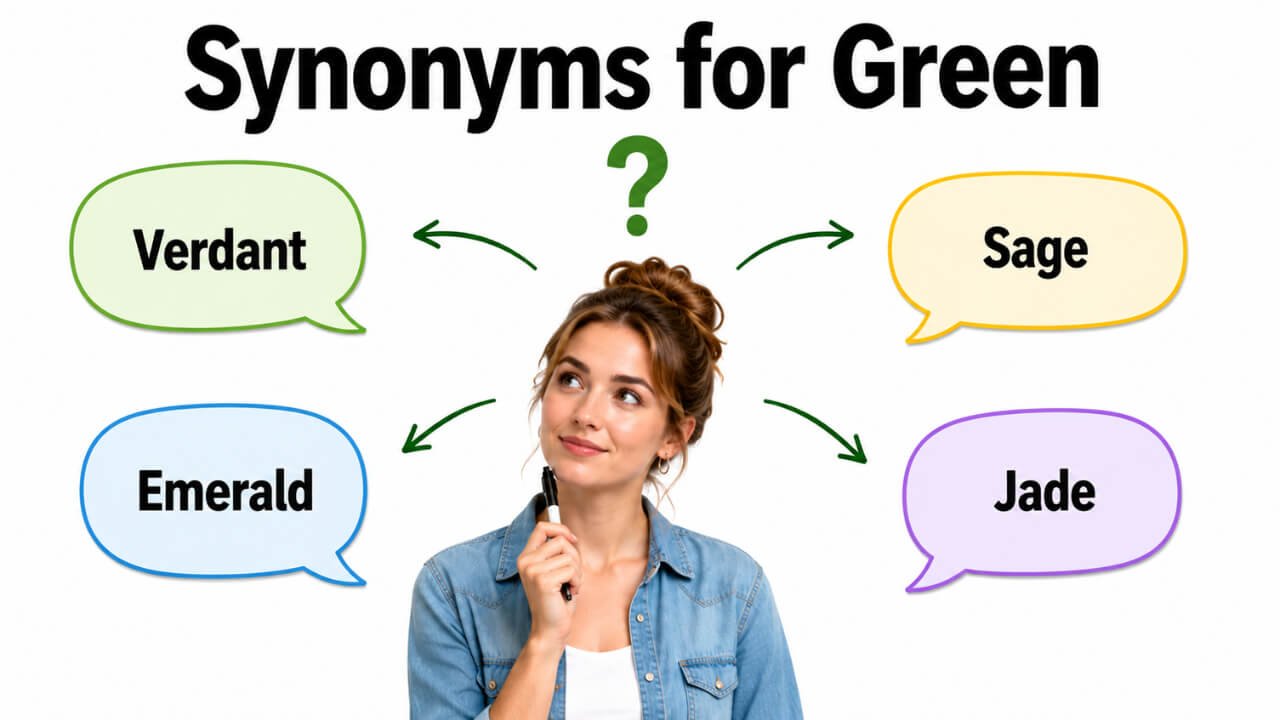
Quick Answer: The best synonyms for green include emerald, jade, olive, verdant, leafy, lush, sustainable, eco friendly, inexperienced, and unripe. Emerald, jade, olive, and mint describe specific shades of the color. Verdant, leafy, and lush work best for landscapes and vegetation. Sustainable and eco friendly suit environmental writing. Inexperienced is appropriate when green describes a person who lacks experience, while unripe is the clearest choice for fruit that has not fully matured.
Pronunciation and Word Details
Word: Green.
Pronunciation: /ɡriːn/
Part of Speech: Adjective, noun, and verb.
Meaning: Green describes a color between blue and yellow, natural vegetation, environmental responsibility, inexperience, or something that is not fully ripe.
US Pronunciation:
UK Pronunciation:
What Does “Green” Mean?
Green commonly means having the color of fresh grass or healthy leaves. It can function as an adjective, noun, or verb, and its exact meaning changes according to context.
As an adjective, green can describe color, as in “She wore a green dress.” It can also describe a landscape covered with plants, an environmentally responsible product, an inexperienced worker, or fruit that has not ripened.
As a noun, green can refer to the color itself, a grassy public area, or leafy vegetables. As a verb, it can mean making something more environmentally responsible or filling an area with plants.
Green can also express jealousy in figurative language. Because the word has several meanings, the best synonym must match the specific sentence.
Meaning, Tone, and Context of “Green”
Green usually has a neutral, positive, and natural tone. When it refers to color, it can suggest freshness, growth, calmness, vegetation, renewal, or the natural world.
In environmental writing, green often has a positive and responsible tone. It describes practices, products, buildings, technology, or policies intended to reduce environmental harm. Sustainable or environmentally responsible may be more precise in formal reports.
When green describes an inexperienced person, it may sound neutral, informal, or slightly critical. Inexperienced and untrained are clearer in professional writing.
Green can also describe fruit that is young or unripe. In this context, it is neutral and literal. When connected with jealousy, the word becomes emotional and figurative.
The term appears in everyday conversation, creative writing, fashion, gardening, environmental discussions, agriculture, business communication, and technical descriptions.
When and How to Use “Green”
For Color: Use green when describing objects that have the color of grass, leaves, or similar natural surfaces.
Example: The room has soft green walls and cream furniture.
For Nature: Use green to describe land that is covered with healthy plants or vegetation.
Example: Spring rain turned the dry fields green.
For Environmental Responsibility: Use green for actions, products, or systems designed to reduce environmental damage.
Example: The organization introduced greener methods of producing energy.
For Inexperience: Use green to describe someone who is new to a job, activity, or situation.
Example: The new assistant was talented but still green.
For Unripe Food: Use green when fruit, vegetables, or crops have not reached maturity.
Example: The peaches are still green and need several more days to ripen.
For Jealousy: Use green figuratively when describing feelings of envy.
Example: He was green with envy after hearing about her promotion.
For Public Spaces: Use green as a noun for an open grassy area.
Example: Families gathered on the village green.
For Environmental Change: Use green as a verb when describing efforts to make a place or system more sustainable.
Example: The community plans to green the neighborhood by planting more trees.
Best Synonyms for Green
Emerald: A rich and bright green color associated with the gemstone.
Example: She selected an emerald scarf for the evening event.
Jade: A smooth green shade that may appear soft, cool, or slightly blue.
Example: The kitchen cabinets were painted a gentle jade color.
Olive: A muted green shade with yellow or brown tones.
Example: He wore an olive jacket with dark trousers.
Verdant: Richly covered with fresh green plants or grass.
Example: The travelers admired the verdant hills.
Lush: Growing thickly and healthily, especially when describing vegetation.
Example: A lush garden surrounded the small house.
Sustainable: Able to continue without causing unnecessary environmental harm.
Example: The company adopted sustainable packaging practices.
Eco Friendly: Designed to cause less damage to the environment.
Example: They chose eco friendly materials for the renovation.
Inexperienced: Lacking knowledge or practice in a particular activity.
Example: The inexperienced driver needed additional training.
Unripe: Not fully developed or ready to be eaten.
Example: The unripe bananas were firm and bitter.
Envious: Feeling unhappy because another person has something desirable.
Example: He felt envious of his colleague’s success.
50 Synonyms for Green with Short Meanings
- Emerald: A rich and brilliant green shade.
- Jade: A smooth green shade inspired by the mineral.
- Olive: A muted green with yellow or brown tones.
- Lime: A bright yellow green color.
- Mint: A pale and refreshing green shade.
- Moss: A deep and earthy natural green.
- Sage: A soft gray green color.
- Forest Green: A dark green associated with dense woodland.
- Grass Green: A fresh green resembling healthy grass.
- Leaf Green: A natural shade resembling plant leaves.
- Fern Green: A medium green associated with fern plants.
- Pine Green: A dark and cool evergreen shade.
- Sea Green: A soft green with blue tones.
- Bottle Green: A very dark and rich green shade.
- Hunter Green: A deep green traditionally associated with outdoor clothing.
- Apple Green: A clear and lively yellow green shade.
- Pea Green: A light or medium yellow green color.
- Chartreuse: A vivid color between yellow and green.
- Viridian: A deep blue green pigment or shade.
- Malachite: A strong green inspired by the mineral.
- Verdant: Covered with fresh green vegetation.
- Grassy: Covered with grass or resembling grass.
- Leafy: Having many healthy leaves.
- Lush: Growing thickly and abundantly.
- Flourishing: Growing or developing successfully.
- Thriving: Growing strongly and successfully.
- Fresh: New, healthy, or recently produced.
- Fertile: Able to support healthy plant growth.
- Blooming: Producing flowers or growing healthily.
- Luxuriant: Growing richly, thickly, and abundantly.
- Sustainable: Able to continue with reduced environmental damage.
- Ecological: Connected with living things and their environment.
- Eco Friendly: Designed to limit harm to nature.
- Environmentally Responsible: Acting with concern for environmental effects.
- Conservation Minded: Concerned with protecting natural resources.
- Low Impact: Producing relatively little environmental harm.
- Renewable: Naturally replaceable or able to be restored.
- Natural: Existing in nature rather than being artificial.
- Clean: Producing little pollution or harmful waste.
- Planet Conscious: Aware of effects on the natural environment.
- Inexperienced: Lacking practice or knowledge.
- Untrained: Not yet taught the necessary skills.
- Novice: New to an activity or profession.
- Raw: Lacking experience, development, or refinement.
- Unseasoned: Not experienced in a particular field.
- Immature: Not fully developed in age, skill, or judgment.
- Naive: Lacking practical experience or informed judgment.
- Unripe: Not fully mature or ready to eat.
- Envious: Wanting an advantage or possession held by another person.
- Jealous: Feeling resentment because of another person’s success or advantage.
Read Also:
Synonyms for Art

Synonyms for Green by Context
When Green Describes a Color
Emerald, jade, olive, lime, mint, sage, moss, viridian, and chartreuse describe different green shades. These words are more precise than green because each identifies a particular tone.
Example: She replaced the plain green curtains with elegant emerald curtains.
Emerald is bright and rich. Jade is usually smoother and cooler. Olive is muted and earthy, while lime and chartreuse are bright and energetic. Sage and mint are softer choices for calm or delicate descriptions.
When Green Means Covered With Plants
Verdant, grassy, leafy, lush, flourishing, thriving, blooming, and luxuriant describe areas filled with healthy vegetation.
Example: The rain transformed the valley into a lush landscape.
Verdant is especially effective in formal or descriptive writing. Lush suggests thick and healthy growth. Leafy is useful for trees, streets, gardens, and neighborhoods with abundant leaves.
When Green Means Environmentally Responsible
Sustainable, eco friendly, ecological, low impact, clean, conservation minded, and environmentally responsible describe actions intended to protect natural resources.
Example: The builders selected sustainable materials for the new homes.
Sustainable is appropriate for formal reports, essays, policies, and business writing. Eco friendly is common in general communication. Low impact is useful when comparing activities or products by their environmental effects.
When Green Means Inexperienced
Inexperienced, untrained, novice, raw, unseasoned, immature, and naive describe someone who lacks practice or knowledge.
Example: Although the employee was inexperienced, she learned quickly.
Inexperienced is the most neutral and direct replacement. Untrained means that a person has not received formal instruction. Raw may suggest natural ability that has not yet been developed. Naive can imply poor judgment, so it should be used carefully.
When Green Means Unripe
Unripe, immature, undeveloped, young, and not ready describe fruit, vegetables, or crops that have not reached maturity.
Example: The unripe mangoes were too firm to eat.
Unripe is the clearest replacement in food and agricultural contexts. Immature may be used in technical descriptions of plants, seeds, or crops.
When Green Means Jealous
Envious and jealous are the most direct alternatives when green refers to wanting something another person has.
Example: He became envious when his friend received the award.
Envious focuses on wanting another person’s success or possession. Jealous may also involve fear of losing attention, affection, or status.
Another Word for Green
The best single replacement for green depends entirely on its meaning. Emerald is a strong choice for a rich color, verdant suits land covered with plants, sustainable works for environmental responsibility, inexperienced describes a beginner, and unripe describes fruit that has not matured.
Original: She wore a green evening dress.
Better Option: She wore an emerald evening dress.
Original: The region is famous for its green valleys.
Better Option: The region is famous for its verdant valleys.
Original: The business introduced green production methods.
Better Option: The business introduced sustainable production methods.
Original: The new technician is still green.
Better Option: The new technician is still inexperienced.
When Not to Use “Green”
Do not use green when the reader needs a precise color description. A specific shade such as olive, mint, sage, or emerald creates a clearer picture.
Weak: She chose green paint for the bedroom.
Better: She chose soft sage paint for the bedroom.
Avoid using green as a vague environmental claim. Explain exactly how a product, policy, or practice reduces harm.
Weak: The building has many green features.
Better: The building uses renewable energy and collects rainwater.
Green may sound too informal when describing an inexperienced person in professional writing.
Weak: The applicant is green but willing to learn.
Better: The applicant is inexperienced but willing to learn.
Do not replace green with lush or verdant when discussing color alone. Those words normally describe healthy vegetation or land covered with plants.
Weak: He bought a verdant notebook.
Better: He bought an emerald notebook.
Avoid using green for jealousy unless the figurative meaning is clear. In direct communication, envious or jealous is usually easier to understand.
Weak: She felt green after hearing the announcement.
Better: She felt envious after hearing the announcement.
Words Commonly Confused With Green
Green vs Emerald: Green is the general color category, while emerald is a rich and vivid shade of green.
Green vs Olive: Green can describe many shades. Olive specifically refers to a muted green with yellow or brown tones.
Green vs Verdant: Green can describe any object with the color. Verdant usually describes land or vegetation that is fresh, healthy, and abundant.
Green vs Lush: Green identifies a color, while lush describes thick and healthy growth. A garden can be both green and lush.
Green vs Sustainable: Green is a broad and sometimes informal environmental term. Sustainable describes practices that can continue while limiting resource depletion and environmental harm.
Green vs Eco Friendly: Green may refer to color, nature, or environmental ideas. Eco friendly specifically means designed to cause less environmental harm.
Green vs Inexperienced: Green is an informal figurative description of a beginner. Inexperienced is clearer and more suitable for formal writing.
Green vs Unripe: Green may describe the color of fruit even when it is mature. Unripe specifically means that the fruit has not fully developed.
Green vs Envious: Green can suggest jealousy through figurative language. Envious directly identifies the emotion.
Which Synonym Should You Choose?
Choose emerald when describing a rich and elegant green shade.
Choose jade when the color is smooth, cool, or slightly blue.
Choose olive when describing a muted or earthy green.
Choose mint or sage for soft colors in fashion, design, and decoration.
Choose verdant in formal or descriptive writing about fields, hills, valleys, or gardens.
Choose lush when vegetation is thick, healthy, and abundant.
Choose leafy when describing streets, trees, neighborhoods, or gardens with many leaves.
Choose sustainable in reports, essays, policies, and professional environmental writing.
Choose eco friendly in general communication about products, habits, or materials intended to reduce environmental harm.
Choose renewable when discussing energy or resources that can be naturally replaced.
Choose inexperienced when describing someone who lacks practice or knowledge.
Choose novice when referring to a person who is new to a skill, profession, or activity.
Choose untrained when the person has not received the required instruction.
Choose unripe when discussing fruit or crops that have not matured.
Choose envious when green expresses a desire for another person’s success or possessions.
Real Life Examples of “Green” in Sentences
Original: She carried a green handbag to the ceremony.
Better Option: She carried an emerald handbag to the ceremony.
Original: The walls were painted a pale green.
Better Option: The walls were painted a soft mint color.
Original: The green valley stretched toward the mountains.
Better Option: The verdant valley stretched toward the mountains.
Original: The garden remained green throughout the summer.
Better Option: The garden remained lush throughout the summer.
Original: The organization is developing green energy solutions.
Better Option: The organization is developing renewable energy solutions.
Original: They want to use greener building materials.
Better Option: They want to use more sustainable building materials.
Original: The young reporter was still green.
Better Option: The young reporter was still inexperienced.
Original: The green tomatoes were too firm for the recipe.
Better Option: The unripe tomatoes were too firm for the recipe.
Original: He was green with envy when his colleague won.
Better Option: He was envious when his colleague won.
Original: Volunteers helped make the neighborhood greener.
Better Option: Volunteers added more trees and plants to the neighborhood.
Synonym Groups and Usage Differences
Color Group
Emerald, jade, olive, lime, mint, sage, moss, chartreuse, viridian, and malachite identify particular shades within the green color family.
Emerald and malachite are rich shades. Mint and sage are softer. Lime and chartreuse appear brighter and contain stronger yellow tones.
Example: The designer paired sage walls with cream furniture.
Vegetation Group
Verdant, grassy, leafy, lush, flourishing, thriving, blooming, and luxuriant describe healthy plant life.
Verdant is polished and descriptive. Grassy refers specifically to land covered with grass. Luxuriant suggests especially rich and abundant growth.
Example: Luxuriant plants surrounded the quiet path.
Environmental Group
Sustainable, ecological, eco friendly, renewable, clean, low impact, and conservation minded relate to environmental protection.
Sustainable focuses on long term resource use. Renewable describes resources that can be replaced naturally. Low impact compares the amount of environmental damage caused by an activity.
Example: The project relies on renewable sources of electricity.
Experience Group
Inexperienced, novice, untrained, raw, unseasoned, immature, and naive refer to limited skill or knowledge.
Inexperienced is neutral. Novice identifies a beginner. Raw may suggest undeveloped talent, while naive can suggest a lack of practical judgment.
Example: The novice cook carefully followed every instruction.
Maturity Group
Unripe, immature, undeveloped, and young describe something that has not reached full maturity.
Unripe is most natural for fruit. Immature and undeveloped are broader and may refer to plants, ideas, skills, or behavior.
Example: The farmer left the unripe fruit on the tree.
Jealousy Group
Envious and jealous describe uncomfortable feelings related to another person’s advantages, success, relationships, or possessions.
Envious usually means wanting what someone else has. Jealous can include fear that something valued may be taken away.
Example: She felt envious of her friend’s exciting opportunity.
Antonyms of Green
Green does not have one universal opposite because it has several meanings. The correct antonym depends on whether green refers to vegetation, environmental responsibility, experience, maturity, freshness, or jealousy.
Barren: Unable to support much plant growth.
Withered: Dried, weakened, or no longer fresh.
Dry: Lacking water, moisture, or fresh vegetation.
Lifeless: Showing little life, growth, or energy.
Polluted: Contaminated by harmful substances.
Wasteful: Using resources carelessly or unnecessarily.
Unsustainable: Unable to continue without exhausting resources or causing serious harm.
Artificial: Made by people rather than occurring naturally.
Experienced: Having practical knowledge gained through activity.
Skilled: Having developed ability and training.
Trained: Taught how to perform a task correctly.
Seasoned: Having considerable experience in a particular field.
Mature: Fully developed in growth, ability, or judgment.
Ripe: Fully developed and ready to be eaten.
Developed: Advanced beyond an early or incomplete stage.
Content: Satisfied rather than envious of another person.
Admiring: Showing appreciation without jealousy.
Comparison: Green vs Related Words
Green vs Emerald
Green is a broad color category. Emerald is a specific rich and vivid shade within that category.
Example With Green: She placed a green cushion on the chair.
Example With Emerald: She placed an emerald cushion on the chair.
Green vs Jade
Green can refer to any shade between yellow and blue. Jade usually suggests a smoother and slightly cooler green.
Example With Green: The artist added green details to the painting.
Example With Jade: The artist added jade details to the painting.
Green vs Verdant
Green can describe the color of any object. Verdant describes land or plants that are fresh, healthy, and richly green.
Example With Green: The fence was painted green.
Example With Verdant: Verdant fields surrounded the village.
Green vs Lush
Green primarily identifies color. Lush emphasizes thick, healthy, and abundant plant growth.
Example With Green: The garden looked green after the rain.
Example With Lush: The garden looked lush after the rain.
Green vs Sustainable
Green is a broad environmental label that may lack detail. Sustainable describes something designed to continue without using resources irresponsibly.
Example With Green: The company announced a green building plan.
Example With Sustainable: The company announced a sustainable building plan.
Green vs Eco Friendly
Green has several meanings, while eco friendly specifically describes something intended to cause less environmental harm.
Example With Green: They purchased green cleaning products.
Example With Eco Friendly: They purchased eco friendly cleaning products.
Green vs Inexperienced
Green is an informal and figurative word for a beginner. Inexperienced is more direct, neutral, and appropriate for professional writing.
Example With Green: The new salesperson is still green.
Example With Inexperienced: The new salesperson is still inexperienced.
Green vs Unripe
Green describes color, but unripe describes a stage of development. Some mature fruit remains green, so the two terms are not always interchangeable.
Example With Green: She bought a green apple.
Example With Unripe: She picked an unripe peach.
Common Phrases and Expressions With “Green”
Green Light: Permission to begin or continue an activity.
Green With Envy: Feeling strongly jealous of another person.
Green Thumb: A natural ability to grow and care for plants.
Green Space: An area of grass, trees, or other vegetation.
Green Energy: Energy produced from sources intended to reduce environmental harm.
Green Living: A lifestyle that aims to reduce waste and environmental damage.
Green Building: A structure designed with environmental effects and resource efficiency in mind.
Green Around the Gills: Looking pale, sick, or uncomfortable.
Village Green: An open grassy area within or near a village.
The Grass Is Always Greener: The idea that another situation often appears better than one’s own.
Common Mistakes to Avoid
A frequent mistake is assuming that every green synonym refers only to color. Verdant and lush usually describe vegetation, while sustainable and eco friendly describe environmental responsibility.
Another mistake is using a specific color name without checking the shade. Emerald is rich and vivid, olive is muted, mint is pale, and chartreuse is bright. These words are not interchangeable in detailed descriptions.
Avoid using green as an unsupported environmental claim. A sentence should explain what makes a product, building, or practice environmentally responsible.
Vague: This is a green product.
Clear: This product uses recyclable packaging and requires less energy to produce.
Do not use green for inexperience in formal reports when inexperienced, untrained, or novice would be clearer.
Informal: The employee is still green.
Formal: The employee has limited experience in this role.
Writers should also avoid confusing green fruit with unripe fruit. A green apple may be fully ripe, while an unripe apple has not completed its development.
Repetition can weaken descriptive writing. Instead of using green several times, choose precise alternatives such as sage, olive, emerald, verdant, leafy, or lush.
Conclusion
The best synonyms for green depend on the intended meaning. Emerald, jade, olive, mint, and sage identify specific color shades. Verdant, leafy, and lush describe healthy vegetation, while sustainable, renewable, and eco friendly suit environmental contexts. Inexperienced and novice describe someone new to an activity, and unripe refers to fruit that has not matured. Envious works when green expresses jealousy. Choosing a precise alternative will make descriptions clearer, improve vocabulary, and help readers understand the exact meaning of each sentence.
FAQs About Synonyms for Green
What Is the Best General Synonym for Green?
There is no single replacement for every context. Emerald works for a rich color, verdant for vegetation, sustainable for environmental writing, and inexperienced for a beginner.
What Is Another Word for the Color Green?
Emerald, jade, olive, lime, mint, sage, moss, viridian, and chartreuse are useful names for different green shades.
What Is a Formal Synonym for Green Landscape?
Verdant is a polished synonym for land covered with healthy green vegetation. Lush and flourishing are also suitable.
What Is Another Word for Green Products?
Sustainable, eco friendly, low impact, and environmentally responsible are clearer alternatives, depending on how the product reduces environmental harm.
Can Green Mean Inexperienced?
Yes. Green can informally describe someone who lacks experience. Inexperienced, novice, untrained, and unseasoned are clearer alternatives.
What Is Another Word for Green Fruit?
Unripe is the best choice when fruit has not fully matured. Green should be used only when describing its actual color.
What Is the Opposite of Green?
The opposite depends on context. Barren contrasts with green vegetation, polluted contrasts with environmental responsibility, experienced contrasts with green as inexperienced, and ripe contrasts with green as unripe.
