
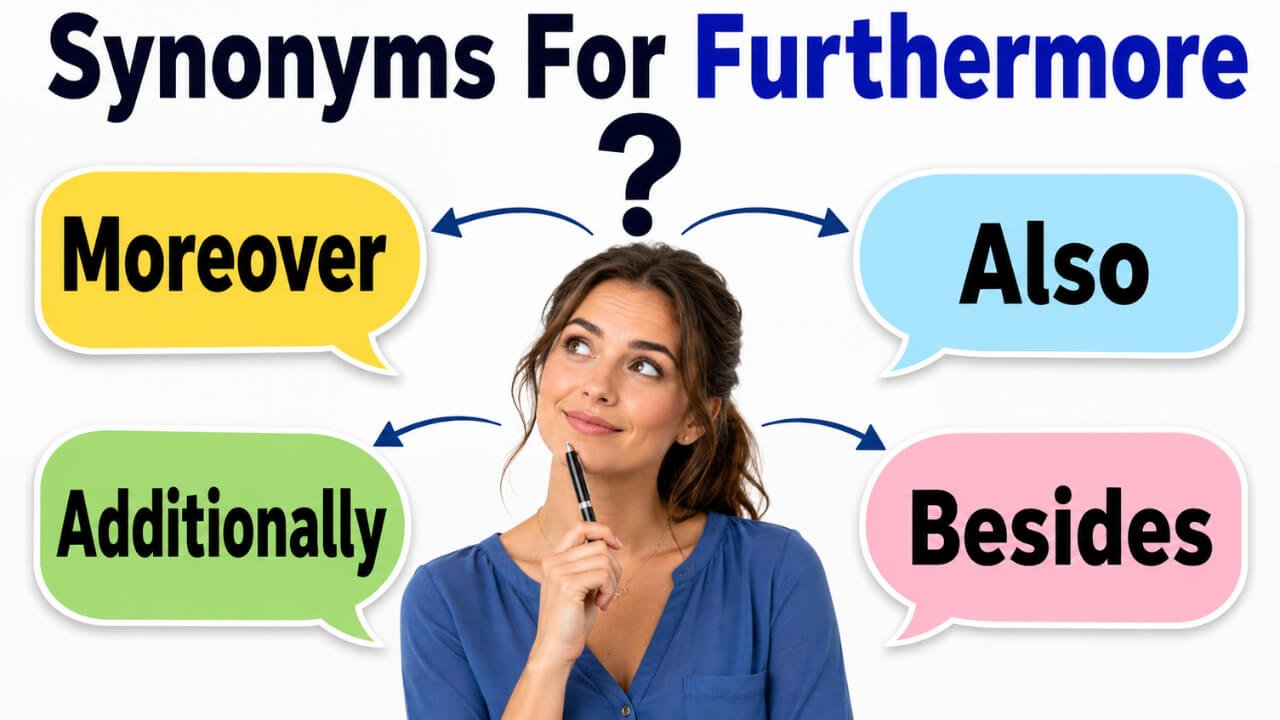
Quick Answer: The best synonyms for furthermore include moreover, in addition, additionally, also, besides, what is more, as well, further, on top of that, and plus. Use moreover in formal writing, in addition in essays and reports, also in simple sentences, besides for extra reasoning, as well in natural conversation, and plus in casual speech.
Pronunciation and Word Details
Word: Furthermore
Pronunciation: /ˌfɜːrðərˈmɔːr/
Part of Speech: Adverb
Meaning: Used to add more information, another point, or extra support to what has already been said.
US Pronunciation:
UK Pronunciation:
What Does “Furthermore” Mean?
Furthermore means in addition to what has already been said.
It is an adverb and a transition word used to connect ideas, add supporting information, or introduce another point. Writers often use furthermore in essays, reports, formal explanations, academic paragraphs, professional messages, and persuasive writing.
The word usually appears at the beginning of a sentence or clause. It helps show that the next idea continues the same line of thought.
Example: The plan is affordable. Furthermore, it is easy to maintain.
In this sentence, furthermore adds another positive point about the plan.
Meaning, Tone, and Context of “Furthermore”
Furthermore has a formal, logical, and polished tone. It is more formal than also and more academic than plus.
The word is common in essays, research writing, reports, arguments, explanations, professional emails, and detailed comparisons. It helps readers follow the structure of an idea because it clearly signals addition.
In casual conversation, furthermore can sound too stiff. People often choose also, plus, or on top of that instead.
In formal writing, furthermore is useful when you want to add a strong point that supports the previous sentence.
When and How to Use “Furthermore”
For Adding Information: Use furthermore when you want to add another detail to the same topic.
Example: The room is spacious. Furthermore, it receives plenty of natural light.
For Strengthening an Argument: Use furthermore when the next point gives more support to your claim.
Example: The method saves time. Furthermore, it reduces errors.
For Formal Writing: Use furthermore in essays, reports, articles, and professional explanations.
Example: The study is well organized. Furthermore, the examples are easy to understand.
For Connecting Related Points: Use furthermore when two ideas belong together and the second one adds value.
Example: The course teaches grammar. Furthermore, it improves vocabulary skills.
For Persuasive Writing: Use furthermore when you want to make your reasoning sound stronger.
Example: The product is durable. Furthermore, it requires little maintenance.
Best Synonyms for Furthermore
Moreover: Adds a strong formal point.
Example: The policy is fair. Moreover, it is simple to apply.
In Addition: Adds another related point in a clear way.
Example: The guide explains grammar rules. In addition, it gives useful examples.
Additionally: Adds more information in formal or professional writing.
Example: The package includes lessons. Additionally, it offers practice exercises.
Also: Adds another point in simple everyday language.
Example: She writes clearly. She also explains difficult words well.
Besides: Adds an extra reason or supporting idea.
Example: The plan is cheap. Besides, it saves time.
What Is More: Adds emphasis to the next point.
Example: The idea is practical. What is more, it is easy to test.
As Well: Adds something in a natural and conversational way.
Example: The book teaches vocabulary and grammar as well.
Further: Adds another point, often in formal discussion.
Example: Further, the results show steady improvement.
On Top of That: Adds extra information in a casual or conversational tone.
Example: The room is clean. On top of that, it has a great view.
Plus: Adds a point in casual speech or informal writing.
Example: The lesson is short. Plus, it is easy to follow.
50 Synonyms for Furthermore With Short Meanings
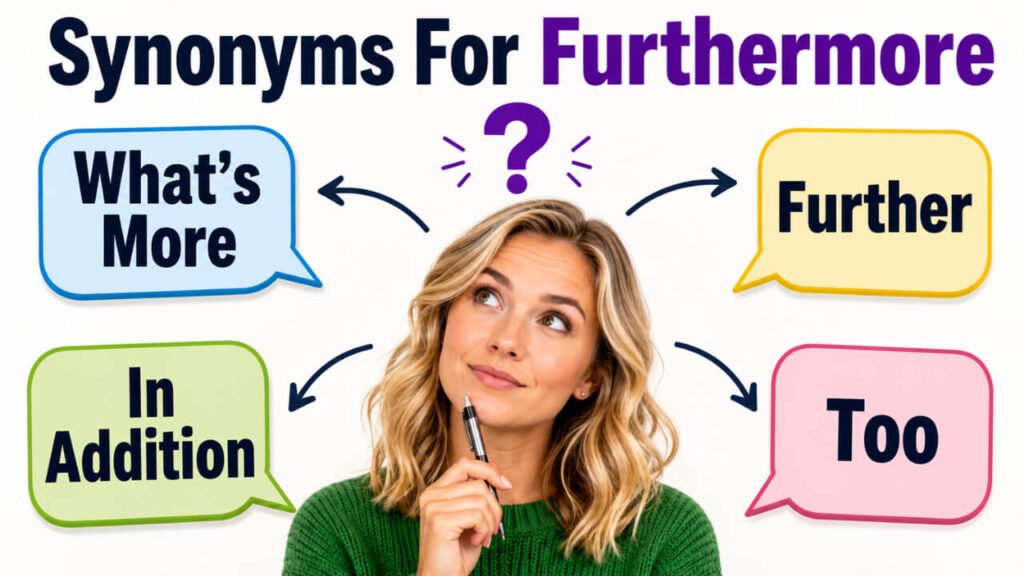
- Moreover: Adds a stronger related point.
- In Addition: Adds another idea or detail.
- Additionally: Adds more information formally.
- Also: Adds a simple extra point.
- Besides: Adds another reason or fact.
- What Is More: Adds emphasis to a further point.
- As Well: Adds something naturally.
- Further: Adds another point in formal writing.
- On Top of That: Adds extra information casually.
- Plus: Adds a point in informal speech.
- Too: Adds something to what was said.
- Likewise: Adds a similar related point.
- Similarly: Adds a point with a similar meaning.
- Along With That: Adds a connected idea.
- Added to That: Adds another supporting point.
- In the Same Way: Adds a similar idea.
- More Than That: Adds a stronger extra idea.
- Beyond That: Adds information beyond the first point.
- Apart From That: Adds another separate point.
- Not Only That: Adds emphasis to an extra point.
- Equally: Adds a point with equal importance.
- In Like Manner: Adds a similar point formally.
- In Addition to This: Adds directly to the previous idea.
- On a Related Note: Adds a connected point.
- Another Point Is: Introduces one more idea.
- Another Reason Is: Adds a further reason.
- To Add to This: Adds more detail to a point.
- It Should Also Be Noted: Adds a formal extra detail.
- It Is Also Important: Adds another important point.
- One More Point Is: Introduces another supporting idea.
- More Importantly: Adds a stronger or more important point.
- In Further Support: Adds more evidence or reasoning.
- As an Additional Point: Introduces another related idea.
- To Continue: Moves forward with another point.
- Continuing This Idea: Adds to the same thought.
- Building on This: Adds a point based on the previous idea.
- Coupled With This: Adds a connected supporting factor.
- Together With This: Adds something linked to the first point.
- As Another Benefit: Adds one more advantage.
- As Another Example: Adds one more example.
- Alongside This: Adds a related idea.
- Over and Above This: Adds something extra formally.
- In Extra Support: Adds more backing to a claim.
- To Strengthen This Point: Adds stronger support.
- As Further Evidence: Adds more proof.
- In Further Detail: Adds more explanation.
- At the Same Time: Adds a related point happening together.
- By the Same Token: Adds a related logical point.
- In the Same Context: Adds a related contextual idea.
- In the Same Argument: Adds another point to the same reasoning.
Read Also:
Synonyms for Provide

Synonyms for Furthermore by Context
When Furthermore Means In Addition
Use these synonyms when you want to add another fact, detail, or idea.
In Addition: The article explains the meaning. In addition, it gives examples.
Additionally: The tool saves time. Additionally, it improves accuracy.
Also: The lesson covers grammar. It also includes vocabulary practice.
Too: The answer is clear, and it is useful too.
When Furthermore Means Moreover
Use these choices when you want a formal transition that strengthens a point.
Moreover: The rule is simple. Moreover, it applies to many sentences.
Further: The evidence is strong. Further, the results are consistent.
What Is More: The service is reliable. What is more, it is affordable.
In Further Support: The data is complete. In further support, the examples show the same pattern.
When Furthermore Means Besides
Use these options when you are adding another reason, benefit, or argument.
Besides: The plan is easy. Besides, it costs very little.
Another Reason Is: The book is useful. Another reason is that it includes practice tasks.
Not Only That: The guide is detailed. Not only that, it is beginner friendly.
More Than That: The method is fast. More than that, it is reliable.
When Furthermore Means Also
Use these synonyms when the sentence needs a simple and natural addition.
Also: She writes clearly. She also explains each rule.
As Well: The course teaches spelling and punctuation as well.
Plus: The app is simple. Plus, it works quickly.
On Top of That: The room is quiet. On top of that, it is comfortable.
When Furthermore Means Building on This Idea
Use these phrases when the next point grows from the previous idea.
Building on This: The lesson defines the word. Building on this, it explains usage.
Continuing This Idea: The paragraph introduces the topic. Continuing this idea, the next paragraph gives examples.
To Add to This: The sentence is clear. To add to this, the tone is natural.
Alongside This: The report discusses cost. Alongside this, it explains long term value.
Another Word for Furthermore
Another word for furthermore is moreover. It is the best single replacement in formal writing because it adds another point with a strong, logical tone. The best choice still depends on context. Use also for simple writing, in addition for essays, and plus for casual speech.
Original: The plan is affordable. Furthermore, it is easy to manage.
Better Option: The plan is affordable. Moreover, it is easy to manage.
Original: The lesson explains the rule. Furthermore, it gives examples.
Better Option: The lesson explains the rule. In addition, it gives examples.
Original: The room is bright. Furthermore, it is quiet.
Better Option: The room is bright. It is also quiet.
Original: The task is simple. Furthermore, it takes only ten minutes.
Better Option: The task is simple. Plus, it takes only ten minutes.
When Not to Use “Furthermore”
Do not use furthermore when the sentence is casual, short, emotional, or conversational. It can sound too formal in everyday speech.
Weak: I like this shirt. Furthermore, it fits me well.
Better: I like this shirt. It also fits me well.
Weak: Come early. Furthermore, bring your notebook.
Better: Come early, and bring your notebook too.
Weak: The tea is hot. Furthermore, it tastes nice.
Better: The tea is hot. Plus, it tastes nice.
Avoid furthermore when the next sentence does not add related information.
Weak: The report is complete. Furthermore, the weather is cold today.
Better: The report is complete. Also, the final chart is ready.
Avoid using furthermore too many times in one article. Repetition makes writing stiff and less natural.
Weak: Furthermore, the method is simple. Furthermore, it is useful. Furthermore, it is cheap.
Better: The method is simple. In addition, it is useful. It is also affordable.
Words Commonly Confused With Furthermore
Furthermore vs Moreover: Both add information, but moreover often sounds slightly stronger and more persuasive. Furthermore is formal and smooth, while moreover can add extra emphasis.
Furthermore vs Additionally: Additionally is clear and professional. Furthermore sounds more polished and is often used in essays and formal arguments.
Furthermore vs Also: Also is simpler and more conversational. Furthermore is better for formal transitions between complete ideas.
Furthermore vs Besides: Besides often adds another reason, sometimes with a casual tone. Furthermore adds information in a more formal way.
Furthermore vs In Addition: In addition is a direct and flexible phrase. Furthermore is more formal and works well when adding support to an argument.
Furthermore vs Therefore: Furthermore adds information. Therefore shows a result or conclusion. They do not mean the same thing.
Furthermore vs However: Furthermore adds a similar point. However introduces contrast. Using one instead of the other can change the meaning.
Which Synonym Should You Choose?
Choose moreover when you want a formal synonym that adds strength to an argument.
Choose in addition when writing essays, reports, explanations, or structured paragraphs.
Choose additionally when writing professional, academic, or instructional content.
Choose also when you need a simple and natural word for everyday writing.
Choose besides when adding another reason, especially in conversational or persuasive writing.
Choose what is more when you want to add emphasis to a useful or surprising point.
Choose as well when the sentence needs a smooth conversational addition.
Choose further when writing formal notes, reports, or analytical discussion.
Choose on top of that when writing casually and adding an extra benefit.
Choose plus when the tone is informal, friendly, and simple.
Real Life Examples of “Furthermore” in Sentences
Original: The course is affordable. Furthermore, it offers lifetime access.
Better Option: The course is affordable. In addition, it offers lifetime access.
Original: The rule is simple. Furthermore, it works in many contexts.
Better Option: The rule is simple. Moreover, it works in many contexts.
Original: The room is large. Furthermore, it has good lighting.
Better Option: The room is large. It also has good lighting.
Original: The plan saves money. Furthermore, it reduces stress.
Better Option: The plan saves money. On top of that, it reduces stress.
Original: The article explains the meaning. Furthermore, it shows sentence examples.
Better Option: The article explains the meaning. Additionally, it shows sentence examples.
Original: The team finished early. Furthermore, the final work was accurate.
Better Option: The team finished early. What is more, the final work was accurate.
Original: The guide is short. Furthermore, it is easy to understand.
Better Option: The guide is short. Plus, it is easy to understand.
Original: The method improves speed. Furthermore, it improves clarity.
Better Option: The method improves speed. It improves clarity as well.
Original: The policy protects workers. Furthermore, it supports fair treatment.
Better Option: The policy protects workers. Further, it supports fair treatment.
Original: The lesson covers spelling. Furthermore, it covers punctuation.
Better Option: The lesson covers spelling. It also covers punctuation.
Synonym Groups and Usage Differences
Formal Addition Group
This group includes moreover, in addition, additionally, and further. These words work best in essays, reports, professional writing, and formal explanations.
Example: The evidence is reliable. Moreover, it supports the main argument.
Simple Addition Group
This group includes also, too, and as well. These options are useful when the sentence should sound natural and easy to read.
Example: The book explains grammar and vocabulary as well.
Emphasis Group
This group includes what is more, more importantly, not only that, and more than that. These phrases add force to the next point.
Example: The method is quick. What is more, it is highly accurate.
Casual Addition Group
This group includes plus, on top of that, and besides. These options fit casual speech, friendly writing, and simple explanations.
Example: The place is clean. Plus, it is close to home.
Argument Support Group
This group includes in further support, as further evidence, and to strengthen this point. These phrases are useful when adding proof, reasoning, or examples.
Example: The results improved. As further evidence, the error rate also dropped.
Antonyms of Furthermore
However: Shows contrast instead of addition.
Nevertheless: Shows contrast despite the previous point.
Instead: Shows replacement rather than added information.
On the Other Hand: Introduces an opposing point.
Conversely: Shows the opposite idea.
In Contrast: Highlights a difference.
Rather: Corrects or replaces the previous idea.
Yet: Adds contrast or surprise.
Although: Introduces a limiting or contrasting idea.
But: Connects an opposite or different idea.
Comparison: Furthermore vs Related Words
Furthermore vs Moreover
Furthermore adds another point in a formal way. Moreover also adds a point, but it often feels slightly stronger and more persuasive.
Example With Furthermore: The design is simple. Furthermore, it is easy to update.
Example With Moreover: The design is simple. Moreover, it is highly effective.
Furthermore vs Additionally
Furthermore sounds polished and formal. Additionally sounds clear, practical, and professional.
Example With Furthermore: The plan is cost effective. Furthermore, it saves time.
Example With Additionally: The plan is cost effective. Additionally, it saves time.
Furthermore vs Also
Furthermore is best for formal transitions. Also is better for simple sentences and everyday communication.
Example With Furthermore: The guide is detailed. Furthermore, it includes exercises.
Example With Also: The guide is detailed. It also includes exercises.
Furthermore vs Besides
Furthermore adds a point formally. Besides often adds a reason and can sound more conversational.
Example With Furthermore: The task is useful. Furthermore, it builds confidence.
Example With Besides: The task is useful. Besides, it builds confidence.
Furthermore vs Therefore
Furthermore adds information. Therefore introduces a result, conclusion, or effect.
Example With Furthermore: The test is short. Furthermore, it is easy to score.
Example With Therefore: The test is short. Therefore, it saves time.
Furthermore vs However
Furthermore adds a similar or supporting idea. However introduces contrast or disagreement.
Example With Furthermore: The answer is clear. Furthermore, it is complete.
Example With However: The answer is clear. However, it is too long.
Common Phrases and Expressions With “Furthermore”
Furthermore, It Shows: Adds another observation or proof.
Furthermore, It Suggests: Adds another possible meaning or conclusion.
Furthermore, It Supports: Adds another reason in favor of an argument.
Furthermore, It Helps: Adds another benefit or function.
Furthermore, It Includes: Adds another item, feature, or detail.
Furthermore, It Allows: Adds another ability or opportunity.
Furthermore, This Means: Adds another explanation of meaning.
Furthermore, This Proves: Adds another point of evidence.
Furthermore, This Creates: Adds another result or effect.
Furthermore, This Improves: Adds another positive outcome.
Common Mistakes to Avoid
A common mistake is using furthermore in casual sentences where also or plus sounds more natural. Formal transition words can make simple writing feel heavy.
Another mistake is using furthermore to show contrast. Furthermore adds information, while however, but, and in contrast show difference or opposition.
Avoid placing furthermore between unrelated ideas. The word should connect points that belong to the same topic or argument.
Do not repeat furthermore in every paragraph. Use moreover, in addition, also, besides, or as well to create smoother variety.
Also remember punctuation. When furthermore starts a sentence, it is usually followed by a comma.
Example: Furthermore, the results were accurate.
Conclusion
The keyword synonyms for furthermore includes strong alternatives such as moreover, in addition, additionally, also, besides, what is more, as well, and plus. Choose moreover for formal arguments, in addition for essays and reports, also for simple writing, and plus for casual speech. Understanding these differences helps you connect ideas clearly, avoid repetition, and make your writing sound natural, polished, and easy to follow.
FAQs About Synonyms for Furthermore
What is the best synonym for furthermore?
The best synonym for furthermore is moreover in formal writing. For simpler writing, in addition or also may sound more natural.
Is furthermore a formal word?
Yes, furthermore is a formal transition word. It is common in essays, reports, academic writing, and professional explanations.
Can I use also instead of furthermore?
Yes, you can use also instead of furthermore when the tone is simple or conversational. Also is less formal and easier for everyday sentences.
What is a casual synonym for furthermore?
Casual synonyms for furthermore include plus, also, as well, and on top of that. These sound more natural in speech and friendly writing.
What is the difference between furthermore and moreover?
Furthermore and moreover both add information. Moreover often sounds slightly stronger, while furthermore sounds formal and smooth.
Can furthermore start a sentence?
Yes, furthermore can start a sentence. It is usually followed by a comma when it introduces another point.
What is the opposite of furthermore?
The opposite of furthermore depends on the meaning. Words like however, instead, nevertheless, and in contrast show contrast instead of addition.
