
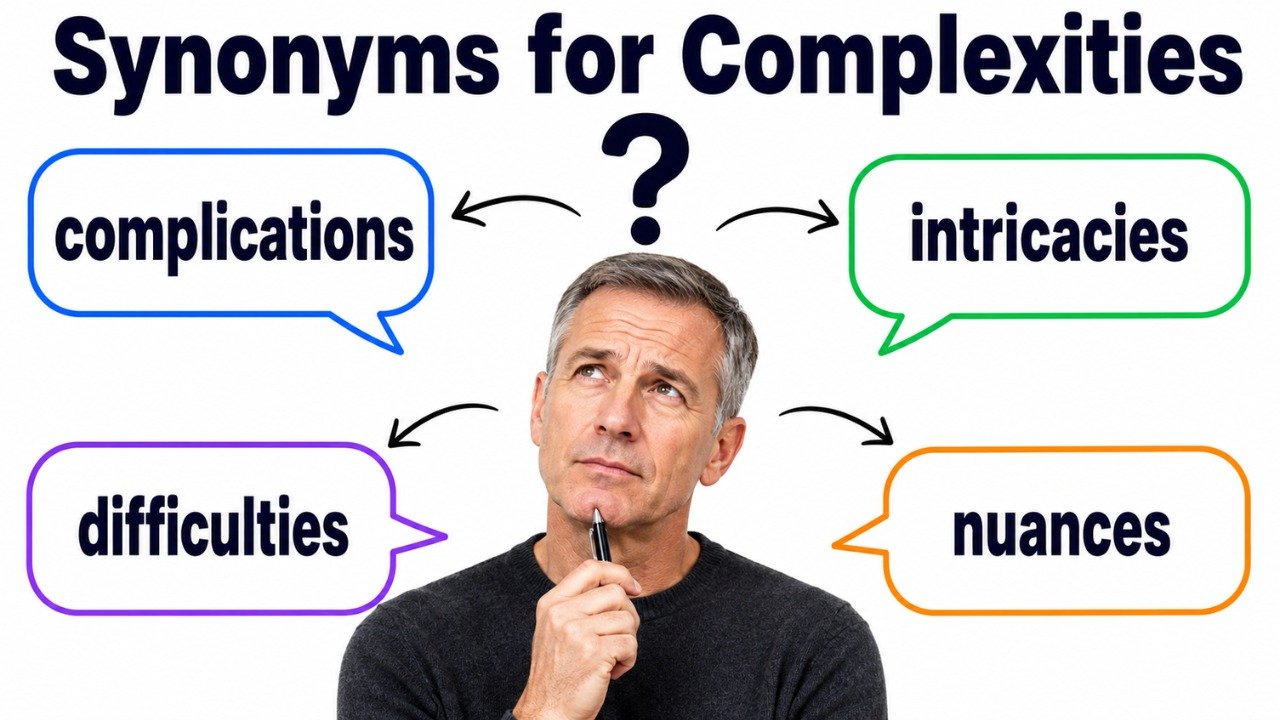
Quick Answer: The best synonyms for complexities include intricacies, complications, difficulties, challenges, nuances, subtleties, entanglements, technicalities, variables, and interconnected factors. Use intricacies for detailed or sophisticated features, complications for problems that make a situation harder, difficulties for general obstacles, nuances for small differences in meaning, and variables for changing factors in research or planning. Among all synonyms for complexities, the most accurate choice depends on whether you are describing detailed structure, practical problems, uncertain conditions, or connected parts.
Pronunciation and Word Details
Word: Complexities.
Pronunciation: /kəmˈplek.sə.tiz/
Part of Speech: Plural noun.
Meaning: Difficult details, connected factors, or complicated features that make something harder to understand or manage.
US Pronunciation:
UK Pronunciation:
What Does “Complexities” Mean?
Complexities are difficult details, connected elements, or complicated features within a subject, system, problem, or situation.
The word complexities is the plural form of complexity. It is a noun used when more than one difficult feature, detailed issue, or interconnected factor is involved.
Example: The team studied the complexities of the new transportation system.
Complexities may refer to intellectual difficulty.
Example: Students explored the complexities of human behavior.
The word can also describe practical problems.
Example: Unexpected legal complexities delayed the agreement.
In technical contexts, complexities may be the many interacting parts of a process, machine, system, or calculation.
Example: The engineers considered the complexities of integrating the two systems.
In emotional or social contexts, the word often describes subtle feelings, relationships, motives, or cultural differences.
Example: The novel examines the complexities of friendship and loyalty.
Complexities therefore does not always mean problems. It can also refer to depth, sophistication, detail, or the presence of many connected elements.
Meaning, Tone, and Context of “Complexities”
Complexities has a neutral to formal tone. It is common in academic writing, business reports, technical discussions, essays, professional emails, research papers, and analytical conversation.
The word often suggests that a subject cannot be understood through a simple explanation. It may contain many layers, conditions, perspectives, or connected parts.
Academic Context: The study investigates the complexities of language development.
Business Context: Managers must understand the complexities of international trade.
Technical Context: The software contains several architectural complexities.
Legal Context: The case introduced unexpected procedural complexities.
Emotional Context: She understood the complexities of grief and forgiveness.
Social Context: The discussion highlighted the complexities of cultural identity.
Complexities can have a negative meaning when it refers to obstacles, delays, or confusion.
Example: Financial complexities prevented the project from moving forward.
It can also have a positive or neutral meaning when it refers to richness, sophistication, or meaningful detail.
Example: Readers appreciated the complexities of the central character.
In casual conversation, complications, difficulties, or problems may sound more natural. In formal writing, intricacies, interconnected factors, variables, and technicalities can provide greater precision.
When and How to Use “Complexities”
For Detailed Subjects
Use complexities when a topic contains many parts, layers, or relationships that require careful study.
Example: The course introduces students to the complexities of modern economics.
For Difficult Situations
Use the word when several problems or obstacles make a situation difficult to manage.
Example: The organizers were unprepared for the complexities of coordinating such a large event.
For Interconnected Systems
Complexities is appropriate when the parts of a system affect one another.
Example: The model reflects the complexities of the regional water supply.
For Emotional Experiences
Use complexities when feelings, relationships, or motives cannot be described simply.
Example: The story captures the complexities of family relationships.
For Legal and Administrative Matters
The word can describe detailed rules, procedures, conditions, and responsibilities.
Example: A specialist helped them understand the complexities of the agreement.
For Technical Processes
Use complexities when discussing advanced machinery, software, engineering, mathematics, or scientific procedures.
Example: The update created new technical complexities for the development team.
For Cultural and Social Issues
Complexities can show that an issue involves multiple experiences, viewpoints, and historical factors.
Example: The speaker discussed the complexities of social change.
For Planning and Decision Making
Use the word when a choice depends on numerous risks, conditions, or variables.
Example: The committee considered the complexities of each available option.
For Literary Analysis
Complexities is useful when discussing layered characters, themes, conflicts, or meanings.
Example: The essay explores the moral complexities of the main character’s decision.
Best Synonyms for Complexities
Intricacies: Detailed and closely connected features that require careful attention.
Example: The designer explained the intricacies of the pattern.
Complications: Problems or additional factors that make a situation more difficult.
Example: Several complications delayed the construction work.
Difficulties: Problems that require effort, skill, or patience to overcome.
Example: The team encountered difficulties during the final stage.
Challenges: Demanding situations that test ability, judgment, or resources.
Example: The project presented several technical challenges.
Nuances: Small but meaningful differences in meaning, tone, or interpretation.
Example: A skilled translator must recognize the nuances of each expression.
Subtleties: Fine details that are not immediately obvious.
Example: The lecture examined the subtleties of human communication.
Entanglements: Complicated connections or situations that are difficult to separate.
Example: The dispute involved several financial entanglements.
Technicalities: Detailed rules, procedures, or technical points.
Example: The application was delayed by administrative technicalities.
Variables: Factors that can change and affect a result or decision.
Example: Researchers controlled several variables during the experiment.
Interconnected Factors: Elements that influence one another within a situation or system.
Example: The plan must account for several interconnected factors.
50 Synonyms for Complexities with Short Meanings
- Intricacies: Detailed and closely connected features.
- Complications: Problems that make a situation more difficult.
- Difficulties: Conditions that require effort to overcome.
- Challenges: Demanding situations or problems.
- Nuances: Small but meaningful differences.
- Subtleties: Fine details that are not immediately obvious.
- Details: Individual facts or features within a larger subject.
- Layers: Different levels of meaning, structure, or difficulty.
- Technicalities: Detailed rules or specialized points.
- Variables: Changeable factors that affect an outcome.
- Factors: Elements that influence a situation or result.
- Interdependencies: Relationships in which different parts rely on one another.
- Entanglements: Complicated connections that are difficult to separate.
- Entwinements: Closely connected elements or relationships.
- Convolutions: Complicated turns, structures, or developments.
- Perplexities: Confusing or difficult matters.
- Puzzles: Problems or situations that are difficult to understand.
- Conundrums: Difficult questions or confusing problems.
- Dilemmas: Situations requiring a choice between difficult options.
- Ambiguities: Details that allow more than one interpretation.
- Uncertainties: Conditions that are not known or predictable.
- Compounding Factors: Elements that increase an existing difficulty.
- Ramifications: Complicated results or consequences.
- Implications: Possible meanings, effects, or consequences.
- Fine Points: Small but important details.
- Ins and Outs: All the practical details of a subject.
- Sophisticated Features: Advanced or highly developed characteristics.
- Elaborate Details: Carefully developed and complicated features.
- Interconnected Elements: Parts that influence or depend on one another.
- Moving Parts: Numerous active factors within a process or plan.
- Structural Challenges: Difficulties caused by the way something is organized.
- Procedural Difficulties: Problems involving rules, methods, or official steps.
- Technical Challenges: Difficulties requiring specialized knowledge.
- Hidden Factors: Less obvious elements that affect a situation.
- Underlying Issues: Deeper problems beneath the visible situation.
- Tangled Issues: Problems connected in a confusing way.
- Obstacles: Conditions that block progress.
- Hurdles: Difficulties that must be overcome.
- Snags: Unexpected problems that cause delay.
- Constraints: Limits that restrict choices or actions.
- Demands: Requirements that make a task more difficult.
- Burdens: Difficult responsibilities or pressures.
- Conditions: Circumstances that affect how something works.
- Dependencies: Situations in which one element relies on another.
- Contradictions: Opposing facts, ideas, or requirements.
- Inconsistencies: Details that do not agree or remain uniform.
- Exceptions: Cases that do not follow the general rule.
- Qualifications: Conditions or limits added to a statement.
- Detailed Aspects: Specific parts that require close attention.
- Complicated Features: Elements that make something difficult to understand.
Read Also:
Synonyms for Additionally

Synonyms for Complexities by Context
When Complexities Means Intricate Details
Intricacies, details, fine points, subtleties, elaborate details, and sophisticated features are useful when the word refers to detailed construction or meaning.
Intricacies is often the strongest alternative because it suggests that several small parts are closely connected.
Example With Complexities: She studied the complexities of the traditional design.
Example With Intricacies: She studied the intricacies of the traditional design.
Fine points focuses on small details that may affect understanding or accuracy.
Example: The instructor explained the fine points of the procedure.
Subtleties emphasizes details that are difficult to notice.
Example: The actor understood the subtleties of the character’s emotions.
When Complexities Means Practical Problems
Complications, difficulties, challenges, obstacles, hurdles, and snags are suitable when something is difficult to complete or manage.
Complications often refers to new problems that make an existing situation harder.
Example: Unexpected complications delayed the opening.
Difficulties is a broad and neutral alternative.
Example: The organization faced financial difficulties.
Challenges can sound more positive because it suggests that the situation may be overcome through skill or effort.
Example: The team successfully addressed several logistical challenges.
Snags is more casual and usually describes smaller unexpected problems.
Example: We encountered a few snags during installation.
When Complexities Means Connected Factors
Interdependencies, interconnected factors, interconnected elements, dependencies, variables, and moving parts work well for systems, organizations, research, and planning.
Interdependencies emphasizes that different parts rely on one another.
Example: The report examines the interdependencies between transportation and housing.
Variables refers to factors that may change.
Example: Weather is one of several variables affecting the schedule.
Moving parts is a conversational phrase for the many active elements in a plan.
Example: The event has many moving parts that require careful coordination.
When Complexities Means Subtle Differences
Nuances, subtleties, ambiguities, qualifications, and fine distinctions are useful in language, communication, law, culture, and interpretation.
Nuances are small differences that change meaning, feeling, or effect.
Example: The discussion revealed important cultural nuances.
Ambiguities are details that can be understood in more than one way.
Example: The wording contained several legal ambiguities.
Qualifications are conditions or limits that make a statement less simple or absolute.
Example: Her support came with several qualifications.
When Complexities Means Confusing Problems
Perplexities, puzzles, conundrums, dilemmas, contradictions, and tangled issues emphasize confusion or difficulty in finding an answer.
A conundrum is a particularly difficult problem or question.
Example: The funding shortage created a serious conundrum for the committee.
A dilemma involves a difficult choice.
Example: The manager faced a dilemma between reducing costs and protecting jobs.
Contradictions involve opposing statements, facts, or requirements.
Example: The policy contains several contradictions that need clarification.
When Complexities Means Rules and Procedures
Technicalities, procedural difficulties, conditions, exceptions, and requirements fit legal, administrative, contractual, and official contexts.
Technicalities are detailed rules or specialized points that may affect a decision.
Example: Several legal technicalities delayed the transfer.
Exceptions are cases that do not follow the general rule.
Example: The policy includes exceptions for urgent situations.
Procedural difficulties refer specifically to problems with required steps or methods.
Example: Procedural difficulties prevented the application from being approved quickly.
When Complexities Means Consequences
Ramifications, implications, consequences, and compounding factors work when the word refers to difficult or far reaching effects.
Ramifications are complicated consequences that may develop from an action.
Example: The committee considered the financial ramifications of the proposal.
Implications may be direct or indirect meanings and effects.
Example: The research has important implications for public planning.
Compounding factors make an existing difficulty greater.
Example: Limited funding and staff shortages were compounding factors.
When Complexities Means Emotional Depth
Nuances, layers, subtleties, contradictions, and entanglements work well for feelings, motives, personalities, and relationships.
Layers suggests that a person or experience contains several levels of meaning.
Example: The story gradually reveals the emotional layers of the character.
Entanglements refers to relationships or responsibilities that are difficult to separate.
Example: The novel explores personal and emotional entanglements.
Contradictions can describe opposing feelings or behaviors within the same person.
Example: Her character is shaped by emotional contradictions.
Another Word for Complexities
The best single replacement for complexities is often intricacies. It preserves the idea of numerous connected details without automatically suggesting that they are negative.
The best alternative still depends on context. Complications works for practical problems, nuances suits subtle differences, challenges fits demanding tasks, and variables is appropriate for changing factors.
Original: The book explores the complexities of human relationships.
Better Option: The book explores the intricacies of human relationships.
Original: The project faced several unexpected complexities.
Better Option: The project faced several unexpected complications.
Original: The translator understood the complexities of the expression.
Better Option: The translator understood the nuances of the expression.
Original: The team considered the complexities affecting the final result.
Better Option: The team considered the variables affecting the final result.
When Not to Use “Complexities”
Complexities is useful in analytical writing, but it can sound vague, formal, repetitive, or unnecessarily complicated when a more precise word is available.
When You Mean Simple Problems
Use problems, difficulties, snags, or obstacles when the issues are straightforward.
Weak: We experienced complexities with the printer.
Better: We experienced problems with the printer.
When You Mean Detailed Features
Use intricacies, details, or fine points when the subject is detailed but not necessarily difficult.
Weak: The artist explained the complexities of the decorative border.
Better: The artist explained the intricacies of the decorative border.
When You Mean Changing Factors
Variables is more precise in research, science, planning, and analysis.
Weak: The researchers considered all the complexities in the experiment.
Better: The researchers considered all the variables in the experiment.
When You Mean Subtle Differences
Nuances or subtleties may communicate the intended meaning more clearly.
Weak: The reader missed the complexities of the speaker’s tone.
Better: The reader missed the nuances of the speaker’s tone.
When You Mean Legal Details
Technicalities, conditions, provisions, or requirements may be more accurate.
Weak: The agreement contains many complexities.
Better: The agreement contains many technicalities and conditions.
In Casual Conversation
Complexities may sound too formal when a simpler word would be natural.
Weak: There were several complexities when we planned the dinner.
Better: There were several difficulties when we planned the dinner.
When the Meaning Is Unclear
Complexities can hide the exact nature of a problem.
Weak: The plan failed because of several complexities.
Better: The plan failed because of funding constraints and scheduling conflicts.
When the Word Is Repeated
Repeated use can make writing sound abstract.
Weak: The report describes financial complexities, legal complexities, and operational complexities.
Better: The report describes financial pressures, legal technicalities, and operational challenges.
Words Commonly Confused With Complexities
Complexities vs Complications: Complexities may be detailed, difficult, or interconnected features. Complications are usually problems that make a situation worse or harder.
Complexities vs Intricacies: Complexities emphasizes difficulty or numerous connected parts. Intricacies emphasizes detailed and carefully connected features.
Complexities vs Difficulties: Complexities may include detail and sophistication. Difficulties directly refers to problems that require effort to overcome.
Complexities vs Challenges: Complexities describes difficult features or conditions. Challenges often suggests tasks that can be addressed through effort and skill.
Complexities vs Problems: Problems are specific matters needing solutions. Complexities may include many factors without identifying a single clear problem.
Complexities vs Nuances: Complexities involves many difficult or connected elements. Nuances are small differences in meaning, tone, or interpretation.
Complexities vs Subtleties: Complexities may be broad and structural. Subtleties are fine details that are difficult to notice.
Complexities vs Technicalities: Complexities is a broad term. Technicalities are specialized details, rules, or procedures.
Complexities vs Variables: Complexities describes the overall difficulty created by numerous factors. Variables are individual factors that can change.
Complexities vs Ambiguities: Complexities may come from detail, connection, or difficulty. Ambiguities specifically come from unclear or multiple meanings.
Complexities vs Dilemmas: Complexities are complicated features. Dilemmas are situations that require a difficult choice.
Complexities vs Ramifications: Complexities exist within a subject or situation. Ramifications are the effects or consequences that result from an action.
Complexities vs Complexity: Complexity is singular and refers to one state or quality of being complicated. Complexities is plural and refers to several difficult details, features, or issues.
Which Synonym Should You Choose?
Choose intricacies when describing detailed designs, systems, ideas, relationships, or creative works.
Choose complications when unexpected problems make a situation harder.
Choose difficulties for broad and neutral descriptions of problems.
Choose challenges when emphasizing effort, problem solving, growth, or the possibility of success.
Choose nuances when discussing small differences in language, emotion, culture, meaning, or interpretation.
Choose subtleties when the important details are difficult to notice.
Choose technicalities for specialized rules, legal points, official procedures, or administrative details.
Choose variables in research, analysis, planning, experiments, and calculations.
Choose interdependencies when different parts rely on one another.
Choose interconnected factors when several elements influence each other within a system.
Choose obstacles when something directly blocks progress.
Choose hurdles when a difficulty must be overcome before progress can continue.
Choose snags for small and unexpected problems in casual conversation.
Choose constraints when limits reduce available choices.
Choose dilemmas when someone must choose between difficult alternatives.
Choose ambiguities when wording, evidence, or information has multiple possible meanings.
Choose conundrums for puzzling problems that are especially difficult to solve.
Choose ramifications when discussing complicated future consequences.
Choose implications when focusing on possible meanings, effects, or results.
Choose entanglements when relationships, duties, finances, or interests are difficult to separate.
Choose layers when describing emotional, literary, cultural, or conceptual depth.
Choose moving parts in conversational business language when a project contains many active elements.
Choose detailed aspects in clear, neutral explanations where technical vocabulary is unnecessary.
Real Life Examples of “Complexities” in Sentences
Original: The lawyer explained the complexities of the agreement.
Better Option: The lawyer explained the technicalities of the agreement.
Original: The novel explores the complexities of family relationships.
Better Option: The novel explores the intricacies of family relationships.
Original: The team faced several complexities during construction.
Better Option: The team faced several complications during construction.
Original: Researchers examined the complexities affecting the outcome.
Better Option: Researchers examined the variables affecting the outcome.
Original: The translator understood the complexities of the phrase.
Better Option: The translator understood the nuances of the phrase.
Original: The manager discussed the complexities of coordinating several departments.
Better Option: The manager discussed the interdependencies among several departments.
Original: The project contains many financial complexities.
Better Option: The project contains many financial challenges.
Original: The documentary presents the complexities of the historical conflict.
Better Option: The documentary presents the many layers of the historical conflict.
Original: The committee considered the complexities of each decision.
Better Option: The committee considered the implications of each decision.
Original: The system has complexities that are difficult for new users to understand.
Better Option: The system has intricate features that are difficult for new users to understand.
Synonym Groups and Usage Differences
Detail Group
Intricacies, details, fine points, elaborate details, and sophisticated features describe parts that require close attention.
Intricacies suggests that the details are closely connected. Fine points emphasizes small but important distinctions. Elaborate details suggests careful development.
Example: The architect described the intricacies of the building’s design.
Difficulty Group
Complications, difficulties, challenges, obstacles, hurdles, and snags describe situations that interfere with progress.
Complications usually make an existing situation harder. Obstacles block progress. Hurdles must be overcome. Snags are smaller and often unexpected.
Example: Several logistical obstacles delayed the event.
Subtle Meaning Group
Nuances, subtleties, ambiguities, qualifications, and fine distinctions relate to meaning and interpretation.
Nuances and subtleties are small differences. Ambiguities create uncertainty. Qualifications limit or modify a statement.
Example: The translation preserved the emotional nuances of the original passage.
System Group
Interdependencies, interconnected factors, dependencies, variables, and moving parts describe relationships within a process or structure.
Interdependencies emphasizes mutual reliance. Variables may change. Moving parts refers informally to active elements requiring coordination.
Example: The planner mapped the interdependencies between housing, employment, and transportation.
Confusion Group
Perplexities, puzzles, conundrums, contradictions, and tangled issues emphasize uncertainty or difficulty in finding a solution.
Perplexities are confusing matters. Conundrums are particularly difficult problems. Contradictions involve opposing facts or ideas.
Example: The conflicting evidence created several perplexities.
Procedure Group
Technicalities, procedural difficulties, conditions, exceptions, and qualifications refer to rules and required steps.
Technicalities are detailed specialized points. Conditions must be satisfied. Exceptions identify cases outside the normal rule.
Example: Administrative technicalities delayed approval.
Consequence Group
Ramifications, implications, consequences, and compounding factors relate to results and effects.
Ramifications are often complicated and far reaching. Implications may be indirect. Compounding factors increase an existing problem.
Example: The decision could have serious financial ramifications.
Relationship Group
Entanglements, entwinements, dependencies, and interconnected elements describe close connections.
Entanglements often suggests that the connections are difficult to separate. Dependencies show reliance. Entwinements emphasizes close association.
Example: The dispute involved personal and financial entanglements.
Limitation Group
Constraints, demands, burdens, conditions, and requirements describe pressures or limits.
Constraints reduce available choices. Demands require time or effort. Burdens involve difficult responsibilities.
Example: Budget constraints reduced the scope of the project.
Antonyms of Complexities
The opposite of complexities may refer to simplicity, clarity, ease, independence, or straightforwardness.
Simplicities: Features that are easy to understand or manage.
Clarity: The quality of being understandable and unambiguous.
Simplicity: The condition of having few parts or difficulties.
Ease: Freedom from effort or difficulty.
Straightforwardness: The quality of being direct and uncomplicated.
Plainness: The quality of being simple and easy to recognize.
Transparency: Openness and clarity in information or processes.
Certainty: The absence of doubt or unpredictability.
Consistency: Agreement and stability among different parts.
Uniformity: The condition of remaining the same throughout.
Order: A clear and organized arrangement.
Coherence: Logical connection and consistency.
Independence: Freedom from reliance on other elements.
Resolution: The successful settlement of a problem.
Solution: An answer that removes a difficulty.
Simplicity of Structure: An arrangement with few connected parts.
Directness: Clear expression without unnecessary detail.
Predictability: The quality of being easy to anticipate.
Comparison: Complexities vs Related Words
Complexities vs Intricacies
Complexities emphasizes difficulty, numerous parts, or connected problems. Intricacies emphasizes fine details and close connections.
Example With Complexities: The report discusses the complexities of the healthcare system.
Example With Intricacies: The guide explains the intricacies of the traditional weaving method.
Complexities vs Complications
Complexities may be neutral, positive, or negative. Complications almost always refers to problems that make a situation more difficult.
Example With Complexities: The novel reflects the complexities of human motivation.
Example With Complications: Unexpected complications delayed the procedure.
Complexities vs Difficulties
Complexities may involve depth, structure, or connected factors. Difficulties are direct problems that require effort to overcome.
Example With Complexities: The course examines the complexities of international law.
Example With Difficulties: Students experienced difficulties understanding the final chapter.
Complexities vs Challenges
Complexities describes difficult features within a situation. Challenges emphasizes demanding tasks that may be addressed or overcome.
Example With Complexities: The project involves several technical complexities.
Example With Challenges: The team is prepared to overcome the technical challenges.
Complexities vs Nuances
Complexities refers broadly to difficult or interconnected features. Nuances are subtle distinctions in meaning, tone, or effect.
Example With Complexities: The discussion addressed the complexities of the issue.
Example With Nuances: The discussion addressed the cultural nuances of the issue.
Complexities vs Subtleties
Complexities may be obvious and structural. Subtleties are fine details that may not be noticed immediately.
Example With Complexities: The engineer studied the complexities of the system.
Example With Subtleties: The critic noticed the subtleties of the performance.
Complexities vs Variables
Complexities describes the difficulty created by many elements. Variables are specific factors that may change and influence a result.
Example With Complexities: The forecast must account for several economic complexities.
Example With Variables: The forecast includes several economic variables.
Complexities vs Technicalities
Complexities is broad and may include problems, relationships, or details. Technicalities are specialized details involving rules, methods, or procedures.
Example With Complexities: They discussed the complexities of the application process.
Example With Technicalities: They reviewed the legal technicalities of the application.
Complexities vs Ambiguities
Complexities comes from numerous details or connections. Ambiguities comes from unclear meaning or multiple interpretations.
Example With Complexities: The policy reflects the complexities of the issue.
Example With Ambiguities: The policy contains ambiguities that could cause confusion.
Complexities vs Ramifications
Complexities are difficult features within a subject or situation. Ramifications are the results that may follow an action or decision.
Example With Complexities: The committee examined the complexities of the proposal.
Example With Ramifications: The committee examined the financial ramifications of the proposal.
Complexities vs Problems
Problems are specific matters requiring solutions. Complexities may be detailed features that are not necessarily wrong or harmful.
Example With Complexities: The character’s complexities make the story more realistic.
Example With Problems: The software problems prevented users from signing in.
Common Phrases and Expressions With “Complexities”
The Complexities of Life: The difficult, subtle, and interconnected parts of human experience.
The Complexities of Human Nature: The many motives, emotions, and contradictions within people.
The Complexities of Relationships: The emotional and practical factors that shape personal connections.
The Complexities of the System: The numerous connected parts and rules within an organized structure.
Legal Complexities: Detailed laws, procedures, conditions, and responsibilities.
Technical Complexities: Difficult features requiring specialized knowledge.
Financial Complexities: Connected monetary issues, risks, rules, and obligations.
Operational Complexities: Difficulties involving the practical management of activities.
Administrative Complexities: Detailed procedures, rules, and official requirements.
Cultural Complexities: Subtle traditions, beliefs, identities, and social differences.
Political Complexities: Connected interests, institutions, conflicts, and decisions.
Emotional Complexities: Mixed feelings, motives, and personal conflicts.
Navigate the Complexities: To understand and manage a difficult situation successfully.
Understand the Complexities: To recognize the important details and connected factors.
Address the Complexities: To examine and respond to difficult aspects of a situation.
Common Mistakes to Avoid
Using Complexities for Every Problem
Not every problem contains numerous connected factors. Use problem, difficulty, or snag for simple issues.
Vague: The door has several complexities.
Clear: The door has several mechanical problems.
Assuming Complexities Is Always Negative
Complexities can describe richness and sophistication rather than failure.
Example: The emotional complexities of the character make the novel more engaging.
Confusing Complexities With Complications
Complications are usually negative problems. Complexities may simply be detailed or interconnected features.
Incorrect Meaning: The painting contains beautiful complications.
Better: The painting contains beautiful intricacies.
Using Complexities When Variables Is More Precise
In research and analysis, name the factors whenever possible.
Vague: Several complexities influenced the result.
Precise: Several environmental variables influenced the result.
Using Complexities for Subtle Meaning
Nuances is usually better for small differences in language, tone, or culture.
Weak: She understood the complexities of his tone.
Better: She understood the nuances of his tone.
Overusing Abstract Language
Complexities can hide specific information from the reader.
Vague: Operational complexities delayed the launch.
Specific: Staffing shortages and delivery delays postponed the launch.
Repeating Complexities in One Paragraph
Use precise alternatives to improve readability.
Repetitive: The report discusses legal complexities, financial complexities, and technical complexities.
Improved: The report discusses legal technicalities, financial challenges, and technical difficulties.
Using the Plural Form Incorrectly
Use complexity when referring to the general state of being complicated. Use complexities when referring to multiple difficult features or issues.
Singular: The complexity of the system surprised the new users.
Plural: The engineers examined the system’s many complexities.
Treating Intricacies and Difficulties as Identical
Intricacies focuses on detail, while difficulties focuses on problems.
Unnatural: The team overcame the decorative intricacies.
Better: The team mastered the decorative intricacies.
Better for Problems: The team overcame the technical difficulties.
Choosing a Synonym With the Wrong Tone
Conundrum, snag, technicality, and ramification are not interchangeable.
A conundrum is a puzzling problem. A snag is a small unexpected difficulty. A technicality is a specialized detail. A ramification is a consequence.
Using Complexities Without Explaining Them
In reports and essays, identify the main complexities after introducing the term.
Vague: The issue contains many complexities.
Better: The issue contains legal restrictions, financial risks, and conflicting responsibilities.
Conclusion
The strongest synonyms for complexities include intricacies, complications, difficulties, challenges, nuances, subtleties, technicalities, variables, and interconnected factors. Intricacies works best for detailed features, while complications and difficulties describe practical problems. Nuances suits subtle differences in meaning, and variables fits research or planning. Use interdependencies for connected systems and ramifications for complicated consequences. Selecting the right alternative makes writing clearer, more accurate, and better suited to academic, professional, technical, or conversational contexts.
FAQs About Synonyms for Complexities
What Is the Best Synonym for Complexities?
Intricacies is the best general synonym when complexities refers to detailed and connected features. Complications is better when the word refers to problems.
What Is a Simple Word for Complexities?
Problems, difficulties, details, and challenges are simpler alternatives. The best choice depends on the intended meaning.
What Is a Formal Synonym for Complexities?
Intricacies, interdependencies, variables, technicalities, and ramifications are useful formal alternatives.
Are Complexities and Complications the Same?
Not exactly. Complexities may be neutral and refer to detailed or interconnected features. Complications usually refers to problems that make a situation harder.
What Is Another Word for the Complexities of Life?
The intricacies of life, challenges of life, uncertainties of life, and many layers of life are natural alternatives.
What Is a Synonym for Technical Complexities?
Technical challenges, system intricacies, engineering difficulties, procedural complications, and specialized issues are suitable choices.
What Is the Opposite of Complexities?
Simplicity, clarity, ease, straightforwardness, and transparency are common opposites of complexities.
