
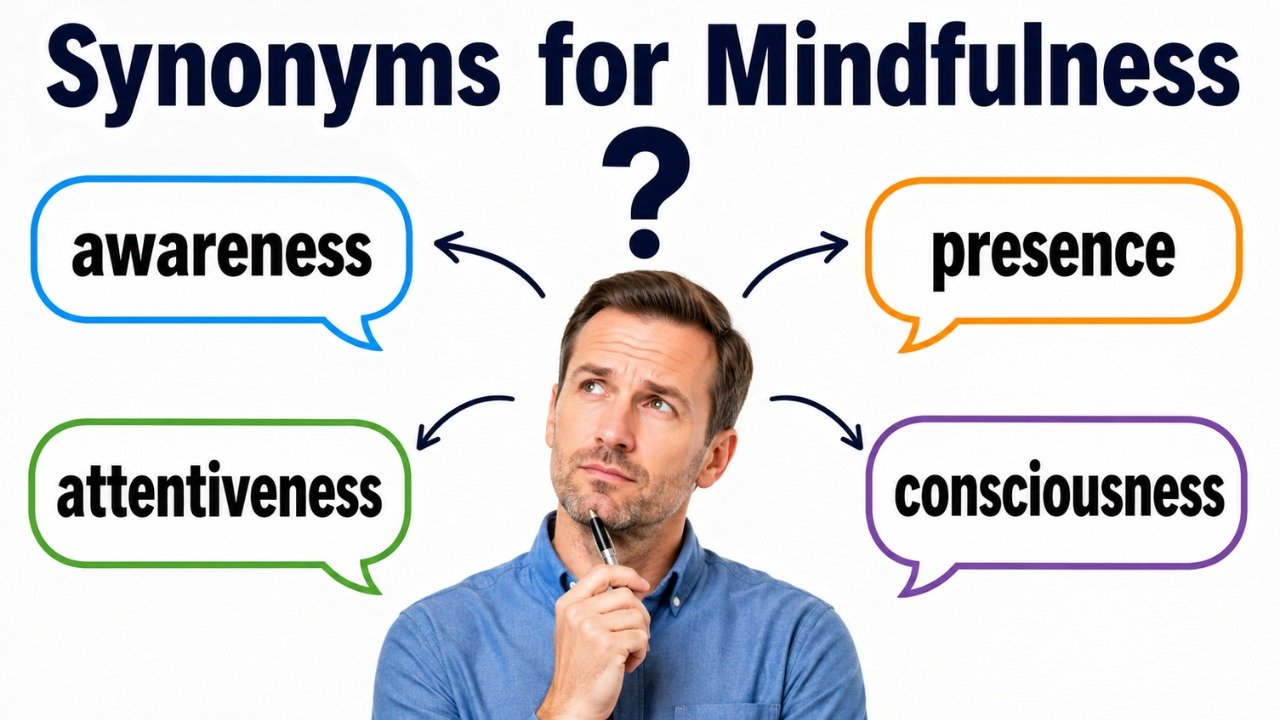
Quick Answer: The best synonyms for mindfulness include awareness, attentiveness, presence, conscious awareness, focus, self awareness, alertness, intentionality, centeredness, and contemplation. Awareness is the strongest general replacement in formal and everyday writing. Presence works well when describing attention to the current moment, while attentiveness suits work, study, and communication. Use self awareness for understanding thoughts and emotions, centeredness for emotional calm, and intentionality when emphasizing deliberate choices or actions.
Pronunciation and Word Details
Word: Mindfulness.
Pronunciation: /ˈmaɪnd.fəl.nəs/
Part of Speech: Abstract noun.
Meaning: The state of giving calm, careful, and conscious attention to the present moment.
US Pronunciation:
UK Pronunciation:
What Does “Mindfulness” Mean?
Mindfulness means giving calm and deliberate attention to what is happening in the present moment. It is an abstract noun that describes a mental state, personal quality, or practice of noticing thoughts, emotions, sensations, surroundings, and actions.
A person shows mindfulness by paying attention without becoming immediately distracted or reacting without thought. The word often suggests awareness, calm observation, and acceptance of present experience.
Mindfulness can describe attention to internal experiences, such as thoughts and feelings. It can also refer to awareness of external experiences, such as sounds, movement, conversations, surroundings, and everyday tasks.
Present Moment Attention: Mindfulness helped her notice the sounds and sensations around her.
Emotional Awareness: He practiced mindfulness before responding to the criticism.
Careful Action: Mindfulness encouraged the team to make thoughtful decisions.
Focused Observation: The exercise developed mindfulness of breathing and posture.
Daily Practice: She brought mindfulness to simple activities such as eating and walking.
In a sentence, mindfulness can refer to a state of mind, a personal habit, a mental exercise, or a deliberate approach to life.
Meaning, Tone, and Context of “Mindfulness”
Mindfulness has a calm, positive, reflective, and neutral tone. It is common in everyday conversation, education, personal development, psychology, health discussions, workplace communication, and academic writing.
The word may sound slightly formal when used in research or professional writing. In ordinary conversation, it often describes being fully present, paying attention, or slowing down before reacting.
Neutral Tone: Mindfulness can describe attention without suggesting a particular emotion.
Positive Tone: The word often carries ideas of calmness, balance, patience, and thoughtful behavior.
Reflective Tone: It is frequently connected with noticing thoughts, feelings, and physical sensations.
Academic Tone: In formal contexts, mindfulness may refer to a defined practice of present moment awareness.
Conversational Tone: People often use it to mean being present, attentive, or aware.
Practical Context: Mindfulness can apply to eating, listening, studying, working, walking, breathing, and communicating.
Emotional Context: It may describe observing emotions before choosing how to respond.
Professional Context: It can refer to careful attention, thoughtful communication, and deliberate decision making.
Mindfulness does not always mean meditation. Meditation can be one way to develop mindfulness, but mindfulness can also occur during ordinary activities.
When and How to Use “Mindfulness”
Use mindfulness when discussing calm awareness, present attention, thoughtful behavior, emotional observation, or deliberate action.
For Present Moment Awareness: Use mindfulness when someone is focusing on what is happening now rather than worrying about the past or future.
Example: Mindfulness helped her focus on the conversation instead of thinking about tomorrow.
For Emotional Observation: Use it when describing the ability to notice emotions without reacting immediately.
Example: He used mindfulness to recognize his frustration before speaking.
For Careful Listening: Mindfulness can describe full attention during a conversation.
Example: Mindfulness made her a more patient and attentive listener.
For Focused Work: Use the word when someone gives deliberate attention to a task.
Example: A few minutes of mindfulness helped him return to his work with greater focus.
For Calm Decision Making: Mindfulness can suggest pausing before making a choice.
Example: The manager encouraged mindfulness before important decisions.
For Personal Reflection: Use it when someone observes thoughts, habits, or reactions.
Example: Mindfulness allowed her to notice patterns in her thinking.
For Physical Awareness: Mindfulness can refer to noticing breathing, movement, posture, or bodily sensations.
Example: The instructor encouraged mindfulness of breathing and movement.
For Everyday Activities: Use it when someone performs an ordinary task with full attention.
Example: He practiced mindfulness while preparing his meal.
For Thoughtful Communication: Mindfulness can describe choosing words carefully and listening without interruption.
Example: Mindfulness improved the quality of their discussion.
For Formal Writing: Use mindfulness when discussing present moment attention as a mental quality or structured practice.
Example: The report examined how mindfulness affected attention during demanding tasks.
Best Synonyms for Mindfulness
Awareness
Synonym: Conscious knowledge of what is happening within or around you.
Example: Greater awareness helped her recognize when her attention began to wander.
Awareness is the broadest and most flexible synonym for mindfulness. It works in formal writing, everyday conversation, education, and descriptions of thoughts, feelings, or surroundings.
Attentiveness
Synonym: The quality of listening, watching, or concentrating carefully.
Example: His attentiveness made every team member feel heard.
Attentiveness is best when mindfulness involves careful listening, observation, study, work, or communication.
Presence
Synonym: Full mental and emotional attention to the current moment.
Example: Her calm presence helped her enjoy the experience without distraction.
Presence is a natural alternative when the focus is on being mentally available and engaged in the present.
Conscious Awareness
Synonym: Deliberate recognition of thoughts, feelings, sensations, or surroundings.
Example: Conscious awareness allowed him to notice tension in his shoulders.
This phrase is useful in academic, reflective, and professional writing because it clearly emphasizes deliberate attention.
Focus
Synonym: Concentrated attention directed toward one activity or subject.
Example: A quiet environment improved her focus during the exercise.
Focus is best when mindfulness refers mainly to concentration. It does not always include emotional acceptance or broad awareness.
Self Awareness
Synonym: Understanding of your own thoughts, emotions, motives, and behavior.
Example: Self awareness helped him recognize why the comment had upset him.
Self awareness is most suitable when discussing internal experiences and personal behavior.
Alertness
Synonym: The state of being awake, attentive, and ready to notice changes.
Example: The task required constant alertness and careful observation.
Alertness is stronger than mindfulness when quick attention or readiness is important.
Intentionality
Synonym: The quality of acting with a clear and deliberate purpose.
Example: She approached each conversation with patience and intentionality.
Intentionality works well when mindfulness involves purposeful choices rather than automatic behavior.
Centeredness
Synonym: A calm, stable, and emotionally balanced state.
Example: A moment of quiet helped him regain his centeredness.
Centeredness emphasizes emotional steadiness more than active observation.
Contemplation
Synonym: Deep and careful thought about an idea, feeling, or experience.
Example: The quiet setting encouraged contemplation and honest reflection.
Contemplation is best when mindfulness involves thoughtful reflection rather than immediate present moment attention.
50 Synonyms for Mindfulness with Short Meanings
- Awareness: Conscious knowledge of present experiences.
- Attentiveness: Careful attention to what is happening.
- Presence: Full engagement with the current moment.
- Conscious Awareness: Deliberate recognition of thoughts or surroundings.
- Present Moment Awareness: Attention directed toward current experience.
- Focus: Concentrated attention on one subject or activity.
- Concentration: Sustained mental attention without distraction.
- Self Awareness: Understanding of personal thoughts, emotions, and behavior.
- Alertness: Readiness to notice and respond.
- Watchfulness: Careful observation of events or changes.
- Observation: The act of noticing something carefully.
- Careful Attention: Deliberate and thoughtful notice.
- Full Attention: Complete mental engagement with something.
- Focused Awareness: Concentrated recognition of present experience.
- Conscious Attention: Deliberate focus on what is happening.
- Active Awareness: Engaged and purposeful noticing.
- Attentive Presence: Calm and complete involvement in the moment.
- Mental Presence: The state of being mentally engaged.
- Wakefulness: An alert and conscious mental state.
- Consciousness: Awareness of yourself and your surroundings.
- Noticing: The act of becoming aware of something.
- Perception: Awareness gained through the senses or mind.
- Receptiveness: Openness to thoughts, feelings, or experiences.
- Openness: Willingness to observe experience without immediate resistance.
- Intentionality: Acting with clear and deliberate purpose.
- Deliberate Attention: Purposeful focus on a chosen experience.
- Thoughtfulness: Careful consideration of actions and effects.
- Consideration: Careful thought before acting or responding.
- Carefulness: Attention that reduces careless action.
- Reflection: Serious thought about experience or behavior.
- Contemplation: Deep and calm consideration.
- Introspection: Examination of personal thoughts and emotions.
- Inner Awareness: Attention to internal feelings and mental activity.
- Reflective Awareness: Thoughtful recognition of experience.
- Insight: Clear understanding of a thought, feeling, or situation.
- Discernment: The ability to notice and understand subtle differences.
- Clarity: A clear and undistracted state of mind.
- Mental Clarity: Clear thinking without confusion or distraction.
- Centeredness: Calm emotional and mental stability.
- Groundedness: A steady connection with present reality.
- Calm Attention: Peaceful focus on current experience.
- Composure: Calm control of thoughts and reactions.
- Equanimity: Emotional balance during pleasant or difficult experiences.
- Serenity: A peaceful and undisturbed state.
- Calmness: Freedom from agitation or hurried reactions.
- Balance: Mental and emotional steadiness.
- Situational Awareness: Understanding of what is happening around you.
- Careful Observation: Close and deliberate noticing.
- Meditative Awareness: Calm attention developed through reflective practice.
- Attuned Awareness: Sensitive attention to thoughts, feelings, or surroundings.
Read Also:
Synonyms for Analytical

Synonyms for Mindfulness by Context
When Mindfulness Means Present Moment Awareness
Use awareness, presence, present moment awareness, attentive presence, mental presence, and conscious awareness when describing attention to what is happening now.
Awareness Example: Awareness of her breathing helped her remain calm.
Presence Example: His presence allowed him to enjoy the conversation fully.
Present Moment Awareness Example: Present moment awareness reduced her habit of thinking about unfinished tasks.
Presence sounds natural in conversation. Conscious awareness is more suitable for formal or explanatory writing.
When Mindfulness Means Careful Attention
Use attentiveness, focus, concentration, full attention, careful attention, and deliberate attention when the main idea is sustained observation or concentration.
Attentiveness Example: Her attentiveness helped her understand every instruction.
Focus Example: He returned his focus to the task.
Full Attention Example: The speaker received the audience’s full attention.
Attentiveness is useful for listening and observation. Focus and concentration are stronger when discussing study, work, or a demanding activity.
When Mindfulness Means Self Awareness
Use self awareness, inner awareness, introspection, insight, reflection, and reflective awareness when discussing thoughts, feelings, motives, or habits.
Self Awareness Example: Self awareness helped her understand her reaction.
Introspection Example: Introspection revealed a pattern of unnecessary worry.
Insight Example: The experience gave him insight into his behavior.
Self awareness is the clearest everyday choice. Introspection has a more formal and analytical tone.
When Mindfulness Means Calm Observation
Use calm attention, centeredness, groundedness, equanimity, composure, serenity, and balance when emphasizing emotional steadiness.
Centeredness Example: A quiet pause restored her centeredness.
Equanimity Example: He responded to the unexpected news with equanimity.
Groundedness Example: Slow breathing gave her a sense of groundedness.
Centeredness and groundedness are common in reflective conversation. Equanimity sounds more formal and emphasizes emotional balance.
When Mindfulness Means Deliberate Action
Use intentionality, thoughtfulness, consideration, carefulness, and deliberate attention when describing purposeful choices.
Intentionality Example: She answered with patience and intentionality.
Thoughtfulness Example: His thoughtfulness improved the quality of the discussion.
Consideration Example: The decision required careful consideration.
Intentionality emphasizes purpose. Thoughtfulness and consideration focus more on careful judgment and concern for consequences.
When Mindfulness Means Awareness of Surroundings
Use alertness, watchfulness, situational awareness, active awareness, perception, and careful observation when attention is directed outward.
Alertness Example: The work required alertness throughout the shift.
Situational Awareness Example: Good situational awareness helped the group respond safely.
Careful Observation Example: Careful observation revealed a small change in the pattern.
Alertness suggests readiness to react. Situational awareness is more technical and refers to understanding the surrounding environment.
When Mindfulness Means Openness to Experience
Use receptiveness, openness, attuned awareness, and noticing when someone observes an experience without immediately rejecting or judging it.
Receptiveness Example: Her receptiveness allowed her to consider a different view.
Openness Example: He approached the discussion with curiosity and openness.
Noticing Example: Simple noticing helped her recognize the change in her mood.
These alternatives suit reflective, emotional, and interpersonal contexts.
Another Word for Mindfulness
The best single replacement for mindfulness is awareness. It is clear, flexible, and appropriate in both formal and conversational writing.
However, the best alternative depends on meaning. Choose presence when emphasizing the current moment, attentiveness for careful listening, self awareness for inner understanding, and intentionality for deliberate action.
Original: Mindfulness helped her notice the tension in her body.
Better Option: Awareness helped her notice the tension in her body.
Original: He brought mindfulness to the conversation.
Better Option: He brought full attention to the conversation.
Original: Mindfulness helped her understand her emotional reaction.
Better Option: Self awareness helped her understand her emotional reaction.
Original: He completed the task with mindfulness and care.
Better Option: He completed the task with attentiveness and care.
When Not to Use “Mindfulness”
Mindfulness is useful, but another word may be clearer when you need to describe a specific type of attention, emotional state, or action.
When You Mean Concentration Only
Mindfulness includes awareness, while concentration refers more directly to sustained focus.
Weak: The examination required mindfulness for three hours.
Better: The examination required concentration for three hours.
When You Mean Quick Readiness
Alertness is more accurate when someone must notice danger, change, or important information quickly.
Weak: The driver maintained mindfulness during the difficult journey.
Better: The driver maintained alertness during the difficult journey.
When You Mean Emotional Understanding
Self awareness is clearer when the focus is on recognizing personal feelings, motives, or behavior.
Weak: Her mindfulness helped her understand why she felt jealous.
Better: Her self awareness helped her understand why she felt jealous.
When You Mean Formal Reflection
Contemplation or reflection may be more precise when describing deep thought about a subject.
Weak: The question required several hours of mindfulness.
Better: The question required several hours of reflection.
When You Mean Purposeful Action
Intentionality is stronger when the important idea is acting with purpose.
Weak: He planned the meeting with mindfulness.
Better: He planned the meeting with intentionality.
When The Word Sounds Vague
Mindfulness can be unclear if the sentence does not explain what the person is noticing or doing.
Weak: The project needs more mindfulness.
Better: The project requires greater attention to detail.
When Repetition Weakens the Paragraph
Repeated use can make writing sound general and monotonous.
Weak: Mindfulness improves attention because mindfulness creates awareness, and mindfulness supports calmness.
Better: Mindfulness improves attention by developing awareness and supporting calmness.
When A Practical Word Is Better
In workplace instructions, direct words such as attention, care, observation, or focus may be clearer.
Weak: Use mindfulness when checking the figures.
Better: Use careful attention when checking the figures.
Words Commonly Confused With Mindfulness
Mindfulness vs Awareness: Awareness is the general state of noticing something. Mindfulness is usually deliberate, calm, and focused awareness of present experience.
Mindfulness vs Attention: Attention means directing the mind toward something. Mindfulness involves attention combined with conscious observation and present moment awareness.
Mindfulness vs Concentration: Concentration narrows attention onto one object or task. Mindfulness may include a broader awareness of thoughts, emotions, sensations, and surroundings.
Mindfulness vs Meditation: Meditation is a structured activity or practice. Mindfulness is a quality of awareness that can be developed through meditation or used during everyday activities.
Mindfulness vs Self Awareness: Mindfulness includes awareness of both internal and external experience. Self awareness focuses specifically on your own thoughts, emotions, motives, and behavior.
Mindfulness vs Reflection: Reflection usually involves thinking carefully about something that has happened. Mindfulness mainly emphasizes noticing present experience.
Mindfulness vs Alertness: Alertness suggests readiness and quick awareness. Mindfulness usually has a calmer and more observational quality.
Mindfulness vs Thoughtfulness: Thoughtfulness means careful consideration and may include concern for others. Mindfulness means conscious attention to present experience.
Mindfulness vs Calmness: Calmness is a peaceful emotional state. Mindfulness is a form of awareness and can be practiced even when a person feels uncomfortable or upset.
Mindfulness vs Presence: Presence means being fully engaged in the current moment. Mindfulness adds the idea of consciously observing experience with care.
Which Synonym Should You Choose?
Choose awareness for the strongest general replacement in essays, reports, explanations, and everyday writing.
Choose presence when describing full engagement with the current moment in conversation or reflective writing.
Choose attentiveness when discussing careful listening, learning, communication, customer care, or workplace behavior.
Choose focus when the main idea is directing attention toward a task, goal, or subject.
Choose concentration when sustained mental effort is required for study, work, reading, or problem solving.
Choose self awareness when writing about thoughts, feelings, habits, motives, or personal reactions.
Choose conscious awareness for formal, academic, or detailed explanations of deliberate noticing.
Choose alertness when readiness, safety, or quick observation is important.
Choose situational awareness when someone must understand changing conditions in the surrounding environment.
Choose intentionality when the emphasis is on deliberate choices, purposeful communication, or thoughtful action.
Choose centeredness when describing emotional stability and calmness.
Choose groundedness when someone feels steady, present, and connected with reality.
Choose contemplation for deep, calm thought about an idea or experience.
Choose reflection when reviewing an event, decision, lesson, or personal experience.
Choose equanimity when formal writing requires a word for emotional balance during difficulty.
Choose openness or receptiveness when discussing a willingness to notice and accept new experiences or ideas.
Real Life Examples of “Mindfulness” in Sentences
Original: Mindfulness helped her listen without interrupting.
Better Option: Attentiveness helped her listen without interrupting.
Original: He used mindfulness to remain connected to the present moment.
Better Option: He used present moment awareness to remain connected to the experience.
Original: Mindfulness improved her ability to complete the detailed task.
Better Option: Focus improved her ability to complete the detailed task.
Original: His mindfulness helped him recognize his emotional reaction.
Better Option: His self awareness helped him recognize his emotional reaction.
Original: The group approached the discussion with mindfulness.
Better Option: The group approached the discussion with thoughtfulness.
Original: Mindfulness allowed the worker to notice changes in the environment.
Better Option: Situational awareness allowed the worker to notice changes in the environment.
Original: She responded to the criticism with mindfulness.
Better Option: She responded to the criticism with composure.
Original: He brought mindfulness to every step of the project.
Better Option: He brought intentionality to every step of the project.
Original: A moment of mindfulness helped her feel steady again.
Better Option: A moment of groundedness helped her feel steady again.
Original: Mindfulness encouraged him to examine his thoughts carefully.
Better Option: Introspection encouraged him to examine his thoughts carefully.
Synonym Groups and Usage Differences
Awareness Group
Awareness, conscious awareness, active awareness, present moment awareness, and focused awareness all involve noticing experience.
Awareness is broad and flexible. Conscious awareness emphasizes deliberate recognition, while present moment awareness focuses specifically on what is happening now.
Example: Present moment awareness helped her notice the warmth of the sunlight.
Attention Group
Attentiveness, attention, focus, concentration, full attention, and deliberate attention describe mental engagement.
Focus and concentration are narrow and task based. Attentiveness often relates to listening or observation. Deliberate attention emphasizes conscious choice.
Example: His attentiveness allowed him to notice a small error in the instructions.
Presence Group
Presence, attentive presence, and mental presence describe full participation in the current situation.
These words are especially useful when a person is physically present but could otherwise be mentally distracted.
Example: Her calm presence made the conversation feel meaningful.
Self Knowledge Group
Self awareness, introspection, inner awareness, insight, and reflective awareness relate to understanding internal experience.
Self awareness is the clearest general term. Introspection suggests deeper examination, while insight refers to the understanding gained.
Example: Introspection helped him understand the source of his frustration.
Calmness Group
Centeredness, groundedness, calmness, composure, serenity, balance, and equanimity describe emotional steadiness.
These words may accompany mindfulness, but they are not exact replacements in every sentence. Mindfulness describes awareness, while these terms mainly describe emotional condition.
Example: She maintained her composure during the difficult discussion.
Purpose Group
Intentionality, thoughtfulness, consideration, and carefulness involve deliberate behavior.
Intentionality emphasizes purpose. Thoughtfulness suggests careful judgment, while consideration may also imply concern for other people.
Example: He chose his words with thoughtfulness.
Observation Group
Observation, noticing, perception, watchfulness, and careful observation describe the act of becoming aware of information.
Observation is neutral. Watchfulness is more vigilant, while perception includes how something is understood through the mind or senses.
Example: Careful observation revealed a change in the pattern.
Openness Group
Openness, receptiveness, and attuned awareness describe a willingness to experience or notice something.
These alternatives are useful when mindfulness involves accepting new information, emotions, or perspectives.
Example: Her receptiveness helped her understand the opposing view.
Antonyms of Mindfulness
Mindfulness has several possible opposites because it can refer to awareness, attention, care, or emotional presence.
Mindlessness: Acting without conscious thought or awareness.
Inattention: Failure to give sufficient attention.
Distraction: Attention pulled away from the present task or experience.
Carelessness: Lack of proper thought, attention, or concern.
Unawareness: Lack of knowledge about what is happening.
Absentmindedness: A state of being mentally distracted or forgetful.
Negligence: Failure to give the care or attention that is required.
Thoughtlessness: Acting without careful consideration.
Impulsiveness: Acting quickly without reflection or deliberate control.
Automaticity: Performing an action with little conscious awareness.
Preoccupation: Mental absorption in something that prevents attention to the present.
Confusion: Lack of clear understanding or mental organization.
Agitation: A restless state that makes calm attention difficult.
Emotional Reactivity: Responding immediately to feelings without pausing to observe them.
Indifference: Lack of attention, concern, or interest.
These words are contextual antonyms rather than perfect opposites in every sentence.
Comparison: Mindfulness vs Related Words
Mindfulness vs Awareness
Awareness means noticing or knowing that something exists. Mindfulness is a deliberate form of awareness focused on present experience.
Example With Mindfulness: Mindfulness helped her observe the thought without reacting.
Example With Awareness: Awareness of the problem allowed the team to respond.
Mindfulness vs Presence
Presence means being fully engaged in the current moment. Mindfulness includes presence but often adds calm observation of thoughts, feelings, and sensations.
Example With Mindfulness: Mindfulness helped him notice his changing emotions.
Example With Presence: His presence made the conversation feel sincere.
Mindfulness vs Attentiveness
Mindfulness is broad present moment awareness. Attentiveness is careful attention to a person, activity, or detail.
Example With Mindfulness: Mindfulness helped her become aware of surrounding sounds.
Example With Attentiveness: Her attentiveness helped her follow every instruction.
Mindfulness vs Focus
Mindfulness may involve broad awareness. Focus directs attention toward a specific subject or activity.
Example With Mindfulness: Mindfulness allowed him to observe his breathing and thoughts.
Example With Focus: Focus allowed him to complete the calculation accurately.
Mindfulness vs Concentration
Concentration involves maintaining attention on one thing. Mindfulness may include noticing several parts of present experience without becoming lost in them.
Example With Mindfulness: Mindfulness helped her notice sounds without following each one.
Example With Concentration: Concentration helped her finish the difficult reading.
Mindfulness vs Self Awareness
Mindfulness covers both internal and external experience. Self awareness is limited to understanding your own thoughts, emotions, motives, and behavior.
Example With Mindfulness: Mindfulness helped him notice the room, his breathing, and his thoughts.
Example With Self Awareness: Self awareness helped him recognize his defensive response.
Mindfulness vs Meditation
Meditation is an activity that may be used to develop attention or awareness. Mindfulness is the quality of awareness itself.
Example With Mindfulness: She used mindfulness while eating breakfast.
Example With Meditation: She practiced meditation in a quiet place.
Mindfulness vs Reflection
Mindfulness emphasizes present experience. Reflection usually looks back on an event or considers an idea in depth.
Example With Mindfulness: Mindfulness helped her notice her feelings during the conversation.
Example With Reflection: Reflection helped her understand the conversation afterward.
Mindfulness vs Alertness
Mindfulness is calm, deliberate awareness. Alertness is readiness to notice and respond quickly.
Example With Mindfulness: Mindfulness helped him observe his nervousness.
Example With Alertness: Alertness helped him respond to the sudden change.
Mindfulness vs Intentionality
Mindfulness concerns conscious awareness. Intentionality concerns deliberate purpose and choice.
Example With Mindfulness: Mindfulness helped her notice how she was speaking.
Example With Intentionality: Intentionality helped her choose respectful words.
Common Phrases and Expressions With Mindfulness
Practice Mindfulness: Regularly develop conscious present moment awareness.
Mindfulness Practice: An activity intended to strengthen awareness and attention.
Present Moment Mindfulness: Awareness focused on current experience.
Daily Mindfulness: The use of conscious attention during ordinary activities.
Mindfulness Exercise: A structured activity for developing focused awareness.
Mindfulness Technique: A method used to improve attention or observation.
Mindfulness of Breathing: Careful awareness of the natural breathing process.
Mindfulness in Daily Life: Conscious attention applied to everyday actions and experiences.
Mindfulness at Work: Deliberate awareness used during professional tasks and communication.
Mindfulness and Self Awareness: The combined practice of present attention and understanding internal experience.
Common Mistakes to Avoid
Treating Every Synonym as Identical
Awareness, focus, meditation, calmness, and self awareness are related to mindfulness, but they do not have exactly the same meaning.
Incorrect: Concentration and mindfulness always mean the same thing.
Better: Concentration focuses attention narrowly, while mindfulness may involve broader present moment awareness.
Using Meditation as a Complete Replacement
Meditation is a practice, while mindfulness is a quality of awareness.
Incorrect: She used ten minutes of mindfulness by sitting silently.
Better: She practiced ten minutes of meditation to develop mindfulness.
Assuming Mindfulness Always Means Calmness
A person can practice mindfulness while experiencing sadness, anger, discomfort, or anxiety. The word describes awareness, not guaranteed peace.
Unclear: Mindfulness means never feeling upset.
Better: Mindfulness means noticing feelings carefully before deciding how to respond.
Confusing Mindfulness With Self Awareness
Self awareness focuses on internal thoughts and emotions. Mindfulness can include both inner experience and the surrounding environment.
Incorrect: Mindfulness only means understanding your personality.
Better: Self awareness helps you understand yourself, while mindfulness includes attention to present experience.
Using Mindfulness Vaguely
Explain what kind of awareness or attention the sentence describes.
Vague: The team needs mindfulness.
Clearer: The team needs greater attention during quality checks.
Repeating The Word Too Often
Use precise alternatives where they improve clarity.
Repetitive: Mindfulness develops mindfulness because mindfulness strengthens mindful attention.
Improved: Mindfulness develops present moment awareness by strengthening deliberate attention.
Choosing A Formal Synonym in Casual Speech
Words such as equanimity and introspection may sound too formal in simple conversation.
Unnatural: I needed equanimity while making lunch.
Natural: I needed calm attention while making lunch.
Using Presence When Physical Attendance Is Meant
Presence can mean physical attendance or mental engagement. Make the intended meaning clear.
Unclear: Her presence improved during the lesson.
Clearer: Her mental presence improved during the lesson.
Confusing Alertness With Calm Awareness
Alertness often suggests readiness to respond quickly. Mindfulness usually suggests observation without immediate reaction.
Incorrect: Mindfulness is the best word for watching for sudden danger.
Better: Alertness is the best word for watching for sudden danger.
Using A Noun Where An Adjective Is Needed
Mindfulness is a noun. Mindful is the related adjective.
Incorrect: She was mindfulness during the discussion.
Better: She was mindful during the discussion.
Alternative: She showed mindfulness during the discussion.
Conclusion
The most useful synonyms for mindfulness depend on the type of awareness you want to describe. Awareness is the strongest general alternative, while presence emphasizes engagement with the current moment. Choose attentiveness or focus for careful work, self awareness for understanding thoughts and emotions, intentionality for deliberate action, and centeredness for calm stability. More specific words such as alertness, reflection, contemplation, and situational awareness can make your writing clearer and better suited to each context.
FAQs About Synonyms for Mindfulness
What Is the Best Synonym for Mindfulness?
Awareness is the best general synonym. It is clear, natural, and suitable for formal writing, conversation, and explanations of present experience.
Is Presence Another Word for Mindfulness?
Yes, presence can replace mindfulness when the sentence describes being fully engaged in the current moment. Mindfulness usually carries a stronger sense of conscious observation.
Are Mindfulness and Awareness the Same?
They are closely related. Awareness is broad, while mindfulness usually means deliberate and calm awareness of present thoughts, feelings, sensations, or surroundings.
Is Meditation a Synonym for Mindfulness?
Meditation is a related word rather than an exact synonym. Meditation is a practice, while mindfulness is a quality of attention that can be used during meditation or ordinary activities.
What Is a Formal Synonym for Mindfulness?
Conscious awareness is a strong formal alternative. Attentiveness, intentionality, introspection, and reflective awareness may also fit specific academic or professional contexts.
What Is a Casual Word for Mindfulness?
Presence, awareness, attention, and focus are natural choices in casual conversation. The best option depends on whether you mean being present, noticing something, or concentrating.
What Is the Opposite of Mindfulness?
Mindlessness is the closest general opposite. Other contextual antonyms include inattention, distraction, carelessness, unawareness, and thoughtlessness.
