
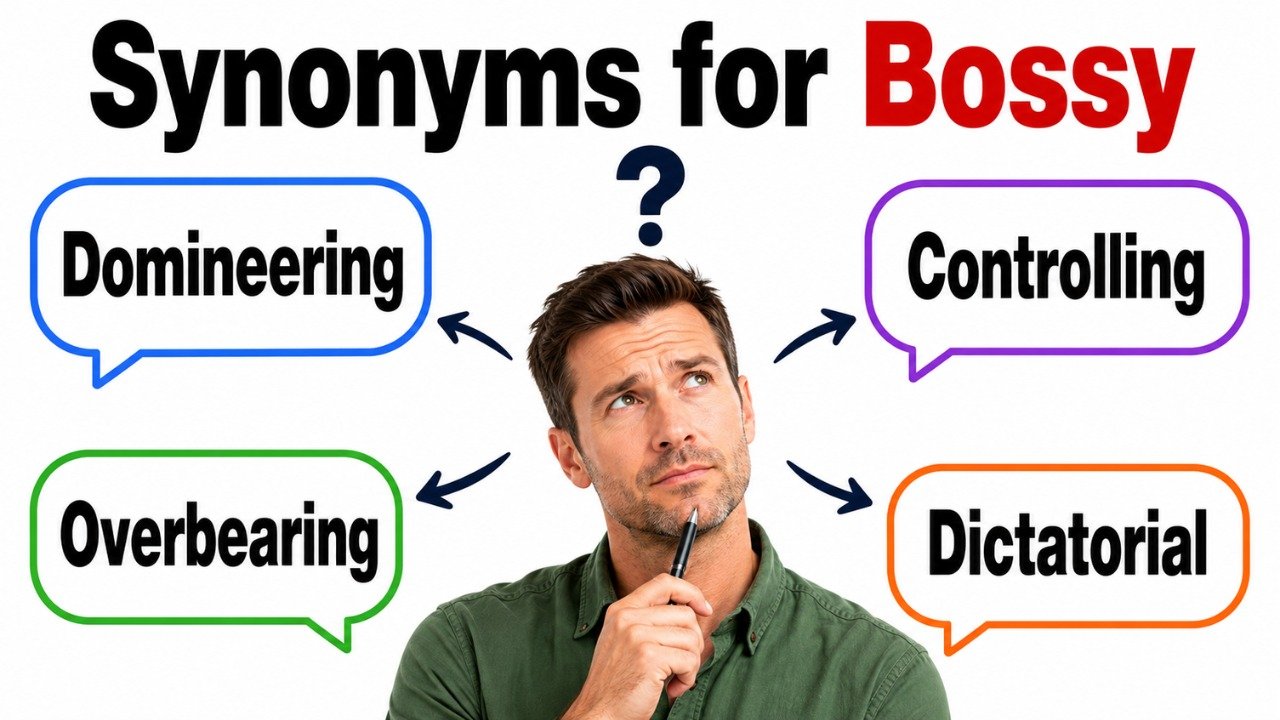
Quick Answer: The best synonyms for bossy include controlling, domineering, overbearing, dictatorial, authoritarian, pushy, demanding, imperious, commanding, and officious. Use controlling for someone who tries to manage other people’s choices. Domineering and overbearing describe stronger, more unpleasant behavior. Pushy works well in casual speech, while dictatorial and authoritarian suit formal writing. Demanding describes someone who expects too much, and commanding can be neutral or positive when the person shows confident leadership rather than disrespectful control.
Pronunciation and Word Details
Word: Bossy.
Pronunciation: /ˈbɔːsi/.
Part of Speech: Adjective.
Meaning: Describing someone who frequently tells other people what to do in a controlling or irritating way.
US Pronunciation:
UK Pronunciation:
What Does “Bossy” Mean?
Bossy means too eager to give orders, control decisions, or tell other people how they should behave. It is an adjective and usually carries a negative meaning.
A bossy person may speak as though their preferences are rules. They may interrupt, make decisions for others, or expect immediate obedience even when they do not have the authority to do so.
The word is common in everyday conversation. It can describe children, friends, relatives, coworkers, supervisors, teammates, or anyone who acts too controlling.
Person Description: She becomes bossy whenever the group must make a decision.
Behavior Description: His bossy attitude made everyone uncomfortable.
Tone Description: The message sounded bossy because it gave commands without explanation.
Workplace Description: The team disliked the bossy way he assigned tasks without asking for input.
Bossy does not always mean cruel or aggressive. Sometimes it describes a person who is confident but communicates too forcefully. In other situations, it refers to someone who deliberately controls and pressures others.
Meaning, Tone, and Context of “Bossy”
Bossy is an informal and conversational adjective. Its tone is usually critical, disapproving, or mildly insulting.
People often use it when someone gives unnecessary orders or behaves as though they have more authority than they actually possess. The word may describe a temporary attitude or a regular personality trait.
Casual Tone: Bossy is common in ordinary conversations between friends, family members, classmates, and coworkers.
Negative Tone: The word suggests that the person’s instructions are unwanted, excessive, or disrespectful.
Emotional Tone: A speaker may use bossy when feeling annoyed, controlled, or ignored.
Workplace Context: Bossy may describe a supervisor or coworker who gives commands without listening to others.
Family Context: It can describe a relative who tries to control plans, choices, or responsibilities.
Social Context: It may refer to a friend who always decides where to go, what to do, or how others should behave.
Formal Context: In professional reports, evaluations, or academic writing, domineering, controlling, authoritarian, or overbearing may sound more precise than bossy.
Bossy focuses mainly on visible behavior. It tells the reader that someone gives too many orders, but it does not always explain the person’s motive. A more specific synonym can show whether the person is controlling, rude, forceful, strict, interfering, or power seeking.
When and How to Use “Bossy”
For Unwanted Orders
Use bossy when someone frequently tells others what to do without having a good reason or proper authority.
Example: My cousin becomes bossy when we organize family events.
For Controlling Behavior
Use bossy when a person tries to control choices that should belong to other people.
Example: She was being bossy about what everyone should wear.
For an Irritating Tone
Use bossy when instructions sound rude, impatient, or unnecessarily forceful.
Example: His bossy tone made a simple request sound like a command.
For Group Decisions
Use bossy when one person tries to make every decision without considering anyone else’s opinion.
Example: The group stopped inviting him to plan activities because he was too bossy.
For Workplace Communication
Use bossy to describe someone who gives orders without cooperation, respect, or discussion.
Example: The new coordinator sounded bossy when she assigned responsibilities without consulting the team.
For Children’s Behavior
Use bossy when a child repeatedly controls games, assigns roles, or tells other children what they must do.
Example: The child became bossy and refused to let anyone else choose the game.
For Friendly Criticism
Bossy can express mild criticism when the behavior is annoying but not seriously harmful.
Example: Do not be so bossy. Let everyone share an idea.
For Stronger Criticism
Choose a stronger synonym when the behavior involves intimidation, oppression, manipulation, or abuse of authority.
Example: The manager’s authoritarian leadership prevented employees from expressing concerns.
Best Synonyms for Bossy
Controlling
Synonym: Trying to direct another person’s behavior, decisions, or freedom.
Example: Her controlling behavior made it difficult for the team to work independently.
Domineering
Synonym: Attempting to control people in an arrogant and forceful way.
Example: His domineering personality discouraged others from sharing their opinions.
Overbearing
Synonym: Unpleasantly forceful, confident, or controlling.
Example: The overbearing supervisor expected everyone to follow his instructions without question.
Dictatorial
Synonym: Giving strict orders and refusing to consider other opinions.
Example: Her dictatorial approach created tension during the project.
Authoritarian
Synonym: Demanding obedience and allowing little personal freedom or discussion.
Example: The director used an authoritarian management style.
Pushy
Synonym: Too determined to make people agree, act, or decide in a particular way.
Example: The salesperson sounded pushy when he refused to accept her answer.
Demanding
Synonym: Expecting a great deal of effort, attention, or obedience from others.
Example: The demanding coach expected every player to follow a strict routine.
Imperious
Synonym: Arrogantly commanding and expecting immediate obedience.
Example: She spoke in an imperious voice that silenced the entire room.
Commanding
Synonym: Showing authority and confidence when giving directions.
Example: His commanding manner helped the group respond quickly during the emergency.
Officious
Synonym: Eager to give unwanted advice, instructions, or assistance.
Example: The officious neighbor kept telling everyone how to manage their gardens.
50 Synonyms for Bossy with Short Meanings
- Controlling: Trying to manage other people’s choices or behavior.
- Domineering: Controlling others in an arrogant and forceful manner.
- Overbearing: Unpleasantly forceful, confident, or controlling.
- Dictatorial: Giving strict orders without accepting disagreement.
- Authoritarian: Demanding obedience and limiting discussion or freedom.
- Imperious: Arrogantly expecting immediate obedience.
- Pushy: Trying too hard to influence or pressure others.
- Demanding: Expecting a great deal from other people.
- Commanding: Speaking or behaving with noticeable authority.
- Officious: Giving unwanted advice or instructions.
- Autocratic: Making decisions alone and expecting complete obedience.
- Despotic: Using power in a cruel or unfair way.
- Tyrannical: Exercising authority in an oppressive manner.
- Coercive: Using pressure or threats to control behavior.
- Oppressive: Using authority in a harsh and restrictive way.
- Bullying: Intimidating others to gain power or obedience.
- Dominant: Having more power or influence than others.
- Dominating: Taking control of people, situations, or conversations.
- Forceful: Expressing demands with strong confidence or pressure.
- Assertive: Expressing needs and opinions confidently and directly.
- Insistent: Continuing to demand something despite resistance.
- Peremptory: Giving orders in a way that prevents refusal or discussion.
- Presumptuous: Taking authority or control without having the right.
- Meddlesome: Becoming involved in matters that belong to others.
- Interfering: Involving oneself in another person’s decisions or affairs.
- Intrusive: Entering personal matters without permission.
- Directive: Focused on giving clear instructions or commands.
- Prescriptive: Telling people exactly what they should do.
- Strict: Requiring rules and instructions to be followed closely.
- Stern: Serious, firm, and unwilling to tolerate disobedience.
- Firm: Clear and confident without necessarily being unkind.
- Rigid: Unwilling to change rules, decisions, or expectations.
- Inflexible: Refusing to adapt or consider other options.
- Uncompromising: Unwilling to reduce demands or reach an agreement.
- Unyielding: Refusing to change a position or decision.
- Arbitrary: Making decisions based on personal wishes rather than fairness.
- Authoritative: Confident and believable because of knowledge or authority.
- Decisive: Able to make choices quickly and confidently.
- Imperative: Expressing something as an order or urgent requirement.
- Dogmatic: Treating personal beliefs as unquestionably correct.
- Opinionated: Expressing strong opinions too confidently or frequently.
- Manipulative: Controlling people through indirect or unfair methods.
- Possessive: Trying to control someone because of jealousy or attachment.
- High handed: Using authority without considering other people’s feelings.
- Heavy handed: Using too much force, control, or authority.
- Lordly: Behaving as though one is superior to everyone else.
- Masterful: Showing strong control, confidence, or skill.
- Magisterial: Showing impressive but sometimes arrogant authority.
- Self important: Acting as though one’s opinions or status matter most.
- Power hungry: Strongly desiring authority and control over others.
Read Also:
Synonyms for Attract

Synonyms for Bossy by Context
When Bossy Means Controlling
Controlling, domineering, overbearing, and manipulative describe people who try to direct other people’s choices.
Controlling is the broadest option. Domineering suggests forceful personal control. Overbearing emphasizes unpleasant pressure, while manipulative describes indirect control through guilt, dishonesty, or emotional pressure.
Example With Controlling: Her controlling behavior prevented her partner from making independent decisions.
Example With Domineering: The domineering captain refused to listen to the rest of the team.
Example With Overbearing: His overbearing manner made every conversation uncomfortable.
Example With Manipulative: The manipulative employee pressured others into supporting his proposal.
When Bossy Means Too Commanding
Dictatorial, authoritarian, autocratic, imperious, and peremptory describe people who give orders and expect obedience.
Dictatorial and authoritarian are strong choices for formal criticism. Autocratic often describes a leadership style in which one person makes all decisions. Imperious focuses on arrogant superiority. Peremptory describes a command that does not allow discussion.
Example With Dictatorial: The chairperson’s dictatorial style prevented an open debate.
Example With Authoritarian: The organization became less creative under authoritarian leadership.
Example With Autocratic: The autocratic director approved every decision personally.
Example With Imperious: She gave an imperious order and expected everyone to obey immediately.
Example With Peremptory: His peremptory reply ended the discussion.
When Bossy Means Pushy
Pushy, demanding, insistent, forceful, and uncompromising describe someone who pressures others to agree or act.
Pushy is informal and common in everyday speech. Demanding focuses on high expectations. Insistent suggests repeated pressure. Forceful can be negative or positive depending on the situation. Uncompromising describes someone who refuses to adjust their demands.
Example With Pushy: The organizer became pushy when several guests declined the invitation.
Example With Demanding: The client was demanding but remained polite.
Example With Insistent: She was insistent that everyone arrive an hour early.
Example With Forceful: His forceful presentation persuaded the committee to reconsider.
Example With Uncompromising: The uncompromising supervisor refused to discuss a different schedule.
When Bossy Means Interfering
Officious, meddlesome, interfering, intrusive, and presumptuous describe someone who becomes involved in matters that are not their responsibility.
Officious often describes unwanted advice or assistance. Meddlesome and interfering refer to unnecessary involvement. Intrusive emphasizes invasion of privacy. Presumptuous suggests taking authority without permission.
Example With Officious: The officious volunteer kept correcting everyone’s work.
Example With Meddlesome: A meddlesome relative tried to control the couple’s wedding plans.
Example With Interfering: His interfering behavior caused tension between the two departments.
Example With Intrusive: The questions felt intrusive and unnecessary.
Example With Presumptuous: It was presumptuous of him to change the schedule without asking.
When Bossy Means Firm but Not Necessarily Rude
Assertive, authoritative, decisive, firm, and directive may describe strong communication without the negative judgment carried by bossy.
Assertive means expressing needs clearly while respecting others. Authoritative suggests knowledge and credibility. Decisive focuses on confident choices. Firm describes clear boundaries. Directive describes communication that provides specific instructions.
Example With Assertive: She was assertive about the deadline without disrespecting anyone.
Example With Authoritative: The expert gave an authoritative explanation of the procedure.
Example With Decisive: His decisive leadership helped the team solve the problem quickly.
Example With Firm: The teacher was firm but fair.
Example With Directive: A directive approach was necessary during the emergency.
Another Word for Bossy
Domineering is often the best single replacement for bossy because it clearly describes a person who tries to control others in an arrogant or forceful way. However, the best alternative depends on the exact behavior and level of criticism.
Use controlling for general attempts to manage another person’s choices. Use pushy for mild pressure in casual conversation. Use authoritarian for formal discussions of leadership. Use assertive when the behavior is confident but still respectful.
Original: The committee leader was bossy during every discussion.
Better Option: The committee leader was domineering during every discussion.
Original: My friend became bossy when we planned the trip.
Better Option: My friend became controlling when we planned the trip.
Original: The representative was bossy about completing the form.
Better Option: The representative was pushy about completing the form.
Original: The supervisor sounded bossy but explained the emergency clearly.
Better Option: The supervisor sounded firm but explained the emergency clearly.
When Not to Use “Bossy”
Do not use bossy when you need a formal, objective, or detailed description. The word is broad and may sound emotional or personal.
In Formal Employee Feedback
Bossy may sound insulting in a performance review. Describe the specific communication problem instead.
Weak: The employee is bossy with other team members.
Better: The employee frequently gives instructions without inviting input from other team members.
When Someone Is Simply Confident
Do not call someone bossy merely because they communicate clearly or make quick decisions.
Weak: She was bossy when she clearly explained the safety procedure.
Better: She was authoritative when she clearly explained the safety procedure.
When Strict Direction Is Necessary
During an emergency, a commanding tone may be appropriate rather than bossy.
Weak: The officer sounded bossy during the evacuation.
Better: The officer used a commanding tone during the evacuation.
When the Behavior Is More Serious
Bossy may sound too mild when someone uses threats, intimidation, or unfair power.
Weak: The employer was bossy and threatened workers who disagreed.
Better: The employer used coercive and oppressive tactics against workers who disagreed.
When the Problem Is Interference
Choose meddlesome, intrusive, or interfering when the person enters private matters rather than simply giving orders.
Weak: She was bossy about her neighbor’s personal decisions.
Better: She was intrusive about her neighbor’s personal decisions.
When Repetition Reduces Clarity
Repeating bossy throughout a paragraph can make the writing sound limited.
Weak: The bossy manager gave bossy instructions in a bossy tone.
Better: The overbearing manager gave dictatorial instructions in an imperious tone.
Words Commonly Confused With Bossy
Bossy vs Assertive: Bossy describes disrespectful or excessive control. Assertive describes clear and confident communication that respects other people’s rights.
Bossy vs Controlling: Bossy usually refers to giving too many orders. Controlling has a wider meaning and may include managing someone’s choices, relationships, movements, or emotions.
Bossy vs Commanding: Bossy is usually negative. Commanding may be neutral or positive when authority is necessary and appropriate.
Bossy vs Demanding: Bossy focuses on giving orders. Demanding focuses on expecting a great deal of effort, time, attention, or obedience.
Bossy vs Authoritative: Bossy suggests irritating control. Authoritative suggests confidence based on knowledge, experience, or legitimate authority.
Bossy vs Authoritarian: Bossy is informal and may describe everyday behavior. Authoritarian is stronger and often refers to a leadership system based on strict obedience.
Bossy vs Domineering: Bossy can describe mild or temporary behavior. Domineering suggests a stronger and more consistent desire to control others.
Bossy vs Opinionated: Bossy people tell others what to do. Opinionated people express strong personal views, although they may not try to control anyone.
Which Synonym Should You Choose?
Choose Controlling: Use controlling when someone tries to manage another person’s choices, freedom, or behavior.
Choose Domineering: Use domineering when the person controls others arrogantly and forcefully.
Choose Overbearing: Use overbearing when the person’s confidence or pressure feels unpleasant and difficult to tolerate.
Choose Dictatorial: Use dictatorial in formal writing when someone gives orders and rejects discussion.
Choose Authoritarian: Use authoritarian for leadership based on strict obedience and limited participation.
Choose Pushy: Use pushy in casual speech when someone pressures others too strongly.
Choose Demanding: Use demanding when someone expects excessive effort, attention, or obedience.
Choose Officious: Use officious when someone gives unwanted instructions or advice.
Choose Imperious: Use imperious when someone speaks with arrogant authority.
Choose Assertive: Use assertive when a person communicates confidently while respecting other people.
Choose Firm: Use firm when instructions or boundaries are clear but not rude.
Choose Commanding: Use commanding when authority is strong, confident, and appropriate to the situation.
For Formal Writing: Domineering, authoritarian, dictatorial, controlling, and overbearing are usually more precise than bossy.
For Casual Conversation: Pushy, controlling, demanding, and bossy sound natural.
For Workplace Reports: Use controlling, overbearing, directive, authoritarian, or domineering, depending on the exact behavior.
For Essays: Choose a word that explains whether the person is controlling, oppressive, interfering, or merely firm.
For Emails: Avoid directly calling someone bossy. Describe the specific action and its effect.
For Conversation: Bossy works well for mild criticism, while domineering and overbearing express stronger disapproval.
Real Life Examples of “Bossy” in Sentences
Original: My older brother becomes bossy whenever we cook together.
Better Option: My older brother becomes controlling whenever we cook together.
Original: The project leader sounded bossy during the meeting.
Better Option: The project leader sounded overbearing during the meeting.
Original: She is bossy because she always decides where the group should go.
Better Option: She is domineering because she always decides where the group should go.
Original: The customer became bossy when the order was delayed.
Better Option: The customer became demanding when the order was delayed.
Original: He was bossy about how everyone should complete the task.
Better Option: He was prescriptive about how everyone should complete the task.
Original: The volunteer was bossy even though she was not responsible for the event.
Better Option: The volunteer was officious even though she was not responsible for the event.
Original: Her bossy messages made the team feel unappreciated.
Better Option: Her peremptory messages made the team feel unappreciated.
Original: The coach was bossy during practice.
Better Option: The coach was strict during practice.
Original: The guide sounded bossy while explaining the safety rules.
Better Option: The guide sounded authoritative while explaining the safety rules.
Original: Our neighbor is bossy about how we maintain our garden.
Better Option: Our neighbor is meddlesome about how we maintain our garden.
Synonym Groups and Usage Differences
Control Group
Controlling, domineering, dominant, dominating, and manipulative describe attempts to influence or direct other people.
Controlling is the broadest word. Domineering suggests arrogant personal control. Dominant describes greater influence or power. Dominating means taking over a situation. Manipulative refers to indirect or dishonest control.
Example: His domineering behavior prevented the rest of the group from participating.
Authority Group
Authoritarian, dictatorial, autocratic, imperious, despotic, and tyrannical describe strong uses of authority.
Authoritarian and autocratic often describe leadership styles. Dictatorial emphasizes refusal to accept discussion. Imperious refers to arrogant commands. Despotic and tyrannical suggest cruel or oppressive power.
Example: The director’s autocratic approach left employees with little influence over decisions.
Pressure Group
Pushy, demanding, insistent, forceful, uncompromising, and unyielding describe different levels of pressure.
Pushy is informal and mildly negative. Demanding refers to high expectations. Insistent describes repeated demands. Forceful may be positive or negative. Uncompromising and unyielding suggest refusal to change.
Example: The client became increasingly insistent as the deadline approached.
Interference Group
Officious, meddlesome, interfering, intrusive, and presumptuous describe unwanted involvement.
Officious often refers to unnecessary instructions. Meddlesome and interfering describe involvement in other people’s affairs. Intrusive focuses on personal boundaries. Presumptuous suggests acting without permission.
Example: His officious comments irritated the people who were managing the event.
Harsh Control Group
Coercive, oppressive, bullying, heavy handed, and high handed describe control that involves excessive force or unfair pressure.
Coercive behavior forces compliance. Oppressive behavior restricts freedom. Bullying uses fear or intimidation. Heavy handed behavior uses more force than necessary. High handed behavior ignores other people’s rights or feelings.
Example: The organization was criticized for its heavy handed treatment of employees.
Positive Leadership Group
Assertive, authoritative, decisive, firm, commanding, and directive can describe strong leadership without unfair control.
Assertive communication respects both the speaker and the listener. Authoritative communication is credible. Decisive people make choices efficiently. Firm people maintain clear limits. Commanding leaders inspire attention. Directive communication provides specific instructions.
Example: Her firm but respectful response prevented further confusion.
Antonyms of Bossy
The antonym of bossy depends on whether the contrast involves communication, leadership, personality, or decision making.
Cooperative: Willing to work with others and share responsibility.
Collaborative: Involving other people in ideas, decisions, and actions.
Respectful: Showing consideration for other people’s rights and feelings.
Considerate: Thinking carefully about how actions affect others.
Accommodating: Willing to adjust plans to meet other people’s needs.
Flexible: Open to changing decisions, methods, or expectations.
Easygoing: Relaxed and not eager to control other people.
Supportive: Offering assistance without taking unnecessary control.
Tactful: Communicating carefully to avoid causing offense.
Democratic: Allowing people to participate in decisions.
Permissive: Allowing considerable freedom and few restrictions.
Deferential: Respectfully accepting another person’s judgment or authority.
Patient: Willing to listen and allow others enough time.
Receptive: Open to suggestions, feedback, and different opinions.
Humble: Not acting superior or more important than others.
Comparison: Bossy vs Related Words
Bossy vs Domineering
Bossy describes someone who gives too many orders. Domineering is stronger and suggests an ongoing desire to control other people.
Example With Bossy: My sister became bossy while we arranged the furniture.
Example With Domineering: The domineering supervisor controlled every minor decision.
Bossy vs Controlling
Bossy usually refers to speech and instructions. Controlling can include broader attempts to manage someone’s behavior, relationships, finances, or personal choices.
Example With Bossy: He sounded bossy when he told everyone where to sit.
Example With Controlling: He was controlling and refused to let his partner make independent plans.
Bossy vs Assertive
Bossy behavior ignores other people’s views or boundaries. Assertive behavior communicates needs clearly while respecting everyone involved.
Example With Bossy: She ordered the group to accept her idea.
Example With Assertive: She clearly explained why she preferred her idea and invited feedback.
Bossy vs Authoritative
Bossy suggests unwanted control. Authoritative suggests confidence, credibility, and knowledge.
Example With Bossy: The assistant gave bossy instructions about a task she did not understand.
Example With Authoritative: The specialist gave authoritative instructions based on years of experience.
Bossy vs Pushy
Bossy usually involves giving orders. Pushy often involves pressuring someone to agree, buy, join, or act.
Example With Bossy: He told every guest where to stand and what to say.
Example With Pushy: He repeatedly pressured the guests to make a donation.
Bossy vs Demanding
Bossy describes the manner in which a person gives instructions. Demanding describes the amount of effort, attention, or obedience that person expects.
Example With Bossy: The director used a bossy tone when assigning the work.
Example With Demanding: The director expected the work to be completed within an extremely limited time.
Bossy vs Dictatorial
Bossy is informal and may describe mild everyday behavior. Dictatorial is stronger and describes someone who expects complete obedience.
Example With Bossy: The team captain became bossy during practice.
Example With Dictatorial: The team captain used a dictatorial system and punished anyone who questioned him.
Bossy vs Officious
Bossy people frequently give orders. Officious people become unnecessarily involved and offer unwanted instructions or help.
Example With Bossy: She told everyone exactly how to arrange the chairs.
Example With Officious: She interrupted the organizers and began correcting their arrangement without being asked.
Common Phrases and Expressions With Bossy
Bossy Person: Someone who frequently gives unwanted orders.
Bossy Attitude: A controlling or commanding way of behaving.
Bossy Tone: A voice that sounds rude, forceful, or overly commanding.
Bossy Behavior: Actions that involve unnecessary control over others.
Bossy Manner: A way of speaking or acting that suggests excessive authority.
Bossy Coworker: A colleague who tries to control other employees or their work.
Bossy Friend: A friend who often makes decisions for the entire group.
Bossy Child: A child who repeatedly tells other children what to do.
Sound Bossy: To communicate in a way that resembles giving an unwanted order.
Come Across as Bossy: To create the impression of being too controlling or commanding.
Common Mistakes to Avoid
Using Bossy for All Strong Communication
Not every confident, direct, or firm person is bossy. A person can give clear instructions while remaining respectful.
Incorrect Choice: The emergency coordinator was bossy because she gave clear directions.
Better Choice: The emergency coordinator was commanding because she gave clear directions.
Confusing Bossy With Assertive
Assertiveness involves confidence and respect. Bossiness involves excessive control or disregard for other people’s opinions.
Incorrect Choice: He politely defended his position, so he was bossy.
Better Choice: He politely defended his position, so he was assertive.
Using Bossy in Formal Evaluations
Bossy may sound emotional or insulting in professional feedback. Describe the observable behavior instead.
Weak Feedback: She is bossy during team meetings.
Better Feedback: She frequently interrupts colleagues and gives instructions without considering their input.
Choosing a Synonym That Is Too Strong
Do not use tyrannical, despotic, or oppressive for mild controlling behavior. These words suggest serious misuse of power.
Weak Choice: My friend was tyrannical because she chose the restaurant.
Better Choice: My friend was pushy because she insisted on choosing the restaurant.
Choosing a Synonym That Is Too Mild
Firm or assertive may not accurately describe someone who intimidates or controls others.
Weak Choice: The employer was firm when he threatened workers for disagreeing.
Better Choice: The employer was coercive when he threatened workers for disagreeing.
Repeating Bossy Too Often
Use more precise alternatives to improve clarity and avoid repetition.
Repetitive: The bossy coach gave bossy instructions in a bossy voice.
Improved: The overbearing coach gave dictatorial instructions in an imperious voice.
Ignoring the Context
A commanding style may be appropriate in emergencies but inappropriate in an ordinary discussion. Consider the person’s role, the urgency of the situation, and whether others are being respected.
Using Vague Criticism
Calling someone bossy does not explain exactly what happened. Strong writing identifies the behavior.
Vague: He was bossy throughout the meeting.
Specific: He interrupted three speakers, rejected every suggestion, and assigned tasks without discussion.
Confusing Opinionated With Bossy
An opinionated person expresses strong views. A bossy person attempts to direct other people’s actions.
Incorrect: She is bossy because she has strong opinions about art.
Correct: She is opinionated because she has strong opinions about art.
Conclusion
Synonyms for bossy can describe many different levels of control, pressure, authority, and interference. Controlling is the broadest alternative, while domineering and overbearing express stronger criticism. Pushy suits casual situations, and dictatorial or authoritarian works well in formal writing. Officious describes unwanted instructions, while assertive, firm, and authoritative can replace bossy when the behavior is confident rather than disrespectful. Choosing the most accurate word helps readers understand whether someone is merely direct, unnecessarily demanding, or seriously controlling.
FAQs About Synonyms for Bossy
What Is the Best Synonym for Bossy?
Domineering is often the best strong synonym for bossy. Controlling is a broader and more common alternative.
What Is a Polite Word for Bossy?
Directive, firm, assertive, or commanding may be more polite, but only when the person is not actually disrespectful or controlling.
Is Controlling the Same as Bossy?
Not exactly. Bossy mainly refers to giving too many orders, while controlling can include managing another person’s choices, behavior, relationships, or freedom.
Is Assertive a Synonym for Bossy?
Assertive is a close alternative only in certain situations. Assertive communication is confident and respectful, while bossy communication is usually controlling or inconsiderate.
What Is a Stronger Word Than Bossy?
Domineering, overbearing, dictatorial, authoritarian, imperious, and coercive are stronger alternatives. The correct choice depends on how serious the behavior is.
What Is an Informal Synonym for Bossy?
Pushy is a common informal synonym. Demanding and controlling also sound natural in everyday conversation.
How Can I Describe a Bossy Person Professionally?
Describe the exact behavior rather than using a personal label. You might say that the person gives instructions without inviting input, interrupts colleagues, or attempts to control decisions outside their responsibility.
