
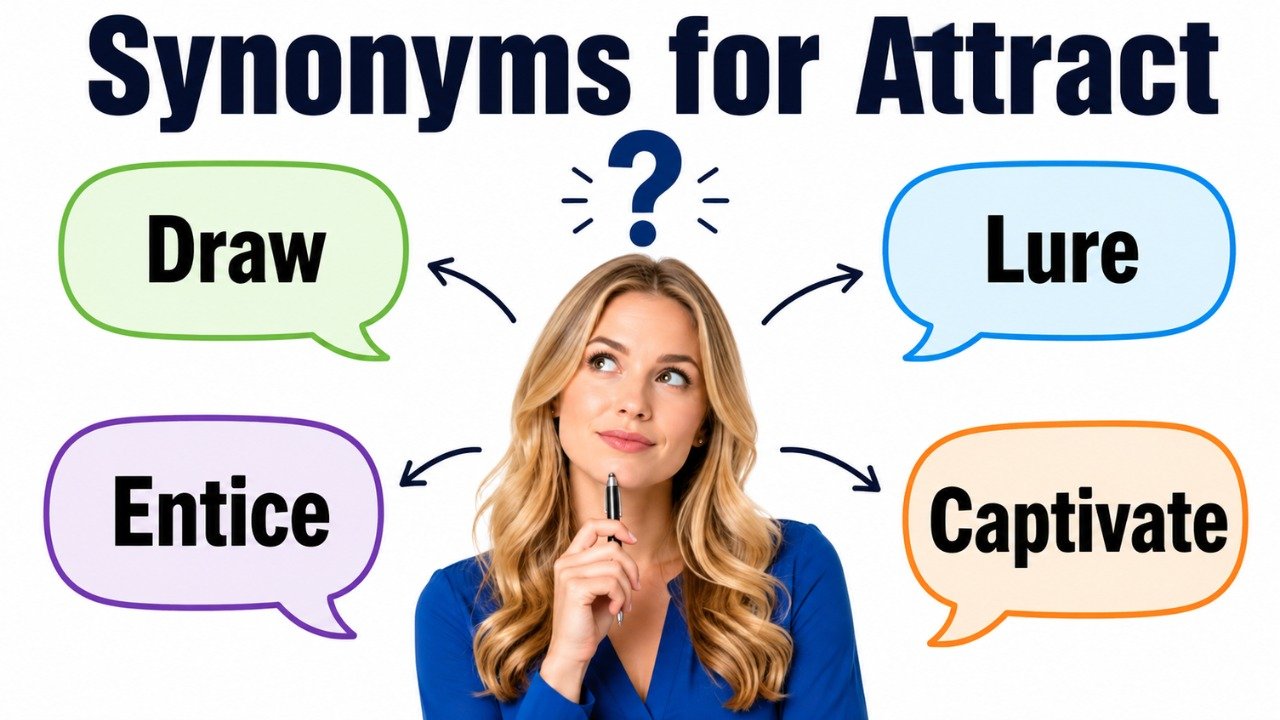
Quick Answer: The best synonyms for attract include draw, appeal to, entice, captivate, fascinate, charm, engage, intrigue, lure, and invite. Use draw as the most flexible replacement when something gains attention or brings people closer. Appeal to works well for preferences and emotions, while entice suggests encouraging someone with an appealing benefit. Captivate and fascinate describe strong interest. Charm focuses on pleasant personal influence. Lure can suggest temptation or hidden risk, so it should be used carefully.
Pronunciation and Word Details
Word: Attract.
Pronunciation: /əˈtrækt/.
Part of Speech: Verb.
Meaning: To cause someone or something to come closer, become interested, or give attention.
US Pronunciation:
UK Pronunciation:
What Does “Attract” Mean?
Attract means to cause a person, animal, object, opportunity, or reaction to move closer or become interested.
Attract is mainly used as a verb. It can describe physical movement, emotional interest, public attention, business growth, personal appeal, or the creation of a particular response.
A bright display may attract attention. A pleasant garden may attract birds. A useful service may attract customers. A confident speaker may attract support. In science, one object may attract another through a physical force.
The exact meaning depends on the object that follows the verb.
Physical Movement: A magnet can attract certain metals.
Personal Interest: Her confident manner attracted many admirers.
Public Attention: The unusual announcement attracted widespread attention.
Business Interest: The new shopping area attracted more visitors.
Positive Response: The proposal attracted strong support.
Negative Response: His careless statement attracted criticism.
Attract is often followed directly by a person or thing. It can also be used with the preposition “to” when showing where someone or something is being drawn.
Example: The exhibition attracted visitors to the town.
Example: Bright flowers attract bees.
Meaning, Tone, and Context of “Attract”
Attract is a neutral and widely useful word. It can appear naturally in casual conversation, formal writing, academic discussion, reports, essays, advertising, science, and professional communication.
The word itself does not always suggest a positive result. Someone can attract praise, but the same person can also attract criticism. A place can attract visitors, while a bad decision can attract unwanted attention.
Neutral Tone: Attract usually states that something causes interest, movement, or a reaction without strongly judging it.
Formal Context: It is suitable for reports, essays, research writing, professional communication, and economic discussion.
Conversational Context: It works naturally when talking about people, places, clothing, events, animals, and personal interests.
Emotional Context: It can describe romantic, social, or personal appeal.
Technical Context: It is used in science to describe forces that pull objects toward one another.
Business Context: It often describes gaining customers, workers, investors, visitors, or public interest.
Some synonyms have a stronger emotional tone. Captivate, enchant, and mesmerize suggest a powerful effect. Entice and tempt suggest that a reward or benefit is encouraging someone. Lure can suggest manipulation, danger, or dishonesty. Draw is more neutral and flexible.
When and How to Use “Attract”
For Gaining Attention
Use attract when something causes people to notice it.
Explanation: This use is common in writing about design, communication, events, public behavior, and visual details.
Example: The bright entrance attracted the attention of passing shoppers.
For Creating Interest
Use attract when something makes people curious or interested.
Explanation: The interest may be intellectual, emotional, social, or practical.
Example: The unusual topic attracted several curious readers.
For Bringing People to a Place
Use attract when a place, activity, or event causes people to visit.
Explanation: This use is common in travel, business, education, entertainment, and community writing.
Example: The weekend market attracts visitors from nearby towns.
For Appealing to Preferences
Use attract when something matches a person’s taste, needs, values, or interests.
Explanation: This meaning often appears when discussing products, careers, ideas, styles, and experiences.
Example: The flexible schedule attracts people who value independence.
For Personal or Romantic Interest
Use attract when one person creates emotional, physical, or romantic interest in another person.
Explanation: This use can refer to appearance, personality, confidence, humor, kindness, or shared values.
Example: His calm confidence attracted her immediately.
For Producing a Reaction
Use attract when an action, statement, or decision causes praise, criticism, support, concern, or another response.
Explanation: The response may be positive or negative.
Example: The decision attracted criticism from local residents.
For Business Growth
Use attract when an organization, service, event, or location gains customers, workers, investment, or public interest.
Explanation: This usage is common in reports, proposals, and professional writing.
Example: Better training opportunities can attract skilled employees.
For Physical Force
Use attract when a force pulls one object toward another.
Explanation: This meaning is used in scientific and technical contexts.
Example: Opposite electrical charges attract each other.
Best Synonyms for Attract
Draw
Synonym: To cause someone or something to move closer, notice something, or become interested.
Example: The performance drew a large audience.
Appeal To
Synonym: To be pleasing, interesting, or suitable to someone.
Example: The simple design appeals to people who prefer a clean style.
Entice
Synonym: To encourage someone by offering something attractive or desirable.
Example: The warm atmosphere enticed customers to stay longer.
Captivate
Synonym: To hold someone’s complete attention through beauty, interest, or charm.
Example: The speaker captivated the audience with a powerful story.
Fascinate
Synonym: To create strong curiosity or interest.
Example: Ancient buildings fascinate many history students.
Charm
Synonym: To attract someone through a pleasant personality, appearance, or manner.
Example: Her kindness charmed everyone at the gathering.
Engage
Synonym: To gain and hold someone’s attention or involvement.
Example: The opening question engaged the entire class.
Intrigue
Synonym: To attract interest by creating curiosity or mystery.
Example: The unexplained message intrigued the investigators.
Lure
Synonym: To attract someone with a tempting offer, sometimes for a dishonest or dangerous purpose.
Example: The false promise lured people into making a poor decision.
Draw In
Synonym: To bring people closer or make them increasingly interested.
Example: The welcoming entrance drew in passing visitors.
50 Synonyms for Attract with Short Meanings
- Draw: To bring closer or gain attention.
- Appeal To: To be pleasing or interesting to someone.
- Entice: To attract through an appealing reward or benefit.
- Lure: To tempt someone toward something, sometimes with hidden risk.
- Tempt: To make someone want to do or obtain something.
- Captivate: To hold someone’s complete attention.
- Charm: To attract through pleasant qualities or behavior.
- Fascinate: To create powerful interest or curiosity.
- Engage: To gain and maintain attention or involvement.
- Intrigue: To attract by creating mystery or curiosity.
- Allure: To attract through beauty, mystery, or strong appeal.
- Invite: To encourage interest, participation, or approach.
- Beckon: To seem welcoming or call someone closer.
- Pull: To draw someone or something toward a point.
- Draw In: To bring closer or gradually gain interest.
- Bring In: To cause people, money, or opportunities to arrive.
- Win Over: To gain someone’s approval, interest, or support.
- Enchant: To delight and attract someone strongly.
- Mesmerize: To hold someone’s attention completely.
- Entrance: To fill someone with wonder and complete attention.
- Spellbind: To hold attention as if through magic.
- Absorb: To occupy someone’s full attention.
- Engross: To hold someone’s interest completely.
- Grip: To hold attention with great strength.
- Arrest: To catch and hold attention suddenly.
- Catch: To gain someone’s notice or interest.
- Grab: To gain attention quickly and strongly.
- Command: To receive attention, respect, or interest naturally.
- Interest: To make someone curious or concerned about something.
- Excite: To create enthusiasm, interest, or emotional energy.
- Stimulate: To encourage interest, thought, or activity.
- Arouse: To cause an emotion, interest, or reaction.
- Awaken: To bring an interest, feeling, or desire into activity.
- Elicit: To cause a response, reaction, or piece of information.
- Provoke: To cause a strong reaction or response.
- Generate: To produce interest, attention, support, or activity.
- Inspire: To create enthusiasm, admiration, or motivation.
- Encourage: To make participation or interest more likely.
- Persuade: To influence someone to accept or do something.
- Induce: To cause or influence someone to act.
- Coax: To gently persuade someone through patience or encouragement.
- Woo: To seek and gain someone’s affection, approval, or support.
- Magnetize: To attract strongly, as if through magnetic force.
- Pull In: To attract people, attention, or income.
- Recruit: To attract and gain new members or workers.
- Gather: To bring people or things together.
- Acquire: To gain customers, support, resources, or interest.
- Gain: To obtain attention, approval, support, or interest.
- Secure: To successfully obtain support, interest, or participation.
- Rouse: To awaken interest, emotion, or action.
Read Also:
Synonyms for Double
Synonyms for Attract by Context
When Attract Means Gain Attention
Draw, catch, grab, arrest, command, engage, and captivate are useful when something causes people to notice it.
Draw is the most neutral choice. Catch and grab are more conversational. Arrest is formal and describes something that stops a person’s attention immediately. Command suggests that something naturally receives attention or respect.
Example With Attract: The unusual headline attracted my attention.
Example With Draw: The unusual headline drew my attention.
Example With Catch: The unusual headline caught my attention.
Example With Grab: The unusual headline grabbed my attention.
When Attract Means Create Interest
Interest, fascinate, intrigue, engage, stimulate, and excite describe different levels of curiosity or involvement.
Interest is neutral. Fascinate suggests strong and lasting curiosity. Intrigue often involves mystery. Engage means gaining active attention or participation. Stimulate is useful for intellectual interest.
Example With Attract: The discovery attracted the interest of researchers.
Example With Fascinate: The discovery fascinated researchers.
Example With Intrigue: The discovery intrigued researchers.
Example With Engage: The discovery engaged researchers in further discussion.
When Attract Means Persuade People to Come
Entice, invite, draw in, bring in, beckon, encourage, and lure can describe bringing people to a place, event, service, or opportunity.
Entice suggests an appealing benefit. Invite has a welcoming tone. Draw in is neutral and natural. Beckon creates an image of something calling people closer. Lure should be used when temptation or possible deception is involved.
Example With Attract: The peaceful garden attracted many visitors.
Example With Entice: The peaceful garden enticed many visitors.
Example With Draw In: The peaceful garden drew in many visitors.
Example With Beckon: The peaceful garden beckoned to passing visitors.
When Attract Means Have Personal Appeal
Charm, captivate, enchant, allure, fascinate, woo, and win over describe social, emotional, or romantic influence.
Charm emphasizes pleasant behavior or personality. Captivate describes complete attention. Enchant is more emotional and expressive. Allure often relates to beauty or mystery. Woo describes an effort to gain affection, approval, or support.
Example With Attract: Her warmth attracted everyone in the room.
Example With Charm: Her warmth charmed everyone in the room.
Example With Captivate: Her warmth captivated everyone in the room.
Example With Win Over: Her warmth won over everyone in the room.
When Attract Means Pull Physically
Draw, pull, magnetize, and bring closer are suitable when describing physical force or movement.
Draw is common in both general and scientific writing. Pull is direct and easy to understand. Magnetize is more specific and should be used when actual magnetism or a powerful figurative attraction is intended.
Example With Attract: The magnet attracted the metal pieces.
Example With Draw: The magnet drew the metal pieces toward it.
Example With Pull: The magnet pulled the metal pieces closer.
Example With Magnetize: The device magnetized the material and caused the pieces to move.
When Attract Means Cause a Reaction
Elicit, provoke, generate, arouse, inspire, and rouse are useful when attract refers to causing attention, support, criticism, concern, or emotion.
Elicit means to bring out a response. Provoke often suggests a strong or negative reaction. Generate is neutral and common in formal writing. Arouse and rouse describe awakening emotions or interest.
Example With Attract: The announcement attracted criticism.
Example With Provoke: The announcement provoked criticism.
Example With Generate: The announcement generated criticism.
Example With Elicit: The announcement elicited a critical response.
Another Word for Attract
Draw is usually the best single replacement for attract because it works in many physical, emotional, social, and professional contexts. However, the strongest alternative depends on what is being attracted and how strong the effect is.
Use appeal to when discussing preferences. Use entice when an attractive benefit encourages action. Use captivate when someone’s attention is held completely. Use generate when an action produces interest, support, or criticism.
Original: The event attracted a large crowd.
Better Option: The event drew a large crowd.
Original: The peaceful setting attracts older visitors.
Better Option: The peaceful setting appeals to older visitors.
Original: The special offer attracted new customers.
Better Option: The special offer enticed new customers.
Original: Her storytelling attracted the audience.
Better Option: Her storytelling captivated the audience.
When Not to Use “Attract”
Attract is clear and useful, but it may sound repetitive, weak, or less accurate when a more specific verb can show the exact type of interest or reaction.
When the Interest Is Extremely Strong
Attract may not fully express complete attention or emotional power. Use captivate, mesmerize, fascinate, or enchant when the effect is intense.
Weak: The dramatic performance attracted the audience.
Better: The dramatic performance captivated the audience.
When an Offer Encourages Action
Use entice or tempt when someone is encouraged by a reward, benefit, or desirable opportunity.
Weak: The free sample attracted shoppers to enter.
Better: The free sample enticed shoppers to enter.
When the Attraction Is Misleading
Use lure when someone is drawn toward danger, dishonesty, or a hidden disadvantage.
Weak: The dishonest message attracted people into the scheme.
Better: The dishonest message lured people into the scheme.
When Describing Personal Pleasantness
Use charm when personality, politeness, humor, or warmth creates the attraction.
Weak: His friendly humor attracted the guests.
Better: His friendly humor charmed the guests.
When Writing About a Specific Reaction
Use generate, elicit, provoke, or inspire when the main meaning is causing a response.
Weak: The proposal attracted a positive response.
Better: The proposal elicited a positive response.
When Attract Is Repeated Too Often
Repeating attract in nearby sentences can make writing sound dull.
Weak: The park attracts families. It also attracts photographers and attracts many tourists.
Better: The park draws families, appeals to photographers, and welcomes many tourists.
When the Meaning Is Only Visual Notice
Use catch, grab, or draw attention when something is simply noticed.
Weak: The bright sign attracted my eyes.
Better: The bright sign caught my eye.
Words Commonly Confused With Attract
Attract vs Appeal To: Attract means causing someone to notice, approach, or become interested. Appeal to means matching someone’s taste, needs, feelings, or preferences. A display can attract attention, while its colors may appeal to younger viewers.
Attract vs Entice: Attract is neutral and broad. Entice suggests that a reward, benefit, or pleasant feature encourages someone to act. A restaurant may attract visitors because of its location, but a special menu may entice them to enter.
Attract vs Lure: Attract does not automatically suggest dishonesty. Lure often implies temptation, manipulation, danger, or a hidden disadvantage. Use lure carefully because it can create a negative meaning.
Attract vs Draw: Draw is one of the closest synonyms for attract. Both can describe attention, interest, people, or physical movement. Draw often sounds slightly more natural in phrases such as draw attention, draw a crowd, and draw interest.
Attract vs Fascinate: Attract means creating interest or bringing someone closer. Fascinate means creating very strong curiosity. Something can attract a person at first and then fascinate that person after closer examination.
Attract vs Captivate: Attract describes gaining attention. Captivate describes holding attention completely. A title may attract readers, while the story may captivate them.
Attract vs Tempt: Attract is neutral. Tempt describes creating a desire to do or obtain something, especially when the person may be resisting that desire.
Attract vs Invite: Attract describes the result of gaining attention or visitors. Invite describes making something seem welcoming or encouraging participation.
Attract vs Recruit: Attract can describe general interest from possible workers or members. Recruit means actively finding and gaining people for a particular role or group.
Attract vs Distract: Attract means gaining attention toward something. Distract means pulling attention away from the main subject or task.
Which Synonym Should You Choose?
Choose draw when you need a neutral and flexible replacement for attract.
Choose appeal to when something suits a person’s taste, needs, age, values, or preferences.
Choose entice when an appealing reward, benefit, or experience encourages action.
Choose captivate when someone gains and holds complete attention.
Choose fascinate when something creates powerful curiosity or intellectual interest.
Choose charm when a person’s warmth, behavior, appearance, or personality creates positive interest.
Choose engage when you mean gaining active attention, involvement, or participation.
Choose intrigue when mystery or uncertainty creates curiosity.
Choose lure when someone is attracted through temptation, deception, or possible danger.
Choose invite when a place, design, message, or atmosphere seems welcoming.
Choose generate when writing formally about producing interest, attention, support, criticism, or discussion.
Choose elicit when a statement, question, or action brings out a particular response.
Choose provoke when something causes a strong, controversial, or negative reaction.
Choose arrest when something suddenly catches and holds attention in formal or descriptive writing.
Choose grab or catch in casual speech when something gains attention quickly.
Choose command when something naturally receives attention, respect, or admiration.
Choose magnetize when describing magnetic force or an unusually powerful figurative attraction.
Choose recruit when discussing efforts to gain employees, volunteers, members, or participants.
Choose woo when describing an effort to gain affection, approval, customers, voters, or support.
Choose stimulate when discussing intellectual activity, discussion, thought, or curiosity.
Real Life Examples of “Attract” in Sentences
Original: The colorful window display attracted many shoppers.
Better Option: The colorful window display drew many shoppers.
Original: The quiet neighborhood attracts families with young children.
Better Option: The quiet neighborhood appeals to families with young children.
Original: The discount attracted customers into the store.
Better Option: The discount enticed customers into the store.
Original: Her clear explanation attracted the students’ attention.
Better Option: Her clear explanation engaged the students.
Original: The mysterious package attracted his interest.
Better Option: The mysterious package intrigued him.
Original: The performer attracted the audience with her graceful movements.
Better Option: The performer captivated the audience with her graceful movements.
Original: The advertisement attracted people with an unrealistic promise.
Better Option: The advertisement lured people with an unrealistic promise.
Original: The new policy attracted strong criticism.
Better Option: The new policy provoked strong criticism.
Original: The peaceful music attracted everyone’s attention.
Better Option: The peaceful music caught everyone’s attention.
Original: The research program attracted talented graduates.
Better Option: The research program recruited talented graduates.
Synonym Groups and Usage Differences
Attention Group
Draw, catch, grab, arrest, command, engage, and captivate all relate to attention.
Draw is neutral. Catch and grab are conversational. Arrest is more formal. Command suggests authority or natural importance. Engage suggests active attention. Captivate suggests complete attention.
Example: The opening image immediately grabbed the reader’s attention.
Interest Group
Interest, fascinate, intrigue, stimulate, excite, and absorb describe different forms of curiosity.
Interest is general. Fascinate is strong. Intrigue involves mystery. Stimulate often refers to thought. Excite adds enthusiasm. Absorb suggests complete concentration.
Example: The surprising results fascinated the research team.
Invitation Group
Invite, beckon, draw in, bring in, entice, and encourage describe movement toward a place, activity, or opportunity.
Invite and beckon feel welcoming. Draw in and bring in are neutral. Entice focuses on an appealing benefit. Encourage focuses on making participation more likely.
Example: Comfortable seating invited visitors to remain in the room.
Personal Appeal Group
Charm, enchant, captivate, allure, woo, and win over describe attraction created through personality, appearance, emotion, or persuasion.
Charm is warm and positive. Enchant is more expressive. Allure emphasizes beauty or mystery. Woo suggests deliberate effort. Win over means gaining approval or affection gradually.
Example: Her honesty and humor quickly won over the group.
Persuasion Group
Entice, tempt, persuade, induce, coax, lure, and woo involve influencing someone’s decision.
Persuade is direct and neutral. Induce is formal. Coax suggests gentle patience. Tempt suggests desire. Lure may imply deception or danger. Woo suggests seeking support, affection, or approval.
Example: The flexible benefits persuaded several candidates to apply.
Physical Pull Group
Draw, pull, magnetize, and bring closer describe movement caused by physical force.
Draw and pull are general. Magnetize is specific to magnetism or a powerful figurative effect.
Example: The electrical charge pulled the particles toward the surface.
Reaction Group
Generate, elicit, provoke, arouse, inspire, rouse, and awaken describe causing a feeling, response, or action.
Generate is neutral. Elicit means bringing out a response. Provoke is often strong or negative. Inspire is positive. Arouse, rouse, and awaken describe activating an emotion or interest.
Example: The speech inspired hope among the listeners.
Growth Group
Bring in, acquire, gain, secure, recruit, and gather can replace attract when the result is obtaining people, support, income, investment, or resources.
Acquire and secure are formal. Gain is general. Recruit applies to people joining a role or group. Bring in is conversational. Gather describes bringing people together.
Example: The program secured support from several community groups.
Antonyms of Attract
The opposite of attract depends on whether attract refers to attention, personal appeal, physical movement, participation, or emotional response.
Repel: To force someone or something away.
Repulse: To cause strong dislike or rejection.
Deter: To discourage someone from acting or approaching.
Discourage: To reduce someone’s confidence, interest, or willingness.
Drive Away: To cause people or animals to leave.
Alienate: To make someone feel distant, unwelcome, or opposed.
Bore: To fail to hold someone’s interest.
Disinterest: To cause someone to lose interest.
Distract: To pull attention away from the main subject.
Displease: To create dissatisfaction rather than positive appeal.
Reject: To refuse, dismiss, or turn away.
Dismiss: To treat something as unworthy of attention.
Release: To stop holding or pulling something.
Scatter: To cause people or things to move apart.
Disperse: To spread people or things away from one place.
Comparison: Attract vs Related Words
Attract vs Draw
Attract and draw are close synonyms. Both can describe gaining attention, bringing people to a place, or pulling something closer. Draw is often more natural in established expressions such as draw attention, draw a crowd, and draw interest.
Example With Attract: The festival attracted thousands of visitors.
Example With Draw: The festival drew thousands of visitors.
Attract vs Appeal To
Attract describes causing interest or approach. Appeal to describes being suitable, pleasing, or meaningful to someone’s preferences.
Example With Attract: The course attracts experienced professionals.
Example With Appeal To: The course appeals to experienced professionals who want flexible study options.
Attract vs Entice
Attract is broad and neutral. Entice suggests that an appealing reward, advantage, or experience encourages action.
Example With Attract: The café attracted people from nearby offices.
Example With Entice: The aroma of fresh bread enticed people into the café.
Attract vs Lure
Attract does not suggest dishonest intent. Lure often suggests that someone is tempted toward danger, deception, or an unwise decision.
Example With Attract: The low price attracted many buyers.
Example With Lure: The false claim lured buyers into an unfair agreement.
Attract vs Captivate
Attract means gaining initial attention or interest. Captivate means holding attention completely.
Example With Attract: The title attracted my interest.
Example With Captivate: The first chapter captivated me.
Attract vs Fascinate
Attract can describe mild or strong interest. Fascinate always suggests powerful curiosity.
Example With Attract: The museum attracted young students.
Example With Fascinate: The ancient tools fascinated the young students.
Attract vs Charm
Attract is general. Charm describes gaining affection or approval through pleasant qualities.
Example With Attract: His confident personality attracted new friends.
Example With Charm: His kindness and humor charmed everyone he met.
Attract vs Engage
Attract means gaining attention. Engage means holding attention or encouraging active involvement.
Example With Attract: The question attracted the class’s attention.
Example With Engage: The question engaged the class in a thoughtful discussion.
Attract vs Intrigue
Attract is broader. Intrigue means gaining interest through mystery, uncertainty, or unusual details.
Example With Attract: The message attracted her attention.
Example With Intrigue: The unexplained final sentence intrigued her.
Attract vs Invite
Attract describes a result. Invite describes a welcoming quality or an encouragement to approach.
Example With Attract: The garden attracts many birds.
Example With Invite: The flowers and fresh water invite birds into the garden.
Common Phrases and Expressions With Attract
Attract Attention: To cause people to notice something.
Attract Interest: To make people curious or concerned about something.
Attract a Crowd: To cause many people to gather in one place.
Attract Visitors: To encourage people to come to a location.
Attract Customers: To gain the interest of potential buyers.
Attract Talent: To encourage skilled people to join an organization or project.
Attract Investment: To encourage people or groups to provide money for growth.
Attract Support: To gain approval, assistance, or agreement.
Attract Criticism: To cause people to express disapproval.
Attract Praise: To cause people to express approval or admiration.
Attract Opportunities: To create conditions that bring useful possibilities.
Attract New Members: To encourage people to join a group or program.
Attract the Eye: To be visually noticeable or appealing.
Attract Interest From: To gain attention from a particular person or group.
Attract Someone To Something: To cause someone to approach, choose, or become interested in something.
Common Mistakes to Avoid
Repeating Attract Too Often
Using attract several times in one paragraph can make the writing sound repetitive.
Incorrect: The event attracted families, attracted tourists, and attracted local businesses.
Improved: The event drew families, welcomed tourists, and gained support from local businesses.
Treating Every Synonym as Identical
Attract, entice, lure, fascinate, and captivate do not have exactly the same meaning.
Entice involves an appealing benefit. Lure may suggest deception. Fascinate means creating powerful curiosity. Captivate means holding complete attention.
Incorrect: The dangerous trap captivated the animal.
Improved: The bait lured the animal toward the trap.
Using Lure for a Positive Situation Without Care
Lure can sound dishonest or dangerous. Avoid it when you simply mean welcome or appeal to.
Unnatural: The friendly library lured families inside.
Natural: The friendly library invited families inside.
Confusing Attract With Attractive
Attract is a verb. Attractive is an adjective.
Incorrect: The bright colors attractive more visitors.
Correct: The bright colors attract more visitors.
Correct: The bright colors are attractive to visitors.
Using the Wrong Preposition
Attract usually takes a direct object. Use “to” when showing the destination, choice, or source of interest.
Incorrect: The event attracted to many visitors.
Correct: The event attracted many visitors.
Correct: The event attracted many visitors to the town.
Using Attract When the Meaning Is Distract
Attract brings attention toward something. Distract pulls attention away from something else.
Incorrect: The noise attracted me from my work.
Correct: The noise distracted me from my work.
Using a Weak Object
Attract should usually identify what is being gained, such as attention, visitors, interest, support, criticism, or investment.
Vague: The idea attracted many things.
Clear: The idea attracted attention from local educators.
Using Captivate for Mild Interest
Captivate is much stronger than attract. Do not use it when the interest is brief or limited.
Unnatural: The small notice captivated me for a second.
Natural: The small notice caught my attention for a second.
Using Entice Without an Appealing Reason
Entice usually suggests that a reward, benefit, or pleasant feature encourages action.
Weak: The empty room enticed visitors.
Clear: The comfortable seating and quiet atmosphere enticed visitors to remain.
Ignoring Positive and Negative Contexts
Attract can introduce both desirable and undesirable results.
Positive Example: The project attracted generous support.
Negative Example: The careless remark attracted criticism.
Choose the surrounding words carefully so the reader understands the intended meaning.
Conclusion
The best synonyms for attract depend on the kind of interest, movement, or reaction being described. Draw is the most flexible general replacement, while appeal to suits personal preferences. Entice suggests an appealing benefit, captivate and fascinate express strong interest, and charm describes pleasant personal influence. Use lure carefully because it may suggest deception or danger. Understanding these synonyms for attract will help you describe attention, emotional appeal, physical pull, public response, and persuasion with greater accuracy.
FAQs About Synonyms for Attract
What Is the Best Synonym for Attract?
Draw is the best general synonym for attract because it can describe attention, interest, visitors, crowds, and physical movement.
What Is a Formal Synonym for Attract?
Elicit, generate, induce, appeal to, and engage are useful formal alternatives. The correct choice depends on whether you mean causing a response, gaining interest, or encouraging action.
What Is a Stronger Word Than Attract?
Captivate, mesmerize, fascinate, and enchant are stronger words when someone’s attention or emotions are affected deeply.
What Is Another Word for Attract Attention?
Draw attention, catch attention, grab attention, command attention, and arrest attention are useful alternatives.
Are Attract and Entice the Same?
Not exactly. Attract is broad and neutral. Entice means encouraging someone through an appealing reward, advantage, or experience.
Can Lure Be Used as a Synonym for Attract?
Yes, but lure often suggests temptation, deception, danger, or a hidden disadvantage. It is not suitable for every positive situation.
What Is the Opposite of Attract?
Repel is the most direct opposite. Other antonyms include deter, discourage, alienate, bore, repulse, and drive away.
