
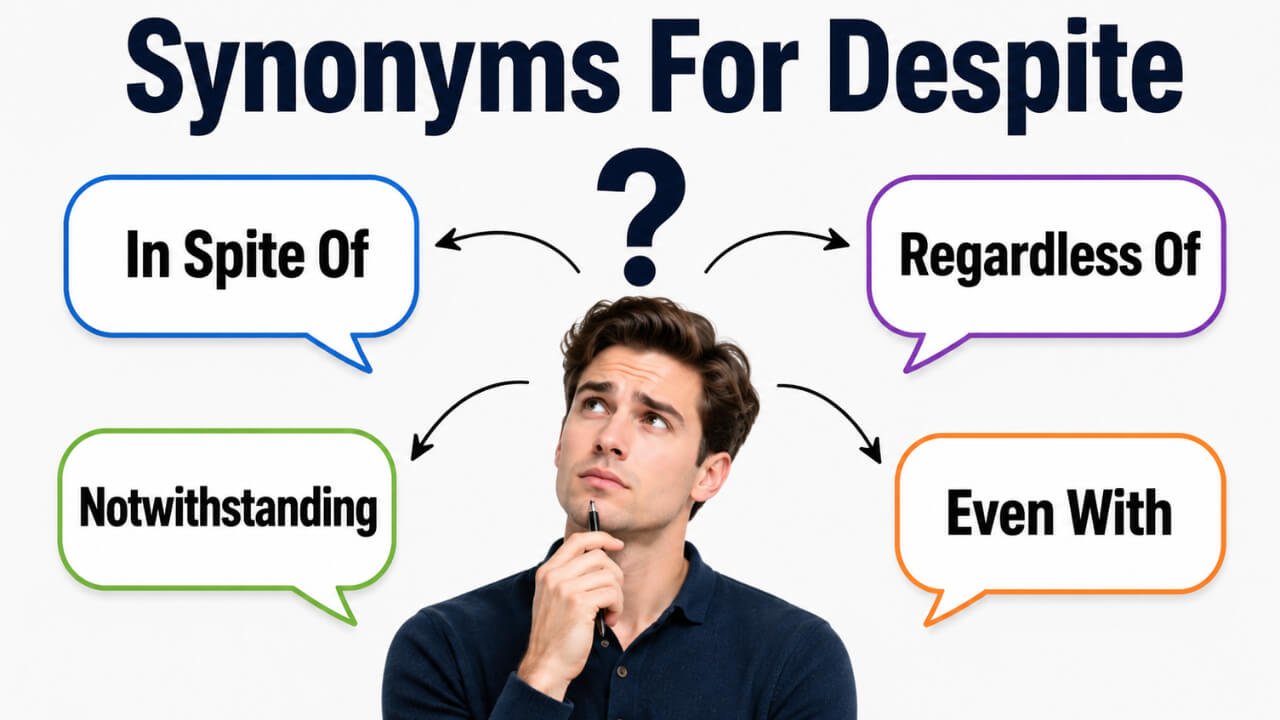
Quick Answer: The best synonyms for despite include in spite of, regardless of, notwithstanding, even with, although, though, even though, irrespective of, for all, and no matter. Use in spite of as the closest everyday replacement. Use notwithstanding in formal or legal writing. Use although or even though when you need a full clause after the word. Use regardless of when the meaning is about continuing without being affected by a condition.
Pronunciation and Word Details
Word: Despite.
Pronunciation: /dɪˈspaɪt/.
Part of Speech: Preposition.
Meaning: Despite means that something happens or remains true even though another fact could have stopped it or changed it.
US Pronunciation:
UK Pronunciation:
What Does “Despite” Mean?
Despite means in spite of or even though something happened or existed. It is mainly used as a preposition before a noun, pronoun, or gerund.
You use despite when you want to show contrast between two ideas. One idea creates an obstacle, problem, limitation, or unexpected condition, while the other idea still happens.
Example: Despite the rain, the match continued.
Here, the rain could have stopped the match, but it did not. The word despite connects the obstacle with the result.
Despite is common in essays, reports, formal writing, academic writing, news style sentences, and everyday conversation when the speaker wants a clear contrast.
Meaning, Tone, and Context of “Despite”
Despite has a neutral to formal tone. It is not emotional by itself, but it often appears in sentences about challenges, results, limitations, effort, disagreement, or unexpected success.
In formal writing, despite sounds polished and concise. In casual speech, people often use even though or in spite of instead.
Formal Context: Despite several delays, the project was completed on time.
Casual Context: Even though there were delays, we finished on time.
Academic Context: Despite limited evidence, the theory remains widely discussed.
Professional Context: Despite rising costs, the company maintained product quality.
The word is useful because it lets writers express contrast without making the sentence too long.
When and How to Use “Despite”
For Contrast: Use despite when one fact seems likely to prevent another fact, but it does not.
Example: Despite the heavy traffic, she arrived early.
For Unexpected Results: Use despite when the outcome is surprising.
Example: Despite his lack of experience, he handled the task well.
For Challenges: Use despite when someone succeeds, continues, or remains steady during difficulty.
Example: Despite many setbacks, the team stayed focused.
For Formal Writing: Use despite to make contrast sound clear and professional.
Example: Despite the survey limits, the results provide useful insight.
For Concise Sentences: Use despite before a noun phrase instead of using a longer clause.
Example: Despite the noise, I could concentrate.
Best Synonyms for Despite
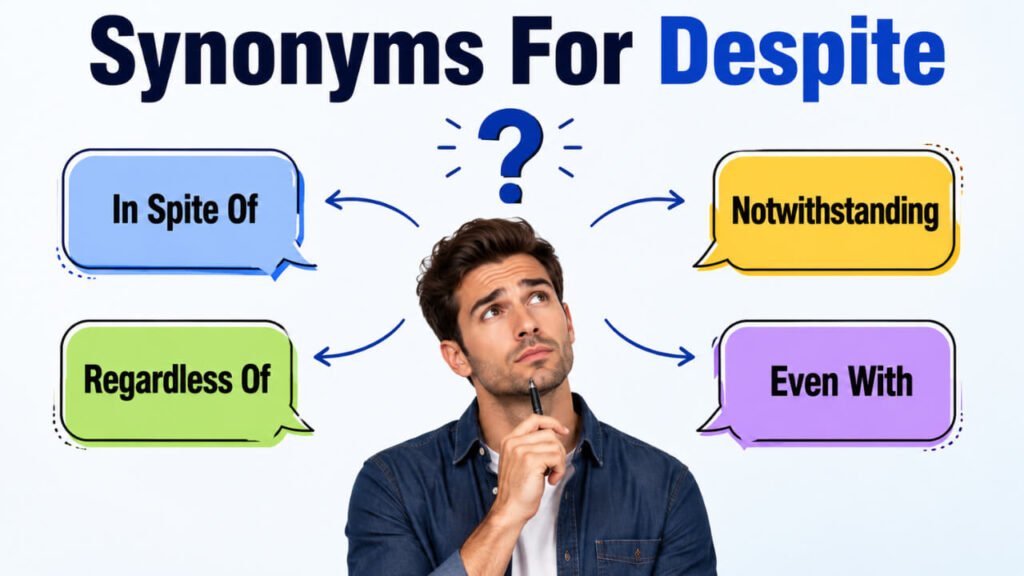
In Spite Of: Means even though something exists or happens.
Example: In spite of the cold weather, they went outside.
Regardless Of: Means without being affected by something.
Example: The rule applies regardless of age.
Notwithstanding: Means despite something, often in formal or legal writing.
Example: Notwithstanding the delay, the agreement remained valid.
Even With: Means despite the presence of something.
Example: Even with limited time, she completed the work.
Although: Means despite the fact that, used before a full clause.
Example: Although it was late, they continued working.
Though: Means although, usually softer and more conversational.
Example: Though tired, he kept studying.
Even Though: Means despite the fact that, with stronger emphasis.
Example: Even though she was nervous, she gave a strong speech.
Irrespective Of: Means without considering or being affected by something.
Example: Everyone will be treated fairly, irrespective of status.
For All: Means despite a certain amount or quality.
Example: For all his confidence, he still made mistakes.
No Matter: Means regardless of a condition or situation.
Example: No matter the difficulty, she refused to quit.
50 Synonyms for Despite with Short Meanings
- In Spite Of: Even though something happens.
- Regardless Of: Without being affected by something.
- Notwithstanding: Despite, especially in formal use.
- Even With: Despite having or facing something.
- Although: Despite the fact that.
- Though: Although, often in casual or softer use.
- Even Though: Despite the fact that, with emphasis.
- Irrespective Of: Without considering something.
- No Matter: Regardless of what happens.
- For All: Despite a stated quality or amount.
- Despite The Fact That: Even though something is true.
- In The Face Of: Despite difficulty, danger, or opposition.
- Against: Despite resistance or pressure.
- Contrary To: Opposite to what was expected.
- In Defiance Of: Despite rules, pressure, or opposition.
- Without Regard To: Without considering something.
- Without Respect To: Without depending on something.
- Disregarding: Not taking something into account.
- Ignoring: Not allowing something to affect action.
- Setting Aside: Not considering something for the moment.
- Allowing For: Considering something but continuing.
- Even After: Despite something that happened earlier.
- Even Under: Despite being in certain conditions.
- With All: Despite having many problems or qualities.
- Come What May: Regardless of what happens.
- Be That As It May: Even if that is true.
- Nonetheless: Still, despite what was said.
- Nevertheless: Still, in contrast to something.
- Still: Even so or in spite of that.
- Yet: But still or nevertheless.
- However: Used to introduce contrast.
- All The Same: Still, despite that.
- Even So: Nevertheless or still.
- That Said: Despite what has just been mentioned.
- Granted: Accepting something, but still contrasting.
- Admittedly: Accepting a fact before contrast.
- While: Although or whereas.
- Whereas: Used to contrast two facts.
- Albeit: Although, usually formal.
- But: Used to show contrast.
- In Contrast With: Showing difference from something.
- As Opposed To: In contrast to something else.
- Overcoming: Succeeding despite difficulty.
- Undeterred By: Not discouraged by something.
- Unaffected By: Not changed by something.
- Unmoved By: Not influenced emotionally or mentally.
- Independent Of: Not depending on something.
- Apart From: Not considering something.
- Save For: Except for, sometimes used in contrast.
- Excepting: Leaving something out of consideration.
Read Also:
Synonyms for Develop

Synonyms for Despite by Context
When “Despite” Means In Spite Of
Use these synonyms when the sentence shows that something happened even though a problem, obstacle, or negative condition existed.
In Spite Of: In spite of the warning, they continued the trip.
Even With: Even with limited support, the plan succeeded.
For All: For all his effort, he could not finish on time.
With All: With all her responsibilities, she still found time to help.
When “Despite” Means Regardless Of
Use these synonyms when the sentence means that a rule, decision, result, or action is not affected by a condition.
Regardless Of: The policy applies regardless of income.
Irrespective Of: Applicants are considered irrespective of background.
Without Regard To: The rule was applied without regard to personal preference.
Independent Of: The result is valid independent of outside pressure.
When “Despite” Means Although
Use these synonyms when you need a full clause with a subject and verb.
Although: Although the road was blocked, they found another route.
Though: Though the exam was difficult, many students passed.
Even Though: Even though the price increased, demand remained strong.
While: While the solution is simple, it is not always easy to apply.
When “Despite” Means Still or Nevertheless
Use these alternatives when you want to connect two full sentences or clauses with contrast.
Nevertheless: The task was difficult. Nevertheless, they completed it.
Nonetheless: The evidence was limited. Nonetheless, the idea remained important.
Even So: The weather was bad. Even so, the event continued.
Still: He was exhausted. Still, he kept going.
When “Despite” Means In The Face Of Difficulty
Use these synonyms when the sentence focuses on strength, courage, persistence, or resistance.
In The Face Of: In the face of criticism, she stayed calm.
Against: Against strong opposition, the plan moved forward.
In Defiance Of: In defiance of the order, they continued their work.
Undeterred By: Undeterred by failure, he tried again.
Another Word for “Despite”
In spite of is the best single replacement for despite in most sentences. It has almost the same meaning and works naturally in both formal and everyday writing. The best alternative still depends on grammar and context. Use although when a full clause follows. Use regardless of when the meaning is about not being affected by a condition.
Original: Despite the delay, the meeting started calmly.
Better Option: In spite of the delay, the meeting started calmly.
Original: Despite the risks, they approved the plan.
Better Option: Regardless of the risks, they approved the plan.
Original: Despite he was tired, he kept working.
Better Option: Although he was tired, he kept working.
Original: Despite the criticism, she remained confident.
Better Option: In the face of criticism, she remained confident.
When Not to Use “Despite”
Do not use despite before a full clause with a subject and verb unless you add the fact that. This is one of the most common grammar mistakes.
Weak: Despite he was tired, he finished the work.
Better: Although he was tired, he finished the work.
Better: Despite being tired, he finished the work.
Avoid using despite too many times in one paragraph. Repetition can make writing sound stiff.
Weak: Despite the rain, despite the delay, and despite the traffic, they arrived.
Better: In spite of the rain, delay, and traffic, they arrived.
Do not use despite when the sentence needs a simple contrast word like but or however.
Weak: The plan was expensive despite it was useful.
Better: The plan was expensive, but it was useful.
Do not choose a synonym that changes the grammar. Despite needs a noun phrase, pronoun, or gerund. Although needs a full clause.
Weak: Although the bad weather, the trip continued.
Better: Despite the bad weather, the trip continued.
Words Commonly Confused With “Despite”
Despite vs In Spite Of: Both mean the same thing, but despite is shorter and slightly more formal. In spite of sounds more conversational.
Despite vs Although: Despite is followed by a noun, pronoun, or gerund. Although is followed by a full clause with a subject and verb.
Despite vs Even Though: Even though is stronger than although and works with a full clause. Despite does not work directly before a full clause.
Despite vs Regardless Of: Despite focuses on contrast or obstacles. Regardless of focuses on not being affected by a condition.
Despite vs Notwithstanding: Notwithstanding is more formal and often appears in legal, academic, or official writing.
Despite vs Nevertheless: Despite usually comes before a noun phrase. Nevertheless connects two ideas as an adverb.
Which Synonym Should You Choose?
Choose in spite of when you want the closest and most natural replacement for despite.
Choose regardless of when writing about rules, decisions, policies, conditions, or outcomes that are not affected by something.
Choose notwithstanding when you need a formal, official, legal, or academic tone.
Choose although when the next part of the sentence has a subject and verb.
Choose even though when you want stronger emphasis in speech or writing.
Choose though when you want a softer, more conversational contrast.
Choose in the face of when writing about difficulty, pressure, danger, opposition, or courage.
Choose nevertheless or nonetheless when connecting two complete sentences with a contrast.
Choose undeterred by when the meaning is about continuing with confidence after difficulty.
Choose irrespective of when writing about fairness, inclusion, rules, or categories that should not affect a result.
Real Life Examples of “Despite” in Sentences
Original: Despite the rain, the workers repaired the road.
Better Option: In spite of the rain, the workers repaired the road.
Original: Despite her fear, she spoke clearly.
Better Option: Even though she was afraid, she spoke clearly.
Original: Despite the high cost, the family bought the house.
Better Option: Regardless of the high cost, the family bought the house.
Original: Despite many problems, the team finished the project.
Better Option: In the face of many problems, the team finished the project.
Original: Despite the warning, he opened the file.
Better Option: Notwithstanding the warning, he opened the file.
Original: Despite being new, she understood the process quickly.
Better Option: Although she was new, she understood the process quickly.
Original: Despite the noise, I completed the report.
Better Option: Even with the noise, I completed the report.
Original: Despite the delay, the guests remained patient.
Better Option: Even though there was a delay, the guests remained patient.
Original: Despite his confidence, he made several mistakes.
Better Option: For all his confidence, he made several mistakes.
Original: Despite the pressure, she made a wise decision.
Better Option: Undeterred by the pressure, she made a wise decision.
Synonym Groups and Usage Differences
Obstacle Group
This group includes words and phrases that show something happened even with a difficulty or barrier.
Examples: In spite of, despite, even with, in the face of.
Example: In the face of serious challenges, the team stayed focused.
Condition Group
This group works when the result does not depend on a condition, category, or limitation.
Examples: Regardless of, irrespective of, without regard to, independent of.
Example: The offer is available regardless of location.
Clause Contrast Group
This group works before a full clause with a subject and verb.
Examples: Although, though, even though, while, albeit.
Example: Even though the instructions were complex, she followed them correctly.
Formal Contrast Group
This group fits professional, academic, official, or legal writing.
Examples: Notwithstanding, irrespective of, nevertheless, nonetheless.
Example: Notwithstanding the objections, the decision was approved.
Persistence Group
This group shows that a person continues without being discouraged.
Examples: Undeterred by, unaffected by, unmoved by, in defiance of.
Example: Undeterred by early failure, he improved his method.
Antonyms of “Despite”
Antonyms of despite depend on the meaning. Since despite shows contrast, its opposites usually show cause, agreement, support, or result.
Because Of: Shows the reason something happened.
Due To: Shows a cause or explanation.
Owing To: Means because of, often in formal writing.
As A Result Of: Shows that one thing caused another.
Thanks To: Shows a positive cause.
On Account Of: Means because of a reason.
By Reason Of: Formal phrase meaning because of.
In Accordance With: Means following a rule or condition.
In Line With: Means matching or agreeing with something.
With The Help Of: Shows support rather than contrast.
Comparison: “Despite” vs Related Words
Despite vs In Spite Of
Despite and in spite of have the same core meaning. Despite is shorter and often sounds more polished. In spite of can sound slightly more conversational.
Example With Despite: Despite the storm, the flight landed safely.
Example With In Spite Of: In spite of the storm, the flight landed safely.
Despite vs Although
Despite comes before a noun phrase, pronoun, or gerund. Although comes before a complete clause.
Example With Despite: Despite the cold weather, we walked outside.
Example With Although: Although the weather was cold, we walked outside.
Despite vs Even Though
Even though adds stronger emphasis and must be followed by a full clause. Despite is more concise and often more formal.
Example With Despite: Despite her doubts, she accepted the challenge.
Example With Even Though: Even though she had doubts, she accepted the challenge.
Despite vs Regardless Of
Despite highlights an obstacle or contrast. Regardless of shows that something does not affect the decision, rule, or result.
Example With Despite: Despite the cost, they repaired the building.
Example With Regardless Of: The building must be repaired regardless of the cost.
Despite vs Notwithstanding
Notwithstanding means despite, but it sounds much more formal. It is common in official, legal, and academic contexts.
Example With Despite: Despite the change, the rule still applies.
Example With Notwithstanding: Notwithstanding the change, the rule still applies.
Despite vs Nevertheless
Despite is a preposition and usually comes before a noun phrase. Nevertheless is an adverb used to connect two contrasting ideas.
Example With Despite: Despite the risk, he continued.
Example With Nevertheless: The risk was serious. Nevertheless, he continued.
Common Phrases and Expressions With “Despite”
Despite Everything: Even after all problems or difficulties.
Despite The Fact That: Even though something is true.
Despite This: Even with the thing just mentioned.
Despite That: Even with that situation or fact.
Despite All Odds: Even when success seemed unlikely.
Despite Himself: In a way that happens even though a person did not intend it.
Despite Her Best Efforts: Even though she tried hard.
Despite Strong Opposition: Even though many people disagreed.
Despite The Circumstances: Even with the situation being difficult.
Despite Repeated Attempts: Even after trying several times.
Common Mistakes to Avoid
One common mistake is using despite before a full clause. Write despite the fact that or use although instead.
Wrong: Despite he studied hard, he failed.
Correct: Although he studied hard, he failed.
Correct: Despite studying hard, he failed.
Another mistake is confusing despite with because of. Despite shows contrast, while because of shows cause.
Wrong: Despite the rain, the ground became wet.
Correct: Because of the rain, the ground became wet.
Writers also overuse despite when but, however, or nevertheless would sound smoother.
Weak: Despite the idea was useful, it was difficult to apply.
Better: The idea was useful, but it was difficult to apply.
Avoid choosing formal synonyms in casual writing when they sound unnatural.
Weak: Notwithstanding the bad weather, we went for a walk.
Better: Even though the weather was bad, we went for a walk.
Be careful with regardless of. It does not always mean exactly the same thing as despite. Use it when the focus is on not being affected by a condition.
Weak: Regardless of the rain, the flowers were wet.
Better: Because of the rain, the flowers were wet.
Conclusion
Learning synonyms for despite helps you express contrast with better accuracy, tone, and sentence variety. Use in spite of as the closest everyday alternative, notwithstanding for formal writing, regardless of for conditions that do not affect a result, and although or even though before full clauses. The best choice depends on grammar, context, and tone. When used correctly, these alternatives make writing clearer, smoother, and more natural.
FAQs About Synonyms for Despite
What is the best synonym for despite?
The best synonym for despite is in spite of. It has nearly the same meaning and works in most everyday and formal sentences.
Can I use although instead of despite?
Yes, but the grammar changes. Use although before a full clause, and use despite before a noun phrase, pronoun, or gerund.
Is despite formal or informal?
Despite is neutral to formal. It works well in essays, reports, professional writing, and ordinary conversation.
What is a formal synonym for despite?
A formal synonym for despite is notwithstanding. It is common in official, legal, and academic writing.
What is the difference between despite and regardless of?
Despite shows contrast with an obstacle or problem. Regardless of means something is not affected by a condition or category.
Is “despite of” correct?
No. Despite of is incorrect. Use despite alone or use in spite of.
What can I say instead of despite in casual writing?
In casual writing, you can use even though, though, or in spite of, depending on the sentence structure.
