
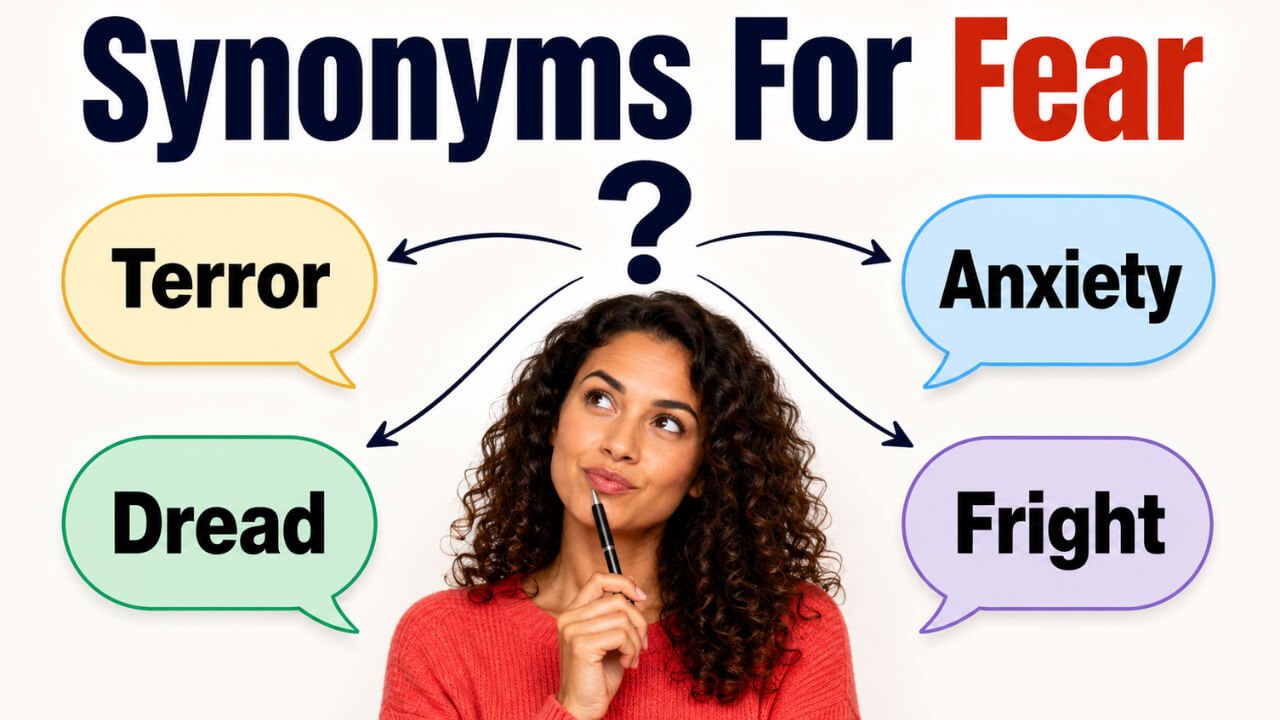
Quick Answer: The best synonyms for fear include anxiety, dread, terror, panic, fright, alarm, worry, concern, unease, and apprehension. Use fear for a general feeling of danger or threat. Use anxiety for nervous worry about the future, dread for strong fear before something happens, terror for extreme fear, panic for sudden uncontrolled fear, and concern for a softer or more polite tone.
Pronunciation and Word Details
Word: Fear.
Pronunciation: /fɪr/.
Part of Speech: Noun and verb.
Meaning: Fear means an unpleasant feeling caused by danger, threat, pain, risk, or uncertainty.
US Pronunciation:
UK Pronunciation:
What Does “Fear” Mean?
Fear means a strong or mild feeling of being afraid because something seems dangerous, harmful, uncertain, or threatening.
As a noun, fear describes the emotion itself.
Example: Her fear of failure stopped her from trying.
As a verb, fear means to feel afraid of something or to worry that something bad may happen.
Example: Many people fear sudden change.
The word fear works in emotional, personal, academic, medical, social, and everyday sentence contexts. It can describe a small worry, a deep emotional reaction, a survival response, or a serious psychological state.
Meaning, Tone, and Context of “Fear”
Fear has a neutral but emotional tone. It can be used in casual speech, formal writing, essays, reports, stories, psychology topics, health discussions, and personal communication.
In everyday conversation, fear often means being scared or worried.
Example: I fear making the wrong decision.
In formal writing, fear may describe a social concern, public reaction, emotional response, or risk based behavior.
Example: Fear of economic instability affected public confidence.
In stronger emotional contexts, fear can suggest danger, trauma, panic, or intense distress.
Example: The sudden noise filled the room with fear.
The word is clear, flexible, and widely understood, but choosing the right synonym can make your writing more precise.
When and How to Use “Fear”
For Danger: Use fear when someone feels threatened by harm, pain, loss, or risk.
Example: The child felt fear when the lights went out.
For Uncertainty: Use fear when someone worries about an unknown result.
Example: He had a fear that the plan might fail.
For Emotional Writing: Use fear when describing inner feelings, tension, or personal struggle.
Example: Her fear grew as the footsteps came closer.
For Social Concerns: Use fear when discussing public worries, group reactions, or community issues.
Example: Fear of job loss changed how people spent money.
For Strong Warning: Use fear when something creates caution or hesitation.
Example: Fear of injury kept him from running too fast.
Best Synonyms for Fear
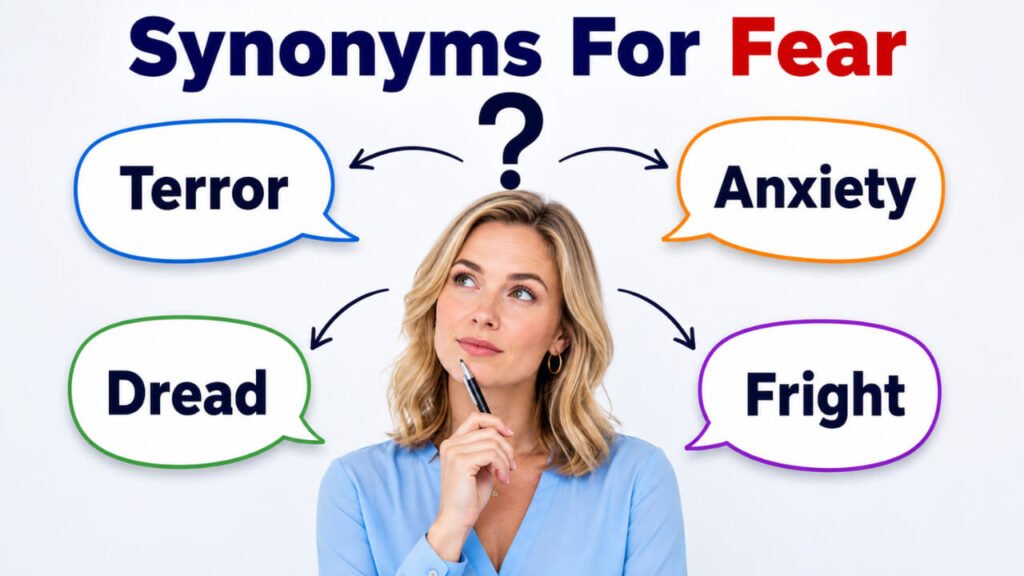
Anxiety: A feeling of nervous worry, especially about what may happen.
Example: Her anxiety increased before the exam.
Dread: Strong fear about something expected in the future.
Example: He felt dread before the difficult meeting.
Terror: Extreme fear that can feel overwhelming.
Example: The sound of the explosion caused terror in the crowd.
Panic: Sudden fear that makes calm thinking difficult.
Example: Panic spread when the alarm started ringing.
Fright: A sudden feeling of fear or shock.
Example: The loud crash gave everyone a fright.
Alarm: Fear or concern caused by possible danger.
Example: The warning message caused alarm among residents.
Worry: Repeated concern about a problem or possible bad result.
Example: His worry about money kept him awake.
Concern: A softer word for worry, often polite or professional.
Example: The teacher expressed concern about the student’s progress.
Unease: A quiet feeling that something may be wrong.
Example: She felt unease when the room became silent.
Apprehension: Nervous fear about something that may happen.
Example: He entered the interview with apprehension.
50 Synonyms for Fear with Short Meanings
- Anxiety: Nervous worry about possible trouble.
- Dread: Strong fear before something unpleasant happens.
- Terror: Extreme and overwhelming fear.
- Panic: Sudden uncontrolled fear.
- Fright: Sudden fear caused by shock.
- Alarm: Fear caused by warning or danger.
- Worry: Concern about a problem or risk.
- Concern: Mild or serious care about a possible issue.
- Unease: Quiet discomfort or nervous fear.
- Apprehension: Fear about something that may happen.
- Nervousness: Uneasy feeling before pressure or risk.
- Trepidation: Formal word for nervous fear.
- Horror: Fear mixed with shock or disgust.
- Shock: Sudden emotional disturbance from fear or surprise.
- Distress: Strong emotional pain or fear.
- Dismay: Fear, disappointment, or sudden discouragement.
- Disquiet: A calm but troubling sense of fear.
- Misgiving: Doubt or fear that something may be wrong.
- Suspicion: Fearful doubt about someone or something.
- Foreboding: A feeling that something bad will happen.
- Intimidation: Fear caused by pressure or threat.
- Timidity: Fearful shyness or lack of confidence.
- Cowardice: Lack of courage because of fear.
- Phobia: Strong irrational fear of something specific.
- Scare: A sudden feeling or event that causes fear.
- Jitters: Informal nervous fear before an event.
- Cold Feet: Fear that makes someone hesitate.
- Stage Fright: Fear of performing before people.
- Nervous Anxiety: Strong worry with physical uneasiness.
- Agitation: Restless fear or emotional disturbance.
- Tension: Mental strain caused by worry or fear.
- Insecurity: Fear caused by doubt or lack of confidence.
- Doubt: Uncertainty that can create fear.
- Vulnerability: Feeling exposed to danger or harm.
- Disturbance: Emotional upset caused by fear or worry.
- Fearfulness: A general tendency to feel afraid.
- Afraidness: Simple state of being afraid.
- Timorousness: Formal word for fearful behavior.
- Shyness: Social fear or discomfort.
- Caution: Carefulness caused by possible danger.
- Hesitation: Delay caused by fear or uncertainty.
- Mistrust: Fearful lack of trust.
- Suspense: Tense uncertainty that may include fear.
- Threat Response: Reaction caused by perceived danger.
- Survival Instinct: Natural fear based reaction to danger.
- Nervous Tension: Tight emotional strain from fear.
- Emotional Distress: Strong painful feeling linked to fear.
- Inner Alarm: Internal feeling of warning or danger.
- Deep Concern: Serious worry about a situation.
- Sense Of Danger: Awareness that something may be unsafe.
Read Also:
Synonyms for Despite
Synonyms for Fear by Context
When “Fear” Means Anxiety
Use these synonyms when fear is about nervousness, uncertainty, pressure, or future events.
Anxiety: She felt anxiety before the results were announced.
Apprehension: He showed apprehension about moving to a new city.
Nervousness: Her nervousness was clear before the speech.
Trepidation: They entered the room with trepidation.
When “Fear” Means Extreme Fear
Use these words when the emotion is intense, overwhelming, or difficult to control.
Terror: The storm filled the village with terror.
Panic: Panic took over when the door would not open.
Horror: He stared in horror at the damage.
Fright: The sudden scream gave her a fright.
When “Fear” Means Concern
Use these softer alternatives when the tone should be polite, professional, or less dramatic.
Concern: Parents expressed concern about safety.
Worry: His worry grew as the deadline came closer.
Unease: There was unease among the workers.
Misgiving: She had misgivings about the agreement.
When “Fear” Means Suspicion
Use these synonyms when fear includes doubt, distrust, or a feeling that something is wrong.
Suspicion: His silence raised suspicion.
Mistrust: Years of conflict created mistrust.
Disquiet: The strange message caused disquiet.
Foreboding: A sense of foreboding filled the room.
When “Fear” Means Lack of Courage
Use these words carefully because they can sound judgmental or negative.
Timidity: His timidity kept him from speaking.
Cowardice: The accusation of cowardice hurt him deeply.
Hesitation: Her hesitation came from fear of rejection.
Insecurity: Insecurity made him doubt every decision.
Another Word for “Fear”
Anxiety is often the best single replacement for fear when the meaning is nervous worry about something uncertain. However, the best alternative depends on context. Use terror for extreme fear, dread for fear before something expected, concern for polite worry, and panic for sudden uncontrolled fear.
Original: She had a fear of failing the test.
Better Option: She had anxiety about failing the test.
Original: The people ran in fear after the explosion.
Better Option: The people ran in terror after the explosion.
Original: He felt fear before the surgery.
Better Option: He felt dread before the surgery.
Original: The manager showed fear about the report.
Better Option: The manager showed concern about the report.
When Not to Use “Fear”
Do not use fear when a softer word would sound more natural or professional.
Weak: The teacher had fear about the student’s low grades.
Better: The teacher had concern about the student’s low grades.
Avoid fear when the feeling is specifically about future uncertainty. Anxiety or apprehension may be more accurate.
Weak: She felt fear before the interview.
Better: She felt anxiety before the interview.
Do not use fear repeatedly in emotional writing. Repetition can make the paragraph sound flat.
Weak: His fear grew, and the fear made him silent because the fear felt too strong.
Better: His dread grew, and the anxiety made him silent.
Avoid strong synonyms like terror or horror for mild worry.
Weak: He felt terror about being five minutes late.
Better: He felt worry about being five minutes late.
Do not use cowardice unless you are clearly describing a lack of courage. It can sound harsh and insulting.
Weak: Her fear of public speaking was cowardice.
Better: Her fear of public speaking was nervousness.
Words Commonly Confused With Fear
Fear vs Anxiety: Fear often responds to a clear danger, while anxiety is usually worry about something uncertain or future based.
Fear vs Dread: Fear is general, while dread is strong fear before something unpleasant is expected.
Fear vs Terror: Fear can be mild or strong, while terror is extreme and overwhelming.
Fear vs Panic: Fear is an emotion, while panic is a sudden intense reaction that may make someone act without thinking clearly.
Fear vs Worry: Fear is usually stronger and more connected to danger, while worry is repeated concern about a problem.
Fear vs Concern: Concern is softer, more polite, and often professional. Fear sounds more emotional and serious.
Fear vs Phobia: Fear can be general or reasonable, while phobia is a strong and often irrational fear of a specific thing.
Which Synonym Should You Choose?
Choose anxiety when writing about nervous worry, uncertainty, pressure, exams, interviews, or future events.
Choose dread when the fear is strong and connected to something expected soon.
Choose terror when describing extreme fear, danger, violence, disaster, or a life threatening moment.
Choose panic when fear is sudden, intense, and difficult to control.
Choose fright when the fear is sudden but often short.
Choose alarm when a warning, risk, or possible danger causes fear.
Choose worry when someone keeps thinking about a problem.
Choose concern when you need a polite, professional, or softer word.
Choose unease when the feeling is quiet, uncertain, and difficult to explain.
Choose apprehension when writing in a formal style about fear before a future event.
Real Life Examples of “Fear” in Sentences
Original: She felt fear before entering the dark room.
Better Option: She felt dread before entering the dark room.
Original: His fear of failure stopped him from applying.
Better Option: His anxiety about failure stopped him from applying.
Original: The sudden sound filled them with fear.
Better Option: The sudden sound filled them with fright.
Original: People watched the rising water with fear.
Better Option: People watched the rising water with alarm.
Original: He spoke with fear in his voice.
Better Option: He spoke with nervousness in his voice.
Original: The child had a fear of dogs.
Better Option: The child had a phobia of dogs.
Original: Her fear increased as the deadline approached.
Better Option: Her worry increased as the deadline approached.
Original: The report caused fear among investors.
Better Option: The report caused concern among investors.
Original: They ran in fear when the fire spread.
Better Option: They ran in panic when the fire spread.
Original: He could not explain his fear about the place.
Better Option: He could not explain his unease about the place.
Synonym Groups and Usage Differences
Anxiety Group
This group describes nervous worry, uncertainty, and pressure before something happens.
Examples: Anxiety, apprehension, nervousness, trepidation.
Example: Her apprehension grew before the final interview.
Extreme Fear Group
This group describes strong fear that may feel overwhelming or shocking.
Examples: Terror, panic, horror, fright.
Example: Panic spread through the room after the warning.
Concern Group
This group is useful when fear is mild, polite, professional, or linked to care.
Examples: Concern, worry, unease, misgiving.
Example: The doctor expressed concern about the symptoms.
Suspicion Group
This group describes fear mixed with doubt, distrust, or a bad feeling.
Examples: Suspicion, mistrust, disquiet, foreboding.
Example: A sense of foreboding followed the strange silence.
Courage Group
This group describes fear as hesitation, shyness, or lack of confidence.
Examples: Timidity, insecurity, hesitation, fearfulness.
Example: His insecurity made it hard for him to speak openly.
Antonyms of Fear
Antonyms of fear depend on the meaning. Some opposites show courage, while others show calmness, safety, confidence, or trust.
Courage: Strength to face danger or difficulty.
Bravery: Boldness during fear or risk.
Confidence: Belief in one’s ability or safety.
Calmness: Peaceful state without fear.
Security: Feeling safe and protected.
Trust: Belief that someone or something is safe.
Reassurance: Comfort that reduces fear.
Peace: Freedom from worry or fear.
Comfort: Emotional ease and safety.
Boldness: Willingness to act without hesitation.
Comparison: Fear vs Related Words
Fear vs Anxiety
Fear is often connected to a clear danger, while anxiety is usually nervous worry about what may happen.
Example With Fear: She felt fear when she saw the snake.
Example With Anxiety: She felt anxiety before the medical test.
Fear vs Dread
Fear can happen before, during, or after danger. Dread usually appears before something unpleasant that someone expects.
Example With Fear: He felt fear during the storm.
Example With Dread: He felt dread before the difficult conversation.
Fear vs Terror
Fear can be mild, moderate, or strong. Terror means extreme fear.
Example With Fear: The dark hallway caused fear.
Example With Terror: The sudden explosion caused terror.
Fear vs Panic
Fear is the feeling of being afraid. Panic is a sudden intense reaction that can make thinking clearly difficult.
Example With Fear: Fear kept her alert.
Example With Panic: Panic made everyone rush toward the exit.
Fear vs Worry
Fear is stronger and more connected to danger. Worry is repeated thinking about a possible problem.
Example With Fear: His fear grew when he heard footsteps.
Example With Worry: His worry grew when the payment was late.
Fear vs Concern
Fear sounds emotional and serious. Concern sounds calmer, softer, and more professional.
Example With Fear: The news created fear among families.
Example With Concern: The news created concern among families.
Fear vs Phobia
Fear can be natural, general, or reasonable. Phobia is a strong fear of a specific object, place, activity, or situation.
Example With Fear: She had fear during the storm.
Example With Phobia: She had a phobia of heights.
Common Phrases and Expressions With Fear
Fear Of Failure: Worry about not succeeding.
Fear Of Change: Worry about new situations or uncertainty.
Fear Of Rejection: Anxiety about not being accepted.
Fear Of The Unknown: Fear caused by uncertainty.
Live In Fear: Spend time feeling unsafe or worried.
Face Your Fear: Deal with something that scares you.
Overcome Fear: Become stronger than the feeling of fear.
Driven By Fear: Controlled or influenced by fear.
Paralyzed By Fear: Unable to act because of fear.
Fear And Doubt: A mix of worry and uncertainty.
Common Mistakes to Avoid
One common mistake is using fear for every level of worry. Choose a softer word when the emotion is mild.
Weak: I have fear that I may forget my keys.
Better: I worry that I may forget my keys.
Another mistake is using extreme synonyms when the situation is not extreme.
Weak: She felt terror about sending the email.
Better: She felt anxiety about sending the email.
Writers also confuse fear and phobia. A phobia is specific and intense, while fear can be general or normal.
Weak: He has a phobia that the meeting will go badly.
Better: He has anxiety that the meeting will go badly.
Avoid repeating fear too often in one paragraph. Use related words such as dread, worry, unease, or alarm when the meaning fits.
Weak: Fear filled her mind, and the fear made her unable to move.
Better: Dread filled her mind, and panic made her unable to move.
Do not use concern when the sentence needs a stronger emotional word.
Weak: The trapped hikers felt concern in the freezing night.
Better: The trapped hikers felt fear in the freezing night.
Conclusion
Understanding synonyms for fear helps you choose words that match the exact emotional level and context. Use anxiety for future worry, dread for expected trouble, terror for extreme fear, panic for sudden uncontrolled fear, and concern for polite or professional writing. Words like unease, apprehension, and alarm add useful shades of meaning. The best synonym depends on intensity, tone, grammar, and the situation being described.
FAQs About Synonyms for Fear
What is the best synonym for fear?
The best general synonym for fear is anxiety when the meaning is nervous worry. For stronger emotion, terror or panic may fit better.
What is a stronger word for fear?
Terror is a stronger word for fear. It means extreme fear that can feel overwhelming.
What is a polite synonym for fear?
Concern is a polite synonym for fear when you want a softer and more professional tone.
What is the difference between fear and anxiety?
Fear is often linked to clear danger, while anxiety is usually worry about something uncertain or future based.
What is another word for fear of something?
Phobia means a strong fear of a specific thing, place, activity, or situation.
Can worry be a synonym for fear?
Yes, worry can be a synonym for fear when the meaning is repeated concern about a possible problem.
What is a formal synonym for fear?
Apprehension is a formal synonym for fear, especially when describing nervousness about something that may happen.
