
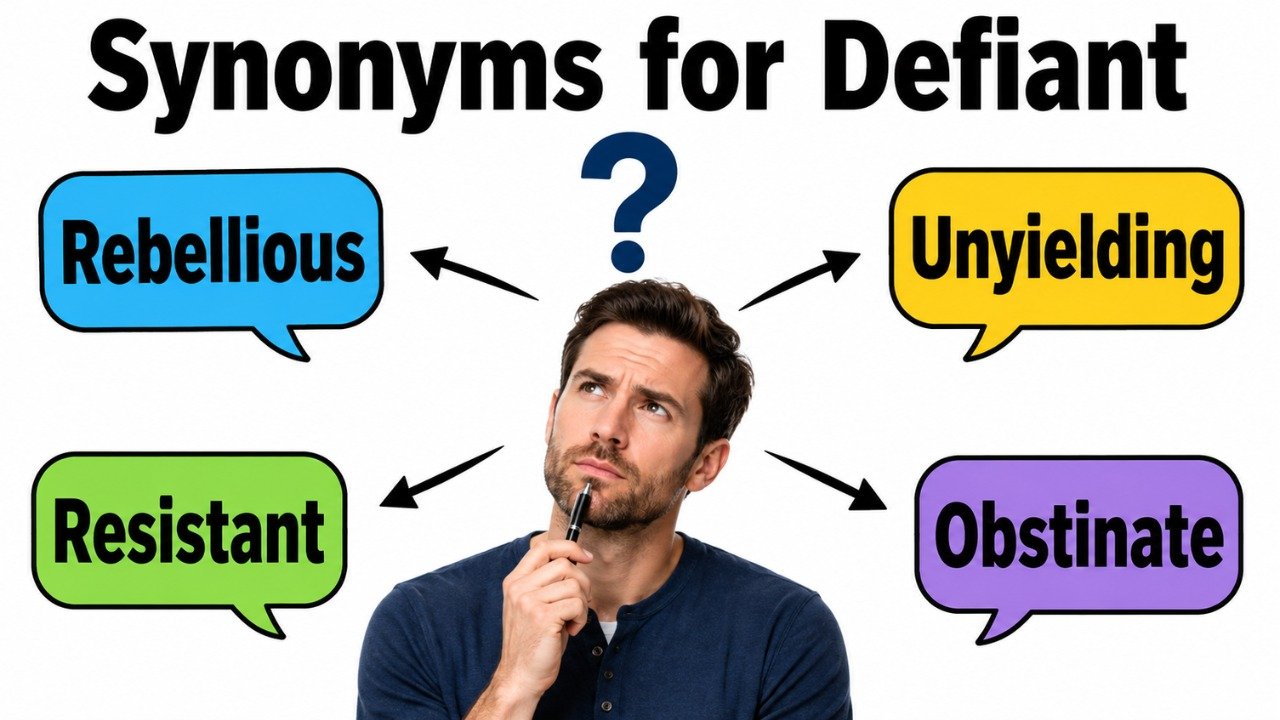
Quick Answer: Useful synonyms for defiant include rebellious, resistant, disobedient, insubordinate, unyielding, oppositional, stubborn, confrontational, recalcitrant, and uncompromising. The best choice depends on context. Use rebellious for resistance to authority, resistant for refusal to accept change or pressure, insubordinate for workplace or military disobedience, unyielding for a firm refusal to give way, confrontational for openly challenging behavior, and uncompromising for a strong position that allows little negotiation.
Pronunciation and Word Details
Word: Defiant.
Pronunciation: /dɪˈfaɪənt/
Part of Speech: Adjective.
Meaning: Openly refusing to obey, accept authority, or give in to pressure.
US Pronunciation:
UK Pronunciation:
What Does “Defiant” Mean?
Defiant means openly resisting authority, rules, demands, expectations, or pressure. It is an adjective commonly used to describe a person, attitude, expression, action, statement, or response.
Someone who is defiant does not simply disagree quietly. The word usually suggests visible resistance or a deliberate refusal to submit. A defiant student may refuse to follow instructions, while a defiant leader may publicly reject demands from opponents.
The word can also describe body language or emotional expression. A defiant stare, for example, communicates resistance without words.
In some situations, defiant has a negative meaning because it suggests disobedience or disrespect. In other situations, it can sound positive because it describes courage, determination, or resistance against unfair pressure.
Meaning, Tone, and Context of “Defiant”
Defiant has a strong and emotionally charged tone. It usually communicates deliberate resistance rather than simple disagreement.
Formal Use: Defiant works well in reports, essays, journalism, historical writing, and discussions about authority, protest, discipline, or conflict.
Conversational Use: The word is also natural in everyday speech when describing someone who refuses to cooperate or back down.
Negative Tone: Defiant can suggest stubbornness, disrespect, disobedience, or hostility when a person challenges reasonable rules or instructions.
Positive Tone: It can suggest courage, independence, strength, or determination when someone resists unfair treatment or unreasonable demands.
Emotional Context: Defiant often appears with words describing expressions, voices, gestures, behavior, and attitudes.
Authority Context: It is especially common when someone challenges a parent, teacher, manager, government, institution, rule, or other source of authority.
When and How to Use “Defiant”
For Resistance to Authority: Use defiant when someone openly refuses to obey a person or institution with authority.
Example: The defiant employee refused to follow the manager’s direct instruction.
For Challenging Behavior: Use defiant when someone deliberately challenges expectations or rules.
Example: His defiant behavior continued despite repeated warnings.
For a Strong Attitude: Defiant can describe a person who refuses to surrender or change position under pressure.
Example: She remained defiant despite intense criticism.
For Facial Expressions: Defiant commonly describes a look, stare, smile, or expression showing resistance.
Example: He gave the officer a defiant stare.
For Speech: Use defiant for statements or responses that openly reject demands.
Example: Her defiant reply made it clear that she would not cooperate.
For Courageous Resistance: The word can describe determined opposition to unfair treatment.
Example: The community remained defiant in the face of intimidation.
Best Synonyms for Defiant
Rebellious: Resisting authority, rules, or accepted expectations.
Example: The rebellious teenager repeatedly ignored household rules.
Resistant: Unwilling to accept, support, or cooperate with something.
Example: Several employees were resistant to the proposed changes.
Disobedient: Refusing or failing to follow rules or instructions.
Example: The disobedient child ignored repeated requests to sit down.
Insubordinate: Deliberately refusing to obey someone in authority, especially at work or in an organized institution.
Example: The supervisor described the employee’s conduct as insubordinate.
Unyielding: Refusing to change position, surrender, or give way.
Example: She remained unyielding during the difficult negotiations.
Oppositional: Characterized by active resistance or disagreement.
Example: His oppositional attitude made cooperation difficult.
Confrontational: Likely to challenge others directly or aggressively.
Example: Her confrontational response increased the tension in the room.
Recalcitrant: Stubbornly resisting authority, control, or instruction.
Example: The recalcitrant member refused to follow the agreed procedure.
Stubborn: Unwilling to change an opinion, decision, or behavior.
Example: He remained stubborn even after seeing stronger evidence.
Uncompromising: Refusing to weaken a position or make concessions.
Example: The negotiator took an uncompromising position on the issue.
50 Synonyms for Defiant with Short Meanings
- Rebellious: Resisting authority or accepted rules.
- Resistant: Unwilling to accept pressure or change.
- Disobedient: Refusing to follow instructions or rules.
- Insubordinate: Refusing to obey a recognized authority.
- Unyielding: Refusing to give way or surrender.
- Oppositional: Actively resisting or disagreeing.
- Confrontational: Directly challenging another person.
- Recalcitrant: Stubbornly resisting authority or control.
- Stubborn: Unwilling to change one’s position.
- Uncompromising: Refusing to make concessions.
- Obstinate: Stubbornly refusing to change.
- Headstrong: Determined to act according to one’s own wishes.
- Willful: Deliberately doing what one chooses despite instructions.
- Uncooperative: Unwilling to work with others or follow requests.
- Noncompliant: Refusing to follow rules or requirements.
- Mutinous: Openly resisting established leadership or authority.
- Refractory: Difficult to control, manage, or influence.
- Contumacious: Stubbornly disobedient toward authority.
- Intractable: Difficult to control, persuade, or change.
- Fractious: Irritable and difficult to control.
- Restive: Unwilling to remain controlled or restricted.
- Wayward: Resistant to guidance or expected behavior.
- Contrary: Deliberately opposing what is expected or requested.
- Unsubmissive: Unwilling to submit to authority.
- Nonconforming: Refusing to follow established expectations.
- Renegade: Rejecting established authority or convention.
- Dissenting: Expressing disagreement with an accepted position.
- Dissident: Opposing established authority or policy.
- Protesting: Expressing active objection or resistance.
- Challenging: Questioning or resisting authority directly.
- Provocative: Deliberately encouraging a strong reaction.
- Audacious: Boldly willing to challenge limits or authority.
- Brazen: Bold and shameless in challenging expectations.
- Insolent: Showing disrespectful boldness toward authority.
- Impudent: Boldly disrespectful or rude.
- Bold: Showing confidence in the face of opposition.
- Daring: Willing to confront danger or opposition.
- Fearless: Showing little fear when facing pressure.
- Assertive: Firmly expressing one’s position or rights.
- Determined: Firmly resolved to continue despite resistance.
- Resolute: Strongly committed to a decision or position.
- Steadfast: Remaining firm despite pressure.
- Firm: Unwilling to weaken one’s position.
- Unbending: Refusing to change or compromise.
- Unshaken: Remaining strong despite opposition.
- Unrepentant: Showing no regret for one’s actions.
- Unapologetic: Refusing to express regret for a position or action.
- Militant: Aggressively committed to a cause or position.
- Rebellious minded: Inclined to resist rules or authority.
- Self willed: Determined to follow one’s own wishes.
Read Also:
Synonyms for Slightly

Synonyms for Defiant by Context
When Defiant Means Rebellious
Rebellious, disobedient, insubordinate, mutinous, noncompliant, unsubmissive, and wayward work when defiant describes resistance to authority or rules.
Example: The rebellious student refused to follow the classroom instructions.
Example: His insubordinate response caused concern among the supervisors.
When Defiant Means Resistant
Resistant, oppositional, recalcitrant, uncooperative, refractory, restive, and intractable emphasize unwillingness to accept control, change, or direction.
Example: The committee remained resistant to outside pressure.
Example: The recalcitrant official refused to cooperate with the investigation.
When Defiant Means Firm
Unyielding, uncompromising, resolute, steadfast, firm, unbending, and determined describe someone who refuses to abandon a position.
Example: She remained resolute despite repeated criticism.
Example: His uncompromising position left little room for negotiation.
When Defiant Means Boldly Challenging
Confrontational, challenging, provocative, audacious, brazen, bold, and daring emphasize visible or direct opposition.
Example: His confrontational tone immediately changed the mood of the discussion.
Example: She made a bold statement against the proposed restriction.
When Defiant Means Unapologetic
Unrepentant, unapologetic, stubborn, obstinate, and headstrong work when someone refuses to admit fault or change behavior.
Example: He remained unapologetic after receiving criticism.
Example: Her obstinate refusal prevented further discussion.
Another Word for Defiant
The best general replacement for defiant is rebellious because both words commonly describe resistance to authority or accepted rules. However, the most accurate alternative depends on what kind of resistance you want to describe.
Original: The defiant student ignored the teacher’s warning.
Better Option: The rebellious student ignored the teacher’s warning.
Original: She remained defiant during the negotiations.
Better Option: She remained unyielding during the negotiations.
Original: His defiant behavior violated workplace expectations.
Better Option: His insubordinate behavior violated workplace expectations.
Original: The crowd remained defiant despite growing pressure.
Better Option: The crowd remained resistant despite growing pressure.
When Not to Use “Defiant”
Defiant should not replace every word connected with disagreement, confidence, determination, or independence. It specifically suggests resistance or refusal.
Avoid using defiant when someone merely has a different opinion but is not challenging authority or pressure.
Weak: She was defiant because she preferred tea instead of coffee.
Better: She had a different preference and chose tea instead of coffee.
Do not use defiant when determined or persistent describes the situation more accurately.
Weak: He was defiant about completing his university degree.
Better: He was determined to complete his university degree.
Avoid defiant when assertive is more appropriate for respectful confidence.
Weak: She gave a defiant explanation of her professional boundaries.
Better: She gave an assertive explanation of her professional boundaries.
Defiant can also sound unnecessarily negative when a person is simply standing firmly by a reasonable decision.
Weak: The researcher remained defiant about the evidence.
Better: The researcher remained firm about the evidence.
Words Commonly Confused With Defiant
Defiant vs Rebellious: Defiant describes active resistance in a particular attitude, action, or moment, while rebellious often describes a broader tendency to resist rules or authority.
Defiant vs Disobedient: Defiant emphasizes deliberate and often visible resistance. Disobedient simply means failing or refusing to obey.
Defiant vs Stubborn: Defiant involves resistance to authority, pressure, or expectations. Stubborn focuses on refusing to change an opinion or behavior.
Defiant vs Assertive: Defiant suggests opposition or refusal, while assertive means expressing needs, rights, or opinions confidently and directly.
Defiant vs Resistant: Defiant usually sounds more active and confrontational. Resistant can describe quieter unwillingness to accept change or influence.
Defiant vs Insubordinate: Defiant is broad, while insubordinate specifically describes refusal to obey someone with recognized authority, especially in professional or organized settings.
Defiant vs Unyielding: Defiant emphasizes challenge and resistance. Unyielding emphasizes refusing to change or give way.
Which Synonym Should You Choose?
Choose rebellious when describing general resistance to authority, rules, traditions, or expectations.
Choose resistant when someone is unwilling to accept pressure, change, influence, or a proposal.
Choose disobedient when the main issue is failure or refusal to follow instructions.
Choose insubordinate when writing formally about refusal to obey authority in a workplace, institution, or organized group.
Choose unyielding when someone refuses to surrender, change position, or give way.
Choose confrontational when the resistance is direct, argumentative, or openly challenging.
Choose recalcitrant in formal writing when someone stubbornly resists control or instruction.
Choose stubborn when describing everyday refusal to change an opinion or behavior.
Choose uncompromising when someone refuses to make concessions in discussions, negotiations, or principles.
Choose assertive when the person is confidently expressing a position without necessarily resisting authority.
Choose resolute when you want a more positive word emphasizing courage and determination.
Real Life Examples of “Defiant” in Sentences
Original: The child gave his father a defiant look.
Better Option: The child gave his father a rebellious look.
Original: She remained defiant despite repeated demands to change her statement.
Better Option: She remained unyielding despite repeated demands to change her statement.
Original: The defiant employee refused to carry out the supervisor’s instruction.
Better Option: The insubordinate employee refused to carry out the supervisor’s instruction.
Original: His defiant attitude made cooperation difficult.
Better Option: His oppositional attitude made cooperation difficult.
Original: The protesters remained defiant despite growing pressure.
Better Option: The protesters remained resistant despite growing pressure.
Original: He spoke in a defiant tone during the meeting.
Better Option: He spoke in a confrontational tone during the meeting.
Original: The defiant official refused to provide the requested information.
Better Option: The recalcitrant official refused to provide the requested information.
Original: She stood defiant in the face of criticism.
Better Option: She stood resolute in the face of criticism.
Original: His defiant refusal surprised everyone in the room.
Better Option: His uncompromising refusal surprised everyone in the room.
Original: The team remained defiant after being told that success was impossible.
Better Option: The team remained determined after being told that success was impossible.
Synonym Groups and Usage Differences
Rebellion Group
Rebellious, disobedient, mutinous, insubordinate, and unsubmissive describe resistance to authority or established rules. These words differ mainly in strength and setting.
Example: The rebellious group refused to accept the new restrictions.
Resistance Group
Resistant, oppositional, recalcitrant, noncompliant, refractory, and uncooperative describe refusal to accept control, demands, or change.
Example: Several members remained resistant to the proposed policy.
Stubbornness Group
Stubborn, obstinate, headstrong, willful, intractable, and contrary focus on refusal to change one’s behavior or position.
Example: His obstinate attitude prevented a practical solution.
Confrontation Group
Confrontational, challenging, provocative, brazen, insolent, and impudent describe direct or sometimes disrespectful opposition.
Example: Her confrontational reply made the disagreement more intense.
Determination Group
Unyielding, uncompromising, determined, resolute, steadfast, and firm emphasize strength and refusal to give in.
Example: She remained steadfast when others pressured her to abandon her position.
Courage Group
Bold, daring, fearless, and audacious may replace defiant when the important idea is courage rather than disobedience.
Example: His bold response showed that he was not intimidated.
Antonyms of Defiant
The opposite of defiant depends on whether the word refers to obedience, cooperation, flexibility, or willingness to submit.
Obedient: Willing to follow rules or instructions.
Compliant: Willing to follow requirements or requests.
Submissive: Willing to accept another person’s authority or control.
Cooperative: Willing to work with others toward a shared result.
Agreeable: Willing to accept suggestions or cooperate pleasantly.
Yielding: Willing to give way under pressure.
Acquiescent: Willing to accept something without resistance.
Docile: Easily controlled or guided.
Meek: Quiet and unlikely to challenge others.
Respectful: Showing appropriate regard for another person’s position or authority.
Flexible: Willing to adjust a position or approach.
Conforming: Following accepted rules, standards, or expectations.
Comparison: Defiant vs Related Words
Defiant vs Rebellious
Defiant describes openly resisting pressure, authority, or demands. Rebellious often describes a continuing tendency to reject rules or authority.
Example With Defiant: She remained defiant when asked to withdraw her statement.
Example With Rebellious: He went through a rebellious period during his teenage years.
Defiant vs Resistant
Defiant often suggests active and visible opposition. Resistant is broader and can describe quiet unwillingness to accept something.
Example With Defiant: The defendant gave a defiant response to the accusation.
Example With Resistant: The staff remained resistant to the new procedure.
Defiant vs Disobedient
Defiant emphasizes the attitude behind refusal. Disobedient emphasizes the act of not obeying.
Example With Defiant: The student gave the teacher a defiant stare.
Example With Disobedient: The disobedient student repeatedly ignored classroom rules.
Defiant vs Stubborn
Defiant involves challenge or resistance. Stubborn means refusing to change one’s mind or behavior, even without an authority figure being involved.
Example With Defiant: He remained defiant after receiving the order.
Example With Stubborn: He was too stubborn to reconsider his opinion.
Defiant vs Assertive
Defiant suggests resistance to another person’s control or demand. Assertive suggests confident and respectful expression.
Example With Defiant: She rejected the demand in a defiant tone.
Example With Assertive: She explained her boundaries in an assertive tone.
Defiant vs Unyielding
Defiant highlights opposition. Unyielding highlights firmness and refusal to compromise.
Example With Defiant: The group remained defiant despite the warnings.
Example With Unyielding: The negotiator remained unyielding on the central issue.
Common Phrases and Expressions With Defiant
Defiant Attitude: A manner showing open resistance or refusal.
Defiant Behavior: Actions that deliberately challenge rules or authority.
Defiant Stare: A look that visibly communicates resistance.
Defiant Look: A facial expression showing unwillingness to submit.
Defiant Tone: A manner of speaking that sounds challenging or resistant.
Defiant Response: An answer that openly rejects a demand or instruction.
Defiant Gesture: A physical action expressing opposition or resistance.
Defiant Stand: A firm position maintained despite pressure.
Remain Defiant: To continue resisting despite consequences or criticism.
Openly Defiant: Clearly and publicly unwilling to obey or submit.
Common Mistakes to Avoid
Using Defiant for Ordinary Disagreement: A person who simply holds another opinion is not necessarily defiant. Use disagreeing, unconvinced, or opposed when there is no active challenge to authority.
Confusing Defiant With Confident: Confidence means belief in oneself. Defiance means resistance. A confident person may cooperate fully, while a defiant person deliberately refuses to give in.
Using Insubordinate Too Broadly: Insubordinate is most appropriate when a clear authority relationship exists. It is less suitable for ordinary disagreements between equals.
Replacing Defiant With Stubborn in Every Sentence: Stubborn describes refusal to change, but it does not always involve authority or opposition. Choose it only when persistence of opinion or behavior is the main idea.
Overusing Defiant: Repeating defiant several times in one paragraph can make writing sound monotonous. Use context appropriate alternatives such as resistant, rebellious, unyielding, or confrontational.
Choosing an Overly Strong Synonym: Words such as mutinous, insolent, and militant can carry stronger meanings than defiant. Use them only when the situation supports that intensity.
Ignoring Tone: Resolute and steadfast often sound positive, while insolent and disobedient usually sound negative. Choose according to the attitude you want readers to understand.
Using Vague Context: Make clear what the person is resisting. A sentence such as “He was defiant” gives less information than “He remained defiant when ordered to withdraw his complaint.”
Conclusion
Synonyms for defiant range from rebellious, resistant, and disobedient to unyielding, recalcitrant, confrontational, and uncompromising. Rebellious works well for general resistance to authority, while insubordinate fits formal situations involving direct refusal to obey. Resistant is useful for opposition to change or pressure, and unyielding emphasizes firmness. For a more positive tone, resolute, steadfast, or determined may be better. Choosing the right synonym depends on whether you want to emphasize disobedience, confrontation, stubbornness, courage, or firm resistance.
FAQs About Synonyms for Defiant
What is the best synonym for defiant?
The best general synonym is rebellious. However, resistant, disobedient, insubordinate, or unyielding may be more accurate depending on the situation.
Is rebellious the same as defiant?
They are similar, but not identical. Defiant often describes an immediate act or attitude of resistance, while rebellious can describe a broader pattern of rejecting authority or rules.
What is a formal synonym for defiant?
Recalcitrant and insubordinate are useful formal alternatives. Recalcitrant means stubbornly resistant, while insubordinate specifically refers to refusing recognized authority.
What is a positive synonym for defiant?
Resolute, steadfast, fearless, determined, and bold can express the strength behind defiance without emphasizing disobedience.
What is a negative synonym for defiant?
Disobedient, insolent, obstinate, insubordinate, and confrontational can carry stronger negative meanings when defiance is seen as disrespectful or disruptive.
Can stubborn be a synonym for defiant?
Yes, but only in some contexts. Stubborn emphasizes refusal to change, while defiant more specifically suggests active resistance to authority, pressure, or demands.
What is the opposite of defiant?
Common antonyms include obedient, compliant, cooperative, submissive, yielding, and acquiescent. The best opposite depends on the context.
